




Abstract
The scientific evidence to support the value of a range of non-pharmacological interventions for people with Parkinson’s disease (PD) is increasing. However, showing unequivocally that specific interventions are better than usual care is not straightforward because of generic drawbacks of clinical trials. Here, we address these challenges, specifically related to the context of evaluating complex non-pharmacological interventions for people with PD. Moreover, we discuss the potential merits of undertaking “real world” analyses using medical claims data. We illustrate this approach by discussing an interesting recent publication in The Lancet Neurology, which used such an approach to demonstrate the value of specialized physiotherapy for PD patients, over and above usual care physiotherapy.
BACKGROUND
It is increasingly being recognized that Parkinson’s disease (PD), given its range of problems, is managed best using a multidisciplinary approach [1, 2]. Such a team approach should include not only conventional medical interventions (pharmacotherapy and deep brain stimulation), but also a range of non-pharmacological approaches including, but not limited to, physiotherapy, occupational therapy and speech-language therapy. The perception that such non-pharmacological interventions have added value for people with PD was, at least initially, based largely on theoretical rationale and anecdotal evidence. An exponential increase in randomized controlled trials and systematic reviews now provides high-quality scientific evidence to support the merits of a range of non-pharmacological interventions for people with PD.
However, to unequivocally demonstrate that specific non-pharmacological interventions are better than usual care is not an easy task. This is related in part to the generic drawbacks of clinical trials, which become even more apparent when evaluating complex healthcare interventions such as physiotherapy or multidisciplinary interventions. Here, we briefly address these generic challenges, and discuss them in the context of evaluating non-pharmacological interventions for people with PD. We then consider a complementary approach, which is based on an analysis of medical claims data, with particular reference to a recent publication in The Lancet Neurology [3]. We conclude by highlighting the broader implications of this approach, and how this and other methodological approaches might help to shape the future of care for neurological patients.
THE CHALLENGES OF CLINICAL TRIALS
The randomized controlled trial (RCT) remains the gold standard for evaluating new healthcare interventions and is a powerful approach to evaluate effectiveness [4]. Clear advantages include the rigorous measures that are taken to avoid bias and to control for influences of confounding factors by means of a concealed randomization procedure. However, the design of RCTs is also subject to a number of limitations [5].
First, the population included in a RCT is typically selected using strict inclusion/exclusion criteria, which by definition means that the study results cannot be generalized to a real-life population. Recent pragmatic RCTs are to be commended for having used broader in- and exclusion criteria, [6, 7] but some populations are still structurally over- or underrepresented in other studies on PD. For example, most patients with PD are older adults with multiple co-morbid conditions, but RCTs usually exclude such co-morbid patients, and consist largely of younger patients. Therefore, we do not know whether evidence-based treatments are also effective in a real-life and more vulnerable population of PD patients [8]. Patients with cognitive decline are also often excluded from trials; this exclusion can be problematic when the outcome is related in part to cognitive functional capacity. For example, an analysis in this journal showed that fall intervention studies typically do not include patients with cognitive decline, yet falls are clearly related to the presence of frontal executive deficits [9]. Patients at the extremes of the age spectrum are often also excluded from trials, even though both treatment effects and adverse events may well be different for very young or very old patients. Underrepresentation of older adults with PD, who represent the majority of the PD population, from clinical trials is particularly evident. The effect of these commonly applied inclusion/exclusion criteria is that patients with mild disease are preferentially included in trials, so the results cannot be generalized to those with more advanced disease. Finally, we recently showed that men are significantly overrepresented in RCTs (even accounting for the slighter higher incidence of PD in men compared to women), with the proportion of men being extra high in more complex or technically oriented studies (Tosserams et al., submitted). Studies of non-pharmacological interventions are certainly no exception, and in fact seem particularly plagued by these recruitment challenges [10, 11]. For example, a recent RCT showed that treadmill walking combined with virtual reality immersion helped to reduce falls in PD patients [12]. However, our own center (which participated in this study) faced serious recruitment issues because the intervention was hospital-based, and many patients refused participation because the time and energy needed for multiple weekly visits to the hospital was perceived as too cumbersome.
Second, since RCTs are very costly and time-consuming, most studies include only a relatively small sample size, and follow their participants for only a limited period. A recent review showed that this issue also applies to the field of non-pharmacological interventions, where the majority of RCTs included only between 20 and 100 patients (mean = 80) [13]. The largest study included 586 patients, but many others appeared to be underpowered. Moreover, these studies followed their patients for only short periods of time, with a median of only 16 weeks [13]. In exceptional cases, a two-year follow-up period was reached, so the long-term effects remain unknown for virtually all non-pharmacological interventions.
Third, many studies of non-pharmacological interventions are troubled by rather high numbers of patients who are lost to follow-up. For example, a recent review showed a great variability in attrition rates, between 10% up to 80% in studies on vocal rehabilitation [14]. These high attrition rates introduce bias to the results of any study. We should point out that loss to follow-up is a problem for any study design, and RCTs actually perform reasonably well here by comparison to other clinical studies.
Finally, after successfully completing an RCT, it often proves difficult to implement new interventions into everyday clinical practice. In fact, also replication of study results is difficult, where initial stronger results as well as contradictions are reported [15]. This issue is potentially particularly vexing for non-pharmacological interventions, which in the clinical trial setting are administered typically by well-trained and highly motivated personnel (‘selection bias of therapists’). It is possible that the positive experiences with, e.g., dance therapy are explained at least in part by the enthusiasm and dedication of the dance trainers in those studies [16]. It is not necessarily feasible to engage similarly motivated and equally skilled personnel to now deliver these interventions in daily practice outside the original study centers, and this may have a detrimental effect on the therapy being administered.
WHAT ANALYSES OF MEDICAL CLAIMS CAN OFFER
Mining medical claims databases, on the other hand, offers a potential solution for at least some of these drawbacks. This includes the opportunity to include very large numbers of patients that can potentially be followed for long periods of time without attrition. Moreover, medical claims data are more likely to reflect healthcare in real-life clinical practice, including access to a much more representative population across all ages, disease severities and co-morbid conditions. By definition, medical claims data contain information about medical expenses, enabling evaluations of cost-effectiveness after a real-life implementation of an intervention, especially when being linked to other databases, for example clinical outcome registries. Studying a medical claims database is also much cheaper than performing a clinical trial, because data collection has already taken place as part of regular healthcare, so only the personnel for data analyses has to be funded [17]. Research has shown that PD patients can be identified reliably in medical claims data using a combination of PD claim factors [17]. Table 1 offers an overview of studies that used medical claims in the field of PD.
Studies that have used medical claims analyses in the field of PD
Search terms: Parkinson’s disease AND medical claims OR administrative data, November 21th 2017, 101 hits. PD, Parkinson’s disease; LTCF, long term care facility; DBS, deep brain stimulation; AP, antipsychotic; ED, emergency department.
However, this approach also has challenges of its own. The first drawback relates to the lack of direct information on disease-specific patient characteristics. Simple demographics such as age and gender are available, but detailed information about disease status is normally lacking (e.g., MDS-UPDRS scores). Therefore, comparability between groups who either did or did not receive a particular intervention on disease-specific measures cannot be guaranteed. A second drawback is that group separation is not based on randomization, and therefore potentially subject to all sorts of bias. For example, it is theoretically possible to mine medical claims data to search for differences in outcome between patients who received multidisciplinary care, versus those who did not. However, it is quite possible that patients with, for example, greater disease severity or those with higher education were preferentially referred to such interventions, leading to baseline differences that could explain differences in outcome. Third, it is impossible to be certain which intervention was ultimately responsible for the results, because patients in everyday clinical practice may receive a broad range of treatments, all of which can contribute to a different outcome. Moreover, coupled to this, there may be changes in social circumstances which are not captured in such databases. Without carefully controlling for each of them (which is a strength of RCTs), it is impossible to pinpoint a particular treatment as being the most effective ingredient. Fourth, medical claims databases also have to deal with attrition. In the Netherlands, this attrition rate is limited because of some national regulatory rules (i.e., health insurance is obligatory for every citizen, insurers have nationwide coverage, and changing from one insurer to another is only allowed at the beginning of each new year). The percentage of people switching their health insurance in the Netherlands (mostly young, healthy individuals) was 6.8% in 2016 and 6.3% in 2017, [18, 19] which is comparable to other European countries (i.e., Germany and Switzerland) and higher than for example Belgium and Israel where only 1% switches insurer [20]. However, also in other medical claims databases where loss to follow-up is higher compared to the Dutch situation, attrition is usually not the main concern because these rates in general do not reach 20% (which is often used as the cut-off for introducing bias [21]). Fifth, the quality of the data in medical claims databases (e.g., reliability, validity, sensitivity) is often unknown, and sometimes even known to be insufficient [22]. A particular concern is the presence of measurement error, which refers to the fact that in medical claims, conditions are defined imprecisely and inaccurately (specifically, it is uncertain how well general neurologists follow accepted international criteria to diagnose PD), that measurement may vary in a biased way, and that little is known about how robust the measures are. For example, the number of claims is often not identical to the number of unique visits [23] and some treatments or components of treatments may either not be claimed or wrongly coded [24]. Augmenting medical claims databases with other data sources, for example with prospective, longitudinal registries, may offer a potential solution for this [22]. Finally, just as in RCTs, researchers who analyze medical claims must define a primary outcome at the outset, prior to performing the analyses. The number of possible outcomes in a medical claims database is almost infinite, creating a risk of spurious findings unless a predefined primary outcome is decided upon before embarking upon the analyses.
Importantly, in light of these challenges, we do not see this approach as a substitute for well-designed trials, but rather as a complementary method to gather converging evidence to help in the design or interpretation of findings in a RCT. Indeed, medical claims data are increasingly being recognized and used as a valuable source of scientific information, next to the more traditional research methods in medical science [25].
RCTs and analyses of medical claims databases can be seen as two extremes of a spectrum of study methodologies. However, there are also other methodological options along this spectrum that can be used to study the effectiveness of medical treatments, each with their own benefits and challenges (Fig. 1). Examples include the prospective longitudinal cohort study (of which a number of PD specific studies have emerged in the last few years, such as the Parkinson Progression Marker Initiative [26], the National Center of Excellence in Research–PD cohort [27] and the Parkinson Precision Project [28]), prognostic disease modeling [29, 30], the randomized registry trial (i.e., combining a randomization procedure to already existing high-quality observational registries) [4] and the pragmatic RCT (where the basic concept is to combine the strength of randomization with the cost-savings of using administrative data for outcome ascertainment) [31]. Here, we will further focus on the analyses of medical claims data as an example of an alternative research method, complementary to the traditional RCT.
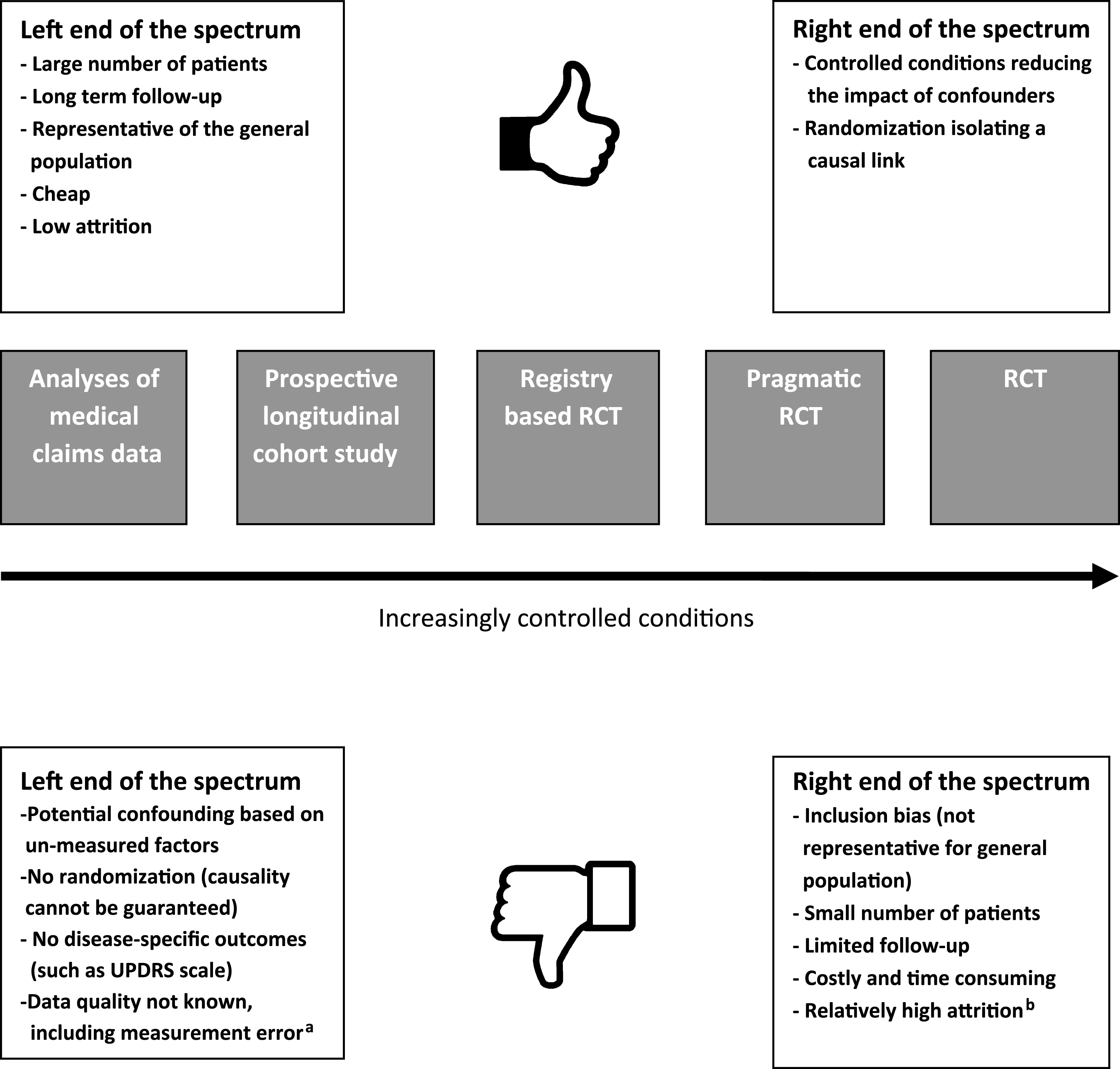
This figure shows the RCT and analyses of medical claims as two extreme ends of the spectrum of study designs, with a low versus a high level of control. In between these two extremes, there are a number of alternative designs, and some of thesehave been included as examples here. aMeasurement error refers to the fact that in medical claims, conditions are defined imprecisely and inaccurately, that measurement may vary in a biased way, and that little is known about how robust the measures are. bAttrition rate is a problem for any study design. RCTs actually perform reasonably well by comparison to other clinical studies.
ANALYZING MEDICAL CLAIMS TO STUDY PHYSIOTHERAPY FOR PARKINSON PATIENTS
A recent study illustrates the value of this whole approach, in this specific case to demonstrate the cost-effectiveness of specialized physiotherapy [3]. There is now class II evidence to support the merits of specific physiotherapy interventions for patients with PD [32]. It is also clear that specific physiotherapy interventions such as external cueing require a great deal of PD-specific expertise to ascertain that these interventions are delivered optimally, i.e., both according to evidence-based guidelines [32] and tailored to each patient’s unique needs and personal profile. For example, inappropriate setting of visual or auditory cues is not only ineffective, but can lead to a worsening of gait disability in PD patients [33, 34]. Similar issues are at play when delivering other non-pharmacological interventions, such as occupational therapy, speech-language therapy or more recently introduced treatments such as cognitive rehabilitation or dance [13].
To address this matter of PD-specific expertise, the ParkinsonNet model of care was introduced in 2004 in the Netherlands as an innovative treatment concept for patients with PD. Specifically, ParkinsonNet consists of regional community-based networks that encompass a number of dedicated allied health therapists who have been trained specifically according to evidence-based guidelines [35]. The core elements of the ParkinsonNet model include: (1) professional empowerment, by concentrating care among specifically trained professionals; (2) patient empowerment, by informing patients and including them as partners in healthcare; and (3) team empowerment, by organizing and supporting care into multidisciplinary, regional networks [36]. The professional training consists of a 4-day baseline course in PD according to evidence-based guidelines (for each discipline separately). Additionally, professionals are required to participate in regional meetings (thrice annually) and national congresses where the latest evidence is presented. ParkinsonNet has reached full national coverage in the Netherlands, and currently includes 70 regional sub-networks with a total of 3,100 specifically trained healthcare professionals, including—among others—physiotherapists, occupational therapists, speech-langue therapists, dieticians, and Parkinson nurses [16].
The cost-effectiveness of this ParkinsonNet model has been studied in several RCTs, which overall revealed a better quality of care, lower healthcare costs and equal, if not better, health outcomes, at least in the short term (the longest follow-up was 6 months) [37–40]. A recent review conservatively estimated the cost-savings to amount to at least 381 euros per patient annually [36], and this would translate into an annual cost saving of around 15,2 million euros for the entire Dutch population (around n = 40,000 patients with PD). However, the aforementioned drawbacks of RCTs also applied here. Most importantly, there has been no information about the cost-effectiveness of specialized ParkinsonNet treatment in the long-term, within a representative real-life population. If the cost-effectiveness found in trials could be extrapolated to daily practice, then health insurers might have reasonable grounds to initiate a process of preferential or even selective reimbursement of ParkinsonNet therapy, thereby promoting better care and contributing to further cost savings.
Stimulated by these considerations, one of the largest Dutch healthcare insurers (the CZ Groep) took the initiative for a new evaluation of the ParkinsonNet model, using their own large medical claims database as their source of information [3]. The specific aim of this study was to compare the health outcomes and healthcare utilization of specialized physiotherapy via ParkinsonNet for a large, real-life population of people with PD, who had been followed for up for at least three years. Compared to RCTs, the inclusion criteria were purposely left broad: merely having a diagnosis of PD and being in receipt of physiotherapy as part of their regular PD care. Importantly, patients with co-morbid conditions were not excluded. Their claims database included a large group of no less than 4,381 patients who fulfilled these broad inclusion criteria.
By chance, about half of these patients had received care by a specialized community-based ParkinsonNet physiotherapist (n = 2,129 patients, with 4,649 observations over the 3-year period), while the other half had received usual care physiotherapy (n = 2,252 patients, with 5,353 observations). Importantly, this group separation did not result from careful randomization, but was created by the fact that Dutch patients (and their referring physicians) are free to choose their physiotherapy providers. Theoretically, all sorts of bias could have affected this choice, but this is what happens in “real life”. Correcting for potential baseline differences was challenging because, as we pointed out earlier, a claims database does not contain any PD-specific information about disease duration or severity. The researchers tackled this issue by comparing the two groups for a number of reasonable proxies for PD-related health status: number of neurology outpatient visits, number of drugs for PD, presence of depression, use of mental healthcare, number of different consulted professionals, and number of co-morbid conditions. Their analyses identified only small and clinically irrelevant group differences, suggesting that at the least, both groups did not differ substantially with respect to their underlying PD. A final concern was socio-economic status, as patients with higher education might be more prone to seek treatment from a well-trained expert. Therefore, socio-economic status was also corrected for in the statistical models and in addition showed to be very comparable between both groups. The results can neither be explained by differences in treatment intensity. In fact, the specialized ParkinsonNet therapists required significantly fewer treatment sessions than regular therapists, yet reached better outcomes. Finally, the investigators also took care to define a primary outcome prior to performing the analyses, and opted for the percentage of patients having one of the following common and major PD-related complications: hospital visits or admissions for sustaining a fracture, other orthopedic injuries, pneumonia, or a combination thereof. This outcome seems reasonable, because ParkinsonNet physiotherapists are specifically trained to promote safer mobility, by offering gait and balance training, reducing freezing of gait events, and thereby preventing falls and fall-related injuries [35].
The results were striking, showing that patients who had been treated by a specialized physiotherapist experienced significantly fewer PD-related complications (17.3%) compared to patients treated by a usual care physiotherapist (21.3%). Post-hoc analyses showed that this reduced risk of sustaining a complication was also significant for each of the three components of the primary outcome. It is likely that these outcomes can be ascribed to the specialized ParkinsonNet physiotherapy, as this was the only variable that consistently separated the two groups. An alternative option, that cannot be totally excluded, is that patients receiving specialized physiotherapy were also receiving specialized care by one or more of the other professional disciplines trained by ParkinsonNet [16]. For example, specialized speech-language therapists might have helped to reduce the risk of sustaining aspiration pneumonia, while home visits by specialized occupational therapists might have helped to remove domestic hazards for falls. Even though this was partially corrected for in the statistical model by including the number of healthcare professionals, the quality of these health professionals was not taken into account. To address this issue, further detailed analyses are now ongoing to identify which professional ParkinsonNet disciplines typically co-treat patients in daily practice. Such analyses would also help to further reinforce the quality of the multidisciplinary team approach for individual patients with PD, which is the ultimate goal of the ParkinsonNet approach. Nevertheless, if patients receiving specialized physiotherapy also incurred additional costs associated with provision of other specialist allied health services via ParkinsonNet, the positive cost-effectiveness outcomes of this study may be considered all the more impressive.
The investigators also analyzed whether the improved outcomes could be related to measures of better quality of care, and this was indeed the case. Specifically, the specialized physiotherapists treated a much higher case load (this helps to gain more expertise i.e. ‘practice makes perfect’) [41] and offered greater continuity of care than regular care therapists (which is greatly valued by patients). Moreover, specialized therapists required significantly fewer treatment sessions, which was expected since this is a part of their ParkinsonNet training (they are trained to support patients in self-management, and to utilize home-based and community-based exercise for maintaining gains made with supervised therapy), [35] whereas usual care therapists tend to offer chronic less intense maintenance treatments [42].
The better outcomes and greater quality of care also translated into tangible cost savings: compared to usual care physiotherapy, direct physiotherapy costs were almost € 400 less annually for specialized therapy (reflecting their greater efficiency), while total healthcare costs (including hospital expenses) were on average € 530 less annually (reflecting the prevented hospital visits). Finally, the investigators performed a very exploratory mortality analysis, motivated by the fact that survival in PD can be affected by specific complications such hip fractures or other fall-related injuries [43–46]. The uncorrected data showed a lower mortality risk for patients in the specialized physiotherapy group as compared to usual care (2.9% risk reduction), but this difference was no longer significant in a Cox’s proportional hazard model for survival time.
SIGNIFICANCE AND FUTURE PERSPECTIVES
The importance of this study lies, first of all, in the fact that this medical claims analysis offered supporting evidence to confirm and extend the findings of prior RCTs, but now within a large and real-life population, and—importantly—over a much longer follow-up period (3 years). In contrast to the cluster-controlled trial performed in 2010, [37] the new claims analysis found better health outcomes (reduced percentage of patients having a complication) for patients treated by specialized physiotherapists. Several factors can explain this difference with the earlier 2010 study. First, the regional ParkinsonNet networks included in the new claims study were quite “mature” (i.e., they had been operational for several years, allowing the participating therapists to accrue additional PD-specific expertise from treating a high case load), while the networks in the 2010 study were newly founded and then immediately analyzed (i.e., the networks included freshly trained physiotherapists, without the additional expertise from years of daily clinical practice). Mature or seasoned therapists are likely to achieve better outcomes than freshly trained therapists [16, 37]. Second, the 2010 study evaluated monodisciplinary networks that consisted of strictly physiotherapists. The new study evaluated regional networks that had meanwhile become multidisciplinary in nature [16]. As we mentioned earlier, we cannot fully exclude that patients who received specialized physiotherapy may also have received treatment by other specialized disciplines, and this may potentially have contributed to the positive outcomes, even though a correction for the number of other health professionals was applied. Finally, the follow-up duration of the RCT in 2010 was only 6 months [37], which is hardly enough to measure clinically relevant changes in health status, and in particular for rare events such as fractures. In contrast, the new study had a much longer follow-up of 3 years.
Both RCTs and claims analyses have their own strengths and weaknesses, and as such, the two approaches can really complement each other. Taking these two evidence sources together, it is now clear that, compared to generically trained professionals who treat PD patients only occasionally, specialized PD therapists offer better care, prevent major complications and hospital admissions, and help to reduce their treatment costs for society. These findings should stir a debate about promotion of evidence-based practice and specialization in the field of allied health, and indeed for many other health professionals delivering non-pharmacological interventions. In that regard, ParkinsonNet is just one example of how physiotherapy specialization in PD management can be achieved. Some other countries provide opportunities for specialization, for example, in Australia, specialist neurological physiotherapy training [47] includes PD, but is not limited to PD. Whatever the process of specialization, a key fundamental is the need for high-level skills in evidence-based practice, so that emerging evidence (not available in current guidelines and, where feasible, including evidence of cost-effectiveness) can be evaluated and implemented appropriately without delay. Recent examples include the PD-WEBB program (progressive strength and progressive balance exercises plus cueing strategies for freezing of gait) for falls prevention, [48] and intensive amplitude training for improving writing [49].
Additionally, the recent study in The Lancet Neurology offers an interesting “proof of concept” for using medical claims (in countries where such systems of health care exist) as a new way of assessing healthcare interventions, and in particular complex treatments like specialized physiotherapy. The main lesson brought forward by this new paper is that medical claims databases contain a surprising wealth of information about relevant care issues in the field of PD, and that mining such databases can offer an inexpensive and attractive approach to learn more about the functioning of clinical interventions in a real-life setting. Linking medical claims databases to a clinical outcomes registry would also be in interesting option, as it would allow entry of more disease-specific outcomes into the analyses, and might help to address the issue of misclassification (by introducing a greater standardisation according to established criteria, for example using the recently published criteria for health outcomes) [50]. Bearing in mind the drawbacks associated with claims analyses, the same approach could now be adopted with other healthcare disciplines, and even for a multidisciplinary team approach. In addition, this approach offers other unique opportunities, such as examining whether specialized interventions can help postpone admission to long-term care facilities such as nursing homes. Finally, other more invasive therapies for PD could also be tracked in similar ways, especially as we are entering an era of cell, gene and immune therapies. For example, do such therapies really impact on the problems of real life PD, and how do they compare with standards of care and non-pharmacological therapies? The time is now fast approaching when we have to radically rethink how we assess what we do for patients, not in clinic, but in the real world.
CONFLICTS OF INTEREST
Several of the authors of the present publication were part of the writing group that published the recent paper in The Lancet Neurology (BRB, JY, MM, NV).
Footnotes
ACKNOWLEDGMENTS
Professor Bastiaan R. Bloem is supported by a research grant of the Parkinson’s Foundation. Dr. Nienke M. de Vries is supported by a research grant from The Netherlands Organization for Health Research and Development. Dr. Allison Willis is supported by the Parkinson’s Foundation, the National Institutes of Health (R01-NS-099129-01A1), the Patient Centred Outcomes Research Institute, and the University of Pennsylvania.