




Abstract
The main objective of present investigation is to evaluate and optimize the operational availability of the solar photovoltaic systems. As the solar energy is a prominent source of renewal energy and contribute a lot in global development having less environmental impacts but the safety and reliability issues of these systems also observed during the operational phase. Availability is an effective tool that is used to discourse the safety and performance issues of renewal energy sources especially solar photovoltaic systems. Here, a stochastic model is developed for solar photovoltaic system having solar photovoltaic plates, solar charger, solar battery, and inverter. The Markov birth-death process is applied for development of the mathematical model of the proposed system. The chapman-Kolmogorov differential difference equations of the proposed solar photovoltaic system used to predict the steady state availability of system. On the basis of literature, the failure and repair rates of all components of solar photovoltaic system are considered as exponentially distributed. In addition, an effort is also made to predict the optimum availability of solar photovoltaic system using well-known optimization technique cuckoo search algorithm. It is revealed that, the predicted availability of the solar photovoltaic system is 0.9988799 at population size 60 after 700 iterations. The estimated parametric values of the failure and repair rates also derived. To highlight the importance of the study the numerical and graphical results are presented and shared with the system designers and maintenance engineers.
Keywords
Introduction
The availability of sustainable energy sources plays a critical role in the economic development of any nation. Energy is required in every sphere of human life like industries, transportation, agriculture, medical and even operation of home appliances. In present day, most of the requirement of energy is fulfilled by the energy plants which works on the coal, petroleum, gas, steam, and nuclear fusion/fission. But all these fuel materials are limited in nature and are non-sustainable as well as most of them generates CO2. In this situation requirement of alternative energy sources is felt those are renewal in nature. During last few decades, major renewal energy sources which got attention are solar energy, wind energy, hydro energy, tidal energy, geothermal energy, and biomass energy. Solar energy is ample and freely available source of energy on earth. It is a perfect source of renewable energy, but its availability varies according to geographical location, time of the day, and season. In the countries like India, solar energy is a popular renewal energy resource. Solar photovoltaic (SPV) has emerged as the world’s most commonly equipment to provide clean electrical energy to the customers. These SPVs turn unlimited amount of sunlight into electrical energy without emission of CO2. Due to this benefit many industries, educational institutes as well as residential societies installing SPV systems to meet out their energy demands. Though installation capability and position of SPV remains most important factors during the installation of SPV for the direct penetration of sunlight on the device. This fastest growing sector attracted the investors for financial investment in the SPV networks as well as researchers are also trying to reduce the downtimes of these SPV systems. Though more rigorous efforts still required to ensure the projected production of energy through a SPV networks.
The proposed SPV system configured using five PV modules out of which three must be available for operation at a time. Basically, proposed SPV is a 3-out-of-5 type system. In addition, charge controller, battery bank with capacity of three batteries having two operational at a time, inverter and two distributers in parallel are other subsystems of the proposed SPV system. Here, a stochastic model is developed for proposed solar photovoltaic system having subsystems namely solar photovoltaic plates, solar charger, solar battery, and inverter. The Markov birth-death process is applied for development of the mathematical model of the proposed system. The chapman-Kolmogorov differential difference equations of the proposed solar photovoltaic system used to predict the steady state availability of various subsystems. On the basis of literature, the failure and repair rates of all components of solar photovoltaic system are considered as exponentially distributed. In addition, an effort is also made to predict the optimum availability of solar photovoltaic system using well-known optimization technique cuckoo search algorithm. The major contribution of the present study are as follows: Development of a stochastic model for solar photovoltaic systems for performance evaluation using Markov methodology. Steady state availability of the model is evaluated, and impact of various failure and repair rates observed on the availability of system. Cuckoo search algorithm is employed to predict the optimum availability of the solar photovoltaic system and extensive analysis is carried out for estimation of best fitted parameters.
The whole manuscript is organized into five subsections including introduction as Section 1. The detailed literature review appended in Section 2 while material and methods along with system development and notations given in Section 3. A mathematical model for solar photovoltaic system proposed and simplified in Section 4 and optimized in Section 5. Numerical results presented in Section 6 and concluding remarks along with future direction and managerial implication given in Section 7. To highlight the importance of the study the numerical and graphical results are presented and shared with the system designers and maintenance engineers.
Literature review
World’s energy demand increasing day by day due to population explosion, economic growth, and technological advancements. At present most of the energy requirements fulfilled by the fossil fuel-based plants that release greenhouse gases and adversely affect our environment. In this situation, it becomes important to switch on alternative energy sources and renewable energy sources are the best option that can help in mitigate the climate change. Among various renewable energy sources, solar is the key resource of energy. The establishment process of all kinds of energy generating plants including solar plants is very complex. The associated infrastructure is also very complex that included mechanical, electrical, electronic and mechatronics equipment’s. Despite the present achieved advancement towards shifting from fossil fuel energy to renewable energy lot of technological and scientific challenges, like safety and reliability evaluation, plant’s performance and efficiency still exist and should be talked to certify the sustainability of the plant. The intensified expansion of renewable energy plants attracted the concentration of investors, owners and stakeholders for financial investments and unexpected failure of such a plant for long time causes the huge financial loss. Thus, more sincere efforts required to ensure the availability of plant for power generation. Several studies have been conducted on the performance evaluation of solar plants.
Collins et al. [16] derived the expression and numerical results of reliability and availability of a fielded photovoltaic system. Park et al. [28] provided a probabilistic model for reliability evaluation of power systems including the renewable energy systems. Moharil and Kulkarni [38] investigated the reliability of solar photovoltaic system utilizing the hourly average data of solar radiation. Zini et al. [22] investigated the reliability of a large-scale solar photovoltaic system connected with the power grid. Zahedi [13] proposed a methodology for maximum solar energy penetration in solar PV device through energy storage technology. Blaabjerg et al. [20] established the connection between reliability and power electronics in renewable energy resources. Sharma and Chandel [47] explored the studies related to performance and degradation analysis on the steady state reliability of solar photovoltaic systems.
Kanagaraj et al. [21] used hybrid cuckoo search algorithm in redundancy allocation problem. Valian et al. [18] suggested an improved cuckoo search algorithm for reliability evaluation of industrial systems. Valian [19] used cuckoo search algorithm for reliability optimization. Valian and Valian [17] solved reliability redundancy allocation problems using levy flight cuckoo search algorithm. Wang et al. [25] implemented Monte-Carlo simulations in reliability evaluation of a grid-connected solar photovoltaic system. Garg [23] used cuckoo search algorithm under intuitionistic fuzzy set environment for reliability evaluation of systems. Yun et al. [50] proposed an adaptive hybrid genetic algorithm with cuckoo search algorithm for reliability optimization. Kaabeche et al. [5] proposed a firefly algorithm based on reliability criteria for optimal sizing of renewable hybrid system. Kumar et al. [9] optimized the reliability of complex system using cuckoo search algorithm.
Kumar and Fernandes [46] proposed a fault-tolerant single-phase grid connected inverter topology to enhance the reliability of solar PV systems. Gupta et al. [36] proposed sensitivity and reliability models for solar PV systems connected to grid. The availability and other system effectiveness measures derived by considering exponential distribution for failure and repairs. Perveen et al. [41] assessed the reliability of SPV system by utilizing fuzzy fault tree analysis methodology. Cheng et al. [27] investigated the impact of common cause failures on the solar energy generating systems having inverters assembled in series structure. Sayed et al. [10] performed the reliability, availability and maintainability analysis of a grid connected solar photovoltaic system utilizing the time between failure and time to repair data. Sanajaoba [42] discovered the optimal size of a hybrid energy system by considering minimal cost and reliability criteria using firefly algorithm.
Shivaie et al. [32] suggested a reliability-based cost-effective model for optimal size renewal energy system utilizing bat search algorithm. Abedi et al. [1] investigated various analysis techniques used for reliability analysis of power systems. Ghiasi et al. [29] proposed analytical model for reliability and failure analysis of distributed power systems. Mudgal et al. [40] performed the reliability evaluation of a solar energy-based power system. Airoboman and Ogujor [2] optimized the reliability of power system network using genetic algorithm. Gupta et al. [35] used Markov process to derive the operational availability of generator unit of STTP. Zhang et al. [14] used variance based global sensitivity analysis method for reliability evaluation of power systems dominated by converter unit. Steele et al. [4] investigated the impact of random availability of renewal energy resources on power systems reliability. Kahouli et al. [37] used nature inspired algorithms namely GA and PSO to enhance the reliability of power plant by distributing in small networks. Akhtar and Kirmani [26] investigated the reliability of power systems by considering the renewable energy sources. Gupta et al. [34] investigated reliability characteristics of generator of STTP using RAMD analysis. Pandit et al. [15] evaluated the reliability of a SPV system by utilizing dependent failure rates.
Devrim and Eryilmaz [49] performed the evaluation of hybrid wind-solar plant based on reliability characteristics. Jagtap et al. [24] proposed an integrated approach for operation ability and proposed research methods for power generation sector. Saini et al. [30] investigated the performance measures of power generating unit associated with sewage treatment plant. Kumar et al. [6] presented the critical perspectives of cyber physical systems used in power systems. Kumar et al. [7] developed an optimized stochastic model for availability of cooling tower of power plant. Devi et al. [39] performed a critical review on the redundancy allocation problems and presented future directions. Kundu and Garg [44] proposed an enhanced neural network algorithm for the reliability optimization of engineering problems. Kundu and Garg [45] suggested a hybrid algorithm namely TLNNABC for simplification of reliability and design issues in engineering systems. Danjuma et al. [33] conducted the RAMD investigation of series-parallel system adopting cold standby redundancy and exponential failure and repair laws.
Saini et al. [31] proposed an efficient stochastic model for condenser unit of steam turbine power plant. Kumar et al. [8] investigated tube-wells with integrated underground pipelines having three different sources of energy. Hassan et al. [3] proposed optimal size and energy scheduling for a grid-supplemented solar PV system having mattery storage. The sensitivity of reliability and financial constraints also included in the development of the model. Patil et al. [43] performed the failure modes, effect, and crucial analysis of boiler system. Maihulla et al. [11] developed a reliability model and performed performance evaluation of solar photovoltaic system. The probabilistic arguments and Gumbel-Hougaard copula approach has been utilized for evaluation of various reliability characteristics of solar photovoltaic system.
It is observed that, most of the studies performed on the reliability and redundancy allocation problems of the solar power plants. The reliability characteristics investigated by few researchers under various set of assumptions and correlated repair times. Though, a very few works reported on the optimization of the availability of solar photovoltaic systems. There is a gap observed in the reliability optimization of solar photovoltaic systems. So, the present study is performed to optimize the performance of solar photovoltaic system by using cuckoo search algorithm.
Material and methods
System description
The solar photovoltaic plants are the emerging entities of power generation among renewable power sources. In present investigation, a solar photovoltaic system configured using five PV modules is investigated. Mainly in all SPV systems comprised using PV modules, controller, batteries, and inverters. All these components are configured in a series structure. The flowchart of SPV system configuration is presented in Fig. 1. The solar module is the first subsystem in a SPV system. In present system five modules are used in a 2-out-of-3: G along with 2 standby structures. The system failed upon the failure of more than two components out of five. Its failure resulted in the failure of complete system. Next subsystem in the series configuration of SPV is charge controller. It is a single unit subsystem, and its failure resulted the complete plant failure. Battery is another subsystem in the configuration of SPV having single unit structure. Inverter is the last subsystem and it also have one unit. The failure and repair rate of all the subsystems are exponentially distributed. The constant behaviour of various failure and repair rates motivated to utilize Markov birth-death process for reliability evaluation of solar photovoltaic system. A state transition diagram is made for the SPV system as shown in Fig. 2.
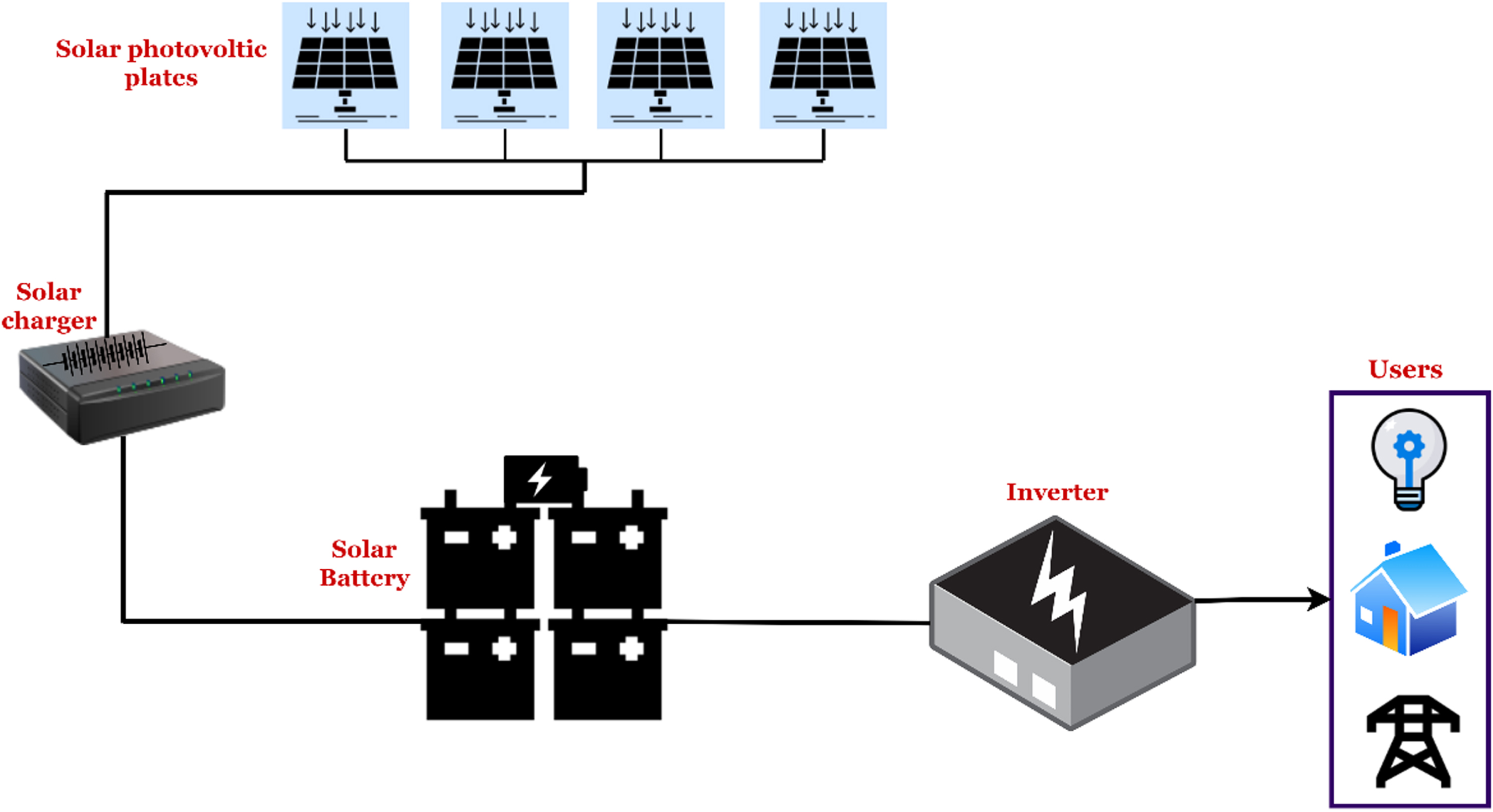
Flowchart of solar photovoltaic system.
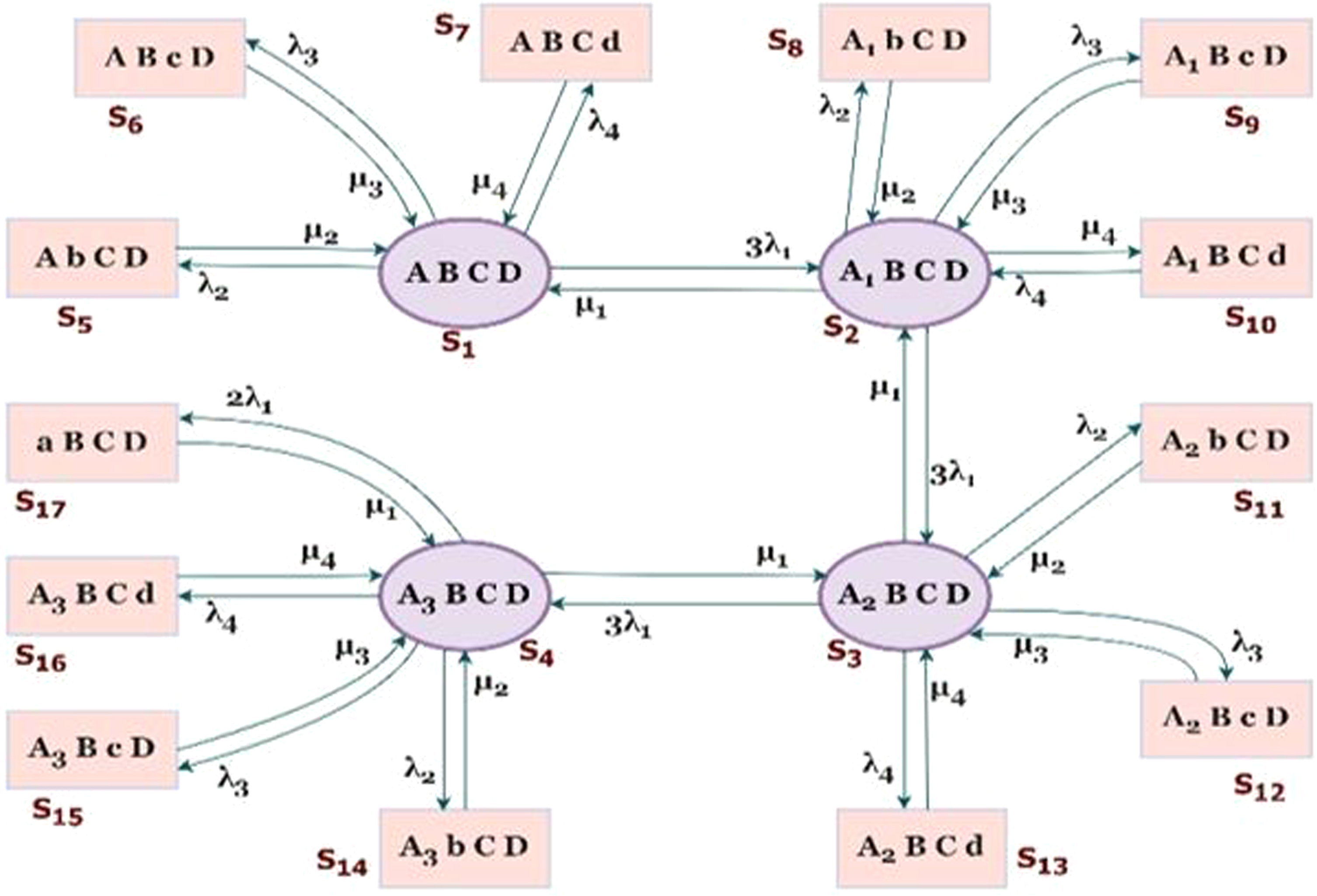
State transition diagram of solar photovoltaic system.
The following assumptions are made in the development of state transition diagram:
Notations for solar photovoltaic system model
The proposed model of solar photovoltaic system is developed using the following notations:
Nomenclature for system model development
Nomenclature for system model development
In this section, a mathematical model for solar photovoltaic system is developed by using Markov birth-death process. The set of Chapman-Kolmogorov differential difference equations are developed based on the state transition diagram given in Fig. 2. As an illustration, suppose the system is in state S1 at time t then the probability that system remain at same state is given by: Probability that SPV system available at state S1 at time t and remain at same state during (t + Δt) and/or if SPV s at any other state it come back at state S1. Mathematically, it is explained as:
Dividing both sides by Δt, we get
Taking limit Δt → 0, we get
The initial condition of the solar photovoltaic system is given as
The time independent probabilities obtained by taking t → 0, as:
After solving Equations [20–22], we get P2, P3andP4 in terms of P1 as follows:
By utilizing normalization condition
We get
Where
The steady state availability of the solar photovoltaic system is derived by the expression [30] as follows:
The traditional approaches like Markov birth death process, semi-Markov process, reliability block diagram, fault tree analysis, etc. provided the local value of the system availability. The repair and maintenance strategies of any industrial entity or power plant depends on the system availability. The high availability of any system resulted as the high revenue generation. So, by considering above benefits, it becomes necessary to system designers to develop such systems which remains highly available for operation and proper maintenances strategies should be proposed. In this situation, it becomes necessary to predict the optimum availability as well as best estimated parameters for any system. Several researchers provided various linear, nonlinear optimization techniques as well as metaheuristic algorithms to predict the global solution of optimization problems. Cuckoo search is one of such metaheuristic algorithms which shown applications in the reliability investigation of process industries. Xin and Deb [48] proposed cuckoo search (CS) algorithm based on natural phenomena. It is inspired by the obligate brood parasitism of some cuckoo species by laying their eggs in the nests of other host bird of different species. As compared to other algorithms it is very easy to implement. It is based upon a simple random walk, i.e., a particular kind of Markov chain having future outcome based on present state. There are some ideas on which it is based on: Number of eggs laying in the host nests. Each cuckoo lays one egg at a time. The best nests with high quality of eggs (solution) will carry over to the next generation. The number of available host nests is fixed, and a host can discover an alien egg with probability p ∈ [0, 1].
The new solution is generated by using Levy flight and next step is derived by the expression:
Here
In present problem, Cuckoo search algorithm is applied on the objective function given in Equation (31) in the search space appended in Table 2. The simulation study is performed using R studio on window 10 64-bit operating system with intel core i5 8th generation CPU having 8GB of RAM.
Range of the decision variables
Range of the decision variables
Here the steady state availability derived using Markovian approach of the proposed model of solar photovoltaic system is appended for a particular set of rates parameter λ1 = 0.045, λ2 = 0.002, λ3 = 0.09, λ4 = 0.4, μ1 = 0.9, μ2 = 0.85, μ3 = 0.98 and μ4 = 0.9. The impact of variation in various failure and repair rates observed on the steady state availability of solar photovoltaic system. It is observed from Table 3 that after making ±10% and ±20% steady state availability of solar photovoltaic system varies between 0.614322 to 0.68964. The detailed distribution of availability is appended in Table 3.
Impact of failure rates on steady state availability of solar photovoltaic
Impact of failure rates on steady state availability of solar photovoltaic
From Table 4, it is observed that the steady state availability of solar photovoltaic system varies from 0.606049 to 0.682665 after making ±20% variation in various repair rate. It is also identified that failure and repair rates of inverter is most sensitive.
Impact of repair rates on steady state availability of solar photovoltaic
The results of solar photovoltaic system derived through cuckoo search algorithm appended in Table 5 and shown graphically in Fig. 3. The optimal solution of the solar photovoltaic system is identified in the search space given in Table 2. It is identified that solar photovoltaic system attaines the optimum availability 0.9988799 after 700 itrations at population size 60. The corresponding estimated values of the best fitted prameters is λ1 = 0.01036878, λ2 = 0.001083257, λ3 = 0.3521385, λ4 = 0.156259, μ1 = 0.7084732, μ2 = 0.968037, μ3 = 0.9324668, and μ4 = 1.103596. The estimated parametric values for rest of population sizes derived at various iterations and appended in Tables 6–10. It is identified that the optimum value of the solar photovoltaic system’s availability is much higher than the steady state availability of system.
Optimum availability of solar photovoltaic system using Cuckoo search algorithm at various population sizes
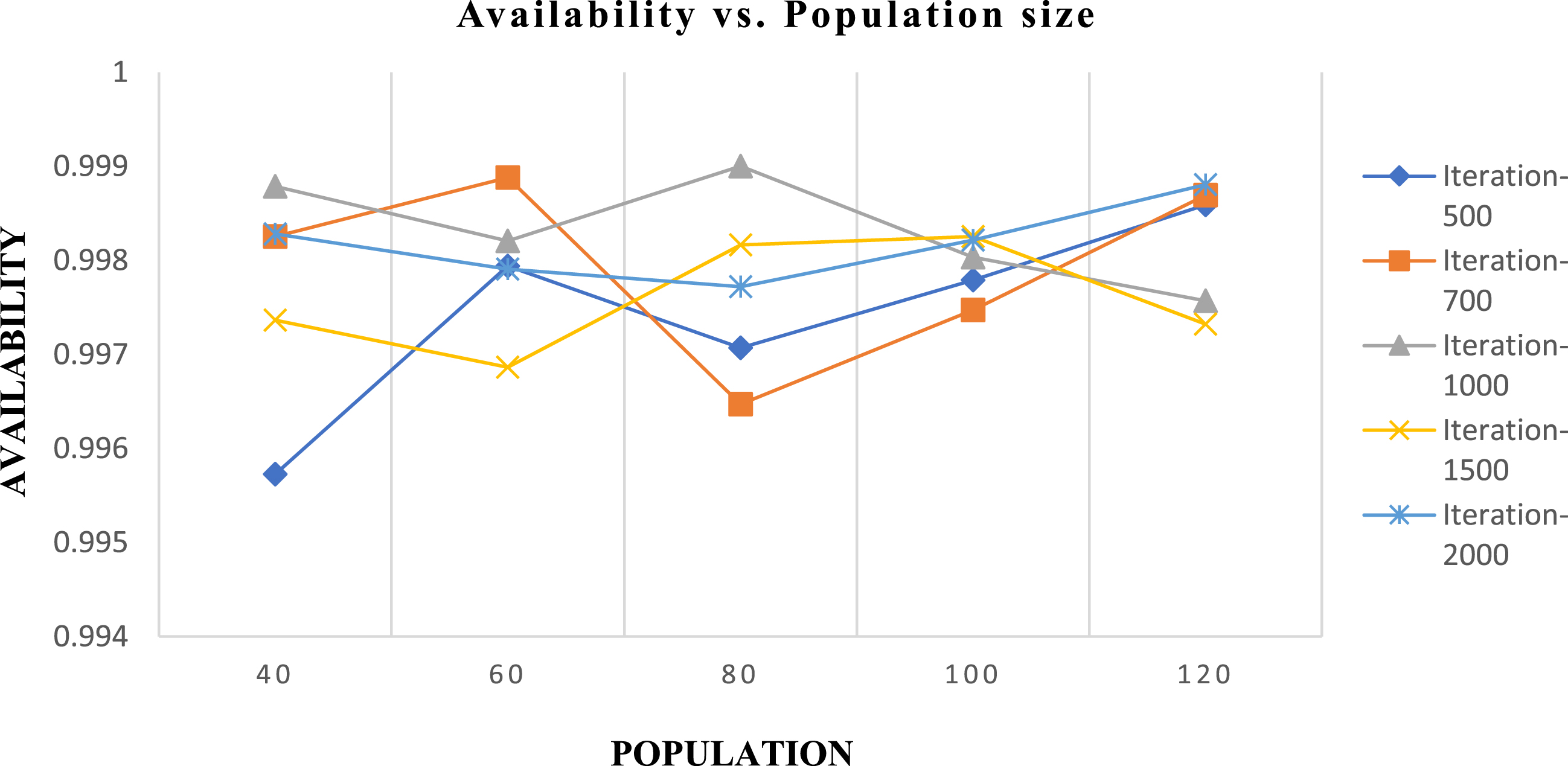
Availability representation of solar photovoltaic system at various iterations.
Parameters Estimated value with respect to different population sizes after 500 iterations
Parameters Estimated value with respect to different population sizes after 700 iterations
Parameters Estimated value with respect to different population sizes after 1000 iterations
Parameters Estimated value with respect to different population sizes after 1500 iterations
Parameters Estimated value with respect to different population sizes after 2000 iterations
The Cuckoo search algorithm predicted the best fitted values of the failure and repair rates of the subsystems of the solar photovoltaic system. So, for attainment of optimal availability of the solar photovoltaic system, system designer should use such subcomponents whose failure and repair rates are like the predicted by cuckoo search algorithm. As well as the redundancy similar redundancy methodology should be followed in physical system to attain the optimal availability. It is observed that the best estimated values of the parameters predicted by cuckoo search algorithm for proposed solar photovoltaic system are not equal to the lower and upper limits of the search space.
In present study, an efficient stochastic model is developed for availability analysis of a solar photovoltaic system using Markov birth death process. It is observed from the numerical study, that the solar photovoltaic system attained 0.68964 availability for a particular case when all failure and repair rates are exponentially distributed having rate parameters λ1 = 0.045, λ2 = 0.002, λ3 = 0.09, λ4 = 0.4, μ1 = 0.9, μ2 = 0.85, μ3 = 0.98 and μ4 = 0.9. From Markov analysis, it is identified that steady state availability declined sharply with the increment in failure rate of all subsystems while inclined with the increment of repair rates of components. It is revealed from Table 3, that after making ±20% variation in various failure rates of subsystems the availability ranges in the interval (0.68964,0.614322). Table 4 depicted that, ±20% variation in various repair rates also significantly influence the availability and it ranges between 0.606049 to 0.682665. It is discovered from Table 3, 4, that inverter is the most sensitive component of solar photovoltaic system. So, inverter unit needs utmost attention to enhance and maintain the performance of the whole solar photovoltaic system. It is depicted from tabular results appended in table 5 that cuckoo search algorithm predicts the optimum availability of the solar photovoltaic system as 0.9988799 after 700 itrations at population size 60. The corresponding estimated values of the best fitted prameters is λ1 = 0.01036878, λ2 = 0.001083257, λ3 = 0.3521385, λ4 = 0.156259, μ1 = 0.7084732, μ2 = 0.968037, μ3 = 0.9324668, and μ4 = 1.103596. It is observed that the predicted value of the availability is much higher in comparison to the steady state availability. So, these results may be utilized by system designers to enhance the performance of the solar photovoltaic systems. In addition, cuckoo search algorithm is a randomization technique based on Levy flight so provide the efficient predicted values of the solar photovoltaic system. The proposed study performed under a set of assumptions that failure and repair rates are exponential distribution, no occurrence of simultaneous failure and immediate availability of repairman as well as it is performed on a small-scale system. These assumptions may also be treated as the limitations of the proposed model. So, the present study may be further extended on large-scale solar photovoltaic plants under the more relaxed assumptions such as arbitrary failure and repair rates, possibility of multiple failure and non-availability of service facility. The proposed methodology may be opted in other similar kind of process industries like milk plant, ghee manufacturing industry, urea manufacturing plant, shoe manufacturing plant, etc. to predict the performance of the plants. Furthermore, some other optimization algorithms viz. genetic algorithm, particle swarm optimization, grey wolf optimization, dragonfly optimization, whale optimization may be opted for the optimization of performance and estimation of parameters of solar photovoltaic systems in the future work. The outcomes of the present study can be utilized for planning the maintenance schedules of the solar photovoltaic systems to enhance the performance of the plants.