




Abstract
Collaboration is essential to improve the efficiency of product research and development (R&D), shorten the R&D cycle, and reduce the R&D costs in complex product lifecycle model management (CPLMM). However, disorganized processes and the unreliability of the result evaluation remain enormous challenges for efficient collaboration. This article proposes an active-passive collaboration mechanism to enable a regulated collaboration system, which can direct the self-organized collaboration of stakeholders. C-D-Petri Net is presented for the formal collaboration process modeling. The result evaluation in active-passive collaboration involves multi-source knowledge across disciplines and phases. To address the unreliable collaboration evaluation (Co-evaluation) caused by insufficient evaluation knowledge and weak correlation between expertise and evaluation task, the collaborative fuzzy comprehensive evaluation (CFCE) model is established to support Co-evaluation actions, and its core improvement lies in the definition and introduction of collaboration volume. Finally, a simulated aircraft horizontal tail control system is regarded as an engineering application case to demonstrate and verify the effectiveness of the proposed method.
Keywords
Introduction
With the drastic increase in the scale and complexity of products, enormous challenges are involved in product R&D [1, 26]. Meanwhile, products are gradually characterized by “small-batch" and “multi-state", which spark and intensify the requirements of higher R&D efficiency and shorter R&D cycle. This status quo brings more difficulties to complex product R&D. Collaboration becomes indispensable for product R&D to save time and costs [2, 28]. Through product lifecycle management (PLM), related information on the product lifecycle is managed in an integrated manner to realize an efficient and convenient collaboration [3]. However, a complex product lifecycle is an internal iterative process, comprising multi-disciplinary, multi-phase, and multi-level. Throughout the lifecycle, collaboration is critical to reaching a consensus on key decisions and designs, which always involves a diverse range of stakeholders [4, 5]. Confronted with a massive quantity of multi-source heterogeneous data, traditional PLM based on documents is no longer effective [6]. Therefore, product lifecycle model management (PLMM) is proposed [7]. Model-based PLMM presents better performance in model construction, correlation, integration, and simulation. Stakeholders could agilely obtain knowledge of product concepts, performance, manufacturing processes, and real-time operating conditions, and collaboration quality and efficiency are improved.
PLMM provides large-amount, high-quality model knowledge and an information interaction platform for collaboration. However, spontaneous collaboration is undoubtedly inefficient, which results in wasted model resources and chaotic processes. Thus, one of the significant issues is proposing a mechanism that can reasonably manage and control the collaboration process and enable stakeholders to self-organize and implement collaboration actions according to the established rules. In addition, compared with traditional PLM, the collaboration resources in PLMM are integrated, and the collaboration processes are object-oriented. It is imperative to research novel process modeling methods to adapt to the characteristics of PLMM.
Co-evaluation is another critical content and plays a vital role in the collaboration mechanism. The evaluation knowledge comes from stakeholders in different disciplines, phases, and industries. However, the traditional comprehensive evaluation method fails to utilize the richness of the evaluation knowledge and obtain the relevance between the evaluation knowledge and the evaluation task. The problem of incomprehensive and unreliable evaluation results caused by insufficient knowledge and a weak correlation between knowledge and task remains to be addressed.
In this research, the concept of active-passive collaboration is proposed. Subsequently, collaboration actions can be implemented effectively under the direction of the collaboration machine with stakeholders in the loop. Then, the C-D-Petri Net is presented for active-passive collaboration process modeling. The process model extends diversified action types to accommodate active and passive collaboration forms and knowledge-related evaluation with multi-stakeholder participation. Besides, an improved FCE with the collaboration volume, named CFCE, is elaborated to enhance the reliability of the Co-evaluation. The reliability improvement relies on the quantitative measuring of the richness of evaluation knowledge and the relevance between evaluation tasks and evaluation knowledge by the proposed CFCE model. Through the joint application of the analytic hierarchy process (AHP) and CFCE, a combined method AHP-CFCE is provided, which is suitable for Co-evaluation actions.
This article is organized as follows. In Section 2, the preliminaries and some related works are introduced, and some existing problems are stated incidentally. Section 3 details the active-passive collaboration mechanism and the process model. The AHP-CFCE based Co-evaluation method is described in Section 4. Section 5 provides an engineering application case, a simulated aircraft horizontal tail control system, to demonstrate the effectiveness of this active-passive collaboration mechanism. Section 6 discusses the merits and limitations of this paper. Section 7 concludes and prospects some future work.
Preliminaries and related work
The preliminaries and related work are introduced in this section. There are still some problems that need to be further researched and addressed.
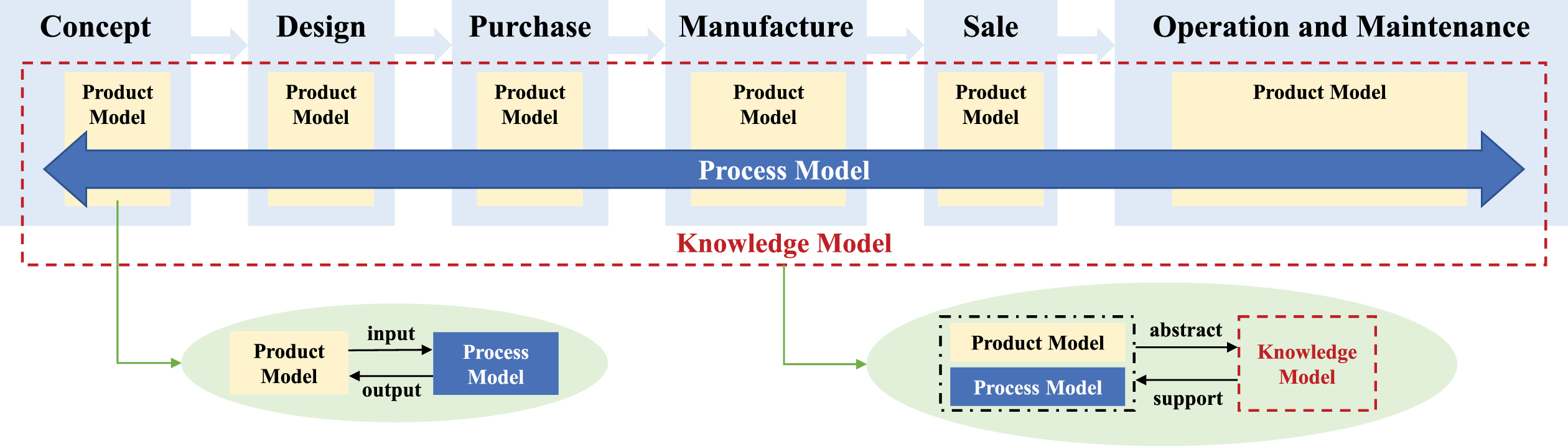
Relation of product model, process model and knowledge model in PLMM.
Product lifecycle, containing six phases of concept, design, purchase, manufacture, sale, and operation and maintenance (O&M), is the whole process of a product from demand generation to scrap disposal [8]. PLM based on data and document realizes information sharing, reference design, etc., and integrates document management, design management [9], structure management [10], process management, etc. PLM is widely used in aerospace [11, 12], energy [13] and other industries, providing convenience for the management of scattered product data.
A complex product is an integration of multiple subsystems. The product model is the formalized description of product lifecycle knowledge, which involves multiple disciplines and is strongly heterogeneous. It flows and evolves continuously with the progress of the process model (see Fig. 1). The high complexity of the product model demands collaborative R&D by cross-domain and cross-department stakeholders. In the latest research, considering the deficiency in information integration across disciplinary boundaries and lifecycle phases, Wang [7] proposes to extend PLM to PLMM in compliance with the model-based system engineering (MBSE) methodology. PLMM is more suitable for the collaborative R&D of complex products at the model level. The attributes, states, and interaction rules of complex product multi-level models can be obtained, and the research demands, model-based simulation, deduction and digital twin, can be satisfied.
However, it is hard to support efficient and high-quality collaboration only with the help of rich model knowledge. The disordered collaboration process and unreasonable Co-evaluation will reduce the knowledge effectiveness and lead to a surge in collaborative costs. This article studies the active-passive collaboration mechanism to address the above problems.
Complex Product Lifecycle Process Model
A complex product lifecycle process model is used to dynamically link and handle product models in collaborative R&D. It is composed of a series of logical and interdependent actions. The progress of actions is organized and controlled by the process model, and orderly progress is essential to collaborative R&D.
Process modeling methods are focused on formal models [14]. Design structure matrix (DSM) based on the process architecture, possessing excellent computing capabilities, can analyze and optimize R&D process [15]. However, one of the challenges is that when process modeling spans multiple domains, the complexity of matrices grows to a level where they become difficult to handle [16]. Although the object-oriented system modeling language SysML in MBSE can be applied to describe complex product process models, the activity diagram is hard to be analyzed and optimized, and its dynamic performance is deficient [17]. Petri Net has great power in dynamic dealing with concurrences and is widely used to model, analyze, verify and optimize workflows [18]. Liu et al. [19] proposes D-Petri Net, which is defined as a triplet, see Eq. (1). The graphical representation is shown in Fig. 2.
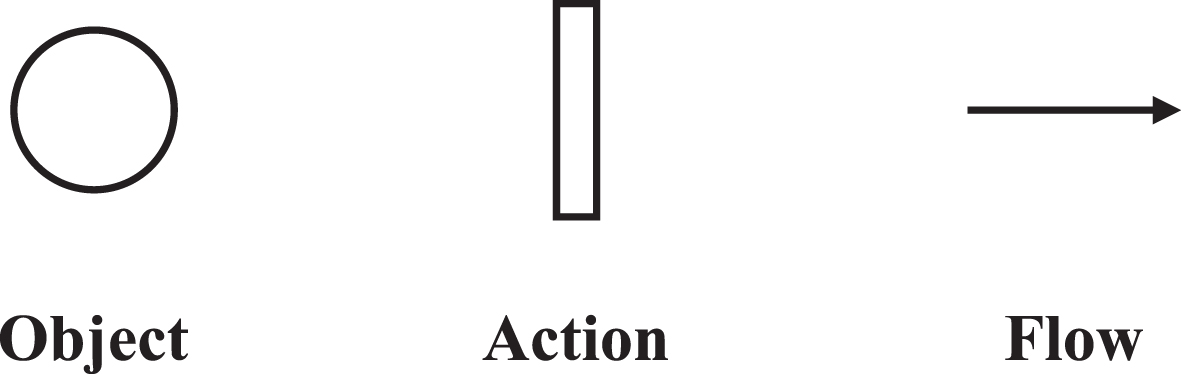
Graphical representation of D-Petri Net.
In D-Petri Net, resources required in an action are the highly integrated object (i.e., product model package). With the progress of the product lifecycle and collaboration, general actions are implemented automatically. The generation of core objects depends on the Co-evaluation action. Therefore, the place capacity, token, and weight of Petri Net are simplified, which reduces the complexity and granularity of Petri Net and improves operability. D-Petri Net is more suitable for object-oriented process modeling in PLMM. However, the existing process models, including D-Petri Net, still do not pay attention to collaboration and fail to model collaboration processes with multi-stakeholder participation, which are indispensable in the proposed active-passive collaboration mechanism. Thus, C-D-Petri Net is established in this papaer.
Collaboration is involved in most process model changes. The changes with uncertainty are generated due to the different demands of stakeholders. For example, the design change caused by changed performance demand, and the action sequence change caused by variable costs. The effective collaboration mechanism and evaluation method contribute to achieving process changes.
Co-evaluation is a vital link of the active-passive collaboration mechanism, which shows the collaboration effect. The diversity of evaluation objects and indexes and the evaluation process’s subjectivity determine that Co-evaluation is a complex multiple criteria decision (MCD) problem. FCE shows satisfactory performance on complex MCD problems [20].
FCE specializes in quantitative evaluation, and the weight factors of evaluation indexes are essential elements of implementing FCE. Belief entropy is a splendid data-driven method for obtaining the weight factors [32]. In complex MCD problems, most criteria are intangible. AHP excels in getting measures for intangible, using pairwise comparisons of knowledgeable and expert people to determine the weight of decision criteria [34]. Panchal et al. [35] use AHP to assess landslide hazard as a semi-qualitative approach. More extensive studies combine the merits of AHP and FCE for accurate quantitative evaluation [21–24]. Compared with isolated methods, integrated FCE is more efficient in addressing complex multi-index situations [25, 29].
AHP-FCE is the basic theory of Co-evaluation in this article, and a brief introduction is needed. FCE model is defined as FCE = (U, V, R, A). U and V are the index set and the remark set, described by Eqs. (3).
By AHP, normalized absolute scales of numbers are derived based on 1 to 9 fundamental scale or pairwise dominance ratios, and their elements are then used as weights a
i
to indicate the priorities of the indexes [33]. The weight vector A correlates to U, we have
However, the knowledge of complex product lifecycle is diverse, and Co-evaluation requires the participation of stakeholders with multiple knowledge backgrounds. FCE can not measure the richness of the evaluation knowledge and the relevance between the evaluation knowledge and the evaluation task, which leads to unreliable evaluation results. In this article, CFCE is proposed to avoid the problem.
To analyze the collaborative mode and improve collaboration efficiency in CPLMM, the collaboration mechanism should be precisely defined, and the collaboration process is supposed to be modeled explicitly. In this section, We define active collaboration and passive collaboration. Then, the active-passive collaboration machine with stakeholders in the loop is provided to guide self-organizing collaboration. C-D-Petri Net, shown in Section 3.3, is well adapted to the process modeling of the active-passive collaboration. Besides, the Co-evaluation problem is introduced.
Active-passive collaboration
Two types of collaboration are defined in CPLMM: 1) active collaboration and 2) passive collaboration. There are two bases for the classification: 1) the relation between the collaboration process and the product lifecycle main process (hereinafter referred to as the main process) and 2) the collaboration cause. The details are as follows.
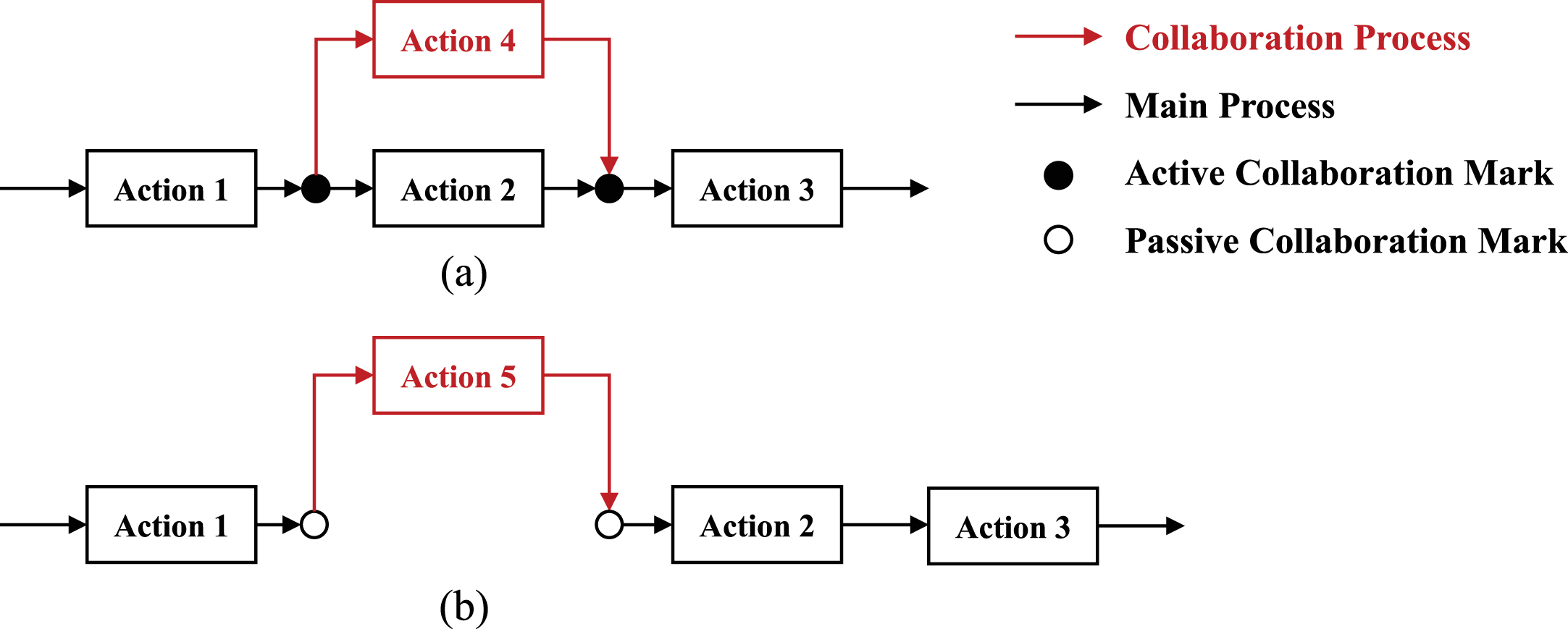
Principle of active-passive collaboration. (a) Active collaboration. (b) Passive collaboration.
Active collaboration is a collaboration process initiated by stakeholders due to their own requirements and develops in parallel with the main process (see Fig. 3a). At the end of the active collaboration process, the collaboration result is integrated into the main process as additional input for the next action.
Passive collaboration is a collaboration process driven by the interruption of the main process and is connected in series at the breakpoint of the main process (Fig. 3b). To respond to the passive collaboration process, the main process needs to be suspended. The collaboration result is used as input for the next action to restart the main process.
The principal differences between active collaboration and passive collaboration lie in three aspects: cause, form, and costs.
The cause of active collaboration is the product interests change (e.g., engineering indexes, economic indexes, time indexes). A stakeholder actively requires related product developers from multi-domain, multi-phase, and multi-department to collaborate on the PLMM platform to satisfy new product interests at a certain price. Active collaboration, a type of parallel collaboration, is cost-effective. Because it does not affect the progress of the main process, and the results is of reference value for failure prevention.
The cause of passive collaboration is that problems occur in product R&D (e.g., application rejection, design error, delivery timeout), and the main process is forced to be interrupted. Stakeholders collaborate to solve the problems based on the original product interests. Passive collaboration belongs to serial collaboration, with low cost-effectiveness. Although the main process can be restarted, it is bound to cause great losses.
Similarities: after initiating the collaboration, stakeholders should complete some actions, such as analysis, calculation, deduction, comparison, optimization, evaluation, and decision. Iterative optimization may be necessary until the collaboration results are obtained.
In CPLMM, stakeholders are the main body of actions and collaboration. The active-passive collaboration machine with stakeholders in the loop is provided to maintain the autonomous and efficient operation of the collaboration mechanism. The internal structure of the collaboration machine is shown in Fig. 4.
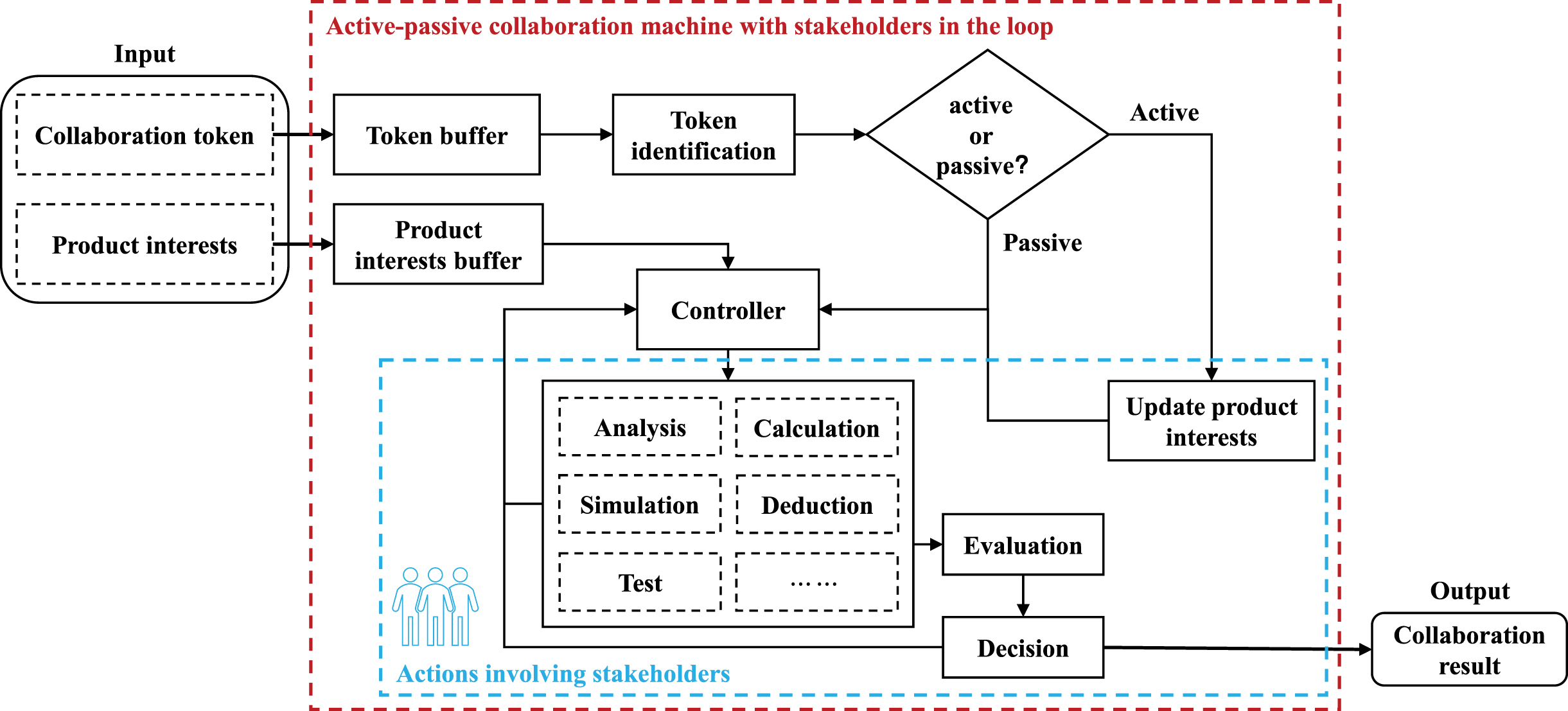
Active-passive collaboration machine with stakeholders in the loop.
The collaboration machine operates in the following steps. Initiate collaboration and generate a collaboration token and product interests. Read and identify the collaboration token. If it is an active collaborative token, update product interests. Otherwise, no action. The controller reads the current product interests from the buffer. According to the product interests, stakeholders create and complete actions, such as analysis, simulation and deduction. Evaluate and decide the collaboration results. If passed, output the collaboration results. Otherwise, collaborative process is iteratively optimized until the product interests are met. Wait for the next collaboration.
C-D-Petri Net is a process modeling tool especially proposed for active-passive collaboration. It is improved based on D-Petri Net.
Co-initiation and Co-evaluation are unique collaboration actions in the active-passive collaboration mechanism. Co-initiation has the function of distinguishing the types of collaboration. Co-evaluation should determine whether the collaboration process can be terminated based on the collaboration results. As the beginning and end of the collaboration process, collaboration actions can accurately identify the collaboration process. Therefore, C-D-Petri Net must have the ability to model collaboration actions.
C-D-Petri Net is defined as a triplet.
The graphical representation of C-D-Petri Net in O, F, and A is consistent with D-Petri Net (as Fig. 2). The graphical representation of A c is shown in Fig. 5.
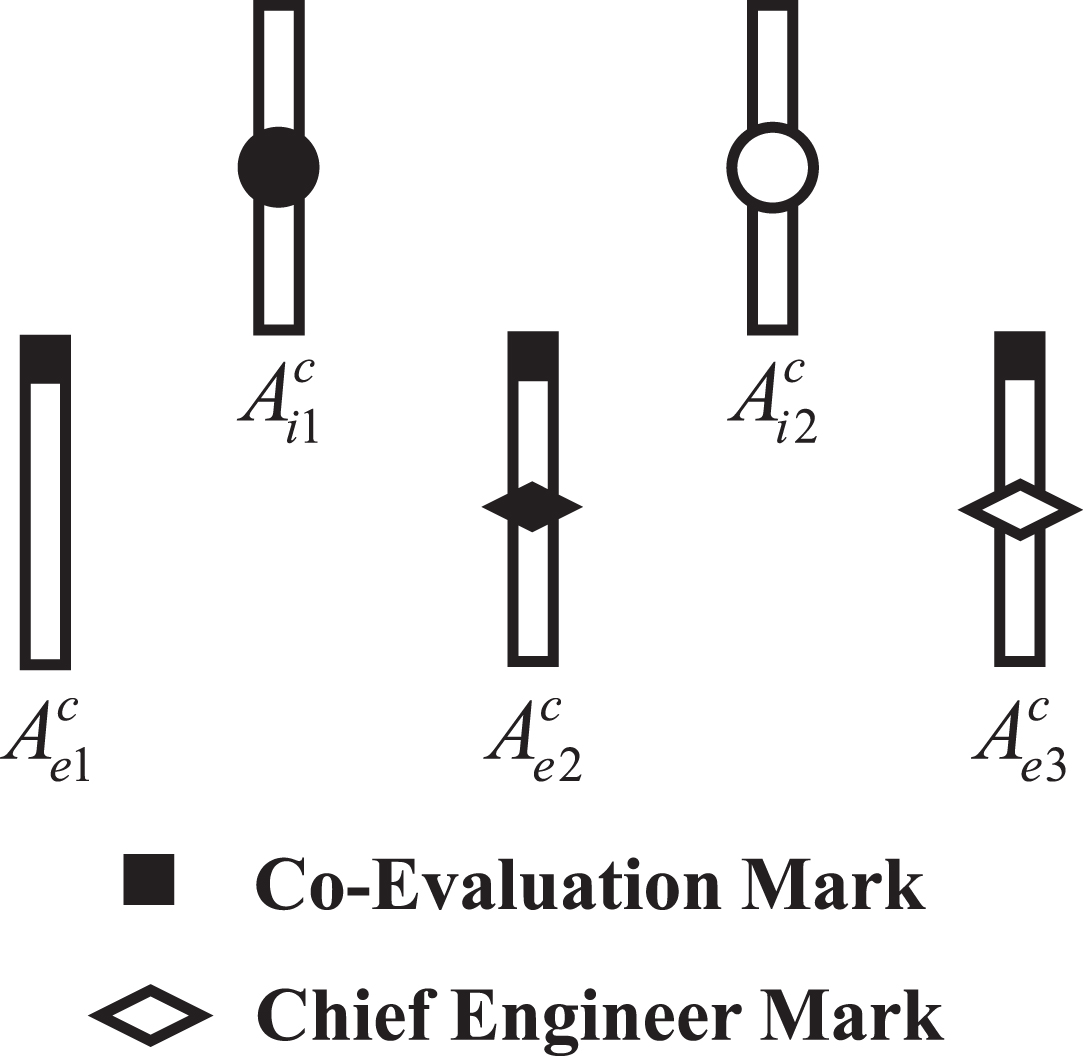
Graphical representation of collaboration action.
Co-evaluation action (i.e.,
•Stakeholders are required to provide an evaluation result v for the index set U. v indicates the stakeholders’ perception of the superiority of U.
An evaluation problem involves an index set U (as Eq. (2)), an remark set V (as Eq. (3)), and an stakeholders set P = (p1, p2, ⋯ , p Q ). U is the evaluation index system corresponding to the collaboration results. For each p i ∈ P, it keeps three types of knowledge attributes of stakeholder i, namely discipline, knowledge level and lifecycle phase.
Fuzzy mapping
It is claimed that (U, V, R*) constitutes a mathematical model of an evaluation problem. Where R* = (R, c), c is the collaboration degree of the Co-evaluation action and depends on the number Q and knowledge attributes of stakeholders.
Co-evaluation result v is obtained as.
In the mechanism, Co-evaluation is a comprehensive decision action involving multi-source knowledge. Insufficient knowledge and weak correlation between evaluation knowledge and the evaluation task may cause low collaboration quality and unreliable evaluation results. Therefore, a quantitative evaluation model that can measure the richness of evaluation knowledge and the relevance between the knowledge and task is imperative. In this section, we first define the collaboration volume. Importing the collaboration degree, CFCE model is established. Ultimately, the AHP-CFCE based Co-evaluation method is provided for the active-passive collaboration mechanism.
Collaboration Volume
Collaboration volume is a measure of the total knowledge contributed by all stakeholders from multiple disciplines, phases, and industries to the Co-evaluation action. It can characterize the richness of evaluation knowledge and the relevance between knowledge and the evaluation task.
Collaboration volume is calculated as
The collaboration degree c is imported to the fuzzy evaluation matrix R (as Eq. (5)), the collaborative fuzzy evaluation matrix R* is established. As a result, FCE is improved to CFCE that possesses the knowledge feature.
R* is described as
The collaborative fuzzy comprehensive evaluation B* can be calculated by Eq. (18).
The operator ⊙ is stipulated as: 1) b
j
is calculated by the selected fuzzy operator M (* , *); 2) c
j
is calculated by the fuzzy operator M (· , +) shown in Eq. (19).
The Co-evaluation result v is obtained by the weighted average method, the formula is improved as
Multi-layer CFCE model is widely applied in the Co-evaluation action, and the single-layer model is a special case of the multi-layer model. Let multiple lower-layer index subsets form a upper-layer index set, U = (U1, U2, ⋯ , U k ).
For each lower-layer model, we have a collaborative fuzzy comprehensive evaluation B
i
*, as Eq. (21).
The collaborative fuzzy evaluation matrix of the upper-layer model is established as
The collaborative fuzzy comprehensive evaluation of the upper-layer model is calculated by
The above calculation process continues until the highest-layer collaborative fuzzy comprehensive evaluation B* is obtained.
By Eqs. (23), the weight vector A directly affects the Co-evaluation result. Thus, it is essential to obtain A effectively.
(1) Calculate weight vector based on AHP: Establish the index system, corresponding to the evaluation problem, for the multi-layer CFCE model. Construct judgment matrix E = (e
ij
) n×n of each layer model based on 1 ∼ 9 scale, as Table 1. where n is the number of indexes at this layer. Hierarchical single arrangement. For each E, calculate the maximum eigenvalue λmax and the corresponding eigenvector Normalize Consistency check. Calculate the consistency index CI, Query the average consistency index RI, shown in Table 2. Calculate the consistency ratio CR, CR = CI/ RI. When CR < 0.1, the consistency is considered acceptable, and the weight vector A is valid.
1 ∼ 9 Scale
Average Consistency Index RI
(2) Apply AHP-CFCE model in Co-evaluation action:
For the three Co-evaluation forms in the active-passive collaboration mechanism, corresponding AHP-CFCE application principles is defined as
1) Democratic evaluation
The Co-evaluation result v should be directly accepted.
2) Static chief engineer evaluation
A chief engineer comprehensive evaluation is imported for the highest layer model, as Eq. (24).
The final Co-evaluation result is obtained as
3) Dynamic chief engineer evaluation
Corresponding to the previous K chief engineers, there are K comprehensive evaluations.
Let the duration of the Co-evaluation action be T. For the chief engineer who loses the collaboration token at time t (k), the influence on the final evaluation result increases with time. Therefore, we define the token function as
Then, the final Co-evaluation result is obtained as
When K = 1, dynamic chief engineer evaluation degenerates into static chief engineer evaluation.
Elements of the active collaboration process model
To demonstrate the active-passive collaboration mechanism, the simulated aircraft horizontal tail control system, a typical aviation complex product, is used here. It is used to control aircraft pitch angle, including the controller, control valve, hydraulic cylinder, transmission components, and horizontal tail. The stakeholders’ collaboration is inevitable on account of the complexity of the R&D process, the richness of disciplinary knowledge, and the high coupling of activity. However, spontaneous collaboration is undoubtedly unregulated owing to significant differences in individual collaboration plans. Meanwhile, CPLMM provides rich elements of information and knowledge for the R&D of the simulated aircraft horizontal tail control system, and these resources have not been fully utilized in collaboration. The above status quo limits the level of lifecycle management of the simulated aircraft horizontal tail control system. With the support of the active-passive collaboration mechanism, orderly and efficient collaboration, and knowledge-related reliable evaluation can reduce wasted resources caused by redundant iterative activities, and avoid collaboration failure and even equipment fault due to wrong collaborative evaluation. The valve-controlled hydraulic cylinder system is the core of the control system. There are engineering cases of active collaboration and passive collaboration in its manufacturing phase.
Active-passive Collaboration Cases
(1) Active collaboration case
The main process in the manufacturing phase of the valve-controlled hydraulic cylinder includes processing, assembly, debugging, test, and other actions. The active collaboration case initiates before the processing action.
The active collaboration process is modeled by C-D-Petri Net (as Fig. 6). The meanings of actions and objects are shown in Table 3.
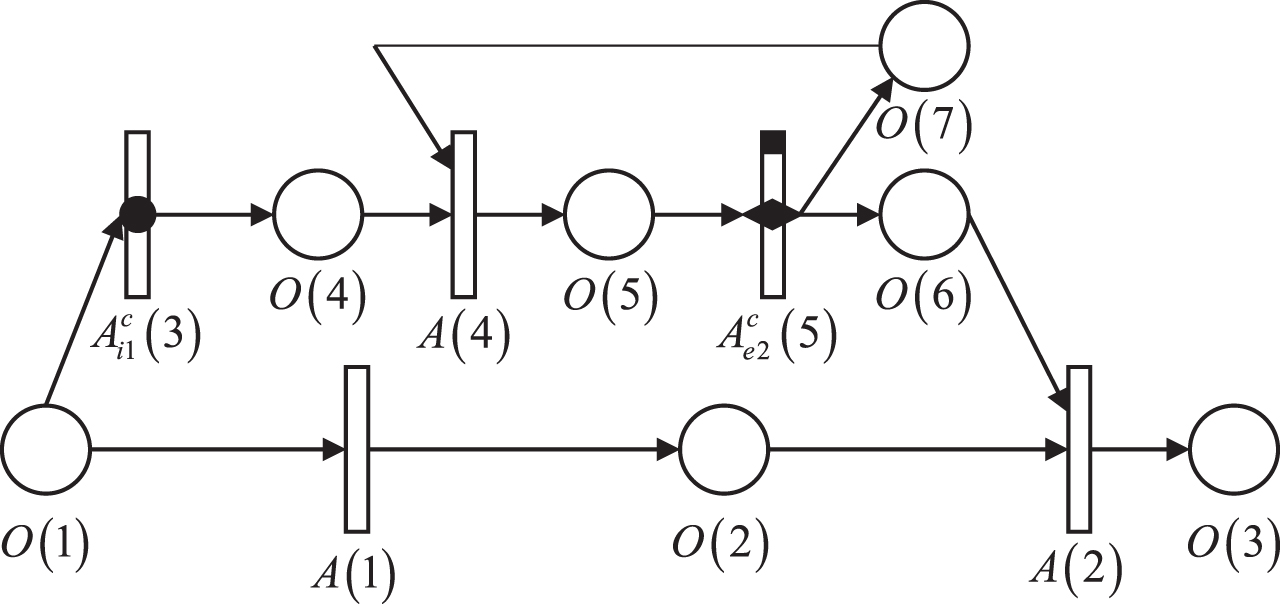
Process model for the active collaboration case.
In detail, in the main process, components O (2) are processed based on processing models O (1). And then, The components are assembled into a valve-controlled hydraulic cylinder O (3) that needs to be tested next. However, a stakeholder discovered in advance that the oil supply pressure used for testing was occasionally unstable. This situation may cause test failures. Thus, the active collaboration action
The incidence matrix of Fig. 6 is a boolean function about the Co-evaluation result, as Eq. (31).
Elements of the passive collaboration process model
Significantly, the active collaboration avoids possible product damage caused by unstable oil supply pressure. It shortens the R&D cycle and saves R&D costs.
(2) Passive collaboration case
The process model of the passive collaboration case is shown in Fig. 7. The actions and objects are introduced in Table 4.
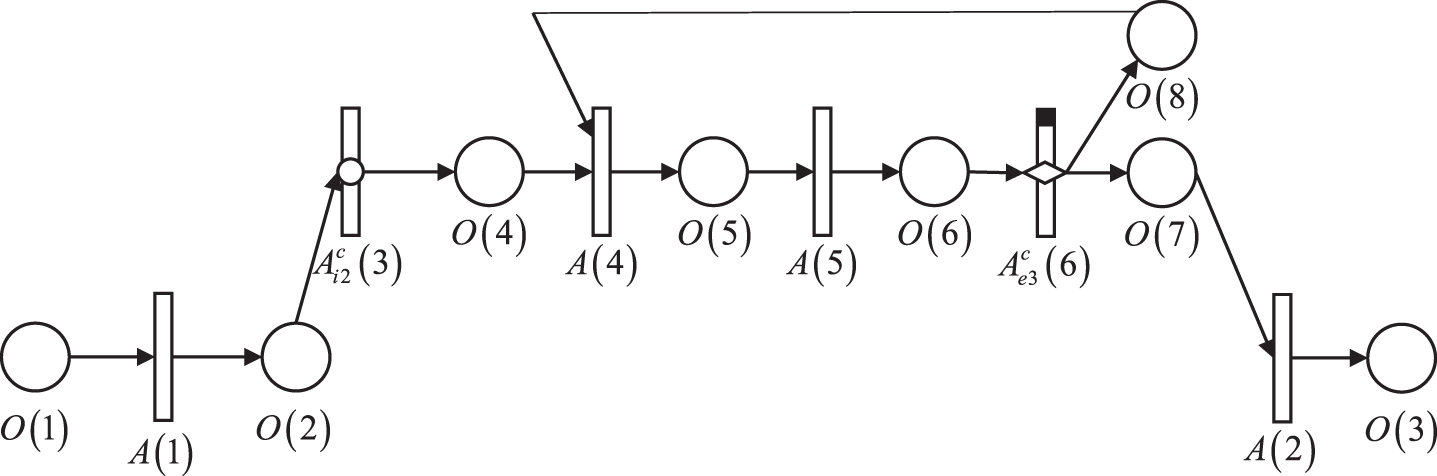
Process model for the passive collaboration case.
The passive collaboration process is detailedly described as follows, the incidence matrix is shown in Eq. (32).
The assembled valve-controlled hydraulic cylinder system (referred to as the primary system) originally needs to undergo testing A (1) and certification A (2) actions. However, the oil supply pressure loss and instability caused by the long pipeline lead to the invalid test result O (2) (as Fig. 9a), which does not satisfy the performance requirements of the product. The main process, O (2) to A (2), is interrupted. The passive collaboration
The valve-controlled hydraulic cylinder and the hydraulic oil pumps are shown in Fig. 8a, Fig. 8b, and Fig. 8c. Fig. 9a and Fig. 9b compare the performance test results of the primary system and the improved system. The performance test actions A (1) and A (5), including the step response performance test and the sine response performance test, are implemented in the simulated aircraft horizontal tail control system before and after replacing the hydraulic oil pump. Fig. 9 shows the performance test results O (2) and O (6), generated from A (1) and A (5) in the passive collaboration process (as Fig. 7). Where O (2) corresponds to Fig. 9a, and O (6) corresponds to Fig. 9b.
The significant performance improvement resulting from the passive collaboration is visualized in the comparison in Fig. 9. Specifically analyzed as
•In step response, the primary system takes over 7 seconds to reach full response, while the improved system takes less than 5 seconds to complete the same task. Response time is accelerated by more than 35%.
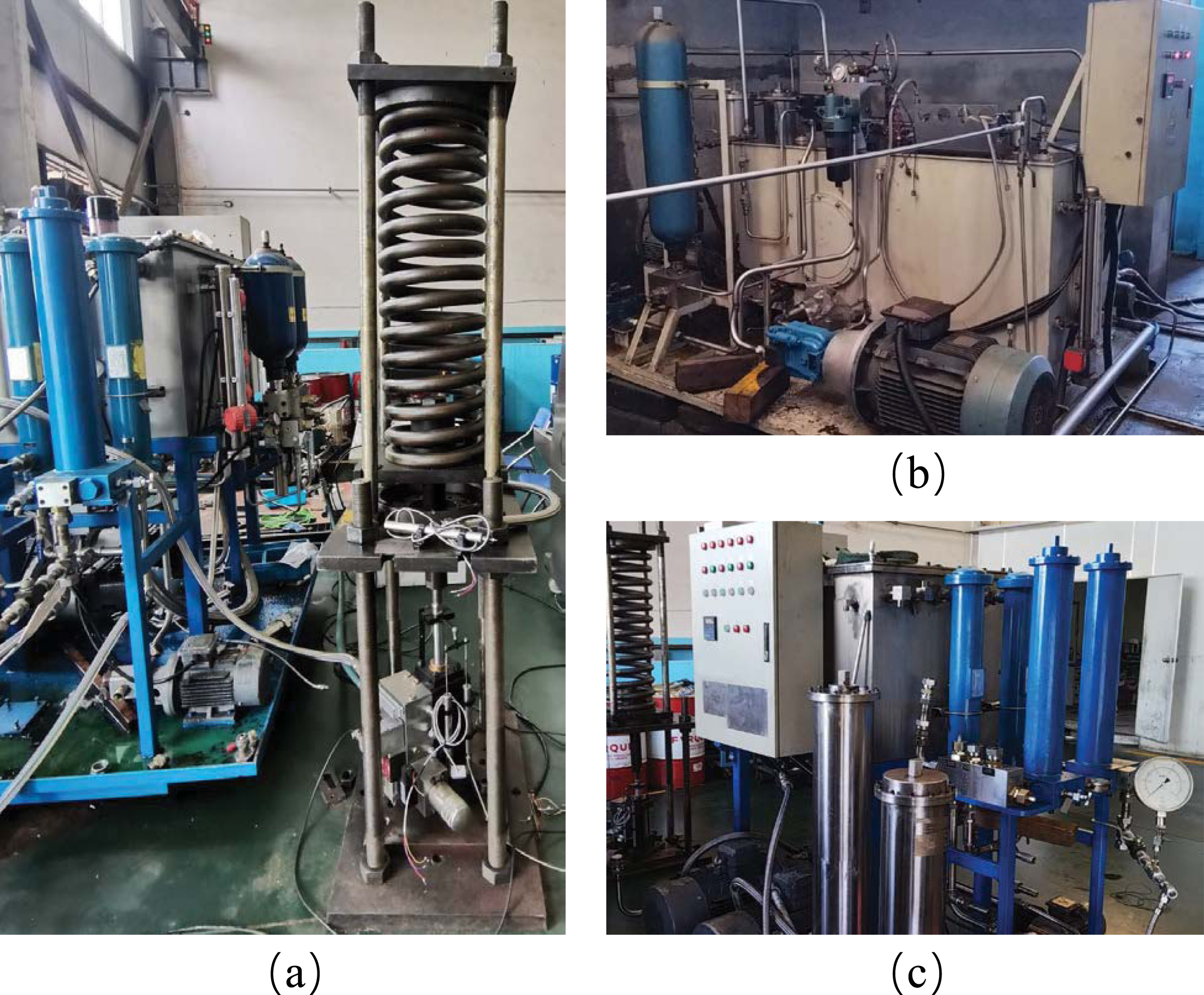
Valve-controlled hydraulic cylinder system. (a) Valve-controlled hydraulic cylinder. (b) Former hydraulic oil pump. (c) Latter hydraulic oil pump.
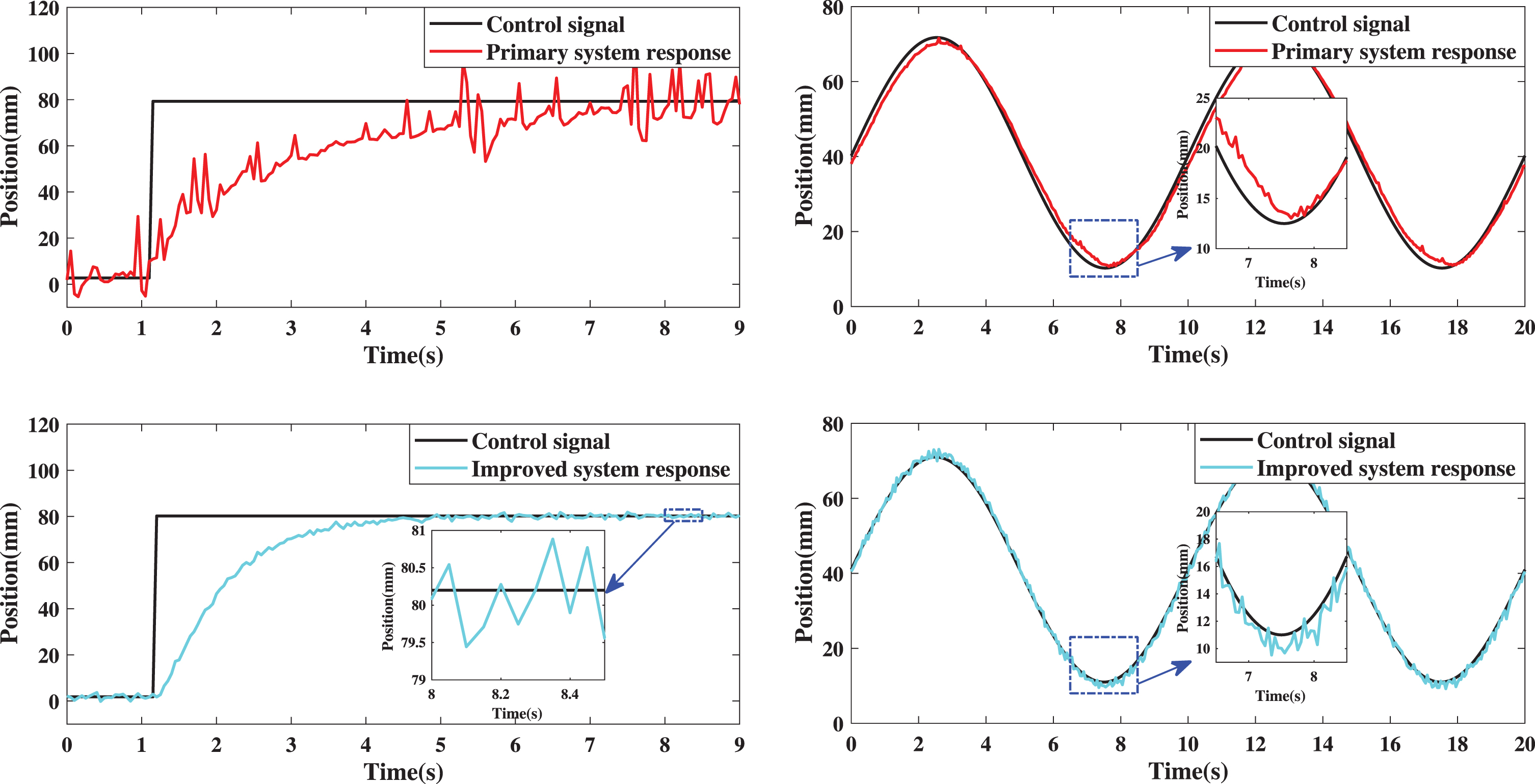
Performance test results of the primary system and the improved system. (a) Step response. (b) Sine response.
•In Fig. 9a, the response fluctuations of the improved system are substantially less than the primary system. This condition benefits from the stability of the new hydraulic oil pump (see Fig. 8c). It means that the improved system has better resistance to disturbances.
•In sine response, almost no phase difference between the response of the improved system and the control signal. This result demonstrates the advanced continuous actuation speed and accuracy of the improved system. These results amply prove the passive collaboration effect.
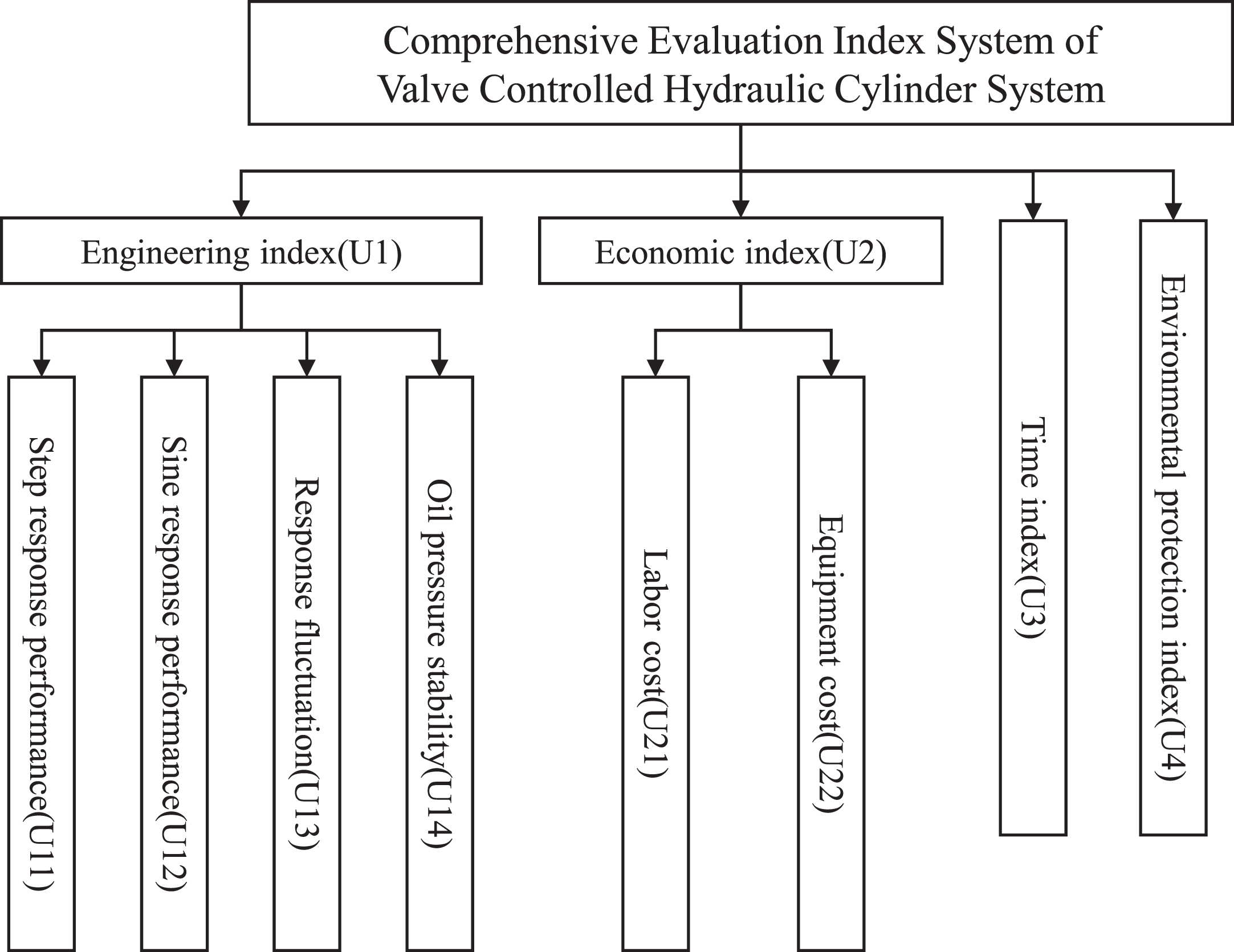
Comprehensive evaluation index system for the valve-controlled hydraulic cylinder system.
According to the active-passive collaboration mechanism (as Fig. 4), the test result O (6) of the improved system needs to be evaluated to verify the collaboration effect. Where the Co-evaluation action
The application of the Co-evaluation method is not related to the collaboration type. Considering the Co-evaluation action in the active collaboration case is simple, the passive collaboration case is used to demonstrate the Co-evaluation method comprehensively and clearly.
The various indexes of the improved valve-controlled hydraulic cylinder system should be evaluated to quantify the effect of passive collaboration. There are two key steps: 1) Establish a comprehensive evaluation index system for the performance evaluation problem of the valve-controlled hydraulic cylinder system, and 2) Calculate the Co-evaluation result based on the proposed AHP-CFCE model. To show our method briefly, the indexes, remarks, and the stakeholders’ organizational structure is simplified in this case.
(1) Comprehensive evaluation index system
With the help of experts in multiple domains, eight performance indexes of the valve-controlled hydraulic cylinder system are selected to establish a two-layer comprehensive evaluation index system (as Fig. 10). All indexes constitute the index set U.
Remarks are divided into 5 levels: Great improvement-5, Improvement-4, Common-3, Degradation-2, Great degradation-1. The remark vector is described as
(2) Co-evaluation
Ten stakeholders from the aviation, economic, and environmental fields participate in the Co-evaluation action, numbered a ∼ j. The knowledge attributes of the stakeholders are shown in Table 6.
Knowledge level of stakeholders
Discipline and phase of stakeholders
Index weight
Firstly, we obtain three weight vectors based on AHP, as Eqs. (34)∼(36). The corresponding relation between the weight vectors and the evaluation indexes is shown in Table 7. For all three judgment matrixes, the CR values are less than 0.1, and the consistency check is passed.
By the statistics of the evaluation results from ten stakeholders, fuzzy evaluation matrixes R1 ∼ R4 are obtained as Eq. (37).
The knowledge attributes of the Co-evaluation task are: discipline=hydraulics, phase=manufacture, industry=aviation. Collaboration volume matrixes are calculated by Eqs. (12)∼(15), as Eq. (38). Note: the correlation degree of the two types of knowledge attributes (type 1: the knowledge attributes of stakeholders; type 2: the knowledge attribute of the Co-evaluation task) and related parameters are determined based on the experience of domain experts.
By Eq. (17), the collaboration degree c is calculated and imported into Eq. (37), and collaborative fuzzy evaluation matrixes are constructed as Eqs. (39)∼(42).
We select the fuzzy operator M (∧ , ∨). The second-layer collaborative fuzzy comprehensive evaluation is calculated as Eqs. (43)∼(46).
Then, the first-layer collaborative fuzzy comprehensive evaluation is calculated as Eq. (47).
By Eq. (19), the Co-evaluation result v can be calculated by Eq. (48).
In this case, the dynamic chief engineer evaluation mode is adopted. The passive collaboration process lasts for 5-time units. Stakeholder g and stakeholder b successively hold the collaboration token. Particularly, g hands over the token to b after 2-time units. By Eq. (29), we have Token (1) =2/5, Token (2) =1. The chief engineer comprehensive evaluation is obtained, as Eqs. (50).
According to Eqs. (30), the final Co-evaluation result is obtained as
v final is close to 4. By the defined Co-evaluation remarks, the result indicates that the passive collaboration improves the overall performance of the valve-controlled hydraulic cylinder system.
Stakeholders consider that the improved performance of the valve-controlled hydraulic cylinder system meets the product performance demand. Thus, the Co-evaluation action is regarded as passed. The main process is restarted, and the product certification action is executed immediately (as Fig. 7 and Table 4).
The merits of the proposed Co-evaluation method based on the AHP-CFCE model are shown by the comparative analysis of the improved AHP-CFCE and the classical AHP-FCE. Table 8 lists the evaluation results of the two models for the passive collaboration case described in Sections 5.1(2) and 5.2.
Comparison between AHP-FCE and AHP-CFCE
Comparison between AHP-FCE and AHP-CFCE
Table 8 indicates that the basic result of the AHP-CFCE does not deviate from the AHP-FCE, as reflected by the fact that they have the same membership for each remark. The advancement and reliability of AHP-CFCE are reflected in the introduction of the collaboration degree that characterizes the richness and relevance of evaluation knowledge. The superiority is also reinforced by the modifications made for the three Co-evaluation forms (presented in Section 4.3(2)).
Detailedly, by the bolded elements in Table 8, if we refer to the AHP-FCE model, the membership of evaluation results for remark 4 is greater than remark 5 (0.5 > 0.3). We get the evaluation result of 4.6421, which is closer to “Great improvement". When we introduce the collaboration degree and utilize the AHP-CFCE based Co-evaluation method, we begin to know that “Great Improvement" is a pseudo evaluation. Because, after considering the knowledge richness and relevance, it is obvious that membership 0.5 is much less reliable than membership 0.3 based on the comparison of collaboration degrees 0.5081 < 0.6489. By Section 5.2, a more credible knowledge-related evaluation “Improvement" is obtained. The conflicts indicate that if the Co-evaluation result is calculated only based on the membership, the influence of knowledge richness and correlation on the evaluation result will be ignored to a certain extent, which may lead to evaluation errors. Therefore, the proposed AHP-CFCE model is more suitable for the Co-evaluation involving multi-disciplinary, multi-phase, and multi-industry knowledge in the active-passive collaboration mechanism.
The active-passive collaboration case verifies that the proposed mechanism can effectively help manage and control the collaboration process in CPLMM. Under the guidance of the collaboration machine and process model, stakeholders can conduct self-organized collaboration in an orderly manner. Besides, the AHP-CFCE based Co-evaluation method can precisely measure the richness and relevance of the knowledge involved in the evaluation, overcoming the drawback of unreliable evaluation of collaboration results. It provides a precedent for the knowledge-related fuzzy evaluation in collaboration actions. The proposed method makes it possible to further improve the collaboration efficiency and lifecycle management level.
Two aspects need to be further discussed, especially concerning the limitations.
(1) With the uncertainty of the dynamic process, unknown conflicts may affect the development of the collaboration process, and even lead to interruption. This paper has not addressed uncertain collaboration conflicts. Thus, future research on this limitation is explored as follows. The quantification of uncertainty is an essential topic to measure the uncertainty properties of conflicts. Particularly in collaboration processes involving multi-source information, Dempster-Shafer evidence theory and related improved methods are considered as potentially one of the excellent means for modeling and reasoning uncertain information in future research. The knowledge-based decision on collaboration conflicts may involve multiple uncertain preference information. Distributed linguistic representation is an effective tool for modeling preference information. If the knowledge relevance and evaluation fuzziness of stakeholders proposed in this paper should be compatible, the multi-attribute group decision-making method based on hesitant fuzzy linguistic term sets may be a favorable enabling technique for addressing conflict resolution problems that are accompanied by differences in the knowledge backgrounds of the stakeholders involved in the decision.
(2) The case study in this paper can verify the effectiveness and feasibility of the proposed method. However, the proof of the generalization ability and reliability of the method relies on the effect of extensive engineering applications. Due to limited research resources, it is difficult to achieve abundant engineering verifications, where the limitation lies. Future research will spare no effort in facilitating method improvements and expanding engineering applications. In addition, some hyper-parameters in AHP-CFCE are determined based on the experience of domain experts, so the evaluation results are susceptible to subjective factors. Thus, objective hyper-parameter determination methods also need to be considered in the extensive application of the proposed method.
Conclusion
To effectively manage and control the collaboration process in CPLMM, this paper proposes an active-passive collaboration mechanism. Research results show that the mechanism can adapt to the collaboration mode of CPLMM and support stakeholders to conduct self-organized and ordered collaboration. Subsequently, the proposed Co-evaluation method can reasonably measure the knowledge features of evaluation actions to obtain comprehensive and reliable Co-evaluation results. This research helps to improve the collaborative efficiency and quality in CPLMM and provides a reference for improving R&D efficiency, shortening the R&D cycle, and reducing R&D costs.
The main contributions of this paper are described as follows: 1) The concept of active-passive collaboration is proposed to provide a new collaboration mode for CPLMM. The active-passive collaboration machine with stakeholders in the loop is established to guide stakeholders to collaborate autonomously. C-D-Petri Net model oriented to the active-passive collaboration is presented, which can support the collaboration process modeling and visualization. 2) The collaboration volume is defined and imported into FCE, and CFCE model is presented. CFCE realizes the quantitative calculation of knowledge richness and correlation, which helps to improve the reliability of the Co-evaluation results for complex products. The active-passive Co-evaluation method based on AHP-CFCE is provided, which enriches and develops the collaboration mechanism.
Future research will focus on the resolution of uncertainty-induced collaboration conflicts and the objective determination of the hyper-parameters of the AHP-CFCE model in Co-evaluation. Concurrently, the proposed method needs to develop various application cases to justify its power and generalization ability.
Footnotes
Acknowledgment
This research is supported by the National Key Research and Development Program of China (Grant No. 2018YFB1700900).