




Abstract
Background:
Even in severe states of Alzheimer’s disease and related dementias (ADRD), accounts of an unexpected or paradoxical return of awareness and lucidity have been reported in some patients, documented formally, and studied.
Objective:
A scoping review was undertaken to survey the literature on the topic.
Methods:
Five databases were searched using pertinent search terms. Results were deduplicated and subsequently screened by title and abstract for relevance. Remaining reports were read and included or excluded using specific inclusion criteria. 30 results consisted of a mix of perspective papers, case reports, qualitative surveys of caregivers, law journal comments, and mechanistic speculation.
Results:
An equal mix of primary and secondary research was identified.
Conclusions:
The papers collected in this review provide a valuable methodological outline for researching the topic of lucid episodes in ADRD. The verified legitimacy and simultaneous inexplicability of these events promote philosophical discussion, mechanistic investigations, and sorely needed research in the field of ADRD.
Keywords
INTRODUCTION
Dementia, literally a decline from a former mental state, is a syndrome with numerous neurodegenerative disease causes. A century ago, neurosyphilis was the primary cause, whereas today, in the age of antibiotics and as people are living into older ages, dementia is tropically secondary to many diseases such as Alzheimer’s, Parkinson’s, or Lewy Body diseases to mention just a few of dozens. In a nationally representative cross-sectional survey, the 2016 Health and Retirement Study found that 10% of individuals aged 65 years and older in the US had dementia [1]. Based on 2020 US census data, another study estimated the prevalence of Alzheimer’s disease in the same age group at 1 in 9 [2]. Increasingly, clinicians speak of “mixed diagnoses” combining Alzheimer’s disease with vascular dementia, chronic traumatic encephalopathy, and so forth. In all cases of dementia, there is a gradual decline in mentation and a point where human frailty and dependence make a caregiver necessary.
The term paradoxical lucidity can be defined as the spontaneous, unexpected reemergence of cognitive faculties in a deeply forgetful person for a transient time, or as described by the National Institute on Aging Work-shop on Lucidity in Dementia, the “unexpected, spontaneous, meaningful, and relevant communication or connectedness in a patient who is assumed to have permanently lost the capacity for coherent verbal or behavioral interaction due to a progressive and pathophysiologic dementing process” [3]. We prefer the term “unexpected lucidity” because relatively few people understand the meaning of “paradoxical” in this context, but in this review we use it because it does have a certain unfortunate dominance in the literature. Due to the unexpected nature of such occurrences, it can also be referred to as ‘unexpected lucidity’ [4]. Clinically, ‘deeply forgetful’ [4] connotes those individuals diagnosed with Alzheimer’s disease and related dementias (ADRD), who have limited capacity for memory. The phenomenon of unexpected lucidity is in some sense perhaps paradoxical because cognitive faculties previously presumed extinct reappear, including speech, facial recognition, curiosity, self-identity, and others. Such events, whatever their length and depth, constitute a medical and epistemological surprise, especially to caregivers. The nomenclature of paradoxical or unexpected lucidity is much broader in scope than its cousin, ‘terminal lucidity’, which is more widely anthologized in the literature and is characterized by such a recovery of cognitive activities shortly before death [5, 6]. Unexpected lucidity can occur over many years, sporadically or through stimulation such as personalized music, visual or olfactory stimuli, and touch. It can occur any time in the experience of ADRD and does not have any relation to or require an imminent death. Unexpected or paradoxical lucidity appears as a non-chronological feature of ADRD [5].
The human person is at the center of this discussion. It is with this underlying but opaque continuity of identity and personhood in mind that paradoxical lucidity takes on meaning; namely, that the human subject, regardless of alertness or mental aptitude, remains present to those around them even if signs of properly human emotive and verbal communication have receded. Paradoxical lucidity amounts to a transient reversal of the signs of disease and presents an opportunity for new understanding of the human person still present throughout the disease. ADRD are fraught with medical and ethical quandaries, and these discussions must be centered around the personhood of the patient. In a sphere dominated by hypercognitive bias [4, 7] we must make room to notice the elements of self-identity that may reappear in unexpected ways, episodes that redefine the caregiver’s attitude and morale as such.
Until recent years, paradoxical lucidity has received comparatively little direct attention in the neurodegenerative and geriatric research space. The infancy of this topic stems from opaque neurological mechanisms and scarce population-based surveys [8]. With the aim of recentering on the continuity of the underlying identity of the human self, the present scoping review seeks to survey the literature about paradoxical lucidity including the extent and nature of the evidence on the topic, and to identify any gaps in the current body of knowledge spanning heterogenous disciplines (e.g., neurology, psychiatry, psychology, bioethics, etc.). While paradoxical lucidity is not widely characterized in the literature, studies are ongoing [9, 10].
To the authors’ knowledge, this is the first comprehensive literature review on the topic. The scoping review intends to survey the landscape, report the findings to date, and amplify the experiences of deeply forgetful people and their caregivers— who witness paradoxical lucidity— as worthy of attention and thoughtful consideration.
METHODS
A small body of published literature, and an even smaller body of actionable data, exist about episodes of lucidity in deeply forgetful people. For this reason, a scoping review of the existing material was undertaken according to JBI guidelines and reported using the Preferred Reporting Items for Systematic Reviews and Meta-Analyses (PRISMA) Extension for Scoping Reviews checklist [11]. Identifying and characterizing primary and secondary sources about paradoxical lucidity, regardless of discipline or field, was the aim of the scoping review. Primary research is limited to direct evidence: experiments, case reports, surveys and qualitative or quantitative studies. Secondary research consists of theoretical articles, perspectives, and reviews about the topic.
English language literature published from the inception of each database until the month of the scoping review initiation (July 2023) was collected (Fig. 1). The databases included: MEDLINE (hosted by Ovid); Embase (hosted by Elsevier); PsychInfo (hosted by EBSCO); and JSTOR (for possible humanities results). Terms for the concepts of “lucidity” and “advanced dementia” were combined with Boolean operators and searched in the title, abstract and keyword fields. Controlled vocabulary terms were also searched where available. Finally, the Google Scholar search engine was consulted for any stray sources in fields possibly not encompassed by the database searches and a pragmatic decision about quantity was made as display results became less relevant. (See Supplementary for full disambiguation of searches.)
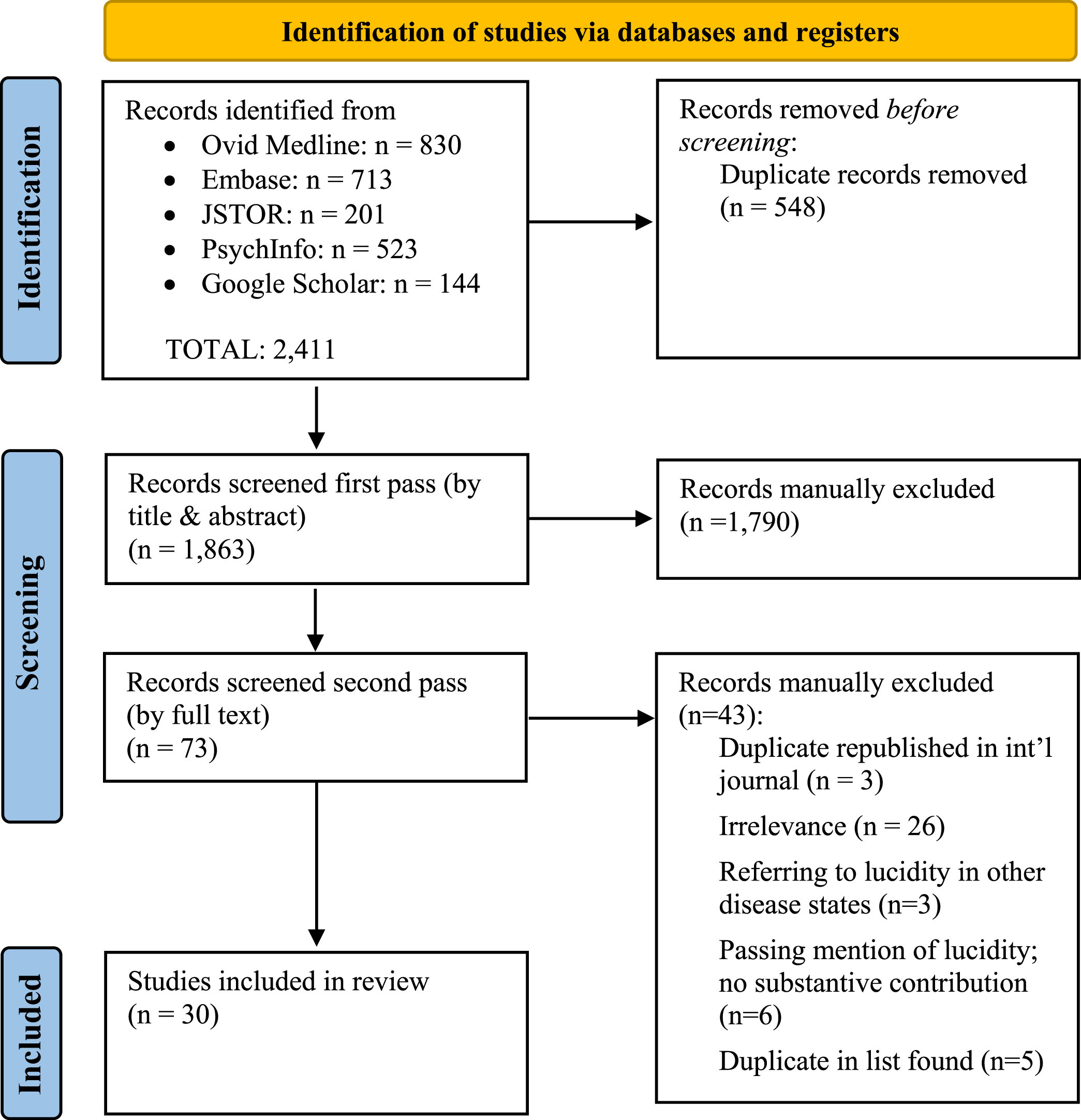
Review algorithm of search results from inception of each database.
Article eligibility was limited to all descriptions of the phenomenon of paradoxical lucidity in the form of data collection studies and secondary literature. Sources were excluded if they addressed properly perimortem phenomena, such as “terminal lucidity”. However, some articles were strategically included if they addressed terminal lucidity in a fashion that noted overlap with paradoxical lucidity. Additionally, if the full text of an article could not be retrieved, such as in symposia or expert workshop summaries, then the result was excluded. Ongoing studies were omitted.
Furthermore, if an eligible article was identified, it was extracted and entered into a record for synthesis in summary format. Information about the article recorded included authorship, date of publication, journal, country, design/article type and author conclusions.
Initial results were downloaded from each database and collated in EndNote 20, where the first author subsequently deduplicated them semi-manually. The results were then uploaded to the Rayyan software (rayyan.ai) where the first phase of screening was performed by title and abstract salience by the first author. In the second phase of screening, full text versions of each result were read to ensure eligibility by the first and second authors. A second, entirely manual deduplication was performed at this stage, to preclude results initially published in a domestic journal and later republished in an international journal. In several cases, journal issues were obtained through interlibrary loan. Finally, a snowballing review of each publication’s citations was performed to account for any otherwise uncovered and germane material. Screening and extraction were completed by the primary author of this paper.
RESULTS
A total of 2,411 records were obtained. 30 were found to be eligible (Table 1). An equal portion of primary and secondary research was identified and included in the final tabulation (Fig. 2). Case studies and insightful perspective papers predominated the results, mostly from the last five years. Most work has attempted to propose a valid methodological framework for studying lucidity in ADRD, with a common focus on defining episodes of lucidity, and consistent caregiver education and reporting techniques.
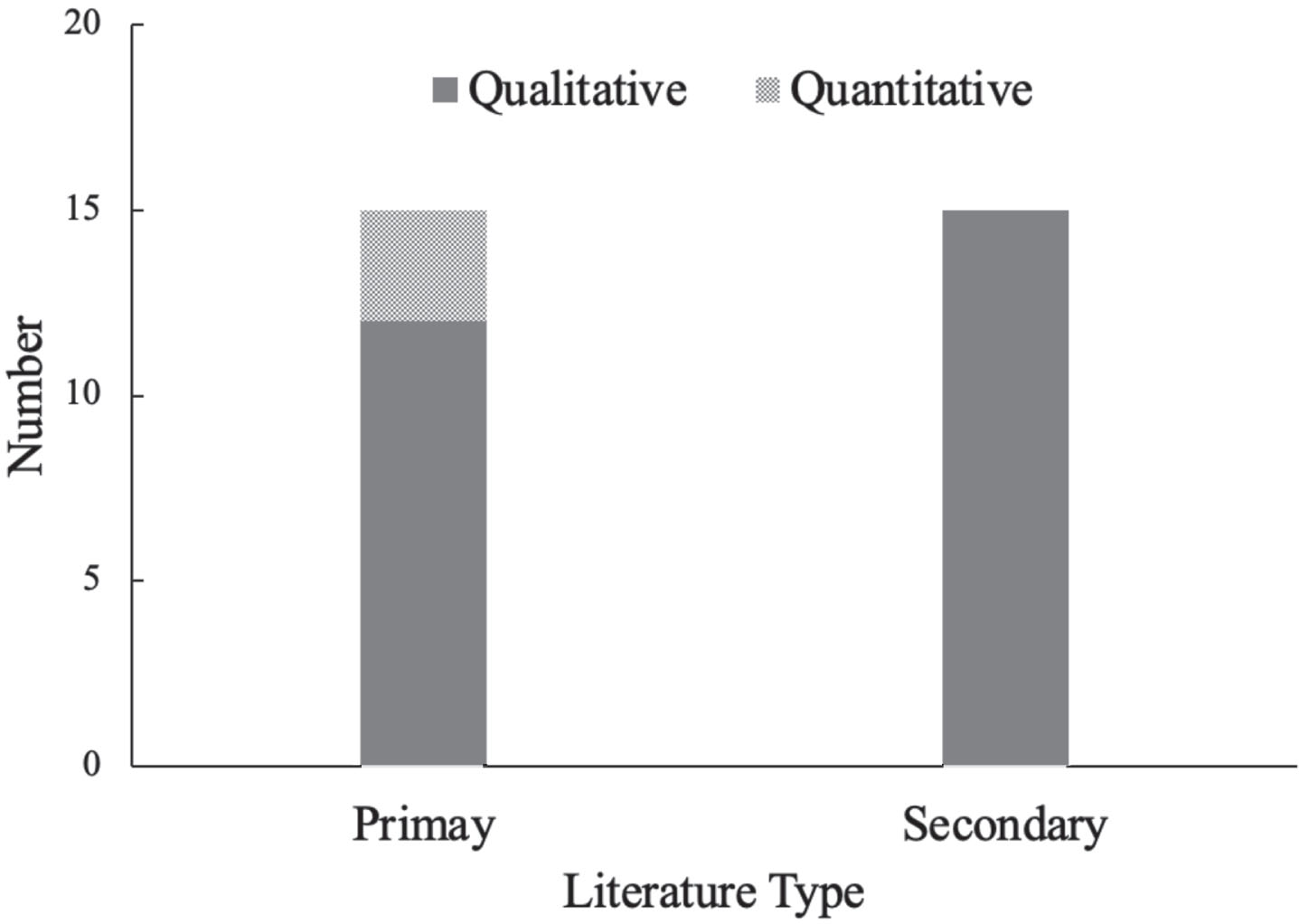
Primary research was predominantly qualitative content analyses of caregiver questionnaires, interviews, or other survey method. Some population-data was quantitatively assessed. Secondary literature focused on theoretical aspects of lucidity and methodology.
Database results and takeaways
DISCUSSION
While it is encouraging to see enthusiasm for the topic, none of the research performed thus far is medically actionable. The study of lucidity in ADRD is nascent and its research frameworks are undergoing multimodal validation [8]. Episodes of lucidity are real, unexplained, and difficult to interpret. Is grandma still fully there in some mysterious sense underlying the neurological decline, or are these episodes simply moments when certain neurological fragments are residually activated [7]? Sir John Eccles, the Nobel Laureate who originally discovered the neurotransmission ongoing at the synapse, and with whom Post studied, warned against the reductionism of “promissory materialism,” as have many great philosophers of mind in recent years including the pre-eminent Thomas Nagel in his 2012 classic Mind and Cosmos [40]. On the other hand, one can interpret these episodes within a metaphysics of pure materialism [7]. The scientific facts remain what they are, but they can be interpreted in different cultural contexts. These facts pose challenges and research opportunities for studies from fields ranging from neurobiology to philosophy of consciousness [41]. Vestigial interdisciplinary walls break down when studying the human mind. A transdisciplinary approach is merited.
The open question of some continuity of underlying identity despite communicative losses related to ADRD is ethically laden. This is because our respect for the deeply forgetful person is at stake. For example, if the person is in some surprising sense “still there” despite losses we are less likely to apply negative metaphors, such as “husk,” “shell,” “gone,” and “empty,” and we are more likely to make attentive efforts to notice the hints or signs of self-identity upon which “respect for persons” is based.
The precise nature of consciousness in deeply forgetful people is poorly understood, leaving open questions. Nonetheless, unfilled gaps in the scientific knowledge of this phenomenon cannot be justification for nonscientific or paranormal explanations. Such arguments by way of negation amount to the fallacy of denying the consequent and their conclusions are invalid (e.g., something of the form: if the brain is purely physical and consciousness is the purely physical product of its activity, then without the brain consciousness is impossible. But we see spontaneous return of consciousness in the setting of the most debilitating, severe, and terminal brain deficits. Ergo, consciousness may not be a purely physical phenomenon.). At the same time, it must be affirmed that the phenomenological whole value-picture of each human life is greater than the sum of its individual biological components.
Conversations about the theory of consciousness are academically enticing but bear little relevance in the day to day lives of deeply forgetful people and their caregivers. The greatest impact in the field of ADRD will come from treatment solutions derived from validated biological mechanisms. These conclusions are thoroughly delineated in the collective results of this review. In other words, in the works found, authors tend to agree that an accurate elucidation of the biological mechanism of these events will promote discovery of possible neurological loci for these experiences and eventual treatment for ADRD. At this point in time, lucidity in ADRD remains shrouded in mystery. Impact will also derive from a better understanding the emotional responses that primary, secondary, and professional caregivers have when they witness these episodes. Are these experiences inspiring of hope and meaning in caregivers, or do they lead to anxiety? Future and ongoing studies would benefit from examining the population prevalence of lucidity in ADRD as well its emotional impact on the caregiver. In a subsequent paper we will resolve the emotional responses to these episodes based on a national survey of caregivers.
Limitations
Limitations to this review method include one person making the first phase screening and data extraction decisions, as well as the exclusion of non-English language reports.
AUTHOR CONTRIBUTIONS
John P. Ross (Conceptualization; Data curation; Formal analysis; Investigation; Methodology; Project administration; Software; Writing – original draft; Writing – review & editing); Stephen G. Post (Conceptualization; Supervision; Writing – review & editing); Laurel Scheinfeld (Data curation; Formal analysis; Investigation; Methodology; Resources; Software; Writing – review & editing).
Footnotes
ACKNOWLEDGMENTS
The authors have no acknowledgments to report.
FUNDING
The authors have no funding to report.
CONFLICT OF INTEREST
The authors have no conflict of interest to report.
DATA AVAILABILITY
The data supporting the findings of this study are available within the article and/or its supplementary material.
