




Abstract
Peer Assisted Learning (PAL) is a teaching method that could improve students’ skills. Research investigating the feasibility of applying PAL in the Information Studies/Science (IS) field concerning the Information and Communication Technology (ICT) courses settings is scarce, and there is a demand to explore this realm. In this research, systems thinking examines the ICT courses as a system with inputs, outputs, and feedback. A holistic manner of enquiry demanded the exploitation of a case study. Seventy-four PAL attendees from four sections of female students completed a short survey at the end of their ICT-related courses. The survey aimed to gather data on the attendees’ opinions regarding the PAL as a peer-learning system. The research framework admitted the data through phases; It integrated a new take on the “old-fashioned” SWOT (Strength, Weakness, Opportunities and Threats) analysis. Then it developed a PAL integration framework to structure its practical implementation in the ICT courses. Finally, the study showed the potential of using SWOT analysis in managing educational methods and evaluating ICT skills by using PAL in the IS field.
Keywords
Introduction
Information and Communication Technology (ICT) has tremendously changed over the last few years. It is increasingly being integrated into teaching in several disciplines to increase knowledge, improve academic success [1–3], and expand the effectiveness of classroom implementation [4,5].
Consequently, the Information Studies (IS) profession is facing challenges in regularly updating the ICT skills of its faculty and students. The updating needs engagement in continuous professional development courses and workshop attendance. It also requires commitment and obligation from the faculty, suitably trained assistant staff (to deal with student inquiries), and ICT maintenance.
Moreover, extra funds to cover the cost may not be available. In this regard, the research adopted Peer Assisted Learning (PAL) to provide student-centred learning. PAL has proven beneficial and costless to all parties concerned [3]. PAL leaders benefit from it by including the experience on their Vitae and gaining extra marks [6]. This research adopts a verified version of PAL practice to suit the IS curriculum at the College of Basic Education (CBE), Public Authority for Applied Education and Training (PAAET). To the researchers’ knowledge, there has been no application in the area aiming for its adaptation as an ICT teaching strategy. PAL has not been applied in Kuwait as an educational practice to assist teaching and learning. This research attempts to employ it in the IS field to examine its strength and weakness and apply it in all disciplines in Kuwait and elsewhere.
The research aims to investigate PAL’s current practices and applications in teaching ICT skills to enhance attendees’ experiences in Kuwaiti education and learning. The following question will be addressed: What is the current practice of PAL concerning ICT learning (opportunities), if any? How has PAL helped in developing students’ learning (Strengths)? What weaknesses and threats can be traced and treated by applying PAL? These questions lead to the following research objectives: Identify PAL research, mainly IS-related, if any. Identify methods of using PAL that has helped in developing students’ learning. Identify the strengths, weaknesses, opportunities, and threats that can be traced through applying PAL from students and leaders.
A systems thinking approach is implemented, and the ICT course is examined as a system under focus, with inputs, outputs, and feedback. In addition, a holistic manner of enquiry demanded using case studies to envision employment of the best practices and better understand the complicated nature of implementing PAL within the ICT course at the tertiary level. As a result, a PAL integration framework is developed that maximises the benefit of employing PAL within an ICT course.
Review of related literature
PAL has been applied in several countries worldwide, aiming to improve student’s grades with the help of their peers. It has been proven to show positive results in learning [6]. Furthermore, it suggested that learning is practised at its best when it is exchanged with peers within the same community, age and/or subject area [7]. The argument is that tutors learn by tutoring is frequently used to encourage teaching, where they learn through instructing one another [3].
The concept of peer assisting/coaching (PA) was initiated in the 1970s by Joyce and Showers [8]. In 1973 the University of Missouri, Kansas, adopted PAL. It defined it as undergraduate students training in coaching and facilitation of skills as part of the PAL academic assistance program, which prepares them to lead study sessions for other students [4]. Previous literature has gathered a lot of the top educational research on PAL, which involves classmates aiding and supporting one another’s efforts [3,9].
A study discussed how implementing PAL into a computer science course affects student learning and satisfaction. The research aimed to collect and compare data from peer-assisted learning and a non-PAL teaching style in a controlled setting. Student performance was assessed after each lesson, and an opinion survey was collected. It found that besides other non-PAL practices, PAL could deliver a varied experience to students by combining lecture and teacher-led demonstrations with PAL activities leading students to investigate and learn with their peers [1].
In the 1990s, PAL was modified to suit English education [7]. It is proven to be multidisciplinary in higher education teaching and learning. It benefits the curriculum; attendees gain better grades, enhancing their retention as they adjust to university life [10]. Moreover, West, H., Jenkins, R. and Hill, J. [7] found that being a PAL Leader made students confident, social, and motivated and had positive benefits in terms of professional development [6]. Another research that used a case study methodology to measure the perceptions of both PAL members and attendees proved that both groups perceived benefits [11].
A study of two technology institutes in Ireland aimed to determine if peer-assisted learning enhances the learning experience of first-year students [12]. Quantitative and qualitative data illustrated the challenges associated with applying PAL program as part of the first-year student experience. The findings revealed benefits for the two institutes in collaborating on developing and evaluating the PAL program. The students thought it was a positive experience as they understood the lecturers’ expectations, met other students, learned how to revise, improved their confidence, and learned about the college system [12].
Recent research looked at the impact of a structured PAL implementation of a computer science curriculum on senior students who had trouble learning to code and how they would view their learning. The findings indicated that the students expressed higher learner confidence and a deeper comprehension of programming languages. In addition, PAL Leaders supported them and were admirable role models to help them better adapt to higher education [13].
Research at the Faculty of Business in Australia aimed to identify academic staff perceptions, experiences, and expectations in a bilingual PAL program in improving international students’ performance. It found that the program positively affected the student’s performance and that the academic staff indicated a high level of support for this student’s learning [14].
Another investigation focused on e-learning and Web 2.0 technologies in an early childhood unit at an Australian university. Qualitative (interviews and focus groups) and quantitative (online surveys) were used to discover the potential involved in learning through the PAL practice. It was found that PAL can interface with e-learning to create a different dynamic in the classroom, and the students felt that it increased their active participation [15]. In addition, PAL develops good communication, listening and negotiating skills. And can raise self-confidence and enthusiasm [4]. PAL was ideal for increasing Information Literacy (IL) throughout campus and across the curriculum [3].
PAL and ICT
In many countries worldwide, the necessity of incorporating ICT into the classroom has elevated to a top priority at most levels of instruction [9]. Students’ ICT skills and knowledge are frequently intact in the school, while teachers typically lack time and confidence in their ICT use [16]. However, it is highlighted that students learn the ICT skills they need better via their peers [17]. As a result, they gain new beneficial knowledge and express gratitude for peer learning [18].
Collaborated groups of undergraduate students explored PAL during their online physiotherapy clinical fieldwork program. They used ICT (blogs) and focussed their discussion on professional practice. The results indicated that the blogs enhanced learning, fostered trust, and assisted students in blending theory with practice. The experience showed how ICT could increase a professional’s capacity during peer learning. Blogging and ICT can be used as learning tools in any subject where training is a crucial component of professional growth [5].
In another study, Wang and Chen employed PAL to improve learners’ ICT skills [16]. Their findings showed that female students had higher comprehension scores and thought studying from peers was more of a compensation than male students. The gender difference significantly affected students’ performance, learning progress, and achievement. The study is an outreach pedagogy approach that encourages a community of learners among ICT instructors, generalist teachers, and preservice teachers [16].
Moreover, a study examined the impact of using ICT tools to assist students in fostering learning awareness and self-monitoring skills and to ascertain the participant’s perceptions of their learning. The results show that individual personality traits and ICT competence variations impacted the preference for ICT tools. Although peer learning encourages computer skills and advanced learning abilities, it also creates emotional characteristics like socialising, interacting and having psychological repercussions. The relevance of learning with peers regarding the informative level of ICT popularisation was also highlighted [17].
In a research study at the University of Iceland, teacher-students networked during an ICT course. One of its aims was to understand the importance of peer learning and sharing experience, information, and ideas on using ICT in education. The findings indicated that teacher students like learning alongside their peers. Early exposure to the strategy should help teacher students become more aware of the potential for future peer-to-peer learning and opportunities to offer their knowledge [18].
PAL and the IS field
The IS field is characterised by being multidisciplinary. It is a discipline whose domains are not limited to libraries but extended to every academic area, centre, organisation, and institution that collect, generate, acquire, process, organise, preserve, retrieve, share, and use information in various formats [19]. The field is constantly changing and encountering numerous challenges as technology advances. ICT was explicitly incorporated into its curriculum, which altered the information handling responsibilities of librarians and incorporated a wide range of related subjects with the inclusion of new trends, knowledge, methods, and technologies [19,20]. IS students must have multitasking abilities to operate at the job market institutions. However, IS courses do not cater to the demands of the labour market due to a lack of pertinent information and inadequate training [20,21]. As such, there is a need to incorporate PAL as a training method where teachers are burdened with teaching priorities. Also, to apply PAL in hiring qualified librarians and information scientists in all organisations that house information [19].
The field has used PAL to collaborate with tutors as library supporters. PAL, however, promotes students’ academic performance, social networks, leadership qualities, and institutional engagement of the tutors. PAL students participate in university and community events while maintaining academic distinction [6]. Since ICT proficiency is a requirement for LIS professionals’ education, using PAL can be very beneficial in their skills training and updating.
The literature review indicated that PAL had had positive benefits, as revealed by students, teaching faculty and PAL leaders. PAL affects student learning, satisfaction, performance, retention, understanding, confidence, participation, socialising, and motivation. In addition, it develops communication, listening, negotiating, interacting and professional skills.
The reviewed literature also discussed using PAL in different subjects (such as computer science, geography, Information literacy, business, e-learning, physiotherapy, languages, libraries, and ICT) from other parts of the world. Students acquire ICT skills and knowledge effectively from their peers. PAL strategy fosters ICT skills, computer skills, advanced learning abilities and increases professional capacity when used with peer learning. ICT can be used as a learning tool in any subject. Moreover, PAL can be applied in the IS multidisciplinary field in students’ training, preparing them for multitasking roles. However, there hasn’t been much research on how informal peer learning affects students’ ICT skills development [22]. Unfortunately, limited research has been published on PAL in the IS field concerning ICT skills [6,23–25]. Therefore, this research aims to fulfil this gap.
Research related terminology
Information Communication Technology (ICT): the use and management of Microsoft Office applications, automated systems use and search, Web 2.0 technologies, in-house databases, and web page design. Peer Assisted Learning (PAL): peer-to-peer learning practises of student support. It is an organised, cooperative, and voluntary skills session provided by a student in the same year or the above years [11]. The student is expected to act as a guide, not as a tutor [10]. This research does not use PAL as an alternative to formal teaching hours. PAL leaders are students at the senior level trained as mentors, act as “experts”, and are more knowledgeable in the field; they can encourage first-year students to become experts [11]. PAL attendees are students in their earlier years who voluntarily chose to attend a PAL practice. PAL sessions typically are informal subject discussions discussing students’ opinions and ideas that last up to an hour.
Methodology
Framework development
A framework was Constructed to explore the benefits of introducing PAL as an educational approach in ICT courses at tertiary institutions in Kuwait. The complex factors influencing the success or failure of adopting the framework are examined. Systems thinking concepts are adopted in complex settings to enforce structure [26,27]. In this study, the framework looks at embedding PAL within an ICT course as a system. Thus, it attempts to encapsulate the complexity of human interactions between interacting stakeholders in the five phases presented below, Fig. 1.
Phase 1, Kuwait’s Tertiary institution, PAAET, is used as the study environment. PAAET is one of the largest establishments in the Middle East in terms of students enrolled. It houses fifteen different colleges and institutes providing various academic programs and serves the country’s learning requirements through education and training. Three main stakeholders were identified: the course teacher, the PAL leader, and the attendees from the IS department, CBE at PAAET.
Phase 2 involves a review of innovative pedagogy in specific PAL worldwide education; this will primarily uncover factors that aid in embedding PAL smoothly within ICT courses; this is essential to explore whether PAL was a positive innovative paedology. It is necessary to measure the factors indicating if they influenced practice. Phase 3 requires extracting PAL experiences among influential dominant stakeholders (teacher, attendee, and PAL leader). It is then mapped to previous studies of PAL influencing factors in the literature. Phase 4 centres around the analysis and interpretation of evaluating PAL, where SWOT analysis is utilised as a potential tool. Phase 5 concludes with an intervention plan.
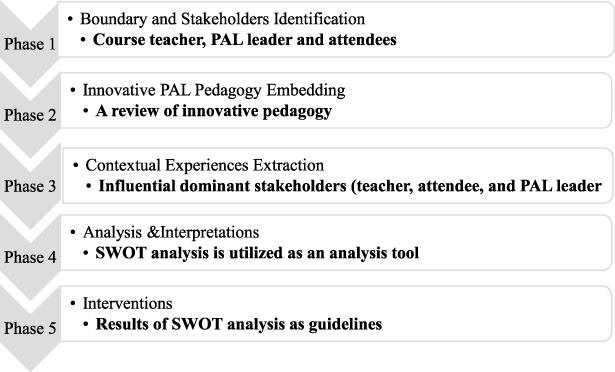
The 5 phases embedding of PAL within an ICT course.
This research is implemented among students attending ICT-related courses (E-publishing and Introduction to computer) at PAAET. That requires basic ICT skills (such as Microsoft Office). Twenty-five attendees of the second and third years are enrolled in each of the classes every semester. Four sections have applied PAL and were chosen as the research sample. Since PAAET applies student segregation, all the PAL attendees and leaders were female in their second or third year. PAL attendees were aware of the research and were told to complete a short survey at the end of the courses. The survey aimed to gather data on the attendees’ opinions regarding the PAL as a peer-learning system applied in the sessions.
The course teachers selected the PAL leaders as senior students who have successfully finished and demonstrated proficiency in the ICT courses; they have at least a distinction in the subject and have achieved the best overall academic grades and interpersonal skills.
The course teachers train PAL leaders through an introductory lecture during the PAL program training. They teach them how to plan and structure the PAL session. The contents of the sessions are further developed through PAL attendees’ feedback discussing weaknesses and concerns. Finally, the teachers train the leaders to share thoughts and helpful hints with PAL attendees in a cooperative learning environment to ensure they fulfil the necessary tasks. The leaders were informed to conduct one PAL session every week.
Course teachers were on call to answer questions or provide additional information to PAL leaders and attendees. They also checked after the class to ensure that all the attendees were getting help and asking for assistance. PAL attendees should be able to do their assignments/projects with the help of PAL leaders. The assignments are usually due a week after they are assigned. The teacher explains the assignment, and the PAL leader helps attendees to complete and submit it. The teacher then grades the assignments and discusses the results with the students before the next assignment is due.
The investigation
The researchers informed all parties concerned (lecturers, attendees, leaders, and department/college management) of their intentions in collecting the research data. In addition, a survey was administered to PAL attendees’, semi-structured interviews were conducted with PAL leaders, and views of lecturers and management were observed and noted to collect qualitative data on applying the PAL experience during ICT-related courses, Fig. 2.
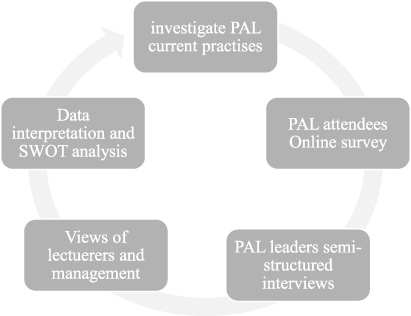
PAL integration framework.
The PAL attendees’ survey collected quantitative and qualitative responses. It was anonymously administered online during the final week of the course to PAL attendees who attended all the practices during the semester and explained their participation consent. The questionnaire had three main questions. The first one combined yes/no/to some degree. The second one had six Likert scale sub-questions (five indicating strong agreement and one suggesting disagreement). The third open-ended question asked the attendees their opinion of attending the PAL practice and its strengths and weaknesses. The survey primarily aimed to address the incentive for implementing PAL as well as the degree of its success.
Afterwards, the four PAL leaders were interviewed using semi-structured interviews. They were asked five main questions. The first one combined yes/no/to some degree. The second had five Likert scale sub-questions (five indicating strong agreement and one suggesting disagreement). The third, fourth and fifth questions were open-ended questions on the strength, weaknesses, and areas of improvement of the PAL practice. In addition, the researchers noted the views of lecturers and department/college management after taking their permission.
The quantitative and qualitative results of the PAL attendees’ survey and leaders’ semi-structured interviews were examined using thematic text analysis and then presented using SWOT analysis. SWOT is an analytic method of encapsulating the status of something, such as an experience. It aids in developing future procedures for devising strengths, eliminating weaknesses, seizing opportunities, and protecting against threats.
All four PAL session attendees were females in their second or third year. The total response rate was 92.5 per cent (74 from 80 attendees) attendees who answered the questionnaire. Their response may reflect that the attendees liked their PAL experience, although it was introduced to them for the first time. Seventy-two per cent (53 from 74) indicated that attending the PAL session was beneficial, 20 per cent (15 from 74) thought it was beneficial to some extent, and only 8 per cent (6 from 74) indicated that it was not.
The qualitative data was examined through SWOT analysis, which revealed PAL’s strengths, weaknesses, opportunities, and threats. PAL attendees’ views of the session six categories were all positive. They expressed their opinions as follows:
First, the “experience helped me to do my homework” (75 per cent, 55 from 74). The “experience helped me in understanding the course overall” (61 per cent, 45 out of 74). “PAL should be applied to all courses” (55 per cent, 40 out of 74); The PAL leaders were “knowledgeable with course material” (53 per cent, 39 out of 74). Finally, the attendees “easily asked for clarification” (50 per cent, 37 out of 74).
The attendees stated their opinion that teachers were better at instructing the lessons. However, they expressed their views on the same categories less. In addition, a small percentage of the attendees disagreed.
The attendees’ qualitative views from the open-ended questions on the PAL session revealed mostly positive views. They were grouped into seven recurring themes relevant to the research aim: collaboration and teamwork, skills progress, learning environment, course benefits, and leaders’ qualities, as discussed below.
Collaboration and teamwork
The attendees thought that the PAL experience “taught us (them) teamwork, helping, and learning from each other”, and it made them “collaborate and work in a group. We (they) learned how to use Microsoft OneNote together”. Another comment was that they “learned teamwork, listening to each other, and getting the needed information” and that “peer help somewhat makes learning easier because they (peers) are closer to our thinking and age”. In addition, the PAL leaders aided them in “doing the homework and explained all the information needed” and prepared them to be “responsible and coordinating while working in groups” similar findings were reported by Yildiz Durak [13] and Ala and Yang [2] and Wang and Chen [16].
The PAL leaders were helpful; the attendees commented that they helped them “solve and understand the difficult questions easily”. They ”simplified the assignment; they provided cooperation and ease of understanding”. They “helped the students and offered the best help to help us”, and “they were there to help us do our homework independently and deepen our understanding with the right information”. The attendees added that one of the leaders had the “ability to bear the misguided, providing information accurately with clarification and helping students when they do not understand the assignment’s requirements”. PAL is valuable for acquiring new experiences and understanding and fosters a spirit of cooperation among students. As attendees said, “It was very useful; thank God I received the help required”.
Skills progress
PAAET provides complete access to hardware, software, and computers at the ICT laboratories. Students can access the facilities from 7:00 am to 5 pm during daily working hours with the attendance of lecturers or PAL leaders. However, students have different ICT skill levels [21], depending on their previous knowledge and practices. For example, one of the attendees explained that she felt confident as she “learned to debate respectably”, developed her “ICT skills and learned to save different file formats”, and “how to access and search for different websites”. The attendees added that in the group assignment, they learned “how to use the technology-based programs in the course together, such as Sway and how to overcome difficulties” and “learned to use the computer and apply its programs”, for example, PowerPoint presentation. This finding supports using technology to create an adequate collaborative space [15].
Learning environment
The attendees stated encouraging responses reflecting that the PAL experience positively influenced them. This result is in line with what was found by Cui, Huang, Cortese, and Pepper [14] and Ginty and Harding [12] and Wang and Chen [16]. Among these was that the experience helped them “a lot in solving the assignments” working “with each other in a loving environment”. They “learned how to do the assignments encouragingly from peers, who guided me (them) well”. The attendees described PAL as a “very well-organised positive practice”. Moreover, PAL eased attendees “to come prepared to ask questions” this is in line with the finding of Bone and Edwards [15], and they were ready to interact with one another:
A good experience, especially for those afraid to ask questions; peers help break the barrier of shyness and the experience is very positive and has helped me greatly.
Course benefits
The PAL practice had several strengths and benefits that are unique to it, such as attending the PAL as the attendees explained they “learned how to do the assignment and use the different course programs independently”. It was a “new and beneficial experience”. They learned to use “different programs and how to answer the assignment questions”. It even helped them break the barriers of nervousness “because many students are ashamed to ask questions”. The attendees suggested that “all courses should apply this experience because it simplifies solving queries and saves time”. The attendees presented PAL benefits and emphasised that it developed their skills and saved time.
Leaders’ qualities
The attendees realised the PAL leaders’ qualities as they “simplified, explained and helped us through the assignment”. They were “honest, helping us and not working instead of us”. One was described as being “respectful with a lovely helping character”. Another would answer a “clarification of any incomprehensible point” and be “so patient in answering any query”. Comparable qualities were emphasised through PAL leader training, providing the tools and resources to lead effectively [13].
The leaders thought the experience was a “good incentive” for them; they learned “self-respect and loyalty”. Overall, it was a “positive experience. It gave me (them) the motivation to volunteer and gain more experience”, related to the results reported by Ala and Yang [2] and Topping and Ehly [3]. In addition, the four PAL leaders were asked about their opinion of the PAL experience sessions, and all agreed that they benefited from the PAL tutoring.
Table 1 represents the SWOT analysis of the PAL data, as discussed above, in addition to the positive comments (strength) about the PAL sessions, as the PAL leaders expressed, such as the following.
“I practised delivering information to students faster because of our similar backgrounds”. “Students interact with us without fear or confusion”. “I learned a sense of responsibility and self-confidence. It helped me to some extent develop my personality”. “Developed my information searching skills, and most importantly, I helped students”. “There are some questions students are embarrassed to ask the teaching staff. It develops my skill to explain better and prepare for the lesson. It also helped me to speak freely”. “I learned self-development, gained more knowledge and made new friends.”
The negative (weaknesses) comments about the PAL sessions are listed as follows:
“Students rely on us a lot and ask many questions”. “Sometimes preparation takes time before each lesson”. “PAL attendee’s disrespectful behaviour”.
The leaders added suggestions (opportunities) to enhance the PAL experience, some as follows:
“Applying the PAL experience to all courses and making us part of the department.” “Providing PAL leaders the priority to apply for a scholarship to encourage them to participate at PAL.” “Offering educational courses for PAL leaders”.
As the lecturers, leaders, attendees, and management pointed out, the threats are few compared to the strength and could be overcome to deliver better PAL sessions to all parties concerned.
SWOT analysis of the PAL session
SWOT analysis of the PAL session
PAL was found as an effective and valuable practice to encourage students’ ICT skills learning through the course; similar results were reached by Karademir, Erdoğdu, and Gökçearslan [17]. In addition, the students acknowledge the significance of ICT in assisting their lifelong learning [5,17]. The SWOT analysis of attendees’ comments and feedback has led teachers to develop the course eventually. In addition, it highlighted several concerns that influenced modifications and improved the PAL practice for attendees.
The PAL practice indicated that it has had a positive effect on the overall grades of students attending its sessions and that it improved their skills and knowledge, in agreement with the findings of West, Jenkins and Hill [7], Wang and Chen [16], and Karademir Erdoğdu, and Gökçearslan [17]. The PAL attendees’ comments were encouraging to continue applying its sessions, in line with [6,15]. The benefits of PAL are numerous such as skills development, group cooperation, and improved understanding of course assignments resulting in better grades and overall course performance, inconsistent with Smith; May, and Burke [11]. Furthermore, the PAL leaders gained confidence and responsibility and were encouraged to join leading PAL sessions in future. These findings coincide with Bone and Edwards [15]; Ginty and Harding [12]; Topping and Ehly [3]. In addition, PAL leaders enhanced their CVs and their grades. This finding is per the finding reported by Verbeem and Harper [6].
The lecturers and department/college management supported using PAL as a student learning practice, in proportion with Lang [9]. The use of PAL in this research has brought new modes of ICT teaching and group work, as has been previously reported by Tennyson, Casteele and Morena [1]; Verbeem and Harper, [6]; and Ala and Yang [2]. Teaching becomes a challenge when different approaches are applied to meet the aim of delivering the lesson, but PAL leaders are not to be replaced by lecturers, in line with Smith, May, and Burke [11].
Attendees and lecturers made some recommendations to improve the PAL experience. However, the SWOT identified weaknesses such as non/less attendance of students, unawareness of PAL sessions, and less interaction and communication with teachers. Therefore, as suggested by Smith, May, and Burke [11], it is recommended that PAL be incorporated into the department’s timetable to achieve maximum attendance, accessibility, and skills development. It has also identified threats such as repetitive course material, answers to assignments that may be given to attendees with less effort, and attendees’ less commitment and may not show up at all. PAL leaders may replace training faculty and be cost-effective in future. In this regard, Topping and Ehly [3] discussed that a peer will always be considerably different from a professional teacher who is paid and ultimately in charge.
Conclusion
A framework was developed from systems thinking perspective that explores how an innovative pedagogy such as PAL could be embedded within ICT courses. The study focused on considering the ICT course system as a system with inputs, outputs, and feedback; thus, a better understanding of its interrelated components is required. Realising the complexity of the systems enables the evaluator to consider the different perspectives of the stakeholders. This research sets boundaries for the system under investigation and explores their interactions.
The research has specifically examined the SWOT of the PAL practice as a valuable addition to improving the attendees’ performance and skills in ICT-related courses. It has put together the thoughts, views and experiences of PAL attendees, leaders, and teachers. The PAL practice has allowed researchers from two different colleges and two specialisations to cooperate on the publication of research in PAL as a new practice in the area.
The PAL provided insight into a new learning experience of working in a collaborative environment to develop students’ skills while teaching an ICT course, encouraging a program of teacher and student collaboration through peer learning [16].
The application of PAL demands the partnership of all parties concerned, the lecturers, attendees, leaders, and department/college management. Thus, building a community where providers, teachers, administrators, and students can all learn from one another and develop [3,8]. In addition, PAL can be applied in multidisciplinary fields such as the IS to train students for multitasking roles.
Study limitation
The research is a preliminary case study; its dependent measures were limited to self-reported attitudes and opinions. Although the research used surveys resulting in subjective perspectives, it did not measure ICT knowledge gained or improvement in student performance. In future studies, it is recommended to measure such objective measures against a comparison control group. Moreover, applying statistical analyses to evaluate further the program’s usefulness in a longitudinal study of students’ knowledge and performance before and after PAL application across disciplines to anticipate improvements made and to gain a broader result.