



Abstract
Objectives
First, to examine Health Sciences students’ discipline, educational level, number of online courses taken, and emotions regarding distance learning; second, to explore a model in which information and communication technologies' (ICT) beliefs serve as mediators among ICT's emotions and ICT usage.
Methods
This is a cross-sectional study. Participants consisted of 210 students from the School of Health Sciences at the University. Perceptions toward ICTs in Teaching-Learning Process Scale and Computer Emotion Scale were used.
Results
Nursing students report significantly more ICT-related negative emotions than Management of Health Systems students. Students who took a low or medium number of online courses report significantly more ICT-related positive emotions than students who took a high number of online courses. In addition, ICT-related beliefs did not mediate the effects of ICT-related positive emotions and ICT usage but did mediate ICT-related negative emotions and ICT usage.
Conclusions
The digital tools in online courses should be appropriately combined with the learning method, and course content. It requires not only a solid technical foundation but also an educational mentality, as well as an adjustment period.
Keywords
Introduction
The COVID-19 pandemic has influenced educational systems worldwide, causing the physical closure of academic institutions for students and staff. Until August 2020, about 1.6 billion students were influenced by school and higher education closures in response to the pandemic. 1 The transition from traditional education to online distance education influenced different aspects of educational practices.2–4 Research conducted with students encountered barriers to distance learning during the COVID-19 outbreak. Personal barriers, such as lack of training and support, lack of technical expertise, inadequate communication, and lack of qualification. Technical barriers 5 such as insufficient investment, logistical, and financial barriers. 6
The COVID-19 pandemic seems to have a particular effect on methodological strategies and their practical implications for university classrooms. The shift from classroom to online learning environments raises different challenges, such as making the online learning processes flexible while fostering autonomous work and strengthening students’ commitment to their learning process. 7 The very fast transfer of the educational system from face-to-face to online learning causes ICT to become the one methodological solution so that the online learning process is not interrupted, thus avoiding the collapse of educational systems worldwide. 7 A study investigating the rapid movement during the COVID-19 outbreak of practical learning in the authentic hospital setting to virtual setting among nursing students demonstrated that learning via Zoom can't mimic it, and the students feel that they learn a lot better learning with their hands on stuff in the actual situation. 8 One of the important issues to examine is students' negative and positive emotions during the transfer from face-to-face to distance learning occurring due to the pandemic.
Emotions experienced during the learning process are broadly known as vital factors in determining student accomplishment.9,10 This study focuses on analyzing emotions, specifically the emotions the students feel when learning with technologies from a distance. Classifications and taxonomies of emotions can be found in the literature.11–17 Attempts have been made to establish classifications of basic emotions; however, there is still no one generally accepted categorization 12 . It is important to remember that emotional reaction improves rather than suppresses learning results.9,10 Positive emotions, such as emotions of success and happiness, have the potential to help to learn by enhancing self-efficacy and motivation. 18 Negative emotions, however, such as failure, anger, or anxiety, may have the opposite influence on motivation and effort, i.e., they have a negative impact on student learning.18,19 Dissatisfaction can arouse negative emotions as matter research conducted with medical and nursing students during COVID- 19 demonstrated, major dissatisfaction regarding the practical and clinical learning. 20 Research suggested that emotional experiences play a major role in shaping academic achievement and can significantly affect students’ cognitive ability, behavior, and, eventually, success in the academic world. 21 Therefore, it is important to examine different background characteristics that have the potential to affect students’ emotions regarding their learning.
Research that examined differences among academic programs regarding the experience of emotions when using ICT found statistically significant differences in positive feelings, such as curiosity and inquiry. Students in teacher education programs indicated that they felt more curiosity and inquiry than students in other academic programs. 12 In addition, when comparing students at the beginning or end of their academic track, senior students experienced more positive feelings, such as freedom, curiosity, and inquiry, related to ICT usage, than newer students. Newer students described more negative feelings, such as disorientation and a waste of time when using ICT than senior students. 12 In addition, it is worth considering the emerging trend related to the exponential increase in the number of online courses in higher education, as students’ presence in these courses is of great concern. 22 A recent study has found that the more students enrolled in online courses, the lower their level of anxiety about learning in them was. 23 Accordingly, in this study, we chose to examine students of the Health Sciences (Nursing and Health Systems Management), their educational level, the number of online courses they have taken, and their negative and positive emotions toward distance learning. However, positive and negative emotions can also be connected to ICT beliefs and usage.
Since emotions can also be connected to ICT beliefs and usage, understanding how to manage beliefs, doubts, feelings, and knowledge regarding ICT usage in the online learning process would seem to be vital. 24 Research has found that users might feel under pressure to use ICT to prevent being viewed as antagonistic, even though this negatively contradicts their emotions, beliefs, and knowledge about its full potential. 25 Another study has found that there is a clear relationship between emotions and ICT usage. 12 To the best of our knowledge, there is no research to date that examined the mediating role of ICT beliefs between ICT-related positive emotions, negative emotions, and ICT usage. Moreover, another study recommends the investigation of ICT-related constructs, such as beliefs, and frequency of use. 26 Clearly, more research is needed regarding attitudes and emotions related to the use of technologies as a learning resource. 12 Thus, in the present study, we chose to explore a novel model where ICT beliefs serve as mediators between ICT-related positive emotions, negative emotions, and ICT usage.
Research aims and questions
This study has two aims: first, to examine Health Sciences students’ health discipline, educational level, and the number of online courses taken, in relation to their negative and positive emotions regarding distance learning; and second, to explore a model where ICT beliefs serve as mediators between ICT-related positive emotions, negative emotions, and ICT usage regarding distance learning.
Accordingly, the following research questions are addressed:
If and What are the differences between Health Sciences students’ health discipline, educational level, and the number of online courses taken, in relation to their negative and positive emotions regarding distance learning? Does ICT beliefs can serve as mediators between ICT-related positive emotions, negative emotions, and ICT usage regarding distance learning?
Method
Study design
We conducted a cross-sectional design study with a convenience sample. The data were collected from October 2020 to June 2021.
Participants and procedure
The participants in the present study consisted of 210 students from the Nursing and Health Systems Management departments within the School of Health Sciences. The students participated in the study voluntarily, filling in the online survey. An introductory e-mail specified the study's goals and importance, inspiring the participants to complete the survey, a hyperlink to which was provided in the email. In the instructions given to fill out the questionnaire, the participants were instructed to fill out the questionnaire only one time. Participants were asked to answer the questionnaire only once. Another seven participants were excluded because the high number of missing values exceeded the edge of 30% in scale items.
Statistical analysis
Statistical analysis was performed using three software types. First, with the Statistical Package for the Social Sciences (SPSS TM), 25.0 version (IBM, Chicago, Illinois, USA). Statistical analyzes were performed as Cronbach's α, descriptive statistics, T-test, one-way ANOVA, and correlations analysis. Second, R software (version 3.5) was developed by R Core Team, 27 using Lavaan package. 28 We applied confirmatory factor analyses (CFA) to test the adequacy of each scale and then applied a structural equation model (SEM) to test the proposed model for the two-step approach, assessing the measurement and the structural model. Finally, we examined the mediated associations between variables. As goodness-of-fit indices in the two steps of SEM, we used the following: chi-square (χ2); Comparative Fit Index (CFI); Tucker–Lewis Index (TLI), Normed Fit Index (NNFI); Approximation Error of Approximation (RMSEA); and Standardized Root Mean Square Residual (SRMR).
Instruments
The questionnaire was composed of three sections:
First section: We used the perceptions toward ICT in the teaching-learning process scale, composed of three sections – ICT attitudes, beliefs, and usage. In this study, we used the two latter categories. The ICT belief scale contains five items, and Cronbach's α was 0.94. Example of item: “I believe that ICTs enhances students' learning in the online learning process.” The ICT usage scale contains 10 items, and Cronbach's α was 0.92. Example of item: “The use of ICTs in the online learning process makes saves time.” All items were scored on a five-point Likert scale, ranging from 5 (strongly agree) to 1 (strongly disagree). The higher total and subscale scores represent greater positive perceptions toward ICT usage. 29
Second section: We used the computer emotion scale for assessing negative and positive emotions. The scale contains 12 items, divided into two sub-scales – positive and negative emotions. Regarding positive emotions, Cronbach's α was 0.72. Example of item: “In general, when I am learning how to use a new ICT in my learning process, I feel, excited.” Regarding negative emotions, Cronbach's α was 0.91. Example of item: “In general, when I am learning how to use a new ICT in my learning process, I feel nervous.” All items scored on a four-point Likert scale ranging from 4 (All of the time) up to 0 (None of the time). The higher total and subscale scores represent greater negative or positive emotion. 15 For survey items, see Table 1.
Survey items.

Additionally, the study conducted confirmatory factor analysis (CFA). The measurement model was examined to check the validity of the constructs (see Figure 1). As Figure 1 shows, all items presented higher factor loadings than .51. Model fit was tested and it was found that despite the fact that the chi-square test was significant (χ2 = 693.12(312); p < 0.00), thus indicated a poor fit of the model to the data, the other model fit indices indicated a good fit: comparative fit index (CFI) = 0.912, Tucker–Lewis index (TLI) = 0.902, Non-Normed Fit Index (NNFI) = 0.901, root mean squared error of approximation (RMSEA) = 0.07, and standardized root mean squared residual (SRMR) = 0.06. Overall, the model was judged to have adequate fit the data, especially when considering that the chi-square test for sample sizes over 200 observations tends to be significant.
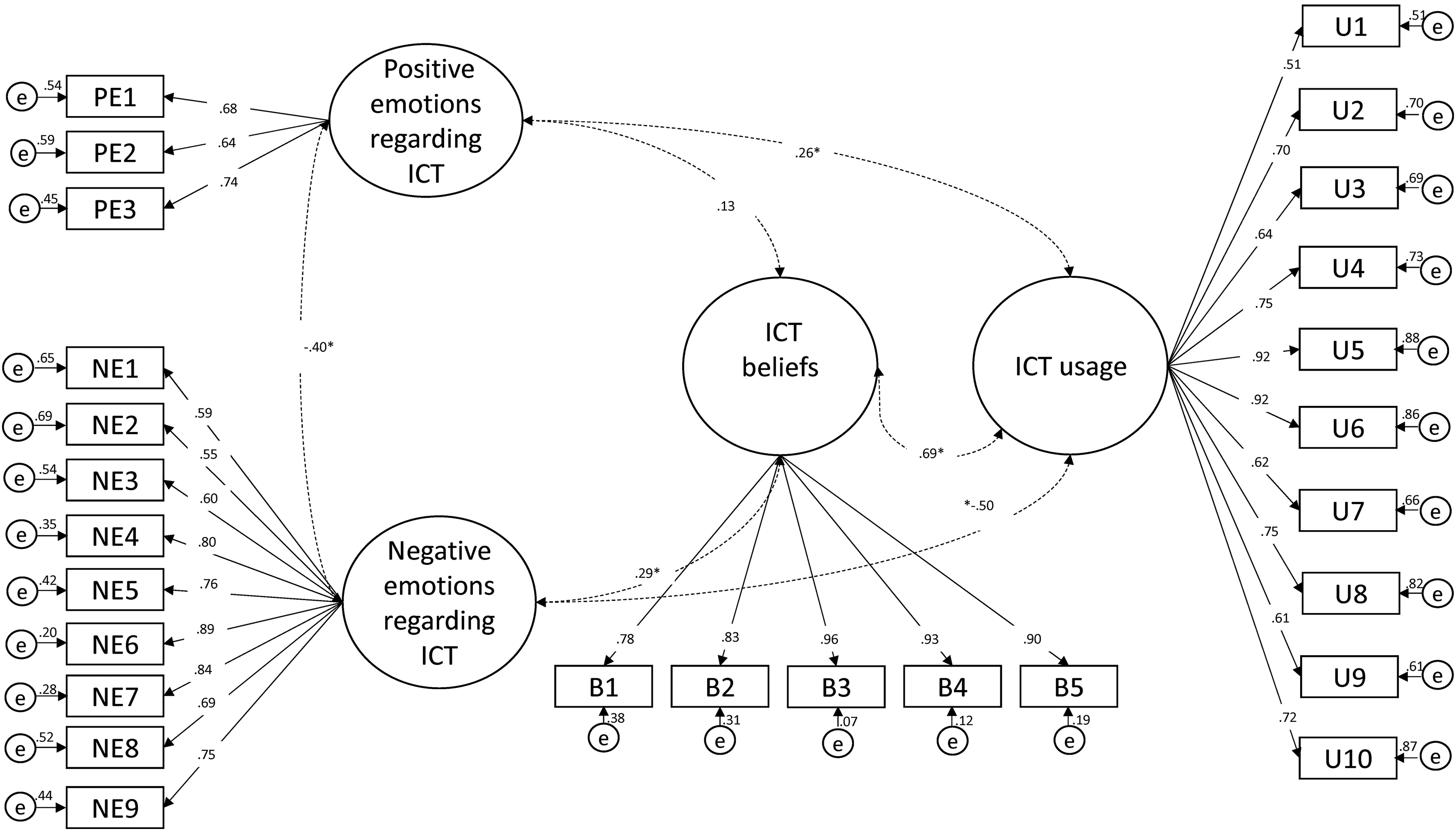
Measurement model.
Third section: Background characteristics, such as age, gender, education, studying the health disciplines, and the number of online courses taken.
Ethical considerations
The University Institutional Review Board (IRB) approved this study. Participants were provided with updated information regarding the aims of the study and participated in it of their own free will. Those who were interested in participating signed an informed consent form prior to filling in the questionnaire. The participants were assured that they had the right to leave the study at any point in time, that their responses would be kept private, and that the questionnaires would be analyzed anonymously.
Results
The participants consisted of 210 students (Nursing students, n = 150; and Health Systems Management students, n = 60). The mean age of students from both groups was 24.77 (SD = 6.18). The mean number of online courses taken by students from both groups was 8.30 (SD = 3.21). Most of the students were females 185 (88%), most of them described themselves as religious 113 (54%), and most had a post-high school education 92% (43%).
For the distribution of background characteristics of the two groups of students, see Table 2. As Table 2 shows, in each group the minority were male, and the majority were females. In addition, most participants belonged to the religious population. Furthermore, in both groups, most participants were in their first year of the academic program.
Frequency and percentage of distribution within the groups.

The duration of the Health Systems Management program is three years.
SD: standard deviation.
In order to address the second research aim, we examined Health Sciences students’ educational level, the number of online courses taken, and negative and positive emotions regarding ICT usage/We conducted an independent T-test and a one-way ANOVA analysis, as described in Table 3.
Comparative analysis of disciplines, educational level, and online courses taken, with the negative and positive emotions regarding ICT usage.

Independent t-test.
ANOVA.
SD: standard deviation.
As Table 3 shows, Nursing students report significantly more ICT-related negative emotions than Health Systems Management students. Regarding the educational level, students with a bachelor's degree report significantly less ICT-related negative emotions than students with a high school or post-high school education. Regarding online courses taken, students who took a high number of online courses report significantly more ICT-related negative emotions than students who took a low number of online courses. Moreover, students who took a low and medium number of online courses report significantly more ICT-related positive emotions than students who took a high number of online courses. Furthermore, students who took a medium number of online courses report significantly more ICT-related positive emotions than those who took a low number of online courses.
We conducted a Pearson's correlation coefficient in an effort to examine the potential relations among the study variables (Table 4). Table 3 shows the relationships among all the variables – negative emotions, positive emotions, and ICT beliefs and usage.
Pearson correlations between variables.

Notes: *p < 0.05; **p < 0.00.
To examine the third research aim, exploring a model where ICT beliefs serve as a mediator between positive and negative emotions and ICT usage, we conducted a structural equation model analysis (see Figure 2).
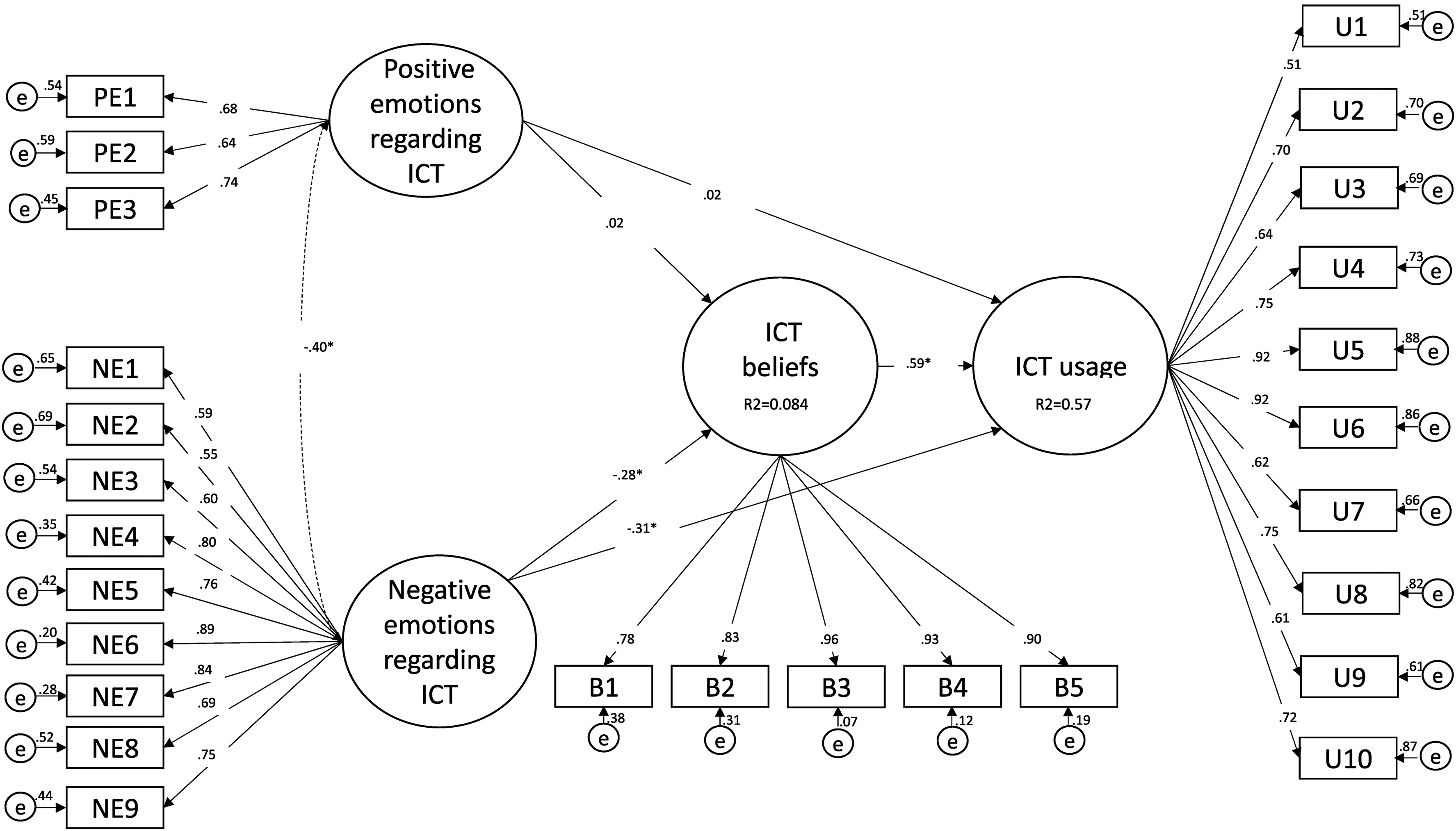
Structural model.
Furthermore, structural equation model (SEM) was performed. The χ2 for the model was 693.16 with 312 degrees of freedom (p < 0.001). The RMSEA value was 0.077; the CFI was 0.912, the TLI was 0.902, the NNFI was 0.901, and the SRMR was 0.06. Figure 2 shows that ICT-related positive emotions were not significantly related to ICT usage and beliefs, respectively. However, ICT-related beliefs were significantly related to ICT usage. Moreover, ICT-related negative emotions were significantly related to ICT usage and ICT beliefs, respectively, and ICT beliefs were significantly related to ICT usage.
To further explore the research model, we performed mediation analyses for the exposure of the direct and indirect effects of ICT beliefs as a mediator between positive and negative emotions and ICT usage (see Table 5).
Mediation analyses.

SE: standard error; CI: confidence interval.
Table 5 shows that mediation analysis has indicated that ICT beliefs did not mediate the effects of ICT-related positive emotions and ICT usage. However, ICT beliefs significantly mediated the effects of ICT-related negative emotions and ICT usage.
Discussion
The study strives to examine two main issues among students during the COVID-19 pandemic: first, differences among students’ Health disciplines, educational level and number of online courses taken, as related to their negative and positive emotions regarding using ICT in distance learning; and second, to explore a model where ICT beliefs serve as mediators between ICT-related positive emotions, negative emotions, and ICT usage in distance learning.
First, it was found that Nursing students report significantly more ICT-related negative emotions than Health Systems Management students. One possible explanation for this is that nursing is considered a more practical profession than Health Systems Management. The nursing students may be concerned that learning from a distance with ICT jeopardize their learning process, particularly the understanding essential for acquiring technical–practical nursing skills. Research has found that nursing on-the-job domains are as important as the socio-emotional domain, the organizational domain, the developmental domain, and a pro-active attitude toward work in the technical–practical domain. 30 In addition, it was found that students with a bachelor's degree report significantly less ICT-related negative emotions than students with a high school and post-high school education. Consistently with our study, research has found that graduate students had higher positive scores than undergraduate students regarding the use of ICT.12,31
Moreover, it was found that students who took a low or medium number of online courses reported significantly more ICT-related positive emotions than students who took a high number of online courses. Furthermore, those who took a medium number of online courses reported significantly more ICT-related positive emotions than those who took a low number of online courses. It appears that a medium number of online courses taken is a gold standard. Students’ positive emotions decreased when they took the number of online courses considered a high or low level. This is dissimilar to another study which found that the higher the number of online courses previously taken, the lower students’ negative emotions, such as stress. 23
Secondly, regarding the model examined, it was found that ICT beliefs did not mediate the effects of ICT-related positive emotions and ICT usage. However, ICT beliefs significantly mediated the effects of ICT-related negative emotions and ICT usage. This is the first time that a model depicting ICT beliefs as mediators between ICT-related positive emotions, negative emotions, and ICT usage has been tested. Other studies have examined specific parts of the model. For example, one study has examined how participants' value beliefs affect the relationship between perceived support on first-order barriers and their classroom technology. 26 Another study examined ICT-related negative emotions, such as stress, and their relations to ICT usage. 32 Yet, another study has found that there is a clear relationship between emotions and ICT usage. 12 The line that guided us in examining the model where ICT beliefs serve as mediators between ICT-related positive emotions, negative emotions, and ICT usage is based on research recommendations to focus on the attitudes and emotions related to the use of technologies as a learning resource. 12
Additionally, it can be concluded that negative emotions have a major impact on ICT usage among students from school of Health Sciences. ICT beliefs mediated the effects of ICT-related negative emotions and ICT usage. It can be several explanations to this. A qualitative study conducted with nursing students during COVID-19 demonstrated that during the transition from face-to-face to remote learning they experienced stress and strain. It is claimed that nursing learning skills in online it's dissimilar for truly doing it and it is complicated and stressful not able to practice it fully. 33 Furthermore study conducted with nursing students during COVID-19 demonstrated that it is needed to composed adapted online learning programs for improve practical learning capabilities. 5 Nursing students claimed that though virtual learning often supportive, they leave them feeling confused or unsure of the skills. 34
Conclusion
There are three practical implications; first, it was found that Nursing students report significantly more ICT-related negative emotions than Health Systems Management students. As this difference can stem from the nature of the applied aspect of the nursing profession, it is advisable to design online courses that can integrate and involve more learner senses, such as vision and hearing, with the help of videos and virtual reality technology, in an effort to simulate a typical clinical field in nursing work. Second, according to the results, it seems that taking a medium number of online courses yielded more ICT-related positive emotions. Although it is important to diversify into online learning with digital tools, it is important not to overdo this, as it can tire and threaten the students. The combination of tools should be planned carefully, based on the learning method and the desired manner of content representation in the course. Third, the use of ICT increased lately, becoming part of our lives at an unprecedented pace. This can cause the development of ICT beliefs, which may, in turn, mediate the effects of ICT-related negative emotions and ICT usage. Therefore, the situation requires not only a solid technical foundation but also a new working and education mentality and an adjustment period.
One theoretical implication is that this study introduces a new mediator, ICT beliefs contribute to the relation between negative emotions and ICT usage. By this, it purposes to accomplish the ‘missing mediator’ gap that ICT usage research has neglected to date. Therefore, this research call for examination of other models with mediators affects based on well-conceptualized theories.
Limitations and future research
There are several limitations to this study. First, our results rely on a self-reporting questionnaire, which is not an unbiased tool. Therefore, we recommend conducting studies with objective tools, such as observations. Second, the cross-sectional design with a convenience sample collection methodology restricts the generalization of the findings and sample representative status. Therefore, it is required to conduct research with a larger sample and in several geographic places. The third limitation is the use of one instrument (questionnaire) in this present study. Therefore, future studies should use different tools, for different perspectives, such as interviews, which can be useful for discovering more unique and deeper insights.
Footnotes
Acknowledgement
This research is the result of research conducted in the university.
Contributions
XX conducted all research stages.
Conflict of interests
The author(s) declared no potential conflicts of interest with respect to the research, authorship, and/or publication of this article.
Informed consent statement
Informed consent was obtained from all research participants involved in the study.
Institutional review board statement
This study was conducted according to university ethical guidelines and approved by the Institutional Review Board (IRB) of Ariel University.
Funding
The author(s) received no financial support for the research, authorship, and/or publication of this article.
Guarantor
GG
