




Abstract
Along with the development of social networking sites, sharing location is becoming mainstream, offering many opportunities and promoting sustainable business performance of firm. Based on a survey of 433 Facebook users and the application of quantitative method, the paper found that the privacy concern substantially influences the perceived risk of location sharing. In addition, tendency is witnessed on trust in the social networking site providers and members. Also, impression management and incentive provision are strongly involved in the perceived benefits of location information disclosure intention. Both perceived risks and perceived benefits illustrate distinctive effects on sharing users’ location. The impact of subjective norms on sharing information related to a users’ location and observing the potential influence of culture, played as moderator. The finding also confirms subjective norms positively impact location information disclosure intention, while the moderating of culture does not play a contribution role.
Introduction
With the popularity of social networking sites (SNS), the Global Positioning System (GPS) advancement, and new location-based services such as location-based advertisements, navigation systems, and transportations, all are becoming familiar to users. In recent years, location-based services (LBS) have created enormous opportunities for the advertisement and marketing sectors, as the proliferation of handheld devices and broadband internet connectivity has increased. Moreover, the location-sharing is a typical feature that marketers are increasingly taking advantage of, and they can better target consumers with customized services. Restaurants, for example, could generate more sales than they did with conventional advertising by delivering commercials and discounts to local prospective clients. Since location-based services rely primarily on consumers’ voluntary disclosure of location-related data, research can be supported to know whether users will reveal their locations is required. Users can use apps to get directions, track their location using real-time data, find recommendations for nearby places and other related information [1]. Users may also use SNS to share locations where they are. Notably, Facebook is a social media behemoth that has the potential to be a lucrative LBS market.
According to statistics, the number of Facebook users is soaring significantly in recent years, with 2740 million people using Facebook by the end of March 2020. It increased 53.24% compared to 2016 [2] and increased in 2.2% of advertising reach under Facebook’s strategy. The number of Facebook users in genders and age groups also witnessed a significant jump [2], implying the increasing popularity of this platform and the vast opportunities for businesses to run the marketing campaign. With the high coverage of this platform, sharing location-related information is considered. To clarify the intention of Facebook users to share places their locations, this study is concerned. Doing that the survey is conducted in Ho Chi Minh City, Vietnam, where Facebook users stood at the seventh leading city by active users [2]. Because of the effectiveness of advertising reach, 68 million advertisements have resulted in Facebook [2], in which Ho Chi Minh City is the leading contribution, the study is necessary to investigate users’ behavior toward the location information disclosure intention once using Facebook. This study is an extension of study of Chen et al. [3].
Previous studies have shown that the SNS users disclose their information due to communications with others, rewards, and perceptions [3–6]. These studies rely on the Privacy Calculus Theory (PCT) or Theory of Planned Behavior (TPB) to indicate the elements influencing users’ intention. Then, they had shown the significant role of privacy calculus in location sharing as well as the factors influencing the perceived benefits [3,7,8] and risks [3,6–10].
In terms of the privacy calculus model, although several studies showed the significant simultaneous effect of perceived benefits and risks in the customer’s intention to disclose their location information, the research of [11] proved that perceived risks might not affect the intention. The reason is that users are willing to provide their information as the inevitable requirement to join the SNS, even they perceive risks. Therefore, it is essential to explain in detail whether the consumers still pay attention to risks when using social networking sites or not, this as a gap of prior studies which is addressed in the current study. Similarly, trust is also a critical factor that diminishes the users’ fear when disclosing their information on social networking sites, but its influences on user’s intentions are not consistent in prior research. The studies of [7,12,13] witnessed different results in the relationships between trust in SNS members, trust in SNS provider, and perceived risks. Furthermore, the same phenomenon was seen in subjective norms [11,14].
The diverse demographics of participants can cause the different outcomes of previous studies. Therefore, the research of [15,16] indicated that gender might affect the behavior of SNS users, which implied men are more risk-taking than women. However, the studies of [17–21] demonstrated that the impact of subjective norms, privacy concerns, and behavior in SNS are not controlled by a difference in gender, while [20] argued that women and men both want to be connected to others on SNS, due to their consideration on social presence [20]. There are, however, differences between age groups compared to gender in behaviors in SNS [22,23] that may control the relationships between the aforementioned variables and users’ intention to disclose location information. Grounded in this evidence, the current study also wants to find a extra argument on differences in age groups toward SNS.
Furthermore, the cultural difference is also a crucial element that has been proved to moderate the behavioral intention. Accordingly, the study of [24] conducted a literature review with the moderation of culture in the conceptual model of promoting location-sharing. However, due to the small number of participants, it did not clearly show the extent of cultural influence on the overall location-sharing model and practical application. As a result, this study employs the factor of culture as mediator to support investigate how the location disclosure intention of Facebook users can be affected. To get an overview of SNS users’ location sharing intentions and test the moderation effect of culture, this paper will inherit and develop the literature from previous studies, its aim is to clarify the factors and identify how these factors impact on the intention of Facebook users to disclose location information.
Firstly, this study accumulated the foundation theories including the PCT, the TPB, and Trust Theory to explain and examine whether or not perceived benefits, risks, privacy concern, and subjective norms affect the intention of SNS users through sharing location. Based on the previous studies [3,6,7,11–14,25], subjective norms, perceived benefits, and risks, and privacy concern are concerned as antecedents of location information disclosure intention. Perceived risks are predicted by trust in SNS members, trust in SNS provider, and privacy concern. Secondly, the qualitative method was used for mining the affecting factors in reality from in-depth interviews and focus groups [26] to confirm the reliability of the conceptual model. The quantitative method is taken to measure impacts of factors on the intention of SNS users to disclose location information. To test hypotheses with the appeared moderation, SmartPLS 3.3.3 [27] and SPSS version 25 with the ANOVA method [28] were used.
The remainder of the paper is organized as follows: the next section presents arguments of the theoretical foundations. In Section 3, the research model and hypotheses are created. Following that, the section on methodology and analysis are taken. Finally, the conclusions and the implications for theory are presented by acknowledging certain limitations and future research opportunities.
Theoretical background
Privacy Calculus Theory (PCT)
Scholars commonly use existing behavior theory as a basis for further research when analyzing personal information disclosure behavior [29]. PCT is the most widely used to provide a better understanding of how consumers evaluate the fairness of disclosing personal information to marketers [30]. Accordingly, an individual’s decision to reveal personal data is based on a risk-benefit analysis, also they appraise perceived risks and benefits before disclosing personal information. These two aspects are often presented simultaneously and affect privacy management [31]. If the benefit perception outnumbers the risk perception, users’ intentions will be driven, and their disclosure behavior will be created [11]. It is discovered that the Internet environment’s privacy threats have a detrimental impact on users’ disclosure of private information [32]. The privacy benefits were conducted by observational research [33]. It has been shown that financial compensation encourages users to disclose personal details [33], and a massive number of users can give up privacy concerns in return for enhanced online services [34]. With the proliferation of the SNS, the benefits, risks, and privacy have been the interest of several studies. Accordingly, the previous studies based on PCT illustrate the information disclosure intention of SNS users through three variables: perceived benefits, perceived risks, and privacy concern [6,7,11].
In the context of LBS, the location information of users are possible to see by others which is conducive to the connection of SNS users. In the study of [7], impression management and incentive provision was found to positively impact the perceived benefits of SNS users in the USA. Another research pointed out that utilitarian and hedonic benefits also showed positive relationships with users’ perceived benefits in China [6]. The location-based application, in reality, paves the innovative ways for travelers and customers of hotels that are more safe and secure [3]. These benefits drive the users to have the intention to disclose their location information to achieve them.
Trust Theory
Trust Theory is primarily used in psychology, sociology, organizational behavior, and other related fields. According to [35], “the willingness of a party to be vulnerable to the actions of another party based on the expectation that the other will perform a particular action important to the trustor, irrespective of the ability to minor or control that other party”. Trust is a prominent element in social networks and is associated with perceived risks regarding online decision-making and behavior intentions [36]. In various social settings, people trust for several reasons. Users are the subject of personal information in the Internet world. They cannot “confront” information service providers because the providers do not have enough information or cannot secure it well enough. As a result, users may be considered a marginalized group. At this time, trust will reduce users’ fears and anxieties, resulting in increased personal information disclosure on purpose [29].
Trust can be divided into two categories as a single construct into recent studies [7,12,13,25,37,38]: SNS provider and SNS members, both of whom can impact personal information disclosure intentions through the mediator construct “personal information disclosure attitude” [7,37]. Following that, this trust can mitigate the perceived risks of SNSs users when disclosing location information. Therefore, trust was often used in conjunction with the Privacy Calculus Model to explain SNS users’ behavior of SNSs users in disclosing information [7,11].
Theory of Planned Behavior (TPB)
The TPB posits that the actual behavior is impacted directly by the personal behavior intention. There are three factors [39] that influence individual behavior intention, namely behavior attitude, subjective norm, and perceived behavioral control. TPB was chosen for this research because of its good support to the research topic. With the viewpoint that factors indirectly influence the individual performance through behavior intentions [11], TPB is used to understand how people’s behavior patterns are changed [36]. Chang and Chen [4] inherited and developed the correlation between subjective norm, positive attitude, perceived usefulness, and the location information disclosure intention. TPB is also used in conjunction with the PCT [11,36]. These studies showed the profound findings of subjective norms in information disclosure intention, although there were some differences in the extent of impact as well as the control variables.
Hypotheses development
Perceived benefits
Based on the PCT, the trade-off between benefits and costs plays a vital role in making decisions, so the prior research mainly focused on the effects of perceived benefits and perceived risks to explain SNS users’ behavior [6,7,29,40]. In the context of location-disclosing, perceived benefits have been clearly explained by the location disclosure intention of networking site users [11]. Users’ perceived benefits are described as the benefit they receive when using a commodity and are conscious of it [41,42]. Users of social media exchange personal information mainly to sustain or create more interpersonal relationships, have a sense of belonging to the organization, and gain more resources. For SNS users, location-based service functions make it possible to know their location and how to share it [3]. The benefit of using Location-based SNS, which is the ability to locate, can automatically detect one’s whereabouts via GPS, wireless connection, triangle network, or wireless cellular network [43]. Revealing the location on social networks, users will easily find friends through the location of both. Checking in places on Facebook will help people know where they are, what there are to do.
The disclosure of location information gives users the sense of being informed from real-life photos or posts of friends. According to the privacy calculus model, perceived benefits should positively affect information disclosure intention [29]. Users can gain the benefits of personalization [40] or enjoyment when they share their location-related information with their friends in their interpersonal networks [5]. As far as it is realized, when users are aware of the benefits, disclosing information on social networks will increase [44]. Thus, it can be seen that if the perceived benefits motivate users to tell their location in social networks such as Facebook, they will voluntarily do it. Based on arguments, the hypothesis is proposed as below.
Perceived risks
An individual’s decision to reveal personal information is based on a risk-benefit study [9]. Before sharing personal details, people consider the risks and benefits. These two factors often coexist and affect privacy management [31]. Perceived risks are the user’s worst-case scenario predictions for the harm their information disclosure behavior could cause due to the unlawful or inappropriate use of information on social media [10]. When posting location information on Facebook, for example (family photos or traveling away from home), they inadvertently provid an incentive for criminals to learn more about their personal lives.
Threats are seen as a product of unauthorized access to and misuse of information by users in general [45], on e-government purchases [46], plan to e-purchase [47], adoption of internet banking services [48], and continued use of SNS [48,49]. These issues enhance the levels of fear when surfing SNS, leading to less likelihood of users sharing their personal information [50,51]. Having the perceived risks, it is an essential barrier to disclosing location information [6,9]. However, as mentioned earlier, the influence of perceived risks in the context of location-sharing is not consistent in recent studies of [11,13], which showed the insignificant impact of perceived risks on the users’ intention. Therefore, to examine the consistency of the role of perceived threats in the location-disclosing model, the current study follows up the literature of [7,9,12,52]. It is posited that the higher users’ risk perception level, the lower the likelihood they will disclose location information on Facebook.
Privacy concern
Prior studies have examined the risks and benefits of located-based information disclosure activity separately [53,54]. In addition, these studies displayed the role of privacy concern as a single construct in the location-sharing model. Recent studies have studied this topic using the PCT. It was discovered that privacy risks influence the correlation between advantages’ perception and the tendency to share location [6]. Privacy is described in information systems as the right of the user to regulate the conditions on which personal information is obtained and used. The term of “privacy concern” refers to an individual’s subjective fear of losing privacy [55] or loss of control of private information when SNS users provide such information in a social space [56]. The study of [25] noted that “privacy concern plays the role as an independent variable for privacy-related outcomes and as a dependent variable of privacy-related antecedents”. However, previous studies approached these aspects separately and did not fulfill the role of privacy concern in the context of location. Hence, this study would demonstrate the privacy concern in both mentioned aspects.
Disclosure of personal information to a service provider has received much attention in the privacy literature, primarily concerned with the consumer–company relationships [57]. However, in the sense of location-based sites, this issue becomes more pressing because the location-related information are more vulnerable than other types of information. Previous studies have looked at the effects of privacy issues on the location-based service adoption, and the findings show that privacy concerns have a detrimental impact on consumers’ willingness to reveal location-related information to service providers [58–60]. The possible abuse of personal knowledge by other people is primarily concerned with interpersonal relationships, and it is typically discussed in studies of SNS [61]. According to [29], the internet privacy issues reduce people’s ability to provide personal information on the internet. This arguments will be tested through the following hypothesis.
After introducing the location-based service by the providers, the users’ initial concern are the privacy of their details, especially their location information [62]. The degree to which one has complete supervision over his or her data is reflected in information privacy. The development of information technology has created a large information hole for bad actors to intrude and exploit for malicious purposes [16]. To sign up for Facebook, users also need to provide basic information and consent for Facebook to access their locations. It is making Facebook users constantly wary of their privacy [63,64].
One of the crucial constructs affecting users’ behavioral intentions in an online environment is privacy considerations [14]. Existing observational literature provides data supporting its direct association in various contexts [65,66]. Privacy considerations have an indirect impact on user intention by trust, utility perception, and risk perception, in addition to a direct impact [67]. The researches on certain information technologies [47,68] found a strong association between privacy concern and risks [49]. Chen and Ha [7] contended that privacy concern enhances the fear of possible risks when sharing information through SNS. This study argues that users are more concerned about a website, where they can be exposed to more risk.
Trust
Trust is believed to be the cost mitigation factor that can dramatically reduce the risk effects on user intention [29]. Other evidence also suggests that trust is a perceived risk determinant [7,46] and is an essential factor related to the foundation in predicting the disclosure of information online [37]. However, trust has not been widely discussed in view of location information disclosure intentions on SNS. Trust will alleviate user fears and worries, leading to the purposeful disclosure of personal information [29]. Previous studies have found that trust mitigates the perception of the risks of SNS users and then raise the likelihood to share their location information in practice [13,24,25,37,38,56,57]. Based on the previous research, it is considered in two perspectives: trust in SNS provider and trust in SNS members.
Trust in a service provider is known as an information system’s proven dependability [37]. Since Facebook or other SNS providers have unrestricted access to user data, their position in fostering customer confidence is critical [69]. The location-related data is confidential since it can establish types of user, explain their activities, lifestyle, preferences, and reveal their personal information after being exploited [70]. This information can help location-based site companies, cellular service providers, and mobile device manufacturers [53]. As a result, everyone’s risk perception is related to the picture represented by the service provider of data collection and the transparency of the simple use of the information gathered. The studies of [37,56] pointed out that trust in SNS provider had a significant impact on location information disclosure intention, while the opposite pattern was found in the study of [7]. Hence, to clarify its recent impact, this study followed the former statement that based on the service provider’s dependability, authenticity, and transparency, Facebook customers, would perceive a lower risk of sharing location-related information on the service provider’s software or website.
In another aspect of trust belief, because of current location-based social networks, connections are intimate and can include service users and other participants [13]. In this topic, trust in other members should also be considered. Interpersonal trust is defined as “one’s trust in the trustworthiness and integrity of others” [37]. It is emphasized that social media users will breach privacy, exposing and invading the privacy of other users [5]. Having the same issue as Trust in SNS provider, Trust in SNS members showed results in some studies [7,37,38], but the study of [12] was different because the trust gravitated towards the provider more than users. Hence, to examine, the study followed the former evidence that individuals would have a lower risk perception associated with sharing location-related information based on their views regarding the integrity of internet users on Facebook.
As argued previously, trust in a platform provider may be affected by trust in this platform’s participants. Belief in an undefined subject or entity may be transformed from belief in a known person or object [37]. Previous research has shown that interpersonal trust can be converted into trust in the system through communication or perception, such as trusting website users to trust a web page or group [7,12,13,37]. Trust in members has a beneficial impact on trust in the system in social networks. So, when an individual believes in a user on Facebook, trust in Facebook’s system will benefit. Hence, to fulfill the influence of trust in the location-disclosing conceptual model, this study addresses the viewpoint of [7,12]. Accordingly, the hypothesis is given as the following.
Subjective norms
Subjective norms are developed from TPB. Accordingly, the subjective standard is one of the measurements used in the research model. Subjective Norms refer to the social burden that consumers experience when determining whether or not to engage in a specific activity [39]. Previous studies [71–73] found that people would share their locations’ information if they do not feel the pressure of society from everyone they know. While another research in China tested the located-based sites and discovered that the personal use of the location-based service is impacted by the suggestions from users’ friends [73]. Accordingly, findings confirmed that people use location-based service due to a subjective norm set by influential people [4,11,74,74–76].
On the other hand, other researchers defined subjective norms as other societies’ ability to reveal location information, and they discovered a connection between subjective norms and the intent of location information disclosure [77,78]. Furthermore, the study of [20] contended that there is no difference between men and women in the effect of subjective norms, while the research of [41] showed evidence about the difference between age groups. Therefore, in the context of location-based service, this study examined the impact of subjective norms on users’ intention and measure its change to across age groups.
Based on previous arguments, the research model with hypotheses is proposed in Fig. 1.
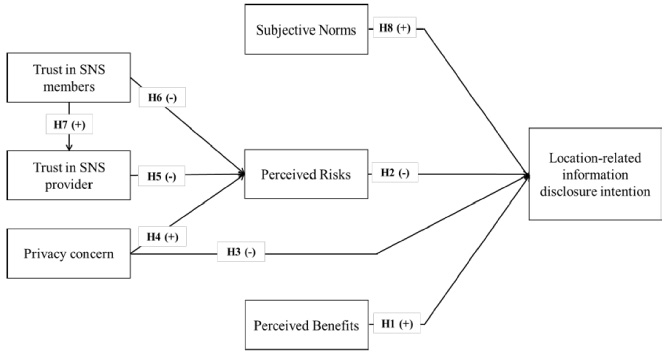
Design research model. Note: + (−) indicates that the effect is positive (negative).
Qualitative method
The research applies both qualitative and quantitative research to examine the reliability of the research model. Based on the research’s objectives, the qualitative research is conducted first to modify the design research model before creating the study’s final model. The method of in-depth interview and focus group were taken into account. The in-depth interviews are conducted with experts who are three lecturers teaching in universities and have a wealth of knowledge about the research topic. While the focus group is aimed to modify the research model with six respondents. There are two surveys of focus group, the first group interview included six second-year students at the University of Social Sciences and Humanities in Ho Chi Minh City, Vietnam. The second interview is conducted with six remaining people who are from many occupations and different ages. The survey is conducted in Ho Chi Minh City.
From the above outcomes of in-depth interviews and focus groups, the design research model and measurement scale are modified to characteristics of Vietnamese people when disclosing their location information on Facebook. To sum up, two main contributions are found as follows:
The incentive provision significantly affects benefits perception of location information disclosure intention on Facebook.
The result shows that incentive provision plays a crucial role in motivating an individual to self-disclose location information. Accordingly, online services often encourage users to engage in monetary and non-monetary rewards, such as earning extra points for free updates, badges, or other interactive objects or installing advanced features [40]. Besides, compensation or promotions can affect the interests of social media users, then increasing their ability to disclose location information [9,73,79].
Facebook users may realize the benefits of sharing location information so that they will do it, and the business’s offer of those incentives is also considered compensation for users who have disclosed information. However, offering a promotion may not always impact the consumer who will reveal information [80]. The studies of [7,18,81] proved the positive impact of incentives of the benefit perception of SNS users. However, these studies did not point out what kinds of incentives would appeal to users of different ages because the studies of [23,82] noted that older people are attracted by the promotion related to health care rather than monetary incentive like teenagers.
Impression management has a positive relationship with perceived benefits of location information disclosure intention.
Qualitative research shows that impression management plays a vital role in motivating individuals to self-disclose location information in society. In the sense of Facebook, impression management is described as “the benefits users derive from being able to develop their self-concept concerning others through the use of SNSs” [83]. The findings of a qualitative study [84] revealed that one of the reasons people use LSB is to show a good and fascinating image of themselves. When people announce their destination, whatever location they are traveling to, they can sometimes want someone else to consider or form an opinion about their lifestyle and social life [53].
In the sense of Facebook, users can exchange information or upload images to create a publicly appropriate self-image, including appearance, success, graciousness, or even well. Furthermore, people have almost complete discretion of what they want to disclose; as a result, they prefer to share details that benefit them. As found, the hypothesis is claimed as below.
The cultural difference, which is individualism and collectivism, moderates the relationship between subjective norms and intention to disclose location on Facebook.
From the qualitative findings that show that an independent individual is not dependent, they are rarely influenced by those around them in disclosing location information on Facebook. This is the significant contribution for this study to develop a moderation of individualism that influence the subjective norms with a tendency to reveal location information.
In the study of [85], they would consider information exposure different from those in Western cultures. However, according to another study [86], it is mentioned that comparing users at the national level does not make sense because culture has many levels and child units. Although Vietnam has a collectivistic culture [87], categorizing users into two aspects (individualism and collectivism) will allow the research to compare the same type of person between each group. Therefore, this study will focus on the cultural diversity of individualism and collectivism in Vietnam. In particular, the intention to share information related to places on LBS, Facebook, is subject to regulating cultural factors (individualism and collectivism) about subjective norms. Accordingly, the hypotheses are built as:
Based on literature review and findings of qualitative method, the final research model is proposed, it can be seen in Fig. 2.
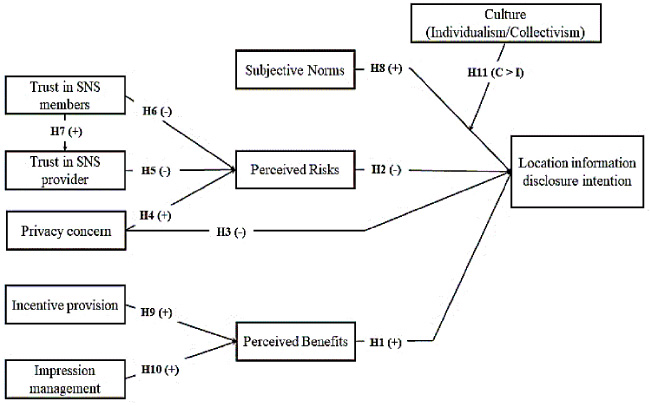
Research model.
Continuously, the quantitative methods are used to test the model. The sample size is calculated with a statistical formula to determine the number of subject populations needed to be collected for representing the whole [26]. Based on the study’s research objectives, our group decided to apply Stratified Random Sampling [26] to delve deeper into the differences in the impact of factors between ages. The research took a survey on 400 respondents with different age range, and the proportionate stratified random sampling is also obtained using the formula: (sample size/population size)*stratum size with the population size of 8,993,082 people, based on the Vietnamese Population Census in 2019. The research separates the subjective population into five age groups as shown in Table 1.
The required number of samples of each age group
Although the quantitative method is initially conducted on 507 respondents, the finally qualified questionnaires are 433 respondents maintained. The descriptive statistics of the respondent’s profile are depicted in Table 2. The questionnaire with questions designed is based on a 7 point Likert scale, 1 being strongly disagree to 7 being strongly agree. The measurement scales are inherited from the previous studies [3,7,9,37,53,88] and applied to the context of location disclosure intention of Facebook’s users.
Demographics
The reliability of measurement scale
Cronbach’s alpha is used to measure the internal consistency of the research’s items to guarantee that a group of items that support a construct is closely related. Accordingly, the Cronbach’s Alpha needs to be greater than 0.7, the Corrected Item – Total Correlation is more significant than 0.3, and the Cronbach’s Alpha If Item Deleted is less than Cronbach’s Alpha [89,90]. The result of reliability test through testing Cronbach’s Alpha of factors are: Culture Individualism/Collectivism (IC) with 0.910; Impression management (IM) with 0.935; Incentive provision (IP) with 0.942; Location information disclosure intention (LO) with 0.961; Perceived benefits (PB) with 0.925; Privacy concern (PC) with 0.911; Perceived risks (PR) with 0.914; Subjective norms (SN) with 0.923; Trust in SNS members (TM) with 0.917; Trust in SNS provider (TP) with 0.895.
Consistent validity
Grounded on previous research, before analyzing the structural equation modeling (SEM), measurement model testing was done to ensure the strength of the research model [7,18,19,88]. Therefore, to measure the accuracy of this scale, the study test some criteria such as Consistency validity, Reliability, Convergent validity, Discriminant validity, Multicollinearity, and Model fit by manipulating SmartPLS 3.3.3 [27]. Consistency validity is evaluated by determining if the outer loadings on their respective variables are greater than 0.7 [89]. Accordingly, the result in Table 3 shows that all outer loadings are much higher than 0.7, in the 0.764–0.955 range. Therefore, all items support their meaning constructs consistently.
Confirmatory factor analysis
Confirmatory factor analysis
Note: IC = Culture (Individualism/Collectivism), IM = Impression management, IP = Incentive provision, LO = Location information disclosure intention, PB = Perceived benefits, PC = Privacy concern, PR = Perceived risks, SN = Subjective norms, TM = Trust in SNS members, TP = Trust in SNS provider.
The variable’s reliability can be evaluated by first examining its composite reliability (CR), and average variance extracted (AVE) [91]. Besides, it is tested by looking at the Cronbach’s alpha of all variables (greater than 0.7) to ensure that the calculations are reliable [91,92]. Table 3 shows that the CRs for all variables are significant and higher than 0.92 exceeding the indicated evaluation metrics of 0.7 [91]. Thus, these variables had adequate reliability and could be used for the structural model.
In terms of Convergent validity, these criteria can be clarified by the AVE of all factors. Based on the preceded data in Table 3, all variables fulfilled the convergent validity criteria since their AVEs are higher than the proposed criterion of 0.50. Hence, the convergent validity of all constructs is not a problem.
Regarding Discriminant validity, the research compares the square root of AVE for a variable with the correlation coefficients associated with that variable. Table 4 reveals that the square roots of AVE for all variables were higher than the correlation coefficients, illustrating that these variables had strong discriminant validity [91]. The study also manipulates the Heterotrait-Monotrait ratio (HTMT) to appraise the discriminant validity [93]. As resulted in Table 5, all Heterotrait-Monotrait ratios of the correlations between the variables are less than the standard of 0.85. Therefore, it is concluded that discriminant validity was not a concern for the variables.
Discriminant validity
Discriminant validity
Heterotrait–Monotrait Ratio (HTMT)
The multicollinearity of the structural model must be investigated for the interaction between all the variables. To assess multicollinearity, the Variance Inflation Factor (VIF) is used; when all VIF < 2, it means there is no multicollinearity problem with the measurement scale [90]. The VIF results demonstrate that the relationship between the variables does not break the multicollinearity assumption since all the coefficients were <2.
Model fit and structural model
To appraise the proper level of the model, the model fit index was tested based on SRMR criteria. The result depicts that SRMR is 0.044, smaller than the 0.08 criterion, indicating that the model is well-fitting [94]. In addition, R square is also used in this study to determine the model’s significance level [93]. Accordingly, the R square of the variable LO is 0.505, indicating that the explanatory level of PB, PR, SN to LO is good. In general, the fitness of the model and the explanation of dependent variables are consistent with previous studies [3,7,73].
The research model is examined by using SmartPLS 3.3.3 [27]. Accordingly, the study has been applied to test the model with 5000 bootstrap samples with a significant level of 0.05 [7,13,95]. As for the moderating effect, it is calculated by the product indication method, which means the combination of the indicator of the latent variable and the latent moderator variable [27]. Hence, the results of all hypotheses is shown in Fig. 3 and Table 6.
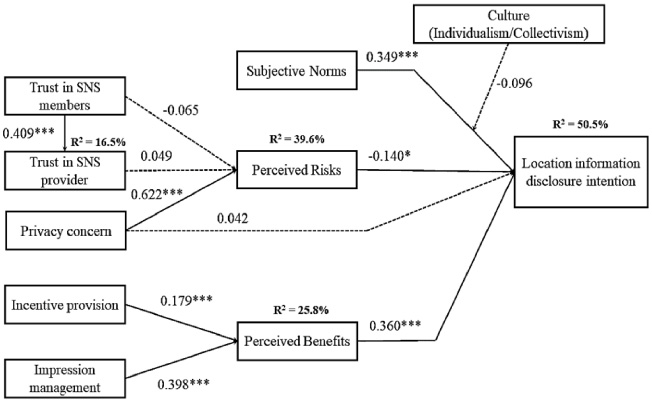
Structural model results. Note: ∗∗∗ is significant at 0.1%, ∗∗ is significant at 1%, ∗ is significant at 5%.
Hypotheses testing
Note: ∗∗∗ p < 0.001, ∗∗ p < 0.01, ∗ p < 0.05.
Grounded from the result, H1 and H2 are supported, which means perceived benefits and perceived risks positively impact the intention to disclose location information of Facebook users (𝛽 = 0.360,p < 0.001; 𝛽 = −0.140, p < 0.05). Although, privacy concern does not influence the intention, it shows a significant positive relationship with perceived risks. H3 is not supported (𝛽 = 0.042, p > 0.05), but H4 is supported (𝛽 = 0.622, p < 0.001). Following that, trust in SNS provider and trust in SNS members do not negatively impact the perceived risks, which does not support H5 (𝛽 = 0.049, p > 0.05) and H6 (𝛽 = −0.065, p > 0.05). However, the hypothesized positive relationship between trust in SNS members and trust in SNS provider is supported, H7 is (𝛽 = 0.409, p < 0.001). Regarding subjective norms, H8 is supported significantly (𝛽 = 0.349, p < 0.001), which indicates subjective norms positively impact the location information disclosure intention. Moreover, H9 and H10 are also supported (𝛽 = 0.179,p < 0.001; 𝛽 = 0.398, p < 0.001). Therefore, incentive provision and impression management influence the perceived benefits in intention to disclose location remarkably. Finally, the moderating effect of culture – the difference between individualists and collectivists, did not affect the relationship between subjective norms and location information disclosure intention. Hence, H11 is not supported (𝛽 = −0.096, p > 0.05).
The research model includes seven specific indirect effects, which are shown in Fig. 3. Hence, the research examines these impacts through the program of SmartPLS and accumulates the result in Table 7. Accordingly, the first finding is that although not directly influencing the location information disclosure intention, privacy concern still negatively impacts the intention through the mediator-perceived risk (𝛽 = −0.087, p < 0.05). Moreover, the second finding reckons the role of perceived benefits as mediator in the relationships between incentive provision and impression management are also supported (𝛽 = 0.064,p < 0.01; 𝛽 = 0.143, p < 0.001). The result also informs that incentive provision and impression management directly affect the location information disclosure intention. Following that, incentive provision has a positive relationship with location information disclosure intention (𝛽 = 0.064, p < 0.01). Significantly, the impression management has a positive impact on location disclosure intention (𝛽 = 0.143, p < 0.001).
Specific indirect effects and extra results of IM and IP
Specific indirect effects and extra results of IM and IP
With the value of R-squared is 50.5%, this presents a goodness-of-fit measure between independent variables (e.g. Subjective norms, Perceived risks, and Perceived benefits) and location information disclose intention. This is a good message to know that changes in location information disclose intention are explained by subjective norms, perceived risks and perceived benefits.
As found, users’ behavior in the LBSNS enhances the experience of SNS users and is conducive to businesses whose services are based on the location information of users. Being reliant on the Privacy Calculus Theory, Trust Theory, and Theory of Planned Behavior, the factors indicated their impact on location information disclosure intention. Most of the previous studies concentrated on perceived benefits and risks when investigating the purpose of LBSNS users and paying less attention to the impact of subjective norms, the difference between age groups, and the moderation of culture. The study had shed light on the strong relationships between impression management, incentive provision, and perceived benefits, between subjective norms and location information disclosure intention. Moreover, the study tested the moderating effect of culture (individualism and collectivism) to explain the difference in persons related to sharing the locations. In conclusion, the findings have theoretical implications for understanding the intention of SNS users to share places. In addition, the research helps businesses with managerial implications.
Two main factors, perceived benefits, and risks show the positive and negative impacts on location information disclosure intension, respectively. Facebook users consider the benefits and risks before sharing, checking in, or disclosing information about any location. To clarify, people expect the information they share on their Facebook homepage will help their friends or people around them know and learn more about the characteristics of those places, which widen their horizon through that information. Regarding the perceived risks, most people are aware of their troubles when sharing location information on Facebook. However, these perceived risks are often overlooked if not mentioned, while Facebook users focus more on the benefits of sharing location information.
Privacy is very concerned with the famous and important people. On the contrary, those who consider themselves normal, do not take security seriously. In addition, if people use free applications, they must comply with the application’s policy. If they disagree, they cannot engage in Facebook – a social networking site. However, privacy concern can boost the perceived risks when people intend to share a location. In addition, regarding security issues, qualitative research shows that many Facebook users do not read the Facebook privacy terms when registering an account on this platform [3]. Therefore, from an objective perspective, security issues also partly come from the subjectivity of Facebook users.
As regards trust, the trust in SNS provider and trust in SNS members do not diminish the perceived risks of Facebook users. However, the trust in SNS members positively affects the trust in SNS provider. This relationship has been indicated in some research [37]. In the study, the people somehow do not trust Facebook and the members of this platform. From respondents’ view, Facebook and Facebook members can exploit their location information for terrible things [96]. Hence, they often set the privacy view for each activity on Facebook to ensure only their sorted friends can see. This finding indicates that SNS users are proactive in protecting their information rather than trust the platform or society. On the other hand, there is a phenomenon that if people trust the SNS members, which means they trust other Facebook users, they will trust Facebook.
Concerning incentive provision and impression management, the findings of this research indicate that incentive provision influences the location information disclosure intention through perceived benefits and directly affects the purpose. Moreover, the teenagers are influenced significantly by incentives and promotions from location-based services compared to other age groups, supporting the research’s finding in the qualitative method. Specifically, the questions in the scale focus on financial promotions so that most young people respond to these services. From a unique perspective, non-monetary promotions such as incentives for services will show a higher level of consent for people over 29 years old.
A similar phenomenon is seen in impression management. Facebook users need to gain face [13,37], and sharing a well-known or unique location can raise their awareness of social status. Facebook users are wary of guessing what others will think about what they share on Facebook. The location information is for entertainment, and contributes to a person’s career and reputation.
Finally, people are influenced by their friends, relatives, and family regarding subjective norms in disclosing location information on Facebook [4,11]. Most of the respondents were more willing to share a common location with people or be tagged in a post by a friend. In addition, the relationship between subjective norms and location information disclosure intention is not moderated by the difference between individualists and collectivists. Hence, the moderating effect of culture in Vietnam is not consistent with previous studies [86]. However, it still exists for a person to value their personal feelings more in being influenced by those around them. Although culture must be considered at an individual level from the point of view, Vietnam is still a country that favors collectivism. Therefore, to better represent cultural moderation, future research could expand the comparison sample in two countries with distinct levels of individualism and collectivism.
Theoretical implications
This study provides insights to the research while also assisting individuals in better understanding the antecedent issues toward disclosure of location information on social networking sites.
Firstly, the current paper has an academic contribution to theory of privacy calculus, planned behavior, and trust and explains the intention of SNS users to disclose their location information [4,6,7,13]. This is proved through a significant impact of perceived risks, benefits, and subjective norms on the location disclosure intention.
Secondly, the authors rarely mention the age difference for studies on location-based service in general or the intention to share information related to location-based service. Testing for age differences is concerned in the study to extend the results, and show how trends and differences in age groups will affect their intention to share. Accordingly, the difference between groups is clearly shown in the incentive provision with engagement in higher ages. Specifically, the young people refer to monetary incentives, while the non-monetary is more suitable for older people. This finding is a good contribution for businesses in orienting their target customers and promotion forms ideal for each age group.
Thirdly, the culture is added to the research model as a moderator related to location information disclosure intention, this is rarely seen. In our study, the cultural factor has a negligible moderating effect on the relationship between subjective norms and the intention to disclose location information. Nevertheless, the culture variable also contributes to explaining the intention to disclose location in social networking sites of Facebook users and has long-term constructive implications for future studies. While talking about culture, the study only explored one of the cultural dimensions of Hofstede’s Theory – individualism vs. collectivism, as well as limited sample diversity.
Managerial implications
The users are easily attracted by something that will give them the immediate economic benefits of interest, so the increased prejudice towards the customer’s economy is compelling. Providing discount vouchers is extremely popular and brings much effectiveness for some businesses. However, for this form of incentive, the companies should hit the target audiences who are young people because the age comparison shows that people above 29 years old often do not pay attention to incentives [16]. To older age groups, it is necessary to research to find out insight appropriate for each age group, thereby providing complementary services to promote the sharing of user’s location information. For example, health is a matter of great concern to many older people and their loved ones. Instead of offering discounts, it is better to combine with health centers to provide vouchers that will bring more positive responses [23,82]. Besides, businesses can offer incentives related to their interests to promote customers’ motivation to share information about locations with their target customer groups.
On the other hand, impression management plays a key role when disclosing location [18]. The visual of location is recently competitive, so shooting in a unique place Facebook users can show their personality, social status, and social images are always considered. Therefore, business locations should focus on improving the style and appearance of their businesses. Notably, companies should research the characteristics of the users they want to target, thereby building a location suiting users’ wishes but still ensuring their unique image in users’ minds. Moreover, businesses can refresh their image by updating and changing the style of the venue according to the seasons or special occasions of the year to avoid being bored in the eyes of customers. These unique and attractive businesses will be an opportunity for users to express their image and style [97].
Referring to minimizing the risks users may perceive, this research implies businesses should start by ensuring the credibility of their posts and brand image on Facebook. Through that, users will have more sympathy and confidence in the industry. The users’ trust will help reduce perceived risks when they hesitate to share locations [11,13]. For the trust in SNS member, the result shows the negative effect of this variable on Perceived Risks is negligible because the study still has many limitations. Nevertheless, this research has realized that Facebook users also have specific concerns during the qualitative survey. Based on the reasons above, the study decided to put in a few recommendations for the business of development. Trust in SNS members, more specifically, is to make customers believe in the company and the information the business provides and minimize customers’ perceived risk when sharing related-location information [38,57].
Another thing is creating networking techniques to attract netizens. As mentioned, customers often follow the crowd, so making the brand’s Facebook account and posts extremely viral would also aid companies in gaining user trust. As a result, companies should spend more on their social media experiences, fan page updates, and on-site ratings. Following that, related topics businesses need can be mentioned or coordinate public opinion whenever “misleading news” affects the company itself. Besides that, informational content and business orientation must be clearly expressed in all communication aspects so that the transmission content will be consistent and gain customers’ trust [13].
Finally, subjective norms have a significant impact on the users’ intention to disclose the location. Facebook users, friends, relatives, and family may influence their behaviors [4]. Accordingly, businesses can boost the eWOM – Electronic Word of Mouth communication to expand the business location awareness. With this way of communication, currently, on the Facebook platform, there are many forms, such as review articles, user comments, user reviews about the business or product, and the information users exchange in their chats.
Consumers are also readily influenced by the comments of foremost opinion leaders (KOLs) and influencers, so this is another path relevant to subjective norms that companies can reference and leverage. Aside from using KOLs and influencers on the Facebook website, companies can also build on other social networking sites and add connections back to Facebook to increase coverage. However, it should be noted that linking with KOLs and influencers is now quite common, and in general, for customers, the fact that a brand appears on these objects’ communication channels makes sense. Therefore, it is necessary to build a long-term process of media cooperation so that followers realize KOLs, influencers are not just promoting at that time, but they have a positive experience with the location.
Limitation and future research directions
Despite our worthiest efforts to perform this research rigorously, there are several limitations faced. Accordingly, our research has not explored depth on how different placements affect Facebook users’ disclosing intentions. Scenic places, for example, would be perceived as more socially attractive, while political, personal, and office locations would be seen as better sensitive. Second, this study is limited to Facebook users and does not account for regional cultural diversity. Grounded on the above aspect, future research should develop and expand some of these recommendations.
Footnotes
Acknowledgement
We would like to thank the University of Economics Ho Chi Minh City (UEH), who fund our paper.
Declaration of interests
As being the corresponding author, on behalf of the all authors, I would like to confirm that this study does not have any conflicts of interest.