




Abstract
Artificial Intelligence (AI) is one of the most significant of the information and communications technologies being applied to surveillance. AI’s proponents argue that its promise is great, and that successes have been achieved, whereas its detractors draw attention to the many threats embodied in it, some of which are much more problematic than those arising from earlier data analytical tools.
This article considers the full gamut of regulatory mechanisms. The scope extends from natural and infrastructural regulatory mechanisms, via self-regulation, including the recently-popular field of ‘ethical principles’, to co-regulatory and formal approaches. An evaluation is provided of the adequacy or otherwise of the world’s first proposal for formal regulation of AI practices and systems, by the European Commission. To lay the groundwork for the analysis, an overview is provided of the nature of AI.
The conclusion reached is that, despite the threats inherent in the deployment of AI, the current safeguards are seriously inadequate, and the prospects for near-future improvement are far from good. To avoid undue harm from AI applications to surveillance, it is necessary to rapidly enhance existing, already-inadequate safeguards and establish additional protections.
Keywords
Introduction
The scope for harm to arise from Artificial Intelligence (AI) has been recognised by technology providers, user organisations, policy-makers and the public alike. On the other hand, effective management of the risks inherent in its application has been much less apparent. Many users of Information & Communications Technologies (ICT) for surveillance purposes have been successful in avoiding meaningful regulation of their activities. This article undertakes an assessment of the prospects of AI’s use for surveillance being brought under control.
The subjects of surveillance that are considered in this article are primarily people, both individually and collectively, but also things and spaces around which and within which people move. Other contexts, such as in public health and seismology, are not considered. A substantial body of knowledge exists about surveillance (e.g. Rule, 1974; Gandy, 1993; Lyon, 2001; Marx, 2016). The original sense of the word, adopted from French, was of ‘watching over’. It was once inherently physical, spatial and visual (Bentham, 1791, Foucault 1975/1977) That limitation has been long since overcome, with enormous developments over the last century in the surveillance of sound, communications, data, and personal experience. It has become routine to locate and track people in physical space, and their digital personae in virtual space (Clarke, 2014b).
Infrastructure to support surveillance has become pervasive, around the environments in which people live, work and play, and even with people, on people, and in people. Surveillance can be conducted retrospectively, or contemporaneously, or even in an anticipatory manner, threateningly referred to as ‘predictive’. It has given rise to circumspect constructs such as ‘surveillance society’ (Marx, 1985; Gandy, 1989; Lyon, 2001), ‘the panoptic sort’ (Gandy, 1993, 2021), ‘ubiquitous transparency’ (Brin, 1998), ‘location and tracking’ (Clarke, 2001; Clarke & Wigan, 2011), ‘sousveillance’ (from below rather than above, by the weak of the powerful – Mann et al., 2003), ‘equiveillance’ (Mann, 2005), ‘uberveillance’ (both comprehensive and from within – Michael & Michael, 2007; Clarke, 2010), ‘surveillance capitalism’ (Zuboff, 2015) and the ‘digital surveillance economy’ (Clarke, 2019a). An 1800-word review of surveillance, intended to provide the reader with background to the analysis in this article, is in Clarke (2022).
An overview of AI is provided, firstly in the abstract, then moving on to sub-fields of AI with apparent relevance to surveillance. An appreciation of the characteristics of the technologies enables the identification of disbenefits and risks involved in AI’s application to surveillance. A review is then undertaken of the ways in which control might be exercised. Particular attention is paid to the wave of publishing activity during the period 2015–21 in the area of ‘Principles for Responsible AI’. The analysis draws on a previously-published, consolidated super-set of Principles.
Almost all of the publications to date are ‘Guidelines’. This provides a justification for individuals and organisations inclined towards greater care in the deployment of technology, but it lacks enforceability, and in most cases has little impact on AI practice. A critique is provided of the proposal of 21 April 2021 of the European Commission, which appears to be a world-first initiative to establish formal regulation of a bespoke nature for AI applications. The analysis suggests that the provisions appear to be so weak, and the exemptions so broad, that enactment of the proposal, while it would provide window-dressing for AI-using organisations, would not deliver any significant protections for the public. The article concludes with an assessment of the prospects of effective control being achieved over AI applications to surveillance even by organisations with limited market and institutional power, let alone by large corporations and government agencies.
AI in support of surveillance
This section provides an overview of the origins and the ambiguous and contested nature of AI. The fields that appear to have particular relevance to surveillance are then outlined. That provides a basis for identifying the disbenefits and risks that AI applications to surveillance appear to embody.
AI in the abstract
The term Artificial Intelligence was coined in the mid-20th century, based on “the conjecture that every aspect of learning or any other feature of intelligence can in principle be so precisely described that a machine can be made to simulate it” (McCarthy et al., 1955). The word ‘artificial’ implies ‘artefactual’ or ‘human-made’. Its conjunction with ‘intelligence’ leaves open the question as to whether the yardstick is ‘equivalent to human’, ‘different from human’ or ‘superior to human’. Conventionally (Albus, 1991; Russell & Norvig, 2003; McCarthy, 2007):
Artificial Intelligenceis exhibited by an artefact if it:
(1) evidences perception and cognition of relevant aspects of its environment; (2) has goals; and (3) formulates actions towards the achievement of those goals.
Histories of AI (e.g. Russell & Norvig, 2009, pp. 16–28; Boden, 2016, pp. 1–20) identify multiple strands and successive re-visits to much the same territory. Over-enthusiastic promotion has always been a feature of the AI arena. The revered Herbert Simon averred that “Within the very near future – much less than twenty-five years – we shall have the technical capability of substituting machines for any and all human functions in organisations.
The last decade has seen an(other) outbreak. Spurred on by the hype, and by the research funding that proponents’ promises have extracted, AI has excited activity in a variety of fields. Some of potential significance are natural language understanding, image processing and manipulation, artificial life, evolutionary computation aka genetic algorithms, and artificial emotional intelligence.
AI intersects with
programmability, implying computational or symbol-manipulative capabilities that a designer can combine as desired (a robot is a computer); and mechanical capability in the form of actuators, enabling it to act on its environment rather than merely function as a data processing or computational device (a robot is a machine).
Two further, frequently-mentioned elements of robotics are sensors, to enable the gathering of data about the devices’s environment; and flexibility, in that the device can both operate using a range of programs, and manipulate and transport materials in a variety of ways. Where robotics incorporates AI elements, additional benefits may be achieved, but the disbenefits and risks are considerably greater, because of the inherent capacity of a robot to act autonomously in the real world (Clarke, 2014a), and the temptation and tendency for the power of decision and action to be delegated to the artefact, whether intentionally or merely by accident.
Considerable scepticism is necessary when evaluating the claims of AI’s successes. This applies in all domains, but none moreso than surveillance. Civil society analyses of AI in surveillance depend very heavily on media reports that repeat the content of corporate and government media releases and that are highly superficial in their depiction of the underlying technologies. Typical of this vacuity is the assertion, unsupported by any evidence, that many workplace surveillance tools are “powered by artificial intelligence” (Cater & Heikkilä, 2021).
In a widely-read study, Feldstein (2019) identified relevant ‘AI surveillance techniques’ as being smart city/safe city platforms, facial recognition systems and smart policing (p. 16). The author was, however, unable to provide much detail about actual techniques used, beyond the ubiquitous example of facial recognition (e.g., Heikkilä, 2021). The limited technical information that is publicly available reflects the strong tendency of the operators of surveillance to obscure the nature of their activities, and in some cases even the fact of their conduct. The reasons underlying the obfuscation appear to include institutional cultures of secrecy, intellectual property considerations, weaknesses in the technologies such that transparency would enable effective countermeasures, and/or the technology’s ineffectiveness for the claimed purpose.
One of the few concrete examples that Feldstein was able to provide was “iBorderCtrl
A further feature of AI applications to surveillance is the vagueness with which the term ‘AI’ is used. From some descriptions, it could be inferred that the longstanding techniques of pattern recognition are being applied, e.g. to the extraction of useful data from images of vehicle registration-plates and faces. In other cases, the intention of product promoters may be to claim that machine learning is being employed, e.g. to perform trawls of data collections, and of mergers of disparate data collections, with the intention of detecting anomalies that create suspicion about people, objects or places. On the other hand, most forms of surveillance were developed independently of AI. They may be being enhanced using AI features; but they may merely be having gloss added through the unjustified appropriation of the AI tag to refer to an ‘advanced’ or merely ‘the latest’ version of a product.
A case in point is another of Feldstein’s few named instances: “The idea behind smart policing is to feed immense quantities of data into an algorithm – geographic location, historic arrest levels, types of committed crimes, biometric data, social media feeds – in order to prevent crime, respond to criminal acts, or even to make predictions about future criminal activity” (p. 20). The example provided was the PredPol predictive analytics program; but the description on the company’s websites (PredPol, 2021) makes clear that it is not an AI product.
Fields of AI potentially relevant to surveillance
Given that supplier obfuscation severely hampers the independent evaluation of existing products, an analysis is reported here that is based on the generic characteristics of AI technologies. This approach identifies several fields of AI that have apparent potential for application to surveillance.
Many AI fields involve ‘pattern recognition’, for which four major components are needed: “data acquisition and collection, feature extraction and representation, similarity detection and pattern classifier design, and performance evaluation” (Rosenfeld & Wechsler, 2000, p. 101).
Pattern recognition can be applied in a variety of contexts. Those relevant to surveillance include:
The last of these requires closer attention. Common features of the classical approaches to pattern-recognition in data have been that:
data is posited to be a sufficiently close representation of some real world phenomenon; that data is processed by software; inferences are drawn from that data processing; the inferences are claimed to have relevance to the understanding or management of the phenomenon.
The software that is used may be developed in a number of different ways. An
Other approaches to developing software exist (Clarke, 1991). Two that are represented as being AI techniques are highly relevant to the issues addressed in the present analysis. The approach adopted in
If <Person> was born within the UK or any of <list of UK Colonies> between <date
When software is developed at this level of abstraction, a model of the problem-domain exists; but there is no explicit statement of a particular problem or a solution to it. In a simple case, the reasoning underlying an inference that is drawn in a particular circumstance may be easy to provide, whether to an executive, an aggrieved person upset about a decision made based on that inference, or a judge. However, this may not be feasible where data is missing, the rulebase is large or complex, the rulebase involves intertwining among rules, the rulebase embodies some indeterminacies and/or decision-maker discretions exist. Inferences drawn from rule-based schemes in surveillance contexts, e.g. for suspicion-generation about individuals who may be involved in bomb-making, and in so-called ‘predictive policing’, are subject to these challenges.
A further important software development approach is (generically)
The processing results in a set of weights on such factors as the tool treats as being involved in drawing the inference. Although the tool may have been developed using a procedural or imperative language implementing an algorithm, the resulting software that is used to process future cases is not algorithmic in nature. The industry misleadingly refers to it as being algorithmic, and critics have adopted that in terms such as ‘algorithmic bias’; but the processing involved is empirically-based, not algorithmic, and hence more appropriate terms are
A critical feature of ANNs is
There are two different patterns whereby the factors and weightings can come about (DeLua, 2021). The description above was of
The vagaries of ‘tagging’ and even moreso of automated construct creation, coupled with the a-rationality of all AI/ML and its inherently mysterious and inexplicable inferencing, leads people who are not AI enthusiasts to be perturbed and even revulsed by the use of ANNs to make decisions that materially affect people. The issues are all the more serious when ML-based inferencing is conducted in surveillance contexts, because of the severity of the consequences for the unjustly-accused, the absence of a rationale for the inference, the strong tendencies in the system towards reversal of the onus of proof, and the near-impossibility in such circumstances of prosecuting one’s innocence.
A great many claims have been made about the potential benefits AI might offer. Many of these feature
Pattern-matching of all kinds is inherently probabilistic rather than precise. It results in inferences that include
As regards AI generally, the disbenefits and risks have been presented in many different ways (e.g., Scherer, 2016, esp. pp. 362–373; Yampolskiy & Spellchecker, 2016; Duursma, 2018; Crawford, 2021). Clarke (2019b) identifies five factors underlying concerns about AI:
The fourth of these, the lack of access to reasoning underlying inferences, has particularly serious implications (Clarke, 2019b, pp. 428–429). Where no rationale for the outcome exists and none can be convincingly constructed,
Where an outcome appears to be in error, the factors that gave rise to it may not be discoverable, and
In summary, “AI gives rise to errors of inference, of decision and of action, which arise from the more or less independent operation of artefacts, for which no rational explanations are available, and which may be incapable of investigation, correction and reparation” (Clarke, 2019b, p. 426).
The second of the five factors relates to problematic aspects of the data. In respect of AI-based data analytics, the quality of outcomes is dependent on many features of data that need to reach a threshold of quality before they can be reliably used to draw inferences (Wang & Strong, 1996; Shanks & Darke, 1998; Piprani & Ernst, 2008; summarised in Clarke 2016 into 13 factors).
As regards the third of the five factors, process quality, all data analytics techniques embody assumptions about the form that the data takes (such as the scale against which it is measured), and its quality, and the reliability of the assumptions made about the associations between the data and some part of the real world. Text-books on data analytics teach almost nothing about the need for, and the techniques that need to be applied to deliver, assurance of inferencing quality. This gives rise to challenges in relation to the use of the inferences drawn by data-analytical processes from data-sets. For inferences to be reliable, and decisions and actions taken based on those inferences equitable, there is a need for:
reality testing, to gain insight into the reliability of the data as a representation of relevant real-world entities and their attributes; safeguards against mis-match between the abstract data-world and the real world in which impacts arise; mechanisms to ensure the reasonableness and proportionality of decisions made and actions taken based on the inferences; and processes whereby decisions can be contested.
Yet, despite the substantial catalogue of problems with data meaning, data quality, and inconsistencies among data-sets, data analytics teaching and practice invest a remarkably small amount of effort into quality assurance. That is the case even with long-established forms of data analytics. The reason such cavalier behaviour is possible is discussed in the following section.
AI/ML-based data analytics, on the other hand, is inherently incapable of addressing any of these issues. Further, the opacity issue overlays all of the other problems. Pre-AI, genuinely ‘algorithmic’ inferencing is capable of delivering explanations, enabling the various elements of accountability to function. Rule-based ‘expert systems’ dilute explainability. AI/ML inferencing, on the other hand, comprehensively fails the explainability test, and undermines accountability.
Procedural fairness has long been a requirement in the hitherto conventional environment of human-made or at least human-mediated decisions, for which courts demand a rational explanation. In the new world of AI, and particularly AI/ML, decisions are being imposed and actions taken that are incapable of being explained and justified before a court of law. The need for effective regulatory mechanisms is clear. What is far less clear is how protective mechanisms can be structured, and whether they are in place, or at least emergent.
AI may have very substantial impacts, both good and ill, both intended and accidental, and both anticipated and unforeseen. Building on the above review, this section presents an analysis of the regulatory spectrum, to support assessment of whether the threats inherent in AI applied to surveillance can be dealt with appropriately. The regulatory framework proposed in Clarke (2021a) is applied, in particular the Regulatory Layers in s.2.2, presented in graphical form in Fig. 1.
A hierarchy of regulatory mechanisms.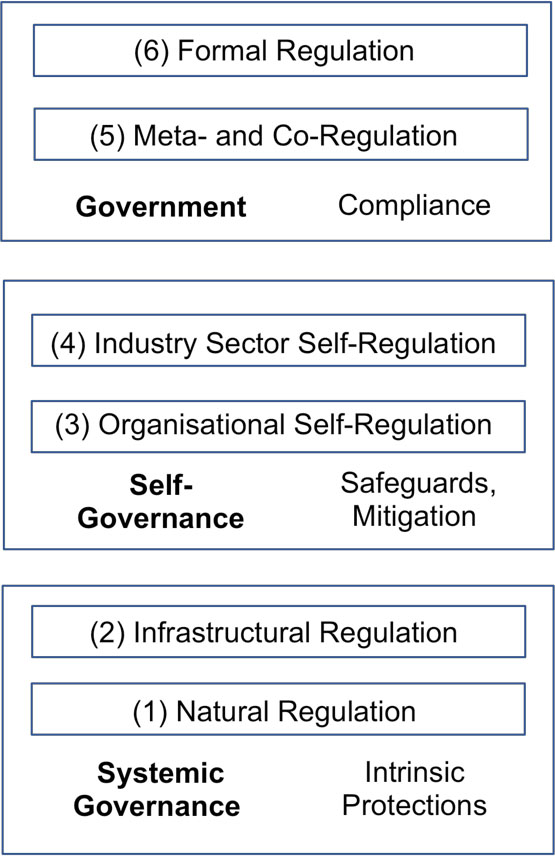
The foundational layer,
The second-lowest layer,
At the uppermost layer of the regulatory hierarchy,
Formal regulation appears to be the most logical approach when confronted by a threat of the magnitude that AI may prove to be. However, IT providers and insufficiently critical user organisations clamour for the avoidance of constraints on innovation. Corporate power has been instrumental over many decades in greatly reducing regulatory commitment in many jurisdictions and in many contexts. De-regulation and ‘better regulation’ movements have achieved ratcheting back of existing controls, commonly followed by unacceptable levels of harm, stimulating clumsy re-regulation (Braithwaite & Drahos, 1999). Safeguards have also been avoided through the outsourcing of both activities and responsibilities, including the use of low-regulation havens, and jurisdictional arbitrage. In the public sector, key factors include the drift from subcontracting, via comprehensive outsourcing, to public-private partnerships, and on towards the corporatised state (Schmidt & Cohen, 2014). A particular factor that appears to have largely ‘flown under the radar’ to date is the conversion of locally-installed software products to remotely-provided services (AI as a Service – AIaaS), of which IBM’s Watson was an early exemplar.
Several intermediate forms lie between the informal and formal ends of the regulatory hierarchy. Examples of
Other, intermediate forms have emerged that have been claimed to offer greater prospects of achieving regulatory objectives. These are clustered into layer
Despite the sceptical tone of the above analysis, several techniques in the mid-layers (3) to (6) of the hierarchy might make contributions, if they are elements within a complex of safeguards.
Another approach to identifying or anticipating potential harm, and devising appropriate safeguards, is
A further possible source of protection might be application of
Finally, the notion of
The likelihood of any combination of Layer (1)–(5) elements providing effective protection for public interests against the ravages of AI appears very low. What, then, are the prospects of effective interventions at Layers (6) and (7), Formal, Meta- and Co-Regulation?
A new phase was ushered in by a proposal for statutory intervention published by the European Commission (EC) in April 2021. This is sufficiently significant that the Proposal is evaluated here as a proxy for formal regulation generally.
The European Commission’s proposal
The EC’s announcement was of “new rules and actions for excellence and trust in Artificial Intelligence”, with the intention to “make sure that Europeans can trust what AI has to offer”. The document’s title was a ‘Proposal for a Regulation on a European approach for Artificial Intelligence’ (EC, 2021), and the draft statute is termed the Artificial Intelligence Act (AIA).
The document of 2021 is formidable, and the style variously eurocratic and legalistic. It comprises an Explanatory Memorandum, pp. 1–16, a Preamble, in 89 numbered paragraphs on pp. 17–38, and the proposed Regulation, in 85 numbered Articles on pp. 38–88, supported by 15 pages of Annexes.
A first difficulty the document poses is that the term “AI System” is defined in a manner inconsistent with mainstream usage. It omits various forms of AI (such as natural language understanding, robotics and cyborgisation), and encompasses various forms of data analytics that are not AI (specifically, “statistical approaches, Bayesian estimation, search and optimization methods”. These pre-date the coinage of the term ‘AI’ in 1955, and are commonly associated with operations research and data mining/‘data analytics’). A more descriptive term for the proposed statute would be ‘Data Analytics Act’.
The EC proposes different approaches for each of four categories of AI (qua data analytics), which it terms ‘Levels of Risk’: unacceptable, high, limited and minimal. A few “AI Practices” would be prohibited (Art. 5). A number of categories of “High-Risk AI Systems” would be subject to a range of provisions (Arts. 6–7, 8–51, Annexes II-VII). A very limited transparency requirement would apply to a small number of categories of “AI Systems” (Art. 52). All other “AI Systems” would escape regulation by the AIA (although not other law that may be applicable in particular circumstances, such as human rights law and the GDPR).
The consolidated set of 50 Principles was used to assess the sole category to which safeguards would apply, “High-Risk AI Systems”. A comprehensive report is provided in an unpublished working paper (Clarke, 2021b). Applying a scoring technique explained in Clarke (2021b), the EC Proposal was found to be highly deficient, scoring only 14.7/50. Of the 50 Principles, 25 scored nothing, and a further 8 achieved less than 0.5 on a scale of 0.0 to 1.0. The foundational Themes 1-4 achieved only 4%, 0%, 33% and 28% of their possible scores, for a total of 20%. The only 3 of the 10 Themes with a Pass-level score are 8 (Exhibit Robustness and Resilience – 68%), 5 (Ensure Consistency with Human Values and Human Rights – 60%), and 9 (Ensure Accountability for Obligations – 50%).
During the ‘ethical guidelines’ phase, the EC’s contribution, the “Ethics Guidelines for Trustworthy AI” prepared by a “High-Level Expert Group on Artificial Intelligence” (EC, 2019) had achieved easily the highest score against the consolidated set of 50 Principles, with 74%. The disjunction between the EC Proposal (EC 2021) and the earlier ‘Ethics Guidelines’ is striking. Key expressions in the earlier document, such as ‘Fairness’, ‘Prevention of Harm’, ‘Human Autonomy’, ‘Human agency’, ‘Explicability’, ‘Explanation’, ‘Well-Being’ and ‘Auditability’, are nowhere to be seen in the body of the 2021 Proposal, and ‘stakeholder participation’ and ‘auditability’ are not in evidence.
The conclusion reached by the assessment was that “the EC’s Proposal is not a serious attempt to protect the public. It is very strongly driven by economic considerations and administrative convenience for business and government, with the primary purposes being the stimulation of the use of AI systems. The public is to be lulled into accepting AI systems under the pretext that protections exist. The social needs of the affected individuals have been regarded as a constraint not an objective. The draft statute seeks the public’s trust, but fails to deliver trustworthiness” (Clarke, 2021b).
The analysis reported in this article was undertaken during the third and fourth quarters of 2021, and reflects the original, April 2021 version of the EU Draft Bill. The EU subsequently published a ‘Compromise Text’, on 29 November 2021. This has not been evaluated. Initial impressions are, however, that the dominance of economic over social objectives has been consolidated; and new exemptions have been created that appear to increase the level of irresponsibility. The use of AI in research is now to be exempted. So are contributors to product development. Of even greater concern is that ‘general purpose AI’ technology is also now out-of-scope. The core of every AI application is thereby free of quality constraints, and its creators are free from any form of liability. The second version appears to be an even greater breach of public trust than the first.
The proposal’s implications for AI and surveillance
Assessment was undertaken of the extent to which the EC’s Proposal affects AI applications to surveillance. Relevant extracts from EC (2021) are provided in an Annex to this article.
Of the four categories of
In addition, scope exists for ‘gaming’ the regulatory scheme, because, a nominally “prohibited AI practice” can be developed, deployed in particular contexts, then withdrawn, without a prior or even contemporaneous application for authorisation, let alone approval. Moreover, any Member State can override the prohibition (Art.5(4)). Hence many systems in these categories would achieve exemption from the scheme.
Multiple
More positively, a system is subject to some conditions if it is “5.
However, even for those systems that do not fit into the array of escape-clauses, the statutory obligations (Arts. 8–29) are very limited in comparison with those in the consolidated set of 50 Principles. Further, most such systems are either absolved from undergoing conformity assessment (Art. 41–43, 47) or are subject to mere self-assessment. It appears that considerably more effort may be expended in finding ways to avoid the requirements than in complying with them.
Finally, of the four categories of AI systems to which a
The large majority of applications of AI to surveillance would be entirely unaffected by the EC Proposal should it be enacted in anything resembling its current form. This includes many applications of AI that lie very close to the boundary of what the EC considers should be prohibited, and many applications that the EC considers to be ‘high-risk’. Even those ‘high-risk’ applications that are subject to the new law would be subject to very weak requirements. Advocates for the public interest are justified in treating the EC Proposal with derision, both generally in respect of AI, and specifically in relation to the application of AI to surveillance.
Conclusions
There is strong evidence that data analytics practices in general are not subject to adequate safeguards for public interests, even before AI’s incursions into the field. One prominent example is the RoboDebt scandal in Australia, in which a new AUD 1 billion system both incorrectly and illegally imposed automatically-generated debts on welfare-recipients, resulting in serious impacts on half a million individuals, AUD 2 billion of repayments, and withdrawal of the scheme (Clarke, 2020). In another case, 20,000 false accusations by the taxation authority of fraudulent drawing of child benefits resulted in the Dutch government resigning (Erdbrink, 2021).
The present article has summarised the many signs of alarm about the damage AI can do, both generally, and specifically when applied to surveillance. To the formal evidence can be added the implicit recognition by AI proponents that the public has much to fear, in that they have undertaken a ‘charm offensive’ involving good news stories about AI applications, and utterances of ‘principles’ further glossed by the word ‘ethical’.
A review of the many forms that regulation can take found nothing outside the uppermost layers of formal regulation that would appear at all likely to deliver meaningful safeguards for the public against AI. Until the second quarter of 2021, there was very little evidence of formal regulation being emergent. The first such proposal, from the EC, when reviewed against a consolidated set of ‘principles for responsible AI’, has been found to be extremely poor.
Given these inadequacies, and the power of the government agencies and corporations that apply surveillance, the current prospects of effective control being achieved over AI applications to surveillance are extremely low. The history of deregulatory/regulatory cycles suggests that, unless very prompt action is taken to elevate both the urgency and the quality of proposals, regulatory protections will come long after the damage has commenced, and in the form of ill-considered, kneejerk reactions to the damage arising during the early, ‘wild west’ phase of deployment.
Footnotes
Acknowledgments
This article had the benefit of substantial comments from two reviewers, which materially assisted the author in clarifying and tightening the analyses.
The Open Access publication of this paper was supported by the Panelfit project. This project has received funding from the European Union’s Horizon 2020 research and innovation programme under grant agreement No 788039. This document reflects only the author’s view and the Agency is not responsible for any use that may be made of the information it contains.
Annex
Extracts of Passages Relevant to Surveillance from the European Commission’s Proposed Regulatory Scheme for ‘AI’ (EC 2021) are available at:
Author biography
Roger Clarke is Principal of Xamax Consultancy Pty Ltd, Canberra. He is also a Visiting Professor associated with the Allens Hub for Technology, Law and Innovation in UNSW Law, and a Visiting Professor in the Research School of Computer Science at the Australian National University.
roger.clarke@xamax.com.au
http://rogerclarke.com
https://scholar.google.com.au/citations?user=V3s6CWYAAAAJ