




Abstract
BACKROUND AND OBJECTIVE:
Grip and knee strength are commonly measured but controversy exists as to whether either is a proxy for the other. The purpose of this meta-analysis was to summarize the correlation between the 2 variables.
METHODS:
Relevant literature was sought using PubMed, Google, and a hand search. Information on populations, measurements, and correlations were extracted. Correlational data were subjected to meta-analysis.
RESULTS:
Results from 17 studies were consolidated. The summary correlation between grip and knee extension strength was 0.64 with 95% CI of 0.57 to 0.71. Data were highly heterogeneous but did not show publication bias.
CONCLUSION:
The correlation between the grip and knee extension strength is good. However, it is not good enough to justify using either as a proxy for the other.
Basic data relevant to the methods and findings of 17 studies addressing the relationship between grip and knee extension strength of adults
Basic data relevant to the methods and findings of 17 studies addressing the relationship between grip and knee extension strength of adults
*IKD
The convenience of using the strength of a single muscle action to characterize overall muscle strength is compelling [1]. Hand-grip strength has often been advocated for such a purpose [2], as has knee extension strength [2]. The legitimacy of using either measure as an indicator of the strength of the other has been examined by analyzing the correlation between the 2 measures in multiple studies of adults. The conclusions drawn from the analyses are contradictory – with recommendations for [3] and against [4, 5] using grip strength as a proxy for overall strength. Based on the variability of the study samples, procedures, and findings, this integrative review and meta-analysis was undertaken to provide practitioners with summary evidence they might use to decide on whether grip and knee extension strength are informative of one another.
Methods
Inclusion of studies in the review required that they reported correlations between grip and knee extension strength in adults. Studies were excluded if they focused on children or exclusively on patients with pathology (eg, cancer). Studies were also excluded if they did not provide sufficient detail as to the exact grip and knee extension strength measures used or if they looked at leg press (a compound measure including but not limited to knee extension.) In cases where multiple relationships between grip strength and knee extension strength were reported, measurements of the right or dominant side and of isometric or the slowest isokinetic speeds for knee extension took priority in meta-analysis.
Relevant articles were identified through a computer search of PubMed (May 1, 2021) with the search string “(grip or hand) AND (knee extension) AND (strength) AND (association OR relationship OR correlation)”, a Google search (May 5, 0210) using the search string “(hand AND knee) And strength AND relationship” and by hand searches of reference lists and personal files. Key information regarding samples studied, grip and knee extension measurements, and correlations were extracted when available and recorded. When missing, authors were contacted for details.
Summary correlations were calculated using the random effects meta-analysis model of the MedCalc Software [6]. Heterogeneity and publication bias were determined using the same software.
Results
The PubMed search identified 335 potentially relevant articles. The Google search identified 4 additional articles. The hand search yielded 5 more articles. After examination of titles, abstracts, and full text, 17 unique articles were found to qualify for use in the review.
Table 1 [3, 4, 7, 8, 9, 10, 11, 12, 13, 14, 15, 16, 17, 18, 19, 20, 21, 22] shows some study details. Seven studies involved Europeans, 4 were focused on Americans, 4 sampled Brazilians, and 2 involved Asians. All involved community-dwelling adults (though some were under medical/rehabilitation care. The mean of the ages of participants ranged from 23.4 to 87.0 y. The sample size of individual studies ranged from 17 to 947. The total number of participants was 4634. Grip strength was usually tested with a Jamar dynamometer but with a diversity of protocols. Knee extension strength was most often tested with a Biodex isokinetic dynamometer or a MicroFET handheld dynamometer, however again with diverse protocols.
Forrest plot showing correlations between grip and knee extension strength for adults in 17 studies.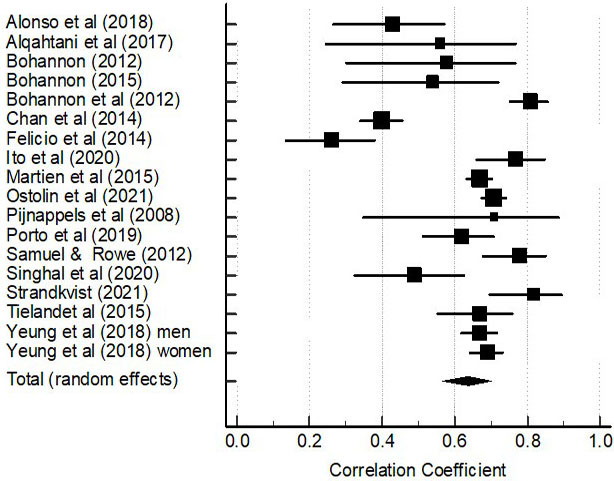
Funnel plot showing lack of significant publication bias in correlations between grip and knee extension strength for adults in 17 studies.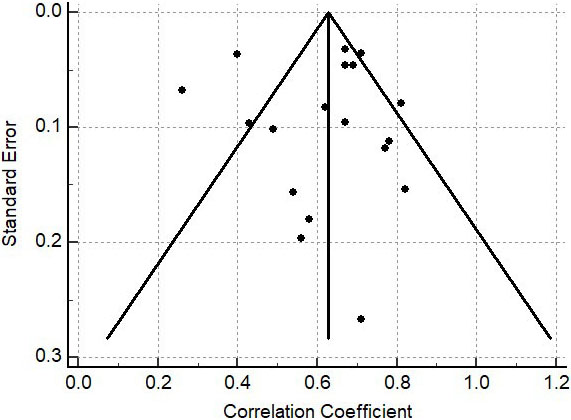
Correlations reported between grip and knee extension strength in individual studies ranged from 0.03 to 0.82, but for correlations included in the meta-analysis ranged from 0.26 to 0.82 (Fig. 1). The summary correlation for the meta-analysis was 0.64 with 95% confidence intervals of 0.57 to 0.70. Heterogeneity of the studies was high (I
This meta-analysis addressed the controversy surrounding the legitimacy of using grip strength as a proxy for knee extension strength. The summary correlation, which should provide a better indicator than correlations from individual studies, suggests that grip strength does covary with knee extension strength. That is, individuals with greater grip strength can be expected to demonstrate greater knee extension strength as well. The magnitude of the summary correlation, which might be considered “quite good…particularly in certain types of epidemiologic or psychosocial data [23]”, explains less than 40% of the variance between grip and knee extension strength. Consequently, the findings of some individual studies notwithstanding [3, 11], the results of this meta-analysis do not justify using grip and knee extension strength interchangeably. Perhaps the strength tested should be determined by the information required, patient specifics, and the resources available. Regarding information required, rising from a chair is correlated strongly with knee extension strength [24] but weakly with grip strength [25]. As for patient specifics, an individual in the intensive care unit may be amenable to testing grip strength but not knee extension strength. Concerning availability, a hand grip dynamometer is portable, easily used, and relatively inexpensive. An isokinetic dynamometer is not.
This review had several limitations. First, as only one bibliographic index was used, some key articles may have been overlooked. However, given the yield of the Google and hand searches, the relevant literature has likely been found. Second, the meta-analysis was highly heterogeneous. This means that the variation across studies was not due to chance. To what it might be attributed is uncertain- though procedural differences might be a factor. Publication bias seems not to blame.
In conclusion, grip and knee extension strength both provide an indication of limb strength. However, the correlation between these two variables is too weak to consider either measurement as a replacement for the other.
Ethical considerations
This study, as a literature review, is exempt from Institutional Review Board approval.
Funding
None.
Footnotes
Acknowledgments
None.
Conflict of interest
None.