




Abstract
BACKGROUND:
The inability of athletes to train or the decrease in the intensity and frequency of training may cause athletes to lose performance. Particularly in view of the current COVID-19 pandemic, maintaining strength outside the normal framework provides an advantage to athletes for the next competitions.
OBJECTIVE:
To compare the CrossFit Barbara which can be applied easily at home during the off-season or some situations such as the epidemic limitation to classic resistance training methods used to maintain the strength performance of national kickboxers.
METHODS:
Forty-three national kickboxers, CrossFit (CF,
RESULTS:
BP (
CONCLUSION:
CF Barbara workout was more effective in maintaining strength endurance performances, and RT in maintaining maximum strength performances. According to the individual performance needs of athletes, reasonable training method can be used to prevent performance decrement in the strength domain.
Introduction
Kickboxing is a combat sport where kicks and punches can be used, taking its origin from karate, Thai boxing, and western boxing [1], and it is mostly used for self-defense. The popularity of kickboxing is growing very rapidly and has approximately one million participants worldwide [1, 2]. Kickboxing requires different energy sources, strength needs, and psychological and physiological demands according to different competition disciplines [3, 4]. In combat sports, especially in kickboxing, it is known that athletes must not also be strong at the beginning of the match but also maintain their strength performance until the last second of the competition [4]. For these reasons, it is crucial for kickboxers to maintain and improve their strength performance in order to be successful in the competitions.
CrossFit
Resistance training (RT) protocols consists of the number and frequency of the muscle groups that are operated over a certain period [14]. Resistance training plays an important role in the protection of skeletal muscle [15, 16, 17]. It has been widely accepted that RT plays an important role for both strength and hypertrophic adaptations, and should be included in training programs [18, 19, 20]. Today, with resistance training, strength, and power development have become the main target for athletes to gain a competitive advantage over their sports discipline [21]. The ultimate goal applied by combat sports athletes of strength training programs is to increase athletic performance [22]. The main focus for sports scientists and coaches should be to reveal their maximum strength gains, to keep the performance at high level, and for these goals to set the most effective training programs [23]. Undoubtedly, classical resistance training is a very effective method for strength development and muscle hypertrophy, but compared to CF trainings, it is normally carried out in a certain place [8].
It is known that athletes enter a resting period for a certain time after active competition periods are over. Equally, extraordinary situations like the Covid-19 oblige people to stay in door. Such situations may result in de-training but maintaining strength performance would be crucial when normal routine is restored. Our study hypothesis is that during these periods the CrossFit Barbara method can be applied instead of the classical resistance training programs since it is easily applied, economic, accessible, and safer. Thus, the aim of this study was to compare CrossFit Barbara and classical RT methods applied for maintaining the strength performance of young national kickboxers during a 6-week rest period.
Methods
Participants
Forty-three young national level kickboxers aged 16–20 participated in this study. They were randomly divided into two training groups CF (
Experimental design
This study was designed to examine the effects of CrossFit Barbara and classical RT methods on maintaining strength performance during the off-season where athletes can choose to decrease the intensity and frequency of their trainings and even to stop their workouts. The data collection process was conducted after all national and international competitions were over when kickboxers have a rest period of 6–8 weeks. Participants performed a familiarization session at the beginning of the study and were allowed to perform the tests at submaximal intensity. After that, the athletes were randomly divided into two training groups CF (
According to the training protocol, CF performed 20 pull-ups, 30 push-ups, 40 sit-ups, and 50 squat exercises with a 3-min rest interval between sets; in all, five sets were performed. RT performed bench press, lat pull down (Spartan, Minneapolis, MN), leg press (Model MD-117, Body Master, Inc., Rayne, LA), biceps curl (Telju, Toledo, Spain) and triceps extension (Brunswick Company, Franklin Park, IL, USA) exercises in 4 sets with 3-min interval rest between sets 8 repetitions with 70% of the weights that they could perform in a predetermined maximum 1 repetition. The participant applied these protocols twice a week for 6 weeks. Before and after the six-week period, the following variables were recorded: anthropometric measurements (body weight, height, and body fat percentage), VO2max (aerobic capacity) [24]; bench press and squat (maximal dynamic strength); leg strength and handgrip strength, pull-up and push-up (strength endurance) [4] and counter movement jump (neuromuscular power) [25].
All tests were performed in all participants between 10:00 and 11:00 am. In combat sports there is a special attention to body weight management and nutrition and all athletes were followed by a nutrition expert. Participants followed the same dietary plans organized by their nutrition expert during the study protocol. Besides, they were not allowed to use any supplements during this period, or perform any exhaustive activity 24 hours before the testing days. Participants were verbally encouraged to maximize their performance during the tests.
Anthropometric measurements
Participants’ height (cm) was determined by Stadiometer (Holtain Ltd., UK); body mass (kg), (BM) and body fat percentage (%) (BF) were measured by bioelectric impedance analyzer (Tanita TBF 401, Japan).
Aerobic capacity test
Yo-Yo interval running test (Level 1) was used to determine indirectly the VO
Strength tests
Maximum Dynamic Strength
The Maximum Dynamic Strength of the participants was measured using a repeat maximum squat and bench press test. Athletes tried 3 attempts at 5-minute intervals for both tests. According to the wishes of the participants, the load was increased by 3–10% in valid trials and decreased by 3–10% in invalid trials. For an experiment to be considered valid, the movement was based on the full joint angle and returned to its starting position.
Isometric strengths tests
The isometric strength of the hand and leg of the participants were measured with the Takei A5001 Hand Claw Dynamometer and Takei A5002 Leg Dynamometer, Tokyo, Japan, respectively. The dominant hand was preferred during the hand grip strength test [26]. During the leg strength test, the pull stick of the dynamometer was placed on the hands and the angle of the knees was adjusted to 45 degrees. In both tests, the highest score from two trials with 3-minute rest intervals was considered valid.
Strength endurance tests
Strength endurance of the participants was determined by pull-up and push-up exercises. The total number of repetitions in which the participant succeeded in pulling his chin over the fixed rod was considered valid for the pull-up test. For the push-up test, the total number of repeats that the participant succeeded in performing at full joint angle and returning to the starting position was considered valid.
Change of the strength performance after 6 weeks of training following CrossFit Barbara or classical resistance training protocols
Change of the strength performance after 6 weeks of training following CrossFit Barbara or classical resistance training protocols
Note:
Counter Movement Jump (CMJ), was evaluated with the My jump 2 mobile application for neuromuscular power, which was previously tested for validity and reliability [25]. The athletes were asked to jump upright by applying maximal power, without any downward movement. During the tests, the athlete’s hands were at their waist, and the knees bent 90 degrees on the floor. This method was applied to the athletes in two repetitions and the best jump heights were recorded in centimeters (cm) as a valid score.
Statistical analysis
Statistical analysis was performed using SPSS 21.0 software (IBM Corp. Released 2012. IBM SPSS Statistics for Windows, Version 21.0. Armonk, NY: IBM Corp). The significance level was accepted at
Graphical display of BP, SQ, LS and CMJ performance values before and after exercise of CF and RT groups. Notes: CF: CrossFit Group, RT: Resistance Training Group, 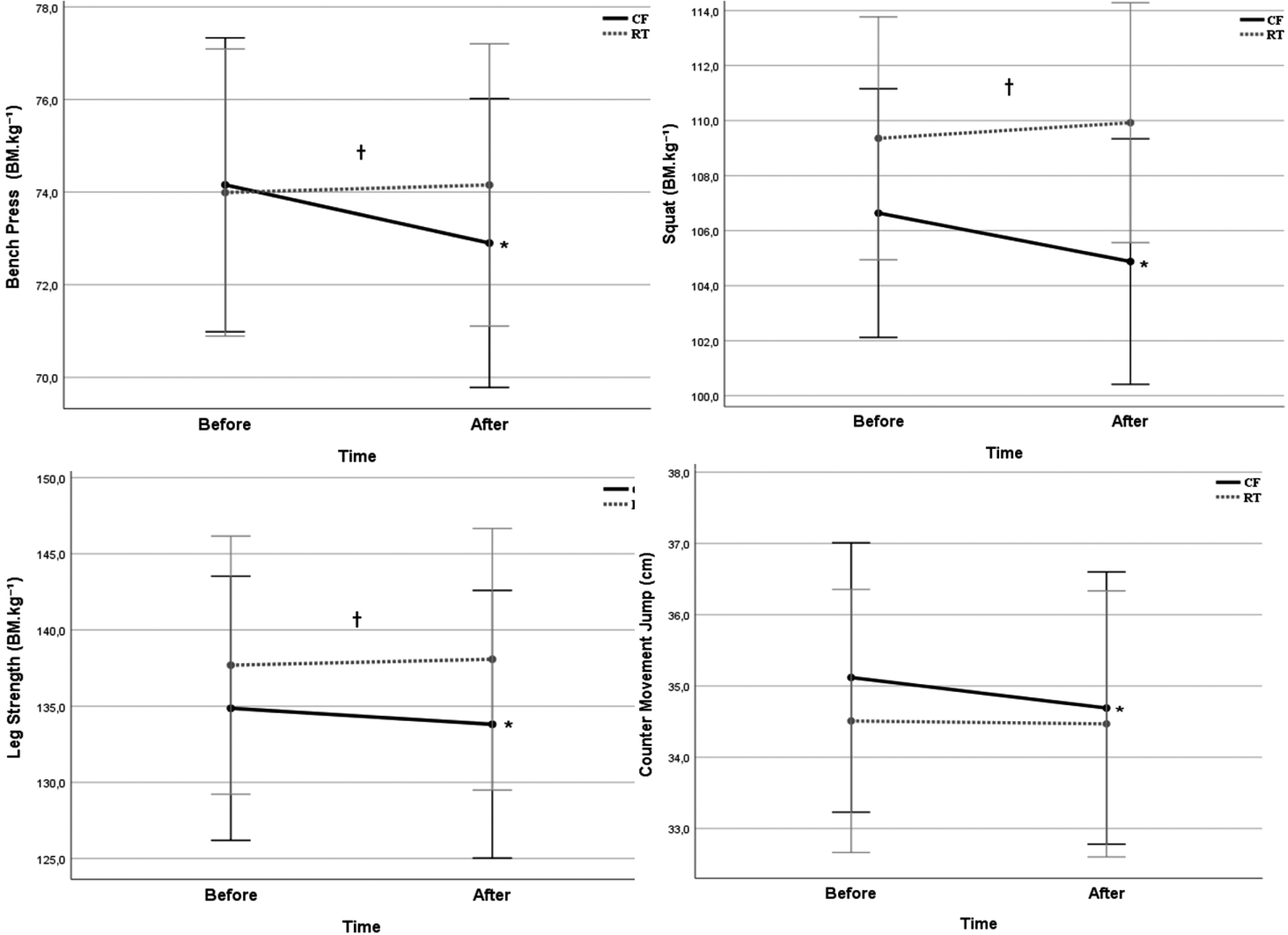
Graphical display of pull-up and push-up performance values of CF and RT groups before and after exercise. Notes: CF: CrossFit Group, RT: Resistance Training Group, 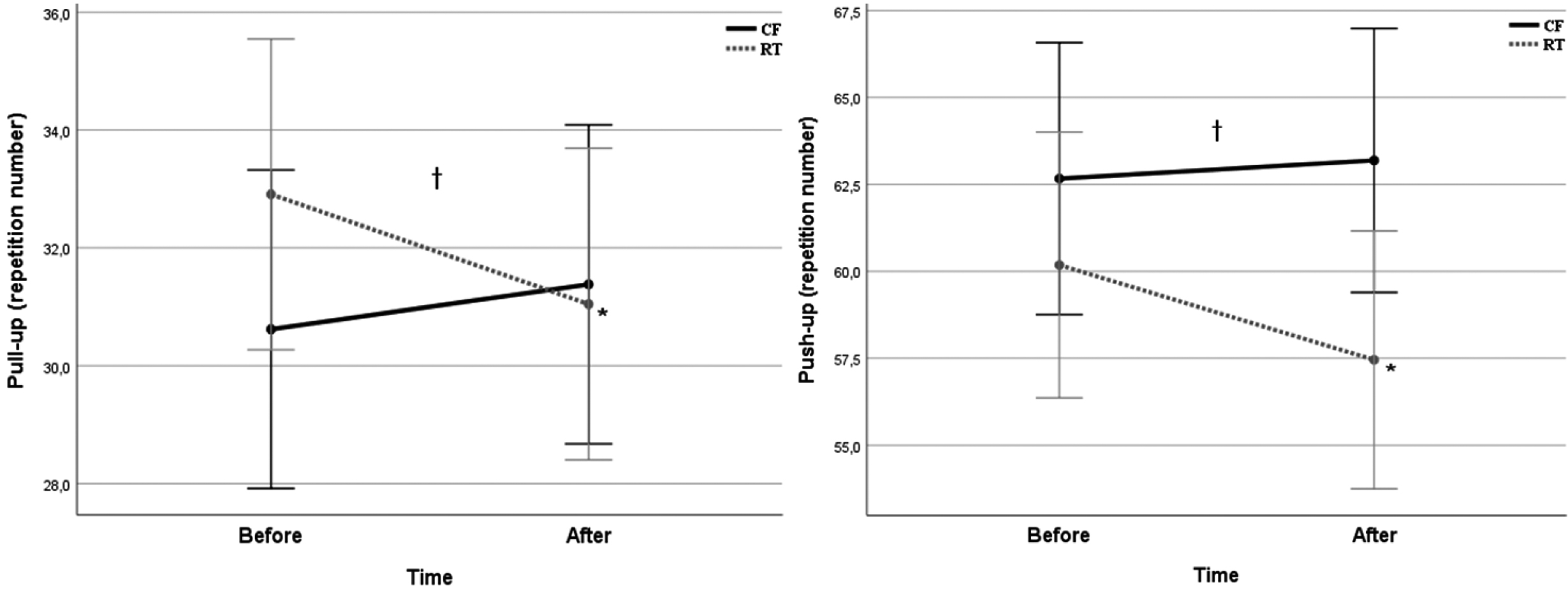
At the beginning of the study, no significant differences were found between the groups in terms of performance and descriptive features. The following outcome measures: BP (
Furthermore, after 6 weeks of training, BP, SQ, LS and CMJ decreased significantly within the group while there were no significant differences in body mass, body fat, HGS, VO
Discussion
Performance control is an important issue in sports and therefore in kickboxing due to a large number of international and national championships [29]. Testing the type of training used, training methods and training programs is an important factor in monitoring performance improvement. In kickboxing where physical competition is very high [30], minimizing the loss of performance in the off-season periods and starting the preparations for the new competitive season more effectively can play a crucial role.
In this study, in order to minimize or prevent the loss of performance during the off-season, the CrossFit Barbara method was used because it is easier, safer, more economic and applicable [8] while the effects of this training method on some strength parameters were examined. We used RT and CF trainings with four exercise practicing models since its effectiveness has been proven before in combat sports [12]. This study was carried out to investigate the effect of CF and RT on strength parameters such as maximum dynamic strength, isometric strength and strength endurance in kickboxing athletes and to show whether these training methods could be interchangeable.
Following 6 weeks of training, the CF group was able to maintain its performance in the domain of strength endurance as shown by the findings relating to pull-up and push-up exercises. However, a decrease in performance was apparent in tests requiring maximal strength (BP, SQ) neuromuscular power (CMJ), and isometric strength (LS) tests.
On the other hand, RT maintained their performance and did not experience any losses in tests requiring maximal strength (BP, SQ), isometric strength (LS) and neuromuscular test (CMJ) measurements while incurring performance loss in the tests requiring strength endurance such as pull-up and push-up, contrary to what was observed in CF group.
The present research is the first to focus on kickboxing. The number of studies conducted to increase strength performance is quite high [16, 17, 31, 32], but the main objective of our study was not the improvement of performance and strength parameters, but whether these parameters were maintained by the training methods we used during the resting periods. Unfortunately, the number of studies in sports literature that we can use to compare our results is quite scarce.
According to previous studies on resistance and CrossFit trainings, both CrossFit and classic resistance training methods have shown positive effects on body composition and strength increase [33, 34]. Murawska et al. stated that a three-month CrossFit exercise of 15 young female participants significantly reduced body fat percentage [33]. In another study in which 6-week different strength training methods were applied on 33 female participants, there was a significant decrease in the body fat of the group that applied the CrossFit training program [35]. In another study, CrossFit based high-intensity strength training program was applied to the participants. A significant decrease of 3.7% in the body fat percentage of the participants was found [7].
The findings we obtained from our study on anthropometric features showed different results compared to the above studies. In our study, no significant difference was observed in body fat percentage and body weight in both CF and RT. Likely, the reason for this difference is that our study covered a shorter period than the above studies since our protocol was done during the off-season. Nevertheless, some studies indicate that CF and RT do not significantly affect body weight and body fat percentages, and show similar characteristics with our study results [34, 35].
On the other hand, in a study conducted by Barfield et al., CrossFit training was applied in a group of 60 physically active people and did not reveal a significant difference in HGS in the results [34]. In the current study, when the HGS test results of both CF and RT were examined, there were no performance losses in this parameter. Possibly, because of the shorter duration the athletes did not experience any loss of isometric HGS performances in this process. However, in view of Barfield et al. [34] we think that the absence of a significant difference in HGS may be due to the difference of the CrossFit training methods applied.
Yüksel et al. [12] applied the CrossFit Cindy method on 32 wrestlers. In this study, they revealed that the CrossFit group had positive effects on some strength and strength endurance parameters [12], comparable to our study results.
Ïzbay also applied CrossFit Cindy and classical resistance training model to 28 elite wrestlers for 16 weeks; he found that CrossFit training had positive effects on strength endurance parameters [36]. In this study which was very similar to ours the effect of CrossFit training methods for protection of performance losses on some strength parameters was explored [8]. Considering the results of these studies, it can be said that CrossFit trainings have positive effects on strength endurance parameters such as pull-up and push-up, and the results of these studies [8, 36] support the current findings.
Sparkes and Behm [17] examined the effects of resistance training on unstable ground on some strength and neuromuscular power parameters. In this study resistance training had a positive effect on neuromuscular power [17] and similar to ours (RT group). However, unlike our results regarding BP, SQ and CMJ performances in the CF group, there are studies showing that CrossFit trainings have positive effects on maximal strength, neuromuscular muscle power and aerobic capacity [13, 37]. Sousa et al. showed that CrossFit training had positive effects on CMJ and VO
In terms of limitations, our study is limited by including only the CF method and the fact that our study group consisted of only junior kickboxers. Moreover, the present study was carried out in a six weekly short time since the study was completed during the rest periods. Future studies need to be performed over longer periods with harder training design on different populations to compare the training methods more effectively.
Conclusion
The CrossFit Barbara or the classical resistance training methods can be selected and used to prevent loss of performance by athletes dealing with different sport disciplines based on physical competition. This study suggests that the athletes who do sports requiring maximal strength such as weightlifting and shot put should apply classical resistance training programs to maintain their sports performance during the off-season. On the other hand, the CF Barbara method is an effective performance loss preventive exercise protocol and should apply by athletes dealing with sports that require strength endurance such as kickboxing, boxing, wrestling, or judo during the rest period for maintaining performance.
Author contributions
CONCEPTION: Cebrail Gençoğlua and İlhan Şen.
PERFORMANCE OF WORK: Cebrail Gençoğlu.
INTERPRETATION OR ANALYSIS OF DATA: Cebrail Gençoğlu.
PREPARATION OF THE MANUSCRIPT: Cebrail Gençoğlu and İlhan Şen.
REVISION FOR IMPORTANT INTELLECTUAL CONTENT: İlhan Şen.
SUPERVISION: Cebrail Gençoğlu and İlhan Şen.
Ethical considerations
Ethics committee approval for the study was obtained from the Ataturk University Faculty of Sport Sciences Ethics Committee (approval number 70400699/11.00-190066441, dated 04.12.2019). Participants, their families and coaches were informed about the study design, and written informed consent forms were obtained to participate in this study.
Funding
The authors report no funding for the present study.
Footnotes
Acknowledgments
This article is produced from a master thesis. The authors wish to thank the participants for their enthusiastic participation.
Conflict of interest
The authors declare no conflict of interest.