




Abstract
BACKGROUND:
Judo practice requires high effort from athletes, mainly focused on the upper limbs, involving the shoulder complex.
OBJECTIVE:
To compare the shoulder internal (IR) and external (ER) rotation peak torque and conventional ratio (ER: IR) between judo athletes from different experience levels (novice vs. advanced) and to verify the distribution of athletes according to the ER: IR ratio classification.
METHODS:
Thirty-nine male judo athletes were divided into two groups (advanced: 20.5
RESULTS:
The main results showed higher values of IR peak torque (77.3
CONCLUSION:
Advanced athletes presented higher shoulder IR peak torque, but higher imbalance in the ER: IR ratio than novices, probably because the long-term training induced an increase in IR strength without concomitant development in ER strength. Coaches and strength and conditioning trainers should monitor shoulder rotator strength in judo athletes to avoid muscle imbalances in this region, which is frequently employed in judo training routines.
Introduction
Sports performance in combat modalities requires a combination of various components to achieve success [1], such as aspects related to motor-specific performance, and physiological, psychological, and neuromuscular attributes [2, 3, 4]. In the case of judo, athletes seek to combine these aspects in order to beat the opponent from three perspectives: throwing to the ground, immobilizations, chocks, or joint locks, or by athlete disqualification [5]. It is important to highlight that judo efforts can last for four minutes or for an unlimited time (in the case of the golden score), requiring high physiological demands and strength due to the varied technical-tactical actions [6]. As a result, there is great focus on the upper limbs, especially involving the shoulder complex [7, 8, 9], for example, during the grip dispute, judo throwing techniques (e.g. seoi-nage, tai-otoshi, etc.), transition to groundwork fight, and groundwork techniques (particularly arm locks).
Repetitive movements (overuse) involving the shoulder through long-term training and several competitive seasons can cause some harmful effects on the shoulder complex, such as imbalance in the strength ratio between internal and external rotator muscles [8], asymmetry between limbs [10], and weakness of the auxiliary muscles in the shoulder region (i.e., rotator cuff muscles) [7]. Consequently, injuries in the shoulder complex are common, regardless of the judo environment (training or competition) [11, 12, 13, 14, 15].
The glenohumeral joint anatomy per se is a factor related to the occurrence of injuries, due to its instability, as it is only sustained by ligaments and musculotendinous units [16]. In this sense, the muscles of the shoulder complex play a fundamental role in the production of strength, power, and stabilization of the joint [17]. Imbalances between shoulder internal and external rotator muscles have been considered important risk factors for shoulder injuries in overhead sports [17, 18, 19, 20]. In judo, some evidence suggests that specific training [8, 21] and/or previous shoulder injury [7] induce imbalance in the strength ratio of shoulder internal and external rotator muscles (ER: IR) (usually weakness in the external rotator). Ruivo et al. [8] found a lower shoulder ER: IR ratio than recommended (from 0.66–0.75) [16, 22] in judokas compared to non-judokas, demonstrating that judokas present a selective increase in the internal rotation strength, without concomitant development in the external rotation. When comparing the ER: IR ratio between advanced and novice judo athletes, Detanico et al. [21] found a lower ER: IR ratio in advanced athletes compared to novices (0.72 and 0.83, respectively), suggesting greater balance between shoulder internal and external strength in experienced athletes compared to novices. However, these findings still need further analysis with a larger sample size.
Identifying shoulder strength parameters (e.g. peak torque, ER: IR ratio) in judo athletes from different competitive levels (e.g., novice vs. advanced) may provide important information on the role of judo systematic practice in shoulder strength balance. Moreover, preventive programs to reduce the probability of shoulder musculoskeletal injuries in judo athletes may be elaborated from the starting point of identification of the shoulder strength profile in athletes from different groups. Therefore, the aim of the current study was to compare the shoulder internal and external rotation peak torque and ER: IR conventional ratio between judo athletes from different experience levels (novice vs. advanced) and to verify the distribution of athletes according to the classification of the ER: IR ratio. The main hypothesis was that advanced athletes would have higher shoulder internal and external peak torque than novice athletes, but higher imbalance in the ER: IR ratio due to the specific muscle adaptation caused by long-term practice.
Materials and methods
Comparison of age, anthropometric variables, and judo experience between novice and advanced groups
Comparison of age, anthropometric variables, and judo experience between novice and advanced groups
Thirty-nine male judo athletes participated in the study, divided into two groups based on their level of experience (novice and advanced). Levels of experience were defined based on two criteria: a) judo graduation (belts), with the novice group composed of athletes with orange, green, and purple belts, and the advanced athletes with purple, brown, and black belts [21] and; b) time of experience, considered as the years of judo formal training. The t-test showed higher time of experience in advanced athletes (
Design
This is a cross-sectional study, in which athletes performed a shoulder rotator strength test using an isokinetic dynamometer. First, we assessed anthropometric variables (height and body mass), age, judo practice, and graduation (belt at that moment). Subsequently, an isokinetic protocol for shoulder internal and external rotation was performed in the dominant upper limb in all athletes.
Shoulder isokinetic assessment protocol
Participants were seated on an isokinetic dynamometer (Biodex Multi-Joint System- Pro 4; Biodex Inc., Shirley, NY, USA) chair and stabilized with restraining straps placed around their chest and hips. The athletes’ arms were weighted to provide gravity compensation. Shoulder external and internal rotation torque was measured with the arm positioned at 45
Before the evaluation, the athletes performed an initial set of three to four submaximal trials to familiarize themselves with the shoulder internal and external rotator concentric contraction, which were also used as warm-up exercises for the upper limbs. After a 3-min passive recovery, participants then performed one set of five maximal shoulder external and internal rotations in concentric/concentric mode at 180
Data analysis
The torque data were exported from the Biodex Advantage software and filtered using a fourth order low pass Butterworth filter at 20 Hz. We considered the highest value (of three trials, the first and last trials were excluded) of shoulder internal rotation peak torque, shoulder external rotation peak torque, and the conventional ratio (ER: IR), defined as the quotient between peak torque of external rotators and peak torque of internal rotators. The relative reliability (consistency) of isokinetic peak torque was calculated for the trials and Intraclass Correlation Coefficient (ICC) indices of 0.98 and 0.99 were found for internal and external rotation torque, respectively.
Statistical analysis
Data are presented as mean and standard deviation (SD) and individual values for the athletes. The Shapiro-Wilk test was used to verify the data normality. Chi-square tests were used to test the association between group distribution (novice and advanced) and classification of the ER: IR ratio: low (
Comparison of shoulder internal and external peak torque performance between novice and advanced judo athletes.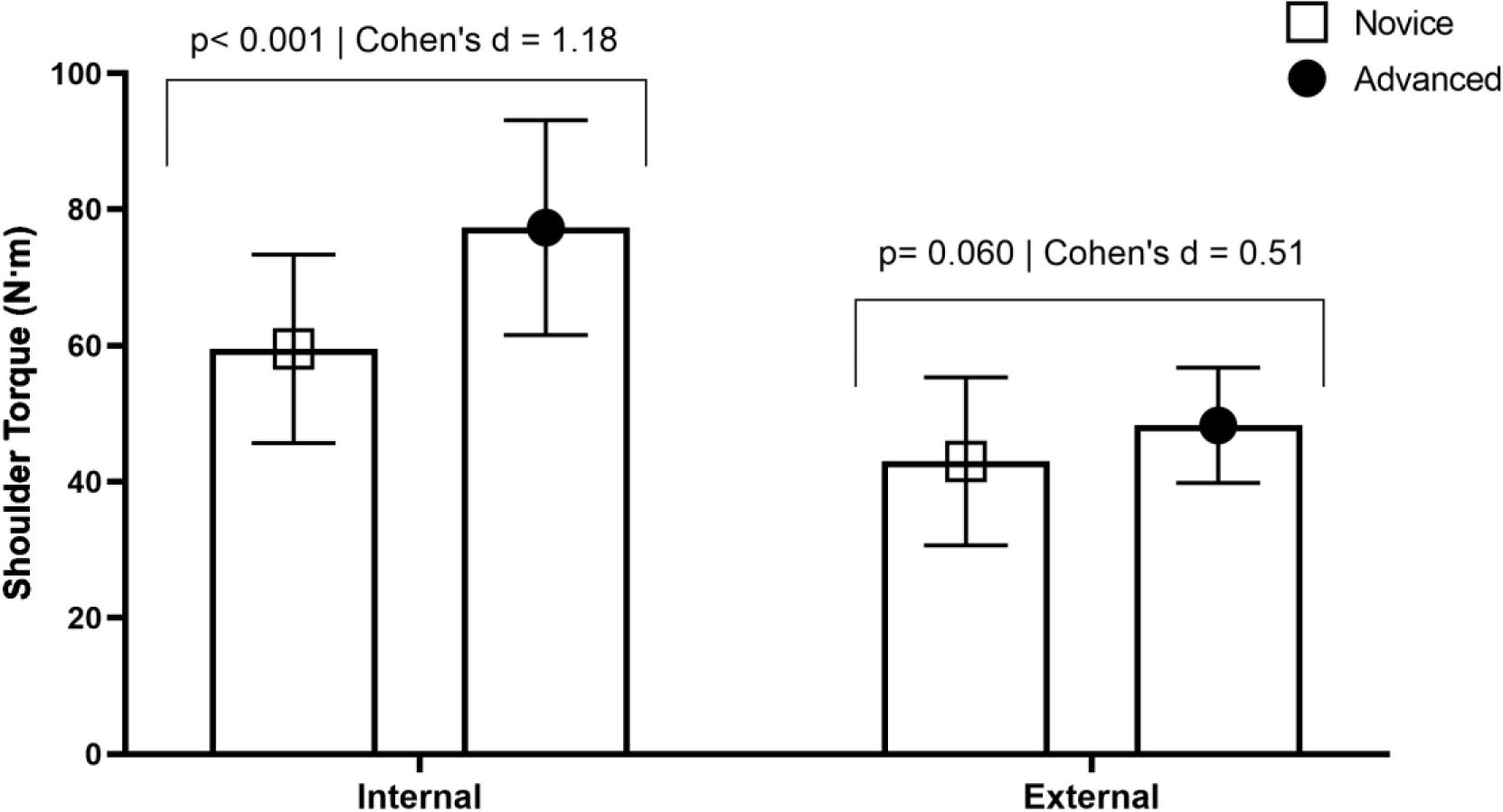
Comparison of ER: IR ratio between novice and advanced judo athletes.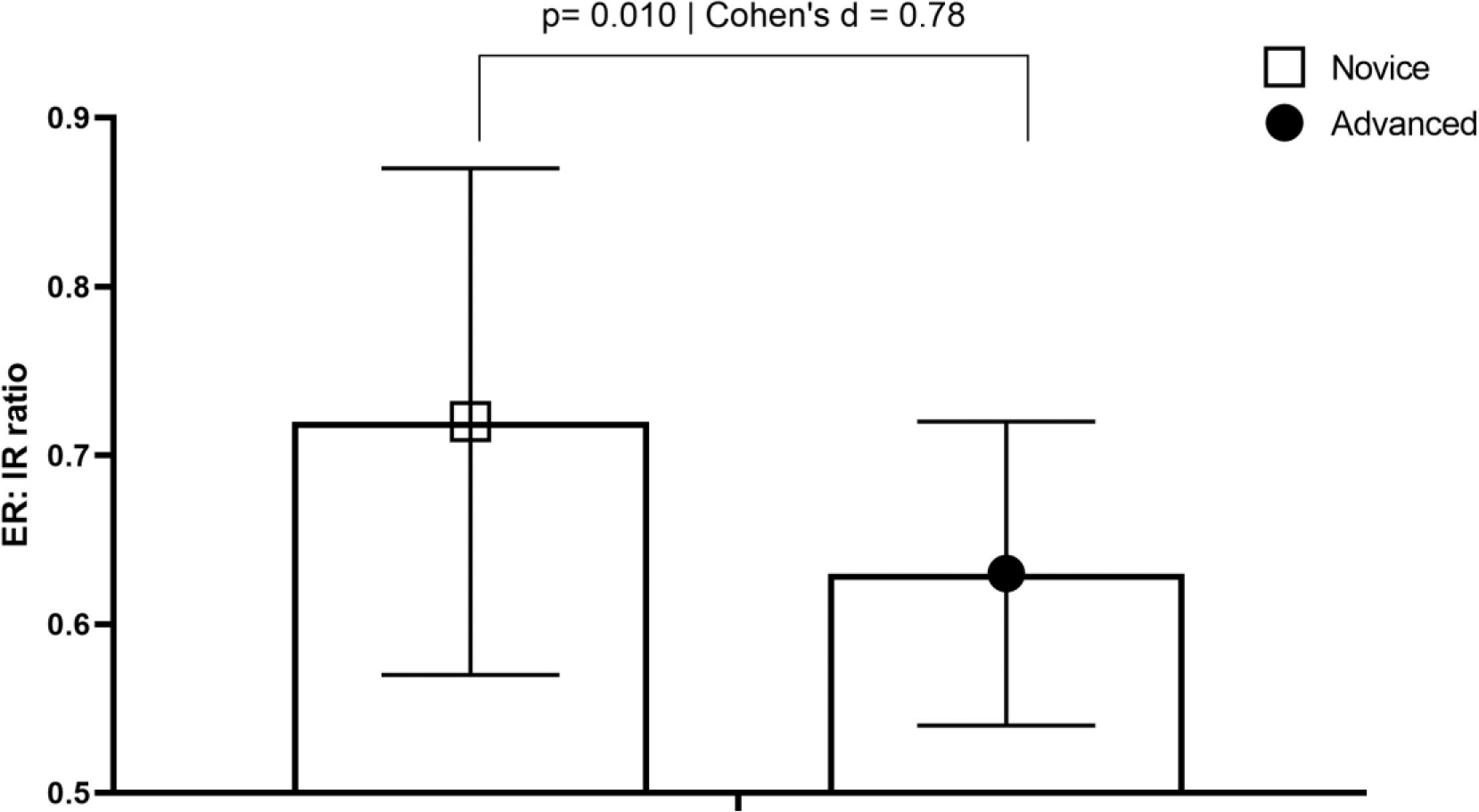
Shoulder rotator torque and ER: IR ratio between novice and advanced groups
Figure 1 presents the values of shoulder internal and external isokinetic torque between advanced and novice athletes. There was a significant difference in the shoulder internal peak torque between novice and advanced athletes, with higher values in advanced athletes compared to novices (moderate effect). No significant difference was found for shoulder external peak torque between groups.
Figure 2 presents the comparison of the ER: IR ratio between novice and advanced athletes. The results showed higher ER: IR values for novice athletes (0.73
Individual values of ER: IR ratio between novice and advanced judo athletes according to classification groups.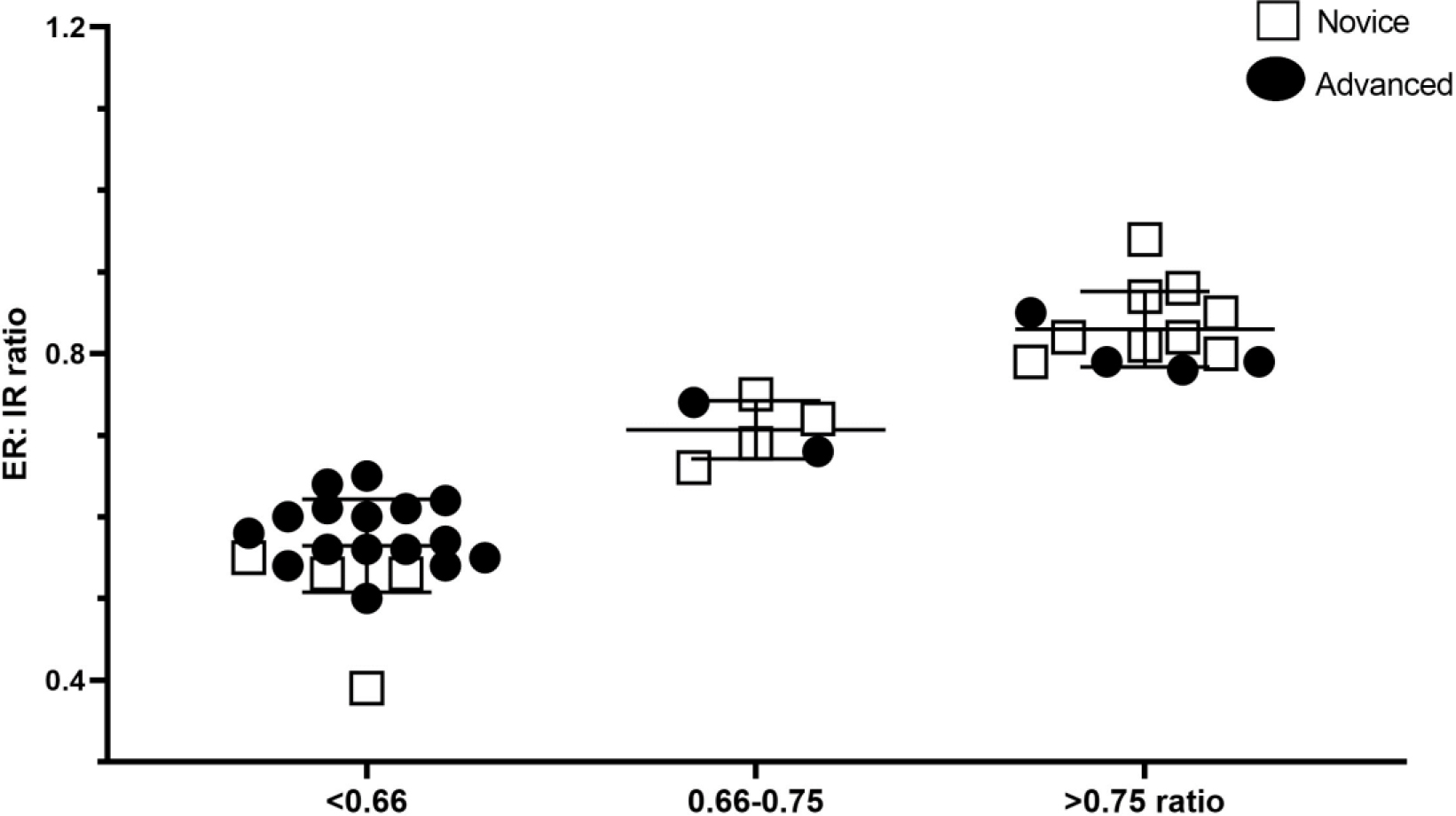
Figure 3 presents the individual values of the ER: IR ratio based on the following classification: low (
Discussion
The current study aimed to compare the shoulder internal and external rotation peak torque and ER: IR conventional ratio between judo athletes with different experience levels (novice vs. advanced), and verify the distribution of athletes according to the ER: IR ratio classification. The hypothesis of this study was accepted, as the advanced athletes showed higher values of shoulder internal peak torque than novice athletes and presented higher imbalance in the ER: IR ratio, probably due to the increase in internal rotation strength without development of external rotation strength.
Advanced athletes presented higher values of shoulder internal rotation torque than novices, without differences in the external rotation torque between groups. Similar results were found by Detanico et al. [21], as higher shoulder internal rotation peak torque was verified in the advanced group compared to the novice group, without difference in the external rotation torque. Although some judo actions also require efforts from the shoulder external rotation muscles (e.g. pulling the sleeve to attack or counterattack) [24], most of the effort during the training and competition is performed by shoulder internal rotator muscles (e.g. grip disputes and execution of several judo throwing techniques) [21]. Therefore, it is suggested that judo practice may induce selective increases in internal rotation strength without concomitant development of external rotation strength, causing high shoulder imbalance in the advanced group. The current literature shows that high shoulder imbalance can impair joint instability and, consequently, increase the risk of injuries [17, 18, 19, 20].
When analyzing individual values of the ER: IR ratio classification, the majority of athletes in the novice group were allocated as having a high ER: IR ratio (
The shoulder complex comprises a group of muscles denominated the rotator cuff, which are very important for dynamic stabilization of the shoulder, mainly in sports tasks involving shoulder abduction and flexion above 90
As practical applications, coaches and strength and conditioning (S&C) trainers should monitor shoulder rotator strength (e.g. conventional and functional ER: IR ratio) in judo athletes to prevent muscle imbalance (i.e. outside the normal ratio), which is a risk factor for shoulder strains and joint instability [17, 18, 19, 20]. Other factors, such as training overload, pain episodes, shoulder instability, and injury history should also be monitored to help identify shoulder rotator imbalance. Preventive exercise programs (unilateral and bilateral) for upper limbs to strengthen the rotator cuff muscles in concentric and eccentric contractions are recommended to promote shoulder stability [20]. Stretching exercises should also be used to improve or maintain the range of motion in the upper limbs to improve mobility, essential for good technical performance and injury prevention [27].
Finally, some limitations can be highlighted in this study. First, no other shoulder assessments were performed considering functional tests (e.g. upper quarter Y balance test, modified closed kinetic chain upper extremity stability test, and unilateral seated shot put test), and no eccentric contraction was investigated, which could help to further explain the injury-related mechanisms in the shoulder complex. Second, only the dominant side was evaluated, meaning it was not possible to verify asymmetry between the upper limbs, which could provide important results related to muscular adaptation in the shoulders of judo athletes. Third, we did not have access to information on the athletes’ previous shoulder injuries, which could influence the ER: IR conventional ratio.
Conclusion
In conclusion, advanced judo athletes performed better in the shoulder internal peak torque than novice athletes, but presented higher imbalance in the ER: IR ratio. Therefore, in the current study, judo practice induced selective increases in internal rotation strength, without concomitant development in external rotation strength, inducing high imbalance in the shoulder rotator muscles.
Author contributions
CONCEPTION: Daniele Detanico and Rafael L. Kons.
PERFORMANCE OF WORK: Daniele Detanico, Rafael L. Kons, Marina Saldanha da S. Athayde and Rodrigo G. Gheller.
INTERPRETATION OR DATA ANALYSIS: Daniele Detanico, Rafael L. Kons.
PREPARATION OF THE MANUSCRIPT: Daniele Detanico, Rafael L. Kons, Marina Saldanha da S. Athayde and Rodrigo G. Gheller.
REVISION FOR IMPORTANT INTELLECTUAL CONTENT: Daniele Detanico, Rafael L. Kons.
SUPERVISION: Daniele Detanico and Rafael L. Kons.
Ethical considerations
The study was approved by the local ethics committee (Protocol number 119.014) of the Federal University of Santa Catarina, Santa Catarina, Brazil. Before the assessment, every participant received the same detailed information about the testing procedure and signed the informed consent.
Funding
This work was financed by Coordenação de Aperfeiçoamento de Pessoal de Nível Superior – Brazil (CAPES) – Finance Code 001.
Footnotes
Acknowledgments
None.
Conflict of interest
The authors certify that there is no conflict of interest.