




Abstract
BACKGROUND:
Repetitive stretch-shortening cycle exercises generate high rates of mechanical work and consequently induce substantial muscular fatigue related to delayed neuromuscular functions.
OBJECTIVE:
To investigate the neuromuscular impairment after high-intensity exercise protocols involving different gravity loads in stretch-shortening cycle – running (RUN) and vertical jumps (VJ).
METHODS:
Twenty-two healthy men, divided into two groups, VJ and RUN participated in this study. The individuals performed a training session involving six bouts of 30 s of VJ or RUN. The isokinetic PM (PM) of the knee extensors and flexor muscles, rate of perceived exertion and delayed onset muscle soreness (DOMS) were evaluated at pre, post, 24 h and 48 h post-training.
RESULTS:
The concentric and eccentric PM of the extensor in the RUN group was reduced until 24 h, while in the VJ a decrement was observed until 48 h. Following running, the PM of the flexors decreased until 48 h, while for VJ there was an eccentric PM decrement at 48 h. The DOMS increased at the anterior thigh and only after VJ training for 48 h.
CONCLUSION:
Acute and delayed neuromuscular impairment may be observed after both exercise regimens, but high-intensity training using vertical jumps seems to induce a more pronounced impairment than running.
Introduction
The stretch-shortening cycle (SSC) is a natural muscle function characterized by a combination between a pre-activated muscle in the eccentric phase (i.e., when the muscle is active during the stretch) and then followed by a concentric (shortening) action of the movement [1, 2]. The efficiency of the SSC muscle contraction is dependent on the capability to transfer energy from the eccentrically stretched muscle-tendon complex to the concentric push-off phase of movements [3]. This mechanism induces an enhancement in muscle performance compared to only the concentric actions [4, 5]. The SSC is utilized when the body segments are subjected to some stretch or impact due to external forces such as gravity. Running and hopping are typical examples in human locomotion of how this phenomenon occurs [1].
Repetitive SSC exercises generate high rates of mechanical work and consequently induce substantial muscular fatigue [1]. The development of fatigue alterations seems to be dependent on the characteristics of the SSC exercise, such as volume [6] and intensity [7]; however, the fatigue responses may also be dependent on the different type of SSC exercises, when performed at the same intensity. Pronounced muscle demands are observed during the braking phase of actions like running and jumping in order to adjust the stiffness of the leg for absorbing high-impact peak forces and storing elastic energy in muscle-tendon complexes [1]. Jumping and running are considered activities of high impact [8], but in the former, the ground reaction forces are more pronounced vertically to overcome the gravity, while the sprint is characterized by the lower vertical displacement, and greater horizontal ground reaction force [9]. These specific characteristics of vertical and horizontal profiles of SSC exercises may cause different eccentric overloads on muscles during the braking phase of movements. However, the magnitude and time-course of these fatigue responses still need to be investigated.
Typically, the SSC fatiguing exercise can have a varied and complex neuromuscular response, often with a bimodal recovery pattern [2, 10] inducing acute and delayed alterations at the proprioceptive and neuromuscular levels [2]. A common response observed immediately after the SSC fatiguing exercise is the decrease in strength/power performance [11], which is accompanied by a faster recovery period after a few hours. The immediate decline in performance is commonly related to acute metabolic alterations [12]. However, a secondary alteration of muscle function can be observed, that is associated with inflammatory processes with the presence of delayed-onset muscle soreness (DOMS) and prolonged strength loss [13]. Usually, these responses have been attributed to muscle damage occurrence during SSC and it can last for several days [13].
Therefore, the objective of the present study was to investigate the acute and delayed neuromuscular impairment (loss of moment production capability and DOMS) after high-intensity exercise protocols involving different gravity loads in SSC (i.e., running or vertical jumps). We investigated the responses of high-intensity training because it has gained great popularity in recent years, mainly using running as an exercise regime and, recently, vertical jumps as an alternative regimen for this type of training [14, 15]. Understanding the acute and delayed effects of an exhausting SSC exercise is important in the control of the training load and in the determination of recovery periods, allowing for greater effectiveness in physical training.
Methods
Participants
Twenty-two healthy men, divided into two groups, vertical jump group (VJ, N
Study design
Participants were randomly assigned into two independent groups, according to their training regime; 1) running (RUN) and 2) continuous vertical jumps (VJ). They attended the laboratory on five non-consecutive days. On the first day, familiarization with testing procedures was conducted and after they performed maximal sprints tests; on the second visit (48 h later), participants performed a progressive maximal test on a treadmill and on the third visit (48 h later), the participants returned to perform the session training. Aiming to analyze the acute and delayed effects of running and jumping training, participants were assessed, in terms of muscle soreness and isokinetic moment of the knee extensor and flexor muscles, prior to the training (baseline), immediately after and 24 and 48 h after training.
Maximal progressive test and maximum sprinting speed
Participants performed three maximal 40 m sprints in a synthetic running track with electronic photocells placed at 0, 30 and 40 m in the course. Sprints were preceded by a standardized warm-up (5-minutes jogging, skills and 2 progressive sprints). The individuals started from a stationary position and no starting blocks were used. The average speed of each section (0–30 m and 30–40 m) of the course was identified and the highest value (considering the three attempts) was considered as the maximum sprinting speed of the individual.
A progressive running test was performed on a treadmill (Cosmos – pulsar
Training session
The training session consisted of six bouts of 30 s jumping (VJ) or running (RUN), adopting a work/rest ratio of 1:6. In the VJ training, bouts consisted of maximal continuous vertical jumps performed on a force platform (Quattro Jump, model 9290AD – Kistler Instrument Corp, Winterthur, Switzerland). A specific warm-up was performed, consisting of one-minute of hopping on a trampoline, three sets of ten hops on the ground and three maximal continuous vertical jumps. The participants were required to keep the trunk as vertical as possible, and hands were placed on hips (akimbo), and were also asked to flex their knees at approximately 90
The running training consisted of six bouts on a motorized treadmill at
Isokinetic assessment
The isokinetic PM of the knee extensors and flexors of the participants’ dominant leg (‘kicking leg’) was evaluated using an isokinetic dynamometer (Biodex System 3, Biodex Medical Systems, Shirley, NY). On the first day, the subjects were familiarized with the dynamometer, performing a protocol consisting of 3–4 submaximal and maximal knee flexion and extension phases corresponding to the eccentric/concentric actions of the extensor and flexor muscle groups. Participants were seated on the dynamometer in an adjustable chair, with the angle between the trunk and thigh at 90
To obtain the PM, participants performed three maximal voluntary concentric and eccentric contractions for the knee extensor and flexor muscles prior to the training (baseline condition), immediately after, 24 h after and 48 h after the training session. The PM (concentric and eccentric) was considered the highest value obtained in the three test repetitions.
Rate of perceived exertion (RPE) and delayed onset muscle soreness (DOMS)
The RPE was recorded on the CR-10 Borg Scale [18] ranging from 0–10 (0
PM of the knee extensors after running (panel A) e vertical jump training (panel B).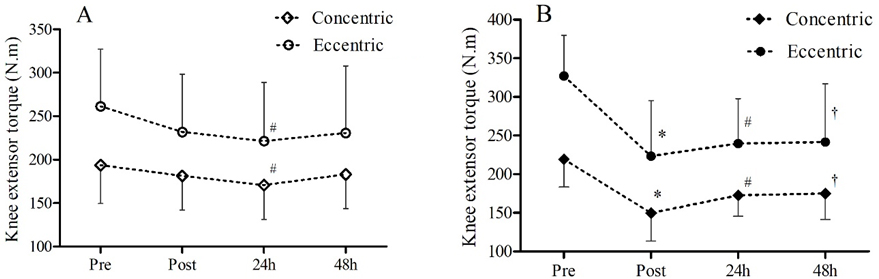
PM of the knee flexors after running (panel A) and vertical jump training (panel B). Note: 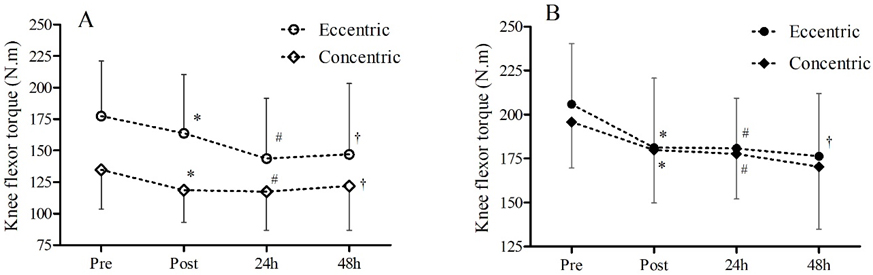
Data were reported as means and standard deviations. Shapiro-Wilk test was used to verify the data normality. A
Results
A significant difference was found for RPE (
Significant effects for extensors eccentric PM (PM
Significant effects was also verified for the flexors eccentric PM (PM
The DOMS in the thigh is shown in Fig. 3, panel A. It verifies changes of DOMS at anterior thigh after VJ training (F
DOMS for thigh (panel A) and leg (panel B). 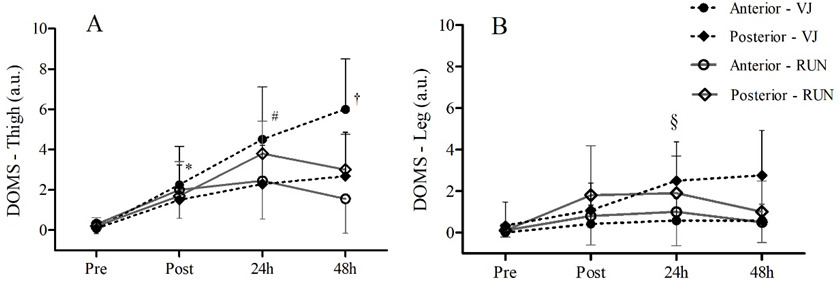
Figure 3B shows the DOMS for the leg. No significant effect was detected for DOMS at anterior leg in VJ (F
The purpose of this study was to investigate the acute and delayed neuromuscular impairment (loss of capacity to produce moment and DOMS) after high-intensity exercise protocols involving different gravity loads in SSC (running and jumping). The main hypothesis was that the VJ exercises would induce greater decrease in PM in the lower limbs and greater DOMS than RUN protocol.
Both running and jump training were performed at high intensity, with same volume (6
In the RUN group, the knee extensor muscles showed delayed fatigue up to 24 h after exercise, while the hamstring muscles (knee flexors) presented moment levels below baseline values even after 48 hours of recovery. This result corroborates with Andersson et al. [20] who have shown that PM for knee extension muscles returned to baseline 27 hours after soccer matches, whereas the knee flexor muscles remained below the baseline for 51 hours. The more prolonged impairment of knee flexors after running training may be related to the role of these muscles in the movement, as they are considered the major muscles involved in the propulsion phase and on the final swing phase during sprinting [21]. In addition, the hamstring muscles seem to be more susceptible to fatigue when compared to the quadriceps muscles immediately after the fatigue protocol involving running and sprint exercises [22].
Considering the DOMS, in the RUN group, there was an acute effect at the anterior thigh and delayed effect at its posterior aspect. This result corroborates with anterior evidence indicating greater muscle soreness localized in the hamstrings following sprint tasks [23]. During the sprint, the hamstring muscles demand great tension while lengthening to slow the knee extension [24], which is a factor that induces muscle soreness and possible muscle damage (i.e. DOMS) [13]. The magnitude of DOMS detected in VJ training is greater than the RUN group after 24 and 48 hours. This may be due to different eccentric overloads imposed on muscles during landing in the braking phase of movements in the vertical jump and running [1]. Highton et al. [25] reported an increase in DOMS at the extensor territory following muscle damaging exercise (10 sets of 10 maximal vertical jumps with 1-minute recovery between sets) until 48 hours post exercise and a decrease in PM in same anatomical area lasting 48 hours post exercise, as well. We found similar results in the VJ group, where DOMS at the anterior thigh peaked 48 hours after exercise and knee extensors PM
It is known that in fatiguing high-intensity exercise involving SSC, the presence of a great magnitude of muscle damage is expected [2, 20]. The DOMS is a very frequent symptom that may indicate muscle damage as a response to an inflammatory process, which can be reported from 8–24 hours and can have the peak from 24–48 hours after the exercise session [13]. The recovery and regeneration processes of the muscle are complex, due to damage involving the Z-band and sarcomere disruption [26], which may take days for complete recovery. It is important to highlight that impairment in muscle function (particularly the ability to exert maximum strength), is expected when DOMS is present, since eccentric contraction may compromise the structures of the sarcomere. However, despite the association between soreness and mechanical stress, Byrne et al. [27] state that one has to be cautious when using DOMS as an indicator of the magnitude of muscle damage. Thus, a possible limitation of the present study is the lack of blood indicators of muscle damage such as creatine kinase (CK) and lactate dehydrogenase (LDH).
The results of the present study may help understanding the fatigue responses imposed by different mechanical overloads on the lower limb muscles. As a consequence, it may be useful for controlling the training load and also for determining recovery periods during high-intensity training, which has gained great popularity in recent years. For example, it was verified that the training performed with vertical jumps induced more prolonged fatigue and neuromuscular impairment when compared to running training, requiring a longer recovery period to ensure that overcompensation had occured.
Conclusion
High-intensity training using VJ causes moment decrement of knee extensors and flexors muscles (eccentric and concentric contractions) until 48 h post-training, while for RUN training only the eccentric moment of knee flexors was decreased until 48 h. This indicates that acute and delayed neuromuscular impairment may be observed after both exercise regimens, but high-intensity training using vertical jumps seems to induce a more pronounced impairment than running. In addition, the magnitude of muscle soreness in lower limbs increased at 24 h and 48 h compared to baseline only for the VJ group, suggesting the occurrence of possible muscle damage after jumps training.
Author contributions
CONCEPTION: Juliano Dal Pupo.
PERFORMANCE OF WORK: Juliano Dal Pupo, Rafael L. Kons, Rodrigo G. Gheller, Filipe E. Costa and Lucas Dalla Vecchia.
INTERPRETATION OR DATA ANALYSIS: Juliano Dal Pupo.
PREPARATION OF THE MANUSCRIPT: Juliano Dal Pupo, Rafael L. Kons, Rodrigo G. Gheller, Filipe E. Costa, Lucas Dalla Vecchia and Daniele Detanico.
REVISION FOR IMPORTANT INTELLECTUAL CONTENT: Juliano Dal Pupo, Rafael L. Kons, Rodrigo G. Gheller and Daniele Detanico.
SUPERVISION: Daniele Detanico.
Ethical considerations
Participants received a detailed explanation of the purpose and methods of the study prior to signing a written informed consent form. The study was approved by the local ethics committee (Protocol number 1.691.982) at the Federal University of Santa Catarina (Aug. 22, 2016).
Funding
Conselho Nacional de Desenvolvimento Científico e Tecnológico (CNPq).
Footnotes
Acknowledgments
The authors acknowledge all volunteer participants for their collaboration and the Biomechanics Laboratory of Federal University of Santa Catarina.
Conflict of interest
None to declare.