




Abstract
BACKGROUND:
The introduction of high-intensity functional training (HIFT) in sport gave rise to the exploration of determinants of success in sport.
OBJECTIVE:
To analyze whether asymmetry inter-limb is related to reduction in physical performance in amateur HIFT athletes.
METHODS:
Twenty-four HIFT amateur athletes, 11 women and 13 men, participated in the study. All volunteers performed three different jump tests: the squat jump (SJ), the countermovement jump (CMJ), performed unilaterally and bilaterally, and the 20-m sprint test.
RESULTS:
An overall asymmetry inter-limb of 9.5% in women and 9.3% men was not associated with any of the outcome measures. There were no significant differences in both genders between asymmetry, sprint, lower limbs’ muscle power (LLMP), SJ, CMJ and stretch-shortening cycle (SSC) (
CONCLUSIONS:
Asymmetry inter-limb in CMJ does not seem to affect the performance of amateur athletes of HIFT. Thus, when the target is to maximise the performance, in the training programme, coaches should prioritise tasks that increase vertical jump capacity at the detriment of the unilateral jump.
Introduction
High-intensity functional training (HIFT) consists of a physical training program comprising high- intensity functional exercises performed under short periods of recovery or in the absence of recovery intervals [1]. The method was originated in the beginning of the 21st century to increase the physical fitness of its practitioners [2]. Moreover, the modality presents certain benefits for physical conditioning. Smith et al. [3] verified that 10 weeks of HIFT, associated with a paleolithic diet (i.e., long fasting, carbohydrate restriction, etc.) promoted an increase in aerobic capacity and improvement of the body composition of 43 HIFT practitioners. After a few years of its emergence, HIFT gained sporting status [2] and, as a result, it opened space for investigations into the determinants of success in sport [4, 5, 6].
Overall, jumping ability has been evaluated by professionals involved in athletic performance analysis and improvement [7, 8]. This aspect is justified by the specificity presented by this type of movement of sport [9]. In addition, evidence indicates that jumping ability is strongly associated with high-intensity, short-duration running performance [10, 11].
Whether asymmetry inter-limb is a cause of sports injuries is a controversial issue. Tomkinson et al. [12] indicate that asymmetry between limbs may exert negative effects on performance in sport. Kyritsis et al. [13] verified that athletes with an inter-limb difference of
Frequently, asymmetry inter-limb relates to strength which is commonly analyzed using isokinetic dynamometers [17]. However these instruments are very costly and require trained professionals to perform the test, and not replicate sports gestures used in the sport [18]. There is hence a need for a more affordable (human resources and equipment) as well as more functional tests that can use movement patterns similar to the relevant sport, such as a vertical jump.
Therefore, considering the relatively limited research relating to the determinants of success in HIFT, the inconclusive results regarding the relationship between the asymmetry between limb found in CMJ with parameters of physical performance, and the search for testing methods with greater practical applicability, better economics, and sensitivity for the monitoring of the differences between limb, our study aimed to analyse the indices of asymmetries between limb in HIFT amateur athletes and verify the relationship between asymmetries and measures of physical performance. In addition, we analysed the relationship between different performance variables required for HIFT.
Methods
Subjects
A total of 24 amateur athletes (age: 27.9
The study was approved by the local ethics and research committee and followed all the ethical standards according to the Helsinki Declaration (CAAE: 02976918.7.0000.5537, N
Procedures
This was a cross-sectional study with a quantitative approach. All experimental procedures were performed at the beginning of the week, and athletes were asked not to perform vigorous activities 48 hours before the evaluation. In addition, to mitigate the climatic effects, all tests (i.e., jumps and sprints) were performed indoors at the same hour each day to minimize the impact of circadian rhythm. Athletes were familiar with all the procedures and tests that were routinely performed during their training programs. Before beginning the tests, the athletes underwent a warming protocol proposed by the training centre’s trainer. The athletes initially performed three jumping tests, followed by the sprint tests. This arrangement of tests was defined by the coaches to attenuate fatigue accumulation and, possibly, to potentiate the performance in the tests.
Physical performance
Speed test (the 20-m sprint)
To analyze the speed, one photocell was positioned 20 m from the starting point (Cefise
Jump assessment
A contact platform (Cefise
To verify the relationship between CMJ and SJ, the eccentric utilization ratio (EUR) was calculated using the following formula: EUR
Statistical analyses
Normality was tested using the Shapiro-Wilk test and z-score analysis of asymmetry and kurtosis (
Results
Data on vertical jump performance characteristics of HIFT amateur female and male athletes are provided in Table 1. Data are reported as average and standard deviations.
Descriptive analysis of the performance variables in women and men
Descriptive analysis of the performance variables in women and men
SD
There were no significant difference in both genders between asymmetry, sprint, lower limbs’ muscle power (LLMP), SJ, CMJ and stretch-shortening cycle (SSC) (
Pearson’s linear correlation between asymmetry and performance variables in women and men
(s)
Women showed strong correlation between strong leg, weak leg and sprint, SJ and CMJ, but there not for muscle power. On the other hand, men showed a strong correlation between strong leg, weak leg and muscular power and SJ (Table 3).
Pearson’s linear correlation between strong leg, weak leg, and performance variables in women and men
(s)
Pearson’s linear correlation between SJ, sprint, LLMP, EUR, SSC, and CMJ in women and men
SJ
In women a strong correlation was found only between sprint and SJ and EUR and SJ. In contrast, no correlation was found between the variables analyzed in men (Table 4).
Description of the unilateral vertical jump asymmetry of female high-intensity functional training athletes.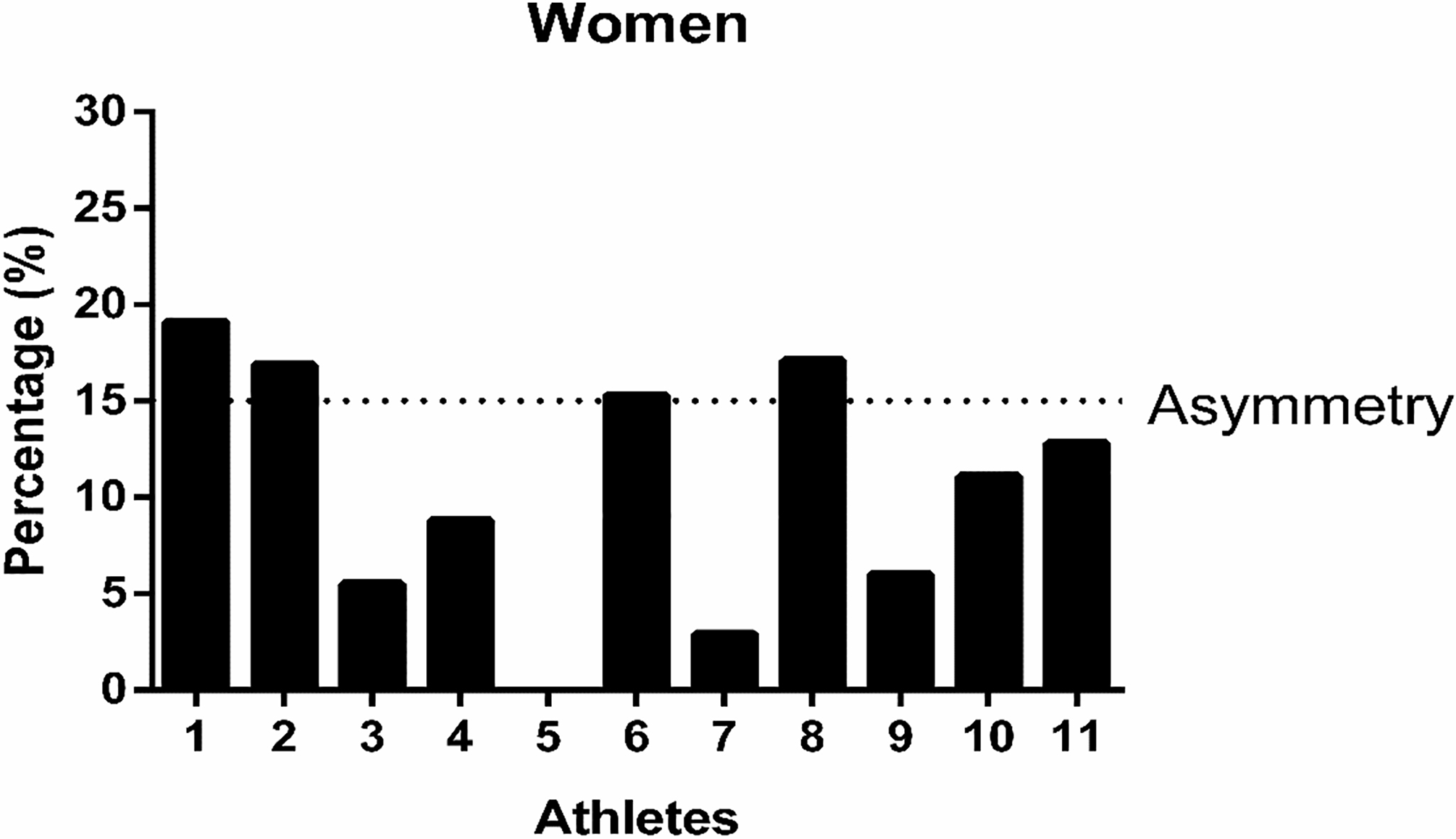
Description of the unilateral vertical jump asymmetry of male high-intensity functional training athletes.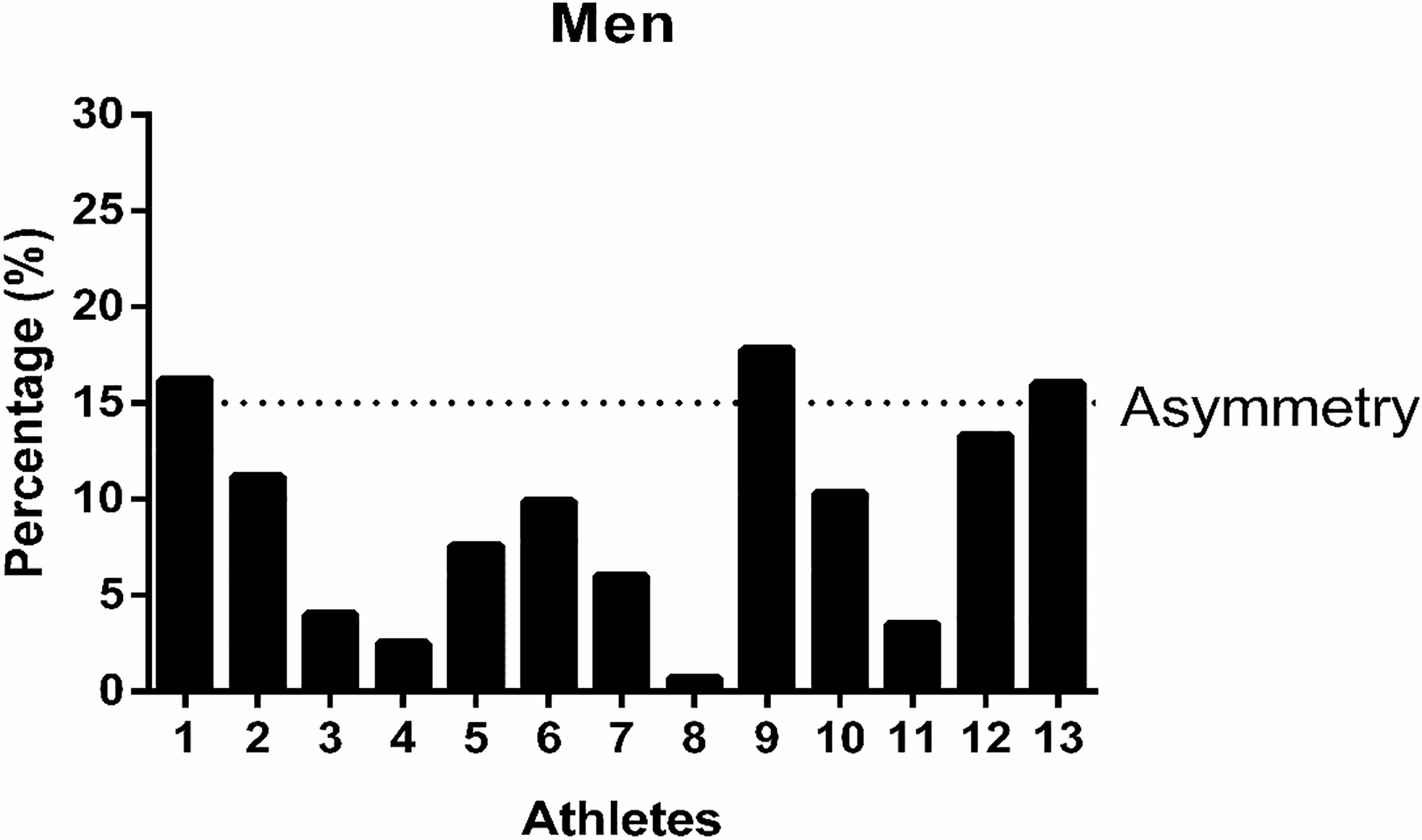
Figure 1 details the asymmetry values of individual female athletes. Of the total of 11 athletes, 4 had asymmetry values of
Figure 2 details the asymmetry values in men. Of the total of 13 athletes, 3 had asymmetry values of
The main findings of this study are as follows: 1) Asymmetry between limbs in CMJ in women and men has no influence on sprint speed of 20 m, SJ, CMJ, power, and SSC; 2) SJ skills performed bilaterally are associated with shorter sprint times of 20 m and higher EUR levels in women only; 3) SJ and CMJ ability in men is not associated with eccentric utilization rate (EUR), stretch-shortening cycle (SSC), sprint of 20 m and muscle power.
Competitive events in HIFT require the athlete to master multiple aspects inherent to fitness in a sporting scenario [5]. Bellar et al. [4] suggested that the presence of short races (up to 800 m) in HIFT competitions supported the idea of the presence of an association between anaerobic performance and success in the modality. In addition, Barbiere et al. [25] identified strong correlations between female athlete classifications and performance of 50- and 400-m sprints (
Since power is the rate at which work is performance or alternatively the multiplication of force by velocity, this physical attribute is a key determinant of success in several types of sport [29, 30, 31]. Therefore, there is a clear need to investigate the factors that may increase the power in sports and reduce the risks of injuries.
Regarding the asymmetry between the limbs in the CMJ, there were no correlations with the abovementioned performance reduction variables, corroborating findings from previous studies [16, 32, 33]. According to McGinnis [34], both the proportion and direction of force and power individually developed by each segment are combined to create only a single force vector. Thus, the existence of inequalities between the dittocould exert a negative effect on jumping skills and sprints [35]. Furthermore, physical performance can be affected by anthropometric asymmetries [35] and strength [36], even though the results of previous studies are conflicting regarding the effect of asymmetries between limbs on jumping ability [14, 37].
Although a few study results [16, 32, 33] indicate that performance is not influenced by the difference between CMJ limbs, asymmetry levels
In our study, we identified strong negative correlations between SJ and sprint (
SSC is present in movements composed by eccentric actions followed by concentric actions. In this type of movement, SSC, through the accumulation of elastic energy, potentiates to the force generating capacity with lower metabolic costs [43]. Therefore, Komi and Bosco [45] proposed the use of CMJ to evaluate the use of SSC. However, some authors have questioned the use of this type of movement for SSC evaluation, because this motor action also depends on coordinating factors [46, 47], which could explain the low correlation and absence of a significant difference between CMJ and SSC in women (
Nevertheless, comparisons between SJ and CMJ represent the most common approach to evaluate the efficiency of SSC [49]. Thus, one of the factors evaluated in our study was EUR, a benchmark of SSC performance, which attains values above 1.00 for trained athletes [22]. In our study, we did not find correlations between CMJ and EUR in women (
Professionals involved with the HIFT prescription should be aware of the factors that can influence the results of their athletes at competitive events, as well as the mitigation of injury risks. However, as a relatively new modality, there are only a few studies that seek to evaluate such variables. Thus, our work is one of the few studies that provides information that can be useful in the evaluation and structuring of HIFT programmes that aim for success in competitions. In addition, the present study demonstrates that the use of vertical jumps, a simple test of low financial cost and movements similar to the one performed in sports, is a better approach to evaluate the presence of asymmetries between limb and as a form of performance analysis.
Limitations of the study
The current study has some limitations that should be highlighted: i) The cross-sectional design does not allow the establishment of a cause-effect relationship; ii) The evaluated group was formed by amateur athletes, different results may be identified in elite athletes; iii) The evaluation instrument used to measure the performance of vertical jumps was not the gold standard (force platform), however, it is clear that the intention of the study was to provide information based on field tests, which in turn present greater applicability for coaches.
Conclusions
We observed that high asymmetry indices are not related to lower performance in speed and power tests. On the other hand, better results in bilateral SJ are associated with shorter sprint time and a lower EUR in female amateur athletes of HIFT. Thus, when the target is to maximize the performance of speed in bilateral activities, in the training programme, coaches should prioritise tasks that increase vertical jump capacity in detriment of the unilateral jump. Furthermore, coaches should be aware of high asymmetry indices, as they might be associated with a greater predisposition to injury.
Footnotes
Acknowledgments
We thank the Coordenação de Aperfeiçoamento de Pessoal de Nível Superior (Capes) for granting a postgraduate scholarship to Rômulo Vasconcelos Teixeira.
Conflict of interest
The authors declare no potential conflicts of interest with respect to the research, authorship, and/or publication of this article.