




Abstract
BACKGROUND:
Vertical jump is an index representing leg power. It is important to determine factors that influence the vertical jump to help athletes improve their leg power.
OBJECTIVE:
This study aimed to determine the relationship between lower limbs muscle volume and peak vertical jump (VJ) power in children for both sexes.
METHODS:
Fourty children healthy boys (
RESULTS:
significant correlations between MV and Peak vertical jump power showed for both sexes. Likewise, significant correlations were found between MV and body mass for boys (
CONCLUSIONS:
The correlation observed between peak vertical jump power and MV in both sexes can be considered as estimation tool of the lower limbs muscle power. Lower limb’s muscle volume are determining factor in muscle power for both sexes.
Introduction
Muscle power (MP) is the main component of muscle-skeletal exercise in children and it is the basis for physical performance and motor skills development [1]. MP, defined as the product of force and velocity, drives high-intensity, short-duration anaerobic tasks, such as maximal running speed and jumping [2] and is positively associated with athletic performance [3, 4]. Consequently, MP can be used to assess and track performance over time as one means to evaluate efficacy of training programs [5]. Power can be defined as the ability of the skeletal muscle to produce rapid force. The peak power (PP) is directly related to performance and functionality in many sports [6, 7]. The assessment of power can be used to track performance improvements or decrements over time and subsequently determine a training program [8]. There are several ways to evaluate anaerobic peak power. The vertical jump test (including its variants) is the most common test used to evaluate athletes’ anaerobic power and performance. It is an essential motor skill in many sports.
The success or failure of a sporting action strongly depends on the athlete’s ability to jump high and fast [9]. This is why many studies have analyzed the vertical jump from a physical point of view, to establish the factors that have to be improved to increase jump height and lower limb power. It is common in many sports to perform unloaded or loaded jump series to increase jump height and explosive strength [10]. The vertical jump test can be performed in laboratory settings using a force platform to measure peak and average power (watts). In field settings, prediction equations are used to estimate peak jump power from jump height and body mass in pediatric ages [11, 12, 13, 14]. Various studies underline the effect of age, gender, muscle type, muscle mass and cross section, hereditary traits, training and body composition on anaerobic performance [9, 15]. Additionally, muscle fibril length, leg volume and muscle mass play an important role in muscle strength in anaerobic sport branches [16]. Therefore, an athlete needs a higher amount of muscle mass, muscle cross section, leg volume and mass for a better anaerobic performance [17]. Regarding the lower limbs, in a longitudinal study, De Ste Croix et al. [18] have shown that the thigh muscle volume had a positive influence on the muscle power of young people aged 10 to 12 years in the Wingate test. Based on the literature, no previously published study has investigated the relationship between lower limbs muscle volume and peak vertical jump power in childhood. During childhood age there is a relationship between the peak vertical jump power and lower limb’s muscle volume. Therefore, the purpose of this study was to determine the relationship between lower limb’s muscle volume and peak vertical jump power in girls and boys. We hypothesized that muscle volume could be a determining factor in muscle power for both sexes.
Methods
Subjects
Fourty healthy children (20 Boys and 20 Girls) ranging in from 10 to 12 years were tested. Their physical characteristics are shown in Table 1. Participants completed a general health survey and were excluded if they had a history of health concerns, disease, or physical condition that may affect physical activity. It is worth noting that all the subjects who participated had no lower limb injuries. All subjects had similar school physical activity, in the form of 2 hours of physical education/week. The study was conducted according to the Declaration of Helsinki and the protocol was fully approved by the Institute Research Ethics Review Committee (IRERC) of the High Institute of Sport and Physical Education of Kef.
Procedures
This study used numerical correlation and regression analysis to establish the relationship between the muscle volume and peak vertical jump power. The tests were performed in the afternoon (1400–1600 hours) to rule out a possible effect of the performance’s circadian rhythm. Vertical jump performance was expressed in centimeters (cm) and each subject performed 3 trials for squat jumps (SJ), counter movement jump (CMJ) and CMJ with arm-swing (CMJarms). The highest jump height for each type of jump was used for further analysis. Each trial was recorded using an Optojump device (Optojump, Microgate, Bolzano, Italy). Peak Power was then calculated from the jump height measured by formula Sayers et al. [19].
Anthropometry
Anthropometric measurements were taken before performance testing and included standing body height, leg length, body mass (BM), and percentage of fat body mass (%fat) were carried out. Upper-thigh circumference, middle-thigh circumference, under kneecap circumference, maximum calf circumference, intercondylar distance, ankle circumference, and the bicipital, tricipital, subscapular, supra-iliac skinfold, quadriceps, and calf skinfold thicknesses were measured following the techniques recommended by the International Biological Program [20]. The corporal density had been evaluated from the skin fold measurement according to the method of Durnin & Rahaman, [21] which is used to determine the fat mass [22]. For male Body density
For female Body density
Where S is the sum of skinfolds measured over the limb.
Mass fat
Total volume was calculated using Jones and Pearson [23] formula. Lower limb bones volume had been calculated from the Intercondylar diameter of the knee, according to Shephard et al. [24]. In addition:
Total limb volume
The fat volume
Bone volume
Muscle volume had finally been calculated according to the formula by Jones and Pearson [23].
Muscle volume
Measured peak muscle power and vertical jump height
Vertical jump had been conducted during the spring school break. After ten minutes of warm-up, the subjects were kept standing in the centre of the Optojump device. For the SJ, subjects started from the upright standing position with their hands on their hips; they were then instructed to flex their knees and hold a predetermined knee position (
Peak vertical jump (VJ) power was also calculated for the best trial by using the equation from [19]:
Statistical analysis
Means and standard deviations (SD) were calculated after verifying the normality of distributions using Kolmogorov-Smirnov statistics. Linear regressions, performed between the peak power measured in SJ, CMJ and CMJ with arms and anthropometric parameters (body mass and muscle volume), were calculated using the SPSS 18.0 (SPSS Inc., Chicago, IL, USA). Comparisons between boys and girls were made using independent
Results
The anthropometric characteristics of the subjects are shown in Table 1. Boys and girls differed on some variables: a significant difference was found in muscle volumes (
Mean
SD of anthropometric variables for both sexes
Mean
Mean
Peak vertical jump power (mean
The parameters describing jump performance data are shown in Table 2, boys jumped significantly higher than girls in CMJ (
Relationships between body mass and the muscle volume for girls and boys.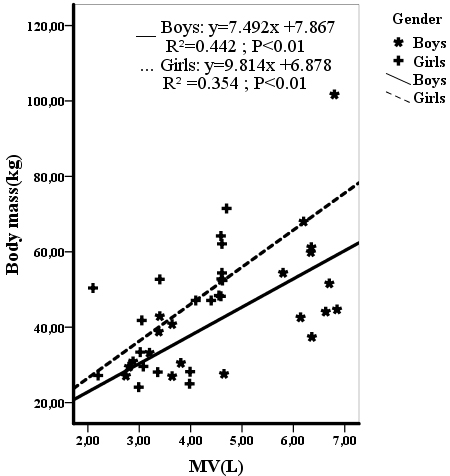
Relationships between muscle volume and the peak squat jump (SJ) power for girls and boys.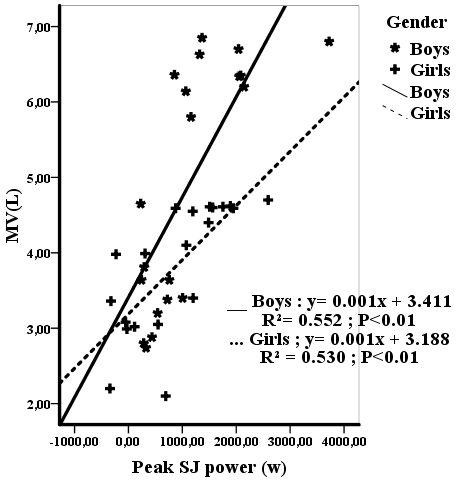
Relationships between muscle volume and the peak counter-movement jump (CMJ) power for girls and boys.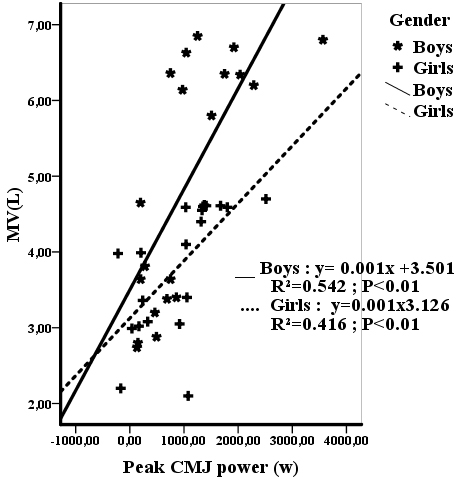
Relationships between muscle volume of lower limbs and the peak counter-movement jump arms (CMJ arms) power for girls and boys.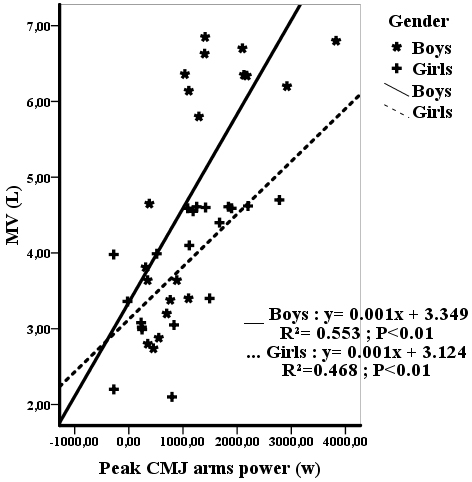
Significant correlations were found between body mass and muscle volume for boys (
The purpose of the study was to determine the relationship between lower limbs muscle volume and peak vertical jump power in children for both sexes We hypothesized that the lower limbs’ muscle volume could be considered a determining factor in muscle power for both sex. The present study showed significant very large correlations between lower limbs muscle volume (MV) and Peak vertical jump power in both sex Likewise, there are significant correlations between lower limbs muscle volume and body mass.
Our results indicated that the two sexes’ anthropometric characteristics revealed significant difference between girls and boys in terms of total body mass, Fat mass and lower limb muscle volume. Regarding the lower limb’s muscle volume, the comparative study of the data showed a higher volume of the order of 28.20% in males compared to females. According to Shepard [26], this difference results essentially from educational and socio-cultural factors imposing more frequent and more sustained physical activity on boys than on girls.
Thus, there were significant differences between the two sexes in performance of SJ, CMJ and CMJ with arms. This difference between the sexes has been noted previously in children [27, 28] and adults [29]. The Boys and girls jumped higher in the CMJ than in the SJ. It is well-established that jumping, hopping, leaping and other bounding movements can be improved by making a countermovement [30]. The greater height reached in the CMJ test could be explained by the active state initiated during the preparatory countermovement, whereas in the SJ, the countermovement is inevitably developed during the propulsion phase, so that the muscles can produce more force and work during shortening [30]. The difference found in maximum jump height between CMJ and SJ (2–3 cm) was similar to that (2–4 cm) found by Bobbert and Casius [30]. In addition there was no significant difference at the level of PSJ, PCMJ and PCMJ with arms. Our results confirm those reported by Davies and Young [31] who did not find gender differences in short-term jumping power output in 11-year-old children. Dore et al. [32] reported similar anthropometric characteristics and cycling performance in the boys and the girls between 8 and 14 years. This study allows us to show, significant correlations between body mass and muscle volume in both sexes and as well as between the peak power vertical jump (SJ, CMJ, and CMJ arms) and MV. Our results are in harmony with those of Bouhlel et al. [33] relating to trained young boys. Noteworthy, Peak power (PP) capabilities correlate with the performance for many athletic [7] and functional [6] tasks. In the same context, power provides a tool helping one identify talented children in dangerous sports that require movement of body mass or manipulating an external mass [34].
In line with our hypothesis, the present results indicate that lower limb’s MV are determining factor in muscle power for both sex.
This study has certain limitations that must be acknowledged. The relatively small sample size for each sex for the three age groups may have influenced the magnitude of the correlation. Secondly, the standard anthropometric method may have affected the values of lower limb muscle volume.
Conclusion
Muscle power is often measured by physical fitness coaches as a performance related measure and to determine factors that influence it. The relationship between muscle volume and both peak power and body mass showed that the muscle volume was a determining factor in muscle power for both sexes during childhood and may be applied to sport talent identification. However, there is no significant difference between male and female subjects in terms of muscle power, and hence an orientation towards explosive sports of both sexes during childhood could be allowed.
Author contributions
CONCEPTION: Souhail Bchini and Anissa Bouassida.
PERFORMANCE OF WORK: Souhail Bchini and Nadhir Hammami.
INTERPRETATION OR ANALYSIS OF DATA: Souhail Bchini and Nejmeddine Ouerghi.
PREPARATION OF THE MANUSCRIPT: Souhail Bchini, Nadhir Hammami, Nejmeddine Ouerghi, Dalenda Zalleg and Anissa Bouassida.
REVISION FOR IMPORTANT INTELLECTUAL CONTENT: Souhail Bchini, Nadhir Hammami and Anissa Bouassida.
SUPERVISION: Nadhir Hammami and Anissa Bouassida.
Ethical considerations
The study was conducted according to the Declaration of Helsinki and the protocol was fully approved by the Institute Research Ethics Review Committee (IRERC) of the High Institute of Sport and Physical Education of Kef (approval number a3-2019, January 14, 2019).
All participants and their legal guardians were duly informed about the study, and provided verbal consent to the performance of the tests during the spring holidays of 2019.
Funding
The authors report no funding.
Footnotes
Acknowledgments
We want to thank all participants who took part in this study and the schools’ directors who gave their permission for performing all of the tests.
Conflict of interest
Authors state no conflict of interest.