




Abstract
BACKGROUND:
Effects of whole-body-vibration (WBV) training have been claimed to depend on individual characteristics and vibration frequency; however, there have not been any studies focusing on effects of different WBV frequencies on flexibility, jump performance, and dynamic balance ability in the same group.
METHODS:
Twenty healthy men participants were randomly assigned to three conditions [0 Hz, 25 Hz, 40 Hz] prior to the study. They stood barefoot on the non-dominant leg and performed WBV of 5 sets
RESULTS:
Ankle dorsiflexion angle at 25 and 40 Hz and SLSJ height at 25 Hz significantly increased after WBV (
CONCLUSIONS:
The acute effects of exposure to WBV on flexibility, jump performance, and dynamic balance ability differ by the selected vibration frequencies.
Introduction
Whole-body-vibration (WBV) training has become a general therapy in athletic training and rehabilitation because it is safer and more practical than other training methods, such as weight training and balance exercise. There are some indications regarding the long-term effects of WBV on improving muscular strength, power, jumping performance, balance ability, and flexibility [1, 2]. In addition, WBV has been shown to produce greater short-term increases in muscle temperature [3], flexibility, muscle strength, dynamic balance ability, and jump ability than other training methods or non-vibration training [4, 5].
The acute effects of WBV have been claimed to depend on the characteristics of vibration, such as vibration frequency and amplitude from transmission of vibration, through their effect on muscle activation [6, 7]. Improvements in neuromuscular performance variables, such as peak moment and muscle activation were confirmed both in studies using lower frequencies, between 25 and 30 Hz (low frequencies) [8, 9], and those using higher frequencies, between and 40 and 50 Hz (high frequencies) [10, 11]. On the other hand, Cardinale and Lim found a 3.9% increase in the vertical squat jump height after a 5-min WBV session at a frequency of 20 Hz, whereas a frequency of 40 Hz produced no improvements [12]. Da Silva et al. have examined the effects of various vibration frequencies on certain measures (squat jump, countermovement jump, maximal strength, and power). At 20 and 30 Hz, squat jump height has shown a significant increase after a 5-min WBV session, whereas WBV with 40 Hz produced a significant decrease [13].
Dallas et al. [4] found a 3.9 and 3.8% increase in sit and reach test score which is index of the flexibility after WBV with 30 and 50 Hz frequency respectively. Cronin et al. [14] reported that the vibration stimulus of 30 s, with four conditions (14, 24, 34, and 44 Hz frequency), significantly increased the flexibility of the hamstring range of motion by 1.6–2.1%, whereas vibration stimulation at 14 Hz did not cause significant increases. However, Cardinale and Lim [12] found an increase in the sit and reach score, by 13.5%, after a 5-min WBV session with 20 Hz frequency, whereas WBV with 40 Hz frequency produced a 3.3% decrease.
It seems from these reports that any frequency makes the peak moment and muscle activation improvements. Additionally, the high improvements for the jump performance might be provided at low frequency, and for the flexibility might be provided at high frequency. However, there is few reports to examine jump performance and flexibility in the same group.
For the balance ability, Borges et al. [15] reported that WBV exercise did not influence the swaying of the center of pressure for healthy women whereas Cloak et al. [5] showed improved dynamic balance ability such as Y-balance test among amateur and elite soccer players. Thus, these studies seem to indicate that WBV exercises do not improve static postural stability but may affect dynamic postural stability. Additionally, the response to acute WBV exercise appears to vary according to participants, exercise program, and vibration characteristics; however, few reports are available on postural stability after landing in healthy subjects of the same group.
Regarding dynamic postural stability, subjects jump and land on single-leg on a force plate, and measurements are made using the dynamic postural stability index (DPSI) [16]. This is a comparative measure for dynamic postural stability that reflects the maintenance of balance as the participant transitions from the dynamic to the static state. It serves as a functional measurement of neuromuscular control, as it is calculated during a single-leg jump stabilization maneuver [17]. Therefore, DPSI might show difference of dynamic postural stability caused by different vibration frequencies, because DPSI evaluates postural stability of minute change using force plate.
To our knowledge, most of the studies related to this topic have examined parallel studies. On the other hand, Gerodimos et al. showed the effects of WBV intervention with different vibration frequencies on flexibility, jump height in the same group [18], but this study only low frequency (15, 20, 30 Hz). In addition, no study has observed effects on posture stability after WBV with different vibration frequency in the crossover study.
The purpose of this study was thus to examine the acute effects of WBV with low and high vibration frequencies on jump height, flexibility, and dynamic postural stability. We hypothesized that WBV with low frequency would improve jump height and dynamic postural stability more effectively than that with high frequency and non-vibration and that WBV with low and high frequencies would improve flexibility more than that with non-vibration.
Methods
Participants
Twenty healthy men (age: 22.7
Flowchart of this study.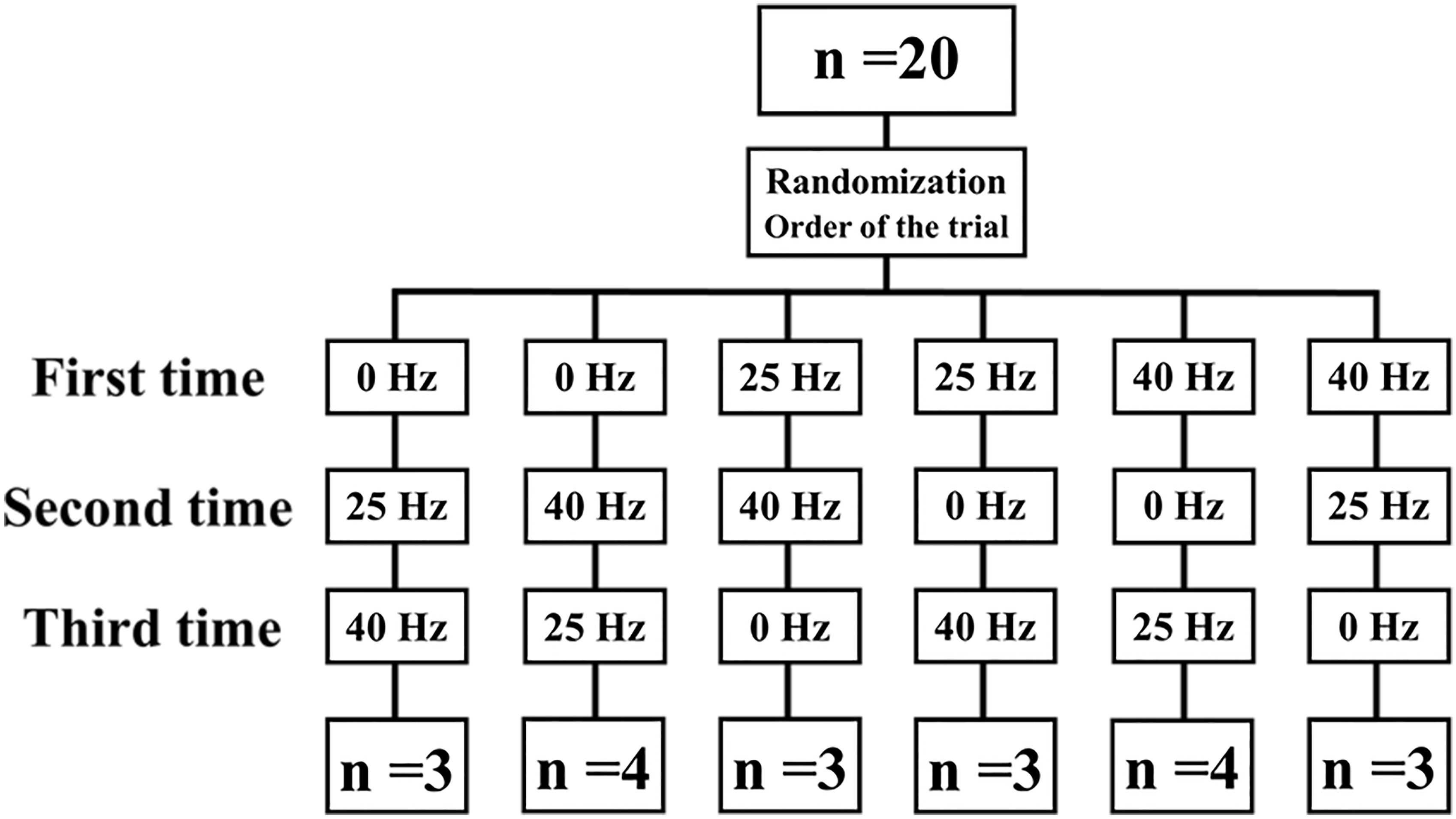
Positioning for the intervention of whole-body-vibration on the vibrating platform.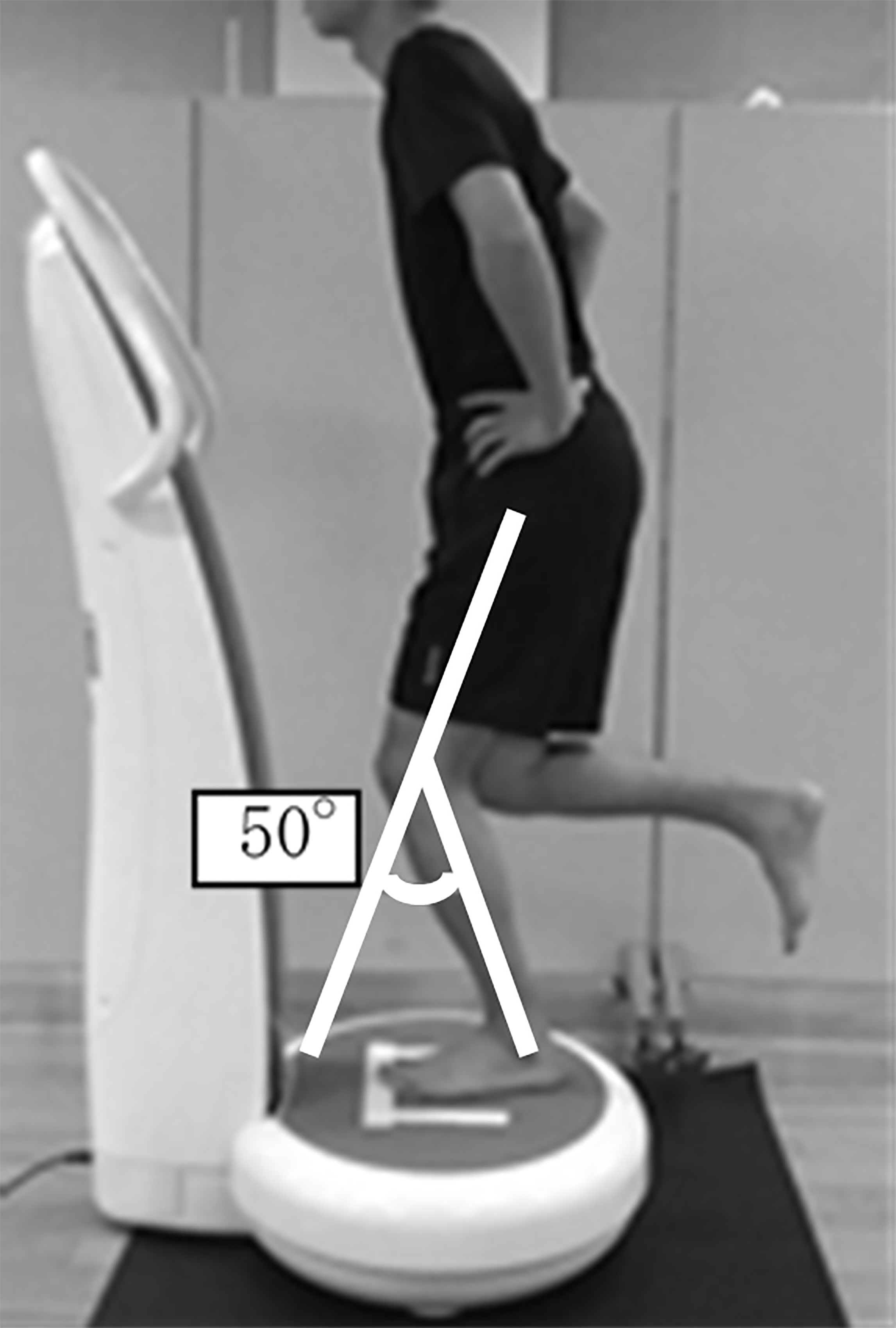
Three conditions including two different vibration frequencies (0 Hz [control], 25 Hz, 40 Hz) were used in this study. To reduce bias the order of the trial was randomized using the method of randomly permuted blocks (
Measurements items
We measured three items of passive dorsiflexion angle, vertical jump height and DPSI.
First, maximum passive dorsiflexion angle was measured using an electronic device with a resolution of 1
Vertical jump height was measured next. This study defined vertical jump height as single leg squat jump (SLSJ) height on the non-dominant leg, since the intervention posture was one of single-leg standing on the non-dominant leg. Participant performed maximal voluntary SLSJ on the floor, using a jump instrument (Myotest SA, Sion, Switzerland). They were instructed to jump straight up and to make an effort to land with the same body form and in the same place as at takeoff, without moving laterally or vertically. Participants failed the SLSJ they performed it from a semi-squat position and with a preparatory countermovement. They kept their hands on their hips during the jump task and maintained their trunk in an upright position to emphasize the use of the leg-extensor muscles [22]. Thirty second of rest were allowed between jumps. This measurement of squat jump height has an ICC range (3,1) of 0.82 to 0.84 while the coefficient of variation is 4.25% [23].
Equations for calculations of APSI, MLSI, VSI and DPSI.
Finally, we assessed the DPSI using a single-leg jump landing in the anterior direction. This measure has good test-retest reliability (ICC3, 1
The ground reaction force values were recorded with sampling frequency of 200 Hz. A Microsoft Excel macro was used to process the ground reaction force values in order to calculate the DPSI; ground reaction values were passed through a zero-lag fourth-order low-pass Butterworth filter with a frequency cut-off of 20 Hz. As shown in Fig. 3, the DPSI is a composite of the ground reaction forces in all planes, and thus, is sensitive to force changes in the anterior-posterior (
Data was analyzed using the SPSS Statistics for Windows, version 20.0 (IBM Japan Co Ltd, Tokyo, Japan). A two-way ANOVA 3 [condition]
Results
The mean values and standard deviations of ankle dorsiflexion angle, single leg squat jump height, and DPSI are shown in Tables 2 and 2. The pre-WBV value within each condition was not significant for any measured items. In addition, no improvements by standing only (control) were found.
Ankle dorsiflexion angle
The ICC value for test-retest was 0.97 respectively, with no significant (
Single leg squat jump (SLSJ) height
The ICC value for test-retest was 0.82, with no significant (
DPSI, APSI, MLSI, VSI, and VGRFmax (%BW)
The ICC values for test-retest were 0.83 at DPSI, 0.82 at APSI, 0.54 at MLSI, 0.84 at VSI, and 0.91 at VGRFmax (%BW) with no significant (
DPSI showed a significant condition
APSI showed a significant condition
VSI showed a significant condition
MLSI and VGRFmax showed no significant condition
| Interaction effect | Main effect | Main effect | |||||||||||||
|---|---|---|---|---|---|---|---|---|---|---|---|---|---|---|---|
|
|
0 Hz | 25 Hz | 40 Hz | (condition |
(condition) | (time) | |||||||||
| Variable | Pre | Post | Pre | Post | Pre | Post |
|
|
|
|
|
|
|
|
|
| Ankle dorsiflexion angle (degrees) | 19.2 |
19.4 |
18.6 |
20.4 |
18.8 |
20.9 |
16.053 | 0.001 | 0.545 | 0.786 | 0.463 | 0.142 | 53.785 | 0.001 | 0.860 |
| Single leg squat jump height (cm) | 20.7 |
20.2 |
20.3 |
21.1 |
20.7 |
20.8 |
10.832 | 0.001 | 0.471 | 0.729 | 0.489 | 0.137 | 0.346 | 0.563 | 0.134 |
Mean and standard deviation of dynamic postural stability index at pre- and post-whole-body-vibration between each condition
The results of the present study partly support our hypothesis, specifically for the ankle dorsiflexion angle and SLSJ height. This indicates that the effect of WBV on flexibility and physical performance differs by vibration frequency. More specifically, two crucial discoveries were reported in this study. First, vibration frequencies of 25 and 40 Hz increased ankle dorsiflexion angle in the same way, compared with control condition. Second, WBV at 25 Hz improved single leg squat jump height, and dynamic postural stability improved at both vibration frequency.
The increase in ankle dorsiflexion angle by 11.0% at 25 Hz and by 11.4% at 40 Hz were congruent with previous studies that revealed increases of 3.8 and 13.5% [4, 24], respectively. On the other hand, the improvement at 40 Hz contradicted the findings of Cardinale and Lim [12] who have reported a decrease of 3.3% after WBV at 40 Hz. However, many previous studies showed improvement in flexibility following WBV [14, 25]. This improvement might be attributed to two known mechanisms: influence of pre-synaptic inhibition through the Ia afferent fiber [26] and influence of the excitatory restraint of the spinal cord exercise cell via the activity of the Ib centripetal tendency fiber from a Golgi tendon organ [27, 28]. These mechanisms may have plausibly caused the increase in flexibility after vibration stimulation in the present study.
The increases in SLSJ by 4.2% at 25 Hz was similar to than in previous studies, which revealed improvements of 5.0% at 26 Hz [29]. Jump height improvement may be related to an increase in muscle temperature [30] and blood flow [31]. During vibratory stimuli skeletal muscles undergo small changes in muscle length called tonic vibration reflex (TVR) [32]. TVR is reflex muscle contraction, through the excitation of muscle spindles which can lead to an enhancement of Ia loop activity [33]. Additionally, transmission of vibration of the ankle, knee, and hip joint differs by vibration frequencies, as does muscle activity during WBV exercise [6, 34]. Such a factor might influence improvement of jump height, but the details are unclear in the present study.
DPSI decreased 5.4% at 25 Hz and 2.7% at 40 Hz after vibration stimulation. A previous study indicated that improvement in the range of motion for ankle, knee, and hip joints is crucial for improvement in DPSI [21]. McKinley and Pedotti indicated that participants with greater and earlier preparatory muscle activity demonstrated better-quality dynamic postural stability scores [35]. Additionally, Borges et al. found improvement of muscle response time regardless of the influence of the vibration frequency after vibration stimulation [15]. Therefore, we speculated that these factors improved DPSI at 25 and 40 Hz. On the other hand, no significant difference was shown in DPSI between 25 and 40 Hz condition, but major differences in rates of decline were shown in DPSI. Interestingly, VSI was significant decreased only at 25 Hz although VGRFmax demonstrated no significant difference. These results show that VGRF during landing decreases after having carried out WBV at 25 Hz.
We hypothesized that improvement in jump performance and postural stability after vibration stimulation varied according to the vibration frequency of 25 Hz or 40 Hz and that improvement of ankle dorsiflexion angle and earlier preparatory muscle activity also varied as a result. Furthermore, our results showed that the effect on exercise performance differed with vibration frequency. In other words, it might be necessary to change vibration frequency depending on the situation, e.g. a warm-up and cool-down.
A limitation of this study was that measurements were not available for all effects across 25 Hz and 40 Hz vibration range. In addition, the results of our study are valid only at the acute phase; long-term training effects of different vibration frequencies are yet to be explores. Further, it is necessary to recall that all the subjects were men, and that jump performance following vibration training differs between women and men [36].
Nevertheless, the findings indicate the importance of the appropriate choice of WBV frequency muscle training.
Conclusions
This is the first study to examine the effect of acute WBV exposure at different frequencies on ankle dorsiflexion angle, single leg squat jump height, and dynamic postural stability in the same group. Our suggest that the effect of WBV on flexibility and physical performance differed by vibration frequency. This finding may be of practical importance for the development of training programs for athletes, older people, and rehabilitation patients in general.
Footnotes
Conflict of interest
None to report.