




Abstract
BACKGROUND:
Few studies have reported contribution of isometric specific training of abdominal muscles to low back and pelvic stability using a modified crook-lying (C-L) posture with and without a labile surface.
OBJECTIVE:
To investigate activation amplitude of rectus abdominis (RA), external oblique (EO), and internal oblique (IO) in C-L posture based on various foot and trunk supporting surfaces.
METHODS:
Participants were 32 healthy adults. Abdominal muscles activities were measured using surface electromyography while performing an exercise with a straight one-leg hold in C-L posture with four different exercise conditions. Two-way repeated measures analysis of variance (ANOVA) with Bonferroni’s correction was used to determine effects of exercise tasks of different conditions on the activation of RA, EO, and IO.
RESULTS:
Significant differences in abdominal muscle activities were found between supporting surface conditions for all muscles (
CONCLUSIONS:
Application of unstable trunk and foot support surface while performing straight one-leg hold exercise in C-L posture could be useful for improving the endurance and strength of each abdominal muscle.
Introduction
Trunk stability plays important roles in maintaining good spine and pelvic alignment during walking or daily activities [1, 2]. Dynamic trunk-stability training protocols are concentrated on increasing muscle strength, endurance, and synergic coordination of agonist and antagonist to improve low back and pelvic stability [3, 4, 5]. Although passive and active body systems contribute to trunk stabilization, muscular system plays a major role as a stabilizer of external perturbations associated with basic movements [6]. In trunk musculature, abdominal muscles play important roles in lumbar spine and pelvic stability related to sagittal plane movement [7, 8, 9].
Although many therapeutic exercises can improve trunk stability using various protocols such as pelvic tilt [10, 11], abdominal hollowing [11, 12], and level 1 of trunk stability test [5, 13], this study focuses on effective abdominal muscle training while performing exercises in supine C-L position with and without unstable surface. Although dynamic trunk stability is related to sufficient strength and appropriate recruitment of abdominal muscles [14], only some studies have reported exercise protocol using standardized electromyography (EMG) methods and shown that the abdominal musculature has low response and differential recruitment amplitudes [6, 14, 15]. Higher levels of exercise protocol to improve trunk stability using EMG amplitude of abdominal musculature have not been reported yet.
Thus, the purpose of this study was to compare abdominal muscle activation and obtain information for clinical application of each exercise to activate specific muscle sites in a manner consistent with dynamic trunk stability training. Specifically, the first objective of this study was to determine the maximum voluntary amplitude of three abdominal muscle sites during each exercise protocol to improve abdominal strength and endurance. The second objective of this study was to verify selective activation of oblique abdominals known to contribute to trunk stability [7, 8] during each exercise condition.
Methods
Participants
We recruited 32 healthy male and female volunteers who consented to participate in this study and who met the selection criteria. Participants were given a detailed explanation of the study procedure. Written informed consent was obtained from each participant. This study was conducted in accordance with the principles of the Declaration of Helsinki. It was approved by the Institutional Review Board of Jeonju University (approval number: jjIRB-151118-HR-2015-1104). Volunteers who had any neurological, musculoskeletal, or cardiopulmonary problems or whose trunk strength was insufficient to comply with instructions of the experiment were excluded. Mean age, height, and weight of all included participants were 22.7
Modified C-L position for measurements of electomyographic activation.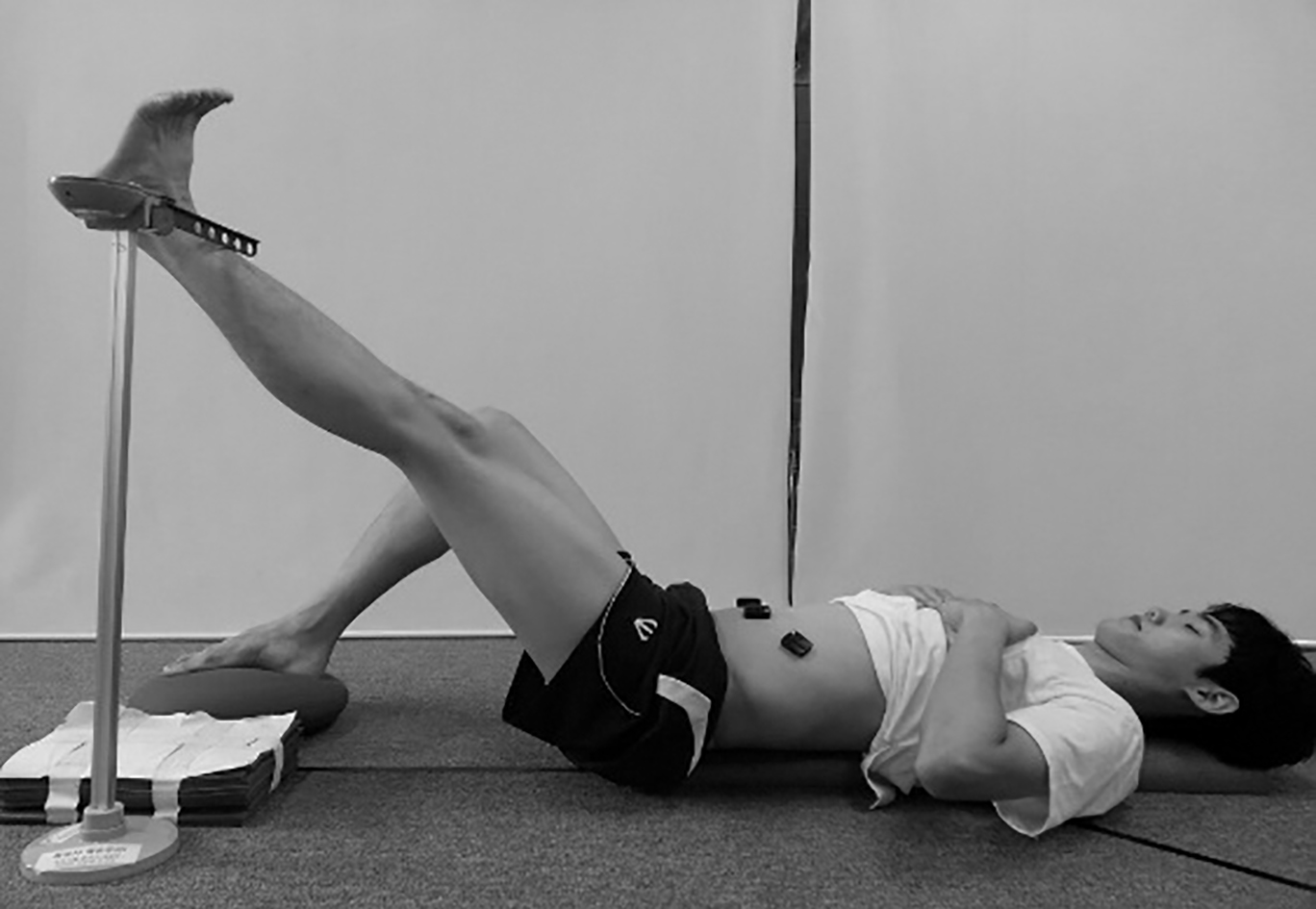
A wireless surface EMG system (Delsys Inc, MA, USA) was used to collect muscle activities of rectus abdominalis (RA), external oblique (EO), and internal oblique (IO) while performing an exercise with modified C-L posture based on different foot and trunk support conditions (Fig. 1). EMG signals collected from each abdominal muscle were converted to digital signals and analyzed with an EMG analysis software. The sampling rate of EMG signals was 2,000 Hz and the EMG frequency bandwidth was restricted to 20 to 500 Hz. Baseline muscle activity was gained for 0.25 seconds while subjects were completely relaxed in a C-L position. Root mean square (RMS) amplitude of baseline activity and noise on all channels was less than 5
Normalization exercises
Before performing experimental exercise, subjects were asked to perform three different maximal contraction exercises for normalization. Mean RMS was expressed as a percentage of a maximum voluntary contraction (MVC) performed for each abdominal muscle before the study exercise. Exercises used for normalization were selected according to protocols from previous studies [6, 17, 19]. The maximal contraction of the RA was performed by a resisted curl-up exercise. Resisted trunk rotation task for MVC of the EO was also performed. Abdominal hollowing and trunk rotation tasks were performed for the IO. The normalization task order was randomized. Two trials were executed for each MVC task. There was a 2-minute rest between trials. The mean value of trials was used for normalization.
Experimental exercise
EMG signals were recorded from three abdominal muscle sites while subjects performed four levels of exercise. Exercise was randomly assigned. The starting standard position of each exercise was C-L supine on the exercise mat, knee flexed 90
Data analysis
All analyses were conducted using SPSS version 23.0 (IBM, Armonk, NY, USA). A repeated-measures analysis of variance (ANOVA) with Bonferroni adjustment was used to compare muscle activation and VAS score. If the main effect was significant, post-hoc test with Scheffé method was used to determine differences in ANOVA results. Significance level was set at
Results
Electromyographic amplitude comparison between exercise tasks
RMS amplitude results expressed as %MVC are shown in Table 1. For RA and EO, activation in modified C-L posture on both round balance cushion and half foam roll in task 4 was the greatest. However, there were no significant differences in activation of EO and IO muscles (
Mean
SD average electromyographic amplitude (%MVC) for each abdominal muscle during the exercise (
36)
Mean
Note. Significant differences are shown between different sides for the activation of that muscle during a particular task.
Repeated measures ANOVA comparing abdominal muscle activations during different exercise tasks for dominant sides (
Mean %MVC results of post-hoc test comparing different exercise tasks. 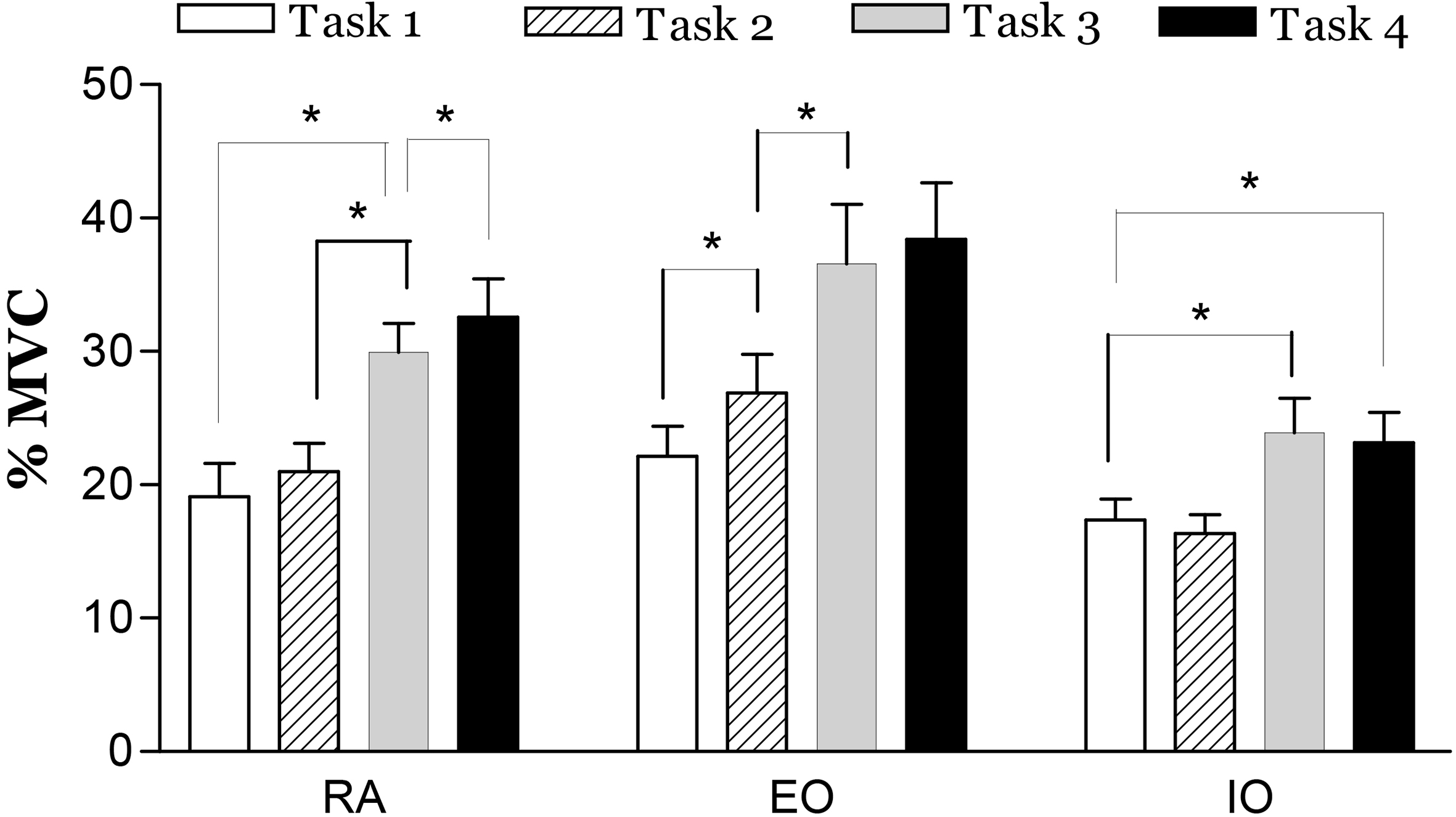
For activity of RA, there were significant differences between the one-leg hold on a firm mat exercise (task 1) and the one-leg hold on a half foam roll exercise (task 3) or between the one-leg hold on a a half foam roll exercise (task 3) and the one-leg hold on a round balance cushion plus a half foam roll exercise (task 4) (
Although the activation amplitude of EO or IO showed similar pattern to that of rectus abdominus during tasks, it showed no significant difference between the one-leg hold on a round balance cushion and the one-leg hold on a round balance cushion plus a half foam roll (
The one-leg hold on a round balance cushion plus a half foam roll exercise was found to be the most difficult task performed in this study (8.82
Discussion
This study was executed to compare the activation amplitude of abdominal muscles for lumbopelvic stability during the performance of modified C-L exercise with or without unstable surface conditions. Results of this study showed that activation amplitude patterns of abdominal muscles were different during four levels of exercise. The recommended load range for muscle strengthening ranges from 60% to 100% for one repetition maximum based on exercise ability of each subject [20]. Considering the significant positive correlation between the force of abdominal muscles and the electromyographic activation [19], activation amplitudes (less than 46% of MVC) of abdominal training methods used in this study were lower than the recommended range and considered to be unsuitable for abdominal muscle strengthening. However, previous researches have suggested that neuromuscular control and endurance of ventrolateral abdominals can be successfully achieved with exercise that minimize activation of abdominal muscles [12, 21, 22]. Considering between-subject variability, some subjects showed high percentages of MVC that might achieve the clinical goal for strengthening abdominal muscles. Activation of abdominal muscles of the one-leg hold on a firm mat exercise through the one-leg hold on a round balance cushion exercise (
As a result of this study, there was no significant difference in muscle activity between the one-leg hold on a half foam roll exercise and the one-leg hold on a round balance cushion plus the half foam roll exercise in EO or IO, although there was a significant difference in RA between the one-leg hold on a half foam roll exercise and the one-leg hold on a round balance cushion plus the half foam roll exercise. Results of previous studies could not be directly compared to results of this study. However, results of previous reports on abdominal amplitudes in response to leg-loading exercise tasks were similar to current results about the activation pattern of abdominal muscles [1, 25]. These previous studies have reported higher EO activation compared to RA activity during leg-lowering and raising exercise tasks [1, 25]. On the other hand, previous studies that have verified the activation of abdominal muscles with leg-loading tasks have reported that both RA and EO have low activity while RA had higher activity than EO [26]. These differences are due to differences in data normalization and task difficulty between previous studies. The present study focused on a task protocol performed the one-leg hold task to improve dynamic stability of the lumbar spine and pelvis with a lumbar spine neutral position. The task protocol included four levels intended to progressively increase muscle activation by increasing task intensity using unstable foot and trunk surfaces. The significant difference of RA activation was found between the one-leg hold on a half foam roll exercise and the one-leg hold on a round balance cushion plus the half foam roll exercise among abdominal muscles. Vertical muscle fiber direction of the RA would help produce an effective force to counteract hip flexor force vectors in sagittal based exercise such as a one-leg hold task. Activation amplitudes of EO and IO were similar between the one-leg hold on a half foam roll exercise and the one-leg hold on a round balance cushion plus the half foam roll exercise. Previous studies have suggested that EO and IO activities are unaffected by external perturbation task [17, 27]. In addition, these abdominal muscles are known to play an important role in lumbar stabilization. It has been reported these muscles can effectively cause an activity level of approximately 40% [17].
The key result of this study was that there was a significant difference in the activity of the RA muscle between the one-leg hold with a half foam roll exercise and with a round balance cushion plus a half foam roll exercise in C-L exercise. This indicates that the modified C-L exercise applying a more labile surface on foot and trunk is a clinically useful exercise task to provide for RA strengthening. However, as mentioned earlier previous studies have reported that increased activation of abdominal muscles such as EO, IO, or the transversus abdominus is required to stabilize the lumbar spine and pelvis rather than RA muscle activation. Therefore, the exercise tasks with high difficulty in this study might have increased the activation of the RA muscle. Thus, it would not be suitable for lumbar stability exercise. The clinical implication of this study is that if the goal of therapeutic exercise intervention is to increase stability of the lumbar pelvic regions, a modified C-L exercise applying a half foam roll support on trunk that could promote the activation of OE and IO is recommended.
The present study has several limitations. This study was conducted on healthy individuals without musculoskeletal problems such as back pain or range limitations who were mostly younger than those suffering from musculoskeletal dysfunction. Therefore, the results of the study cannot be generalized to patients with back pain who have lumbar stability problems. Additionally, in view of different normalization procedures of MVC, there are limitations in terms of comparison to previous research and interpretation of results. However, the MVC normalization procedure used in this study was performed in a similar posture as experimental task and more stable data were obtained. Further studies are needed to investigate trunk muscle responses to a modified C-L exercise progression in individuals with low back pain.
Footnotes
Acknowledgments
This study was supported by the National Research Foundation of Korea (NRF) grant funded by the Ministry of Science and ICT (No. 2018R1C1B5042645).
Conflict of interest
None to declare.