




Abstract
BACKGROUND:
Participation in outrigger canoe racing has gained rapidly in popularity across the United States, Australia, New Zealand, and Japan. Moreover, outrigger canoe racing has recently been included as an official sport of the 2016 Paralympic games in Rio de Janeiro. Hence, evaluation of upper limb pedaling strength in outrigger canoe paddlers would be important to determine optimal sport-specific training techniques for these athletes.
OBJECTIVE:
To compare multiple-joint isokinetic strength (MI) of upper extremity, muscle strength, and overall morphology in outrigger canoe paddlers and non-athletes.
METHODS:
Nine outrigger canoe paddlers (Out-C), and eight healthy male non-athletes (Con) were recruited. The MI of the upper extremity was evaluated using an isokinetic arm ergometer.
RESULTS:
Multiple-joint isokinetic strength was greater in the Out-C group than in the Con group at all pedaling speeds (
CONCLUSIONS:
Asymmetries in MI of upper extremity muscles with stronger left than right side may be an important contributing feature of performance.
Introduction
Outrigger canoe racing was originally developed by Polynesian populations, possibly Hawaiian or/and Tahitian populations, and has evolved into a recreational and competitive sport [8]. The outrigger canoe differs from other canoeing crafts, having a rig, known as an “ama”, extending outwards to act as a balancing flotation device [8]. The six-person sprint racing outrigger canoe weighs 145 kg and is 13.5 m long.
Participation in outrigger canoe racing has rapidly gained in popularity across the United States, Australia, New Zealand, and Japan [4]. Moreover, outrigger canoe racing has recently been included as an official sport of the 2016 Paralympic games in Rio de Janeiro. Outrigger racing is considered to be one of the fastest rowing events, with athletes competing over a linear course of 1000 m, 500 m and 200 m in still water [5]. In other venues, competitive outrigger canoe events are generally divided into short (250–2000 m) and long (10–60 km) distances [4, 8]. Therefore, for both sprint (short) and endurance (long) distances, athletes’ physical characteristics significantly influence performance.
As an Olympic sport, the discipline of canoe sprinting is sub-classified into canoeing (C) and kayaking (K). In canoeing, athletes kneel on one knee and paddle uniquely on one side. In contrast, for kayaking, athletes are in a seated position and paddle on both sides. Although the general strength and physical characteristics of athletes contribute to sprint performance in kayaking [3, 10, 12], a recent study identified upper arm and trunk muscle strength to be positively correlated with sprint performance [5], with canoeists showing a preferential development of muscle size and strength of the forearms, upper arms and trunk [1, 10]. In a similar way, muscle strength correlates with race time in C paddler [9]. Hashimoto et al. [6] evaluated the relationship between muscle strength and race time in University male and female C paddlers, demonstrating a benefit of a high ratio of the volume of the trunk to the lower limbs to faster race times in both of male and female rowers. Absolute upper limb strength was also predictive of race time in female C paddlers [5, 6]. In their recent evaluation of the physical characteristics and fitness of C and K paddlers, [5] further reported that grip strength, back strength, 1 repetition maximum (1 RM) bench press, isometric knee strength, and maximal and mean power, measured using the Wingate test, were positively correlated with performance of these athletes on a rowing ergometer. However, the influence of these physical factors on performance would likely vary depending on the type of canoe and distance of the race.
To our knowledge, only one study reported the measurement of muscle strength in 21 outrigger canoe paddlers [8], identifying upper arm, shoulder and trunk strength as important factors to paddling performance in outrigger canoeing. Therefore, the pedaling power of the upper limbs is very important to the performance in outrigger canoe paddling. Yet, the pedaling power of the upper limbs has not been evaluated in outrigger canoe paddlers.
The pedaling power of the upper limbs has been evaluated in different groups of athletes. Sanghoon et al., reported a higher peak moment (PM) in isokinetic pedaling power of the upper limbs in competitive archers than in non-athletes [14]. Moreover, the bilateral strength difference in competitive archers indicates that upper limb pedaling power is likely to develop in sport-specific ways. As such, evaluation of upper limb pedaling power in outrigger canoe paddlers would be important to determine optimal sport-specific training techniques for these athlete. Therefore, the aim of our study was to evaluate multiple-joint isokinetic strength (MI) of upper extremity, muscle strength, and overall morphology of outrigger canoe paddlers and non-athletes. We hypothesized that MI, back strength, grip strength, and upper limb circumference would be greater in outrigger canoe paddlers than in non-athletes.
Methods
Subjects
Nine outrigger canoe paddlers (Out-C), 32.0
Body composition
The following measures of body composition were recorded for analysis: height, weight, body fat percentage, and body mass index (BMI). Weight, body fat percentage and BMI were measured by impedance using the InBody 770 Body Composition Analyzer (BIOSPACE, Tokyo, Japan).
Picture of an isokinetic arm ergometer (Strength Ergo 240, BK-ERG-003, Mitsubishi Electronic Engineering Co. Ltd, Tokyo, Japan).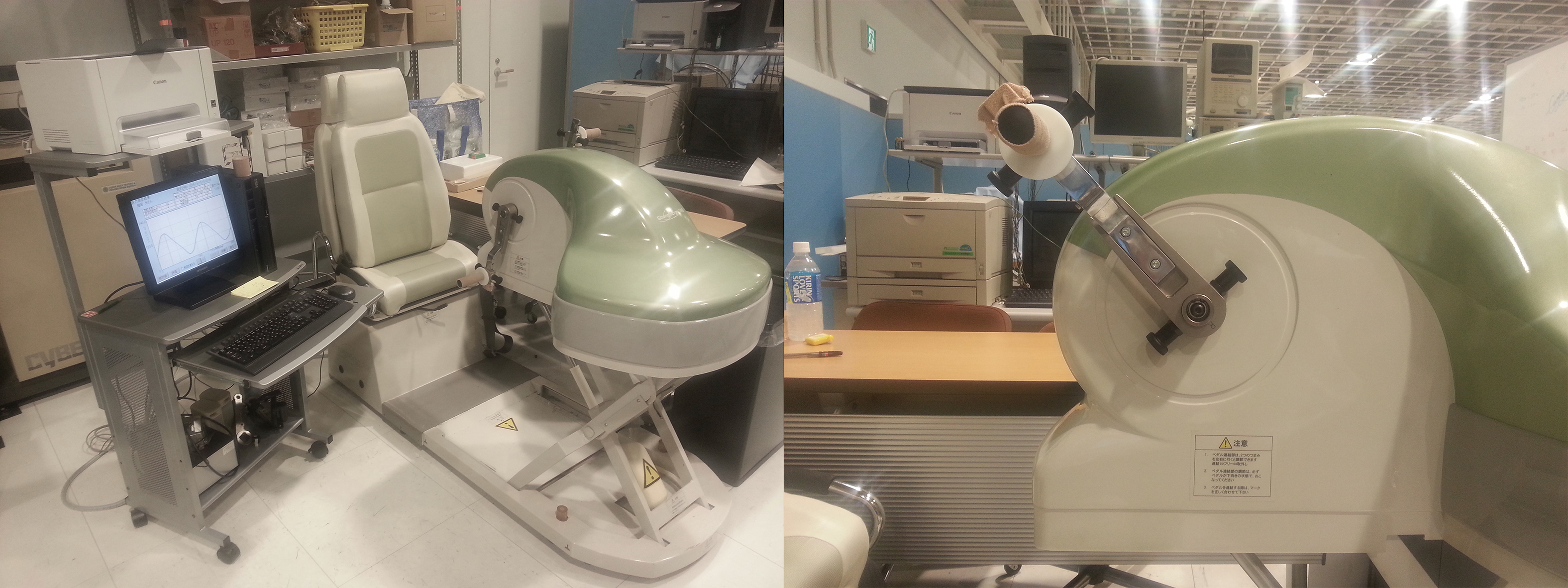
Anthropometric characteristics were evaluated using the following 12 girth measurements: neck, chest, waist, and hips, as well as the upper arm, forearm, thigh, and lower leg, bilaterally. All girth measures were obtained using a tape measure, along the horizontal plane of the body, with participants in a relaxed standing posture with arms by their side, using the methods of [13].
Measurement of back and grip strength
Handgrip strength was measured twice, alternating between the right and left hands, using a digital dynamometer (Takei Kiki Kogyo, Niigata, Japan), with the highest strength measure used for analysis [15]. Back muscle strength was measured once, using a digital back muscle strength meter (Takei Kiki Kogyo), according to the methods of [15].
Evaluation of multiple-joint isokinetic strength of upper extremity
MI was output while rotating the upper limb forward by the ergometer for the upper limbs. Multiple-joint isokinetic was evaluated using an isokinetic arm ergometer (Fig. 1, Strength Ergo 240, BK-ERG-003, Mitsubishi Electronic Engineering Co. Ltd, Tokyo, Japan), according to the methods of previous study [11]. The rotation movement with upper limb is similar to paddling of the outrigger canoe. The peak moment was defined as MI which stands for the power (W) value during pedaling and is calculated by the peak moment (Nm)
Statistical analysis
The mean
Results
Physical characteristics and strength
The physical characteristics and measured variables of muscle strength for the Out-C and Con groups are summarized in Table 1. Groups were comparable in terms of the distribution of height, body weight, percentage body fat, and BMI. However, the girth of the upper arms, forearms, bilaterally, was greater for participants in the Out-C group than for those in the Con group (
Comparison of selected anthropometric measures of ‘absolute size’ between the control group and the outrigger canoe paddlers
Comparison of selected anthropometric measures of ‘absolute size’ between the control group and the outrigger canoe paddlers
Notes: data are reported as the mean
Comparison of multiple-joint isokinetic strength (MI) of upper extremity each pedaling speed in control and outrigger canoe paddler. Values are means 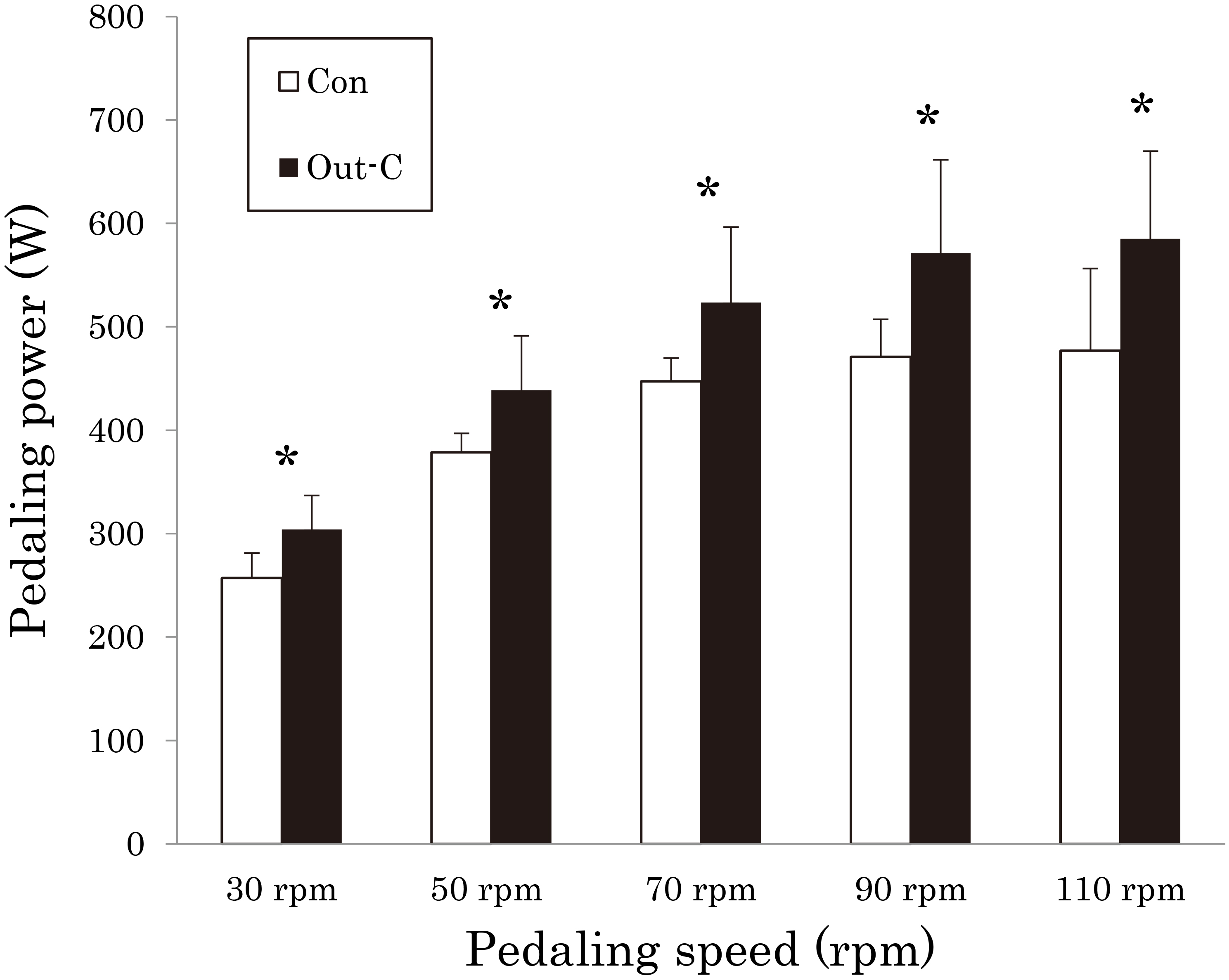
Comparison of peak peddling moment for the left and right upper limbs between the control and outrigger canoe paddlers
Notes: data are reported as the mean
Correlation between selected anthropometric measures and isokinetic muscle strength of upper extremity in outrigger canoe paddlers
Notes: data reported as the correlation coefficient.
Between-group differences in MI of upper extremity are reported in Fig. 2 and summarized as follows: 30 rpm (Con, 257.1
Correlation between the girth and multiple-joint isokinetic strength of upper extremity in outrigger canoe paddler
The relationship between girth measurements and MI of upper extremity among participants in the Out-C group is summarized in Table 3. The following significant correlations were identified (
Discussion
In this study, we compared the MI of the upper extremity, physical characteristics and muscle strength between non-paddlers and Japanese outrigger canoe paddlers. We identified a significantly greater MI of upper extremity and upper limb girth among participants in the Out-C group than the Con group, but no significant differences in grip and back strength.
Our results of the MI of upper extremity (Fig. 2) were different from those of Sanghoon et al. [14] who reported no difference in the MI between competitive archers and non-athletes. The upper limb pedaling power among participants in our Out-C group were comparable to previously reported values for elite handball players in Japan (80 cm/s, 595
Although we identified significantly higher upper arm and right forearm girth among participants in the Out-C group (Table 1), we did not identify a between-group difference in chest girth. The upper arm, forearm and chest girth measurements were comparable to previously reported measures for flat water canoeists [5]: chest girth, 94.6
Our measured values of grip strength (46.5
We did identify a significant between-side difference in maximum voluntary contraction among outrigger paddlers, with a significantly higher RL than LR at paddling speeds of 30, 50, 70 and 90 rpm for the Out-C group (Table 2). By contrast, pedaling power was symmetrical among participants in the Con group. This identified right-side bias in muscle strength which likely reflects the shape of the outrigger canoe in which the floatation outrigger is attached to the left-hand side of the craft, preventing tipping to the left, while tipping to the right is prevented by a paddler’s peak stroke force. Future studies should evaluate the benefit, if any, of this bilateral difference in MI of upper extremity on performance.
In this study, we also analyzed the relationship between MI of upper extremity and morphology, identifying a positive correlation between the girth of left forearm and pedaling power at 50 rpm, 70 rpm and 90 rpm in the Out-C group (Table 3), which would reflect the greater RL pulling power [5] similarly reported a significant correlation between forearm girth and performance in canoe paddlers but not in kayakers. In their evaluation of the fluidity of paddling among elite slalom paddlers, Bily et al. [2] identified the significant contribution of the upper hand on grip, with no significant effect of lower limb strength, among kayakers and canoeists. Therefore, forearm muscles, particularly those of the upper hand on grip, would specifically contribute to performance in outrigger canoe racing. Future studies are needed to completely characterize the optimal upper and lower limb strength requirements for outrigger canoe racing.
Two specific limitations of our study should be acknowledged in the interpretation of our results. First, girth was measured using a measuring tape, which reduces accuracy of measurement and, therefore, limits the valid interpretation of the relationship between girth and strength. Measurements of muscle cross-sectional area, obtained by magnetic resonance imaging or ultrasound would provide a more accurate surrogate measure of strength than girth measurements. Secondly, we did not specifically measure performance during a race. Therefore, future studies will be necessary to evaluate the relationship between stroke speed of paddling during a race and MI measured the arm ergometer. Despite these limitations, our study provides preliminary information regarding the specific strength and MI of upper extremity muscles for outrigger canoe racing which could be used to improve the training of competitive outrigger canoeists.
Conclusion
The present preliminary study compared the physical and strength characteristics of the non-athletes and outrigger canoe paddlers, confirming our hypothesis of a higher MI of upper extremity and girth of the upper arm and forearm among outrigger paddlers. Within the context of our study, back and grip strength were not identified as specific requirements for outrigger paddling. However, asymmetries in upper limb paddling, with stronger left than right pedaling power may be an important contributing feature for the performance.
Footnotes
Conflict of interest
The authors declare no conflict of interest.