




Abstract
Background:
Musculoskeletal injuries to the extremities are a primary concern for the United States (US) military. One possible injury risk factor in this population is side-to-side strength imbalance.
Purpose:
To examine the odds of reporting a previous shoulder injury in US Marine Corps Ground Combat Element Integrated Task Force volunteers based on side-to-side strength differences in isokinetic shoulder strength.
Study Design:
Cohort study; Level of evidence, 3.
Methods:
Male (n = 219) and female (n = 91) Marines were included in this analysis. Peak torque values from 5 shoulder internal/external rotation repetitions were averaged and normalized to body weight. The difference in side-to-side strength measurements was calculated as the absolute value of the limb difference divided by the mean peak torque of the dominant limb. Participants were placed into groups based on the magnitude of these differences: <10%, 10% to 20%, and >20%. Odds ratios (ORs) and 95% CIs were calculated.
Results:
When separated by sex, 13.2% of men reported an injury, while 5.5% of women reported an injury. Female Marines with >20% internal rotation side-to-side strength differences demonstrated increased odds of reporting a previous shoulder injury compared with female Marines with <10% strength differences (OR, 15.4; 95% CI, 1.4-167.2; P = .03 ) and female Marines with 10% to 20% strength differences (OR, 13.9; 95% CI, 1.3-151.2; P = .04). No significant ORs were demonstrated in male Marines.
Conclusion:
Marines with larger magnitude internal rotation strength differences demonstrated increased odds of reporting a previous shoulder injury compared with those with lesser magnitude differences. Additionally, female sex appears to drastically affect the increased odds of reporting shoulder injuries (OR, 13.9-15.4) with larger magnitude differences (ie, >20%) compared with those with lesser magnitude differences (ie, <10% and 10%-20%). The retrospective cohort design of this study cannot delineate cause and effect but establishes a relationship between female Marines and greater odds of larger magnitude strength differences after returning from an injury.
Musculoskeletal injuries are a persistent issue for the United States (US) military. 13,17 –19,22,36 Concern over high injury rates in the military was raised in the early 1990s, 19 with suggestions that the problem is still an underappreciated phenomenon. 13 The Armed Forces Epidemiological Board referred to musculoskeletal injuries as the greatest medical threat to operational readiness facing the US military. 19 In 2013 alone, 1.3 million medical encounters were related to an injury, with female personnel 1.3 times more likely to receive medical attention for an injury when compared with men. 44 Indeed, numerous studies have confirmed that women have much higher injury rates than men in the military, across settings ranging from basic training 10 through to deployment. 38,42
While not completely understood, these enhanced injury risks in women compared with men may be related to physical fitness differences. 2,10 Numerous risk factors for an injury have been identified for military women, including aerobic fitness, body composition, and bone health. 10,17,31,44 However, the risk factor with the largest sex-related differences appears to be muscular strength, as men are reported to be 30% to 50% stronger than women in certain tasks. 11,23,24,33 –36 Upper body strength, specifically, is of particular concern for women, as men in their 20s typically display around 50% more muscle mass in the upper body and thus can produce more torque. 44 Therefore, investigating sex differences in upper body strength may be particularly relevant in military populations, given the recent repealing of the Direct Ground Combat Definition and Assignment Rule. 44 Further, in December 2015, the US Secretary of Defense opened all combat occupations to women. As a result, the potential roles for women in the military have rapidly diversified, and occupational demands for women are higher than ever before. 12 Weakness in upper body strength may place women at an increased risk of injuries, especially in military women whose occupational demands are higher.
An extensively evaluated injury risk factor is the concept of ipsilateral strength ratio, or the balance of strength between agonists and antagonists within a single limb (ie, shoulder external rotators vs shoulder internal rotators). The literature is replete with examples of abnormal ratios being reported as relating to injury development in various types of overhead athletes in sports such as baseball, 6 handball, 9 volleyball, 43 and water polo. 29 However, these sports have highly unique demands, as athletes spend a predominant amount of time performing overhead tasks. This makes a comparison difficult to other populations, such as military personnel, who are not as overhead-centric but still suffer shoulder injuries at a high rate. 14,27,37 For example, previous epidemiological studies on Special Forces personnel have noted the shoulder as the most common anatomic sublocation for medical chart–reviewed injuries over a 1-year period. 1,27
A potentially overlooked injury risk factor is bilateral strength asymmetries. Sapega 39 initially described 3 categories for side-to-side differences in muscle groups: <10% (“normal”), 10% to 20% (“possibly abnormal”), and >20% (“probably abnormal”). Several studies have linked side-to-side differences greater than 10% with injury risk in athletic populations. 3,8,21 However, no studies to date have examined bilateral strength asymmetries related to the injury risk in military personnel.
While a controversial decision, the situation remains that women are eligible to enter direct ground combat positions, and therefore, significant effort should be directed to physically prepare women for arduous occupations. A recent Blue Ribbon Panel composed of subject matter experts on military physical readiness identified upper body strength training as a priority for improving women’s occupational readiness, given that upper body strength is necessary for occupational performance. 32 Therefore, it is worthwhile to investigate the potential role between upper body muscular strength and reporting upper body injuries in an integrated military population. An enhanced risk of injuries in men or women based on side-to-side strength differences could provide critical information for guiding strength training to limit the future injury risk. Thus, the purpose of this study was (1) to compare the odds of reporting previous shoulder injuries in Marines based on the magnitude of shoulder rotator bilateral strength differences, (2) to compare the odds of reporting previous shoulder injuries based on the magnitude of shoulder rotator bilateral strength differences when stratifying the Marine cohort by sex, and (3) to compare the odds of reporting previous shoulder injuries based on bilateral and ipsilateral strength differences.
Methods
A total of 310 Marines volunteered to participate in a comprehensive human performance protocol, including self-reported injury history and isokinetic strength testing of the shoulder rotators. Men and women were tested from the Ground Combat Element Integrated Task Force. The order of strength testing and injury history data collection was not standardized, but research associates collecting data were blinded to the specific research question of the present study. Inclusion criteria included no history within the previous 3 months of a traumatic brain injury or musculoskeletal injury, neurological disorder, metabolic/cardiovascular/pulmonary disorder, or balance disorder. Participants were excluded if they did not meet the above criteria or were not medically cleared for full and unrestricted duty. Participants were fully informed of testing procedures and provided written informed consent before testing. All participants were given the right to end testing at any time. This study was approved by the University of Pittsburgh Institutional Review Board.
The mean peak torque for shoulder internal rotation and external rotation was obtained using Isokinetic System 3 Pro (Biodex Medical Systems). Participants were seated and restrained per the manufacturer’s guidelines to restrict accessory motion. The shoulder was positioned slightly flexed (∼15°) and abducted (∼45°) as the neutral starting position. Participants performed 2 warm-up trials: one at 50% maximal effort and one at 100% maximal effort. 30 A 2-minute rest period was provided between warm-up and testing trials. The testing period consisted of 5 concentric/concentric repetitions at 60 deg/s, which were averaged and normalized to body weight for data analysis (%BW). Isokinetic dynamometry is a valid measure of primary mover strength, with highly reliable results (intraclass correlation coefficient = 0.97-0.99). 25 Figure 1 shows a participant performing the test.
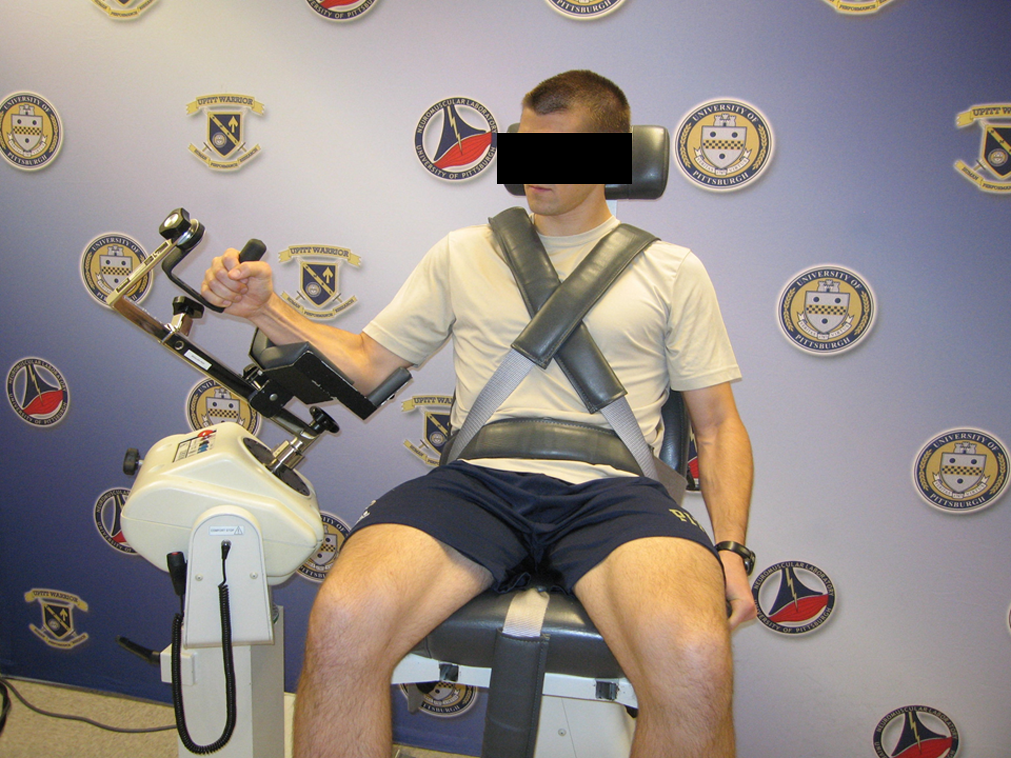
Participant performing the rotator cuff strength test on the isokinetic dynamometer.
To ensure the completeness of medical history, a certified athletic trainer or physical therapist obtained self-reported injuries for each participant’s full history using a standardized interview, designed specifically to address injury epidemiology in military personnel. 1 A musculoskeletal injury was operationally defined as one that resulted in an insult to the musculoskeletal system that resulted in an alteration in physical activity for at least 1 day, regardless of whether medical attention was sought. Sprains, strains, and fractures are examples of injuries that were included for analysis, whereas contusions and lacerations are injuries that were excluded. Shoulder injuries were defined as any injury that occurred to the shoulder complex (ie, glenohumeral joint, acromioclavicular joint, sternoclavicular joint, and scapula) as well as an injury to the musculature that crosses the shoulder. To describe the general risk to a large population, the side of the previous injury, if any, was not matched to any strength outcomes.
Bilateral strength differences were calculated as the absolute value of the difference between limbs divided by the mean peak torque of the dominant limb and then converted to a percentage. Based on the characterization of Sapega, 39 Marines were stratified based on percentage of strength difference: <10%, 10% to 20%, and >20%. A shoulder injury was recorded as a dichotomous variable, separating participants into those who reported a previous shoulder injury and those who did not. Ipsilateral ratios were also calculated by dividing the shoulder external rotator strength by the internal rotator strength. Participants were then stratified based on whether they were within the optimal ratio (0.67-0.85) or outside of the optimal ratio. The optimal ratio was defined by previous work using similar methodology. 16,26 Odds ratios (ORs) with 95% CIs were then calculated, with accompanying chi-square analysis to assess significance. For instances where the group sample size was <5, the Fisher exact test was utilized. The alpha level was set to P < .05 a priori. Statistical analyses were performed using SPSS Statistics for Windows version 24 (IBM).
Results
Male (n = 219; mean age, 22.6 ± 2.6 years; mean height, 177.3 ± 6.6 cm; mean weight: 81.1 ± 10.1 kg) and female (n = 91; mean age, 22.6 ± 2.9 years; mean height, 165.1 ± 5.8 cm; mean weight, 65.5 ± 6.9 kg) Marines were tested. As a combined cohort, 11% of Marines reported a previous shoulder injury. When stratified by sex, 13.2% of men reported an injury, compared with 5.5% of women. ORs for bilateral and ipsilateral strength differences in the combined cohort are presented in Table 1.
Odds Ratios for Reporting Previous Shoulder Injuries Based on Bilateral and Ipsilateral Strength Differences

a Significance at the <.05 level.
Marines with >20% differences in bilateral internal rotation strength demonstrated increased odds of reporting a previous shoulder injury compared with those with <10% differences (OR, 2.5). ORs for bilateral and ipsilateral strength differences when separating the cohort by sex are seen in Table 2.
Odds Ratios for Reporting Previous Shoulder Injuries Based on Bilateral and Ipsilateral Strength Differences When Separated by Sex
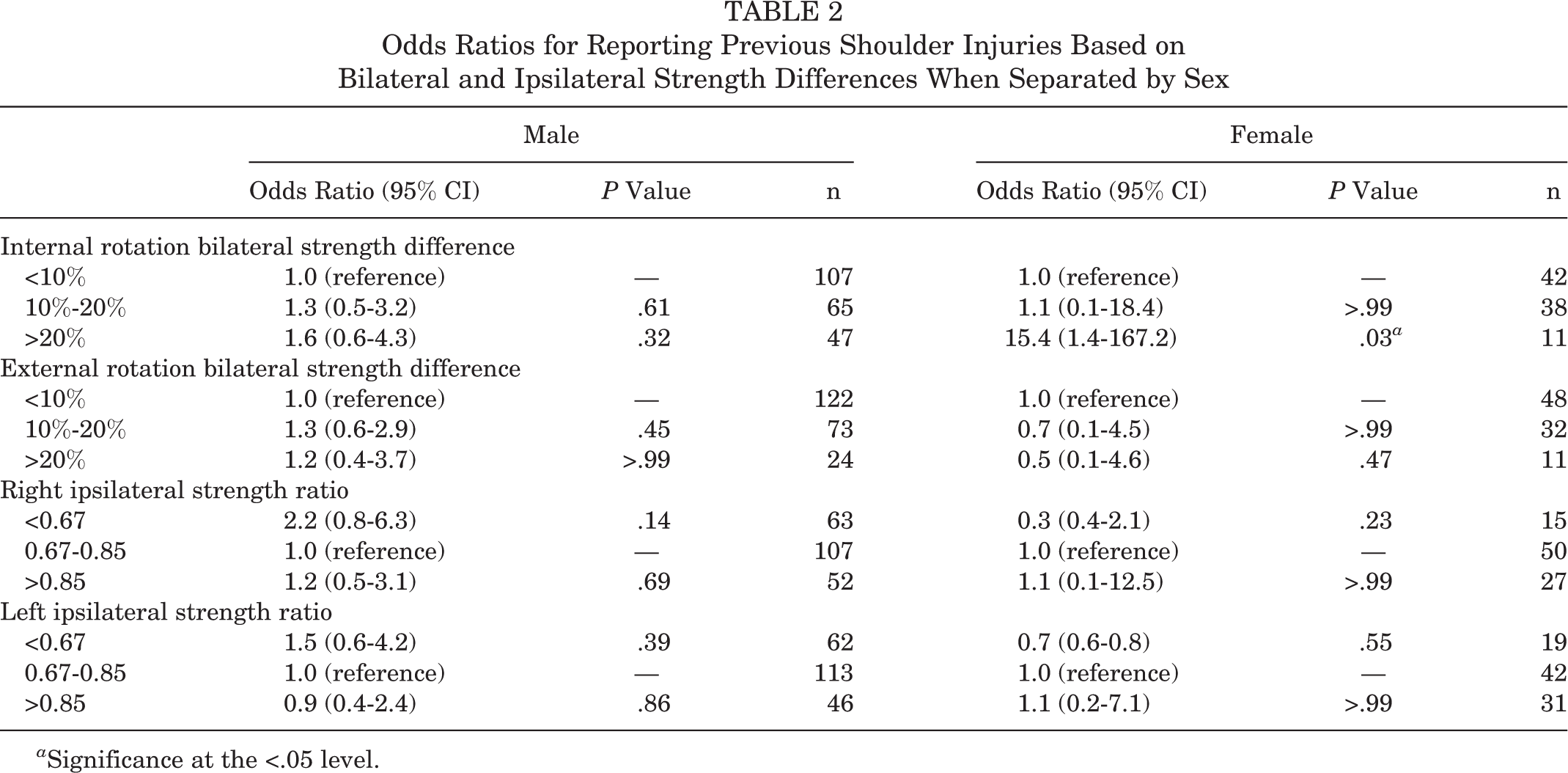
a Significance at the <.05 level.
Female Marines with >20% internal rotation bilateral differences demonstrated increased odds of reporting a previous shoulder injury compared with those with <10% differences (OR, 15.4) and 10% to 20% bilateral differences (OR, 13.9; 95% CI, 1.3-151.2). No ORs for male Marines were statistically significant. Additionally, no ORs were statistically significant based on ipsilateral strength ratios.
Discussion
The current study aimed to evaluate the effect of bilateral and ipsilateral shoulder strength on reporting previous shoulder injuries in a cohort of Marines and to evaluate differences when the cohort was stratified by sex. This study demonstrated increased odds (OR, 2.5) of reporting previous shoulder injuries based on larger magnitude internal rotation strength differences, and this effect was further magnified in women (OR, 13.9-15.4). These findings add further evidence to support the clinical guideline of maintaining bilateral strength within 10% of the contralateral limb. 39 The present study also adds vital information to military personnel by demonstrating a significant increase in injury risk when asymmetrical bilateral strength is observed in women. Interestingly, no significant differences were observed, either as a combined cohort or when separated by sex, for abnormal ipsilateral strength ratios and reporting previous shoulder injuries. This is in contrast to previous literature relating the injury risk to ipsilateral agonist:antagonist strength ratios in overhead athletes. 6,9,29,43
It is important to consider the retrospective design of the current study when interpreting these data. As such, it is unclear in this instance if the bilateral strength differences contributed to sustaining the previous shoulder injury or if the differences occurred as a result of the injury. It is also possible that the injured participants had abnormal bilateral strength differences, sustained an injury, and never rectified the differences to within “normal” ranges. Returning to duty too quickly, before properly restoring muscular strength balance to the injured shoulder, could be a viable explanation for the occurrence of this issue in military personnel. 7,47 Regardless of when the asymmetry developed, the results of this study suggest that bilateral strength asymmetries in the musculature of the rotator cuff, as well as the pectoralis major and latissimus dorsi, are at least related to shoulder injuries. Further, larger magnitude (>20%) asymmetries may be more prevalent in female Marines than male Marines.
The internal and external rotators are dynamic stabilizers of the glenohumeral joint, meaning that they play a critical role in limiting translation of the humeral head within the glenoid fossa. 9,43 These muscles accomplish this goal by balancing torque to produce synergistic movement patterns. 43 As the primary movers of the shoulder during internal rotation, the bilateral asymmetries observed in this study may be related to differences between the right and left pectoralis major and latissimus dorsi. 16 Weakness in these muscles could predispose the shoulder joint to abnormal force coupling during movement and result in pathological kinematic patterns. 15 This principle has been demonstrated in nonathletes with impingement syndrome in which muscular weakness contributed to altered scapular kinematic patterns compared with a nonimpingement control group. 28
Abnormal coupling has also been demonstrated with overhead athletes, as dominant arms typically have a stronger internal rotation musculature, which can lead to overuse injuries of the shoulder complex. 5,9,26 This is commonly measured with ipsilateral torque ratios, which are usually considered normal within 0.67 to 0.85 because of the large size of the internal rotators relative to external rotators. 9,16,26 Weakness in the external rotators (resulting in a ratio <0.67) is an example of abnormal ipsilateral strength balance. This imbalance is hypothesized to lead to excessive humeral head translation anteriorly, which could result in lesions. 46 In the present study, lower ratios were associated with increased odds of reporting previous shoulder injuries, but the ratios did not achieve statistical significance. This difference is possibly related to the repetitive overuse observed unilaterally in overhead athletes, on whom the majority of studies have been conducted. In contrast, Marines are not likely to spend as much cumulative time in overhead activities. However, the Marine Corps is the only branch of the US military that incorporates pull-ups into its annual fitness test. Pull-ups are likely a part of the average Marine’s regular strength training regimen. Additionally, some Military Occupational Specialties within the Marine Corps, such as vehicle crewmen, artillery, and infantry, spend time performing overhead tasks as part of daily tasks, such as rotating turrets and raising items overhead to load a truck bed. Regardless, the authors would still suspect overall training time in an overhead position to be substantially higher in predominantly overhead athletes, such as baseball, softball, and volleyball players.
A particularly interesting result of this study is the significant difference in the odds of reporting previous shoulder injuries for women with >20% internal rotation strength differences (OR, 15.4) compared with men (OR, 1.6). A comparison of the >20% difference with the 10% to 20% internal rotation difference revealed similarly increased odds for women (OR, 13.9) compared with men (OR, 1.3) in those with a >20% difference. Given the known discrepancy in absolute upper body strength between women and men, 2,40,41 it may be reasonable to postulate that differences in bilateral strength symmetry may be particularly relevant to women. Previous work on strength training has noted that a longer training period may be more advantageous in producing optimal strength adaptations in women compared with men. 23,34 Perhaps, after suffering a shoulder injury, women require more rehabilitation time to rectify strength symmetry to within 10% of the noninjured limb than men. However, the results of this study cannot delineate when the injury occurred relative to the muscular imbalance; further study is needed to adequately answer that question.
Bailey et al 4 recently reported that female athletes were more prone to asymmetric force production during weight distribution and jumping tasks compared to male athletes. The authors concluded that increasing strength is critical to minimizing asymmetry, as those with lesser strength (regardless of sex) also demonstrated asymmetric force production. 4 Combined with the results of the present study, the conclusions of Bailey et al 4 may have important ramifications for military leadership, as women have demonstrated similar (or greater) relative improvements compared with men after completing strength training programs. 20,23 This could subsequently lower the injury risk based on minimizing bilateral strength differences. Croisier et al 7 previously reported a reduction in hamstring injuries in soccer players by implementing a strength training program that aimed to normalize bilateral differences in isokinetic hamstring strength. In a cohort of players with a history of hamstring injuries, the training program reduced bilateral differences to within normal ranges, and no hamstring injuries occurred in the following 12 months. 7 The results of the studies by Bailey et al 4 and Croisier et al 7 present promising data that bilateral strength differences, when reduced, can limit the occurrence of a musculoskeletal injury.
While a <10% difference in side-to-side strength is considered “normal,” 39 larger magnitude differences (especially in a setting with repetitive use) can predispose people to injuries. Large-magnitude bilateral strength asymmetries are highly prevalent in overhead athletics because of heavy reliance and repetitive use of the dominant arm 6,26,29 but would be expected to be less prevalent in this population. This makes a comparison with previous literature difficult in the present study because of significant differences in population exposure. However, this study contributes to the literature by demonstrating that bilateral strength differences may be more relevant to evaluate (compared with ipsilateral strength ratios) in populations that are not overhead-centric but still suffer shoulder injuries regularly. 14,27,37 Additionally, the results of this study suggest that larger magnitude bilateral strength asymmetries may be more associated with injuries in women than men, at least in a military population. Further prospective study is necessary to establish the temporal relationship of abnormal bilateral asymmetries and shoulder injuries. Factors such as incomplete rehabilitation and hasty return to activity have been implicated as possible precursors for the existence of abnormal bilateral asymmetries. 7,47
This study does have limitations, which should be noted. As mentioned above, the retrospective design of the present study means that the cause and effect of the injury and muscular imbalance cannot be determined. Thus, conclusions on whether the injury occurred as a result of the imbalance, or the imbalance developed after the injury, cannot be elucidated from these results. However, the results do demonstrate a relationship of previous injuries with bilateral asymmetries that warrants further investigation. Specific details of the injury were not analyzed, nor were subanalyses on the weaker or stronger shoulder and the outcome of injury, which could have potentially strengthened the analysis. Additionally, there is a possibility of recall bias, as the participants were asked to self-report their personal injury history. However, previous work has shown that recall bias can be mitigated if guided through a personal medical history by a clinician, which was done in the present study. 45 Finally, these results may not be generalizable because of the high level of fitness and unique job demands of female Marines.
Conclusion
In the present study, Marines with internal rotation side-to-side strength differences >20% demonstrated increased odds of reporting a previous shoulder injury compared with those with side-to-side strength differences <10%. Interestingly, female Marines with >20% side-to-side strength differences in internal rotation demonstrated much higher odds of reporting previous shoulder injuries than did male Marines. With the full integration of women into combat roles in the US military, leadership and human performance professionals face additional challenges in adequately preparing women for the heavy physical burden of these roles. This study establishes a relationship between shoulder injuries and larger magnitude side-to-side strength differences in female Marines, and this information can be used to assist in physical preparation and/or rehabilitation of this cohort.
Footnotes
Acknowledgment
The authors thank Col Anne M. Weinberg, USMC (retired), and Lt Col Lawrence C. Coleman, USMC, as well as Megan Frame, Yosuke Kido, Corey O’Connor, and Kathleen Poploski for their contributions to this research.
One or more of the authors has declared the following potential conflict of interest or source of funding: This work was supported by Office of Naval Research Award #N00014-14-1-0021.
Ethical approval for this study was obtained from the University of Pittsburgh Institutional Review Board (0506094).