




Abstract
OBJECTIVE:
This study compared the effects of dynamic and static core training programs on soccer related speed, agility. anaerobic power tests, core stability tests and body composition measurements.
METHODS:
A Static (
RESULTS:
Sprint (10–30 m), agility (505 and Arrowhead), vertical and standing long jump scores did not increase in any groups. Neither group demonstrated difference in body composition measurements for repeated test scores and between group comparisons. Experiment groups improved dynamic and static core stabilization test scores while Control group did not change.
CONCLUSIONS:
The results indicate that both training types improved movement related measures of core stability which did not transfer into any anaerobic skills and body composition. Thus core stability training is not generating sufficient stimulus to improve power and strength dependent performance skills such as sprint and agility and therefore may not constitute a cardinal component in soccer conditioning programs.
Introduction
In recent years, the importance of core exercises has become more significant in sports conditioning programs and athletic performance enhancement. The question asked in studies carried out within this framework is “How does core strength and stabilization affect athletic performance?”. Several studies attempting to answer this question reveal different results [1, 2, 3, 4].
Core stabilization is defined as the stabilization of the body center against the dynamic movements of the limbs and the absorption of the pressures on core of the body [5]. A complex process involving actions of biomechanical, motor, sensory and central nervous system components [6]. Since the core will be regarded as the center of the kinetic chain in sports activities, it can be stated that the core power, balance and movement control will maximize the lower and upper extremities’ functions. Thus, the motoric skills of athletes such as strength, endurance, coordination, agility, speed, balance in movements like running, jumping, hitting, spinning and throwing can be expected to develop through the increase in core strength and stability. The inability and impairment of core stabilization while performing athletic movements will cause the antagonist muscles to work more and attempt to compensate this deficiency. This in turn may cause the functional power deficit [7].
In the present study, muscle contraction type forms a variable group. Although this study does not involve maximal strength exercises, it was hypothesized that different contraction types could reveal dissimilar muscle adaptation in terms of neural effects, the use of motor unit within the muscles and the specificity of joint angle [8]. A few studies refer to the effect of differences between isotonic and isometric core training on functional skills and field tests [9, 10]. However, we could not trace a study which focused on the effect of core training in terms of muscle contraction type on soccer specific anaerobic performance measurements. This issue is important for answering two questions. First, the nature of preferred muscle contraction type of core muscles and stabilization exercises fitness trainers and coaches should predominantly use. Second, it addresses the necessity of core exercises in soccer, where anaerobic performance is critical.
Methods
Subjects
Athletes who actively play soccer in semi- professional soccer league have participated in the study. Participants had over 8 hours (4–5 sessions) of training sessions each week in accordance with their training schedule and also played one game each weekend. The athletes have been randomly separated into three groups as Static (
Procedures
The Static and Dynamic core training groups have performed the exercises indicated in the exercises program below (Table 1) for 8 weeks, 3 days/week and about 30–40 minutes for each session with an increasing work load. The Control group continued with the soccer training sessions during this period.
Core training plan
Core training plan
The intensity of exercise was determined by the number of repetitions in the Dynamic Group and the duration (seconds) in the Static Group.
Comparison of anthropometric tests
BFP: Body fat percentage; BMI: Body mass index.
Comparison of pre-post core stability tests
Between group comparison: a
Anthropometric measurements, core stability and field (athletic performance) tests were performed for Dynamic, Static and Control groups before and after core training program. Eight anthropometric measurements were used through the evaluation of the athletes including height, body weight, body mass index, waist circumference, hip circumference, waist-hip ratio, skin thickness taken from 7 areas and body fat percentage [11]. Core performance tests consisted of five measurements, two of which were chosen among the isotonic and three of which were chosen among the isometric type of exercises. While the static tests consisted of leg raise [9], plank [12] and isometric extension [13], the dynamic tests included sit-up and push-up tests [12]. The static tests results were recorded in seconds whereas dynamic tests were recorded in terms of the number of repetitions. In order to measure the athletes’ soccer specific field tests; speed, acceleration and agility, 10 and 30-meter dash, 505 Agility and Arrowhead agility tests were performed [12, 14, 15, 16]. Lower extremity strength and power were determined with the standing long jump and vertical jump [12].
The pre-training and post-training distributions of the variables according to the groups were analyzed and the normality of the distribution and the homogeneity of the variances were determined with the Mauchly Sphericity Test and Levene test. Between group, within group and exercise effect analysis were carried out with repeated variance analysis. The level of significance was set at 0.05.
Results
Between and within group comparisons of pre-training and post-training and time*group interactions of anthropometric measurements revealed no differences. The waist-hip ratio and skinfold thickness decreased in experimental groups, but this change wa not statistically significant.
Leg raise duration significantly increased only in the Dynamic and Static groups. In the push-up, sit-up and back isometric tests, the same effect took place; however only the Static group increased its post-training test score in the plank test. In the sit-up test, a the Dynamic group had statistically higher score than other groups. A time*group interaction was observed in all push-up, sit-up, back isometric and plank tests, probably due to the within group effect of the Dynamic and Static groups. However, the difference in time*group interaction of sit-up test related only to the increment of post-training score in the Dynamic group.
For 10-meter acceleration, 30-meter sprint, 505 agility, Arrowhead agility, Standing long jump and Vertical jump tests, no difference was observed within groups. Time*group relationship and post-training scores did not display a difference between groups.
Discussion
Evaluation of anthropometric findings
No changes were recorded in terms of the anthropometric findings either with respect to the pre-training or post-training measurements for all groups. As a result, there were no time*group interactions either. Studies which show the effect of core stabilization exercises on body compositions are numbered. The existing studies show quite different results which may be due to the study cohorts. While studies on sedentary individuals show that positive effects have generally been achieved on body composition [17, 18, 19], this effect has not been shown in some other studies [20, 21], particularly those relating to athletes [22]. This can be explained by the early adaptation to the exercise. There are very few studies studying the effects of core stabilization programs on elite athletes’ body composition and anthropometric measurements. A 6 week Pilates exercise program added to the normal exercise plan of 18 young male basketball players did not result in any change in their body weight [22]. Considering that these athletes were already suitable for a specific body composition (high lean body mass and low fat mass), it is clear why core stabilization exercises did not create a change in the body composition. A similar effect can be considered valid for the present athletes who have a very low fat percentage (6.8%) and have continued with their soccer practices.
Evaluation of core stabilization test scores
The results of the core tests applied in the study can be seen in Table 3. With the exception of the plank test, the post test scores of the Dynamic and Static study groups increased in all measurements. In the plank test, while there was no change between the pre-training and post-training scores of the Dynamic and Control groups, the Static group increased its test duration. In the sit-ups test, a difference was observed between groups in the posttest. The Dynamic group did significantly more sit-ups compared to the Static and Control groups. Time*group interaction was observed in all of the push-up, sit-up, back isometric and plank tests and this interaction results from the within group development of the Dynamic and Static groups. However, in the sit-up test, the difference between the groups in time*group interaction resulted from the posttest score of Dynamic group. In this test, while the Dynamic study group increased its score by 21.2%, the Static group improved only by 9.8% while the Control group remained the same regarding this variable. In the plank test, while only the Static group increased post test score, the difference between the groups resulted from the Static and Dynamic groups achieving better scores compared to the Control group as is the case in all of the other tests with the exception of the sit-up test. When the results of the leg-raising, test were analyzed, there was no statistical difference between the groups.
The findings relating to the core stabilization/ strength exercises display similar results in many studies [22, 23, 24, 25, 26]. However, the development is not at the same level with programs of similar nature [22]. In one study similar to the present study, both the dynamic and the static groups who did exercises on a unstable surface increased their scores in core tests [9]. In addition, although the primary goal was not the core muscles in some studies, it was observed that there was an improvement in core muscles measures [27, 28]. These findings may point out to the co-working of core muscles i.e. their synergistic pattern and joint transfer of power rather than working in isolated manner. This supports the view of Nesser who had indicated that basic strength exercises might be sufficient for core muscles training [2]. This subject will be discussed in detail once again under the core-performance relationship section.
In the present study, another important result is the presentation of specificity of static and dynamic movements. Both experimental groups increased their scores significantly. This finding relates to movement specificity [29, 30] and was more apparent in the plank and sit-ups tests. While the pre-training and post-training differences in the plank test were evident only in the static group, the time*group relationship in the sit-up test is the result of the increase in the post-training sit-up score in the Dynamic group. As stated in many studies, static exercises improve the strength of the angle they are applied on [29, 30]. This theory is accepted as “constant joint angle” or “angle specificity” [31] and this could explain the variation manifested by the Static group in the static core stabilization tests but not displayed in the dynamic counterparts.
Evaluation of field (performance) test scores
The core exercise program did not improve the field-performance test scores of soccer players in either test (table and Fig. 1). Some studies state that core strength/stabilization development in the athletic level contributes to performance [1, 5, 10, 26, 32, 33, 34] while other show that the relationship between core physical suitability and performance is at a medium or low level or that there is no relationship at all [9, 22, 35]. Therefore, although many studies show that core stabilization test scores improve with core training, similar to the observations in the present study [22, 25, 35], only a handful of studies indicate positive relationship between core function and athletic performance.
Comparison of pre-post core sprint, agility and jumping tests.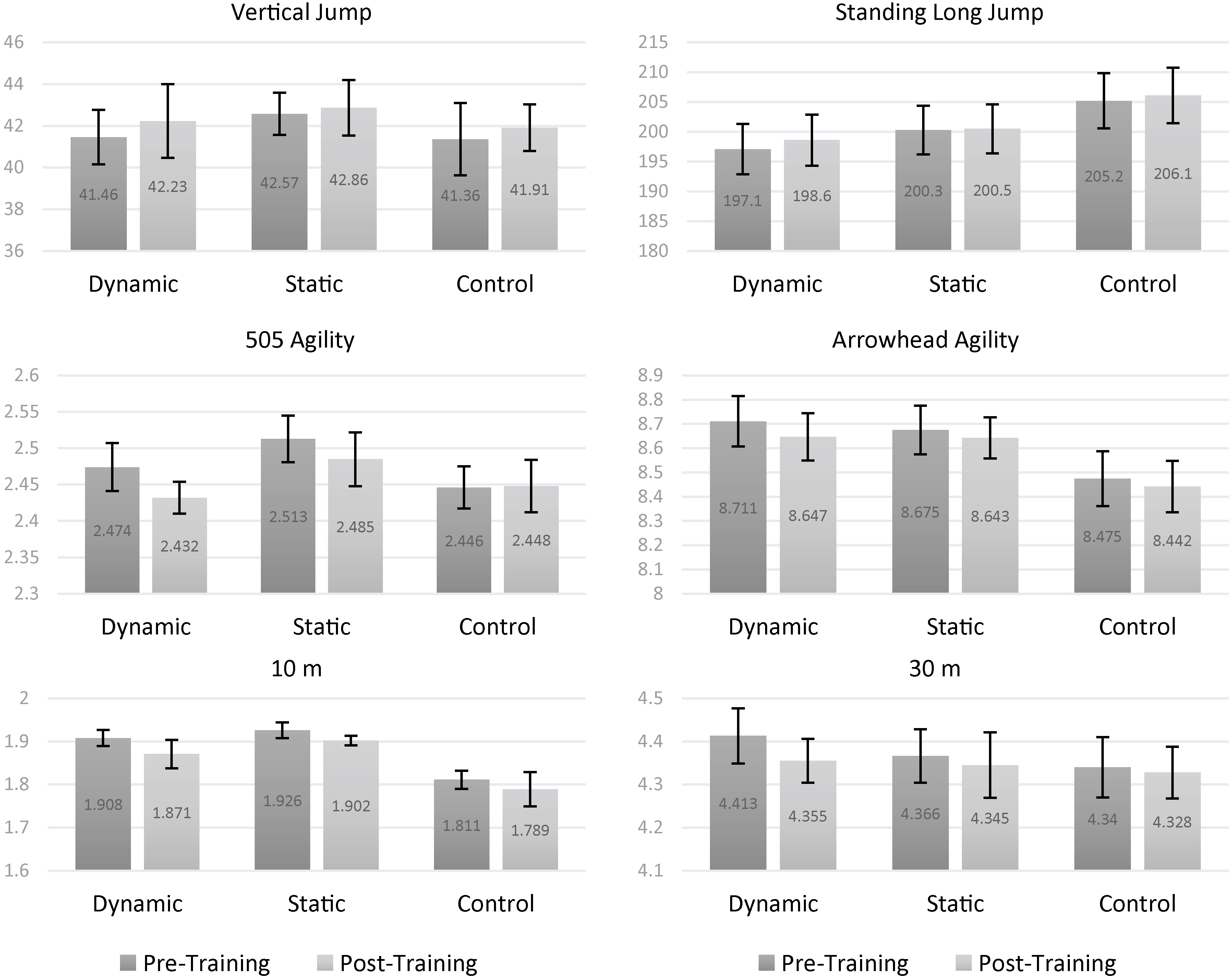
Core exercise applications can rarely take place in isolation. They rather represent a part within a whole physical fitness program routine. In this respect, it is not surprising that there are studies in which there is improvement in the athletic performance. In general, the multi-modal and complex exercise programs including core, balance, strength had a positive effect on various performance characteristics. With these programs positive developments were observed in athletic performance skills such as hitting-throwing [34, 36], strength [core muscle strength-1 RM-extremity strength, etc. [26, 37], power [38, 39], jumping [40, 41], speed [24], agility [41], balance-coordination-proprioception muscle activation [37, 42], muscular endurance [43]. However, since it is not possible or difficult for core muscles to work in isolation, the reliability of the achieved improvements is debatable. Similar to this study, many scientific publications share this view. For instance, in a study looking for the correlation between strength tests (clean and jerk 1RM, squat 1RM, bench press 1RM), performance tests (repetitive jumping, 20–40 yard sprint, 10 yard shuttle run) and core tests (back extension, body flexion, right-left bridge) a medium level relationship was found. Due to the low level of relationship between core exercises and performance, it was concluded that these exercises could not form a main focus for strength development [2]. No significant relationship was found between the core stabilization (rotatory stability test), core strength (double leg lowering, 60 seconds maximum sit-up) tests and their effect on speed of hitting the ball in athletes who play in the 2nd league of NCAA [44]. In another study of the relationship between core stabilization, functional movement and performance it was concluded that core stabilization could not be accepted as a performance indicator of functional movement screening tests [45]. A similar view was held in a systematic review which questioned core-performance relationship. In this review, it was argued that the majority of positive performance developments achieved in 13 out of the 24 studies were due to the exercises and measurements specific to the sports. It was also stated that the improvement in general strength, sprint and jump performance were not verifiable enough [1]. Similar to observational studies above, many experimental studies suggest that the core stabilization improvement does not affect performance tests [22, 46]. According to one study [3] if the purpose of strength conditioning coach is to develop the athletic performance, there is no need to emphasize core exercises much. Similarly, improvement in core stabilization is related to skill and in healthy athletes, who perform traditional strength exercises, stimulate the core muscles sufficiently during these exercises as well [4]. In addition, anaerobic performance findings (jumping, speed, agility), which did not change after core program experiments, may be because of two basic aspects as stated in another research [2]; first, the test methods used to evaluate the core strength and stabilization may not relate to strength and power. Second, the body weight core stabilization training does not have an effect on strength and power performance. For example, the intensity of an exercise will not exceed 10% of the maximal strength in spinal flexion movement without using a weight. This intensity is not enough to stimulate certain fast-twitch muscle fibrils and create an adaptation for strength and power [47]. When the results are analyzed, it is not surprising that the present training program created a positive development in the core stabilization tests and core endurance but this improvement did not transfer to the anaerobic field tests.
An improvement in the endurance of the core muscles which was proved in core stability tests in the present study will cause body stabilization to have resistance against fatigue for a longer time and this in turn will prevent functional losses or the risk of injury. Such a gain is important in sports where the tackle and wrestle continues for a long time and endurance affects the games anaerobic performance. For that reason, it can be stated that core exercises are important for soccer players. But, it may be better to apply core exercises as a part of the basic strength conditioning sessions and to modify basic multi-joint strength exercises in a manner as to develop the core muscles instead of planning strength training sessions only for core stabilization.
Footnotes
Conflict of interest
The authors declare no conflict of interest.