




Abstract
BACKGROUND:
Bone morphogenetic protein and activin membrane-bound inhibitor (BAMBI) and mothers against decapentaplegic homolog 7 (SMAD7) are important transforming growth factor-
OBJECTIVE:
In this study, we examined the expression levels and prognostic values of BAMBI, SMAD7 and TERT and their association with AML patients’ outcomes.
METHODS:
Blood samples were collected from 74 de-novo AML patients and 16 controls. Real-time quantitative PCR (qRT-PCR) was performed to analyze BAMBI, SMAD7 and TERT expressions.
RESULTS:
BAMBI and SMAD7 expression in AML were significantly upregulated versus controls (
CONCLUSIONS:
BAMBI is a novel biomarker in predicting prognosis in AML patients. Moreover, a potential interplay is found between BAMBI, SMAD7 and TERT in AML pathogenies.
Introduction
Acute myeloid leukemia (AML) is the most common type of acute leukemia in adults with the lowest survival rates of all the leukemias [1]. It is a highly heterogeneous hematological malignancy originating from hematopoietic stem cells and is characterized by the clonal expansion of myeloid blasts in the peripheral blood, bone marrow, and/or other tissues [2]. Moreover, AML is associated with a wide variety of molecular and cytogenetic abnormalities [3, 4] which are critically involved in the dismal outcome of many AML patients even those attaing initial complete remsion (CR) [5]. Recently, the role of several genes in AML pathogenesis has become increasingly studied, to discover new discriminative molecular markers for improving diagnosis and outcome prediction [6, 7]. In fact, the interesting role of the transforming growth factor-
The TGF-
An important TGF-
Another important TGF-
Another, interesting cancer specific target, is the human telomerase reverse transcriptase (hTERT), which is the catalytic subunit of the well-known telomerase enzyme. The hTERT allows cells to limitlessly divide and evade apoptosis by extending chromosomes telomeres, hence it is up-regulated in 80–90% of cancers including AML [24]. This is widely known as the telomerase canonical function [25]. However, accumulated evidence suggests that hTERT may have a non-canonical telomerase-independent role in cancer through transcriptionally regulating some genes [26]. In this context, an in vitro study reported that activated hTERT upregulated TGF-
Subjects and methods
Subjects
The study enrolled a total of 74 patients newly diagnosed with de-novo AML as well as 16 healthy age and sex matched volunteers. The AML patients were recruited from the Clinical Hematology and Stem Cell Transplantation Unit, Ain-shams University Hospitals, Cairo, Egypt. The clinical characteristics of patients is described in Table 1. Patients with therapy-related or myelodysplastic syndrome (MDS)-related AML were excluded from the study. The selection of these patients was based on the following criteria: full history taking, thorough clinical examination, and standard diagnostic methods, including cytomorphological, cytogenetic, and immunophenotypic (IPT) evaluation, which was established using Beckman Coulter Navios EX flow cytometer (Frederick, Maryland, USA). The study was carried out in accordance with the regulations and recommendations of the Declaration of Helsinki and informed consent was obtained from every patient for laboratory studies according to the guidelines of Committee of Medical Ethics of Ain Shams University Hospitals (ASUH) (Ethical committee approval number: 68 on May 10, 2018). The study was conducted in the period from May 2018 to June 2020.
Sampling
Both peripheral blood (PB) and bone marrow (BM) aspiration samples were collected at diagnosis from the 74 AML patients, while PB samples only were obtained from the control group. The diagnosis of AML was made based on the morphologic findings from Giemsa-stained smears of BM aspirates and IPT analyses of leukemic cells. The PB samples were withdrawn from the patients before they received any treatment and divided into two aliquots. The first aliquot of blood was collected on vacutainer tubes containing Na2 EDTA for determination of white blood cells (WBC) count, platelets count, hemoglobin, IPT as well as total RNA purification from human whole blood. The second aliquot was collected on plain vacutainer tube for serum preparation for the assay of serum lactate dehydrogenase (LDH). Patients were classified according to the French-American-British (FAB) classification: AML-M0; AML-M1; AML-M2; AML-M3; AML-M4 and AML-M5.
Methods
RNA isolation, reverse transcription and real-time quantitative PCR
Total RNA was extracted and purified from human whole blood using a QIAamp RNA blood mini kit (Qiagen, Hilden, Germany) according to the manufacturer’s protocol and stored at
Clinical outcome assessment
The risk stratification for each patient was done by a specialized hematologist who follows these patients and case by case judgment was done based mainly on karyotype as well as other clinical risk factors that are widely known to affect patient’s overall prognosis like patient’s age, CR achievement, relapse and/or patient’s
Clinical and molecular characteristics of the patients
Clinical and molecular characteristics of the patients
SE, standard error of mean; WBC, white blood cell; BM, bone marrow; LDH, lactate dehydrogenase; FAB, French American British; CR, complete remission.
full disease history. Event-free survival (EFS) and overall survival (OS) were set as clinical endpoints in this study. EFS was defined as the time from diagnosis until death, relapse, or the absence of complete remission (CR). OS was determined as the time from diagnosis to death or the end of the follow-up from any cause.
The clinical and molecular characteristics of subjects were summarized using descriptive statistics. The distribution of quantitative data was tested by Kolmogorov-Smirnov test of normality. Quantitative data were presented in the form of mean with standard error (SE) when parametric and median with range when non parametric. Qualitative data were presented in the form of numbers and percentages. Quantitative data with parametric distribution and non-parametric distribution were compared between two groups using Independent
Results
Clinical and molecular characteristics of the subjects
The control group was selected from 16 age and sex matched healthy volunteers. It is noteworthy to mention that the ages of both controls (42.87
Correlation of the studied genes mRNA expression levels with each other
Correlation of the studied genes mRNA expression levels with each other
Kaplan-Meier analysis and the logrank (MantelCox) test
EFS, event free survival; OS, overall survival.
Kaplan-Meier curves of EFS and OS based on expression levels of BAMBI, SMAD7 and TERT in AML patients. A and B: Patients with high expression of BAMBI had shorter EFS and OS. C and D: Patients with high expression of SMAD7 had shorter EFS and OS. E and F: Patients with high expression of TERT had shorter EFS and OS.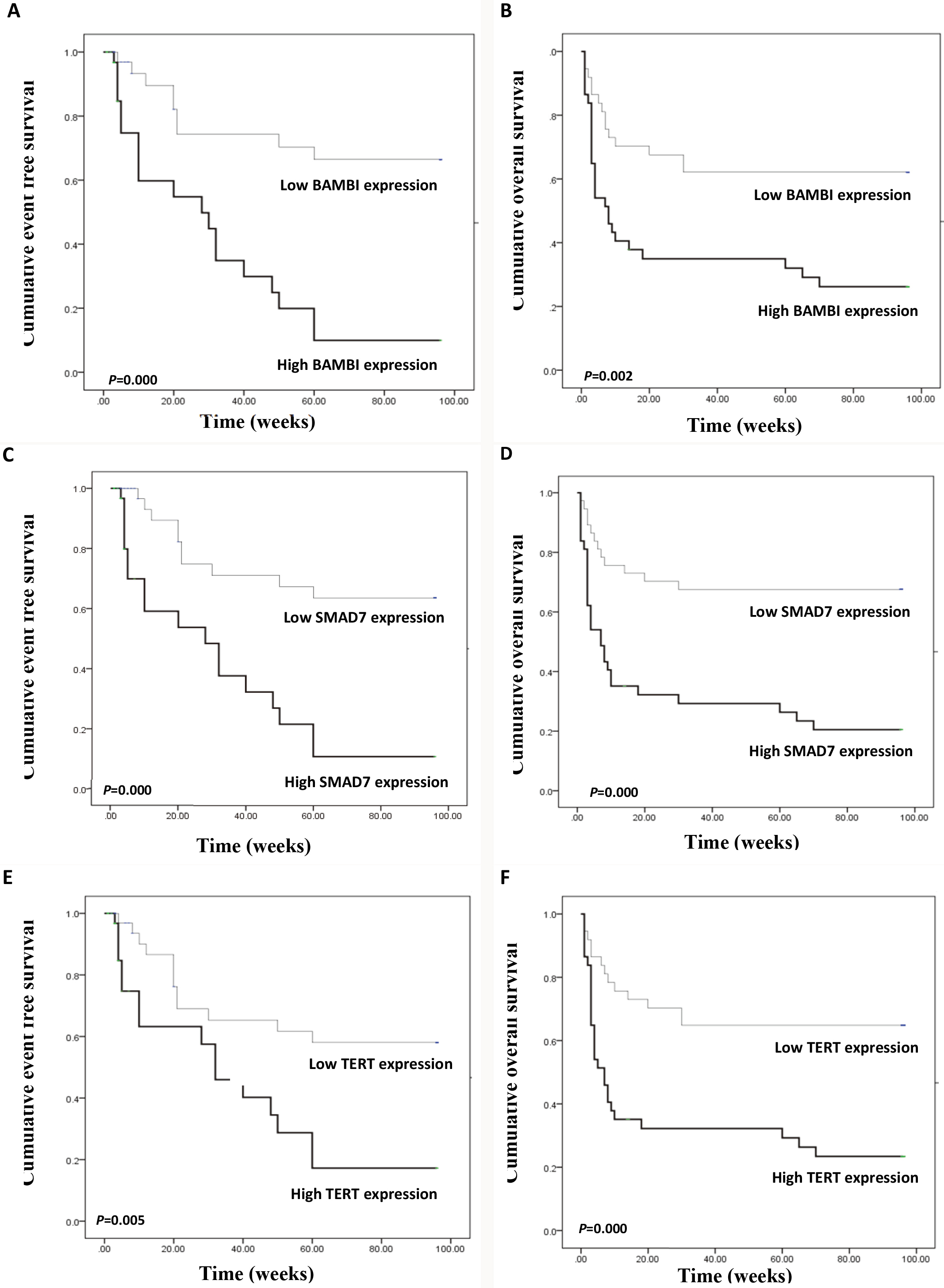
The median BAMBI or SMAD7 expression levels at diagnosis, respectively, were used to divide the patients into low and high BAMBI or SMAD7 expression groups. Patients with BAMBI expression levels
Association of the studied genes mRNA expression levels with each other
Spearman correlation coefficient was used to determine the potential correlation of the expression levels of the 3 studied genes together. Interestingly, there was a highly significant positive correlation between the expression levels of BAMBI, SMAD7 and TERT together at
Prognostic impact of the studied genes expression on outcome (EFS/OS) of AML patients
To investigate the prognostic impact of BAMBI, SMAD7 and TERT expression in AML, survival data were obtained for the AML patients with followup time of 96 weeks. We performed the Kaplan-Meier analysis and the logrank (MantelCox) test to analyze the effect of the studied genes expression on EFS/OS (Table 3). The survival curves showed that patients with high BAMBI, SMAD7 and TERT expression had significantly shorter EFS (
Univariate analysis of prognostic factors for EFS/OS in AML patients
Univariate analysis of prognostic factors for EFS/OS in AML patients
EFS, event-free survival; OS, overall survival; HR, hazard ratio; 95% CI, 95% confidence interval; WBC, white blood cell; CR, complete remission.
Multivariate analysis of prognostic factors for EFS/OS in AML patients
EFS, event-free survival; OS, overall survival; HR, hazard ratio; 95% CI, 95% confidence interval; WBC, white blood cell; CR, complete remission.
To determine independent risk factors affecting OS and EFS, univariate and multivariate cox regression analyses were performed. Prognostic factors including; age (
Discussion
To the best of our knowledge, this is the first study to explore the interplay between BAMBI, SMAD7 and TERT expression levels in AML pathogenesis. In this study, we demonstrated that BAMBI and SMAD7 levels were strongly positively correlated to each other and were found to be highly upregulated in AML patients with poorer risk status and in those failing CR after induction therapy as well as those who died. Moreover, Kaplan Meier analysis revealed that patients with higher BAMBI, SMAD7 and hTERT expression had shorter OS and EFS than those having low expression levels of the 3 genes. Finally, BAMBI was identified as an independent prognostic factor for OS in AML patients. These data collectively indicate that BAMBI may serve as a novel promising prognostic marker in AML and that there is some sort of interplay between BAMBI and SMAD7 in AML pathogenesis and prognosis most probably involving a TERT non-canonical impact.
It is well known that AML is the most common form of acute leukemia among adults, accounting for the largest number of annual deaths from leukemias in the United States [29]. Surprisingly, despite the understanding of AML pathogenesis and the developments done in clinical therapy in the past decades, the outcomes of AML patients are still very poor in general [30]. Thus, more biomarkers need to be discovered to enhance diagnosis, risk stratification, and prognosis in AML that may accordingly help physicians in making appropriate therapeutic decisions [31]. In our study, we focused on the deregulation of the TGF-
Owing to the importance of the TGF-
Another interesting TGF-
Since it is well known that cancers develop due to a dysregulated set of events, it’s not surprising to assume that BAMBI and SMAD7, as TGF-
In conclusion, our study suggested that high expression of BAMBI can predict adverse prognosis in AML and may guide treatment decisions for AML. Moreover, this study demonstrated a potential interplay between BAMBI, SMAD7 and TERT in AML pathogenies. Finally, although the association between BAMBI, SMAD7 and TERT expression levels and clinical outcomes was illustrated in this pilot study, further detailed studies will be required to validate whether BAMBI and SMAD7 functions as a tumor suppressor potentially through a TERT non-canonical impact in larger AML cohorts, elucidate the underlying mechanisms, study the impact of different treatment strategies either chemotherapy or BM transplantation on the expression of these genes and also determine the effect of developing BAMBI receptor blockers as a potential novel treatment for AML to enhance patients’ outcomes and survival rates.
Authors’ contributions
Miral Magdy Shehata: conception, researched data, designed experiments, interpreted data and prepared the manuscript.
Al-Aliaa Mohamed Sallam: conception, designed experiments, revised the manuscript and provided supervision.
Mary Gamal Naguib: provided patients’ samples, interpreted data, and revised the manuscript.
Hala Osman El-Mesallamy: revised the intellectual content and provided supervision and interpretation of data.
Funding
This research did not receive any specific grant from funding agencies in the public, commercial, or not-for-profit sectors.
Footnotes
Acknowledgments
The authors thank all the donors whose names were not included in the author list, but who participated in this study.
Conflict of interest
The authors declare that there is no conflict of interest.