




Abstract
BACKGROUND:
Gastric cancer is a prevalent malignant around the world. Aberrantly expression of microRNAs (miRNAs) contributes to the progression of tumors. The aim of this study was to investigate the expression and role of miR-892a in gastric cancer.
METHODS:
A total of 119 gastric cancer patients were enrolled in this study. And the expression of miR-892a in gastric cancer tissues and cells was measured using RT-qPCR analysis. Kaplan-Meier plotter and multivariate Cox regression analysis were used to explore the prognostic value of miR-892a in gastric cancer. The biological function of miR-892a in gastric cancer cells was evaluated using CCK-8 assays and Transwell assays.
RESULTS:
The expression of miR-892a was high-expressed in gastric cancer tissues and cells. The miR-892a expression was associated with tumor size, differentiation, lymph node metastasis, and TNM stages. Gastric cancer patients with high miR-892a expression showed a short overall survival rate. Overexpression of miR-892a promoted cell proliferation, migration, and invasion of gastric cancer cells.
CONCLUSION:
miR-892a was upregulated and predictor of poor prognosis in gastric cancer patients. The miR-892a in gastric cancer cells significantly promoted cell proliferative, migratory, and invasive properties. Furthermore, miR-892a may be served as a prognostic marker as well as a therapeutic target for gastric cancer.
Introduction
Gastric cancer is one of the most frequent malignancies originating from the gastric mucosa epithelium and the leading cause of cancer-related deaths [1]. Although a worldwide decline in the incidence of gastric cancer, the incidence remains high in China [2]. The primary risk factors causing gastric cancer are dietary habits, stress, and helicobacter pylori infection, other factors such as smoking can also potentially increase the risk of gastric cancer occurrence [3, 4]. Surgical resection is the most common treatment for gastric cancer, especially at early stages, but the prognosis is not good. Additionally, the majority of gastric cancer patients are diagnosed at advanced stages with a short 5-year overall survival [5]. Current treatment, such as surgical resection, radiotherapy, and chemotherapy, did not dramatically improve the survival time of gastric cancer patients [6]. In recent years, target therapy based on cancer gene therapy, as a novel strategy in clinical trials, has been studied and can be used for the treatment of gastric cancer. Therefore, the identification of novel biomarkers and therapeutic targets for the treatment of gastric cancer is urgently needed.
Correlation between miR-892a expression and clinical characteristics of gastric cancer patients
Correlation between miR-892a expression and clinical characteristics of gastric cancer patients
MicroRNAs (miRNAs) are a group of small non-coding RNA molecules that can regulate gene expression by binding to 3’-UTR of target mRNA [7]. Increasing evidence has indicated that the function of miRNAs is widely involved in various cellular activities, including cell differentiation, proliferation, migration, and invasion [8, 9, 10]. miRNAs are aberrantly expressed in various types of cancers that function as oncogene or suppressor affecting the tumorigenesis and development of human cancers [11, 12]. It has been reported that miRNAs may act as diagnostic or prognostic markers and promising therapeutic targets [13]. In gastric cancer, many miRNAs were abnormal expressed and regulated tumor development, as well as acted as diagnostic/prognostic markers, such as miR-383-5p [14] and miR-374a-5p [15]. In a miRNA expression profile research, miR-892a has been reported upregulated in gastric cardia adenocarcinoma using microarray analysis [16]. However, the expression of miR-892a in gastric cancer still needs to be verified, and the prognostic significance and functional role of miR-892a remain need to be explored.
Here we demonstrated that miR-892a was significantly upregulated in gastric cancer and cell lines. Overexpression of miR-892a was correlated with poor prognosis and clinical pathological characteristics. The present study showed that miR-892a promoted gastric cancer cell proliferation, migration, and invasion.
Tissue specimens
The current study was approved by the Research Ethics Committee of Caoxian People’s Hospital of Shandong Province. All the patients enrolled in the present study signed written informed consent. The paired human gastric cancer tissue specimens and corresponding adjacent noncancerous tissue specimens were collected from 119 patients with gastric cancer who underwent surgical resection at Caoxian People’s Hospital of Shandong Province between May 2010 and December 2013. Following resection, tissue specimens were rapidly frozen in liquid nitrogen until RNA extraction. All patients with gastric cancer had not been treated with radiotherapy or chemotherapy before surgical resection. According to the ethical and legal standards, all tissue specimens were handled and made anonymous. The clinical characteristics of gastric cancer patients were listed in Table 1. The 5-year overall survival information was collected and recorded by telephone.
Cell culture and transfection
The gastric cancer cell lines (AGS, MKN-45, NCI-N87, and HGC-27) and one immortalized normal gastric cell line GES-1 were obtained from Cell Bank of Shanghai Institute of Cell Biology, Chinese Academy of Sciences (Shanghai, China). The cells were cultured in DMEM medium (Thermo Fisher Scientific, Waltham, MA, USA) at 37
Before transfection, gastric cancer cells were seeded in 6-well plates until reaching the confluence of 70%–80% in 24 h. For cell transfection, miR-892a mimic (5’-CACUGUGUCCUUUCUGCGUAG-3’), mimic negative control (NC; 5’-UUCUCCGAACGUGUCACGU TT-3’), miR-892a inhibitor (5’-CUACGCAGAAAGGA CACAGUG-3’), inhibitor NC (5’-CAGUACUUUUG UGUAGUACAA-3’) (GenePharma; Shanghai, China) were transfected into MKN-45 and AGS cells with Lipofectamine 3000 reagent (Invitrogen; Thermo Fisher Scientific) following to manufacturer’s instructions.
RNA extraction and reverse transcription-quantitative polymerase chain reaction (RT-qPCR)
Total RNA was extracted from tissue specimens and cells with TRIzol reagent (Invitrogen, Thermo Fisher Scientific) according to the manufacturer’s protocol. The quality of RNA was detected using a NanoDrop 2000 (Thermo Fisher Scientific). Then total RNA was reverse transcribed into cDNA by using miScript Reverse Transcription Kit (QIAGEN, Germany). The expression of miR-892a was detected using RT-qPCR assay using SYBR
Cell proliferation assay
The proliferative abilities of gastric cancer were detected using the Cell Counting Kit-8 (CCK-8) Kit (Donjindo, Japan). In brief, AGS and MKN-45 cells transfected with miR-892a mimic, mimic NC, miR-892a inhibitor, or inhibitor NC were incubated in 96-well plates with a density of 3
Cell migration and invasion assays
To investigate cell migration and invasion, a Transwell assay was performed using Transwell chamber (8
Statistical analysis
The expression levels of miR-892a in 119 gastric cancer tissues and 4 cell lines were detected using RT-qPCR analysis. A. Relative levels of miR-892a were higher in gastric cancer tissues than adjacent non-cancerous tissues. B. Relative levels of miR-892a were high-expressed in gastric cancer cells than that in immortalized normal gastric cell line GES-1. **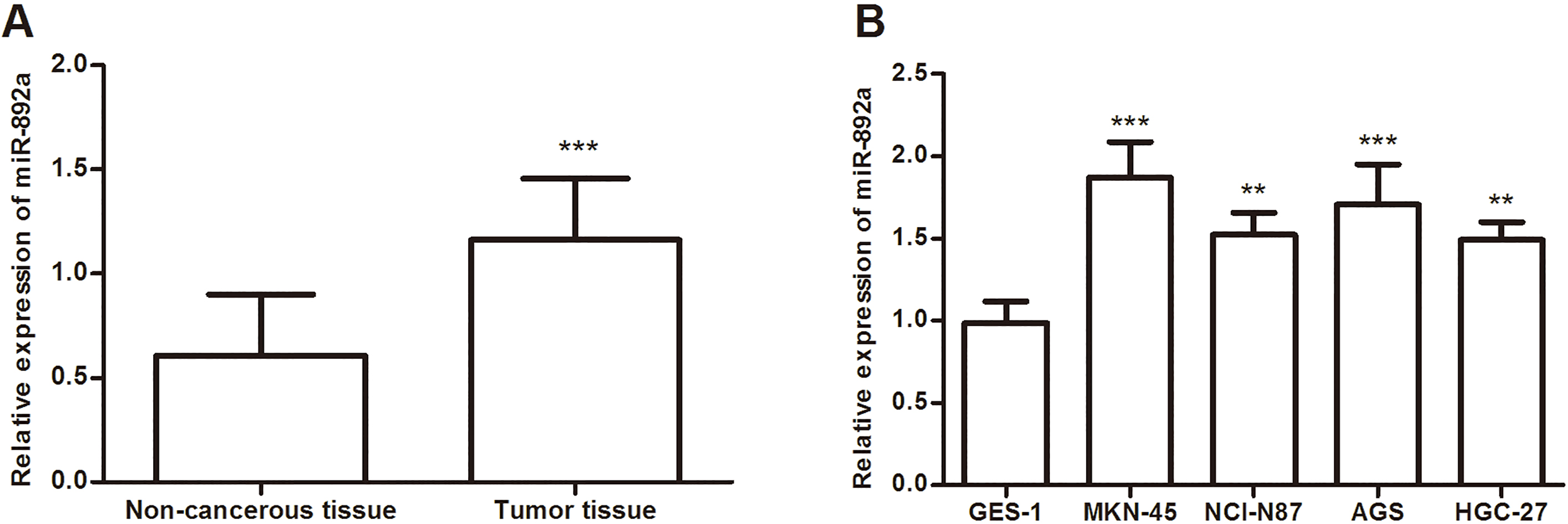
All the data were presented as the mean
miR-892a is upregulated in gastric cancer tissues and cells
RT-qPCR was used to detect the expression of miR-892a in gastric cancer tissues and adjacent non-cancerous tissues, as well as cells. As shown in Fig. 1A, the expression levels of miR-892a were significantly increased in gastric cancer tissues compared with the adjacent non-cancerous tissues (
The relationship between miR-892a expression and clinical characteristics of gastric cancer patients
To investigate the involvement of miR-892a in the development of gastric cancer, the relationship between miR-892a expression and the clinical characteristics of the patients was analyzed. And the patients were classified into low miR-892a expression group and high miR-892a expression group according to the mean value of miR-892a expression as the cut-off value. The results showed that increased miR-892a expression was associated with tumor size, differentiation, positive lymph node metastasis and advanced stages (
Prognostic implication of miR-892a in gastric cancer
Furthermore, the association between miR-892a expression level and gastric cancer patients’ overall survival was analyzed. Kaplan-Meier curve showed that patients with high miR-892a expression exhibited a shorter overall survival compared with those with low miR-892a expression (log-rank test,
Multivariate Cox regression analysis for risk factors for patients with gastric cancer
Multivariate Cox regression analysis for risk factors for patients with gastric cancer
Kaplan-Meier survival plotter of miR-892a expression in the prognosis of gastric cancer patients. Log-rank test 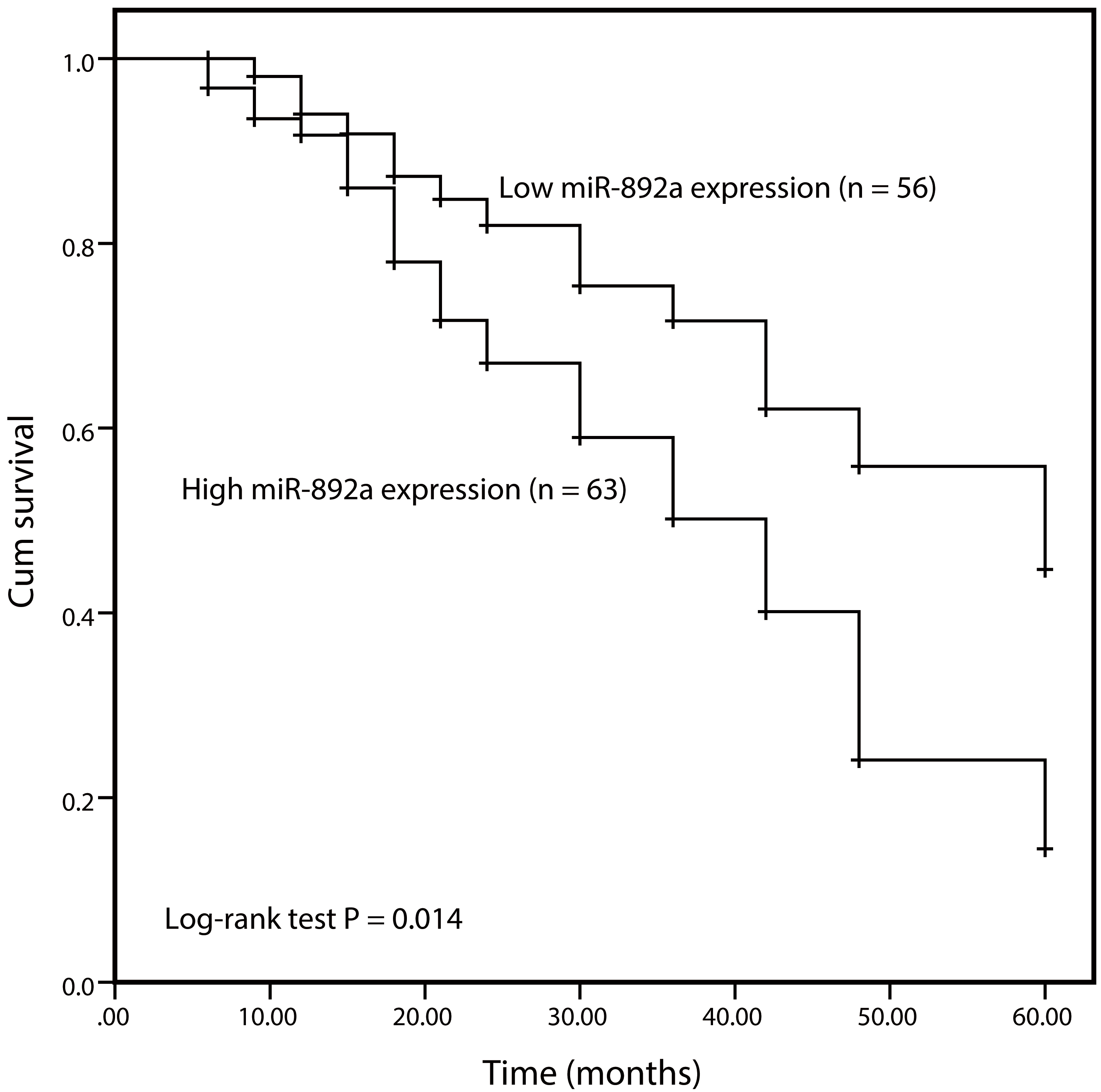
The effects of miR-892a on cell proliferation of MKN-45 and AGS cells. A. Expression of miR-892a was upregulated following transfection with miR-892a mimic and downregulated by its inhibitor as confirmed by RT-qPCR. B. Cell proliferation was enhanced by overexpression of miR-892a, while was inhibited by knockdown of miR-892a, compared with control. All experiments were repeated at least three times. *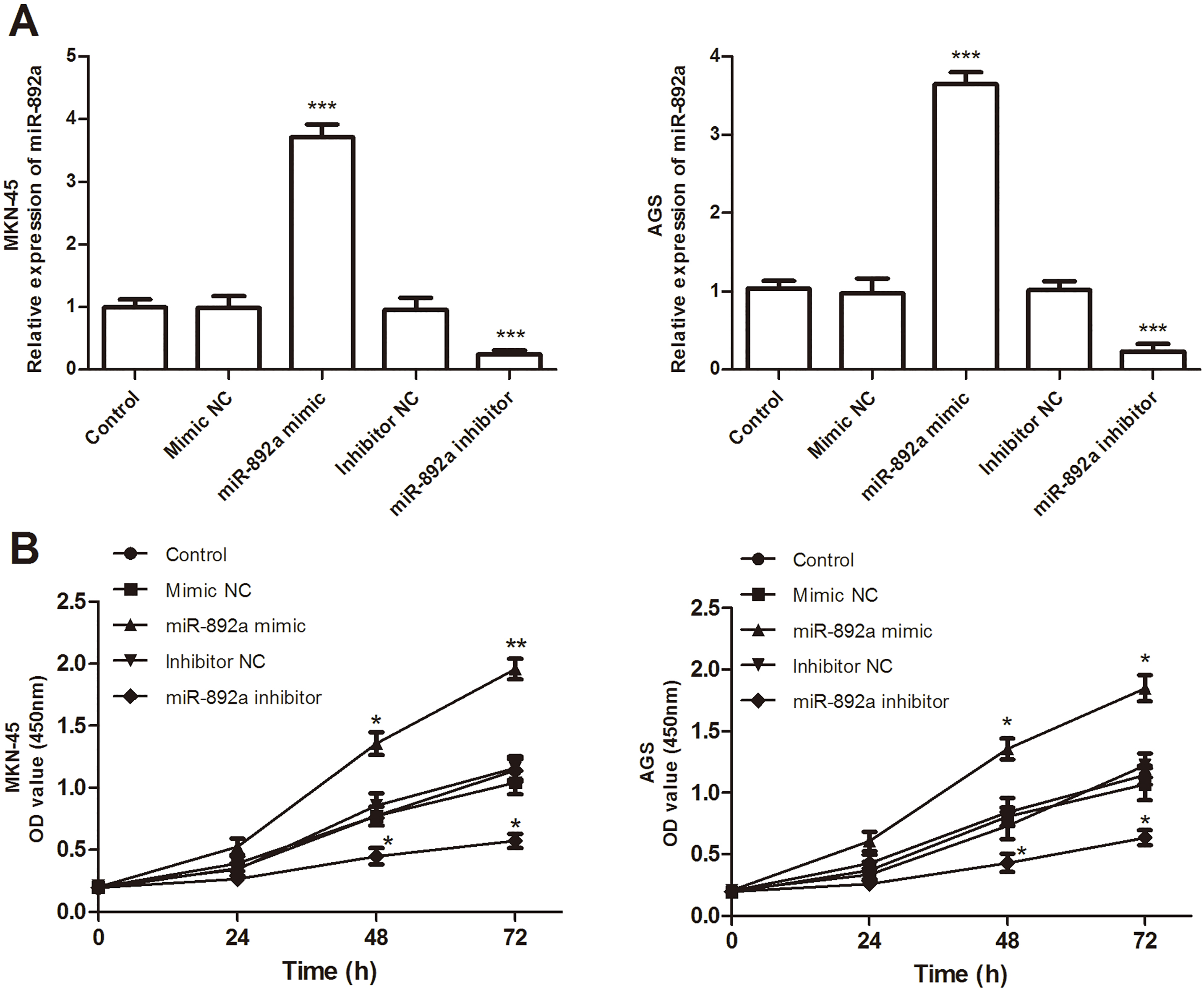
Effects of miR-892a on cell migration (A) and invasion (B) of MKN-45 and AGS cells. Overexpression of miR-892a promoted cell migration and invasion, while downregulation of miR-892a suppressed cell migration and invasion. All experiments were repeated at least three times and the number of cells were counted in five random fields. ***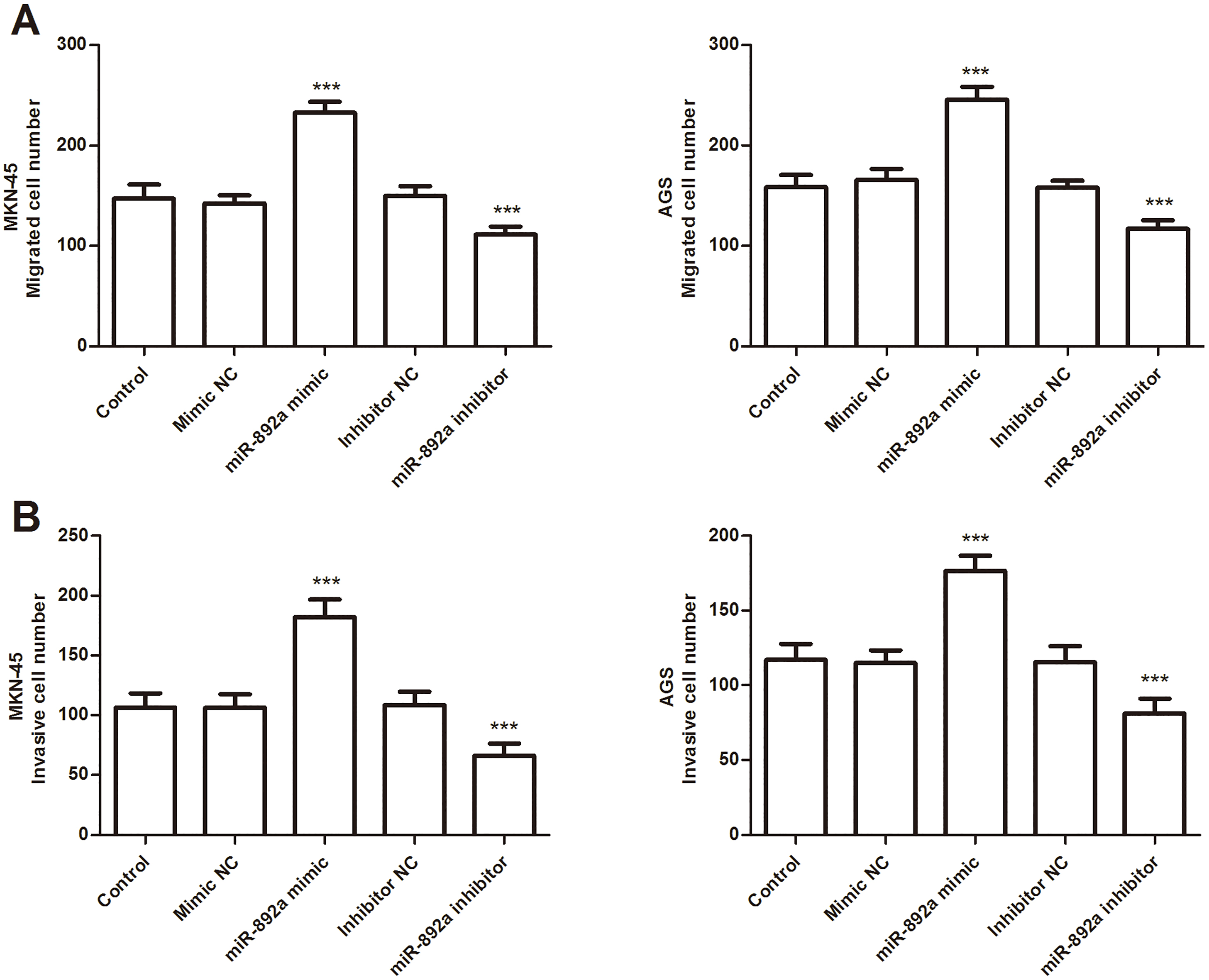
We selected MKN-45 and AGS cells with higher levels of miR-892a to manipulate the expression levels of miR-892a. MKN-45 and AGS cells were transfected with miR-892a mimic or inhibitor to increase or decrease the expression of miR-892a, and the transfection efficiency was confirmed by RT-qPCR. As shown in Fig. 3A, the expression of miR-892a was overexpressed by miR-892a mimic, while it was downregulated by miR-892a inhibitor, compared with control, in both MKN-45 and AGS cells (
Discussion
Gastric cancer is the second leading cause of cancer deaths in China, and the 5-year overall survival rates for gastric cancer patients in China are much lower than in South Korea and Japan [17]. Growing evidence has suggested that miRNAs are involved in the tumorigenesis and development of gastric cancers. Thus, the identification of more novel efficiency biomarkers and targets treatment may be helpful for gastric cancer therapy.
Increasing evidence has identified a strong correlation between miRNAs and various types of tumors [18, 19]. miR-892a resides within a genomic cluster of 7 miRNAs located on human chromosome Xq27.3. The abnormal expression of miR-892a has been identified in various diseases, such as atrial fibrillation [20], nonalcoholic fatty liver disease [21], and unexplained asthenozoospermia [22]. In our present study, we investigated the potential role of miR-892a in gastric cancer. Firstly, the expression of miR-892a in gastric cancer tissues and corresponding adjacent non-cancerous tissues, as well as in gastric cancer cells was measured. Consistent with the results in the previous study [16], the expression of miR-892a was dramatically upregulated in both gastric cancer tissues and cell lines, compared with adjacent non-cancerous tissues and normal epithelial cell GES-1, respectively. Then we analyzed the association between miR-892a expression and clinical features of gastric cancer patients. The results indicated that miR-892a expression was associated with tumor size, differentiation, positive lymph node metastasis, and advanced TNM stage. These results suggested that miR-892a may play an oncogenic role and be involved in the development of gastric cancer.
miRNAs can function as diagnostic and/or prognostic biomarkers in various cancers [23, 24]. In gastric cancer, a number of miRNAs were associated with the prognosis of patients and involved in the development of gastric cancer, such as miR-383-5p [14], miR-125a-5p [25], and miR-1236-3p [26]. In a recent study, some miRNAs (such as miR-145 and miR-185) can assist in predicting outcomes and adverse events for neoadjuvant chemotherapy in gastric cancer [27]. Another study constructed a microarray of metabolic network with miRNAs, lncRNAs, and protein-coding genes, and demonstrated that the metabolism-associated lncRNAs play important roles in the occurrence of gastric cancer [28]. These studies indicated miRNAs play an important role for the diagnosis and prognosis of gastric cancer. In the present study, we also explored the prognostic significance of miR-892a in gastric cancer using patients’ 5-year overall survival information and miR-892a expression levels. Results showed that patients with high miR-892a expression levels exhibited a shorter overall survival rate compared with patients with low miR-892a expression levels. Additionally, miR-892a expression was an independent prognostic factor associated with the prognosis of gastric cancer patients. These above results suggested that miR-892a may be a novel prognostic biomarker in gastric cancer.
miRNAs are not only acted as diagnostic or prognostic biomarkers in cancers but also involved in the regulation progression of cancers [29]. miR-892a has been reported upregulated and promoted the progression of several cancers. For instance, miR-892 was frequently high-expressed in colorectal cancer tissues and cell lines and overexpression of miR-892a might provide a selective growth promotion for colorectal cancer cells through direct inhibition of PPP2R2A expression [30]. miR-892a was upregulated in hepatocellular carcinoma tissues and cell lines, as well as promoted hepatocellular carcinoma HuH-7 cell proliferation and invasion by regulating CD226 expression [31]. To explore the potential functional role of miR-892a in gastric cancer, we manipulated the expression levels of miR-892a using miR-892a mimic or inhibitor in MKN-45 and AGS cells. Similarly, we found that miR-892a mimic expedited the proliferation, migration, and invasion of MKN-45 and AGS cancer cells, whereas, miR-892a inhibitor suppressed these cellular activities of MKN-45 and AGS cells. We thus concluded that miR-892a overexpression could promote the progression of gastric cancer at least in part by enhancing cell proliferation, migration, and invasion in vitro. However, the detailed mechanism of miR-892a in gastric cancer remains to need to be investigated in future studies.
In summary, miR-892a was upregulated in gastric cancer tissues and cell lines. Gastric cancer patients with high miR-892a expression levels exhibited a shorter overall survival rate. miR-892a promoted cell proliferation, migration, and invasion of gastric cancer cells. All the results indicated that miR-892a might serve as a prognostic biomarker and therapeutic marker for gastric cancer.
Footnotes
Conflict of interest
The authors declare that they have no competing interests.