




Abstract
BACKGROUND:
miR-539 functions as a tumor suppressor in many types of cancer. However, the role of miR-539 in gastric cancer remains unclear. The aim of this study is to investigate the clinical significance and functional role of miR-539 in gastric cancer.
METHODS:
Quantitative real-time polymerase chain reaction (qRT-PCR) was performed to detect the expression levels of miR-539 in gastric cancer patients tissues and cells. We analyzed the association between miR-539 expression levels and clinicopathological features, as well as overall survival information with Kaplan-Meier survival curves and Cox regression analysis. The functional role of miR-935 on the proliferation, migration, and invasion was also investigated by using miR-539 mimic or miR-539 inhibitor through CCK-8 assay, Transwell migration and invasion assays. The relationship between miR-539 and RUNX2 was verified by a dual luciferase assay.
RESULTS:
The expression of miR-539 was decreased in gastric cancer tissues and cell lines. Downregulation of miR-539 was closely associated with differentiation, lymph node metastasis, TNM stage, and poor survival outcome of gastric cancer patients. Furthermore, overexpression of miR-539 inhibited cell proliferation, migration, and invasion of gastric cancer cells. In addition, RUNX2 was a direct target of miR-539.
CONCLUSION:
Taken together, miR-539 may serve as a tumor suppressor for inhibiting cell proliferation, migration, and invasion by targeting RUNX2. Reduced expression of miR-539 is an independent prognostic factor in gastric cancer and may be a potential prognostic biomarker and miR-539/RUNX2 axis may serve as a potential therapeutic target for the treatment of gastric cancer.
Relationship between miR-539 expression and clinicopathologic parameters in patients with gastric cancer
Relationship between miR-539 expression and clinicopathologic parameters in patients with gastric cancer
Gastric cancer is a malignant tumor originated from the gastric mucosa epithelium, which is one of the most frequently occurring cancer worldwide [1, 2]. In China, the incidence and mortality of gastric cancer are also still quite high, which remains an important public health burden [3, 4]. The patients with gastric cancer at an early stage usually have no or mild symptoms, and often similar to symptoms of gastric chronic diseases, such as gastritis and gastric ulcer, which result in advanced stages at the time of initial diagnosis for most gastric patients [5]. At present, surgery is currently considered to be the only radical treatment and gastric cancer usually adopts comprehensive treatment based on surgery [6]. For the considerable progress in the treatment of gastric cancer, the 5-year survival rate of patients at early stages can reach more than 90%, however, the 5-year survival rate of patients at advanced stages is still very low [7]. Therefore, finding accurate sensitive biomarkers are needed for evaluation of prognosis and therapeutic strategies for gastric cancer.
MicroRNAs (miRNAs, 18–25 nucleotide) are a growing class of small endogenous non-coding RNAs that control gene expression at the post-transcriptional level by binding to complementary sequences in the 3’-UTR. miRNAs were reported to regulate several biological processes, such as differentiation [8], proliferation [9], migration, invasion [10], and apoptosis [11]. In recent years, increasing evidence shows that altered expression of miRNAs functions as an oncogene or suppressor gene, resulting in the initiation and/or progression of a number of tumors [12, 13]. miR-539, located on human chromosome 4q32.31, has been reported downregulated in several types of cancer, including Wilms’ tumor [14], hepatocarcinoma progression [15], and breast cancer [16]. In gastric cancer, a miRNA microarray result showed that miR-539 expression was found downregulated in lymph node metastasis-positive tissue compared with lymph node metastasis-negative tissue in gastric cancer patients [17]. Whereas the potential clinical significance and functional role of miR-539 in gastric cancer remain unclear.
In the present study, we detected the miR-539 expression and investigated the biological functions of miR-539 in gastric cancer, as well as its potential prognostic significance in gastric cancer.
Materials and methods
Tissue samples
Paired gastric cancer tissues and adjacent normal tissues were obtained from 122 gastric cancer patients who underwent surgery at Yidu Central Hospital of Weifang from January 2011 to May 2013. All the patients did not receive any preoperative chemotherapy or radiotherapy before initial surgery. All tissues were derived from the initial surgery and promptly frozen in liquid nitrogen at the time of surgery and stored at
Cell cultures and transfections
Human gastric cancer cell lines MGC-803, SGC-7901, HGC-27, and BGC-823 were purchased from the Shanghai Institute of Cell Biology, Chinese Academy of Sciences (Shanghai, China). The normal gastric epithelium GES-1 cell line was purchased from BeNa Culture Collection (BNCC, Bejing, China). All these cancer cells were cultured in RPMI-1640 (Gibco, USA) supplemented with 10% FBS (Gibco, USA), 100 U/ml penicillin, and 100
The miR-539 mimics, mimic negative control (NC), miR-539 inhibitor, and inhibitor NC were synthesized by GenePharma (Shanghai, China). The miR-539 mimics sequence was 5’-AUCAUACAAGGACAAUU UCUUU-3’, the miR-NC sequence was 5’-UUCUCCG AACGUGUCACGUTT-3’, the miR-539 inhibitor sequence was 5’-AAAGAAAUUGUCCUUGUAUGAU-3’, and inhibitor NC sequence was 5’-CAGUACUUU UGUGUAGUACAA-3’. For transfection, cells were seeded in 6-well plates at a density of 1
RNA extraction and reverse transcription-quantitative polymerase chain reaction (RT-qPCR)
TRIzol reagent (Invitrogen; Thermo Fisher Scientific, Inc., USA) was used to extract total RNA from gastric cancer tissues and cell lines, following the manufacturer’s instructions. Then total RNA was reverse transcribed into cDNA using a Transcriptor First Strand cDNA Synthesis kit (Roche Diagnostics, Basel, Switzerland). Subsequently, cDNA was used for RT-qPCR, which performed with a TaqMan MicroRNA Assay kit (Applied Biosystems; Thermo Fisher Scientific, Inc., USA) on an Applied Biosystems 7300 sequence detection system (Applied Biosystems, USA). Relative expression of miR-539 was calculated using the 2
CCK-8 assay
The proliferation of gastric cancer cells was determined with the Cell Counting Kit-8 (CCK-8) kit (Dojindo, Japan). Gastric cells (3
Expression of miR-539 in gastric cancer was detected by qRT-PCR. A. Expression of miR-539 in 122 pairs of gastric cancer tissues and adjacent normal tissues. B. Expression of miR-539 in gastric cancer cells and normal gastric epithelium cells (
After 48 h of transfection, migration and invasion assays were performed using Transwell chambers (8
Bioinformatic analysis and luciferase reporter assay
Target genes of miR-539 were analyzed by using TargetScan (
Statistical analysis
Experimental data were analyzed by SPSS 20.0 software (SPSS, Chicago, IL, USA) and GraphPad 5.0 software (GraphPad, Chicago, USA). Data are presented as the mean
Results
miR-539 expression levels are decreased in gastric cancer tissues
qRT-PCR was used to identify the expression levels of miR-539 in 122 pairs of gastric cancer and normal control tissues and cell lines. As shown in Fig. 1A, the expression of miR-539 was significantly downregulated in gastric cancer tissues compared with the adjacent normal tissues (
The relationship of miR-539 level and clinicopathological features of gastric cancer patients
To investigate whether miR-539 expression was involved in the development of gastric cancer, we analyzed the relationship of miR-539 expression in gastric cancer patients and their clinical features. The gastric cancer patients were divided into low miR-539 expression group (
The prognostic significance of miR-539 in gastric cancer
To explore the prognostic significance of low miR-539 expression levels, the survival of gastric cancer patients with low miR-539 levels was compared with that of patients with high miR-539 expression levels. The Kaplan-Meier survival analysis results showed that gastric cancer patients with lower miR-539 expression had significantly poorer overall survival (
Multivariate Cox analysis for miR-539 in gastric cancer patients
Multivariate Cox analysis for miR-539 in gastric cancer patients
Kaplan-Meier curve for overall survival in patients with gastric cancer based on miR-539 expression levels. Low miR-539 expression was associated with shorter overall survival of gastric cancer patients.
The CCK-8 assay was used to determine the proliferation of gastric cancer cell lines SGC-7901 and HGC-27, both of which had a relatively lower miR-539 expression level. Both of SGC-7901 and HGC-27 cell lines were transfected with miR-539 mimic, miR-539 inhibitor, or respective negative controls. Following transfection, qRT-PCR confirmed that miR-539 expression was significantly increased by miR-539 mimic, while significantly decreased by a miR-539 inhibitor, compared with untreated cells (
Effect of miR-539 expression on gastric cancer cell proliferation of SGC-7901 and HGC-27 cells. A. The miR-539 expression was detected in gastric cancer cells containing miR-539 mimic or inhibitor via qRT-PCR. B. CCK-8 assays revealed that miR-539 mimic transfection suppressed the proliferation, while miR-539 inhibitor transfection promoted the proliferation, compared with untreated cells (
Effect of miR-539 expression on cell migration and invasion of SGC-7901 and HGC-27 cells. A. The representative images of the Transwell migration assay (
In order to determine the potential target of miR-539, bioinformatics analysis was used. Among the putative targets, RUNX2 was selected for further analysis as it has previously been reported to be upregulated in gastric cancer and involved in gastric cancer progression [18]. The 3’-UTR of RUNX2 contains a putative binding site for miR-539 (Fig. 5A). A luciferase reporter assay results showed that miR-539 mimics inhibited the luciferase activity in the vector with the WT construct. However, the luciferase activity of MUT RUNX2 was not affected by miR-539 mimics (Fig. 5B). These results demonstrated that RUNX2 may be a direct target gene of miR-539.
RUNX2 is a direct target gene of miR-539. A. The putative binding sites between miR-539 and the 3’UTR of the RUNX2 gene. B. miR-539 overexpression significantly inhibited the luciferase activity of the WT-RUNX2-3’UTR in SGC-7901 cells (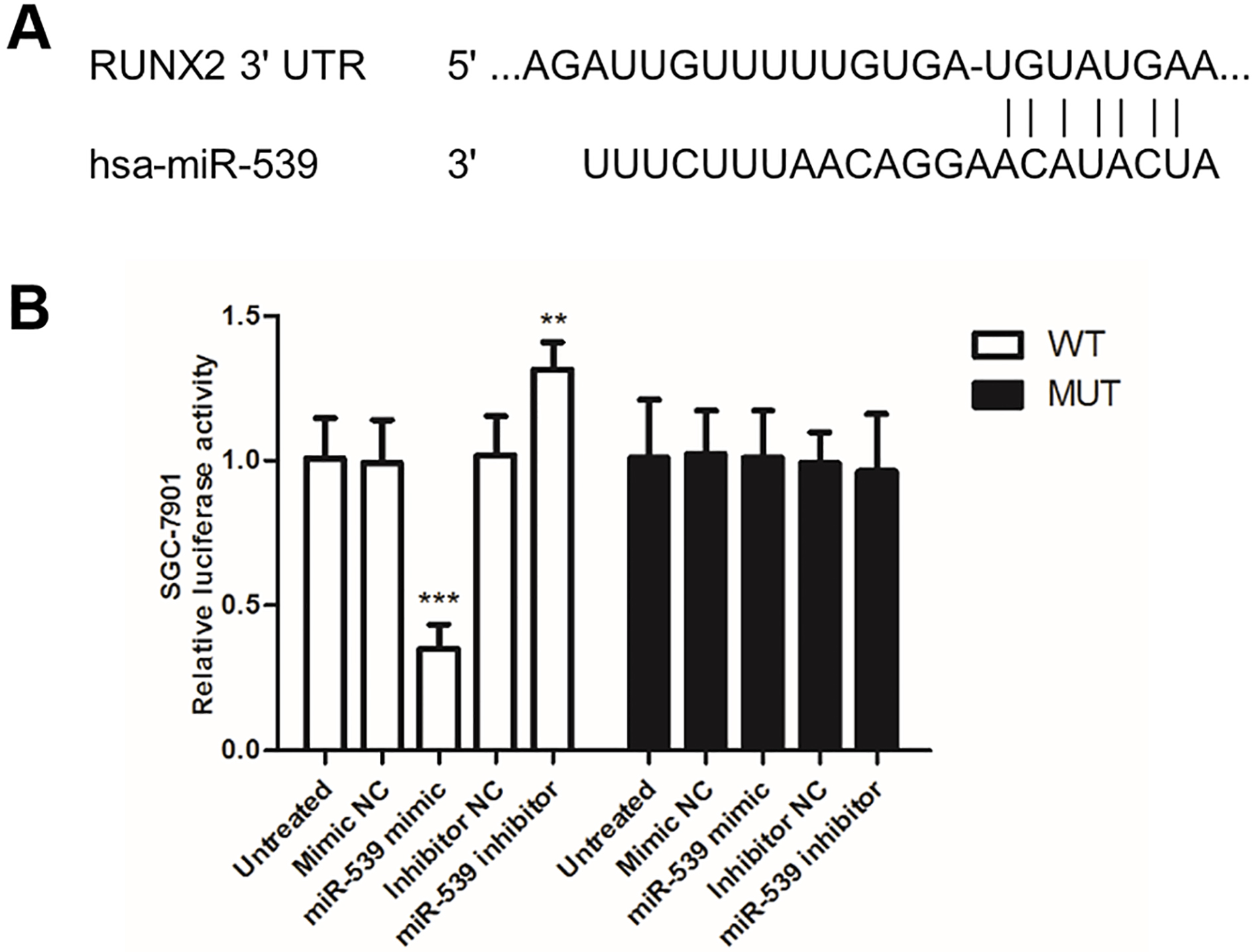
Patients with gastric cancer usually have a high incidence, metastasis rate, and mortality, but have a low early diagnosis rate, radical resection rate, and 5-year survival rate [6]. Despite its worldwide declining incidence, gastric cancer is still one of the most frequent types of cancers in China. Searching for effective markers for the treatment of gastric cancer is still crucial. More and more studies have demonstrated that miRNAs may play an important role in tumorigenesis and be potential tumor biomarkers [19, 20, 21]. For instance, a review study indicated that the presence, absence, or deregulation of several circulating miRNAs (i.e., miR-21) are associated with initiation and progression of gastric and esophageal cancers, and using them as potential prognostic, diagnostic, and therapeutic biomarkers is a key step in cancer therapy [20].
Many miRNAs have been suggested to exert oncogenic or suppressive roles during the initiation and development of various cancers, including gastric cancer [22, 23, 24]. For instance, miR-27b may act as a potential biomarker for differentiating gastric cancer patients from healthy controls, and serve as a tumor suppressor in gastric cancer [24]. miR-100 may function as a tumor suppressor in gastric cancer and be a potential strategy for the treatment of gastric cancer patients [25]. Upregulation of miR-125b was significantly associated with advanced malignant progression and poor prognosis, and it may be a potential biomarker for predicting prognosis and clinical outcomes in patients with HER2-positive gastric cancer that receive trastuzumab treatment [26]. Aberrant expression of miR-539 has been found in a number of different types of human cancers. For instance, in Wilm’s tumor, downregulation of miR-539 was associated with a shorter overall survival rate, and miR-539 inhibited the progression of Wilm’s tumor through downregulation of JAG1 and Notch1/3 [14]. In breast cancer, miR-539 functions as a tumor suppressor by downregulating EGFR, supporting the targeting of the novel miR-539/EGFR axis as a potentially effective therapeutic approach for breast cancer [16]. These studies showed that miR-539 may be a suppressor gene in these types of cancer.
In this study, to explore the expression pattern of miR-539 in gastric cancer, we detected the expression of miR-539 in gastric cancer tissues and cells using qRT-PCR. The results showed that miR-539 was downregulated in gastric cancer tissues and cells. In addition, low expression of miR-539 was significantly associated with differentiation, lymph node metastasis, and TNM stage. The above results suggested that miR-539 may be a suppressor gene in gastric cancer and is involved in the development and progression of gastric cancer. Furthermore, the relationship of the expression of miR-539 in gastric cancer tissues with the 5-year survival information in patients with gastric cancer was analyzed in this study. Kaplan-Meier analysis result indicated that the overall survival outcome of low miR-539 expression group was significantly shorter than that of high miR-539 expression group, which might be a promising biomarker for the survival of patients. The multivariate Cox analysis results revealed that miR-539 expression was an independent poor prognostic factor for overall survival rate, indicating that low miR-539 level was significantly associated with poor prognosis in gastric cancer patients in the present study.
Abnormal expression of miR-539 is associated with tumor progression of several types of tumor. For instance, in breast cancer, miR-539 is downregulated in breast cancer tissues and inhibits cell proliferation and migration [16, 27]. In another study, miR-539 suppresses osteosarcoma cell proliferation, invasion, and migration in vitro and targeting MMP8 [28]. miR-539 is found downregulated in colorectal cancer tissues and cell lines, and overexpression of miR-539 inhibits CRC cell proliferation, and colony formation as well as migration and invasion [29]. In this study, the expression of miR-539 was also found downregulated in gastric cancer tissues and cells. Therefore, it would be necessary to validate the suppressor function of miR-539 on the tumor behavior of gastric cancer with in vitro studies. CCK-8 and Transwell assays were used to detect the abilities of cell proliferation, migration, and invasion, and SGC-7901 and HGC27 cell lines were transfected with miR-539 mimic, miR-539 inhibitor or respective NC. The results showed that overexpression of miR-539 inhibited gastric cancer cell proliferation, migration, and invasion in vitro.
Many research studies have confirmed that miR-539 functions as a suppressor gene in various type of cancers and functions of miR-539 are dependent on some main downstream target genes, such as MMP8, RUNX2, and MAGEA4 [28, 29, 30]. In the present study, bioinformatics analyses results predicted that RUNX2 is a direct target gene of miR-539 in gastric cancer. RUNX2, a transcription factor, play crucial role during embryogenesis, which has been found aberrantly reactivated in various tumors, including non-small cell lung cancer [31], thyroid cancer, breast cancer [32], and gastric cancer [18]. Guo and co-workers demonstrated that RUNX2 is highly expressed in gastric cancer tissues and promotes the migration and invasion of gastric cancer cells in vitro [18]. In colorectal cancer, it was found that miR-539 functions as a tumor suppressor and inhibits colorectal cancer progression by targeting RUNX2 [29]. Therefore, we speculate miR-539 may also function as a tumor suppressor in gastric cancer by targeting RUNX2. In the present study, as expected, the luciferase reporter assays results showed that overexpression of miR-539 inhibited the luciferase activity of WT RUNX2, while downregulation of miR-539 promoted the luciferase activity of WT RUNX2. These data suggested that RUNX2 is a direct target of miR-539. Thus, we speculate that miR-539 inhibits the progression of gastric cancer through targeting RUNX2. However, the detailed mechanism of miR-539 for gastric cancer is still unclear, which will be studied in further investigation.
In conclusion, our results showed that miR-539 was downregulated in gastric cancer tissues and cell lines. Downregulation of miR-539 was associated with some clinical characteristics and poor survival outcome of gastric cancer patients. miR-539 inhibits gastric cancer cell proliferation, migration, and invasion by targeting RUNX2. miR-539 may be a promising prognostic biomarker and miR-539/RUNX2 axis may serve as a potential therapeutic strategy for the treatment of patients with gastric cancer.
Footnotes
Conflict of interest
The authors declare that they have no conflict of interest.