




Abstract
BACKGROUND:
Non-small cell lung cancer (NSCLC) is the most common malignant tumor worldwide. This work focuses on investigating the role of circ_0000353 in NSCLC and its potential mechanism of action.
METHODS:
The expression levels of circ_0000353 and miR-411-5p in NSCLC and their matched normal lung tissues were detected by real-time PCR (RT-PCR). The correlation between the circ_0000353 expression and the clinicopathological parameters of NSCLC patients was also analyzed. CCK-8, BrdU and colony formation assays were adopted to detect the role of circ_0000353 in the proliferation of NSCLC cells. The metastasis of NSCLC cells was measured by Transwell assay. The dual-luciferase reporter gene assay was used to confirm the targeting relationship between circ_0000353 and miR-411-5p. The expression level of FOXO1 was detected by western blot.
RESULTS:
Circ_0000353 was significantly down-regulated in NSCLC tissues and cell lines, and the decreased expression was significantly linked to the increased clinical stage, larger tumor volume, and metastasis. The circ_0000353 over-expression restrained the proliferation, migration, and invasion of NSCLC cells in vitro. Additionally, up-regulation of miR-411-5p was observed in NSCLC tissues and cell lines, and luciferase assay and RT-PCR assay showed that circ_0000353 over-expression could target miR-411-5p and suppress its expression. Further studies confirmed that circ_0000353 and miR-411-5p modulated the FOXO1 expression.
CONCLUSION:
Circ_0000353 repressed the proliferation, migration, and invasion of NSCLC cells via inhibition of miR-411-5p and up-regulation of FOXO1.
Keywords
Introduction
Lung cancer is a deadly malignant tumor with the highest morbidity and mortality in the world [1, 2]. Non-small cell lung cancer (NSCLC) is the most common type of lung cancer, taking up 80–85% of all lung cancer cases [3]. There are about 18.1 million newly diagnosed cases and 1.8 million lung cancer-related deaths worldwide each year [4]. Unfortunately, most patients are in their advanced stage at the time of diagnosis and have poor prognosis [5]. Therefore, there is an urgent need to further investigate the mechanism of NSCLC progress.
Circular RNA (circRNA) is a kind of circular RNA molecule formed via covalent binding of 3’ ends to 5’ ends by trans-splicing, which has the characteristics of sequence conservation, structural stability, high abundance and high specificity [6, 7]. Although circRNA was discovered in the early 1970s, it was not until recent years that people recognized the clinical significance of circRNAs [8]. CircRNA can function at multiple levels, such as sponging miRNA, regulating gene transcription, regulating protein conformation and many other biological processes [9, 10]. More and more researches imply that circRNA plays an important regulatory role in the progression of various cancers including NSCLC [11, 12]. For example, circ_0026134 and circ_100146 promote NSCLC cell proliferation and metastasis, and their high expression levels are notably correlated with the poor prognosis in patients with NSCLC [13, 14]. On the contrary, CircPTPRA impedes the epithelial-mesenchymal transition (EMT) and malignant progression of NSCLC [15]. However, as a member of circRNA, the role and regulation mechanism of circ_0000353 in NSCLC is still unclear.
MicroRNAs (miRNAs) are a sort of small non-coding RNAs containing 19–25 nucleotides, characterized in that miRNAs bind to complementary sequences of the mRNA 3’ untranslated region (3’UTR), resulting in mRNA degradation or translational inhibition, thereby effectively silencing or inhibiting its target gene [16]. Accumulating researches have demonstrated that miRNAs are not only involved in the differentiation, proliferation, apoptosis, and metabolism of normal cells, but also in the tumorigenesis and metastasis of tumors [17]. For example, miR-221 plays a carcinogenic role in NSCLC by directly targeting the tissue inhibitor of metallopeptidases-2 (TIMP2) [18]. MicroRNA-422a inhibits NSCLC progression by impeding the TGF-
A target gene of miR-411-5p, forkhead box O1 (FOXO1), is one member of the forkhead box (FOXO) family and is involved in the regulation of angiogenesis, apoptosis, migration, cellular metabolism, oxidative stress, immune regulation, and self-renewal and differentiation of cells [20, 21]. Accumulating researches have suggested that FOXO1 expression is significantly down-regulated in liver cancer and NSCLC, and are closely linked with the poor prognosis and early relapse, suggesting that FOXO1 functions as a tumor suppressor [22, 23]. However, the mechanism by which FOXO1 is dysregulated in NSCLC has not yet been fully elucidated.
In this study, we found that the down-regulation of circ_0000353 is a characteristic in NSCLC. Further functional assays confirmed that circ_0000353 could restrain the proliferation and metastasis of NSCLC cells. Furthermore, mechanism investigation indicated that circ_0000353 could act as a ceRNA to modulate the FOXO1 expression via competing for miR-411-5p, thereby exerting a tumor-suppressive effect in the progression of NSCLC. Our research has deepened the understanding of the mechanisms of NSCLC progression and is expected to provide new clues to the treatment of NSCLC.
Materials and methods
Clinical samples
This study was reviewed and approved by the Ethics Review Committee of Minhang Hospital. All patients signed a written informed consent form for this study. The patients’ cancer tissues and adjacent normal tissues were collected during the surgery and immediately frozen in liquid nitrogen for further study and analysis.
Cell lines and cell culture
Human NSCLC cells (A549 cells, H226 cells, H23 cells, H838 cells, and H226 cells) and normal bronchial epithelial cells (16HBE cells) were purchased from the Shanghai Institute of Cell Biology, Chinese Academy of Sciences (Shanghai, China). The cells were cultured in the RPMI 1640 medium (HyClone, South Logan, UT, USA) supplemented with 10% heat-inactivated fetal bovine serum (FBS; Invitrogen, Grand Island, NY, USA) and 100 U/ml penicillin, 100
Quantitative real-time polymerase chain reaction (qRT-PCR)
Total RNA from tissue samples and cultured cells were isolated using TRIzol Reagent (Thermo Fisher Scientific, Carlsbad, CA, USA) in accordance with the manufacturers’ instructions. Complementary DNA (cDNDA) was synthesized using the PrimeScriptTM RT reagent kit (TaKaRa, Dalian, China). Thereafter, SYBR
Sequences used for RT-PCR and qRT-PCR
Sequences used for RT-PCR and qRT-PCR
Small interfering RNA (siRNA) against hsa_circ_ 0000353 (5’-GTGGTTTCCAAGGTGTGAGTA-3’), siRNA negative control (si-NC), miR-411-5p mimics (5’-UAGUAGACCGUAUAGCGUACG-3’) and miR-411-5p inhibitor (5’-CGUACGCUAUACGGUCUUAU A-3’), miRNA negative control (miR-NC), circ_ 0000353 overexpression plasmid, empty plasmid were purchased from RiboBio (Guangzhou, China). NSCLC cells were transfected with lipofectamine 3000 (Thermo Fisher Scientific, IL, USA). The efficiency of transfection was determined by qRT-PCR 48 hours after transfection.
BrdU assay
NSCLC cells were seeded in 24-well plates, and when the cells were grown to 80% confluence, 10
Cell counting Kit-8 (CCK-8) assay
NSCLC cells in the logarithmic growth phase were selected, and after trypsinization, the cell density was adjusted to 1
Colony formation assay
The NSCLC cells were seeded in a 6-well plate with 100 cells per well, and after two weeks of culture, the medium was discarded. After that, the colonies were carefully washed 2 times with PBS. Then the colonies were fixed with 10% paraformaldehyde for 10 min, and carefully washed for 3 times with PBS. Following that, 1 ml of crystal violet solution was added to each well, and the colonies were stained for 10 min and dried at room temperature. Finally, the number of colonies was recorded by naked eyes. Each group of cell experiments was repeated three times.
The down-regulation of circ_0000353 expression in NSCLC tissues. (A) qRT-PCR was used to detect the expression of circ_0000353 in 35 cases of NSCLC patients with cancer tissues and adjacent normal tissues. (B and C) Circ_0000353 expression levels were lower in NSCLC patients with higher clinical stages and larger tumor size. (D) The expression of circ_0000353 in NSCLC patients with distant metastases was significantly lower than in patients without distant metastases. 
circ_0000353 is involved in the regulation of NSCLC cell proliferation. The expression levels of circ_0000353 in 4 NSCLC cells (H226, H23, H838, A549 cells) and normal bronchial epithelial cells (16HBE cells) were detected by qRT-PCR. (B) The circ_0000353 over-expression cell model and circ_0000353 knockdown cell model were successfully constructed, which were validated by qRT-PCR. (C) BrdU assay was adopted to evaluate NSCLC cell proliferation. (D) NSCLC cell viability was detected using the CCK-8 assay. (E) The proliferation of NSCLC cells was examined by colony formation assay. 
circ_0000353 exerts an inhibitory effect on NSCLC cell metastasis. (A) Transwell assay was used to detect the migration and invasion of A549 cells. (B) Transwell assay was used to detect the migration and invasion of H226 cells. 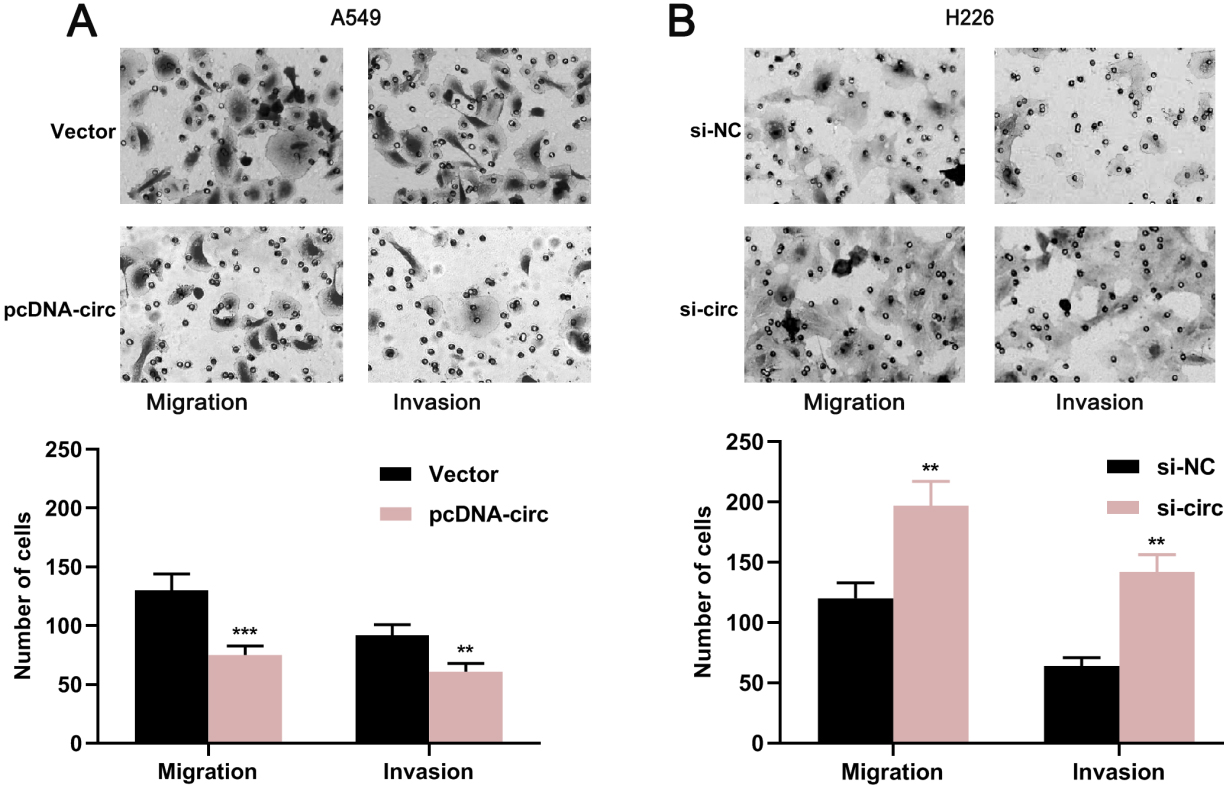
circ_0000353 targets miR-411-5p. After the bioinformatics analysis (
circ_0000353 regulates FOXO1 expression by adsorbing miR-411-5p. (A) The expression level of FOXO1 mRNA in NSCLC cells was detected by qRT-PCR. (B and C) Western blot was used to detect the expression level of FOXO1 in NSCLC cells.
circ_0000353 is involved in the regulation of NSCLC cell proliferation and metastasis by adsorping miR-411-5p. (A and B) The proliferation ability of NSCLC cells was examined by BrdU assay. (C) The viability of NSCLC cells was detected using CCK-8 assay. (D and E) The Transwell assay was adopted to detect the migration and invasion of NSCLC cells. 
The cell migration and invasion tests were carried out using Transwell chambers (Corning Inc., Corning, NY, USA) with 8
Western blot
The cells were lysed with RIPA lysis buffer (Beyotime BiotcchnoloGy, Shanghai, China) containing 1% protease inhibitor PMSF, and the supernatant was collected after high-speed centrifugation. Afterward, the protein was quantified by BCA protein assay kit (Beyotime Institute of Biotechnology, Haimen, China), and the protein was placed in a water bath at 100
Dual-luciferase reporter assay
Circ_0000353 sequence containing the predicted miR-411-5p binding site was subcloned and inserted into the psiCHECK-2 vector (Promega, Madison, WI, USA). Mutation sites were then mutated using the Genetailer
Statistical analysis
The data was processed using GraphPad Prism 8 software (GraphPad Software, San Diego, CA, USA) and SPSS 18.0 software (SPSS Inc., Chicago, IL, USA). All data are expressed as mean
Results
The down-regulation of circ_0000353 expression in NSCLC tissues and its clinical significance
First, qRT-PCR was employed to detect the circ_ 0000353 expression in 35 pairs of NSCLC tissues. In comparison with normal tissues adjacent to cancer, the expression level of circ_0000353 was significantly reduced in NSCLC tissues (Fig. 1A). Furthermore, by analyzing the correlation between circ_0000353 expression and clinicopathological parameters, the result revealed that circ_0000353 down-regulation is significantly correlated with increased clinical stage and tumor volume (Fig. 1B and C). The circ_0000353 expression in patients with distant metastases was strikingly lower than in patients without distant metastases (Fig. 1D). Our results indicated that circ_0000353 was lowly expressed in NSCLC, and its low expression level could serve as a new indicator to help evaluate the prognosis of NSCLC patients.
circ_0000353 is involved in the regulation of proliferation of NSCLC cells in vitro
Subsequently, circ_0000353 expression in four NSCLC cells (H226 cells, H23 cells, H838 cells, A549 cells) and normal bronchial epithelial cells (16HBE cells) were detected by qRT-PCR. As a result, we revealed that the circ_0000353 expression levels in the four NSCLC cells were notably lower than that of the 16HBE cells. Among the four NSCLC cells, circ_0000353 had the lowest expression level in A549 cells, while H226 cells had the highest expression level (Fig. 2A). Therefore, A549 cells were used to construct the cell model of over-expressing circ_0000353, and H226 cells were used to construct the cell model with circ_0000353 knocked down, and the transfection was confirmed by qRT-PCR (Fig. 2B). On this basis, BrdU assay, CCK-8 assay and colony formation assays were performed. The results showed that the circ_0000353 over-expression markedly inhibited NSCLC cell viability in comparison with the control group (Fig. 2C–E). On the other hand, the knockdown of circ_0000353 accelerated cell proliferation (Fig. 2C–E).
circ_0000353 is involved in the regulation of the migration and invasion of NSCLC cells
After confirming that circ_0000353 inhibited the proliferation in NSCLC cells, we were curious about whether circ_0000353 could modulate the migration and invasion of NSCLC cells. To explore the role of circ_0000353 in NSCLC cell metastasis, Transwell assay was performed. The data demonstrated that the migration and invasion of A549 cells with circ_0000353 over-expressed was strikingly inhibited in comparison with the control group (Fig. 3A). On the other hand, the migration and invasion of H226 cells after circ_0000353 knockdown was promoted in comparison the control group (Fig. 3B).
circ_0000353 targets miR-411-5p
The online bioinformatics database was adopted to search for the miRNAs that could be paired with circ_0000353 complementary bases. It was found that miR-411-5p was one of the predicted miRNAs, and its binding sites were shown in the figure (Fig. 4A). Subsequently, the miR-411-5p expression in 35 NSCLC patients and 4 NSCLC cell lines were detected by qRT-PCR. We found that the miR-411-5p expression was markedly increased in NSCLC cancer tissues in comparison with normal tissues adjacent to cancer (Fig. 4B). The miR-411-5p expression was also significantly up-regulated in the four NSCLC cell lines in comparison with 16HBE cells (Fig. 4C). To further verify whether miR-411-5p could bind directly to circ_0000353, the luciferase reporter vector containing wild-type or mutant circ_0000353 sequence was constructed. The results implied that miR-411-5p reduced the luciferase activity of psi-circ_0000353-WT, but did not significantly impede the luciferase activity of psi-circ_0000353-MUT (Fig. 4D). Following that, A549 cells were transfected with empty plasmids and circ_0000353 overexpression plasmid. H226 cells were then transfected with si-con and si-circ_0000353, respectively. As shown, the up-regulation of circ_0000353 significantly reduced the miR-411-5p expression and up-regulated the FOXO1 expression (Fig. 4E and F). On the other hand, the knockdown of circ_0000353 caused the up-regulation of miR-411-5p expression in NSCLC cells and the down-regulation of FOXO1 mRNA expression (Fig. 4E and F). The above data indicated that circ_0000353 negatively regulated miR-411-5p but positively regulated the expression of FOXO1.
circ_0000353 regulates the expression of FOXO1 by adsorbing miR-411-5p
Subsequently, the miR-411-5p mimics and inhibitors were transfected into H226 cells and A549 cells, respectively. It was proved that the the expression of FOXO1 was significantly reduced in H226 cells transfected with miR-411-5p in comparison with the control group on both mRNA and protein levels (Fig. 5A and B). Furthermore, co-transfection of circ_0000353 overexpression plasmids markedly increased the FOXO1 expression in H226 cells (Fig. 5A and B). On the contrary, FOXO1 mRNA and protein were significantly increased in A549 cells when the cells were transfected with miR-411-5p inhibitors, while these effects were impaired when circ_0000353 was knocked down (Fig. 5A and C). These results further suggested that circ_0000353 was a sponge of miR-411-5p and could positively regulate the expression of FOXO1.
circ_0000353 is involved in the regulation of the proliferation, invasion, and metastasis of NSCLC cells via the adsorption of miR-411-5p
Compared with the control group, the proliferation of H226 cells after being transfected with miR-411-5p mimics was dramatically enhanced (Fig. 6A–C). In comparison with the control group, the proliferation of A549 cells was significantly reduced after being transfected with miR-411-5p inhibitors (Fig. 6A–C). Moreover, the proliferation of NSCLC cells was significantly inhibited by the up-regulation of circ_0000353 in comparison with the over-expressed miR-411-5p group, and the knockdown of circ_0000353 significantly accelerated the proliferation of NSCLC cells compared with the low-expressed miR-411-5p group (Fig. 6A–C). It was also concluded from the Transwell assay that the transfection of miR-411-5p mimic increased the number of the migration and invasion cells in H226 cell in comparison with the control group, and this promotion could be weakened by circ_0000353 overexpression (Fig. 6D and E). Meanwhile, miR-411-5p inhibitors were transfected into A549 cells and the number of the migration and invasion cells were decreased (Fig. 6D and E). However, the knockdown of circ_0000353 significantly promoted the metastasis of NSCLC cells in comparison with the low-expressed miR-411-5p group. The data suggested circ_0000353 suppressed the proliferation and metastasis of NSCLC cells via adsorbing the miR-411-5p.
Discussion
Accumulating researches have shown that the role of circRNAs in tumorigenesis and disease progression of human cancers, including NSCLC [24, 25, 26, 27, 28, 29]. For instance, circRNA_069718 facilitates the proliferation and invasion of breast cells via activating Wnt/
More and more studies show that miRNAs participate in various of physiological and pathological processes. MiRNAs can bind directly to the target mRNA and induce mRNA degradation or translational inhibition [31]. At present, the role of miR-411 in cancer biology is still controversial. For example, miR-411-5p promotes the apoptosis and myogenic differentiation by activating p38MAPK phosphorylation in rhabdomyosarcoma [32]; miR-411 represses the progression of gastric cancer by directly targeting SETD6 [33]. However, some studies indicate that miR-411-5p promotes the tumorigenesis of lung cancer via directly targeting the SPRY4 and TXNIP expressions, and induces the activation of EGFR, AKT signaling and EMT [34]. In this study, we found that miR-411-5p expression was markedly up-regulated in NSCLC tissues and cell lines compared with normal lung tissues and cell lines. We demonstrated that after NSCLC cell lines were transfected with miR-411-5p, the proliferation and metastasis were significantly enhanced, while the inhibition of miR-411-5p notably blocked the proliferation and metastasis of NSCLC cells, which is consistent with previous reports [20, 34].
It is worth noting that circRNA can act as a sponge for miRNA, thereby regulating the expressions of downstream genes [35]. For example, circ_AGFG1 enhances the metastasis and EMT of NSCLC cells by sponging miR-203 and up-regulating ZNF281 [36]; Circ_0020123 functions as ceRNA for miR-488-3p to up-regulate ADAM9 and promote NSCLC progression [37]; circ_PTPRA inhibits the NSCLC metastasis by sponging miR-96-5p [15]. Given that circ_0000353 and miR-411-5p play opposite effects in NSCLC, we suspect that there is a similar targeting relationship between them. Interestingly, through bioinformatics analysis, we found a binding site between circ_0000353 and miR-411-5p. It was confirmed by luciferase reporter gene assay that circ_0000353 could bind with miR-411-5p. Moreover, the knockdown of circ_0000353 caused an increase in miR-411-5p expression. The up-regulated miR-411-5p facilitated the proliferation and metastasis of NSCLC cells, and this promotion could be attenuated by circ_0000353. Furthermore, the down-regulated miR-411-5p impeded the ability of NSCLC cells to proliferate and metastasize, while the knockdown of circ_0000353 significantly reversed this inhibition. Therefore, in conclusion, circ_0000003 takes part in the regulation of the proliferation, apoptosis, migration, and invasion of NSCLC cells via suppressing the expression of miR-411-5p.
The FOXO proteins family includes FOXO1, FOXO3A, FOXO4, FOXO6 and so on, most of which are tumor suppressors [38, 39, 40]. As a member of the FOXO family, FOXO1 modulates the cell cycle inhibitors p27 and p21, halting the cell cycle in the G0/G1 phase [41, 42]. Consistently, FOXO1 plays an inhibitory role in the progression of NSCLC [20]. Accumulating researches imply that FOXO1 expression is regulated by multiple miRNAs. For example, in breast cancer, miR-9 facilitates cancer cell proliferation, migration, and invasion via down-regulating FOXO1 expression [43]; miR-155 takes part in the promotion of malignant progression of NSCLC by regulating FOXO1/ROS axis [44]. Furthermore, FOXO1 is also negatively regulated by miR-183 and miR-411-5p in NSCLC [20, 45]. Herein, we found that the knockdown of circ_0000353 induced the down-regulation of FOXO1 expression in NSCLC cells. On the contrary, the over-expression of circ_0000353 caused up-regulation of FOXO1 expression. Moreover, miR-411-5p inhibited FOXO1 expression, and the transfection of miR-411-5p inhibitors strikingly increased the FOXO1 expression in NSCLC cells. Furthermore, the circ_0000353 over-expression attenuated the down-regulation of expression levels in NSCLC cells caused by up-regulation of miR-411-5p. The above data indicated that circ_0000353 could inhibit the progression of NSCLC via adsorbing miR-411-5p and up-regulating the expression of FOXO1.
To sum up, our findings demonstrate the abnormal low expression of circ_0000353 in NSCLC and its clinical significance. It is revealed that circ_0000353 represses the proliferation and metastasis of NSCLC cells through adsorbing miR-411-5p and up-regulating FOXO1. This work is expected to provide new therapeutic targets for NSCLC patients. However, this study is limited to single-center samples and requires in vivo data to confirm our conclusion in the future.
Footnotes
Conflict of interest
The authors declare that they have no competing interests.