




Abstract
BACKGROUND:
Circulating microRNAs (miRNAs) have become increasingly appreciated in the diagnosis and prognosis of colorectal cancer (CRC).
OBJECTIVE:
The aim of this study was to assess the potential diagnostic and prognostic significance of serum miR-30a-5p as a potential biomarker.
METHODS:
The expression levels of serum miR-30a-5p were measured in 138 cases with CRC, 50 cases with benign lesions (colorectal adenoma and polyps) and 60 healthy volunteers by quantitative real time polymerase chain reaction (qRT-PCR).
RESULTS:
The results showed that serum miR-30a-5p levels were frequently downregulated in patients with CRC and benign lesions in comparison with normal controls. Moreover, serum miR-30a-5p levels in early-stage CRC patients were significantly increased after surgery. Receiver-operating characteristic (ROC) curve analysis demonstrated serum miR-30a-5p could well distinguish CRC patients, early-stage CRC patients from healthy controls with a relative high value of area under the curve (AUC). Furthermore, low serum miR-30a-5p expression was more frequently occurred in CRC patients with aggressive clinical variables. Additionally, CRC patients exhibiting high serum miR-30a-5p expression had significantly prolonged overall survival than those exhibiting low expression. Finally, both univariate and multivariate analyses revealed that serum miR-30a-5p expression was an independent prognostic factor for overall survival in CRC patients.
CONCLUSIONS:
Collectively, these findings suggested serum miR-30a-5p might act as a novel biomarker for the diagnosis and prognosis of CRC.
Introduction
Colorectal cancer (CRC) is one of the most common malignant carcinomas and the fourth most frequent cause of cancer mortality around the world [1, 2]. Despite the considerable advances in surgical and chemotherapeutic treatment over the past decades, the prognosis of CRC in advanced stage remains dismal. Unfortunately, less than half of CRC cases are diagnosed at localized stage as CRC patients usually have no symptoms at early CRC stages [3, 4, 5]. Thus, early detection of CRC is very crucial to reduce the mortality of this malignancy. Exploring reliable biomarkers for early diagnosis, prognosis and prediction of response to treatment are urgently needed.
MicroRNAs (miRNAs) are small, non-coding RNA molecules that act as posttranscriptional regulators of target genes expression by binding to the 3’-untranslated region (3’-UTR) of target mRNAs, leading to mRNAs degradation or translation suppression [6]. MiRNAs play important roles in diverse biological behaviors, including differentiation, proliferation, invasion, angiogenesis and migration [7, 8]. Accumulating evidence have revealed that altered expressed miRNAs affects cancer development, and miRNAs might function as either oncogenes or tumor suppressors [9, 10]. In addition, miRNAs can be detected in stable forms in easily accessible blood samples, making them attractive minimally-invasive biomarkers for human cancers, including CRC [11, 12]. Deregulation of serum miRNAs has been reported in CRC and several serum miRNAs such as miR-139-3p [13], miR-200c [14] and miR-196b [15] showed great potential for CRC diagnosis and prognosis.
MiR-30a-5p locates in the chromosomal region 6q13 and the role of miR-30a-5p in carcinogenesis has been explored in various cancer types. For example, miR-30a-5p was significantly decreased in gallbladder carcinoma [18], non-small cell lung cancer [19, 20, 21], clear cell renal cell carcinoma [22], gastric cancer [23] and hepatocellular carcinoma [24, 25], but greatly increased in ovarian cancer [26] and glioma [27]. However, the expression pattern of serum miR-30a-5p and its clinical significance in CRC were poorly known. Here we aimed to explore its potential clinical value for CRC detection and prognosis.
Materials and methods
Patients and serum samples
The study was approved by the Ethical Committee of Jiangsu Taizhou People’s Hospital, and all participants provided written informed consent. A total of 138 cases with CRC (mean age
Correlation of clinicopathological variables with serum miR-30a-5p expression in CRC
Correlation of clinicopathological variables with serum miR-30a-5p expression in CRC
a. Serum miR-30a-5p expression was remarkably reduced in patients with CRC and benign lesions relative to that in healthy controls.b. Changes in miR-30a-5p expression levels in early stage CRC patients before and one month after surgery.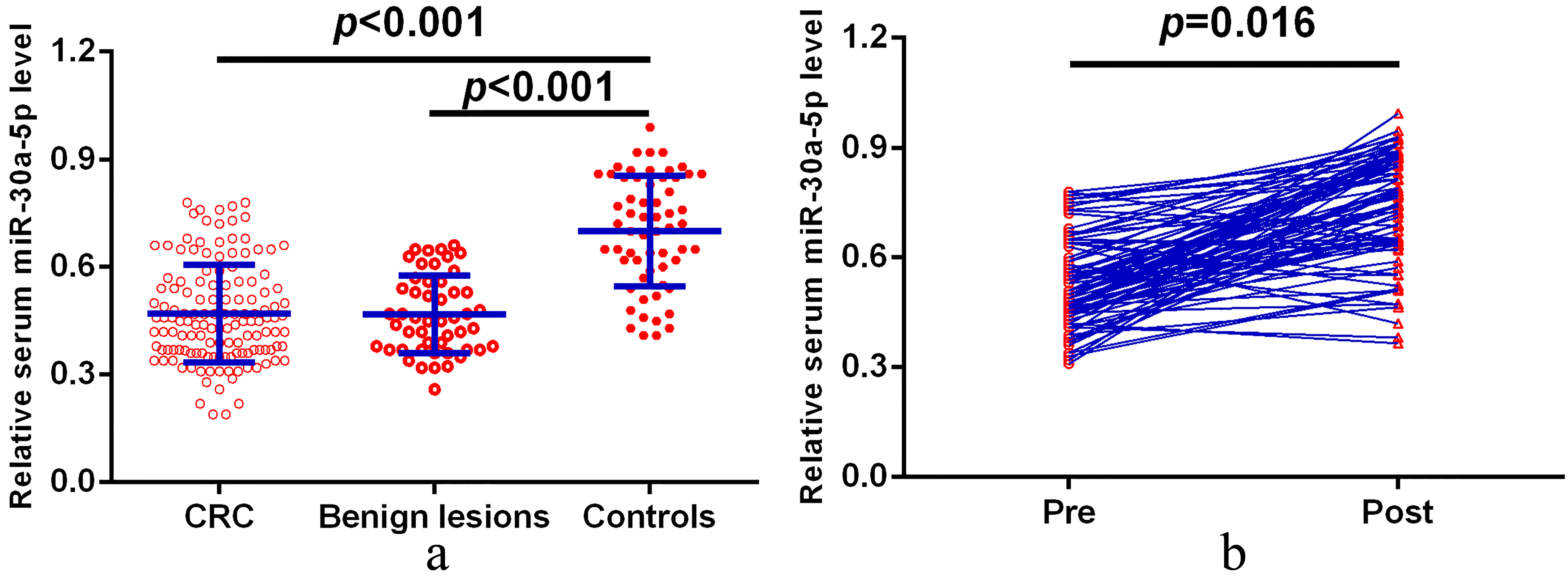
a. The ROC curve analysis for discriminative ability between CRC patients and normal controls. b. The ROC curve analysis for discriminative ability between early stage CRC patients and normal controls.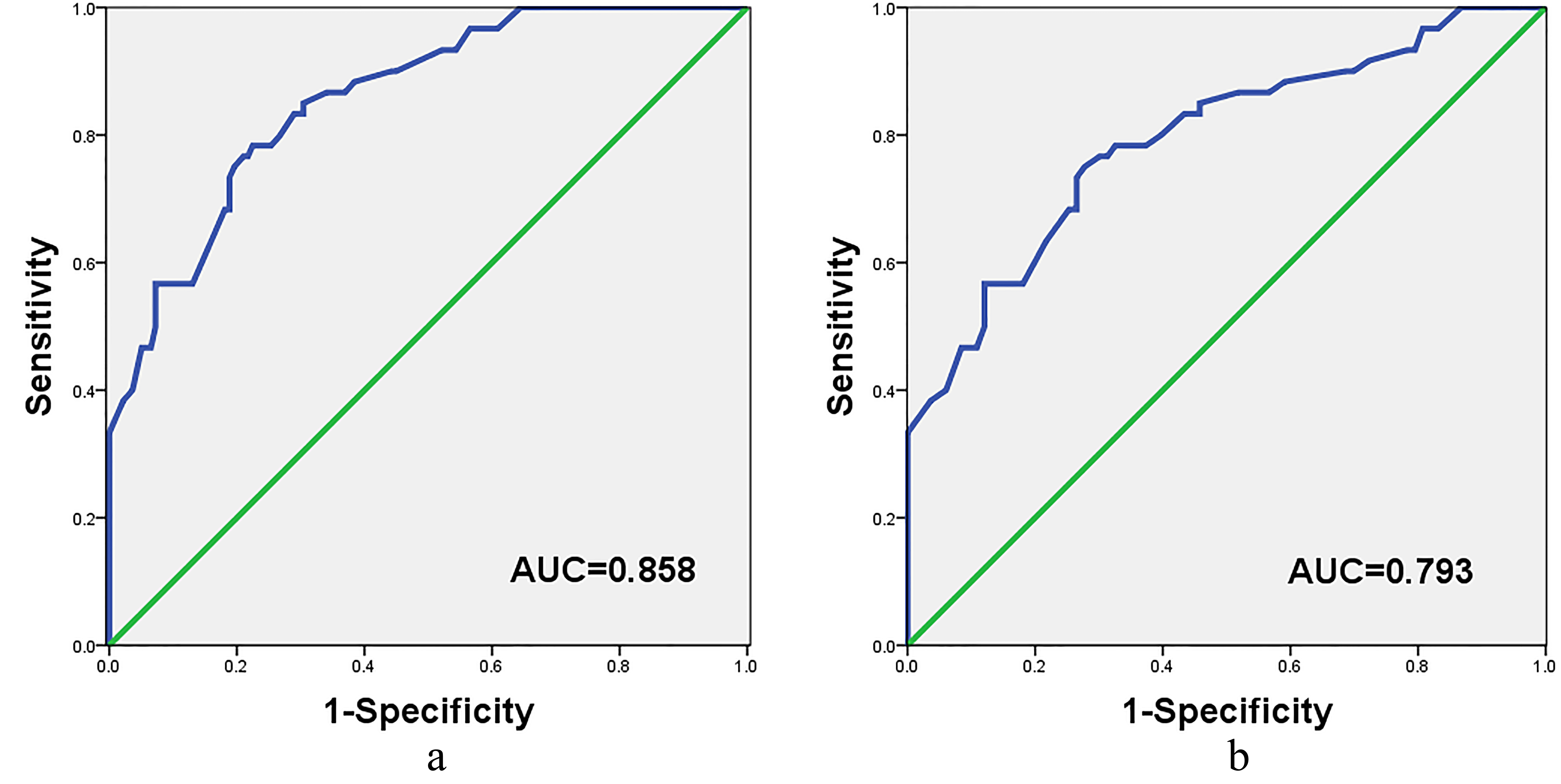
The total RNA was isolated from the serum using the RNA Isolation Kit (Vazyme Biotech, Nanjing, China). One hundred fmol/ml of synthesized cel-miR-39 (Qiagen, Hilden, Germany) was added to each sample before RNA isolation. RNA concentration and purity were determined by measuring the absorbance at 260 nm (A260) in a Nanodrop 1000 spectrophotometer (Thermo Fisher Scientific Inc., Wilmington, DE, USA). Then, the RNA was reverse transcribed using a TaqMan microRNA reverse transcription kit (Applied Biosystems, Inc., Grand Island, NY, USA). qRT-PCR was carried out to detect the expression level of serum miR-30a-5p using a miRNA-specific TaqMan miRNA assay kit (Applied Biosystems, Foster City, CA, USA) under an ABI7300HT instrument (Applied Biosystems, Foster City, CA, USA). Each experiment was run in triplicate. The relative miR-30a-5p expression was calculated using 2
Statistical analysis
IBM SPSS Statistics 17.0.1 (SPSS Inc, Chicago, IL, USA) and GraphPad Prism 7 (Graphpad Software Inc.) were used for all statistical analyses. The Mann-Whitney U test was used to perform statistical analysis of serum miR-30a-5p levels between groups. The Pearson’s Chi-squared test was used to determine the relationship between miR-30a-5p expression and clinical variables. Receiver operating characteristics (ROC) analysis was established to evaluate the ability of serum miR-30a-5p expression in differentiating CRC patients from controls, and the value of area under the curve (AUC) was calculated. Moreover, survival curves were constructed using Kaplan-Meier analyses and compared by log-rank test. Univariate and multivariate Cox proportional hazard regression models were performed to assess the predictive indicators for overall survival (OS). OS was measured from the date of diagnosis to the date of death or last follow-up.
a. Kaplan-Meier curves of overall survival rates, stratified by miR-30a-5p expression. b. Kaplan-Meier curves of overall survival rates, stratified by differentiation. c. Kaplan-Meier curves of overall survival rates, stratified by lymph node metastasis. d. Kaplan-Meier curves of overall survival rates, stratified by TNM stage.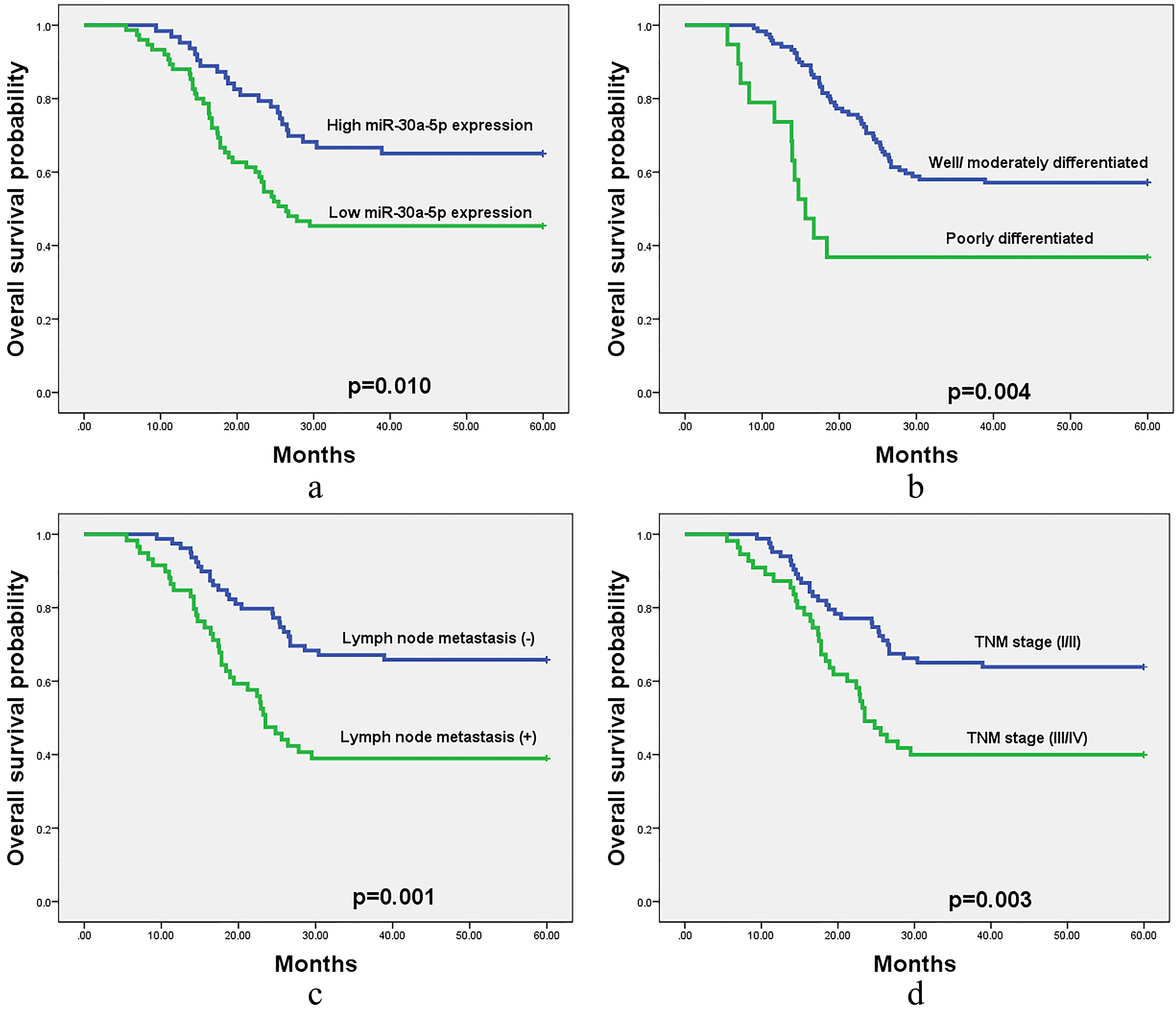
Detection of serum miR-30a-5p expression
We first measured the serum miR-30a-5p levels in all participants using qRT-PCR. The results showed that the expression levels of miR-30a-5p were significantly downregulated in patients with CRC patients and benign lesions compared to those in healthy controls (
Univariate and multivariate Cox regression analysis of overall survival in 138 CRC patients
Univariate and multivariate Cox regression analysis of overall survival in 138 CRC patients
Then, ROC analysis was conducted to explore diagnostic accuracy of serum miR-30a-5p as a potential marker. We found the AUC of serum miR-30a-5p to diagnose CRC was 0.858, the sensitivity and specificity were 77.5% and 78.3% (cut off value
Association between serum miR-30a-5p expression and clinical characteristics
As the data of serum miR-30a-5p levels is not subjected to normal distribution, the median value of serum miR-30a-5p level in patients with CRC was used to divide the patient cohort into high (
Prognostic value of serum miR-30a-5p in patients with CRC
To uncover the relationship of serum miR-30a-5p with OS of CRC patients, Kaplan-Meier analysis plus the log-rank test were carried out. Patients in low serum miR-30a-5p expression group had a significant worse OS compared to those in high serum miR-30a-5p expression group (
Besides, univariate analysis identified differentiation (RR
Discussion
Our study revealed that serum miR-30a-5p level was significantly lower in CRC patients, and it was also decreased in patients with benign lesions compared to normal controls. There were two possible mechanisms accounting for the deceased serum miR-30a-5p in patients with CRC. Firstly, tumor cells might secrete less miR-30a-5p directly into circulation system, resulting in the downregulation of serum miR-30a-5p in CRC patients. Secondly, reduced levels of miR-30a-5p were packaged into the exosomes or other transport vesicles. Interestingly, the serum miR-30a-5p levels in CRC patients at the early stage was dramatically increased following treatment, indicating that serum miR-30a-5p might be a promising biomarker for monitoring therapeutic response. When the tumor was inhibited by the chemotherapy/radiotherapy or removed by surgery, the signaling that suppressed miR-30a-5p might be deactivated, leading to upregulated serum miR-30a-5p in patients with CRC. Notably, ROC analysis showed serum miR-30a-5p could screen CRC patients or early-stage CRC patients from healthy controls with considerable diagnostic accuracy. Moreover, low serum miR-30a-5p level was associated with various important CRC clinical factors and shorter OS. Downregulation of serum miR-30a-5p was an independent prognostic indicator for worse OS in CRC. The results indicated that serum miR-30a-5p might be a promising diagnostic and prognostic biomarker for CRC. Consistent with our findings. Wei and colleagues showed miR-30a-5p expression was significantly reduced both in CRC tissues and cell lines compared with that in normal tissues and cells. MiR-30a-5p overexpression greatly suppressed the CRC cell migratory and invasive capacity, restrained the epithelial-mesenchymal transition by decreasing the expression of integrin
MiR-30a-5p has been reported to serve as a tumor suppressor in many types of cancer. In the study by Ye et al., downregulation of miR-30a-5p was found in the primary lesions of gallbladder carcinoma (GBC) and correlated with shorter survival. MiR-30a-5p knockdown greatly promoted GBC cell proliferation, migration and invasiveness in vitro and in vivo, and its anti-tumor effects might be exerted by targeting E2F transcription factor 7 [18]. In non-small cell lung cancer (NSCLC), miR-30a-5p expression was significantly reduced in NSCLC tissues compared with normal paracancerous tissues. Moreover, enhanced miR-30a-5p expression resulted in the inhibition of carcinogenesis and the epithelial-to-mesenchymal phenotype of NSCLC [19, 20, 21]. Wang and colleagues showed the expression level of miR-30a-5p was decreased in clear cell renal cell carcinoma (ccRCC) and reduced miR-30a-5p was closely associated with poor prognosis. In vitro studies revealed miR-30a-5p overexpression inhibited cell growth and enhanced cell apoptosis of ccRCC by silencing GRP78 expression [22]. In gastric cancer (GC), miR-30a-5p downregulation was found both in GC tissues and cell lines. Ectopic miR-30a-5p expression greatly suppressed GC cell proliferation and invasion by degrading insulin-like growth factor 1 receptor (IGF-1R) expression [23]. In hepatocellular carcinoma (HCC), miR-30a-5p expression was significantly reduced in cancerous tissues and cell lines. Overexpression of miR-30a-5p not only significantly suppressed HCC cell viability, proliferation, but also stimulated cell apoptosis via interaction with AEG-1 [24] or MTDH/PTEN/AKT pathway [25].
However, miR-30a-5p might also act as an oncogene in the carcinogenesis process. Wang et al. demonstrated that miR-30a-5p was a direct regulator of forkhead box D1 (FOXD1) and overexpressed in high-grade serous ovarian carcinoma samples. Overexpression of FOXD1 significantly attenuated OS cell proliferation by inducing cell apoptosis in vitro [26]. Moreover, forced miR-30a-5p expression remarkably stimulated glioma cell growth invasion, and the effects were mediated through the Wnt/
One limitation of our study was the relatively small sample size. Future study with larger cohort is warranted to validate our findings. In addition, the underlying molecular mechanism account for the tumor suppressive role of miR-30a-5p needs further investigation. Previous studies have shown that various circulating miRNAs has great potential for early detection and prognosis prediction of CRC [28, 29]. MiRNAs play crucial roles in regulating many biological functions, and their deregulation results in the initiation and development of many human diseases. Therefore, a single biomarker or even a panel of biomarkers might not be able to distinguish the CRC from other diseases, leading to the potential false positive or negative findings. For instance, deregulated serum miR-30a-5p has been found in cardiovascular diseases, chronic nervous lesion and idiopathic nephrotic syndrome [30, 31, 32]. Combining serum miR-30a-5p with other known promising circulating biomarkers as well as clinical information might help improve the diagnosis, prognosis and therapeutic response monitoring of CRC.
Conclusions
In conclusion, our study has demonstrated that low serum miR-30a-5p expression is associated with aggressive clinical variables and worse prognosis, suggesting miR-30a-5p might be a promising biomarker for CRC diagnosis and prognosis.
Footnotes
Conflict of interest
The authors declare no conflicts of interest.