




Abstract
BACKGROUND:
Plasma carcinoembryonic antigen (CEA), carbohydrate antigen 19-9 (CA19-9), and cancer antigen 72-4 (CA72-4) are common markers which are useful in the diagnosis and prognosis of GC. However, their sensitivity and specificity in GC remain unsatisfactory. Identification of cancer diagnosed-biomarkers would be of great value.
OBJECTIVE:
Evaluate the diagnostic and prognostic value of LINC00086 and miR-214 in GC.
METHODS:
In this study, we determined the expression of LINC00086 and miR-214 in GC by qRT-PCR. Additionally, we investigated the relationship between various clinicopathological features of GC patients and LINC00086 or miR-214 expression, and evaluated the diagnostic and prognostic value of LINC00086 and miR-214 in GC.
RESULTS:
In this study, we found that plasma LINC00086 expression was significantly lower, whereas plasma miR-214 expression was significantly higher in GC patients than in normal individuals. LINC00086 and miR-214 exhibited high sensitivity and specificity in diagnosing GC. Additionally, GC patients with low LINC00086 or high miR-214 expression were likely to have larger tumors, lymphatic metastasis, larger TNM stage, and higher CEA and CA19-9 levels. Moreover, GC patients with low LINC00086 or high miR-214 expression showed lower survival rates. Lymphatic metastasis, LINC00086, and miR-214 are independent factors affecting patient diagnosis.
CONCLUSIONS:
LINC00086 and miR-214 are potentially diagnostic and prognostic markers for GC.
Introduction
Gastric cancer (GC) is one of the most common and malignant cancers in the world today. An estimated 951,600 new stomach cancer cases and 723,100 deaths occurred in 2012 worldwide [1]. Generally, the morbidity and mortality of GC is higher in Eastern Asia than in most countries of the world, particularly in Korea, Mongolia, Japan, and China [1]. In China, more than 420,489 new cases and approximately 297,496 deaths were estimated as a result of GC in 2011 [2]. The early stage of GC, treated through complete surgical resection, has a good prognosis [3]. However, the 5-year survival rate of GC with metastases is approximately 30%, which is very poor [4]. Unfortunately, patients with GC show few symptoms during the early stages of the disease and diagnosis is usually difficult. Plasma carcinoembryonic antigen (CEA), carbohydrate antigen 19-9 (CA19-9), and cancer antigen 72-4 (CA72-4) are common markers which are useful in the diagnosis and prognosis of GC; however, the sensitivity and the specificity of CEA, CA19-9, and CA72-4 in GC still remains unsatisfactory [5]. The early diagnosis of GC is necessary for efficiently improving the outcome of GC patients. Therefore, identification of cancer biomarkers would be of great value.
Noncoding RNAs (ncRNAs) are transcripts that do not have the ability to code for proteins. They can be divided into several subtypes such as transfer RNA, small nucleolar RNA (snoRNA), ribosomal RNA (rRNA), microRNA (miRNA), and long non-coding RNA (lncRNA). ncRNA play critical regulative roles in proliferation, apoptosis, differentiation, metastasis, and development, possessing significant clinical value in GC [6]. Emerging evidence indicates that miRNAs [7, 8] and lncRNAs [9, 10, 11] can serve as diagnostic and prognostic markers in GC. Previous studies found that LINC00086 expression was downregulated in GC with lymphatic metastases when compared to GC patients with non-lymphatic metastases [10]. It was also reported that miR-214 could interact with LINC00086 [12]. However, the plasma LINC00086 and miR-214 expression and its potential diagnostic and prognostic value in GC is still unclear.
In this study, we collected the plasma of GC patients and normal individuals, measured the expression of LINC00086 and miR-214, and analyzed its clinical significance in GC. The aim of this study was to evaluate the diagnostic and prognostic value of LINC00086 and miR-214 in GC.
Methods
Patients and sample processing
Normal individuals (normal group;
RNA extraction and quantitative reverse transcription PCR (qRT-PCR)
Total RNA was extracted using TRIzol reagent (Invitrogen, Carlsbad, CA, USA), according to the manufacturer’s protocol. mRNA was reverse transcribed to cDNA using an miRcute miRNA first-strand cDNA synthesis kit (TIANGEN, Beijing, China) and a PrimeScript™RT reagent kit with gDNA Eraser (TIANGEN). LINC00086 expression was analyzed via qPCR using Power SYBR®Green PCR master mix (Applied Biosystems, Foster City, CA, USA); GAPDH was used as an internal control. miR-214 expression was detected via qPCR using an miRcute miRNA qPCR detection kit (TIANGEN); RNU6B served as the internal reference. qPCR was performed on a 7500 real-time PCR system (Applied Biosystems) using the following conditions: 95
The expression of LINC00086 (A) and miR-214 (B) in the plasma of normal individuals (Normal) and GC patients (GC) was measured via qRT-PCR, and the correlation between LINC00086 expression and miR-214 expression protein was showed (C).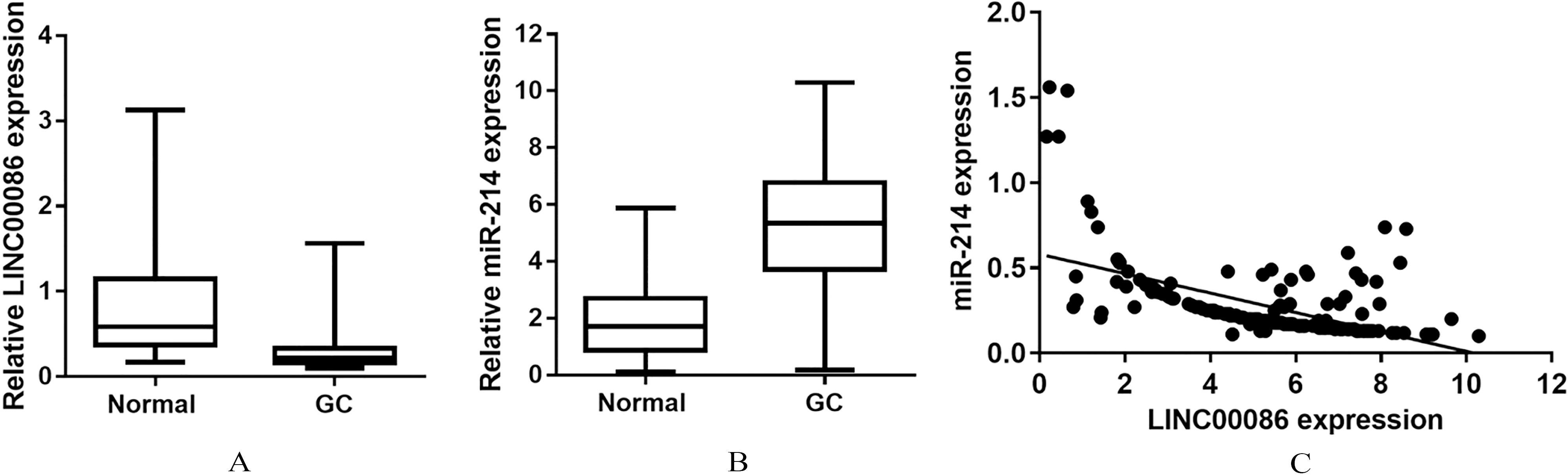
The concentrations of CEA and CA19-9 in the serum of GC patients were measured via electrochemiluminescence immunoassay using the Elecsys 2010 analyzer (Roche, Basel, Switzerland) with matched reagents. In this study, the normal reference values were
Statistical analysis
SPSS 19.0 software (IBM, Armonk, NY, USA) was used to perform all statistical analyses. Data that did not conform to a normal distribution were described using the median and the 25th and 75th percentiles, while data that conformed to a normal distribution were described using the mean
The diagnostic values of LINC00086 (A) and miR-214 (B) in GC were determined by receiver operating characteristic curve analysis.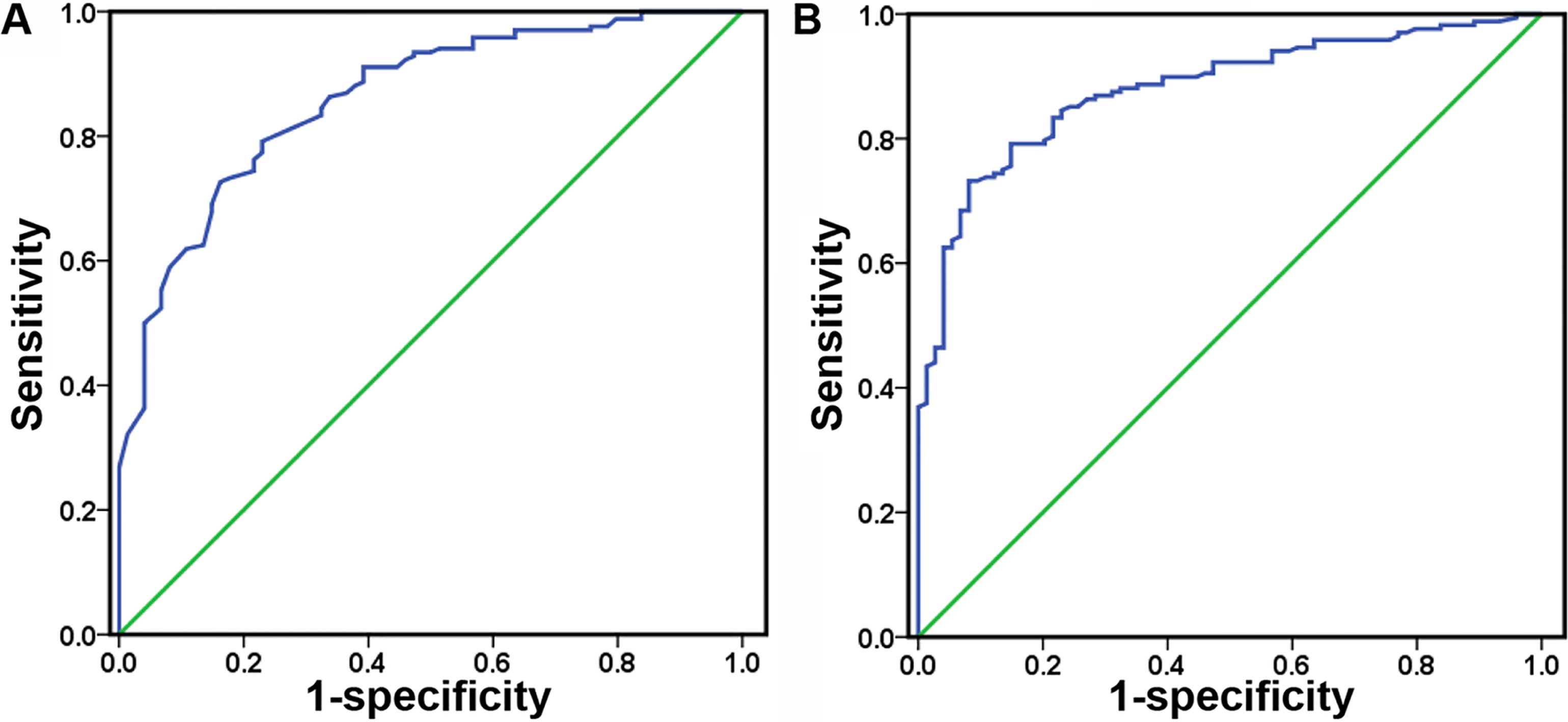
Kaplan-Meier survival curves for GC patients exhibiting LINC00086 expression (A), miR-214 expression (B), and a combination of LINC00086 and miR-214 expression (C).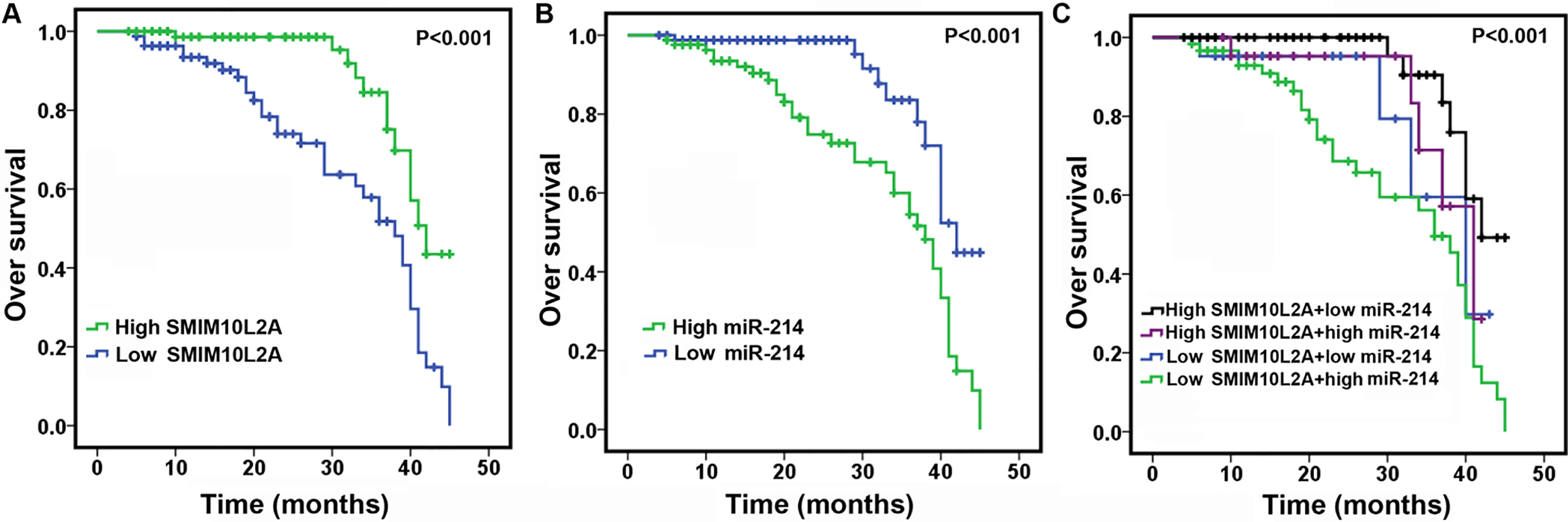
The expression of LINC00086 and miR-214 in GC patients
The expression of LINC00086 and miR-214 in plasma was measured via qRT-PCR. The results indicated that LINC00086 expression in normal individuals and GC patients was 0.585 (0.37–1.145) and 0.215 (0.160–0.330), respectively (Fig. 1A). miR-214 expression in normal individuals and GC patients were observed to be 1.705 (0.875–2.69) and 5.335 (3.718–6.770), respectively (Fig. 1B). Conclusively, the results demonstrated that LINC00086 expression was significantly lower in GC patients than normal individuals, while miR-214 expression was significantly higher (
Diagnostic value of LINC00086 and miR-214 in GC
We analyzed the performance of LINC00086 and miR-214 in diagnosing GC using ROC analysis. For the diagnostic value of LINC00086 in GC, at the optimal expression cut-off value of 0.300 (LINC00086 expression
Association of LINC00086 and miR-214 expression with the clinicopathological features of GC patients
The relationship between the expression of LINC00086 and miR-214 and the clinicopathological features of GC is shown in Table 1. Although there was no correlation between LINC00086 expression and age, sex, tumor location, or differentiation (
Relationship between LINC00086 and miR-214 expression and clinicopathological features of GC patients
Relationship between LINC00086 and miR-214 expression and clinicopathological features of GC patients
Different prognostic parameters of GC patients were evaluated by Cox-regression univariate and multivariate analysis
CI: confidence interval.
During the follow-up period (a time period of 4–45 months; median time is month 22), 48 GC patients died. GC patients were divided into two groups according to the median of LINC00086 expression (which was 0.21): the low LINC00086 group (
Discussion
In this study we found that the LINC00086 expression was significantly lower in GC patients than in normal individuals, while miR-214 expression was significantly higher. Additionally, the main findings of this study suggested that LINC00086 and miR-214 are potentially diagnostic and prognostic markers for GC. Combined, LINC00086 and miR-214 contributed in improving the predicted efficiency of prognosis in GC patients.
Plasma CEA, CA19-9, and CA72-4 are common markers which can help in the follow-up (if initially elevated) and in diagnosis tumor recurrence. However, the sensitivity and the specificity of CEA, CA19-9, and CA72-4 in GC remain unsatisfactory. Liang et al. found that the diagnosed sensitivity of CEA, CA19-9, and CA72-4 varied between 20.1–27.6% individually, and increased to 48.2% when they were considered in combination while diagnosing GC [14]. Increasing evidences have verified that lncRNAs are involved in many biological functions and play crucial roles in GC tumorigenesis and progression [15, 16]. Dysregulated lncRNAs could serve as novel biomarkers for the early diagnosis and prognosis of GC [9, 11]. LINC00086, significantly associated with overall survival, is also observed to be significantly downregulated in GC patients with lymphatic metastases when compared to GC patients with non-lymphatic metastases [10]. In the present study, we found that LINC00086 expression was significantly lower in the plasma of GC patients than in the plasma of normal individuals. ROC curve analysis found that LINC00086 exhibited high sensitivity and specificity in diagnosing GC (sensitivity: 72.6%; specificity: 83.8%; area under the curve: 0.860), which was more than the sensitivity and specificity exhibited by plasma CEA, CA19-9, and CA72-4 [14]. Additionally, GC patients with low LINC00086 expression were likely to have larger tumors, lymphatic metastasis, larger TNM stage, and higher CEA and CA19-9 levels. However, LINC00086 expression had no significant correlation with age, sex, tumor location, and differentiation. Moreover, GC patients with low LINC00086 expression were also shown to exhibit lower survival rates via the Kaplan-Meier survival curve analysis.
Accumulating evidence suggests that lncRNAs act as microRNA sponges by binding to miRNAs and regulating the biological processes of cancer. A previous study found that LINC00086 targeted miR-214 in nasopharyngeal carcinoma [12]. The findings of the present study found that LINC00086 expression exhibited a significantly negative correlation with miR-214 expression. Another previous study also found that plasma miR-214 was significantly higher in patients with GC than in controls; high plasma miR-214 significantly correlated with distant metastasis, where the AUC value of miR-214 was 0.845 by ROC analysis [17]. miR-214 regulated GC cell proliferation, migration, and invasion by targeting PTEN [18]. Similar to our results, these studies also suggested that miR-214 expression was upregulated in the plasma of GC patients, which correlated with GC cell proliferation, migration, and invasion. Our results showed that miR-214 expression was significantly lower in the plasma of GC patients than in the plasma of normal individuals. ROC curve analysis found that miR-214 exhibited high sensitivity and specificity in diagnosing GC (sensitivity: 73.2%; specificity: 91.9%; area under the curve: 0.880) [14]. GC patients with high miR-214 expression were likely to have larger tumors, lymphatic metastasis, larger TNM stage, and higher CEA and CA19-9 levels. However, miR-214 expression had no significant correlation with age, sex, tumor location, and differentiation. Moreover, GC patients exhibiting high miR-214 expression had lower survival rates, as shown by the Kaplan-Meier survival curve analysis. Finally, GC patients with low LINC00086 and high miR-214 expression had significantly lower survival rates than the other three groups of GC patients (low LINC00086 and low miR-214 expression, high LINC00086 and low miR-214 expression, and high LINC00086 and high miR-214 expression).
Previous study found miR-214 expression is down-regulated in Ulcerative Colitis, upregulation miR-214 could decrease the level of INF-
In conclusions, LINC00086 expression was significantly lower and miR-214 expression was significantly higher in GC patients than in normal individuals. LINC00086 and miR-214 are potential diagnostic and prognostic markers for GC. The exact mechanism that determines the impacts of LINC00086 expression on GC tumorigenesis and metastasis, and also the regulation of miR-214 expression will be investigated in our future research.
Footnotes
Conflict of interest
None.