




Abstract
BACKGROUND:
Breast cancer remains the most invasive female malignancy worldwide. Functional role of microRNA-940 (miR-940) have been investigated in various cancer. The purpose of this study was to assess the serum miR-940 expression and its clinical significance in breast cancer.
METHODS:
Expression of miR-940 was measured by quantitative real-time polymerase chain reaction (qRT-PCR). The diagnostic value of miR-940 was analyzed with receiver operating characteristics (ROC) analysis. To explore the prognostic performance of miR-940, Kaplan-Meier survival assay and Cox regression analysis were performed.
RESULTS:
Downregulated miR-940 was detected in the breast cancer patients compared with the healthy controls (
CONCLUSIONS:
Serum downregulated miR-940 may serve as a reliable diagnostic and prognostic biomarker in breast cancer patients.
Introduction
Breast cancer is considered as the most invasive female malignancy and a serious health burden as it is responsible for a large proportion of cancer-related mortality in women around the world [1, 2, 3]. Previous researches reported that obesity, early age at first menstruation, lack of physical exercise, alcohol abuse, late childbirth, family history and older age are closely correlated with the initiation of breast cancer [4]. Owing-to the advances in surgery, chemotherapy, radiotherapy and hormonotherapy, the morbidity and mortality rates in some developed countries have improved during the past several decades, however, these rates are unfavorable in the developing countries, especially in China [5]. The prognosis of breast cancer remains not ideal, especially in the tripe-negative breast cancer (TNBC), which represents the most aggressive subtype among all the breast cancer cases [6]. In order to achieve better prevention and treatment, some obstacles need to be overcome for breast cancer patients, such as early metastasis, tumor recurrence and delayed diagnosis. Currently, biomarkers for diagnosis and prognosis have received more and more attentions for cancer treatment [7, 8]. Thus, novel molecular markers are needed for tumor screening and survival prediction in patients suffering from breast cancer.
Among all the available diagnostic and prognostic biomarkers, microRNAs (miRNAs) represent the pivotal components with abundant members [9, 10]. They are a class of small RNAs without the capacity of protein coding [11]. MiRNAs play important regulatory roles on gene expression by binding the 3’-untranslated region (3’-UTR) of the target messenger RNAs (mRNAs), leading to inhibition of protein translation and/or mRNAs degradation [12]. The biologic functional roles of miRNAs have also been uncovered in both normal and tumor cells, that they can be involved in the cell proliferation, invasion, migration and apoptosis [13]. Increasing researches demonstrate that aberrant expression levels of miRNAs in tumor samples are associated with tumor development and progression [14, 15]. Moreover, the clinical significance of the miRNAs in cancer diagnosis and prognosis has also been proved in diverse cancers [16, 17]. As a member of the miRNAs, microRNA-940 (miR-940) has been identified in some tumor specimens, and its functional role in breast cancer was described in the study by Hou et al. [18]. However, the relationship between miR-940 expression and breast cancer diagnosis and prognosis has never been reported in the previous researches.
In the current study, we aimed to evaluate the serum expression of miR-940 and further explore its clinical value in patients with breast cancer.
Methods and materials
Patients and serum sample collection
The present study was carried out in accordance with the guidelines by the Ethics Committee of Shanxian Central Hospital. The signed informed consent was obtained from each of the participants prior to the clinical materials collection. All the specimens used in our study were made anonymous following the ethical and legal standards.
Total of 128 breast cancer patients were included in our study, who were diagnosed based on the histopathological evaluation in Shanxian Central Hospital during the period from Aug. 2007 to Oct. 2011. The pathological type of the patients were determined to be invasive ductal carcinoma. All these patients had never received any anti-tumor therapy before the samples collection. Seventy healthy volunteers with no history of malignancy were recruited from the individuals who underwent routine physical examination. Venous blood samples were collected from the patients and healthy controls in the same way and serum was isolated by centrifugation. All the serum samples obtained were stored at
Clinical data collection
The clinical characteristics including age, tumor diameter, lymph node metastasis, expression of ER, PR and HER-2 and TNM stage were involved in the present study (Table 1). The tumors of the patients were immunostained for estrogen receptor [ER] (SP1 antibody), progesterone receptor [PR] (1E2 antibody) and human epidermal growth factor receptor 2 [HER2] (4B5 antibody). The staining results of ER or PR were considered to be positive when more than 10% cells were positive nuclear staining. The result for HER2 staining was determined following the published UK guidelines [19]. The tumors were staged according to 2009 Union for International Cancer Control (UICC) TNM system [20].
Association of miR-940 with clinicopathological features of breast cancer patients
Association of miR-940 with clinicopathological features of breast cancer patients
ER, estrogen receptor; PR, progesterone receptor; HER2, human epidermal growth factor receptor 2;
The extraction of total RNA in the serum specimens was performed using Trizol reagent (Invitrogen, Carlsbad, CA, USA) following the instruction of manufacturer. The purity and concentration of RNA were determined by Nanodrop 2000 (Wilmington, DE 19810 USA). The RNA with the ratio of OD A260/A280 close to 2.0 was accepted for subsequent assay.
Quantitative real-time polymerase chain reaction (qRT-PCR)
The single stranded cDNA was synthesized from the obtained RNA using a Transcriptor First Strand cDNA Symthesis Kit (Roche, Vilvoord, Brussel, Belgium). To estimate the expression patterns of miR-940, qRT-PCR was conducted using a SYBR green I Master Mix kit (Invitrogen) on the 7300 Real-Time PCR System (Applied Biosystems, USA). In the reactions,
Serum expression of miR-940 in 128 breast cancer patients and 70 healthy individuals. The expression of miR-940 was significantly decreased in breast cancer patients compared with the healthy controls (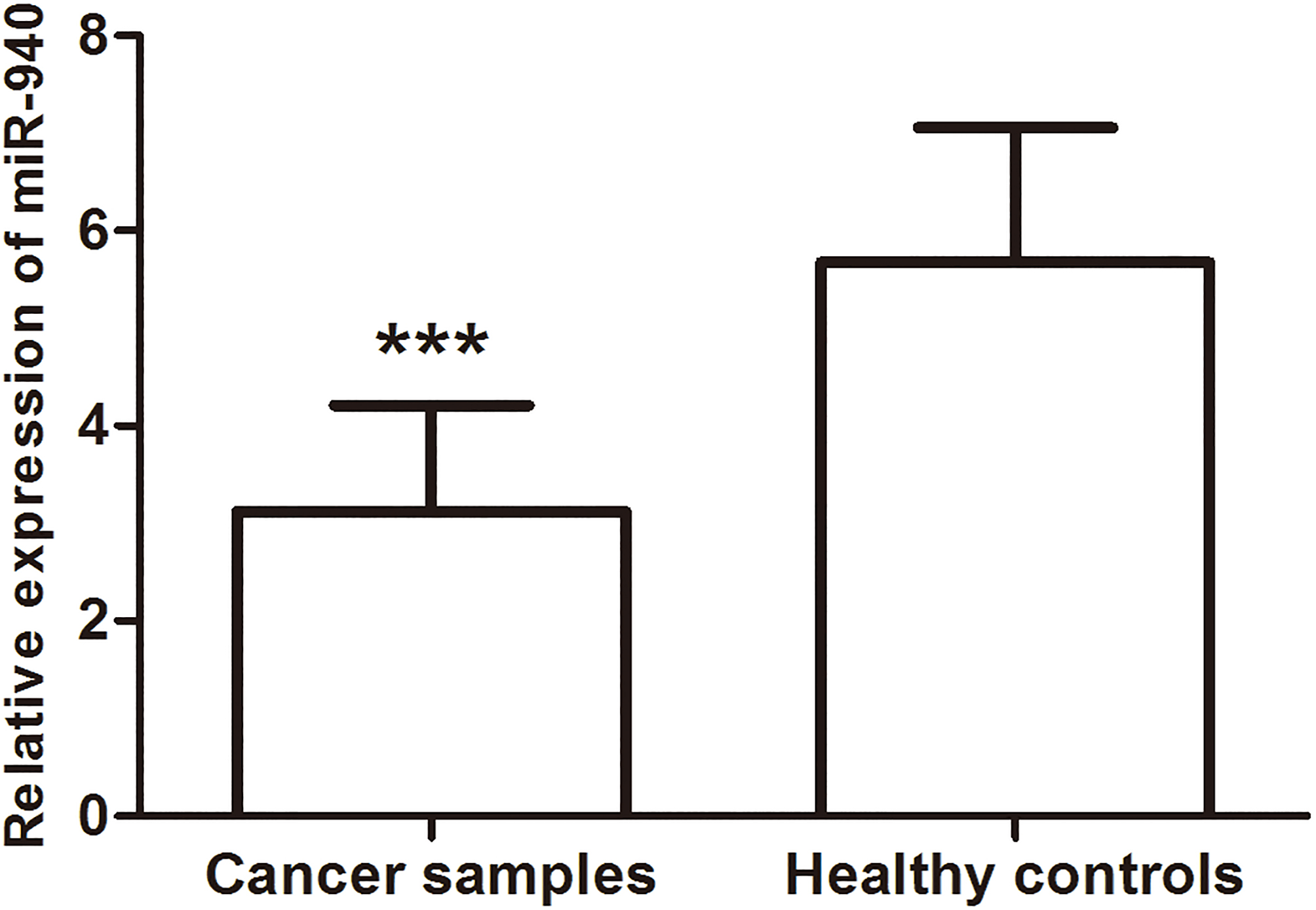
Data in the present study was expressed as mean
Results
Decreased serum miR-940 expression in breast cancer patients
The serum expression of miR-940 in both the breast cancer patients and healthy volunteers was evaluated by qRT-PCR. As shown in Fig. 1, miR-940 expression was significantly lower in the breast cancer patients than that in the healthy controls (
Relationship between miR-940 expression and clinicopathological features of breast cancer
Since the serum expression of miR-940 was abnormal in breast cancer patients, we explored the role of miR-940 during tumor progression. Thus, the association of miR-940 expression and clinicopathological characteristics was estimated in our study. In this analysis, mean miR-940 expression level of 3.123 was used as a cutoff value to classify the patients into two groups: low miR-940 expression group (
Diagnostic performance of miR-940 expression for breast cancer patients
To further investigate the clinical significance of miR-940 in breast cancer diagnosis, the ROC analysis was carried out in the current study. A ROC curve with the area under the curve (AUC) of 0.905 was plotted (Fig. 2). The sensitivity was 94.5% and the specificity was 78.6%.
Prognostic significance of miR-940 expression in breast cancer patients
In addition, the diagnostic value of miR-940 expression, its prognostic performance was also assessed for breast cancer patients. First, the Kaplan-Meier survival analysis indicated that patients with high levels of miR-940 had better overall survival compared with those with low miR-940 levels (log-rank
ROC curve based on miR-940 expression in patients with breast cancer. The AUC value was 0.905, corresponding with sensitivity of 94.5% and specificity of 78.6%.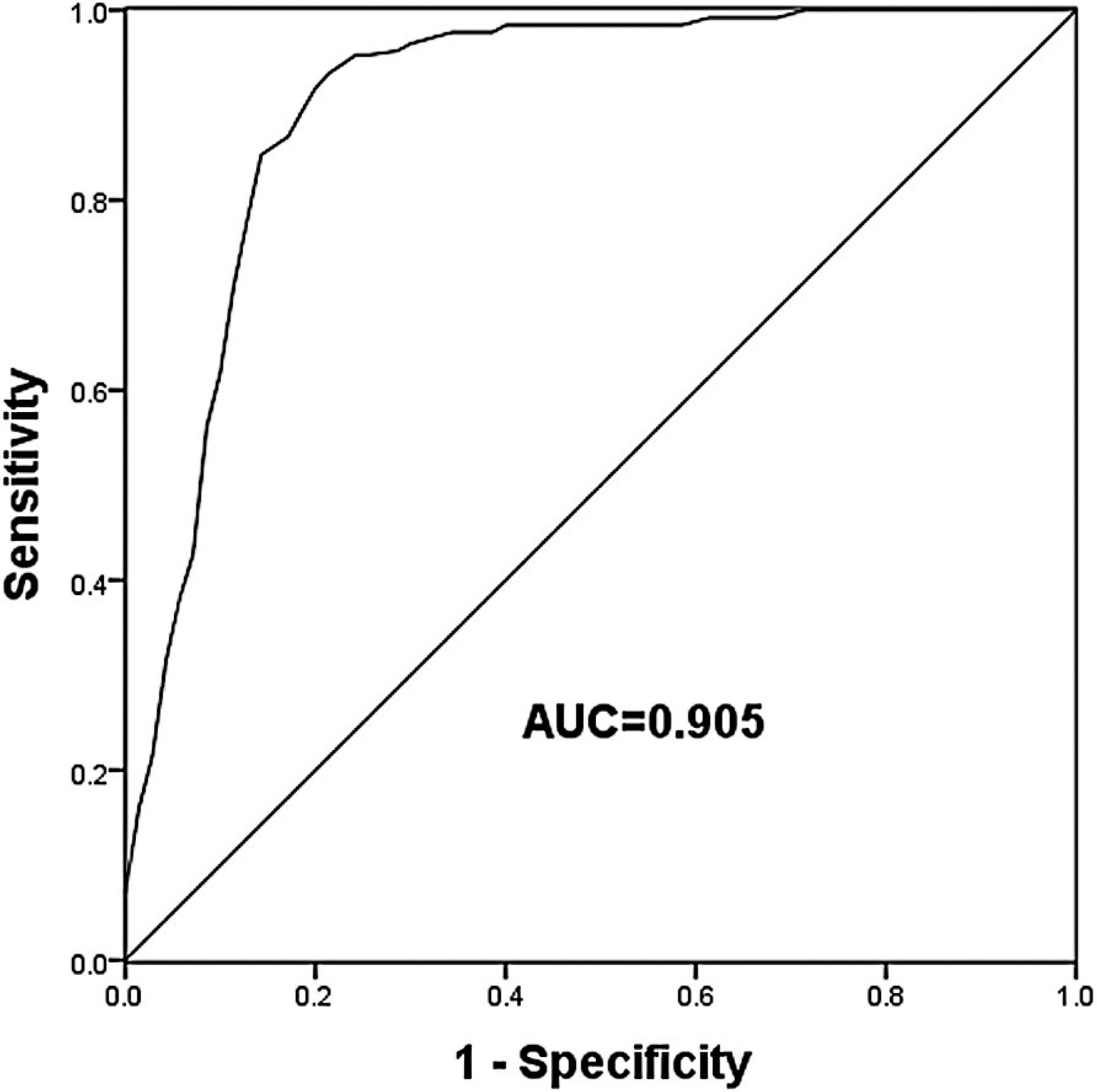
Cox regression analysis in patients with breast cancer
ER, estrogen receptor; PR, progesterone receptor; HER2, human epidermal growth factor receptor 2; –, indicated no related data.
The Kaplan-Meier survival curves constructed for breast cancer patients with different miR-940 expression. The overall survival was poor in the patients with low miR-940 expression compared with those with high miR-940 expression (log-rank 
Expression of miR-940 and its correlation with the overall survival in patients with TNBC. A. MiR-940 expression was lower in TNBC patients than that in the NTNBC patients (
According to the immunohistochemistry analysis, 38 patients were determined as TNBC (HR-, PR- and HER2-). The serum expression of miR-940 was significant downregulated in the TNBC patients compared with the non-tripe-negative breast cancer (NTNBC) cases (
Discussion
Breast cancer represents a common diagnosed female malignancy worldwide with increased rates of morbidity and mortality [21]. Breast cancer patients usually have lump in breast, fluid coming from nipple, bone pain and shortness of breath, leading to reduction in quality of life and high care costs [22]. Statistical data indicated that the overall survival of breast cancer patients with early stage tumor has been improved thanks to the advances in various therapeutic strategies, but the prognosis remains dismal in the cases having advanced disease [23]. Therefore, focused efforts should be carried out on the improvement of early diagnosis and efficient prognosis.
MiRNAs have attracted lots of attentions for their diagnostic and prognostic value in various human malignancies [24]. Accumulated studies revealed that the aberrant expression of miRNAs is usually involved in tumor progression, thus can be used to improve the target therapy in different types of human cancer [25]. In the present study, the expression patterns and clinical significance of miR-940 were evaluated in the patients with breast cancer. According to the qRT-PCR, a significantly decreased serum miR-940 expression was detected in the cancer patients compared with the healthy controls. Furthermore, the downregulated miR-940 expression was found to be closely correlated with positive lymph node metastasis and advanced TNM stage. These data above suggested that the miR-940 expression might act as a tumor suppressor and indicate aggressive behavior of breast cancer. The similar results have been performed in breast cancer tissues [18] and other malignancies, such as prostate cancer [26], hepatocellular carcinoma [27] and ovarian cancer [28]. However, the contrary results have been found in gastric cancer [29] and pancreatic carcinoma [30], that presented the upregulated miR-940 expression in the tumor samples. These discrepancies may indicate that miR-940 acts as different roles among diverse human cancers. In the previous studies, the suppressor role of miR-940 has also been reported in TNBC by targeting ZNF24 [18]. Similarly, the miR-940 expression was involved in tumor progression of gastric cancer with ZNF24 as the targeted gene [29]. ZNF24 has been described as a repressor of vascular endothelial growth factor, thus acted as a tumor suppressor [31]. However, data in the study by Hou et al. indicated that ZNF24 might serve as a promoter in TNBC [18]. Therefore, the precise molecular mechanisms underlying the role of miR-940 in breast cancer should be confirmed in further studies.
In addition to the role of miR-940 expression in breast cancer, its clinical significance was also been investigated. Several miRNAs have been described as biomarkers for patients with breast cancer, such as miR-21 [32] and miR-320a [33]. The understanding of molecular mechanisms and target therapy in breast cancer has been improved benefit from these molecular biomarkers. In the present study, the ROC curve indicated that miR-940 expression might act as an effective diagnostic biomarker with high sensitivity and specificity. The Kaplan-Meier survival analysis and Cox regression assay suggested that the decreased miR-940 expression was associated with poor overall survival and could serve as an independent prognostic factor for breast cancer patients. In other words, downregulated expression of miR-940 was correlated with poor prognosis of breast cancer.
As we all known, breast cancer can be classified into several subtypes and TNBC is the most aggressive one. TNBC accounts for only 15–20% of all the breast cancer cases, but is characterized with its poor prognosis [34]. Thus, some molecular biomarkers for TNBC prognosis have been identified, such as miR-301a [35] and CD73 [36]. In this study, 38 TNBC patients were included in all the collected patients. Downregulated miR-940 expression was found in the TNBC cases compared with the NTNBC patients, suggesting that miR-940 might be involved in the malignant behavior of TNBC. Furthermore, survival analysis demonstrated that low miR-940 expression predicted poor prognosis of TNBC. Thus, we considered that the downregulated expression of miR-940 was not only an independent prognostic factor of breast cancer, but also correlated with poor prognosis of TNBC.
In conclusion, serum expression of miR-940 is decreased in breast cancer patients compared with the healthy controls. The downregulated expression serves as a candidate diagnostic and prognostic biomarker in this malignancy, and low miR-940 expression may predicate poor prognosis of TNBC. Moreover, the miR-940 expression was demonstrated to be related with lymph node metastasis and TNM stage, and may be used in the target therapy for breast cancer.