




Abstract
BACKGROUND:
Gastric cancer is one of the most common malignant tumours. Identifying novel genes that govern the development of gastric cancer will help to elucidate its molecular mechanisms and find novel biomarkers.
METHODS:
Expression of the ANKRD49 protein was assessed by immunohistochemical analysis of tissue microarrays containing 92 sets of human gastric cancer specimens with adjacent non-cancerous tissue. Associations between ANKRD49 levels and clinicopathological characteristics of the patient were investigated. The correlation between ANKRD49 expression and patient survival was analysed by the Kaplan-Meier method.
RESULTS:
The results revealed that the expression level of the ANKRD49 protein in gastric cancer was significantly upregulated and correlated with the tumour size, tumour-node-metastasis (TNM) stage, histological grade, depth of invasion, vessel invasion, lymph node metastasis and distant metastasis. The mean survival time of patients with low expression levels of ANKRD49 was significantly longer than that of patients with high expression levels of ANKRD49. Multivariate Cox regression analysis demonstrated that the ANKRD49 protein expression level was an independent prognostic indicator for the survival rate of patients with gastric cancer.
CONCLUSION:
The results of the present study highlighted an important role of the ANKRD49 protein in the progression of gastric cancer. The ANKRD49 protein could act as a potential biomarker for prognosis evaluation of gastric cancer and may be used as a molecular target for gastric cancer treatment.
Introduction
Gastric cancer (GC) is one of the most common malignant tumours worldwide and is the third leading cause of cancer-associated mortality in China [1]. Every year, approximately 405,000 novel cases are diagnosed in China; approximately 70% of patients are diagnosed at an advanced stage, and the prognosis is poor [2, 3]. It is well known that environmental factors, such as Helicobacter pylori infection [4] and poor diet, and genetic factors, such as abnormal expression of cancer-related genes [5], contribute to gastric carcinogenesis. It is pivotal to investigate novel genes that govern the development of GC to elucidate the molecular mechanisms, identify novel biomarkers and develop personalized therapies for individual patients in the future.
Ankyrin repeat domain 49 (ANKRD49) contains four ankyrin repeat motifs, which include 30 to 34 amino acid residues [6]. Ankyrin repeat proteins mediate protein-protein interactions and have been proven to be involved in the development of diverse human cancers [7, 8]. ANKRD49 has been reported to contribute to the progression of human malignant gliomas and non-small cell lung cancer via promoting cell proliferation and cell invasion [9, 10]. However, the expression pattern of ANKRD49 in GC remains largely unclear. At present, molecular profiling of GC can be performed using gene/tissue expression microarray analysis or DNA sequencing [11, 12, 13], which facilitates the identification of novel biomarkers for subtype classification, prognosis and therapeutic targets. In the present study, we investigate the expression of ANKRD49 by immunohistochemistry (IHC) and identify its potential roles in tumour occurrence and development in and prognosis of patients with GC.
Materials and methods
Patients and follow-up
A total of 92 patients who underwent surgery for histologically proven gastric cancer from June 2007 to July 2008 at hospitals that cooperated with the National Engineering Center for Biochip at Shanghai were selected for this research. There were 62 men and 30 women, whose ages ranged from 37 to 84 years (median: 63 years). Patients had not received any previous treatment, and histological diagnoses were made from formalin-fixed, paraffin-embedded tissues by two pathologists. The clinicopathological characteristics, including gender, age, tumour size, tumour location, histological grade, differentiation grade and surgical record, were obtained from medical records. All patients were followed up, and the follow-up deadline was August 2013. The survival time was determined from the date of surgery to the follow-up deadline or date of mortality. Written informed consent was obtained from the patients for the use of their samples for research, and the research protocols were approved by the Ethics Committee of Shanxi Medical University. The clinicopathological characteristics of our study sample are presented in Table 1.
Tissue microarray construction
Paraffin-embedded tumour specimens and paired adjacent non-tumour specimens (
Immunohistochemistry
The immunohistochemical staining procedure was performed by using the two-step method. Slides were deparaffinized in xylene, rehydrated through graded concentrations of ethanol, and rinsed in distilled water. Endogenous peroxidase activity was blocked by incubating the slides with 30 mL/L H
The evaluation of the immunohistochemical staining was performed independently by two authors without knowledge of the clinicopathological information. The expression of ANKRD49 was examined by viewing the cells with light microscopy, calculating 1000 cells per 5 sites and evaluating the mean number. The percentage of positive cells was quantified under the microscope and classified into five groups as follows: 0% positive cells for 0; 1% to 25% positive cells for 1; 26% to 50% positive cells for 2; 51% to 75% positive cells for 3; and
Clinicopathological characteristics of gastric cancer cases
Clinicopathological characteristics of gastric cancer cases
TNM, tumour-node-metastasis.
Values are expressed as the mean
Results
Expression levels of the ANKRD49 protein in gastric cancer and non-cancerous gastric mucosae
We investigated the protein expression of ANKRD 49 in gastric cancer specimens and adjacent non-tumourous tissue using a large tissue microarray (92 cores). The tumourous or non-tumourous mucosa-specific staining was semi-quantitatively scored by the intensity and the percentage of positive staining. ANKRD49 protein expression was detected in 92/92 (100%) patients with gastric cancer, including high expression levels in 68 (73.9%) cases and low expression levels in 24 (26.1%) patients, whereas the ANKRD49 protein was weakly (13/92 cases) or not expressed in non-cancerous gastric mucosa tissues. The percentage of tissues with a high ANKRD49 protein expression level was significantly higher (
Immunohistochemical expression of ANKRD49 in gastric cancer and adjacent non-cancer tissues. The black arrow indicates ANKRD49 expression in the cytoplasm; the red arrow indicates ANKRD49 expression in the nucleus. Magnification: 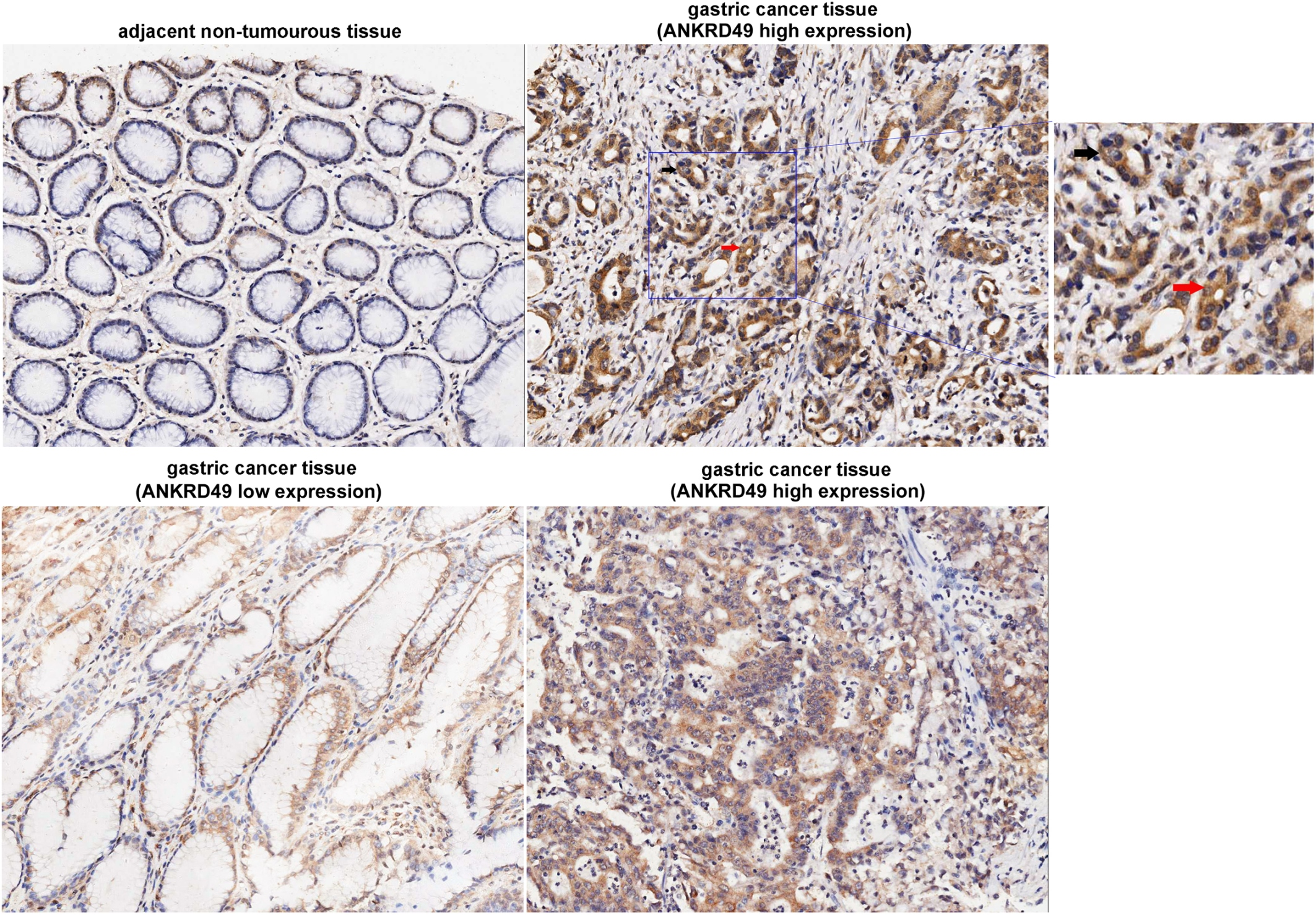
The correlation between ANKRD49 protein expression and the clinicopathological parameters of patients with gastric cancer was evaluated. The expression level of the ANKRD49 protein in gastric cancer was associated with tumour size, deep tumour invasion, TNM stage, vessel invasion, lymph node metastasis and distant metastasis of the tumour, whereas it was not associated with gender, age, location or the histological grade of the tumour. Gastric cancer tissues from patients with large tumour size (
Correlation between the ANKRD49 protein expression level and prognosis of patients with gastric cancer
ANKRD49 expression in tumourous tissue and adjacent non-tumourous tissue
ANKRD49 expression in tumourous tissue and adjacent non-tumourous tissue
T: Tumourous tissue; N: Non-tumourous tissue. Mann-Whitney U-test.
Association of ANKRD49 protein levels with clinicopathological parameters of patients with gastric cancer
TNM, tumour-node-metastasis.
Multivariate analysis of the correlation between clinicopathological parameters and the survival rate of 92 patients with gastric cancer
CI, confidence interval; HR, hazard ratio; SE, standard error; TNM, tumour-node-metastasis.
Clinicopathological parameters associated with overall survival in gastric cancer based on Kaplan-Meier survival curves. The horizontal axis represents overall survival time (years); the vertical axis represents survival function.
Kaplan-Meier curve analysis showed that high expression levels of the ANKRD49 protein were associated with poor prognosis of patients with gastric cancer (
To avoid the influence caused by univariate analysis, the expression of ANKRD49 and other parameters were examined by multivariate Cox analysis. It was revealed that the ANKRD49 protein expression level, distant metastasis, TNM stage and depth of invasion were independent prognostic indicators for the survival of patients with gastric cancer, which indicated that the ANKRD49 protein could act as a potential biomarker for prognosis evaluation of gastric cancer. Of the other parameters, age, tumour location, size, lymph node metastasis and vessel invasion were not found to be independent prognostic factors for patient survival (Table 4).
Ankyrin repeat proteins usually include a varying number of the ankyrin repeat domain, which is an
Approximately 990,000 people are diagnosed with GC worldwide every year, and this disease is multifactorial [18]. Both environmental and genetic factors have a role in its aetiology [19]. In the present study, an elaborate experiment was conducted, and a rigorous analysis of the human ANKRD49 protein was performed on a cohort of 92 gastric cancer specimens to address the potential roles of the ANKRD49 protein in the occurrence and development of GC. Our results revealed that the expression levels of the ANKRD49 protein in gastric cancer tissues were significantly higher than those in adjacent non-cancerous gastric mucosae (
Thus far, the general prognosis of gastric cancer is poor. The specificity and sensitivity of biomarkers are important for choosing the correct treatment options for and evaluating the prognosis of individual patients [21]. As a result of ANKRD49 involvement in the invasion and metastasis of tumours, ANKRD49 is proposed to be a biomarker associated with poor prognosis of GC. The present study demonstrated that the cumulative survival rates and mean survival time of patients with low ANKRD49 expression levels were significantly higher than those of patients with high ANKRD49 expression levels. Moreover, it was revealed that a high expression level of ANKRD49 was an independent prognostic factor for patients with gastric cancer. Other factors that were correlated with the survival rate of patients included age, tumour location, size, depth of invasion, TNM stage, vessel invasion, lymph node metastasis and distant metastasis. In addition, distant metastasis, TNM stage and depth of invasion were independent prognostic indicators for the survival rate of patients with gastric cancer. Thus far, only CEA or CA 19–9 markers are measured in clinical practice for detection of recurrence [22]. Therefore, the present study is of considerable importance since the results from univariate and multivariate survival analyses highlighted the prognostic relevance of the ANKRD49 protein in patients with gastric cancer.
Up to now, the function of ANKRD49 remains largely unclear. It has been reported that ANKRD49 is overexpressed in human malignant glioma and promotes the proliferation of human malignant glioma cells by increasing the cell cycle and inhibiting cell apoptosis [10]. In addition, it has been reported that ANKRD49 augments autophagy in male germ GC-1 cells by enhancing the nuclear factor kappa B (NF-
Although preliminary, our present results suggest that ANKRD49 may be involved in the progression of gastric cancer and that its expression level alone or in combination with other factors (such as TNM stage) is useful for predicting the prognosis of patients with gastric cancer. A limitation of the present study is the smaller size of tissue samples used in the tissue microarray analysis. In addition, the gastric cancer samples were collected from a single institution, which could introduce selection bias. Therefore, more gastric cancer specimens collected from different hospitals are needed to confirm the present analysis, and additional studies are required to elucidate the precise role of ANKRD49 in the development of GC and to examine its potential role as a therapeutic target.
Footnotes
Acknowledgments
This study was supported by the Youth Innovation Fund of the First Hospital of Shanxi Medical University (YC1410) and the Project of International Science and Technology Cooperation of Shanxi Province (2015081039).
Conflict of interest
The authors declare no conflict of interest.