




Abstract
BACKGROUND:
Cervical cancer is one of the malignant tumors which seriously threaten the women health worldwide. SPINT2 is an endogenous inhibitor of hepatocyte growth factor activator and down regulated or even silenced in many human malignant tumors.
OBJECTIVE:
This study was performed to explore the promoter methylation status of SPINT2 gene and the effect on its expression in cervical carcinoma.
METHODS:
HPV-positive and -negative cervical cancer cell lines, 50 cases of cervical carcinoma tissues, and 20 cases of normal cervical tissues were used for this study. The methylation status of promoter and the first exon of SPINT2 gene were analyzed. The expression of SPINT2 was analyzed by qRT-PCR.
RESULTS:
HPV E6/E7 infection affects SPINT2 methylation rate in cell lines. SPINT2 methylation rate of HT-3E6/E7 was 8.8%, while the methylation rate of SPINT2 in HT-3 was 0%. In cervical tissues, the methylation rate of SPINT2 in cervical cancers was 54%, while the methylation rate of SPINT2 in normal cervical samples was 25%. As for cervical cancers, the methylation rate of SPINT2 gene was higher in grade 3 than those of grade 2.
CONCLUSIONS:
The expression of SPINT2 gene is regulated by its methylation status, and the methylation status of SPINT2 is altered by HPV infection. The aberrant methylation status of SPINT2 gene may play an important role in the development of cervical cancer.
Introduction
Cervical cancer is one of the malignant tumors which seriously threaten the women health worldwide, especially in the developing countries [1]. The occurrence and development of cancers including cervical cancer are multi-gene and -factor involved, multi-stage pathological process [2]. It is well established that two viral oncoproteins E6 and E7 mediate the oncogenic activities of high-risk human papillomavirus (hrHPV), especially HPV16 and HPV18 (HPV16/18), which have been demonstrated to play critical roles in cervical cancer through different pathways [3, 4]. HrHPV alone is necessary but insufficient for cervical carcinogenesis; only a small proportion of hrHPV-infected patients develop invasive cervical cancer, and the majority remain subclinical or exhibit only precursor lesions [5, 6]. This can be accounted for the involvement of genetic and epigenetic factors either independent or combined with hrHPV infection, therefore, these factors may be implicated in the development of cervical cancer [7]. Many studies have found that epigenetic abnormalities, particularly aberrant methylation changes, play critical roles in tumorigenesis of many cancers [8, 9].
SPINT2 (HAI) is an endogenous inhibitor of hepatocyte growth factor activator (HGFA) [10]which is an enzyme that transforms HGF into a form of reactive heterodimers. The activated HGF activates MET signaling pathway by binding to the MET receptor [11, 12]. HGF/MET pathway is closely related to the oncogenesis of many kinds of tumors, such as myeloid cell tumor [13], gastric cancer [14], malignant brain tumor [15] and hepatocellular carcinoma [16].
Previous studies have indicated that SPINT2 expression is down-regulated or even silenced in many human malignant tumors, such as glioma [17], colon cancer [18] and breast cancer [19]. The expression of SPINT2 was negatively correlated with histologic level of glioma, where the restore of SPINT2 in the cultured cell lines in vitro could inhibit cell fibrinolytic activity and basement membrane invasion [20]. In addition, downregulation of SPINT2 in breast cancer is associated with poor prognosis [19]. Studies have revealed that the methylation of SPINT2 gene plays a key role in the oncogenesis of multiple tumors, such as esophageal cancer [21], renal cell carcinoma [22] and melanoma [23]. However, the methylation status of SPINT2 gene in cervical cancer has not been reported.
In this paper, we studied the methylation and expression of SPINT2 gene in cervical cancer cell lines and cervical tissues, and discussed the possible roles of SPINT2 gene in cervical cancer.
Materials and methods
Cell lines and constructs
HPV16/18-positive cervical cancer cell lines HeLa, CaSki, SiHa and HPV-negative cervical cancer cells C33A and HT-3 were obtained from Shanghai institute for biological sciences, Chinese academy of Sciences Institute of Cell Resource Center (Shanghai, China). In the present study, we established the ectopically expressed HPV16E6/E7 cell models of HT-3E6/E7 by transfecting HPV16E6/E7 oncogenes with lentivirus vectors into the HPV-negative cervical cancer cell line HT-3 in our lab. The HT-3 vector (HT-3V) cells were established by transfecting HT-3 cell with lentivirus vectors that did not code for the HPV16E6/E7 proteins as controls. Stable transfected cells were selected with 10 ug/ml puromycin for 3 weeks. The transfection efficiency was tested by western blotting. Western Blotting showed that the transfected cells successfully expressed the E6/E7 proteins (Fig. 1).
The transfection efficiency of HPV16 E6/E7 tested by Western blot. SiHa: Positive control.
For the demethylation experiments, demethylation was induced with 5-Aza-CdR treatment at a concentration that could induce the demethylation of the DNA without killing the cells. HeLa and HT-3E6/E7 cells were plated at a density of 8
Methylation-specific polymerase chain reaction (MSP)
2
DNA extraction and Bisulfite genomic sequencing (BGS)
The DNA was extracted by using SDS-proteinase K and purified with phenol: chloroform: isoamyl alcohol. A QIAamp DNA FFPE tissue kit (QIAGEN GmbH, Hilden, Germany) was used of the DNA extraction from the paraffin-embedded tumor tissues. The bisulfite conversion of the DNA was performed using an EpiTect Fast DNA Bisulfite kit (Qiagen, Valencia, CA, USA) according to the instruction of the manufacturer. The methylation statuses of the promoter/exon 1 region of SPINT2 gene in the cervical cancer cells and cervical specimens were analyzed by BGS. The region of SPINT2 gene from
RNA extraction and quantitative real-time polymerase chain reaction (qRT-PCR)
Total RNA was extracted from cervical cancer cell lines and tissue samples using TRIZOL (Invitrogen, Waltham, MA USA). The cDNAs were synthesized from the templates in presence of reverse transcriptase and oligo (dT) 18 primers in accordance with the manufacturer’s instructions. Forward primer (SPINT2-F: AGGTGGTGGTACAATGTCA) and reverse primer (SPINT2-R: GGGACAGAGGAATCCGCTG) weredesigned to generate a 176 bp PCR product. Double distilled water was used as a negative control and the housekeeping gene glyceraldehyde-3-phosphate dehydrogenase (GAPDH) was amplified by primers (5’-GATGACCTTGCCCACAGCCT-3’ and 5’-ATCTCT GCCCCCTCTGCTGA-3’) to generate a 303 bp PCR product as the internal control. Each quantitative reaction contained 10
Western blotting
The harvested cells were lysed in RIPA lysis buffer supplemented with protease inhibitor cocktail. Each protein lysate (50 ug) was mixed with 5
Cervical tissue specimens
This study was approved by the Institutional Review Board (IRB) of the Affiliated Hospital of Qingdao University. All human cervical tissue samples, including 50 HPV16-positive squamous cell carcinomas and 20 normal cervical tissues, were obtained with written informed consent from the donor who underwent primary surgical treatment for cervical tumors or other benign uterine lesions from the Affiliated Hospital of Qingdao University between 2003 and 2013. All cases were reviewed by at least two pathologists to confirm the primary diagnoses.
Statistical analysis
Statistical tests were performed with SPSS version 17.0 (SPSS, Chicago, IL, USA). The correlation between the SPINT2 mRNA expression of different groups was analyzed by t test. The correlations between the clinicopathological characteristics and the methylation status of SPINT2 gene were tested using the
SPINT2 gene mRNA expression before and after treated
SPINT2 gene mRNA expression before and after treated
(a) The methylation status of SPINT2 gene detected by MSP and BGS in cervical cancer cell lines. (b) CpG methylation status of SPINT2 gene detected by BGS.
Comparison of methylation state of SPINT2 gene between cervical cancer tissues and normal cervical tissue
SPINT2 gene methylation status in cervical cancer cell lines.
SPINT2 promoter methylation status was detected in five cervical cancer cell lines by MSP. The results (Fig. 2a) showed that HPV-positive cervical cancer cell line HeLa only appears M band (all methylated), CaSki and SiHa cell lines appear M
(a) The SPINT2 gene expression in HPV-positive cervical cancer cell lines and HPV-negative cervical cancer cell lines. (b) The methylation status of SPINT2 gene detected by MSP in cervical cancer tissues and normal cervical tissues. (c) The SPINT2 gene expression in cervical cancer and normal cervical tissues. (d) The SPINT2 gene expression in methylated cervical cancer tissues and unmethylated cervical cancer tissues.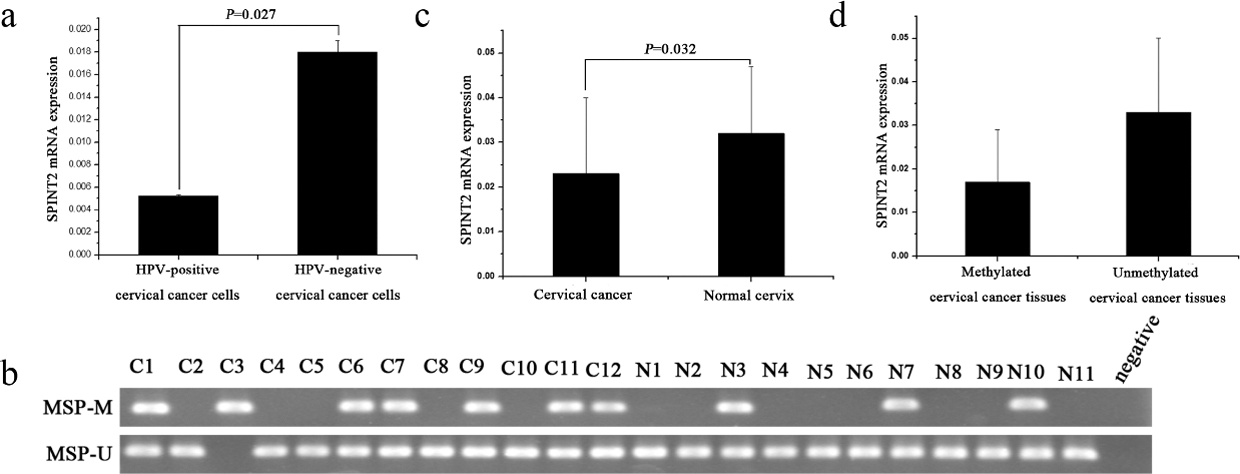
The expression levels of SPINT2 mRNA in the three HPV-positive cell lines were significantly lower than those of in the two HPV-negative cell lines (Fig. 3a and Table 1). However, it was significantly up-regulated in HeLa cells after 5-Aza-CdR treatment. While the mRNA expressions of SPINT2 gene between HT-3 and HT-3E6/E7 cells showed no significant difference (Table 1).
SPINT2 gene methylation status in cervical tissues
MSP results showed that in the 50 cases of cervical cancer tissues, SPINT2 gene presented three different methylation statuses, of which there were 2 (2/50, 4%) cases of M bands, 25 (25/50, 50%) cases of M
Comparison of methylation state of SPINT2 gene between HPV-positive cervical cancer tissues and HPV-negative cervical cancer tissues
Comparison of methylation state of SPINT2 gene between HPV-positive cervical cancer tissues and HPV-negative cervical cancer tissues
In the 50 cases of cervical cancer tissues, 46 cases were HPV16-positive cervical cancer tissues. Of these, 2 cases (2/46, 4.35%) were M type, 25 (25/46, 54.35%) cases were M
qRT-PCR results showed that the mRNA expression of SPINT2 gene was significantly lower in cervical cancer tissues than those in normal cervical tissues (
Of the 50 cases of cervical cancer tissues, there were 27 methylated cervical samples and 23 unmethylated ones. Analysis showed that the mRNA expression of SPINT2 gene was significantly lower in the methylated cervical cancer tissues than those in unmethylated ones (
Analysis between methylation status of SPINT2 and clinicopathologic characteristics in cervical cancers
Analysis between methylation status of SPINT2 and clinicopathologic characteristics in cervical cancers
Analysis between methylation status of SPINT2 and pathological grade in cervical cancers
The relationship between SPINT2 gene methylation and clinicopathological features of cervical cancer was analyzed, including age, FIGO stage, histological type, tumor size, lymph node metastasis vaginal invasion and grade. The results showed that methylation status of SPINT2 was associated with the grade of disease (
Discussion
Specific changes of tumor suppressor gene (TGS) expression in cancer cells could result from epigenetic modifications, such as DNA hypermethylation, which subsequently cause the inactivation of the tumor suppressor gene [24]. Together with genetic changes, epigenetic modifications can be a driving force behind the stepwise progress of cancer initiation, promotion and progression [25]. Despite of cervical cancer screening with Pap cytology and HPV testing, cervical cancer remains one of the leading causes of death in women worldwide. After HPV infection, normal cervical epithelia must accumulate some important genetic and epigenetic changes which play pivotal roles in transcriptional regulation to become an invasive cancer [26]. Consequently, the methylation and silence of TSGs play an important role in the occurrence and development of tumor, and HPV may have some correlation with the aberrant methylation of TSGs. It is valuable to explore the roles of the aberrant methylation of some TSGs and to explore the potential relationship between hrHPV infection and TSGs inactivation.
SPINT2 is an endogenous inhibitor of hepatocyte growth factor activator (HGFA) [10]. HGFA is an enzyme that transforms HGF into a form of reactive heterodimers, and the activated HGF activates MET signaling pathway by binding to the MET receptor [11, 12]. HGF/MET pathway is closely related to the oncogenesis of many kinds of tumors [13, 14, 15, 16]. Studies showed that SPINT2 gene expression is regulated by its methylation status, and the aberrant methylation of SPINT2 played important roles in many human tumors. In this study, we explored the possible roles of SPINT2 in cervical cancers.
The results in our study showed that SPINT2 gene was high methylated in the three HPV-positive cell lines, while the methylation of the two HPV-negative cell lines were low or even unmethylated. The real-time fluorescence quantitative PCR showed that the SPINT2 mRNA expression is lower in the three HPV-positive cervical cancer cell lines than those in the two HPV-negative cell lines. After being treated with 5-Aza-CdR, the methylation rate decreased and the corresponding mRNA expression increased in HeLa cell. As for cervical cancer tissues, SPINT2 gene methylation rate was higher in HPV-positive cervical cancer tissues than those in HPV-negative cervical cancer tissues, which is consistent with the results of the cell lines. All these results indicated that SPINT2 gene mRNA was regulated by its methylation status and SPINT2 methylation status may be correlated to HPV infection. Dong et al. [27] studied roles of SPINT2 in four gastric cancer cell lines AGS, SGC-7901, MKN-45 and BCG-823. They found that hypermethylation of SPINT2 gene led to reduced expression, and treatment of 5-Aza-CdR could upregulated SPINT2 mRNA expression. Dong’s results were consistent with the results of our study.
To further detect the relationship of HPV infection and SPINT2 gene methylation status, we established the HPV16 E6/E7 fusion gene ectopically-expressed cervical cancer cell line HT-3E6/E7. Our results showed that SPINT2 gene methylation and mRNA expression showed no significant difference between HT-3 and HT-3E6/E7. The results indicated that it may take some time for the change of SPINT2 gene methylation status in cervical cancer cells after HPV infection, it may need the intact HPV rather than its oncogenes to impact SPINT2 gene methylation. Thus, further study is needed to clarify the mechanism of methylation status of the gene caused by HPV infection.
Our study showed that the expression of SPINT2 was lower in cervical cancer tissues than those in normal cervical tissues. Nakamura et al. [28] studied the SPINT2 expression in 52 cases of cervical cancer tissues by immunohistochemical method, and found that SPINT2 gene expression was decreased or absent in cervical cancer tissues. Nakamura et al. also proved that the expression of SPINT2 protein in cervical cancer is related to the stage of cervical cancer, lymph node metastasis and ovarian metastasis [28], indicating SPINT2 may play an important role in cervical cancer.
As for the clinicopathological features of SPINT2 gene in cervical cancers, the results showed that methylation status of SPINT2 was associated with grade. There was no significant difference between G1 and G2, G1 and G3, while the difference between G2 and G3 was statistically significant. Because only three cases of highly differentiated cervical cancer tissues were included in this study, it is necessary to further expand the sample content to improve the proportion of highly differentiated cancer tissues to further study the correlation between SPINT2 gene methylation degree and cervical cancer grade. Hamasuna et al. [17] studies showed that the SPINT2 gene expression was negatively correlated with the grade of gliomas, and the results were consistent with our study.
In conclusion, the present study identified thatSPINT2 gene expression is regulated by its promoter methylation status and SPINT2 may be a novel TSG in cervical cancer. Hr-HPV infection was correlated to SPINT2 methylation status, but the mechanism how Hr-HPV can affect SPINT2 gene’s methylation status needs to be further explored. Methylation status of SPINT2 gene was associated with cervical cancer grade. Over all, SPINT2 gene might play important roles in cervical cancers.