




Abstract
BACKGROUND:
The Indian borage (Plectranthus amboinicus) also called Oregano contains many effective antioxidants, which includes caffeic acid, rosmarinic acid and flavonoids. It has been employed in traditional medicine for its several health benefits including the prevention and cure of many debilitating diseases. Anti-inflammatory properties of Plectranthus amboinicus grown within this environment have not been adequately explored.
OBJECTIVE:
The protective and therapeutic effects of Oregano against endotoxaemia and inflammation were evaluated using lipopolysaccharide (LPS)-induced rat models.
MATERIALS AND METHODS:
A total of 30 Wistar rats were randomly selected for this study and divided into six groups, with each group having 5 rats. Inflammation was induced on appropriate animal groups using LPS injection at a concentration of 4 mg/kg. Aqueous leaf extract of Indian borage was administered orally in four doses (100 mg/kg, 200 mg/kg, 400 mg/kg post-LPS exposure and 150 mg/kg pre-LPS exposure) to respective treatment rat groups. Haematological profile, toxicity profile of liver and kidney and levels of biomarkers of inflammation were assayed using standard methods.
RESULTS:
Rats injected with LPS showed severe anaemia and marked leucopoenia with significant decrease in monocytes compared to the control group (
CONCLUSION:
Our study thus reveals that the extract might be an active, natural and non-toxic drug lead against endotoxaemia-induced inflammation and toxicity.
Keywords
Introduction
Inflammation is accountable for roughly 50% of all cases of endotoxaemia and affects one out of every twenty men [38]. Inflammatory response syndrome have been implicated in a number of debilitating conditions such as multiple organ failure which often results from endotoxaemia caused by the release of large quantities of the endotoxin; lipopolysaccharide (LPS) into the blood stream [20, 34]. Endotoxaemia can also result in septic shock caused by the release of LPS due to cell lysis during the course of an antibiotic therapy with its occurrence in critically ill patients [41]. Inflammation represents a complex multistep process which comprises of a dynamic cascade of biological phenomena resulting from concerted participation of a large number of vasoactive, chemotactic and proliferative factors occurring at different stages thereby presenting many targets for anti-inflammatory action [22, 27]. However, excessive inflammatory response has damaging effects and contributes to the pathogenesis of many inflammatory diseases; such as infectious mononucleosis which is the leading cause of haematological malignancies, metabolic diseases, cardiovascular disease, rheumatoid arthritis, and cancers [49].
LPS has been reported to trigger a global activation of inflammatory responses and disruption of normal cellular intermediary metabolism [31], thereby exerting its arrays of pathophysiological effects through the interaction with several of the naturally occurring host’s cellular and humoral elements by activating macrophages that produce a variety of inflammatory cytokines [9, 30]. Activation of the monocytes, neutrophils, and macrophages by LPS could sometimes induce excessive secretion of various pro-inflammatory and toxicity mediating molecules such as tumor necrosis factor alpha (TNF-
Plant-derived phytochemicals are becoming increasingly renowned for their antioxidant and anti- inflammatory properties [2], consequently yielding a growing interest in the identification of natural antioxidants and antimicrobials from these plants [40]. Plectranthus amboinicus (Loureiro) Sprengel represent one of such plants with medicinal constituents, commonly known as Indian borage or Oregano and one of the most documented species in the Lamiaceae family. It is a large fleshy, succulent aromatic perennial herb famous for its distinct oregano-like flavor and odor, found throughout tropical Africa, India, Moluccas, Asia and the Americas [12, 36]. Plectranthus amboinicus has been reported to exert nephroprotective, anti-inflammatory and anti-oxidant effects in both healthy and disease states [43], as well as some recently reported pharmacological properties such as urolithiasis, antiepileptic, anti-tumorigenic, antimutagenic, radioprotective effect, antiviral, antifungal and neuropharmocological properties [39]. This study therefore evaluated the alterations in the biochemical and haematological parameters, anti-inflammatory and protective effects of the aqueous extract of Plectranthus amboinicus on oxidative-inflammatory effects in LPS-induced experimental model of endotoxaemia in rats.
Materials and methods
Plants materials
The leaves of P. amboinicus were collected from a garden located in Ibadan; Oyo state, Nigeria. The plant was authenticated at the Forestry Research Institute of Nigeria, Ibadan, Nigeria and taxonomically authenticated at the Department of Pharmacognosy, Obafemi Awolowo University. The selected parts of the plant were identified at the Botany Department, Obafemi Awolowo University Ile-Ife, Osun State.
Preparation of plant extract
The fresh leaves were washed in three changes of running water and air dried under shade at room temperature for two weeks, ground and reduced to coarse powder. Some quantity of the P. amboinicus (150 g) was extracted with 1.5 L of distilled water on a shaker overnight at room temperature. The extract was then filtered using Whatman No.1 (40 mm) filter paper to obtain a particle free extract and the filtrate concentrated in a lyophilizer using freeze drying system for biological investigations, for a final extract yield of 10.1%. The extract was then stored in the refrigerator for further use and from which a stock solution of 100 mg/ml was prepared for pharmacological experiments.
Chemicals
LPS from Escherichia coli serotype 026:B6 was a product of Sigma, MO, USA (Cat.no.L8274) while rat TNF-
Preliminary phytochemical analysis
Phytochemical screening of the crude extract of the leaves was carried out to ascertain the qualitative chemical composition of the plant using commonly employed procedures described by Harborne [24] and Sofidiya [2] to identify the major constituents.
Animals and experimental protocol
Adult male and female Wistar rats weighing 150–200 g were used for this study. The animals were obtained from the Nigerian Institute of Medical Research; Lagos State, Nigeria and kept at the Laboratory Animal House of the College of Medicine and Health Sciences, Afe Babalola University, Ado-Ekiti, Nigeria. The experimental protocol was approved by the Experimentation Ethics committee on animal use of the University and the protocol conforms to the guidelines of the National Institutes of Health and Use of Laboratory Animals. Animals were maintained under laboratory conditions of temperature, humidity and subjected to standard 12-h light and dark cycle. They were allowed and provided free access to rodent laboratory chow and water ad libitum. The rats were allowed to acclimatize to the laboratory environment for 2 weeks before the beginning of the experiments.
The rats were randomly distributed into six groups with each group containing 5 rats. Group A represented the normal/negative control and each rat in group A was injected with 0.2 ml of normal saline intraperitoneally. Group B represented the LPS group and each rat injected saline containing 4 mg/kg body weight (BW) LPS intraperitoneally. Other groups were administered 4 mg/kg BW LPS injection followed by various doses of P. amboinicus (Table 1) orally with Groups C, D and E receiving 100 mg/kg, 200 mg/kg and 400 mg/kg BW of aqueous leaf extract immediately. While the Group F received 150 mg/kg of the aqueous P. amboinicus extract for 14 days, thereafter 4 mg/kg BW of LPS was injected intraperitoneally. At 3 hrs, 12 hrs and 24 hrs post-exposure, 2 rats from each group were weighed and sacrificed.
Experimental protocol
Experimental protocol
The acute oral toxicity study of the aqueous leaf extracts of P. amboinicus was determined according to the method of Sawadogo and colleagues [48].
Blood sample preparation
The blood specimens were collected from the inferior vena cava with the use of 5 ml syringe dispensed into ethylene diamine tetra-acetic acid (EDTA) vials mixed gently and appropriately labelled and the remaining into Lithium heparin bottles for the biochemical and ELISA analysis. Plasma samples were obtained from the heparinized blood by centrifugation at 10,000 rpm for 5 min, placed in a pyrogen-free Eppendorf and stored at
Haematological assay
Upon decapitation, fresh whole blood was immediately collected into EDTA test tubes for routine haematological analysis by flow cytometry (direct current method) using auto-analyzer Outra O SH800-Plus with the aid of suitable cell packs as described by Akinbo and colleagues [15]. WBC differential count was also done to complement the automation estimation result using Leishman staining technique as previously described by Bain and Lewis [10].
Biochemical assays
Plasma aspartate transaminase (AST), alanine transaminase (ALT) and alkaline phosphatase (ALP) were evaluated using the method of Reitman and Frankel [44]. In addition, urea, electrolyte and creatinine concentrations were also determined according to the methods described by Wahby and colleagues [34].
Expression of circulating proinflammatory cytokines
The plasma levels of TNF-
Statistical analysis
Data obtained were expressed as mean
Results
Phytochemical analysis
The phytochemical screening of the aqueous extract of the leaves of P. amboinicus revealed the presence of Phenol, Tannin, Reducing sugar, Flavonoid and Saponin (Table 2).
Results of the phytochemical study of the aqueous leaf extract of P. amboinicus
Results of the phytochemical study of the aqueous leaf extract of P. amboinicus
Keys: +: Present in little concentration; ++: Present in very high concentration; _: Absent.
No mortality was recorded in the oral administra- tion of graded doses (100, 400, 800, 1,600, 3,200 and 6,400 mg/kg) of aqueous leaf extracts of P. amboinicus using oral gavage and no significant changes in behaviour, breathing or gastrointestinal effects were observed during the experimental period. The LD
P. amboinicus treatment reversed haematological dyscrasias
Haematological parameters as well as the differential counts of white blood cells (WBC) were assessed in both treatment and control groups (Table 3a–c). LPS-treatment induced a dramatic decrease in the erythropoietic indices PCV, Haemoglobin (Hgb) and RBC at 3 h, 12 h and 24 h after LPS injection. The treatment with P.amboinicus attenuated this decrease in the erythropoietic indices at 3 h and 12 h after treatment in a dose dependent manner. LPS also induced a dramatic drop in the total WBC count (leucopaenia), which persisted at 3 h, 12 h and 24 h after LPS treatment but was restored to normal at 24 h by treatment with the P. amboinicus (Table 3c). LPS-treated rats showed significant increase in the peripheral blood lymphocyte enumeration and induced a dramatic decrease in the levels of peripheral monocytes. Neutrophil level was significantly lower in the LPS alone group than the negative control’s and all other groups’. However, P. amboinicus treatment resulted in significant reductions in the lymphocyte count back to normal and a significant increase in the neutrophil enumeration in the extract-treated rats. The group pretreated with 150 mg/kg/d P. amboinicus proved most effective in antagonizing the effects of LPS on haematological parameters.
Effects of P. amboinicus on LPS-induced haematological dyscrasias in rats. (a) Haematological parameters at 3 h after LPS injection (b) Haematological parameters at 12 h after LPS injection and (c) Haematological parameters at 24 h after LPS treatment
Effects of P. amboinicus on LPS-induced haematological dyscrasias in rats. (a) Haematological parameters at 3 h after LPS injection (b) Haematological parameters at 12 h after LPS injection and (c) Haematological parameters at 24 h after LPS treatment
Effects of P. amboinicus treatments on markers of renal and hepatic dysfunction
The plasma levels of the liver enzymes activities and urea, electrolytes as well as the creatinine levels were used to assess the kidneys of the treatment and control groups (Table 4). ALP, ALT and AST activities were significantly (
Urea, electrolytes and creatinine levels were also assessed in the plasma of experimental rats (Table 4). The levels of urea (103.00
Effects of P. amboinicus treatment on inflammatory biomarkers in rats. (a) The levels of plasma circulating TNF and (b) the levels of plasma circulating IL-8 increasing. Bars represent mean 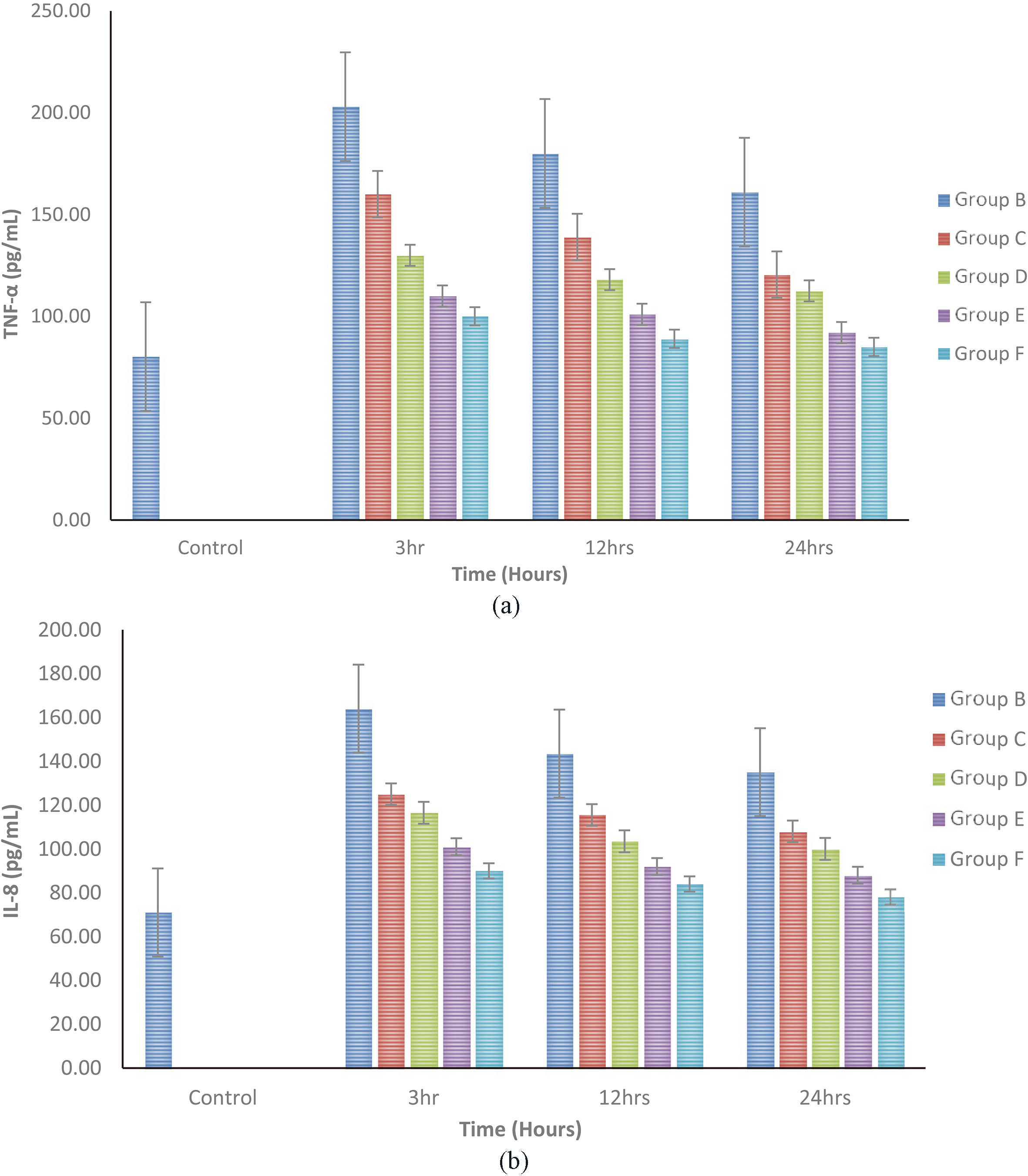
Circulating levels of TNF-
Discussion
Phytochemicals are naturally occurring chemicals in plants, leaves, vegetables and roots that have defense mechanism and help protect from various diseases. The phytochemical analyses of the aqueous P. amboinicus leaf extract revealed the presence of phenol, tannin, reducing sugar, flavonoid and saponin. This result is consistent with the findings of Chiu and colleagues [49] where P. amboinicus was shown to contain cavacrol and other metabolites relating their presence to the inactivation of the iNOS and COX-2 subsequently inhibiting expression of the inflammatory mediators. Several previous studies using various in-vitro and in-vivo experimental procedures have revealed flavonoids; tannin, triterpenoids and other secondary plant metabolites to possess analgesic and anti-inflammatory properties using different models having relevance to human diseases [3, 17]. The reversal of the haematological dyscrasias in the P. amboinicus treated groups suggests that these phytochemicals have the ability to facilitate the endotoxin clearance from the system. Evidence shows a great number of medicinal plants contain chemical compounds exhibiting antioxidant, anti-inflammatory and anticancer properties [7].
A protracted infection or chronic inflammation contributes significantly to dysfunctional haemopoiesis. Consistent with the results from previous studies, LPS treatment in this study compromised haematological indices at multiple levels, including decreased total white blood cells, neutrophils and monocytes enumeration compared to the control group on a time dependent dosage (Table 3a–c) [34]. Liu and colleagues [46] also observed a decrease in monocyte counts where they discovered LPS to inhibit cell viability of monocytes in a significant way. The decrease in the number of white blood cells in the peripheral circulation of the LPS treated rats is possibly due to the rapid migration of neutrophils and macrophages from the peripheral blood circulation to the sites of infection and affected damaged tissues under the effect of chemotactic factors as produced by the humeral response upon LPS injection as previously reported in other studies [18, 21, 32]. This derangement of the haematological indices and decreased total white blood cell counts can be attributed to the destruction of the red blood cells precedent upon LPS-induced systemic inflammation resulting in anaemia of chronic diseases in line with previous reports on LPS-treated animal models by other researchers [34]. However, our findings revealed a significant improvement in both white blood cells count and peripheral neutrophil and monocyte enumerations in the Plectranthus amboinicus co-treated rats even at a dosage of 100 mg/kg at 3 h. This effect may be activity of the P. amboinicus extract as previously been reported [25, 45].
Alkaline phosphatase, AST and ALT are most commonly employed indicators of liver damage or failure. Both AST and ALT are found in high concentrations in the liver and released from hepatocytes in response to increased membrane permeability and toxic exposures. The ALP is mostly used as an index of liver function with an elevated level associated with liver damages while many chemical carcinogens have also been shown to upregulate its activity in the serum [28, 33, 37]. Our data confirmed a highly significant increase in the serum activities of ALP, AST and ALT among the LPS-treated rats compared to that of negative control (Table 4); an index of liver damage possibly due to the endotoxaemic effect of LPS. Treatment with P. amboinicus modulated the changes produced by LPS-toxicity by significantly decreasing these hepatic enzyme activities. Additionally, alterations in serum constituents derived from the kidney were seen in the LPS-treated rats indicated by the significant increase in the levels of serum urea and creatinine compared to control which could occur as a result of any one of the several tissue morphological changes. The presence of these renal biomarkers in the blood stream is probably the most accurate reflection of tissue damage and determination of these markers in the blood is amongst the important study tools of nephrotoxicity. These alterations were however reversed by treatment with P. amboinicus leading to decrease in the elevated urea and creatinine levels as seen in extract co-treatment groups compared to LPS-treated rats [6]. This implies that P. amboinicus not only combats the pro-inflammatory cytokines and macrophage infiltration, but also ameliorates liver and kidney functions [19, 39].
In this study, LPS caused a highly significant increase in the circulating expression of TNF-
Conclusion
This study, therefore, shows that the aqueous extract of P. amboinicus demonstrated significant anti-inflammatory, hepato- and renal-protective activities against circulating LPS-induced endotoxins and possible exacerbation of macrophage infiltration into the tissues, thereby abating the associated inflammatory conditions in addition to its anti-inflammatory and antioxidant properties. Further study is however needed in some more inflammatory and oxidative experimental models to elucidate the exact molecular and biochemical mechanisms involved to establish the extract’s therapeutic role most especially as a chemo-preventive and anticancer agent.
Footnotes
Acknowledgments
The authors thank the authority of ABUAD; Ekiti State, Nigeria, for providing some of the facilities used in these studies. The Botany and Pharmacognosy Departments of Obafemi Awolowo University, Ile – Ife are also appreciated for their contributions. The technical assistance provided by the Staff of the Chemistry and Biology Departments, College of Sciences, ABUAD as well as the support of our research assistants is also appreciated.
Conflict of interest
Authors have declared that no competing interests exist.