




Abstract
OBJECTIVE:
The present study investigates the differences in immune function, hemorheological alterations and prognostic evaluation in colorectal cancer (CRC) patients with different traditional Chinese medicine (TCM) syndromes.
METHODS:
A total of 128 patients, diagnosed as stage II and III of CRC, were recruited. They were assigned into three TCM syndromes: deficiency syndrome, excess syndrome, and syndrome of intermingled deficiency and excess, and another 53 healthy individuals were selected as the control. Flow cytometry was used to determine the peripheral blood lymphocyte subsets (the levels of CD
RESULTS:
Compared with healthy individuals, CRC patients with three different syndromes had lower levels of CD
CONCLUSIONS:
Taken together, we conclude that patients with TCM deficiency syndrome has lower immune function and poorer prognosis while patients with TCM excess syndrome has higher immune function and better prognosis of CRC.
Keywords
Introduction
Colorectal cancer (CRC) is one of the leading malignancies influencing the digestive system, which is also the fourth reason for cancer-associated death with high incidence and high mortality in male and female of China [1, 2]. It is attributable to a great number of factors, such as genetics, lifestyle and environment, but in most cases, CRC is a non-hereditary disease that mainly results from somatic mutations in response to environmental factors [3]. Screening is likely to decrease the incidence rate of CRC with the help of promising tools for screening, such as virtual colonoscopy, colon capsule endoscopy and molecular stool and blood tests [4]. Moreover, the lymph node metastases, tumor differentiation, distant metastases, and tumor stage have been thought as prognostic and clinical factors of CRC [5]. CRC is the most common cancer of gastrointestinal cancer, and surgical resection seems to be the only curative choice for patients with gastrointestinal cancer, whereas the most of patients are diagnosed in advanced stages when the surgery is unavailable and may lead to a poor prognosis [6].
In recent years, traditional Chinese medicine (TCM) has been widely used as a therapeutic target for preventing and treating CRC [7]. TCM believes that all diseases lie in imbalance of people’s body and syndrome plays an important role in TCM due to all the therapies and formulas are determined on the basis of the patients’ syndrome condition [8]. In order to handle invading microorganisms, the innate immune system triggers inflammatory and antimicrobial reactions to protect body [9]. The immune function damage is in connection with the occurrence, metastasis, and prognosis of cancer [10]. Lymphocytes are central components of the immune system and lymphocyte subsets have produced a vital effect in the pathogenesis of CRC [11, 12]. Comparative hemorheology means that comparative variation is collected from blood composition and blood flow traits, moreover, comparative study may help understand variety of medical concepts and raise a new approach to medicine [13]. Over time there has been little emphasis given to study the combination of immune function, comparative hemorheology and TCM syndromes, and therefore, the objective of this study is to evaluate the role of different TCM syndromes in the diagnosis and prognosis of CRC.
Materials and methods
Ethics statement
The study was carried out with the approval of the Ethics Committee of the First Affiliated Hospital of Anhui Medical University. All participates were recruited by random selection and written informed consent was obtained prior to our study.
Study subjects
From June 2012 to January 2014, a total of 128 patients with CRC underwent colonoscopy and pathology in the Department of Gastrointestinal Surgery of the First Affiliated Hospital of Anhui Medical University were selected as the case group, including 65 cases of colon cancer and 63 cases of rectal cancer. The patients consisted of 79 males and 49 females with a mean age of 53.93
Measurement of immune function
The immune function of three kinds of TCM syndromes in patients with CRC (deficiency syndrome, excess syndrome, syndrome of intermingled deficiency and excess,
Determination of hemorheological alterations
Venous blood was extracted from normal subjects and CRC patients with three different syndromes, each for 3 ml. Whole blood viscosity (WBV) at high (200 s
Data collection and follow-up
Clinical data were collected from outpatient electronic medical records. The general data like gender, age, surgical approach, perioperative blood transfusion volume, pathological type, tumor location, tumor node metastasis (TNM) stage, liver metastasis, and TCM treatment time were recorded in detail on the day of admission. Follow-up continued to the third year after surgery and the follow-up rate was 100%. Time for recurrence or metastasis was a period that started from the time of radical operation to the time of recurrence or metastasis. TCM treatment time was calculated during the first time to take TCM after radical operation to the time before metastasis or recurrence. Follow-up records of patients contains tumor marker, stool routine and occult blood, abdominal ultrasound, computed tomography (CT)/magnetic resonance image (MRI) examination records and the four diagnostic information when reexamination. The last follow-up was conducted by outpatient or telephone, and the deadline was January 2017.
Statistical analysis
The data were analyzed statistically using SPSS 19.0 software (IBM Corp Armonk, NY, USA), and measurement data were presented by mean
Results
Baseline characteristics in healthy individuals and patients with deficiency syndrome, excess syndrome and intermingled deficiency and excess
As shown in Table 1, patients with three kinds of syndromes have no significant difference in gender or age when compared with healthy individuals (all
Comparison of baseline characteristics in healthy individuals and patients with deficiency syndrome, excess syndrome and intermingled deficiency and excess
Comparison of baseline characteristics in healthy individuals and patients with deficiency syndrome, excess syndrome and intermingled deficiency and excess
The results in Table 2 indicated that compared with healthy individuals, CRC patients with three different syndromes had low levels of CD
Changes of hemorheological alterations in healthy individuals and patients with deficiency syndrome, excess syndrome and intermingled deficiency and excess
The findings in Table 3 demonstrated that in comparison to healthy individuals, patients with CRC had significant higher WBV, PV, Hct, ESR and PFC (all
Comparison of T lymphocyte subsets and NK cells in peripheral blood in healthy individuals and patients with deficiency syndrome, excess syndrome and intermingled deficiency and excess
Comparison of T lymphocyte subsets and NK cells in peripheral blood in healthy individuals and patients with deficiency syndrome, excess syndrome and intermingled deficiency and excess
Notes:
Comparison of hemorheological alterations in healthy individuals and patients with deficiency syndrome, excess syndrome and intermingled deficiency and excess
Notes:
patients with deficiency syndrome, which were lower than those patients with excess syndrome (all
According to the KPS results in Table 4, there were 29 patients with CRC had a score of 90 accounted for 22.66% of the total cases, 68 patients had a score of 80 accounted for 53.13% of the total cases, and 31 patients had a score less than or equal to 70 accounted for 24.22% of the total cases. Among patients whose KPS
KPS for CRC patients with deficiency syndrome, excess syndrome and syndromes of intermingled deficiency and excess
KPS for CRC patients with deficiency syndrome, excess syndrome and syndromes of intermingled deficiency and excess
Notes: KPS, Karnofsky Performance Scores; CRC, colorectal cancer.
The clinicopathological features of CRC patients with different TCM syndromes were analyzed by univariate analysis (Table 5). The prognostic indicators included gender, age, surgical approach, perioperative blood transfusion volume, pathological type, tumor location, TNM stage, liver metastasis, and TCM treatment time. Among these, there was no significant difference in the prognosis of CRC between female and male patients, patients over 55 years and under 55 years, or patients with colon cancer and patients with rectal cancer (all
The univariate analysis of prognosis in CRC patients with different TCM syndromes
The univariate analysis of prognosis in CRC patients with different TCM syndromes
Notes: TCM, traditional Chinese medicine; CRC, colorectal cancer; TNM, tumor node metastasis.
Survival curves of univariate analysis in patients with different TCM syndromes. Notes: A, survival curves of CRC patients with different pathological types; B, survival curves of CRC patients in different TNM stages; C, survival curves of CRC patients with different perioperative blood transfusion volume; D, survival curves of CRC patients with or without liver metastasis; E, survival curves of CRC patients with different surgical approach; F, survival curves of CRC patients having different TCM treatment time; G, survival curves of CRC patients with different TCM syndromes; H, the total survival curves of 128 CRC patients; TCM, traditional Chinese medicine; TNM, tumor node metastasis; CRC, colorectal cancer.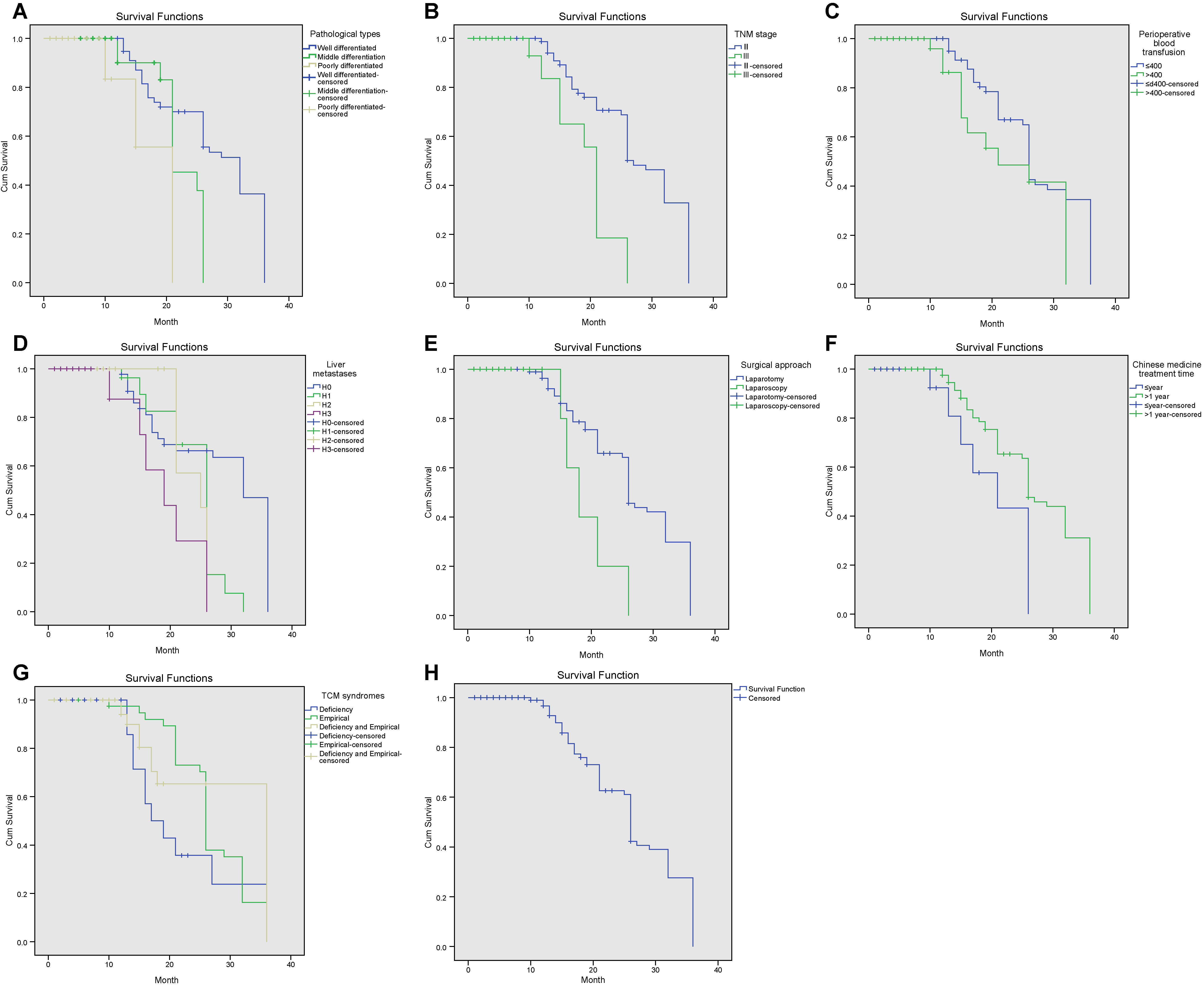
Cox regression analysis was carried out using the prognostic factors of CRC patients with different TCM syndromes analyzed by univariate analysis. The factors affecting the prognosis of CRC were used as the independent variables and the prognostic survival time as dependent variable. As shown in Table 6, the pathological type, liver metastasis, TNM stage, TCM treatment time, surgical approach and different TCM syndromes were independent factors affecting the prognosis of CRC (all
Cox regression analysis of prognosis in CRC patients with different TCM syndromes
Cox regression analysis of prognosis in CRC patients with different TCM syndromes
Notes: TCM, traditional Chinese medicine; CRC, colorectal cancer; CI, confidence interval; TNM, tumor node metastasis.
CRC is a common malignant disease with morbidity and mortality that accounts for 600,000 deaths around the world every year [4]. At present, the survival rate of CRC patients diagnosed at early-stage has been increased greatly, which is owing to the application of several CRC screening tests, but the prognosis of CPC patients at late-stage remains poor [14]. We conducted this study to determine the relationship of different TCM syndromes with the immune function, hemorheological alterations and prognosis of patients with CRC, and found that patients with deficiency syndrome had lower immune function and poorer prognosis than patients with excess syndrome. Patients with the syndromes of intermingled deficiency and excess had proper prognosis. Moreover, our findings suggest that increasing TCM treatment time can improve the prognosis and survival rate of CRC patients.
Initially, a significant result of the present study was that patients with different syndromes had lower levels of lymphocyte subsets than healthy individuals, and the patients with excess syndrome had the highest levels of CD
Another important finding of this study was that blood of CRC patients was in a hypercoagulable state, as patients with CRC had significant higher WBV, PV, Hct, ESR and PFC. Consistently, it has been reported that elevated haemorheological parameters (WBV, PV, Hct, ESR and PFC) are found in sickle cell anaemia patients in vaso-occulussive crisis [18]. The observation results are in accordance with the previous studies that activated coagulation is related with cancer formation and metastasis of different types; particularly, intravascular coagulation can be regarded as clinical biomarker for the diagnosis and prognosis of CRC patients [19, 20]. A review concluded that the hypercoagulable state was associated with CRC from three aspects, and the hypercoagulable conditions played an important role, because venous thrombocytosis, hyperfibrinogenemia or D-dimer enhancement are closely related to clinical progression and poor prognosis of cancer patients [21]. In addition, a former study explained that malignancy and the hemostatic system are interrelated, and there is an interaction between hemostasis and cancer biology [22]. From aforementioned, we can hypothesize that hypercoagulable state and hemorheological alterations can be used as viable biomarkers in the development of CRC.
Our study also suggested that the pathological type, liver metastasis, TNM stage, TCM treatment time, surgical approach and different TCM syndromes were independent factors influencing CRC prognosis, and that prolonging TCM treatment time improved the prognosis and survival rate of CRC patients. The data implied that TCM treatment is feasible to patients with CRC. As it is known to all, TCM has been applied for health care in China for centuries, which has been used to prevent, treat and cure disorders or diseases [23]. It has been previously shown that TCM has been widely applied in additional therapy for CRC; meanwhile, it has significant efficacy with regard to improvement of quality of life and survival rate [24]. Likewise, Chinese medicine is able to prolong survival rate in CRC patients with stage II and III [25]. Furthermore, a previous study suggested that TCM syndrome differentiation and treatment have significant influence on enhancing the prognosis of elderly CRC patients in stage II or III [7]. Based on these findings, a combination of TCM treatment method could provide a novel therapeutic target of CRC patients [26].
Taken together, we concluded that patients with TCM excess syndrome had higher immune function and better prognosis than patients with deficiency syndrome or with the syndrome of intermingled deficiency and excess, and TCM treatment time was an independent factor of CRC and enhancement of it was correlated to the prognosis of CRC. However, it should be noted that this study has examined only by small scale, therefore, further studies are needed to confirm our results.
Footnotes
Acknowledgments
This work was supported by the National Nature Science Foundation of China (Grant No. 81573942). We would like to give our sincere appreciation to the reviewers for their helpful comments on this article.
Conflict of interest
The authors have declared that no competing interests exist.