




Abstract
BACKGROUND:
Breast cancer is a common cancer in women of worldwide. Cancer cells with stem-like properties played important roles in breast cancer, such as relapse, metastasis and treatment resistance. Micro-RNA-155 (miR-155) is a well-known oncogenic miRNA overexpressed in many human cancers.
METHODS:
The expression levels of miR-155 in 38 pairs of cancer tissues and adjacent normal tissues from breast cancer patients were detected using quantitative real-time PCR. The invasive cell line MDA-MB-231 was used to quantify the expression of miR-155 by tumor-sphere forming experiment. Soft agar colony formation assay and tumor xenografts was used to explore whether the inhibition of miR-155 could reduce proliferation of cancer cells in vivo and vitro.
RESULTS:
In the study, we found miR-155 was upregulated in BC. Soft agar colony formation assay and tumor xenografts showed inhibition of miR-155 could significantly reduce proliferation of cancer cells in vivo and vitro, which confirmed that miR-155 is an effective therapeutic target of breast cancer. Sphere-forming experiment showed that overexpression of miR-155 significantly correlated with stem-like properties. Expressions of ABCG2, CD44 and CD90 were repressed by inhibition of miR-155, but CD24 was promoted. Interestingly, inhibition of miR-155 rendered MDA-MB-231 cells more sensitive to Doxorubicinol, which resulted in an increase of inhibition rate from 20.23% to 68.72%. Expression of miR-155 not only was a therapeutic target but also was associated with cancer stem cell formation and Doxorubicinol sensitivity.
CONCLUSIONS:
Our results underscore the importance of miR-155 as a therapeutic target and combination of Doxorubicinol and miR-155-silencing would be a potential way to cure breast cancer.
Introduction
Breast cancer is the most frequent cancer among women of worldwide [1, 2]. Although survival rate of breast cancer is higher than many other cancers, especially in developed countries, it also shows high risks of relapse, metastasis and resistance of traditional chemotherapy [3, 4, 5]. Occurrence of resistant cancer cells is the main reason for relapse and mortality. Analyses of breast cancers initially showed that cancer stem cells (CSCs) existed in solid tumors. CSCs are cancer cells which possess stem cell properties and have ability to invade and metastasize [6]. More and more data show that cancer stem cells act as the resistant role by influencing tumor initiation, proliferation, relapse and metastasis [7, 8, 9].
MicroRNAs (miRNAs), which could regulate the expression of target genes at post-transcriptional level, are involved in several important biological processes, such as cell proliferation, differentiation and apoptosis [10]. Recently, the emerging functional role of miRNAs is suggested to be oncogenes or tumor suppressors in tumorigenesis [11]. So far, many therapies undergoing clinical trials have been developed based on breast cancer molecular profiles, such as microRNAs (small non-coding RNA, miRNAs). Because of the relationship between the aberrant expressions of miRNA and cancer stem cell dysregulation, microRNAs, are acted as promising therapy targets [12, 13]. MiRNA-based molecular cancer therapy not only can eliminate cancer cells with stem cell properties but also reduce the resistance of current chemotherapy. Recent evidence manifests that microRNA-silencing may be an efficient therapy for cancer, which confirms the significant role of microRNA in cancers [14].
The miR-155 gene was firstly characterized in B-cell lymphomas, and was called BIC [13]. Overexpression of miR-155 is commonly related with human cancers, such as breast cancers, lung cancers and other solid malignancies [15, 16]. In 2016, Zhang et al. [17] indicated that miR-155 promoted tumor growth of HCC by targeting ARID2-mediated Akt phosphorylation pathway, and potentially served as a novel prognostic biomarker and therapeutic target for HCC. In 2016, Zeng et al. [18] suggested that miR-155 played a tumor-promoting role in OSCC by regulating the BCL6/cyclin D2 axis. Based on these researches, we thought that miR-155 not only is an important tool to diagnose tumors but also a potential therapy target [19].
In this study, we investigated the gene expression of miR-155 in BC patients and the serum. Then MDA-MB-231 was used to quantify the expression of miR-155 in the process of cancer stem cells formation. Our data showed that inhibition of miR-155, not only prevented the formation of cancer stem cells, but also enhanced the sensitivity of breast cancer cells to Doxorubicinol. In conclusion, the aim of the present study was to show that miR-155 would be a potential therapy target to cure breast cancer.
Materials and methods
Samples
We recruited 38 patients with breast cancer and adjacent normal tissues who underwent surgery without preoperative chemotherapy or radiotherapy in Zhongnan Hospital of Wuhan University, Wuhan, China. Tumor specimens and corresponding adjacent non-tumor tissues were stored in
Tissue and serum specimens, and the use of these clinical materials were collected after obtaining the informed consent of patients in accordance with institutional ethical guidelines, which all approved by the Ethics Committee of Zhongnan Hospital of Wuhan University (Wuhan, China).
Cell cultures
The human breast cancer cell line MDA-MB-231 was obtained from Cell Bank of Shanghai Institute of Cell Biology (Shanghai, China) and was cultured with Royal Park Memorial Institute-1640RPMI-1640media supplemented with 10% Fetal Calf Serum (FBS), penicillin (100 U/ml) and streptomycin (100
Has-miR-155 inhibitor transfection
Logarithmic growth phase cells, treated with 0.25% trypsin (Invitrogen, Carlsbad, CA, USA), were collected by centrifuge. Cells were seeded into 24-well plates (Corning, Lowell, MA, USA) grown overnight and reached 40–50% confluence before transfection. miR-155 inhibitors (GenePharma, Shanghai, China) were transfected into MDA-MB-231 cells at a final concentration of 50
Soft agar colony formation assay
1.2% and 0.7% agar were sterilized and kept warm in 42
Tumor sphere formation assay
Logarithmic growth phase cells were washed to remove serum and cultured with serum-free DMED/F12 media supplemented with 20 ng/ml hrEGF (Sigma-Aldrich), 10 ng/ml hrFGF (Sigma-Aldrich), 4
Real-time quantitative PCR
RNA of the samples and cells were isolated by miRNeasy mini kit (Qiagen, Beijing, China). The synthesis of the first-strand cDNA was performed with Reverse Transcriptase Kit (Takara, Dalian, China). Reaction mixtures contained 7 pmol of random primers (Takara, Dalian, China) and 50 ng of RNA in a total volume of 10
Primers used for real-time quantitative PCR
Primers used for real-time quantitative PCR
The Ct is the PCR cycle at which the fluorescent signal of the sample passes the fixed threshold and was calculated by SDS 2.1. The 2
[4, 5-dimethylthiazol-2-yl]-2, 5 diphenyltetrazolium bromides (MTT, Sigma-Aldrich) endpoint is a useful tool in predicting chemosensitivity [22]. Transfected and untransfected MDA-MB-231 cells were cultured with RPMI-1640 media supplemented with 0.3
MiR-155 expression is upregulated in BC tissues and serum. MiR-155 expression in BC tissues and serum. The relative miR-155 expression was determined using RT-qPCR. (A) MiR-155 levels in tumor tissues were significantly higher than in nontumor tissues. (B) The expression of miR-155 was much higher in BC serum than the normal. (C) The biomarker levels were higher than that in normal tissues. 
BALB/c nude mice, 6–8 weeks old, cared for in accordance with institutional guidelines, were used. Tumors produced by MBA-MD-231. MBA-MD-231 Cell or MBA-MD-231 transfected with miR-155 inhibitor were injected subcutaneously in the right flank of nude mice per mouse respectively (
Statistical analysis
Statistical analysis software (SPSS, version 19.0) was used to perform the analysis [21]. All data were presented as means and standard deviations (M
Association of miR-155 expression with clinical parameters in breast cancer
Association of miR-155 expression with clinical parameters in breast cancer
Abbreviation: Data are mean
Soft agar colony formation assay. Colonies were observed under microscopy (A) and the number of colonies was counted (B) after incubation for 3 weeks (
MiR-155 expression is upregulated in breast cancer tissues and serum
The relative expression levels of miR-155 were assessed by RT-qPCR. In 38 breast cancer and adjacent normal tissues, miR-155 levels in tumor tissues were significantly upregulated than in non-tumor tissues (
Correlation between MiR-155 and clinic variables
We detected the correlation between miR-155 and clinical parameters. As shown in Table 2, the levels of miR-155 expression were significantly correlated with tumor size, metastasis, ER, PR and Her2 (
MiR-155 acted as therapeutic target for breast cancer in vitro and vivo
MiR-155 was reported as diagnostic target for breast cancer [16]. The levels of miR-155 were significantly higher in breast cancer patients compared to healthy controls. Overexpression of miR-155 in breast cancer cell implicated that miR-155 may be a therapeutic target, so we decided to detect whether inhibition of miR-155 affected breast cancer cells in vitro and vivo. Soft agar colony formation assay is the most commonly used in vitro assay to detect anchorage-independent growth, which is the hallmark of cancer cells. To identify the affection of miR-155 inhibition, miR-155 inhibitor was transfected into MDA-MB-231, an invasive human breast carcinoma cell line. MDA-MB-231 with inhibitor showed fewer colonies than MDA-MB-231 without inhibitor (Fig. 2A). MiR-155 inhibitor significantly repressed anchorage-independent growth of breast cancer cells (
Inhibition of tumorigenicity in vivo by miR-155 inhibitor. (A) Photographs of tumor of MBA-MD-231 with and without inhibitor; (B) Tumor volume of MBA-MD-231 with and without inhibitor (
To determine whether miR-155 regulated tumor growth in vivo, we used tumor xenografts by inoculating MDA-MB-231 cells with and without inhibitor in nude mice. The volume of tumors in nude mice containing cells with inhibitor was observed at 12 days and it was smaller than nude mice without inhibitor. At the end of the observation (21 days), the average volume (1.13
Breast Cancer sphere formation. (A) MDA-MB-231 human breast cancer cells with properties of stem cell can form spheres; (B) The expression of miR-155 was increased with growth of sphere (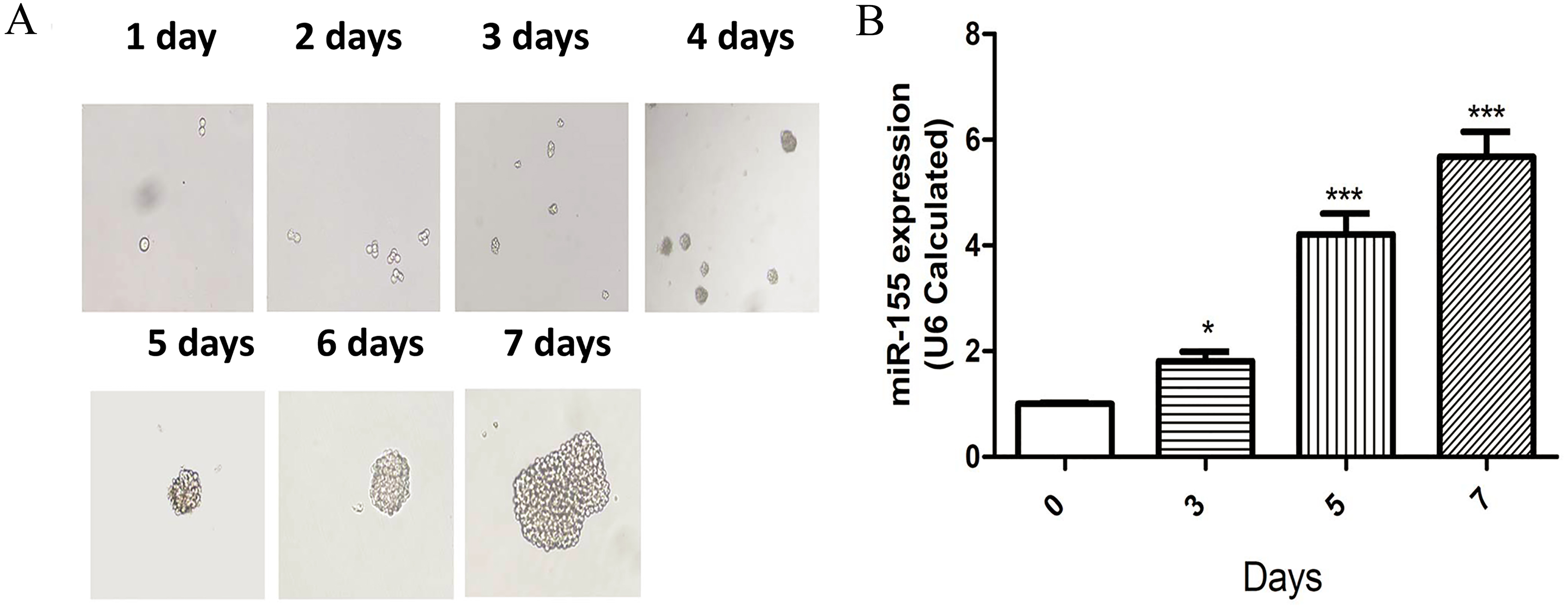
Effects of miR-155 inhibitor on breast Cancer sphere formation. (A) Microphotographs of tumorspheres of MBA-MD-231 with and without inhibitor (100 
Solid tumor containing cancer stem cells was firstly reported in 2003 [6]. One feature of cancer stem cells is capable of sphere-forming in serum free medium containing growth factors. MDA-MB-231 displayed CSC-like characteristics (Fig. 4A). The transcription profiles of miR-155 were analyzed during sphere formation. Total RNAs were isolated from cultures of MDA-MB-231 at 1, 3, 5 and 7 days. The expression of miR-155 was increased with growth of sphere, which showed the relationship between expression of miR-155 and cancer stem cell formation (Fig. 4B). Interestingly, miR-155 inhibitor in MDA-MB-231 significantly reduced cell colony foci (Fig. 5). These results showed that miR-155 promoted the anchorage-independent growth of breast cancer cells in vitro.
Expression of several biomarkers of CSCs
The existence of cancer cells with stem-like properties could be detected by expression of markers, such as CD44, CD90 and CD24 [23]. CD44 and CD24 are surface proteins and involved in cell adhesion and metastasis [24, 25]. CD90, a glycoprotein, is involved in cell-cell and cell-matrix interactions [26]. ABCG2, a breast cancer resistant protein, is a member of the ATP-binding cassette transporter family [27]. Compared to monolayer cells, three genes (CD44, CD90 and ABCG2) were upregulated in sphere-forming cells. After the breast cancer cells transfected by miR-155 inhibitor, above three genes were downregulated in transfected breast cancer cells. Expression of CD24 in monolayer cells was higher than CD24 expression in sphere-forming cells. After inhibition of miR-155, expression of CD24 was enhanced. CD44+/CD24-/low was a significant feature of human breast “cancer stem cells”, which confirmed the relationship between miR-155 and CSCs (Fig. 6).
Effects of miR-155 inhibitor on biomarkers of breast cancer stem cells. ABCG2 is a breast cancer resistant protein; CD90 is a glycoprotein; CD44 and CD24 are surface proteins; MBA-MD-231 C: MBA-MD-231 monolayer cells; MBA-MD-231 sphere: tumor-sphere of MBA-MD-231 without inhibitor; MBA-MD-231 sphere+has-miR-155 inhibitor: tumor-sphere of MBA-MD-231 with inhibitor (
Effects of Doxorubicinol on MBA-MD-231 with and without inhibitor. Inhibition of miR-155 rendered MDA-MB-231 cells more sensitive to Doxorubicinol (
Chemotherapy is a category of cancer treatment which uses chemical compounds with anti-cancer activity, such as Doxorubicin (DOX). Doxorubicin, a member of anthracycline family, can induce cell apoptosis by intercalating DNA [28]. Cancer cells with stem cell properties have mechanisms which make them relatively resistant to chemotherapy. In order to identify whether resistance of MDA-MB-231 was affected by inhibition of miR-155, transfected and untransfected MDA-MB-231 cells were treated by Doxorubicin. Inhibition rate of untransfected cells was only 20.23%. After miR-155 inhibitor was transfected into the MDA-MB-231 cells, inhibition rate was increased up to 68.72%. Inhibition of miR-155 can significantly enhance the chemosensitivity of cancer cells to Doxorubicin (Fig. 7).
Discussion
Breast cancer is one of the most commonly diagnosed cancers, especially in women of worldwide, accounting for 25% of all cases [1]. Cancer cells with stem-like properties played an important role in high risks of breast cancer [29]. Targeting cancer stemness is a novel approach to develop the next generation of cancer therapeutics to suppress cancer relapse, treatment resistance and metastasis. MiRNAs have been considered to be important roles in cancer stem cell function, because expressions of miRNAs in CSCs are different from other normal tissues. and miRNAs may have a unique role in CSCs regulation [30].
The miR-155 gene, a member of micro-RNAs, was firstly characterized in B-cell lymphomas and assumed to be associated with oncogenesis. MiR-155 usually was used as a biomarker in diagnosis [31]. Soft agar colony formation assay and tumor xenografts showed inhibition of miR-155 could significantly reduce proliferation of cancer cells in vivo and vitro. These results implied that miR-155 was act as on oncomiR and could be used as therapeutic target of breast cancer.
The expression of miR-155 was upregulated in BC tissues and serum. Meanwhile, breast cancer cells with stem-like properties were the first to be reported and well clarified. Accumulation of miR-155 was accordance to sphere formation showed miR-155 correlated with CSCs. Expression of biomarkers of CSCs confirmed the stem-like properties of sphere-forming cells. As expected, inhibition of miR-155 could inhibit sphere formation and reduce the expression of biomarkers of CSCs.
Drug resistance phenotype is a critical hurdle for chemotherapy [32]. Interestingly, inhibition of miR-155 not only reduced cancer cells with stem-like properties but also significantly enhanced chemosensitivity of cancer cells. ABC drug transporters play the main and direct role in chemoresistance, because they can export cytotoxic drugs from cancer cells. Compared with monolayer cells, ABCG2, an ABC transporter, were upregulated in sphere-forming cells. On the contrary, expression of ABCG2 was inhibited by miR-155 inhibitor. MDA-MB-231 without miR-155 inhibitor can extrude more DOX than cells with inhibitor and showed higher resistance. DOX killed cancer cells by intercalating DNA [28]. Cancer cells with stem-like properties have proficient DNA repair machinery, so proportion of CSCs in tumor is related with chemoresistance. Inhibition of miR-155 reduced the proportion of CSCs and also enhanced chemosensitivity of cancer cells indirectly.
Recently, a number of evidence showed that miR-155 might be a novel target for cancers. In 2016, Chakraborty et al. [33] indicated that miR-155 as a controlling target for various protein cascades of mitogen-activated protein kinase (MAPK) signaling pathway. Mignacca et al. [34] thought that miR-155 could regulate the tumor suppressor axis composed by the STAT5 target gene SOCS1 (suppressor of cytokine signaling-1) and its downstream effector p53. In ovarian cancer, Chen et al. [35] suggested that miR-155 could mediates cisplatin-induced apoptosis by targeting XIAP in ovarian cancer cells and be a potential therapeutic target to increase the efficiency of ovarian cancer interventions. From these researches, we can know that miR-155 played an important roles in the development of cancers, and could be a potential target for cancers. Meanwhile, in our study, we have revealed that miR-155 might be considered as a therapy target in breast cancer.
In the present study, miR-155 expression was increased in BC and thus thought to be an oncogene, which is in consistent with most of the previous findings. However, there are also some studies proved a tumor suppress profile of miR-155 in BC. For example, Jang et al. [36] showed that high level of miR-155 expression was associated with better DMFS distant metastasis-free survival and was correlated inversely with the expression of several EMT markers including SMA, osteonectin and CD146 in Triple-negative breast cancer (TNBC), He et al. demonstrated that [37] miR-155 inhibits ErbB2-induced malignant transformation of human breast epithelial cells. In our study, the expression of miR-155 was evaluated in all BC rather than one of the types and in MDA-MB-231 cell lines, whereas in Jang’s study, the expression of miR-155 was tested only in TNBC patients. The contradictory results may be caused by the different profile of the samples and hormone receptor status. In the future, biomarkers like vimentin or cadherins proteins related to EMT process will be done both in ER+/ER- cell lines, and a large number of patients will be included in our study to comprehensively clarify the role of miR-155 in BC.
In conclusion, we have unveiled that miR-155 was upregulated in BC and the effects of overexpression of miR-155 on cancer stem cell formation and chemoresistance in breast cancer. Meanwhile, combination of miR-155 inhibitor and DOX would be a potential way to cure breast cancer.
Footnotes
Acknowledgments
This study was supported by the National Basic Research Program of China (973 Program) (2012CB 720605).
Conflict of interest
The authors have declared that no conflict of interest.