




Abstract
BACKGROUND:
Aplysia ras homology member I/ARHI is known as ovarian cancer suppressor gene and potential inhibitor of signal transducer and activator of transcription 3/STAT3 signaling. Resveratrol suppresses growth and STAT3 activation of ovarian cancer cells, while its influence in ARHI expression remains unknown.
OBJECTIVE:
The current study aims to elucidate the status of ARHI expression and its relevance with growth suppression and STAT3 inactivation of resveratrol-treated cells.
METHODS:
ARHI expression patterns of three ovarian cancer cell lines (human CAOV-3, OVCAR-3 and rat NUTU-19) without and with 100
RESULTS:
ARHI is expressed in low levels in three ovarian cancer cell lines, which is upregulated upon resveratrol treatment accompanied with growth arrest, extensive apoptosis, increased autophagic activity and inactivated STAT3 signaling. Specific siRNA transfection efficiently knocked down ARHI expression in resveratrol-treated CAOV-3 and OVCAR-3 cells and increased the total cell number in limited extents (
CONCLUSION:
ARHI upregulation is another molecular event caused by resveratrol and one of the elements related with resveratrol’s anti-ovarian cancer efficacy. Resveratrol may inactivate STAT3 signaling of ovarian cancer cells in ARHI unrelated pattern(s).
Introduction
Ovarian cancer (OC) is the commonest lethal malignancy because of its leading death rates among the gynecologic cancers [1, 2]. Surgery is the first choice to remove OCs if the tumors are well-differentiated, in relative small sizes and/or not widely disseminated [3, 4]. However, the subtle symptoms at the early stages of ovarian carcinogenesis lead to the delayed diagnosis of majority of OC patients (75%) and the difficulties to remove their tumors radically and to prevent cancer dissemination [5]. More accurate staging of the diseases and more aggressive surgical excision of tumor spots in the abdomen have somewhat improved the therapeutic outcome of OC patients, while the overall survival rates remain unoptimistic [6], suggesting the necessity of adjuvant chemotherapy. Nevertheless, drug resistance often occurs among OC patients and severe toxic effects of conventional anti-cancer drugs greatly reduce patients’ life quality [7, 8]. Apparently, more effective and lesser toxic agents with clearer molecular targets are in urgent need for better management of OCs.
Resveratrol (3, 5, 4
A Ras homologue member I (ARHI), a maternally imprinted gene, is frequently down-regulated in OCs [17, 18]. Unlike other ras family members, ARHI has been regarded as a tumor suppressor gene rather than an oncogene, because recovery of its expression causes growth suppression [18] and inactivation of STAT3 signaling [19]. For these reasons, ARHI downregulation is regarded as an unfavourable diagnostic and prognostic factor of OCs [20]. Although both of ARHI and resveratrol are known to exert inhibitory effects on the growth and STAT3 signaling of OC cells, no report has been so far available concerning the influence of resveratrol in ARHI expression in OC cells. The current study thus aims to check the statuses of ARHI expression in OC cell lines, the response of ARHI to resveratrol treatment and its relevance with resveratrol-suppressed STAT3 signaling.
Materials and methods
OC cells and treatment
Human OC CAOV-3 cells [21] were cultured in Dulbecco’s modified Eagle’s essential medium (DMEM) containing 12% fetal bovine serum (Gibco Life Science, Grand Island, NY, USA) under 37
Cell proliferation and death assays
Haematoxylin and eosin (H/E) staining was performed on the cell-bearing coverslips to evaluate the morphological features of the three OC cell lines incubated in different culture conditions. The fractions of viable and unviable cells were estimated with cell counting apparatus (TC20 Automated Cell Counter, BIO RAD) and repeated for three times. Terminal deoxynucleotide transferase (TdT)-mediated dUTP-biotin nick-end labeling (TUNEL) assay was employed to detect apoptotic cells according to producer’s instructions (Promega Corporation, USA). LC3 and Beclin 1 double immunofluorescent/IF staining was conducted to evaluate autophagic activity and F-actin-oriented IF staining was used to assess cell morphology by the methods described elsewhere [15].
Immunocytochemical staining
The coverslips bearing the three OC cell lines without and with resveratrol treatment were subjected to immunohistochemical attaining, using two rabbit anti-human antibodies against ARHI (1:150, Santa Cruz, CA, USA) or mouse anti-human antibody specific for p-STAT3 (1:100, Santa Cruz, CA, USA), respectively. The cell-bearing coverslip lacking incubation with individual primary antibodies were used as background controls. The levels of ARHI and p-STAT3 and the extents of p-STAT3 nuclear translocation were evaluated separately by two investigators, with the intensity of immunolabeling scored as – (negative no staining),
Protein preparation and Western blotting
Total cellular proteins were prepared from the cells under different culture conditions by the method described elsewhere [15]. The sample proteins (50
RNA isolation and RT-PCR
Sample RNAs were isolated from the two human and one rat OC cell lines without and with resveratrol treatment for 48 hours. By the method described elsewhere [15], reverse transcription (RT) was performed on RNA samples, followed by polymerase chain reaction (PCR) with a pair of primers specific for the cDNA of an individual gene (ARHI: Forward primer 5
siRNA transfection and assessment of knockdown efficiency
CAOV-3 and OVCAR-3 cells were selected to elucidate the potential involvement of ARHI in resveratrol-inactivated STAT3 signaling and resveratrol sensitivity by ARHI-specific siRNA transfection by the method described elsewhere [27]. The scrambled oligonucleotides (Mock) were used as negative control of transfection efficiency. Those siRNAs were synthesized by Genepharma Company, Shanghai, China. Briefly, CAOV-3 cells were cultured in 6-well plates to 60% to 70% confluence and then transfected with 0.3 nmol siRNA/well for 3 days using 4 ml X-treme GENE siRNA transfection reagent according to manufacturer’s manual (Roche, Penzberg, Germany). After confirming the efficiency of ARHI inhibition by RT-PCR, the transfectants were incubated in the medium without or with 100
Statistical analyses
Statistical analyses were performed using the software Statistical Product and Service Solutions (SPSS) 17.0. Data were given as the means
Results
Resveratrol caused growth arrest and apoptosis
Distinct morphological alterations (Fig. 1A) with apoptotic phenotypes (insets in Fig. 1A) and reduced proliferation activities (Fig. 1B) can be observed in the three resveratrol-treated human OVCAR-3 and CAOV-3 and rat NUTU-19 OC cells at 48 hour experimental time point. The total cell number counting and the viable/unviable cell fractionation (Fig. 1C) reveals significant growth suppression of all three OC cell lines (
Resveratrol caused growth arrest and extensive cell death of human OVCAR-3, CAOV-3 and rat NUTU-19 OC cells. H/E morphological staining (A; X 40) and MTT cell proliferation assay (B) performed on the three OC cells without and with 100 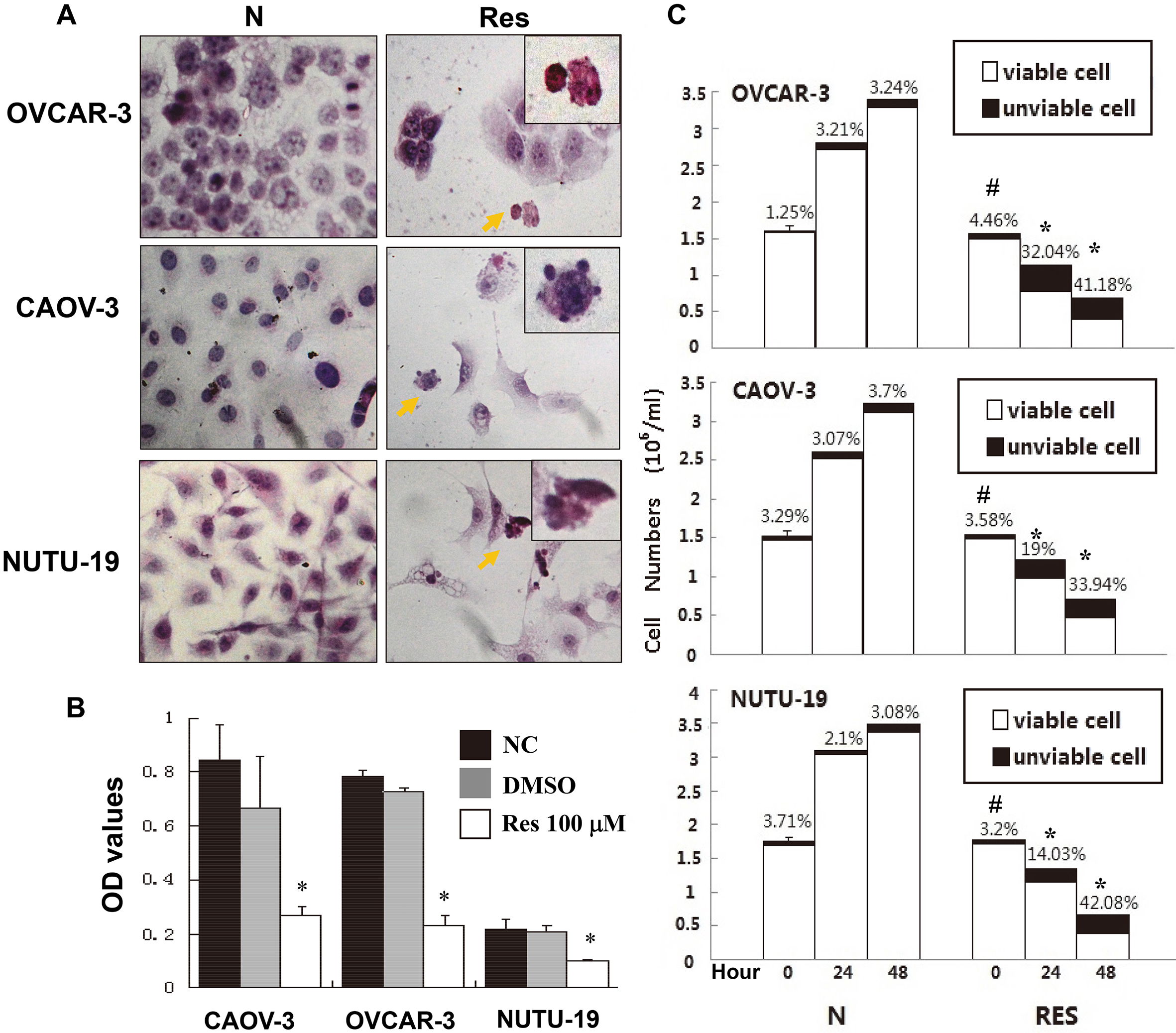
Immunocytochemical staining demonstrates that p-STAT3 is distributed in the cytoplasm and the nuclei of the three OC cell lines, which is remarkably reduced in cytoplasm and rarely translocalized into the nuclei after resveratrol treatment (Fig. 2A). ARHI is expressed in low levels in the normally cultured OC cells and upregulated in resveratrol-treated cells. The results of Western blotting and RT-PCR are in accordance with ICC findings in terms of reduced STAT3 levels and the increased ARHI expression in the three OC cell lines treated by resveratrol (Fig. 2B).
Reversed ARHI and STAT3 expression in OC cells illustrated by immunocytochemical staining (A; X 20), Western blotting and RT-PCR analyses (B). N, normally cultured cells; Res, 100 
H/E staining, total cell number counting and viable:unviable cell fractionation and F-actin immunofluorescent staining reveal that in comparison with the normally cultured CAOV-3 and OVCAR-3 cells, the populations transfected with scrambled oligonucleoti-des/Mock or ARHI-specific siRNA show neither distinct morphological alteration nor increased cell death (Fig. 3A). The results of immunocytochemical staining (Fig. 3B) and RT-PCR (Fig. 3C) demonstrate that after 100
ARHI knockdown in resveratrol-treated CAOV-3 and OVCAR-3 cells by specific siRNA transfection. H/E and F-actin IF staining reveal no distinct morphological alteration and growth inhibition of the two cell lines transfected with ARHI-specific siRNA (A). NC, the normally cultured cells as controls. B. ARHI-oriented immunocytochemical staining performed on both resveratrol-treated and resveratrol-untreated CAOV-3 and OVCAR-3 cells with and without ARHI knockdown and with or without mock treatment. (-), the cells without any transfection; NC, resveratrol-untreated cells; Res, resveratrol-treated cells. C. RT-PCR demonstration of ARHI expression in 100 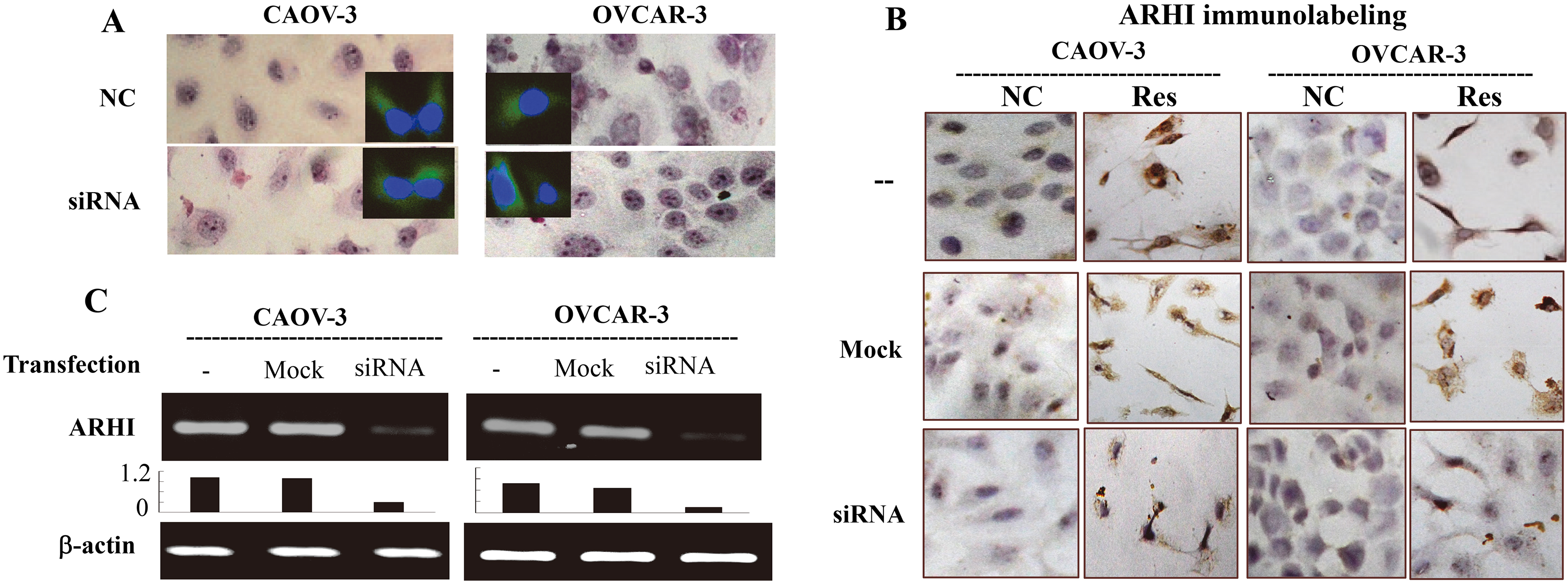
The coverslips bearing ARHI-specific siRNA transfected CAOV-3 and OVCAR-3 cells were treated by 100
Growth arrest and STAT3 inactivation in resveratrol-treated CAOV-3 and OVCAR-3 transfected with ARHI siRNA or mock oligonucleotides. H/E morphological staining, TUNEL apoptosis assay and LC3/Beclin1 double IF labeling (the insets) performed on 48 hour 100 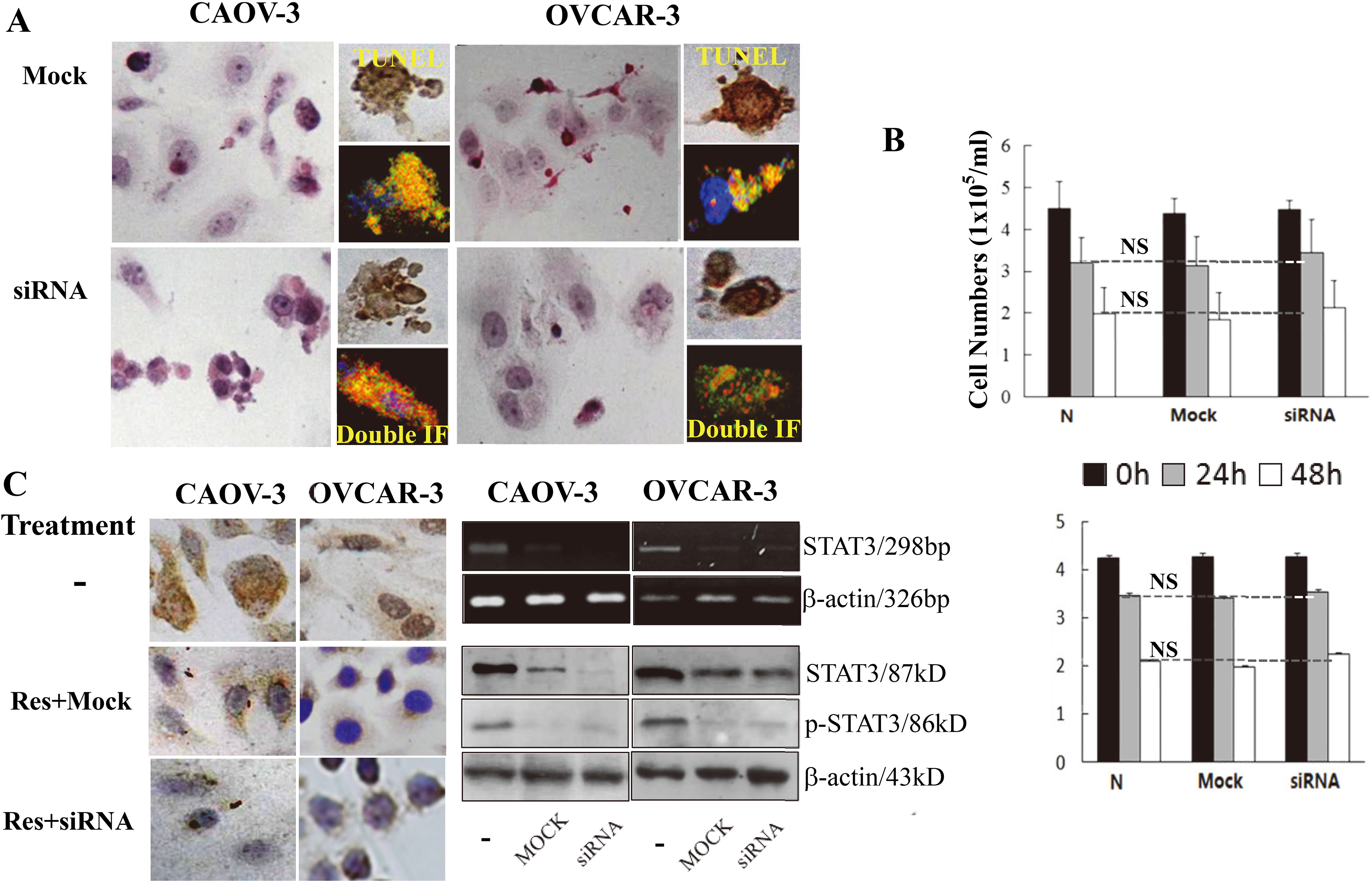
Immunocytochemical staining revealed that, in similar with the findings in CAOV-3 and OVCAR-3 cells without transfection or transfected with the mock oligonucleotide, distinct reduction of cytosolic and nuclear p-STAT3 labeling was observed in resveratrol-treated ARHI siRNA transfected cells (Fig. 4C). In accordance, RT-PCR and Western blot analyses show resveratrol-downregulated STAT3 expression and p-STAT3 generation in CAOV-3 and OVCAR-3 cells irrespective to the statuses of ARHI expression. The normally cultured cells were cited as positive control of activated STAT3 signaling.
Discussion
Ovarian cancer is a common female malignancy with very poor prognosis. A body of molecular alterations has been found in OCs, of which activated STAT3 signaling and ARHI downregulation are known as the critical events [16, 28, 29, 30]. STAT3 activation is frequently found in OCs and its inhibition leads to growth arrest and apoptosis [15]. On the other hand, ARHI (A Ras homologue member I) is considered as tumor suppressor gene, because of its multifaceted suppressive effects on cancer cells [31, 32]. ARHI inhibits tumor growth and negatively regulates STAT3 signaling by directly associating with STAT3 or forming complex with importin
It has been well documented that STAT3 activation is crucial for OCs [35] and can be inhibited by resveratrol [15]. The results of current study show high levels of STAT3 expression and distinct p-STAT3 nuclear translocation in the three OC cell lines, which are remarkably suppressed after resveratrol treatment, accompanied with extensive cell death. Although ARHI is supposed to suppress STAT3 signaling and frequently downregulated and even silenced in OC cells, the impacts of resveratrol in ARHI expression remain unclear. Therefore, a paralleled analysis was conducted to check ARHI expression and its intracellular distribution in resveratrol-treated cells. The results clearly reveal that after resveratrol treatment, ARHI levels are distinctly increased in all of the three cell lines and ARHI proteins are generally distributed in the nuclei and cytosol. So far, the data about cancer inhibitory effects of resveratrol and ARHI are reported separately rather than in combination. Our study thus demonstrates for the first time the ability of resveratrol to upregulate ARHI expression, providing additional molecular evidence for the therapeutic value of this polyphenol compound in the management of OCs. Alternatively, ARHI upregulation would be a novel favorable event caused by resveratrol.
One of the tumor-suppressive effects of ARHI is its negative regulation of STAT3 signaling which is critical for the growth and survival of many human cancers [33, 34]. In this study, the co-existence of activated STAT3 signaling and ARHI downregulation has been found in OC cells and the concurrence of STAT3 inactivation and enhanced ARHI expression in their resveratrol-treated counterparts. However, it is still unclear whether ARHI downregulation is directly linked to or merely the paralleled molecular events with STAT3 activation. It is worthwhile to knockdown ARHI expression and then to check the status of STAT3 signaling and chemosensitivity of resveratrol-treated cells. Small interfering RNA (siRNA) is a means of silencing genes by introducing specific siRNA oligonucleotides into the cytoplasm; the transfected siRNA molecules are complementary to the target mRNAs to be silenced and then be cleaved. This approach was therefore adopted in this study and proved successful in knocking down ARHI expression. The following drug treatment reveals that the transfectants of two OC cell lines remain sensitive to resveratrol in terms of growth arrest and increased apoptotic and autophagic activities. On the other hand, the total cell numbers of resveratrol-treated siRNA transfectants are relatively higher than that of populations without transfection or transfected with mock oligonucleotides. The above results suggests that ARHI is one of the growth inhibitory factors in OC cells and would be partly responsible for resveratrol-caused growth suppression.
One of the tumor-suppressive effects of ARHI is its negative regulation of STAT3 signaling that is critical for the growth and survival of many human cancers including OCs [13, 15]. Because STAT3 inactivation and ARHI upregulation are found in resveratrol-suppressed OC cells, we speculated that there may be a potential correlation between these two molecular events. The results obtained from resveratrol-treated ARHI siRNA transfected OC cells demonstrate that the incidence of p-STAT3 nuclear translocation is distinctly reduced irrespective to the knockdown of ARHI expression. These findings largely rule out the active role of ARHI in inhibiting STAT3 signal transduction in resveratrol-treated OC cells and indicate the presence of other suppressive element(s) for STAT3 signaling. So far, we have investigated the expression patterns of five so-called STAT3 negative regulators (ARHI, SHP2, SOCS1, SOCS3 and PIAS3) in OC cells and their responses to resveratrol treatment. According to our findings, PIAS3 seems more active in inhibiting STAT3 signal transduction in resveratrol-treated ovarian as well as other types of cancer cells [26, 36]. In this context, ARHI, as multifaceted tumor suppressor, may reinforce resveratrol’s anti-OC efficacy via other pathway(s).
Conclusion
The impact of resveratrol in ARHI expression and the biological implication of ARHI upregulation in OC cells have been investigated. The low ARHI expression levels in three OC cell lines were enhanced upon resveratrol treatment accompanied with growth arrest, extensive apoptosis and inactivated STAT3 signaling. ARHI knockdown by specific siRNA transfection leads to increased total number of resveratrol-treated OC cells in comparison with that of OC cells without any transfection and transfected with mock oligonucleotides but failed to prevent resveratrol-caused STAT3 inactivation. These findings suggest for the first time the ability of resveratrol to promote ARHI expression. ARHI upregulation may be one of the tumor suppressive events caused by resveratrol although its involvement in STAT3 inactivation is not evidenced in this study.
Footnotes
Acknowledgments
This work was supported by the grants from National Natural Science Foundation of China (No. 81272 786). We thank the doctors in the Department of Clinical Pathology of Sheng-Jing Hospital, China Medical University for their cooperation in sample collection and pathological consultation.
Conflict of interest
The authors declare that there are no conflicts of interest.