




Abstract
OBJECTIVE:
Selfheal has been used for many years in hyperprolactinemia induced galactorrhea, menstrual disorders, and dysgenesis with satisfactory curative effect. However, its mechanism is still unclear. This study intended to investigate the effect of selfheal extract on hyperprolactinemia in vivo and in vitro, in order to elucidate its mechanism of anti-hyperprolactinemia.
PATIENTS AND METHODS:
Hyperprolactinemia rat model was established. High dose (28.8 g/(kg
RESULTS:
High and middle dose of selfheal extract significantly reduced PRL level in hyperprolactinemia rat compared with model group (
CONCLUSIONS:
Selfheal extract treated hyperprolactinemia through dopamine D2 receptor with significant effect.
Introduction
Hyperprolactinemia refers to peripheral blood prolactin abnormal elevation (PRL
At present, bromocriptine, cabergoline, and pergolide were mainly used for hyperprolactinemia treatment in clinic. They were all dopamine D2 receptor agonist that can inhibit PRL secretion, restore menstruation and fertility, and thus were widely used to treat HPRL with remarkable effect. However, these drugs were expensive and with certain side effects. Bromocriptine can decline PRL level significantly, and also can restrain tumor size and restore gonad function. But it also had side effects, such as dizziness, orthostatic hypotension, and gastrointestinal tract reaction. Specially, about 12% of the patients can’t tolerate its effective treatment quantity [5, 6]. Traditional Chinese medicine had definite therapeutic effect in the treatment of hyperprolactinemia. Selfheal has been used for many years in hyperprolactinemia induced galactorrhea, menstrual disorders, and dysgenesis with satisfactory curative effect. It was reported that selfheal compound preparation can significantly reduce the high PRL level in hyperprolactinemia and regulate endocrine disorder [7]. However, there was still lack of experimental research about selfheal treating hyperprolactinemia. MMQ cell line was derived from rat pituitary adenoma cells with large amount of dopamine D2 receptor expression; GH3 cell line was from rat pituitary prolactinoma cells lack of dopamine D2 receptor expression; PC12 cells were from rat pheochromocytoma PC12 cells highly expressed dopamine D2 receptor and dopamine transporter (DAT). Since they can be used to observe whether through dopamine D2 receptor pathway to inhibit PRL secretion, these three cells were often used to study hyperprolactinemia as in vitro cell model. This study intended to investigate the effect of selfheal extract on hyperprolactinemia in vivo and in vitro, in order to elucidate its mechanism of anti-hyperprolactinemia.
Materials and methods
Animals
Sixty adult female SD rats at 8 weeks and 180
Rats were used for all experiments, and all procedures were approved by the Animal Ethics Committee of Weifang People’s Hospital.
Drugs and reagents
Selfheal medicinal materials were provided by the Chinese herbal medicine co., LTD. and identified by Professor Chen from the Hubei University of Chinese Medicine. Medicinal materials species and quality conformed to the stipulation of “Chinese pharmacopoeia” version 2010. Selfheal extract was prepared according to the following method: selfheal medicinal material was soaked in eight times amount of water for 1 h after cleaning. It was boiled in high heat for 30 min, and then boiled in slow fire for 45 min. The liquid was collected after filtration. Then the dregs were boiled again as before and the liquid got in two times were concentrated to 3.38 g/mL.
ELISA kits for estradiol, progesterone, prolactin, follicle stimulating hormone, and luteinizing hormone were got from Boster (batch number: 201305647). Methanesulfonic acid was from Gedeon Richter Plc (batch number: 10076). Metoclopramide injection was purchased from Wuxi 7th pharmaceutical co., LTD. (batch number: 1006125). Western blot detection kit was from Shanghai Xin Yu Biotech co., LTD. (batch number: 20140506).
Modeling
50 mg/kg metoclopramide injection was subcutaneous injected to the back of the rat twice a day for seven consecutive days [8].
Selfheal extract impact on hormone level in hyperprolactinemia rat (
s,
10)
Selfheal extract impact on hormone level in hyperprolactinemia rat (
Sixty rats were randomly equally divided into 6 groups, including normal control, model group, positive drug bromocriptine group, low, middle and high dose of selfheal extract groups. All the rats were prepared as hyperprolactinemia model except normal control. Dosage of administration was calculated according to body surface area [9]. Distilled water was gave to the stomach in normal control and model group. Selfheal extract high, middle and low dose were gave at 28.8 g/ (kg
Cell culture
MMQ, GH3, and PC12 cell lines derived from rat were cultured in F12 medium containing 5% fetal bovine serum and 12.5% horse serum and maintained in 37
4.0
Sample detection
Rat serum hormone detection
After 30 days, the blood was extracted from the eyeball to detect rat serum prolactin, estradiol, progesterone, luteinizing hormone, and follicle-stimulating hormone levels by ELISA. PRL content in MMQ and GH3 cells were also tested by ELISA according to the manual (Boster).
Western blot
Western blot was applied to test PRL protein expression in MMQ and GH3 cells, and D2 receptor and DAT protein levels in PC12 cells.
Statistical analysis
ANOVA and Student-Newman-Keuls method were used for data comparison. The data was presented as
Results
Selfheal extract impact on hormone level in hyperprolactinemia rat
PRL level significantly increased (
Selfheal extract impact on PRL secretion in MMQ cells at different time point
Selfheal extract impact on PRL secretion in MMQ cells at different time point
Western blot detection of selfheal extract impact on PRL expression in MMQ cells after 24 h.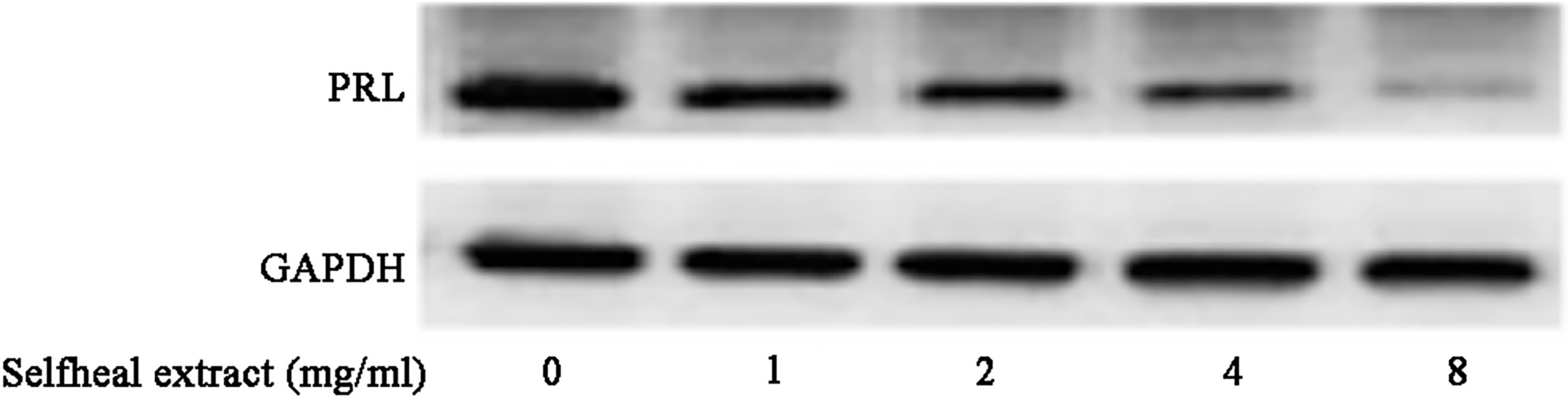
Compared with normal control, 5 mg/ml and 10 mg/ ml selfheal extract obviously inhibited PRL secretion in MMQ cells after 24 and 36 h (
Selfheal extract impact on PRL expression in MMQ cells after 24 h
Selfheal extract impact on PRL expression in MMQ cells after 24 h
Western blot detection of selfheal extract impact on PRL expression in GH3 cells after 24 h.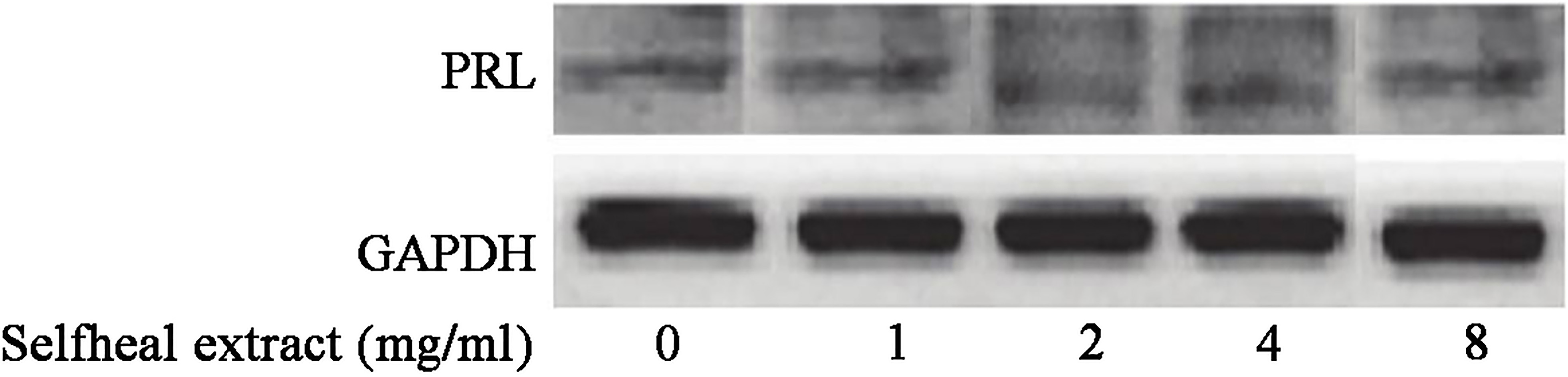
It was showed that after 24 h treatment, 4 mg/ml and 8 mg/ml selfheal extract markedly increased dopamine D2 receptor and DAT expression in PC12 cells (
Selfheal extract impact on PRL expression in GH3 cells after 24 h
Selfheal extract impact on PRL expression in GH3 cells after 24 h
Selfheal extract impact on dopamine D2 receptor expression in PC12 cells
Selfheal extract impact on DAT expression in PC12 cells
Western blot detection of selfheal extract impact on dopamine D2 receptor expression in PC12 cells.
Western blot detection of selfheal extract impact on DAT expression in PC12 cells.
The malfunction of liver can lead to menstrual disorders and breast milk abnormal secretion. Hyperprolactinemia, also called “galactorrhea” in Chinese medicine, is mainly related to imbalance of Chong and Ren Channels, breast collaterals obstacle, or liver Qi stagnation. Selfheal can stimulate the menstrual flow and regulate Chong and Ren balance. Selfheal compound preparations can significantly inhibit high PRL level, thus improve ovarian function by regulating the hypothalamus – pituitary gonadal axis balance and recover estradiol level to cure hyperprolactinemia [7]. In this study, selfheal extract got from high-temperature decoction and filtration can effectively suppress exorbitant PRL and regulate hormone disorder to treat hyperprolactinemia.
PRL is a peptide hormone that is one of the hormones secreted by the pituitary gland. It is mainly regulated by pituitary portal system, and double controlled by PRL release inhibiting factor (PIF) and PRL releasing factor (PRF). In general, PRL release is restrained by neurotransmitter dopamine. PIF inhibitory regulation plays the dominant role which is mainly exerted by dopamine. It can suppress PRL secretion by combining with dopamine D2 receptor on the surface of prolactin cells [10, 11]. On the other hand, thyroid-stimulating hormone controls the PRL release stimulus signal and promotes PRL production. Therefore, in the hypothalamus – pituitary gonad axis, several factors may weaken the PIF inhibitory factor regulation, such as hypothalamus dopamine synthesis retardation, dopamine transmission, or dopamine receptor binding, leading to PRL secreted by hypothalamus greatly elevated and hyperprolactinemia occurrence [12, 13, 14, 15].
At present, bromocriptine, cabergoline, and pergolide were used to treat hyperprolactinemia in clinic. They were all dopamine D2 receptor agonist that can bind with dopamine D2 receptor on pituitary prolactin cells to produce similar effect with dopamine. It can decrease cAMP content in hypothalamus and inhibit protein kinase A (PKA) production to reduce the protein phosphorylation level in cells, thereby inhibiting PRL secretion and restoring patient’s menstruation and fertility [16, 17, 18]. This study used three cell lines MMQ, PC12, and GH3, to discuss the mechanism of selfheal extract in treating hyperprolactinemia. MMQ cell line was derived from rat pituitary adenoma cells with high levels of dopamine D2 receptor expression; GH3 cell line was from rat pituitary prolactinoma cells lack of dopamine D2 receptor expression; PC12 cells were from rat pheochromocytoma PC12 cells highly expressed dopamine D2 receptor and DAT. High and middle dose of selfheal extract can obviuosly inhibit PRL secretion in MMQ cells, but did not affect PRL secretion and expression in GH3 cells. Meanwhile, it can significantly enhance dopamine D2 receptor and DAT expression in PC12 cells, suggesting that selfheal extract suppress PRL secretion through dopamine D2 receptor. However, the limitation in our study still exists that the facilitating effect of selfheal extract on dopamine D2 receptors requires further elucidation. For instance, additional experiments in PC12 cell lines also include the validation of the promoting role of selfheal extract on the agonistic activity of dopamine D2 receptor by using propylbutyldopamine [19] and counteraction of selfheal extract towards dopamine D2 receptor antagonist, such as haloperidol [20].
Taken together, our study demonstrated that selfheal extract contributed to a therapeutic effect on hyperprolactinemia via promoting PRL secretion and increasing dopamine D2 receptor and DAT expressions.
Conflict of interest
None.