



Abstract
Objective
The association between a putative functional promoter polymorphism, −141C insertion/deletion (Ins/Del), in the dopamine receptor D2 gene (DRD2) and schizophrenia was investigated in a Chinese Han population.
Methods
The polymorphism was studied in unrelated schizophrenia patients and unrelated healthy controls. Linkage relationships were explored in core families of the schizophrenic patients using the transmission disequilibrium test. The Positive and Negative Syndrome Scale was used to evaluate the severity of the disorder.
Results
The Del allele was significantly less frequently found in patients (13/120; 11%) than in controls (18/100; 18%). In the 32 core families studied, 16 parents were Ins/Del heterozygotes. Parents transmitted the Ins and Del alleles to their children in 10 and six cases, respectively. Data from core families did not demonstrate linkage. Age, age at onset of schizophrenia and sex were not significantly different between carriers of the Ins and Del alleles. The group with the Ins allele had a significantly higher positive symptom score (75.3 ± 23.4 versus 53.9 ± 21.9) and excitement score (83.6 ± 16.8 versus 50.3 ± 24.6) than the Del group. Groups did not differ significantly in negative symptom and general psychopathology scores.
Conclusions
The DRD2 −141C Ins/Del polymorphism may affect susceptibility to schizophrenia in a Chinese Han population.
Introduction
Schizophrenia is a complex genetic disorder that affects ∼1% of the global population.1,2 Despite extensive research efforts for many years, no mutations or disease‐predisposing DNA sequence variations for schizophrenia have been identified.3,4 The mode of inheritance of schizophrenia is likely to be polygenic and multifactorial, 5 and association studies are the most important strategies for investigating candidate genes that may be implicated in this disorder. Although the biological basis of schizophrenia is unknown, dopamine is considered to be the main neurotransmitter involved, and genes involved in dopaminergic pathways are being studied as candidate genes for schizophrenia. 6 Five distinct subtypes of G‐protein‐coupled dopamine receptors mediate the actions of dopamine, three of which belong to the dopamine D2 family: the dopamine D2 receptor (DRD2), the dopamine D3 receptor (DRD3) and the dopamine D4 receptor (DRD4). 7 DRD2 is expressed in the limbic and caudate areas of the brain, and is a target of antipsychotic agents. 6 Family, twin and adoption studies suggest that genetic factors play a role in the aetiology of schizophrenia. 1 However, no specific hereditary mechanisms have yet been identified for the disease.
Alterations in dopamine transmission and dopamine receptors have been hypothesized in the pathophysiology of schizophrenia.8,9 Findings from postmortem positron emission tomography studies, although controversial, have highlighted the possibility that DRD2 is linked to the pathophysiology of schizophrenia.10,11 As DRD2 is a target of antipsychotic drug therapy, its gene (DRD2) – which is located on chromosome 11q22–q23 – is a candidate susceptibility gene for schizophrenia. 12 In fact, DRD2 has been proposed as a candidate gene in schizophrenia on both functional and positional grounds. 13 An association was reported between a common promoter DRD2 polymorphism (−141C insert/delete [Ins/Del]) and schizophrenia in a Japanese study. 14 The different alleles in this polymorphism have been shown to differ with regard to in vitro luciferase activity in Y‐79 and 293 cells, indicating that the −141C Ins/Del polymorphism is of functional importance. 14 There has been no replication of this study in a Chinese Han population, however.
Patients and methods
Participants
Patients and controls taking part in this study were unrelated Han Chinese people. After being provided with a complete description of the study, written consent was obtained from all participants before examination. The study protocol was approved by the Medical Ethics Committee of Renmin Hospital of Wuhan University.
Patients
All patients included in the study were diagnosed with schizophrenia, using the DSM‐IV‐TR diagnostic criteria. 15 Evaluations were undertaken by treating psychiatrists in the Department of Psychiatry, Renmin Hospital of Wuhan University, over a 2-year period between January 2007 and December 2008. Patients were also evaluated regarding the following: age at first hospitalization; abuse of alcohol, solvents or drugs; previous suicide attempts; whether there was a history of schizophrenia spectrum disorders in first‐degree relatives; response to neuroleptic drug treatment; extrapyramidal side-effects; treatment with anticholinergic drugs. Only patients fulfilling a DSM‐IV‐TR diagnosis of schizophrenia were included. All patient interviews and diagnostic assessments were conducted by one of the authors (L. X.).
The Positive and Negative Syndrome Scale (PANSS) 16 was chosen to evaluate the severity of schizophrenia because it gives equal weight to positive and negative symptoms. PANSS is a 30‐item scale (total score, 210) comprising subscales for positive and negative symptoms, and general psychopathology. Many studies17–19 have analysed PANSS scores and identified five dimensions to the score: negative symptoms; positive symptoms; disorganized thought; uncontrolled hostility/excitement; anxiety/depression. Two of the authors, both of whom are psychiatrists (L. X. and C. S.), were trained in the application of the PANSS by the use of videotaped patient interviews; both trained authors read its Chinese translation, and their performance was confirmed by the assessment of three additional patient interviews. The agreement of scores (Cohen’s κ) between the interviewers was ≥0.80.
Controls
Healthy volunteers, whose geographical region of residence matched that of the patients, were recruited from the general population as control subjects. The control group did not include any people with a positive personal or familial history of major psychiatric disorders.
Families
Linkage relationships were explored in core families of the patients with schizophrenia, using the transmission disequilibrium test (TDT, discussed below).
DNA analysis
A 3–5-ml venous blood sample was collected from each participant after informed consent was obtained. Blood was collected into tubes containing 20 g/l ethylenediamine tetra-acetic acid; genomic DNA was extracted from peripheral leucocytes using a genomic DNA isolation kit (Sangon Biological Engineering Technology, Shanghai, China). A total of 284 bp of the 59‐flanking region of the D2 receptor gene was amplified in vitro by means of polymerase chain reaction (PCR) analysis (QIAamp DNA blood mini kit; Qiagen, Valencia, CA, USA), using the primers D2–677 (5′‐ACTGGCGAGCAGACGGTGAGGACCC‐3′) and D2–676 (5′‐TGCGCGCGTGAGGCTGCCGGTTCGG‐3′). Target sequences were amplified in 25 µl of reaction solution. After initial denaturation of the DNA templates for 5 min at 95℃, 32 cycles were performed, each cycle comprised of 94℃ for 1 min, 57℃ for 45 s and 72℃ for 45 s. After the last cycle, samples were incubated at 72℃ for 10 min. The PCR product was digested at 37℃ for 2 h with BstNI (New England Biolabs, Ipswich, MA, USA).The fragments were subjected to electrophoresis on 8% agarose gel, then visualized under ultraviolet light after staining with ethidium bromide.
Statistical analyses
Data were analysed statistically using SPSS® software, version 14.0 (SPSS, Chicago, IL, USA). The statistical significance of differences in genotype distribution and allele frequency between patients and controls was assessed using the χ2-test. Overall allele and genotype distributions for each single-nucleotide polymorphism in patients and controls were compared using the GENEPOP program (available at http://wbiomed.curtin.edu.au/genepop/) to test for Hardy–Weinberg equilibrium.
Association analysis was performed with the core (nuclear) families with one proband (trios). Only one strategy was used – the TDT (available at http://www.jurgott.org/linkage/TDTae.html) – to avoid the effect of potential population stratification. The statistical significance of differences between clinical features and DRD2 gene −141C Ins/Del polymorphism in patients was assessed using the χ2-test (sex) and two-tailed Student’s t-test (age, PANSS scores), accepting P < 0.05 as significant.
Results
Hardy–Weinberg analysis of the −141C insert/delete (I/D) polymorphism in patients with schizophrenia and healthy controls.
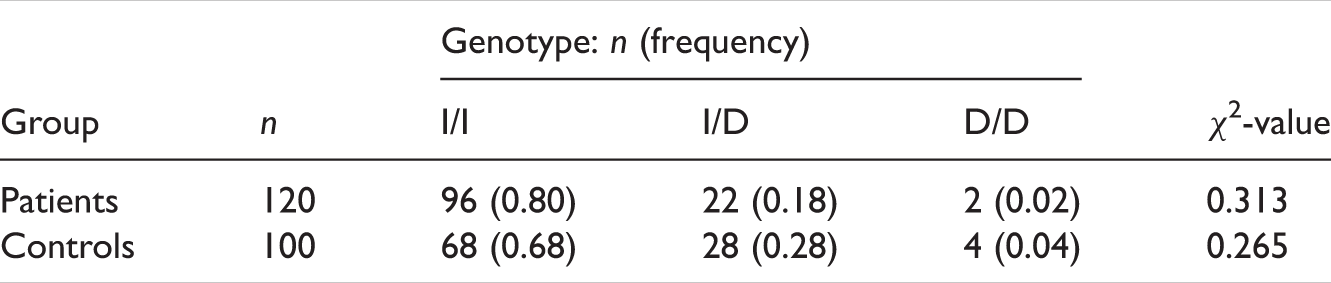
Allele and genotype frequency comparisons for the DRD2 −141C insertion/deletion (I/D) polymorphism between patients with schizophrenia and healthy controls.

χ2 = 4.38, df = 1, P < 0.05, odds ratio, 0.55, 95% confidence interval, 0.30–0.96. bχ2 = 4.63, df = 2, not significant.
Transmission disequilibrium test results for the DRD2 −141C insertion/deletion (I/D) polymorphism in 32 core families (nonschizophrenic parents) of patients with schizophrenia.

2 = 0.71, df = 1, not significant.
Comparison of clinical features between patients with schizophrenia with one or two C alleles and those with no C allele of the DRD2 141C insertion/deletion polymorphism.

PANSS, Positive and Negative Syndrome Scale; NS, not significant.
Statistical significance determined using χ2-test (sex) and two-tailed Student’s t-test (age, PANSS score).
Discussion
Arinami et al. 14 first reported that −141C Ins/Del may be a functional polymorphism in the 54‐promoter region of DRD2 and may affect susceptibility to schizophrenia. Their research suggested that the −141C Del allele acts as a protective factor in schizophrenia, while −141C Ins acts as a genetic predisposing factor for the condition. Breen et al. 20 found that the −141C Del/Ins polymorphism in the DRD2 promoter was associated with schizophrenia in the British Caucasian population. This association was the reverse of that found by Arinami et al. 14 A similar study by Lafuente et al. 12 showed that the −41C Del allele was significantly more frequent in schizophrenic patients (0.19) than in controls (0.13), in a Spanish population. Hori et al. 21 were unable to replicate findings of an association between two functional polymorphisms in the DRD2 gene and schizophrenia in a Japanese population. As reported by Arinami et al., 14 the present study findings also indicated a lower frequency of −141C Del among schizophrenic patients (11%) than control subjects (18%). Our findings are the reverse of those of Breen et al. 20 in the British Caucasian population and those of Lafuente et al. 12 in the Spanish population. Breen et al. 20 suggested that linkage disequilibrium, involving different alleles in different ethnic groups, was the most likely explanation for these conflicting findings. Moreover, it is also possible that these polymorphic variants could be in linkage disequilibrium with other gene variants contributing to disease susceptibility, rather than the variant itself being the susceptibility factor. In summary, our study and similar work in a Japanese population 21 found lower frequencies of −141C Del among schizophrenic patients than among control subjects, while studies in Caucasian populations showed lower −141C Del frequencies among controls than schizophrenic patients.12,20 If our findings are correct, this indicated differences between these ethnic groups, which could have important implications for the study of genetic factors.
In the present study, the TDT was performed in 32 nuclear families with one proband (trios), to reduce the rate of type II error (β errors, false negatives). TDT analysis failed to find linkage between schizophrenia and the −141C Ins/Del polymorphism of DRD2, which is inconsistent with the case‐control study reported here. Findings of the present study are consistent with some of the results of Lafuente et al., 12 who found no linkage between the −141C Ins/Del polymorphism and the catechol-O-methyltransferase polymorphism (A−278 G, G158A), which has been widely studied as a susceptibility gene for the risk of schizophrenia.22–25 In view of the relatively small sample analysed in the present study, replicate studies to evaluate these possibilities are in progress.
Since an association was found in this study between a putative functional promoter polymorphism (−141C Ins/Del) of the DRD2 gene and schizophrenia, we went further and determined whether there were associations between this polymorphism and clinical features of schizophrenia. There was no significant difference in age and sex between −141C Ins and Del schizophrenia patients, but a higher excitement score was observed in the −141C Ins patient group than in the −141C Del patient group. Excessive activation of D2 receptors in frontal dysfunction has been found to manifest as cognitive difficulties and positive symptoms of schizophrenia.9,26,27 Arinami et al. 14 concluded that −141C Ins schizophrenia patients had a higher DRD2 concentration and excessive activation of D2 receptors. Our data support this view.
We did not find a linkage relationship between the −141C Ins/Del polymorphism and negative symptoms. This may be explained by a greater number of receptors being involved in negative symptoms, such as the 5-hydroxytryptamine (5-HT, serotonin) receptor, which was not considered in this study.
Compared with other similar studies, careful primer optimization and improved experimental conditions were used here, to provide better-quality experimental results. Two tests were used to reduce the rates of type I errors (false positives) and type II errors (false negatives). However, studies to identify new genetic loci or estimate linkage disequilibrium for loci with multiple alleles in a larger population will be needed, to confirm or exclude allelic susceptibility to schizophrenia in China.
In conclusion, the present and previous results indicate that the DRD2 gene may be implicated in schizophrenia and that the −141C Del allele acted as a protective factor in schizophrenia, in a Chinese Han population. The Ins allele was associated with positive symptoms (namely, a higher excitement score than that observed in the Del patient group).
Footnotes
Declaration of conflicting interest
The authors declare that there are no conflicts of interest.
Funding
This work was funded by Natural Science Foundation of Shanghai, China (09ZR1427200).