Abstract
BACKGROUND:
Gap junction protein beta 2 gene (GJB2) encodes one of connexins- Connexin 26 (Cx26), which mainly expressed in epithelial cells. Cx26 is usually considered a channel to exchange information between cells, which plays a critical role in tumor cell proliferation.
OBJECTIVE:
We investigated GJB2 rs2274084 polymorphism in three types of tumors, including nasophoryngeal carcinoma (NPC), gastric cancer (GC) and lymphoma.
METHODS:
Proteinase K digestion and phenolchloroform purification and QIAamp DNA FFPE tissue kit was used for DNA extraction. The genotype of GJB2 gene rs2274084 was detected through Sequenom MassARRAY SNP technique. The Chi-square test and Fisher’s exact test were used to compare the differences between two groups.
RESULTS:
The genotype frequency of GJB2 gene rs2274084 was significantly different between EBV-positive NPC and normal control (
CONCLUSIONS:
The mutation rate of TT genotype was a risk factor to the occurrence of EBV-positive NPC.
Keywords
Introduction
Epstein-Barr virus (EBV) is one of the most common human pathogens. EBV infection is usually asymptomatic, but it sometimes may elicit various diseases, including EBV-related lymphoma, EBV-associ-ated gastric cancer (EBVaGC) and EBV-positive nasopharyngeal carcinoma (NPC) [22]. The occurrence of these diseases is resulted from multiple factors. However, EBV infections may play an important role in NPC, lymphoma and gastric cancer through affecting the expression of critical proteins or some key signal pathways. For example, EBV-miR-BART1 reduce the expression of phosphatase and tensin homologue (PTEN), a cellular tumor suppressor, through activating PTEN-dependent pathways including PI3K-Akt, FAK-p130
Cell membranes are composed of lipid bilayers serving as structures that isolate distinct functional environments. Cells communicate via the ions and signaling molecules. This communication is facilitated by connexins. Gap junctions are clusters of intercellular channels formed by connexin subunits between adjacent cells, allowing metabolic signal transduction in a process known as gap junctional intercellular communication (GJIC) [6]. GJIC has been reported to link to critical cellular functions, such as apoptosis, proliferation and migration, which are significantly important in cancer [3]. Connexins are usually reported to be involved in carcinogenesis. Cancer cells have shown alterations in either expression or localization of connexins, eliciting deficient communication capacity [15]. The connexin family in humans consists of 21 genes, mainly including connexin 26 (Cx26) and connexin 43 (Cx43). Gap junction protein beta 2 gene (GJB2) is located on chromosomal region 13q11-q12 and encodes the gap junction protein known as Cx26, which is expressed in cochlea [13], epidermis [4] and skin [5]. Mutations in GJB2 have been investigated to be connected with hepatocellular carcinoma (HCC) [2], hearing loss (HL) [24], malignant melanoma [21] and breast cancer [12]. For example, 13q12.11 homozygous deletion region in human HCC contained at least three significant down-regulated tumor suppressor genes, including GJB2 gene [2]. Additionally, it was found that reexpression of gap junctions, Cx26 and Cx43, may play a vital role in normalizing tumor cell behavior [12].
Single nucleotide polymorphisms (SNPs) are the predominant forms of sequence variations in human genome [1]. Gene polymorphisms have been studied as the key causative factor at the early stage of GC carcinogenesis [8]. SNPs have been widely used as biomarkers for diagnosis and to evaluate the risk and prognosis of some diseases and cancers [19]. It was reported that GJB2 gene rs2274084 polymorphism played a crucial role in sporadic hearing impairment cases [9], and rs3751385 polymorphism was connected with psoriasis [19].
To our knowledge, so far there was no study about the association of GJB2 SNP (rs2274084) with EBVaGC, NPC and lymphoma. Therefore, the aim of the present study was to explore the association of GJB2 rs2274084 SNP and the three tumors which are associated with EBV infection.
Material and method
Tissue samples
Three hundred and forty-eight paraffin-embedded tumor tissues were obtained from Affiliated Hospital of Qingdao University 2008 to May 2016, including 70 NPCs, 127 gastric cancers and 151 lymphomas. Peripheral blood samples from 115 healthy individuals, including 60 males and 55 females with no history of gastric, nasopharynx and lymph diseases, were classified as a normal control, and this group did not receive any medications. The mean age of the control group was 40.06
Confirmation of EBV infection
We screened the EBV-positive samples by using in-situ hybridization (ISH) technology [18] to confirm the EBV-positive tumors. An anti-sense probe (AGACACCGTCCTCACCACCCGGGACTTGTA) [16] and a sense probe designed for EBER1 were used in this study. The probes were tagged by Dig Oligonucleotide 3’-end Labeling kit of Roche.
DNA extraction
DNA of venous blood specimens was extracted by a standard method using proteinase K digestion and phenolchloroform purification. QIAamp DNA FFPE tissue kit (QIAGEN GmbH, Hilden, Germany) was used to extract the DNA from paraffin-embedded tumor tissues. DNA concentration was detected by ultraviolet spectrophotometer. Concentration of all samples must conform to the concentration from 50 ng/
Gene polymorphism detection
The genotype of GJB2 gene rs2274084 was detected through Sequenom MassARRAY SNP technique. Allelic frequency was calculated according to the genotypes. Simultaneously, we verified results of the Sequenom MassARRAY SNP technique via PCR amplification and sequencing on three positive and negative samples of each group. PCR was performed with 2.0
Statistical analysis
The Chi-square test and Fisher’s exact test were used to compare the differences between each group regarding genotype and allelic frequencies. Unconditional logistic regression was used to compare the odds ratio (OR) and P values to indicate the correlation between gene polymorphism and risk of three kinds of tumors. Statistical significance was set at
Genotypes and allelic frequencies of the GJB2 polymorphisms in NPC, GC, lymphoma patients and normal controls
Genotypes and allelic frequencies of the GJB2 polymorphisms in NPC, GC, lymphoma patients and normal controls
EBVaGC: EBV associated gastric carcinoma; EBVnGC: EBV negative gastric carcinoma; OR: odd ratio; 95%CI: 95% confidence interval; *: statistical significance.
Genotypic and allelic distribution GJB2 (rs2274084)
The result was directly displayed the genotype of GJB2 (rs2274084) through Sequenom MassARRAY SNP technology. We analyzed differences of the GJB2 genotype (rs2274084) distribution in GC, NPC and lymphoma. The significantly different distribution of GJB2 genotypes (rs2274084) between normal control and EBV-positive NPC is shown in Table 1 (
Genotypes and allele frequencies of the GJB2 polymorphisms in EBV-positive NPC patients and normal controls
Genotypes and allele frequencies of the GJB2 polymorphisms in EBV-positive NPC patients and normal controls
NPC: nasopharyngeal carcinoma; NC: normal control; OR: odd ratio; 95%CI: 95% confidence interval; *: statistical significance.
Genotypes and allele frequencies of the GJB2 polymorphisms in EBV-negative NPC patients and normal controls
NPC: nasopharyngeal carcinoma; NC: normal control; OR: odd ratio; 95%CI: 95% confidence interval.
Our research also covers EBVaGC, EBVnGC EBV-related lymphoma and EBV-negative lymphoma, both genotype distribution and allelic frequency was presented in Table 1. However, through statistical analysis, these four types of tumors did not showed distinct difference compared with normal control.
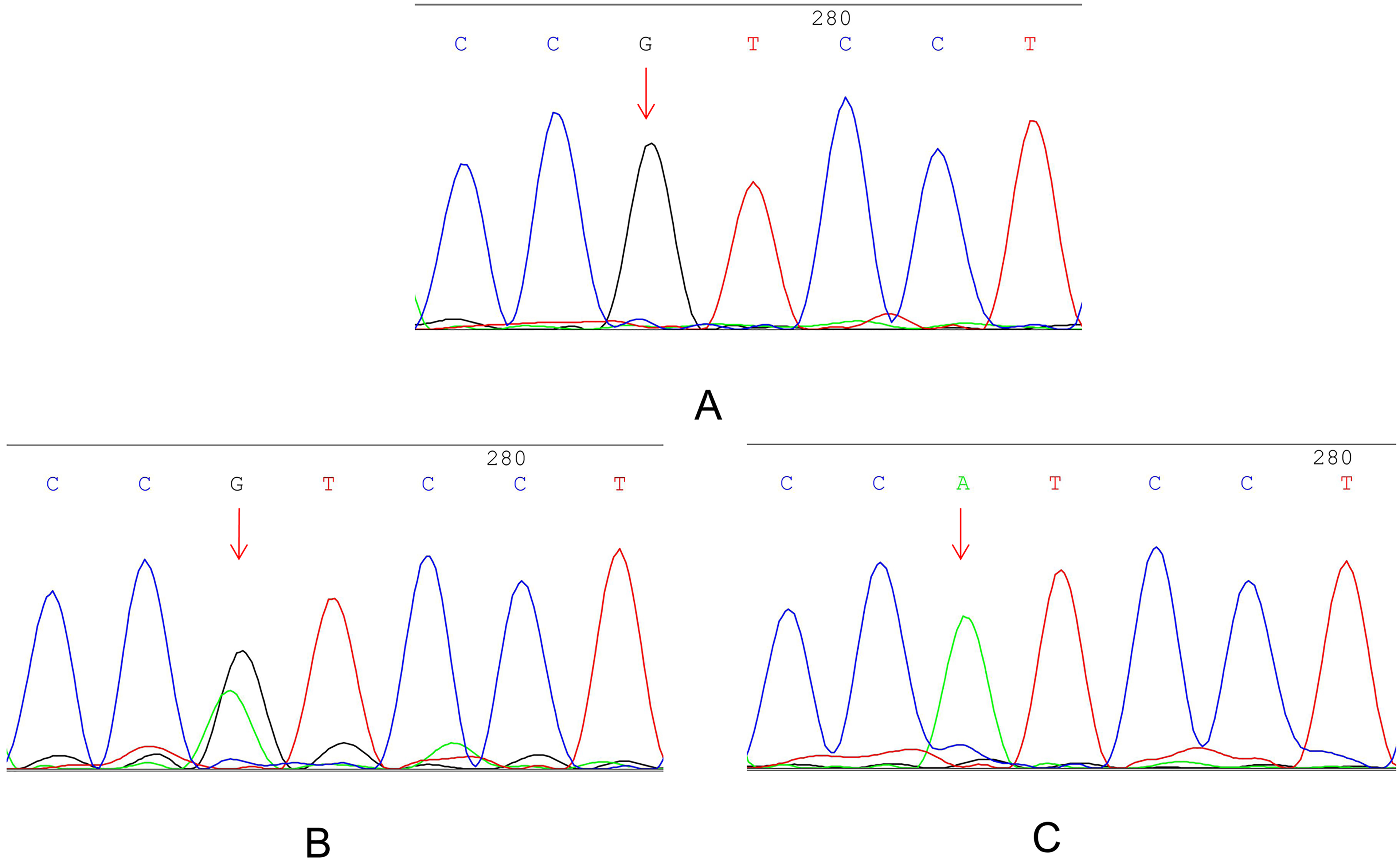
Results of sequencing on three positive and negative samples of each group were coincident with the consequences of Sequenom MassARRAY SNP technique (Sequencing results were shown in Supplementary figure).
In addition to cell-to-cell communication and cell homeostasis, GJIC also participates in regulation of cell growth and differentiation. Once intercellular normal communication is interrupted, cells will autono-mously grow into cancerous cells [14]. Cx26, a member of connexin family, plays significant role in tumor cell growth. In the mammary epithelial tumor cells BICR-M1R
In this study, for the first time, we analyzed the association of GJB2 SNPs with EBV associated tumors. According to the results, the genotype distribution of GJB2 gene in the EBV-positive NPC patients was different from the normal control. However, EBV-negative NPC had no obvious difference compared with the normal control group. Furthermore, connexins have been classified as conditional tumor suppressors, since their decreased expression may be involved in the initial steps of carcinogenesis [7]. Combined with the result of GJB2 gene rs2274084 polymorphism, we could preliminarily consider that TT genotype is a risk factor of EBV-positive NPC. On the basis of above results, it indicates that the SNP (rs2274084) of GJB2 gene could be a biomarker of EBV-positive NPC.
In addition, we also investigated four other types of tumors (EBVaGC, EBVnGC, EBV-related lymphoma and EBV-negative lymphoma), while the results did not reveal significant correlation with GJB2 gene rs2274084 polymorphism. In previous study, we knew that EBV latent infection could take three forms in terms of expression of EBV latent genes: latency I, II and III. EBVaGC belongs to latency I, in which the expression of viral latent genes is restricted to EBV nuclear antigen 1 (EBNA1) and EBER [23]. EBV-positive NPC belongs to type II latency, besides above latent genes which consistently express the latent membrane protein 1 (LMP1) [17]. LMP1 induces expression of the epidermal growth factor receptor (EGFR) in epithelial cells, and EGFR is expressed at high levels in NPC [25]. Based on the incubation period of EBV and distinct expression of LMP1, it might be a reason that why GJB2 gene rs2274084 polymorphism showed differences between GC and NPC. Additionally, vary tissue source could also cause the different result of lymphomas and NPC. However, the exact mechanism needs further indepth study.
In conclusion, our present results indicate an association between GJB2 polymorphisms (rs2274084) and NPC susceptibility. The TT genotype of GJB2 may be a risk factor for NPC. Nevertheless, the underline mechanism the interaction between EBV and GJB2 will be explored in future.
Footnotes
Acknowledgments
This work was supported by National Natural Science Foundation of China (NSFC 81571995), and Natural Science Foundation of Shandong Province (ZR2015HM069).
Conflict of interest
The authors declare that there is no conflict of interest. Additional informed consent was obtained from all patients for whom identifying information is included in this article.
Supplementary data
Sequence analysis of the representative PCR products for GJB2(rs2774084) We verified results of the Sequenom MassARRAY SNP technique via PCR amplification and sequencing on three positive and negative samples of each group. PCR products were sequenced by Illumina-Solexa sequencing platform of BGI. A, representative samples of wild type-Type CC; B, representative samples of heterozygous mutated type-Type CT; C, representative samples of homozygous mutated type-Type TT. Arrow indicates the corresponding base of each genotype.