




Abstract
BACKGROUND:
Bcl-2 interacting mediator of cell death (Bim) appears to have contradictory roles in cancer. It is uncertain whether Bim show prognostic significance in patients with breast cancer.
OBJECTIVE:
To investigate the correlation between Bim expression and clinicopathological characteristics of breast cancer and to evaluate Bim’s effect on overall survival (OS).
METHODS:
We used immunohistochemistry (IHC) technique to detect the expression of Bim via tissue microarray in 275 breast cancer samples, Kaplan-Meier analysis to perform survival analysis, and Cox proportional hazards regression model to explore the risk factors of breast cancer.
RESULTS:
The results revealed that Bim expression was significantly correlated with age, estrogen receptor (ER) and/or progesterone receptor (PR), human epidermal growth factor receptor (HER2) and Ki67 expression (
CONCLUSION:
Bim may serve as an effective predictive factor for lower OS in breast cancer patients, especially in those with luminal A tumors.
Introduction
Breast cancer has been studied in-depth over the past few decades because of its significant morbidity and mortality. The clinicopathological characteristics, prognosis, and treatment strategies of this disease are diverse, possibly because of this tumor’s molecular heterogeneity [1]. The expression of estrogen receptors (ER), progesterone receptors (PR), human epidermal growth factor receptors 2 (HER2), and Ki67 are closely associated with the prognosis and treatment of breast cancer patients [2, 3]. Patients with ER- and/or PR-positive tumors show a good response to endocrine treatment and exhibit a longer relapse-free survival than patients with ER- and PR-negative tumors [4, 5]. HER2-positive tumors have a higher risk of recurrence and metastasis, but treatment with trastuzumab may significantly improve overall survival and quality of life in these patients [6, 7, 8]. Triple-negative breast cancer (TNBC) shows the worst prognosis, with limited responses to endocrine and biological therapy [7, 8, 9, 10]. Ki67, a novel nuclear marker of cell proliferation, is associated with a worse outcome when highly expressed in breast cancer, although the treatment plan to suppress Ki67 expression has not been clear [3]. Moreover, the emergence of treatment resistance has increased the need for additional biomarkers, including new prognostic markers and new therapeutic targets, to supplement the currently used molecular subtypes [11, 12, 13, 14, 15].
Bcl-2 interacting mediator of cell death (Bim) appears to have contradictory roles in cancer. Bim is an important pro-apoptotic protein, and it has been studied extensively [16]. Bim can be up-regulated by multiple apoptotic stimuli including traditional chemotherapy, targeted anti-cancer agents, DNA damage, viral infection, or growth-factor deprivation [17, 18]. Merino et al. [19] have reported that Bim can suppress breast cancer cell metastasis. Sinicrope et al. [20, 21] have confirmed that a high expression of Bim is associated with a favorable prognosis in patients with colon carcinoma and cutaneous malignant melanoma. However, Gogada et al. [22] have found that constitutive overexpression of Bim mediated by E2F1 transcription factor could not lead to cancer cell die, and that in prostate and breast cancer cells, Bim functions as a pro-survival molecule. In light of these potentially contradictory roles, the prognostic significance of pro-apoptotic Bim in breast cancer patients remains uncertain.
In this study, we used immunohistochemistry (IHC) technique to detect the expression of ER, PR, HER2, Ki-67, and Bim in 275 breast cancer samples via tissue microarray. We then analyzed the correlation between Bim expression and other clinicopathological features, and explored the prognostic value of Bim expression in breast cancer patients.
Materials and methods
Patients
This study was approved by the Human Research Ethics Committee of Wuhan Union Hospital. We purchased two tissue microarrays from the National Engineering Center for BioChips (Shanghai, China) to study 275 paraffin-embedded breast cancer tissue specimens. The tissue microarrays were constructed with specimens of the most representative tumor central area avoiding bleeding and necrotic tissues to reduce the impact of various part of the tumor was selected. All patients were women, with a median age of 57.05
Immunohistochemistry and immunohistochemistry scoring
Bim, ER, PR, HER2, and Ki67 expression was detected by immunohistochemistry (IHC) technique via tissue microarray. Positive Bim staining was defined as the presence of cytoplasmic staining in at least 20% of malignant cells. ER-positive and PR-positive tumors were defined as those with staining of at least 1% of nuclei according to ASCO/CAP’s practice guidelines [23]. HER2 positive was defined as 3(
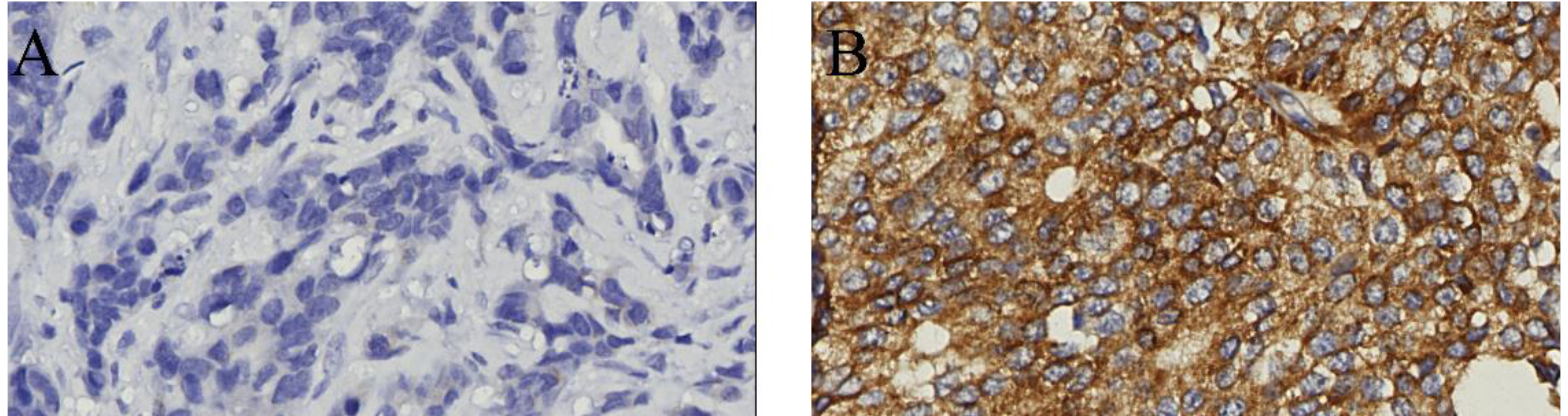
Immunohistochemistry of Bim expression in breast cancer tissues (
Clinicopathological characteristics of breast cancer patients
ER, estrogen receptor; PR, progesterone receptor; HER2, human epidermal growth factor receptor 2; TNBC, triple-negative breast cancer.
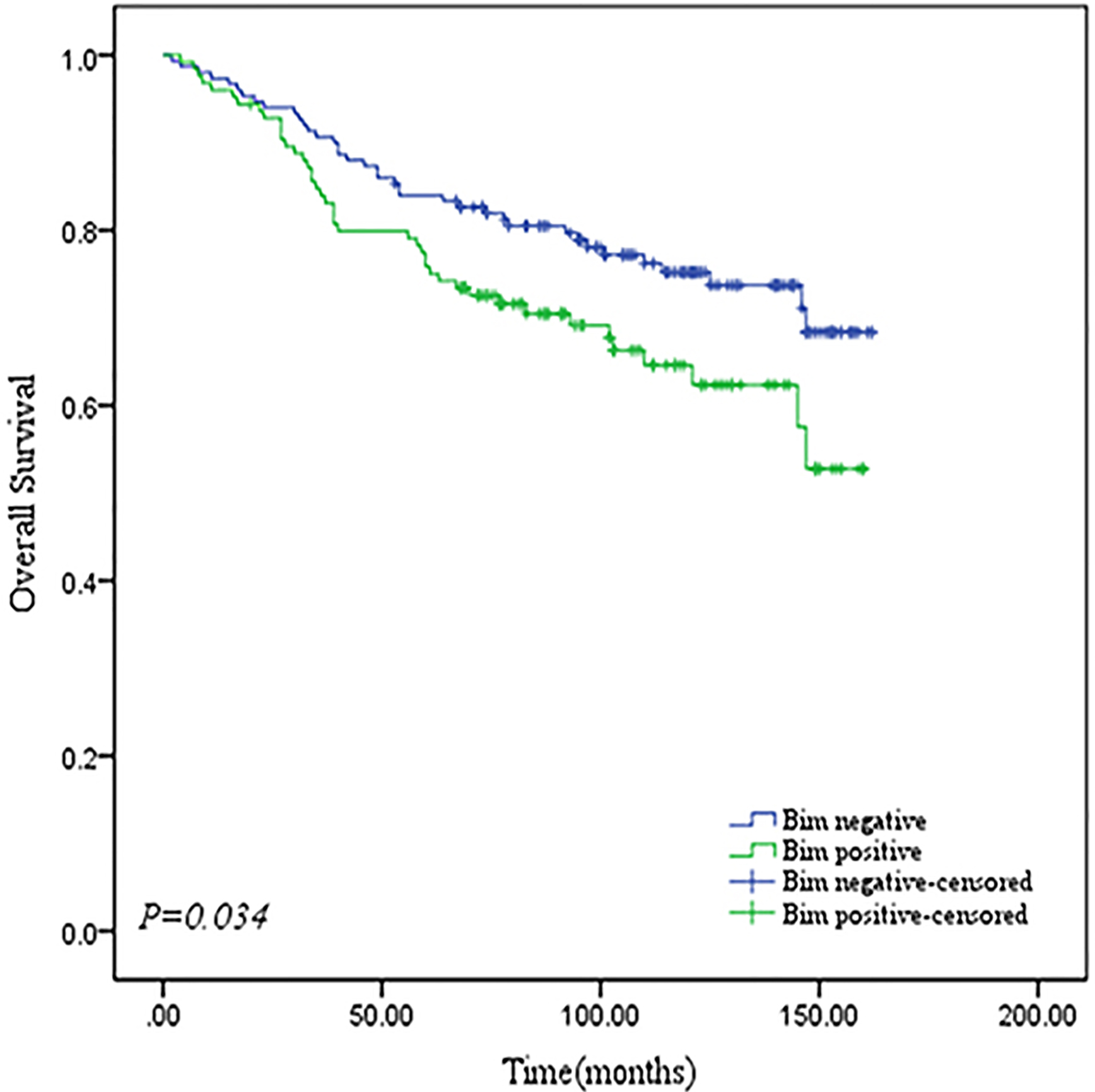
Kaplan-Meier survival curves for overall survival (OS) of all patients according to Bim expression. Patients with Bim positive tumors shows a shorter OS compared to patients with Bim negative tumors (
The relationship between Bim expression and clinicopathological characteristics of breast cancer patients was assessed by using the chi-square test. For survival analysis, overall survival (OS) was defined as the time from primary surgery to death from any cause; patients known to be alive were censored at the time of their last follow-up. The Kaplan-Meier method with the log-rank test was used to perform survival analysis, and the Cox proportional hazards regression model was applied to explore the potential prognostic factors for OS. All statistical tests were two-sided, and
Results
Relationships between Bim expression and clinicopathological characteristics
Relationships between Bim expression and clinicopathological characteristics
Relationships between Bim expression and clinicopathological characteristics
Univariate and multivariate Cox regression analyses of risk factors for breast cancer
HR, hazard ratio; CI, confidence interval.
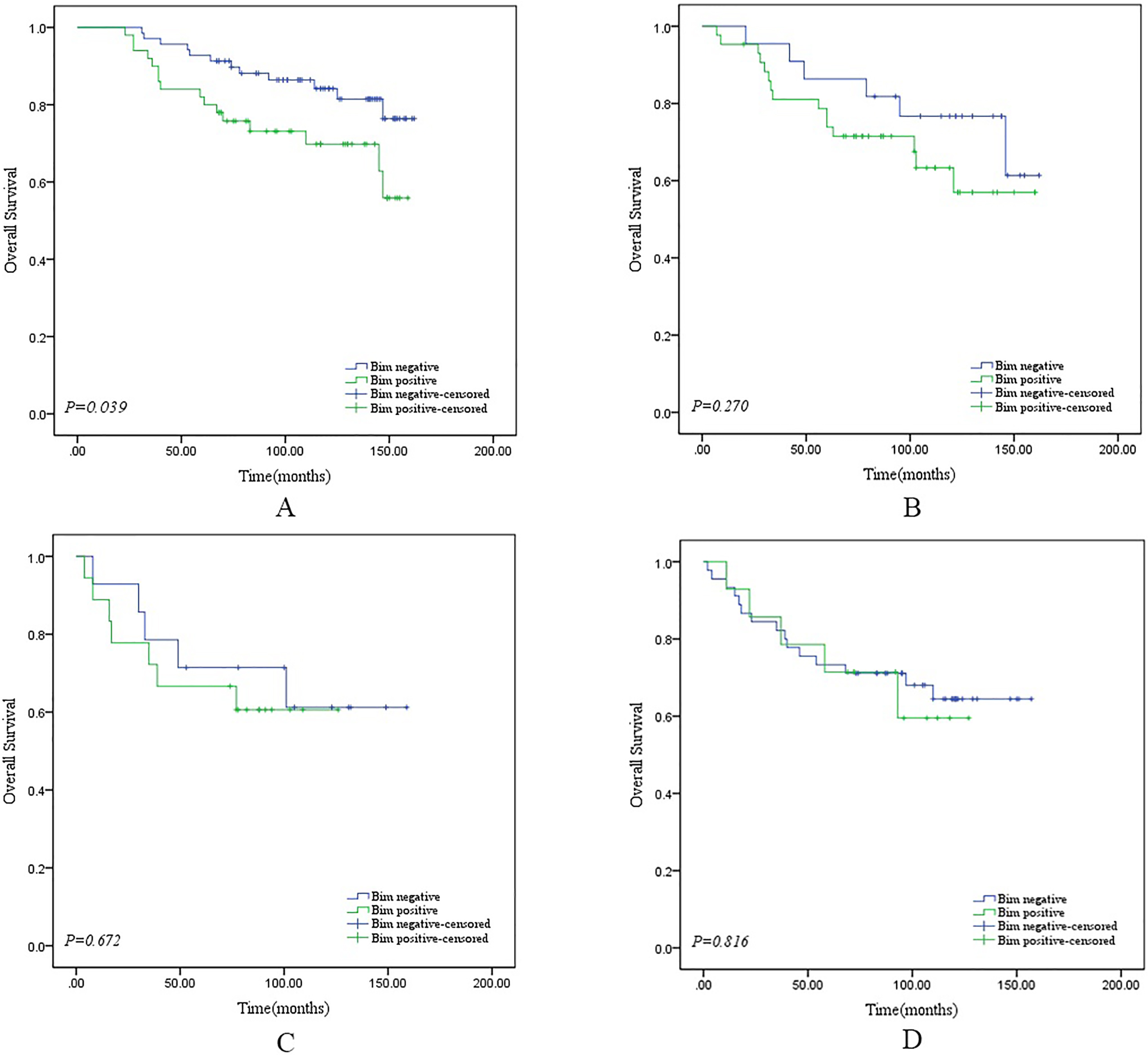
Kaplan-Meier survival curves for overall survival (OS) according to Bim expression. P values were obtained by the log rank test. (A) Luminal A breast cancer patients show a significantly poorer OS according to Bim expression (
The clinicopathological characteristics of the 275 breast cancer patients are summarized in Table 1. About two-thirds of the patients were
At the end of the 2–162-month follow-up period, 81 (29.5%) patients died, 194 (70.5%) patients were still alive. When using Kaplan-Meier method and log-rank test to analyze OS of the 275 patients, we found patients with Bim positive tumors had a lower OS compared to patients with Bim negative tumors (
In pitients with luminal A tumors, Bim positivity was associated with a shorter overall survival
We further analyzed the respective OS of patients with four molecular subtypes. Bim positive expression showed a significantly shorter OS (
Univariate Cox regression analysis of different clinicopathological characteristics for luminal A tumors
Univariate Cox regression analysis of different clinicopathological characteristics for luminal A tumors
In the present study, we found that Bim was a poor prognostic biomarker in breast cancer patients and that it influenced OS independently. The results were consistent with several previous studies. Bim has been shown to function as a pro-survival molecule in epithelial cancer cells, such as prostate and breast cancer cells [22]. However, most studies have reported that a high expression of Bim promotes carcinoma invasion and metastasis [19, 20, 21]. These inconsistent observations deserve further discussion and additional exploration.
Bcl-2 family members have been divided into three subfamilies: anti-apoptotic (e.g., Bcl-2 and Bcl-XL), pro-apoptotic (e.g., Bax and Bak), and pro-apoptotic BH3-only protein (e.g., Bim, Bid, Bmf, and Puma) [18]. Under apoptotic stimulation, anti-apoptotic Bcl-2 family members Bcl-2/Bcl-XL and the pro-apoptotic BH3-only protein are up-regulated [24]. Afterwards, BH3-only proteins bind tightly to Bcl-2 and Bcl-XL, inactivating pro-survival proteins and unleashing Bax and Bak, resulting in the activation of death cascades [25]. Compared to pro-apoptotic Bim, anti-apoptotic Bcl-2 has shown opposing apoptotic activities in cancer [16]. However, Seong et al. [12] have reported that anti-apoptotic Bcl-2 is associated with a favorable prognosis when up-regulated in breast cancers, in spite of its role opposing tumor cell death. Egle et al. [26] have demonstrated that Bcl-2 deficiency causes Bim degeneration, and the loss of Bim contributes to cancer development. Common to these studies is the conclusion that Bcl-2 family members appear to have contradictory roles in cancer, and the balance between Bim and Bcl-2 co-regulate the fate of carcinoma cells.
In cancer cells, Bim is part of the intracellular structure localized to various subcellular compartments separated by microtubules and dynein motor complexes [27]. Down-regulation of endogenous Bim by siRNA or injection of anti-Bim antibodies induces cancer cell detachment and subsequent apoptosis [28]. In animals, Bim is essential for hematopoietic and immune homeostasis, and Bim deficiency causes fatal autoimmune disease [29, 30]. These studies suggest that Bim might promote cancer cell survival and proliferation, regardless of its pro-apoptotic effect on tissue homeostasis and oncogenesis. An analysis of Bim deletion polymorphism in healthy female volunteers, stage I-III breast cancer patients, and metastatic breast cancer patients, indicated that a Bim deletion polymorphism is associated with a poor OS [31]. But Ng et al. [32] have claimed that the accumulation of Bim isoforms lacking pro-apoptotic function does not contribute Bim overexpression to efficient cancer cells death.
In our study, univariate and multivariate regression analysis showed that ER and/or PR positive expression was an independent favorable prognostic factor for breast cancer. The result had been proved, due to a good response to endocrine treatment, ER
We investigated the expression of Bim in breast cancer, the result showed that Bim positive expression was strongly associated with the following factors: older age, ER and/or PR positive, HER2 positive, Ki67
In our study, we conclude that Bim is an effective poor prognostic biomarker in breast cancer patients, especially in those with luminal A tumors. The main treatment for luminal A tumors was endocrine therapy, but chemotherapy was not essential [2]. There was a need to distinguish patients with luminal A tumors at high risk for recurrence. Even for lymph node positive disease or among younger postmenopausal patients, the expression of Bim helps to make a choice of more appropriate endocrine therapy strategies. As a potential poor prognostic biomarker of luminal A disease, Bim may be helpful in deciding to whether adjuvant chemotherapy should be administered when the endocrine therapy were insufficient, although luminal A subtype was less responsive to chemotherapy and there were no preferred chemotherapy regimen could be defined for treatment of Luminal A disease. Whether Bim could be a potential therapeutic target of luminal A disease deserve further study.
This study has two main limitations: the most important is its retrospective design. Second, tissue samples were obtained from a small number of patients treated at a single center. Hence, a prospective multicenter study with a larger number of specimens is needed to confirm that Bim is a poor prognostic biomarker in breast cancer patients.
Footnotes
Acknowledgments
This work was supported by the National Natural Science Foundation of China (Grant No. 81001171). We would like to thank Editage [] for English language editing.
Conflict of interest
The authors declare no potential conflicts of interest with respect to the research, authorship, and/or publication of this article.