




Abstract
BACKGROUND:
Low back pain is highly prevalent and the main cause of years lived with disability, but data on the burden and trends of low back pain (LBP) in adolescents and young adults (AYAs) are sparse.
OBJECTIVE:
To assess trends in the burden of LBP among AYAs aged 15–39 years at the global, regional and national levels from 1990 to 2019.
METHODS:
Data from the Global Burden of Disease (GBD) 2019 were used to analyze incidence, prevalence and Disability-adjusted life year (DALY) due to LBP at global, regional, and national levels. Joinpoint regression analysis calculated the average annual percentage changes (AAPC). Then analyse the association between incidence, prevalence and DALYs and socioeconomic development using the GBD Socio-demographic Index (SDI). Finally, projections were made until 2030 and calculated in Nordpred.
RESULTS:
The incidence, prevalence and DALYs rates (95%UI) were 2252.78 (1809.47–2784.79), 5473.43 (4488.62–6528.15) and 627.66 (419.71–866.97) in 2019, respectively. From 1990 to 2019, the incidence, prevalence, and DALYs rates AAPC (95%CI) were
CONCLUSION:
LBP in AYAs is a major global public problem with a high burden. There are large differences in incidence, prevalence and DALYs across SDIs, regions and countries. there is still a need to focus on LBP in AYAs and tailor interventions to reduce the future burden of this condition.
Introduction
Low back pain (LBP) is characterized by discomfort in the lower back, lumbosacral portion, and buttocks, which may or may not radiate to the lower extremities [1, 2]. In 2019, there were an estimated 223.5 million cases of LBP and 63.7 million disability-adjusted life years (DALYs) due to LBP [3]. Disability-adjusted life year (DALY) is the total number of years of healthy life lost from the onset of illness to death, taking into account a variety of factors such as the severity of the onset of illness, disease, death, disability (incapacity), the relative importance of age, etc., so that it can objectively reflect the degree of harm that illnesses can cause to society and to the population [4]. LBP is already a significant cause of health loss and disability around the globe, and in 2019 it was the ninth-largest disease burden worldwide [5]. The Global Burden of Disease (GBD) database was created with the support of the World Health Organization and the World Bank to research the global disease burden [6]. The database consists of 204 countries and 359 diseases in terms of incidence, prevalence, mortality, and DALYs by age, sex, and year; the GBD is extensively used in research on disease burden [7]. The GBD 2021 Low Back Pain Collaborators examined the global, regional, and national burdens of low back pain in the overall population and found that low back pain remains the leading cause of years lived with disability globally, and although age-standardised prevalence rates have declined slightly over the past three decades, it is projected that more than 800 million people globally will be living with low back pain by 2050 [8]. Wang et al. assess the global, regional, and national burdens of low back pain from 1990 to 2019 in the Global Burden of Disease 2019 study, found that global LBP age standardised prevalence and age-standardised DALY rates trended downwards, especially in East and South Asia [9]. Also some scholars have assessed the disease burden of low back pain in different regions or countries of the total population [10, 11]. However, no study has been conducted on the disease burden of LBP in adolescents and young adults (AYAs). AYAs are individuals between the ages of 15 and 39, a phase of existence that bridges childhood and elderly age [12]. AYAs will experience profound physical, emotional, and psychosocial transformations, and significant life events; it is a characteristic period of life [13]. Current research on the global burden of low back pain focuses on the population as a whole, with insufficient research on the burden of disease in adolescents and young adults, LBP is a serious problem not only among adults but also among adolescents and even children. Therefore, based on the fact that the years of life lost in AYAs will have a significant impact on society [14, 15, 16], the aim of this study was to fill this gap by performing trends in LBP in AYAs based on the GBD 2019 and assessing the diversity caused by the Socio-demographic Index (SDI) and geographic differences.
Methods
Overview
GBD 2019 provides global, regional, and national data on LBP. According to previous research [17, 18], LBP is defined as a condition that lasts at least one day per year. The lower back comprises the lumbar spine, pars sacral, bilateral sacroiliac joints, and their adjacent tissues, including muscles, ligaments, fascia, posterior joints, lumbosacral joints, or sacral joints. The International Classification of Diseases (ICD) assigns the ICD-10 codes M54.3, M54.4, and M54.5 to LBP, while the ICD-9 code is 724. AYAs are defined as individuals aged 15 to 39. This study analyzed incidence cases, incidence rates, prevalence cases, prevalence rates, disability-adjusted life years (DALYs), and DALY rates to estimate the burden of LBP.
Data sources
Search for information using the Global Health Data Exchange’s querying utility. The following parameters were set: the “GBD Estimata” parameter was set to “Cause of death or injury”, the “Measure” parameter was set to “Incidence, Prevalence, and DALYs”, the “Metric” parameter was set to “rates” and “Number”, the “Cause” parameter was set to “low back pain”, the “Location” parameter was set to “Global, High SDI, High-middle SDI, Low SDI, Low-middle SDI, Middle SDI, 21 regional and 204 country”, the “Age” parameter was set to “15–39 years”, and “Sex” parameter was set to “Both”. The “Year” parameter is set to “All year”.
Estimation framework
The GBD 2019 methodology has been described in detail in previous studies [19, 20, 21]. The prevalence rates (per 100,000) were calculated by dividing the total number of cases (including new and previously diagnosed cases) by the population size. The incidence rates (per 100,000) were calculated by dividing the new cases by the total population. DALYs represent the total number of healthy life years lost from onset to death, calculated by aggregating the number of years lost to premature mortality and the number of years lost to disability. YLLs (Years of life lost due to premature mortality) are years lost due to disease-related premature death, whereas YLDs (Years lived with disability) are years lost due to disease-induced disability.
Socio-demographic index
The SDI is a composite indicator of a country or region’s development status based on a combination of data, including per capita income, average education level, and fertility rates. Each region (or country) is assigned an SDI value between 0 and 1, with greater values indicating a more developed region (or country). Worldwide, there are 204 regions or countries corresponding to 204 SDI values. Low SDI (41), low-middle SDI (41), middle SDI (40), high-middle SDI (41), and high SDI (41) are the five levels typically used by the academic community to stratify SDI from low to high.
Statistical analysis
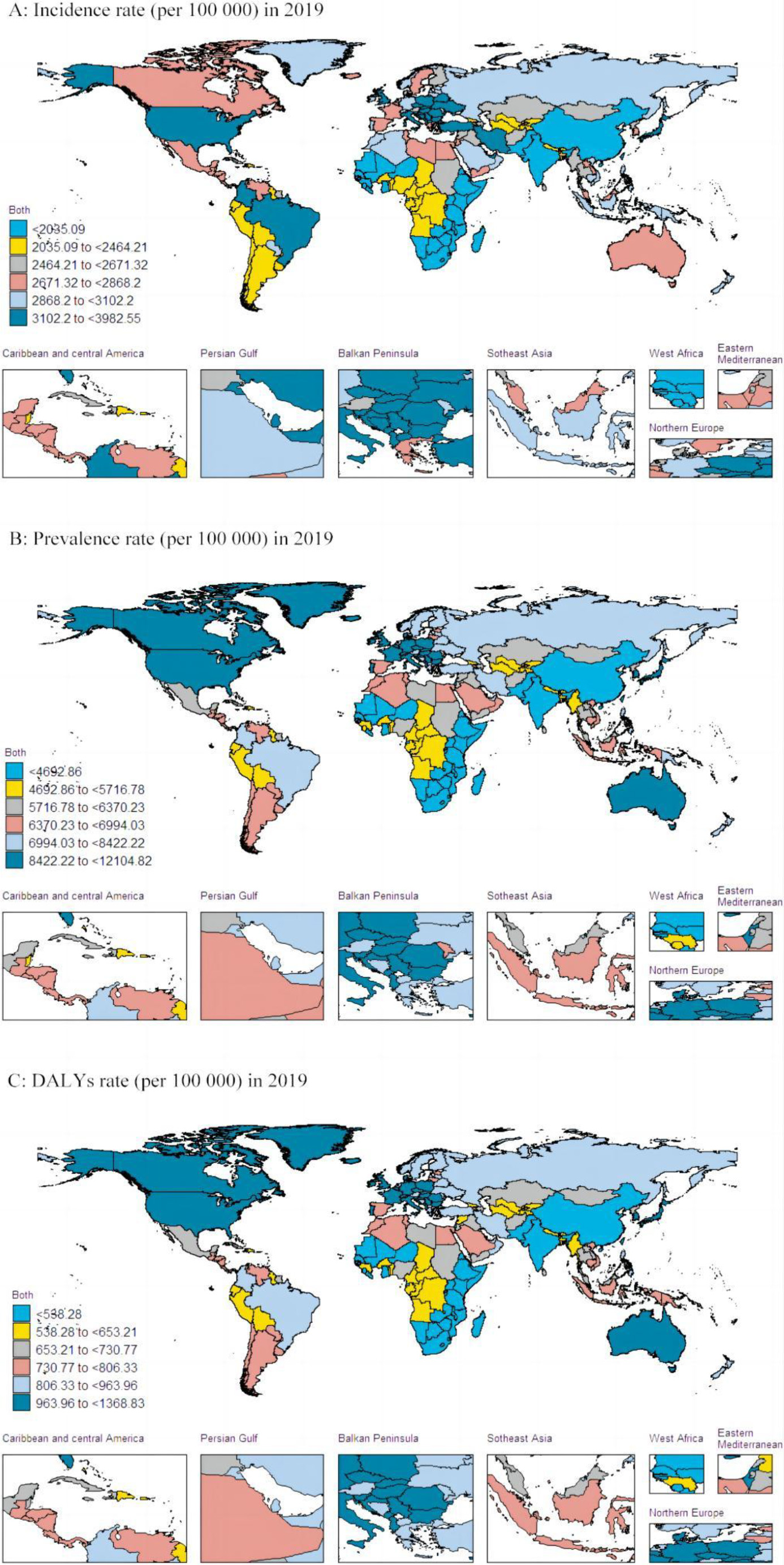
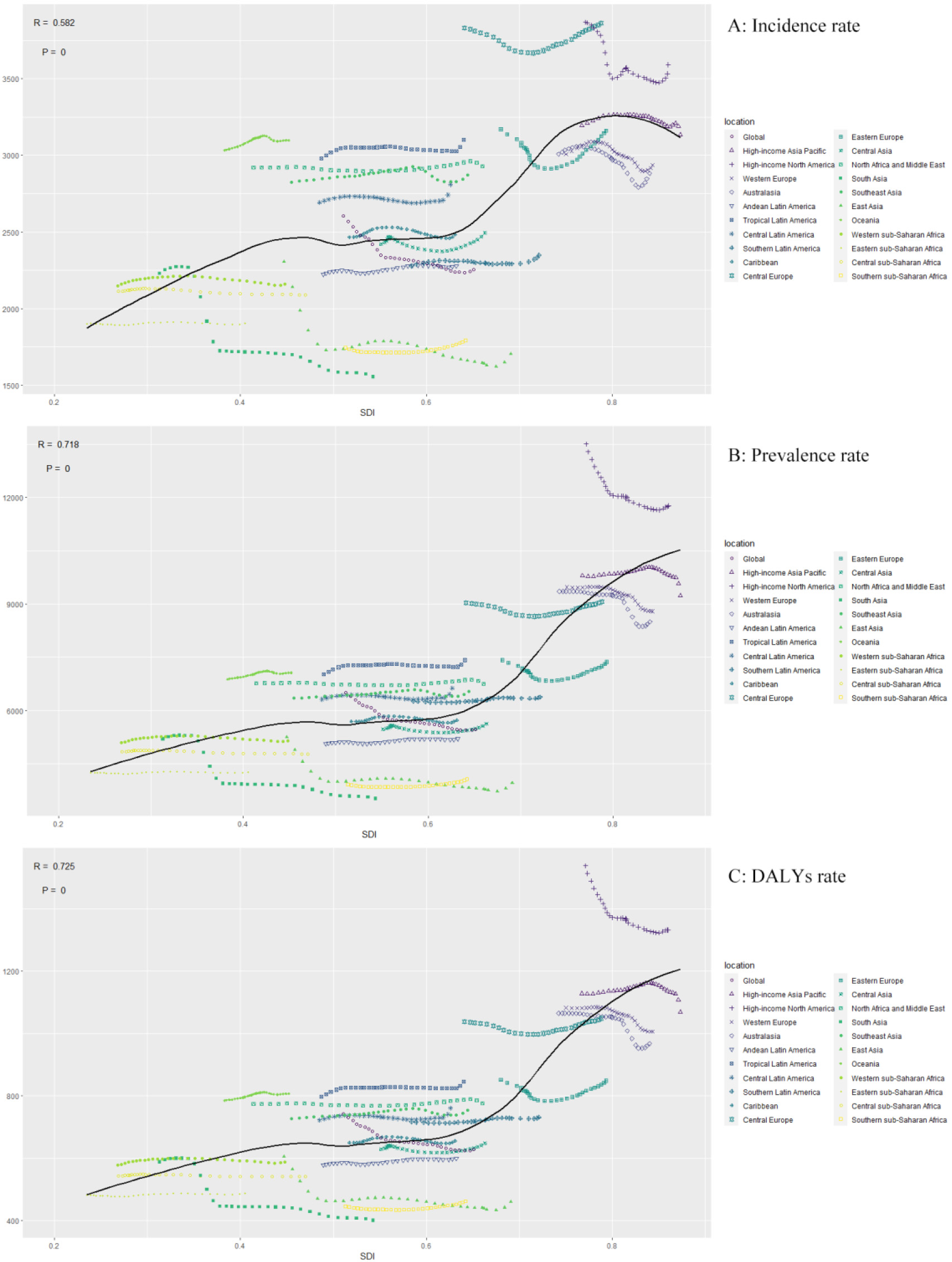
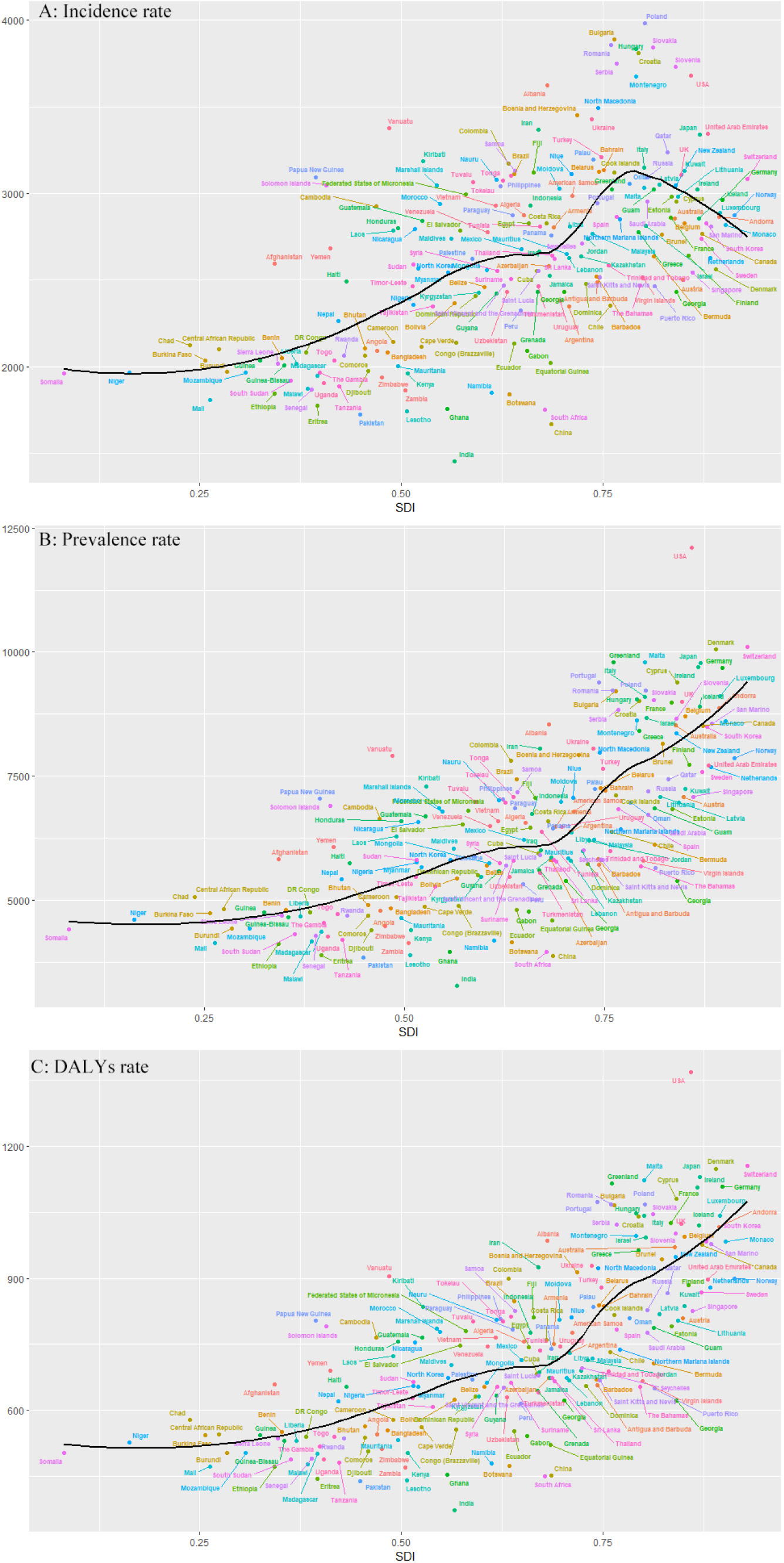
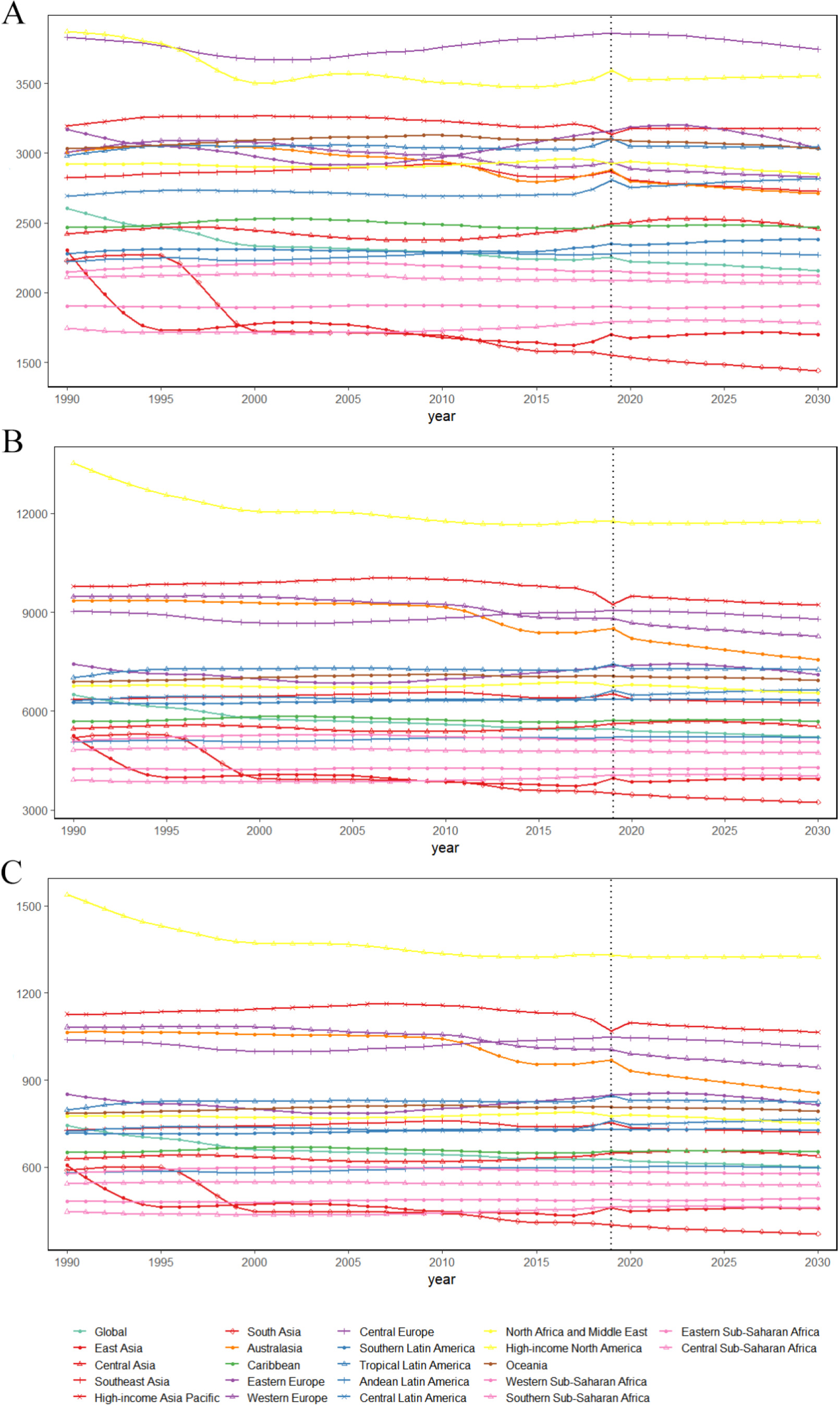
From GBD 2019 datasets, incidence cases, incidence rates, prevalence cases, prevalence rates, DALYs, and DALY rates were extracted directly. GBD generates 95% uncertainty intervals (95% UI) for its metrics to characterize the metrics’ confidence level and account for uncertainty in the initial data and subsequent calculations. The average annual percentage changes (AAPCs) and 95% confidence intervals (CIs) were calculated using the Joinpoint regression program, version 4.9.1.0 (Statistical Research and Applications Branch, National Cancer Institute, Bethesda, MD, USA). The AAPC is a summary measure of the trend over a predetermined fixed interval. It is calculated as a weighted average of the annual percentage change, allowing us to characterize the average APCs over multiple years with a single number. For 204 countries, incidence, prevalence, and DALYs rates were represented graphically. A smoothed spline model determined the relationship between global, 21 regions, and SDI from 1990 to 2019. The GBD datasets recommended Nordpred age-period-cohort model was also used to predict the incidence, prevalence, and DALYs in 2030. The Nordpred model has been extensively used for 15 consecutive years to predict maladies, and its underlying principles have been described in detail (
Results
The incidence, prevalence, DALYs of low back pain at global level
Incidence case, incidence rate, prevalence case, prevalence rate, DALYs, and DALY rate by global and SDI in 1990 and 2019 and the change in the trends from 1990–2019
Incidence case, incidence rate, prevalence case, prevalence rate, DALYs, and DALY rate by global and SDI in 1990 and 2019 and the change in the trends from 1990–2019
Footnotes
Acknowledgments
We thank the collaborators of the Global Burden of Disease (GBD) study 2019 for their excellent work.
Conflict of interest
The authors declare no conflict of interest.