




Abstract
INTRODUCTION:
Housewives are a population at high risk of breast cancer due to repeated or chronic exposure to stress. Prevention in a simple yet evidence-based manner is needed.
METHODS:
This study is a narrative review of the potential of massage as breast cancer prevention through stress and immune system mechanisms.
RESULTS:
Massage is able to prevent chronic stress through improved sleep and fatigue and lower stress levels. Prevention of chronic stress will maximize the function of cells that eliminate cancer cells, such as B cells, T cells, and natural killer (NK) cells, and improve the balance of Foxp3 Tregulator cells. Partnered delivery massage will bring effective benefits for stress reduction.
CONCLUSIONS:
Massage can provide indirect prevention of breast cancer, and partnered delivery massage can be a good choice to reduce stress.
Introduction
Housewives are one of the vulnerable groups exposed to various risk factors for breast cancer. Many mothers already know the dangers of breast cancer, especially those who are highly educated or have chronic diseases, but there are also more who are not aware of the risks and prevention of breast cancer [1].
The most prevalent risk factors for breast cancer are lifestyle-related to nutrition, e.g., low intake of anti-oxidants such as vegetables and fruits, consumption of fast food, and alcoholic beverages [2]. One of the risk factors, recurrent or chronic stress, has also received much attention. Mental health problems such as anxiety and depression can increase the risk of breast cancer through immunosuppression mechanisms that involve cells that function to eliminate cancer cells [3,4].
Extensive research has been conducted on risk factors associated with breast cancer. However, there is a need for preventive measures that incorporate community-specific knowledge, which has been scientifically shown to lower stress and enhance the immune system. Massage is a form of traditional knowledge that is widely practiced and has become a popular supplemental therapy [5–8].
We will review the potential of massage to prevent breast cancer through the mechanisms of stress reduction, chronic stress prevention, and immune system enhancement. There are many publications and reviews on massage as an effective stress reliever, but those that offer massage as an indirect breast cancer prevention solution are rarely published. This review is expected to provide insights for health educators to motivate husbands to provide relaxing massage therapy or hire a therapist to perform massages.
Housewife and potential stress
Housewives are those who fulfill the role of caregivers within the family, and their mental readiness significantly impacts several elements of their health. Along with the happiness of motherhood comes a great responsibility [9]. The mother’s high expectations and the resulting problems that do not align with those expectations might lead to stress [10].
Research by Kaplan (2021) shows that social and cultural factors and genetic and biological factors are important factors for a person’s mental well-being [11]. In addition, self-perception is a factor for mental well-being. Self-perception is how a person perceives themselves in general [12]. Positive and negative self-perceptions are sources of stress [13].
The level of loneliness and fatigue of housewives was also correlated with their level of education. The findings of the study revealed that the level of loneliness and fatigue in the illiterate group was significantly higher. In many studies in the literature, it has been found that individuals with low levels of education feel more fatigue and loneliness [14].
The health situations of children and families that necessitate particular care, such as children with specific requirements or the elderly, also serve as a cause of anxiety and tension for housewives [15]. The absence of familial assistance, particularly from spouses, also substantially influences a mother’s emotional well-being [16].
Stress, Sel Tregulator, and breast cancer
Anxiety, stress, and mental health conditions have a significant influence on the immune system. During acute stress, the body strives to preserve immune system homeostasis by raising the quantity of biomarkers. However, persistent stress or unresolved issues usually lead to immune suppression [3,4,17].
Immunosuppression caused by an imbalance in the function of Tregulator cells is a mechanism that contributes to the development of breast cancer in women who are at risk [18]. Tregulator cells play an essential role in the balance of the immune system. One of the most important biomarkers is the Foxp3 Tregulator cells, closely related to the hormone cortisol.
During instances of stress, the hypothalamus secretes corticotropin-releasing hormone (CRH). The pituitary gland will release adrenocorticotropic hormone (ACTH) in response to CRH. ACTH stimulates the adrenal glands to secrete cortisol, a hormone crucial for the body’s stress response. Throughout intense stress, the hormone cortisol plays a crucial role in maintaining the body’s internal balance, known as homeostasis. The release of this hormone leads to elevated blood sugar levels, heightened blood pressure, increased heart rate, enhanced energy generation, and immunosuppression to prevent excessive immune system reactivity and subsequent inflammation [19].
Immunosuppression, which occurs in response to the secretion of cortisol by the adrenal glands, can be beneficial. However, if stress is frequent or prolonged, it can lead to detrimental effects on the body. Immunosuppression is achieved by augmenting the population of Tregulator cells. The production of Treg cell transcription factors, including Treg cell FoxP3, and the increasing presence of transforming growth factor-beta (TGF-β) lead to an increase in Tregulatory cells. The essential role of the anti-inflammatory cytokine transforming growth factor-1 (TGF-1) is to induce the production of Foxp3 in regulatory T cells [20–23]. TGF-β signaling triggers the differentiation of naïve T cells into Foxp3 regulatory T cells [24–28].
Under chronic stress conditions, the TGF-1/Smad2/3/pSMAD/Foxp3 axis pathway becomes active, leading to immunosuppression. The Foxp3 T regulatory cell is a transcription factor that controls the immune response. Mutations in the expression of the Foxp3 gene have been associated with tumorigenic activity [29,30]. The Tregulator cell Foxp3 has also emerged as a prognostic biomarker in breast cancer and its response to chemotherapy [31–35].
The augmentation of Treg cells will result in a decline in the efficacy of antitumor immunity, hence posing a risk mechanism for breast cancer. Multiple investigations have demonstrated that Treg cells are capable of expressing granzyme B, which facilitates the removal of T cell effectors. During this occurrence, T lymphocytes undergo a reduction in their ability to combat viruses and tumors [36].
Once the number of Treg cells rises, along with an increase in IL-10 and TGF-β, it will suppress the ability of CD8+ T cells to kill target cells. CD8+ T lymphocytes play a critical role in recognizing malignancy and assisting Thelper cells in combating cancer. The stability of the quantity and functionality of CD8+ T lymphocytes is crucial in the immune response against PD-1 (Programmed Cell Death Protein 1). Elevated levels of PD-1 expression will reduce T cell activation, allowing cancer cells to evade immune system detection more effectively. The efficiency of T cell effectors is reduced when dendritic cell maturation is hindered by the production of IL-10 and TGF-β [37,38].
Massage, chronic stress prevention, and breast cancer
Blunted cortisol occurs during chronic stress; preventing chronic stress can lead to cancer prevention. Massage can be prevented by reducing fatigue, improving sleep quality, and increasing indicators of joy in a person who is able to prevent chronic stress [39]. A study published in the Journal of Cancer Treatment has indicated that the symptom load associated with breast cancer prevention includes feelings of despair, joy in life, mood fluctuations, exhaustion, and sleep disturbances [40].
Massage induces a state of tranquility and relaxation, promoting the release of happiness-inducing chemicals such as dopamine and serotonin while inhibiting the production of stress-related hormones [41,42].
Massage therapy can effectively mitigate the release of cortisol during episodes of acute stress, preventing its sustained elevation [43]. The feeling of pleasure after massage that increases serotonin also increases NK cell activity. Serotonin can prevent depression and reduce the inflammatory response, which is very beneficial for breast cancer prevention [44,45].
Massage can increase the expression of glucocorticoid receptor (GR) and brain-derived neurotrophic factor (BDNF), which suggests that massage can act as an antidepressant [46]. BDNF correlates with estrogen receptor, which plays an important role in the development of breast cancer [47].
Sleep disruption is a contributing factor to the development of breast cancer. The lower the quality of sleep, the higher the risk of developing breast cancer [48]. The underlying mechanism that helps elucidate this phenomenon is the disturbance of melatonin levels in individuals with sleep difficulties, which is intricately linked to estrogen receptors [49,50]. Melatonin directly impacts estrogen receptors’ function by suppressing the growth of estrogen receptor (ER)-positive MCF-7 human breast cancer cells [51,52].
Massage, cortisol, and prevention of breast cancer
Multiple studies conducted by researchers have established that massage therapy can effectively lower stress and anxiety levels while also influencing chemicals associated with stress (Table 1) [53,54]. Internationally recognized forms of massage include Swedish massage, traditional Thai massage administered by professional therapists, rhythmical massage, and partnered labor massage. The participants in these diverse trials included individuals who were in good health, patients with Fibromyalgia syndrome, and women who were pregnant or in the postpartum period [5,6,55,56].
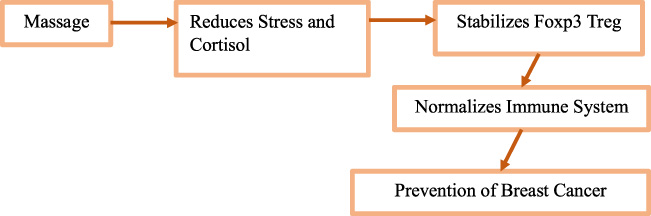
Massage and prevention of breast cancer.
Massages and their outcomes
Massage therapy reduces cortisol levels, which affects the balance and stability of immunological homeostasis by regulating the activity and quantity of Foxp3 Treg cells. Consequently, stabilizing T cells and CD8+ T cells will enhance their capacity to eliminate or prevent cancer effectively.
A study demonstrated that effleurage massage had a discernible impact on cortisol levels and some immune cells, such as natural killer (NK) cells, CD4+ T cells, and CD8+ T cells, although the effect is not statistically significant [58]. Massage can alter immunological biomarkers, but it promotes homeostasis rather than causing a significant increase. Excessive modifications can potentially result in immunosuppression or heightened pro-inflammatory activity.
Massage therapy can enhance the activity of CD8+ T lymphocytes in eradicating cancer cells, particularly in breast cancer, by influencing the production of IFN-γ. If the production of IFN-γ increases, it can lead to the occurrence of CD8+ T cells [59]. Multiple studies have demonstrated that massage therapy can decrease the expression of IFN-γ and enhance the activity of natural killer (NK) cells [7,60,61].
A continuous increase in Treg expression may result in a decline in the activity of cells involved in eliminating cancer. However, a substantial decline in Treg function is also undesirable as it can trigger inflammatory processes in the body [62].
Touch is a form of social interaction that has the ability to soothe and provide a feeling of relaxation, both during and after periods of stress [63]. Physical touch can increase motivation to do or achieve a goal [64]. Specifically, physical contact with a partner can enhance neuroendocrine health compared to contact with other individuals [65].
Despite touch not directly preventing breast cancer, it can help reduce hormone-related stress and boost the immune system, indirectly contributing to protection [66].
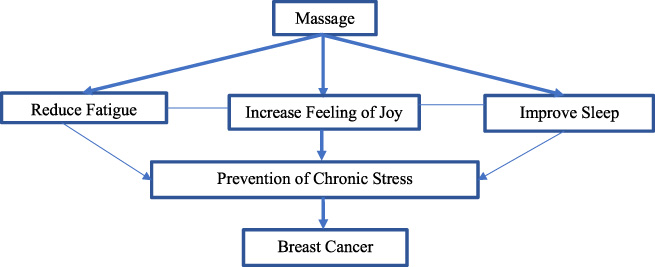
Massage, prevention of chronic stress and breast cancer.
In addition to the pleasures of being a spouse and parent, a housewife also faces a significant risk of experiencing stress. During episodes of acute stress, the body requires an elevation in cortisol levels to respond to the stressor effectively. However, in persistent or chronic stress cases, the body may experience a diminished cortisol response. Reduced levels of cortisol can result in impaired T cell and natural killer cell activity, hence elevating the susceptibility to breast cancer (Figs 1 and 2).
Massage is one of the simple solutions that can be offered for breast cancer prevention. The prevention mechanism is obtained through the prevention of chronic stress by improving sleep quality, providing relaxation, and balancing stress-related hormones. Massage also has the potential to provide Foxp3 homeostasis of Tregulator cells so that immunosuppression does not occur (Figs 1 and 2).
Specifically, partnered delivery massages that provide physical touch also have a beneficial function: providing a sense of happiness and suppressing stress-related hormones during the stress period.
Footnotes
Acknowledgements
The author would like to thank all those who have helped study and prepare this manuscript.
Ethics committee
Not applicable.
Conflict of interest
The authors declare that this article’s publication has no conflict of interest.
Data availability statement
The data presented in this study are available on request from the corresponding author.
Funding
This article review received no external funding.
Authors contribution
All authors drafted and reviewed the manuscript; ZS, ANU, MA, AA, I, AT: design of the work, data collection, and data analysis and interpretation; ANU and ZS design of the work, final approval, and supervision; AA, MA, and ANU: data collection, and data analysis and interpretation; ANU: final approval and supervision; ZS: supervision.