




Abstract
OBJECTIVES:
We reviewed the literature on breast cancer patients’ physical activity and quality of life. This paper should urge health services and breast cancer survivors to continue appropriate physical activity and assess its advantages.
DESIGN:
A systematic review was conducted.
DATA SOURCES:
This systematic review used online databases: PubMed, Web of Science, Scopus, and Google Scholar. A search from the beginning of 2018–2024 was conducted.
REVIEW METHOD:
Medical Subject Headings (MESH) were used for keyword selection along with other target keywords, such as “Quality of life”, “Breast cancer”, “Chemotherapy”, “Treatment side effects”, “Patient experience”, “Psychosocial well-being”, “Physical functioning”, “Emotional distress”, and “Supportive care”. We reviewed and included all English-language publications. A narrative synthesis was conducted to present the results of the studies.
RESULTS:
The search using the keywords yielded a total of 135 studies. Each result was filtered again according to the inclusion and exclusion criteria, resulting in a final total of 15 studies to be included in the systematic review.
CONCLUSION:
The evidence supports the benefits of physical activity in enhancing the quality of life for breast cancer survivors, indicating that further prospective and intervention studies are needed.
Introduction
Quality of life (QoL) in breast cancer patients is multifaceted, including health, well-being, and social aspects. It is critical for understanding the effects of breast cancer, making treatment options, and providing supportive care. Diagnosis, treatment, post-treatment, and survival all impact quality of life. Assessments of health-related quality of life are critical for understanding the impact of breast cancer and designing therapies. Early survivors with higher physical and psychological demands had a lower quality of life, stressing the importance of addressing these needs early in the survivorship stage [1–4].
Breast cancer patients require comprehensive care for their quality of life, including physical, mental, and social aspects [5]. Monitoring changes in quality of life during treatment is essential for customized interventions. Understanding predictors of quality of life can help healthcare professionals improve health and quality of life [6], while qualitative studies can inform interventions that address specific needs and concerns.
Breast cancer is the most common malignancy worldwide, disproportionately affecting women in low- and middle-income countries. The World Health Organisation’s (WHO) Global Breast Cancer Initiative seeks to reduce breast cancer incidence by 2.5% per year, saving 2.5 million lives over 20 years. Key techniques include health promotion, early detection, prompt diagnosis, and comprehensive management [7–9].
The World Health Organisation (WHO) highlights the importance of quality of life (QoL) for breast cancer patients, focusing on emotional, social, and role functioning. Symptoms such as fatigue, sleeplessness, and pain majorly impact these areas. The WHO Global Breast Cancer Initiative seeks to improve survivors’ quality of life by addressing the needs of patients, families, and communities [10,11].
Optimizing breast cancer survivorship care requires QoL research. Health-related QoL indicators affect survival rates. Studies have shown that poor HRQoL increases mortality risk, underscoring the need for focused survival care [12].
Physical activity improves breast cancer patients’ and survivors’ quality of life (QoL) by influencing their independence and health status [13]. The American College of Sports Medicine (ACSM) and the United States Department of Health and Human Services recommend exercise training for chronic diseases such as cancer patients. However, only 28% of survivors meet the recommended activity levels, emphasizing the importance of supporting and encouraging physical activity appropriate to their condition [14,15].
Physical activity is critical for breast cancer survivors to improve their quality of life since it reduces symptoms of melancholy, anxiety, and despair while also improving bodily function, highlighting the importance of continued study and intervention development [16,17].
The review emphasizes self-efficacy and health status in analyzing the association between physical exercise and QOL in breast cancer survivors. Future research should examine other psychosocial dimensions linked with health status, such as self-esteem, depression, functional limitations, and cognitive function, as well as biological mediators [18]. The study also emphasizes the need for studies to determine the optimal time along the breast cancer continuum to intervene to maximize the QOL benefits of a physical activity program [19].
In addition, a study examines demographic trends in the country, notably the aging breast cancer survivors and their distinct physical, social, and psychological health needs. As breast cancer survivors rise due to early detection and treatment, this is significant [20].
A review suggests that self-efficacy and health status markers help explain how physical activity affects global QOL in breast cancer survivors. It suggests that physical activity may improve QOL in breast cancer survivors and can inform future research and interventions to improve cancer survivorship [21].
We conducted a literature review on physical activity and quality of life in breast cancer patients. This article should encourage health services and breast cancer survivors to continue physical activity suited to their conditions and evaluate the benefits.
Material and methods
Search strategy and inclusion criteria
A systematic search was conducted in PubMed, Web of Science, Scopus, and Google Scholar databases, covering 2017 to 2024. The search utilized title/abstract or Medical Subject Headings (MeSH terms), including “breast cancer”, “breast neoplasm”, “breast cancer survivors”, “exercise”, “physical activity”, “quality of life”, “depression”, and “anxiety”. We conducted a comprehensive evaluation and incorporated all literature written in English.
Study design
This review includes all interventional investigations, such as randomized clinical trials, clinical trials, and quasi-experimental studies.
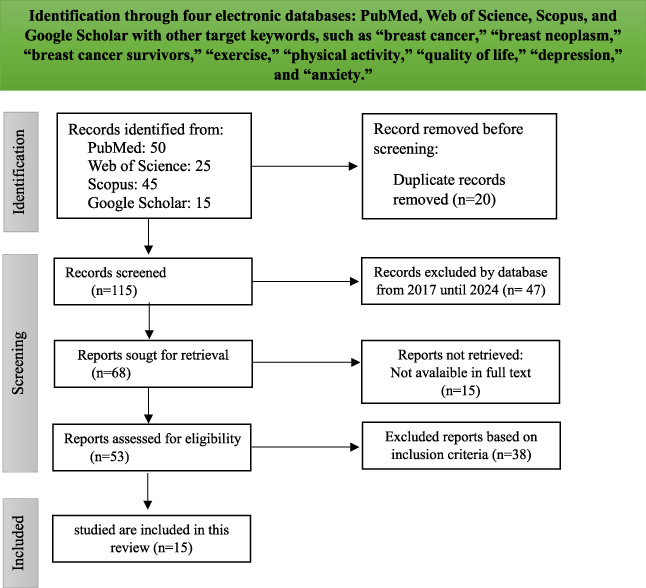
Study selection process.
The search results were transferred into the Mendeley software, eliminating duplicate records. The texts of possibly relevant papers were examined to determine if they satisfied the inclusion criteria. This procedure was executed with the involvement of two independent reviewers. All conflicts were settled through discourse. Figure 1 displays the procedure for selecting the study.
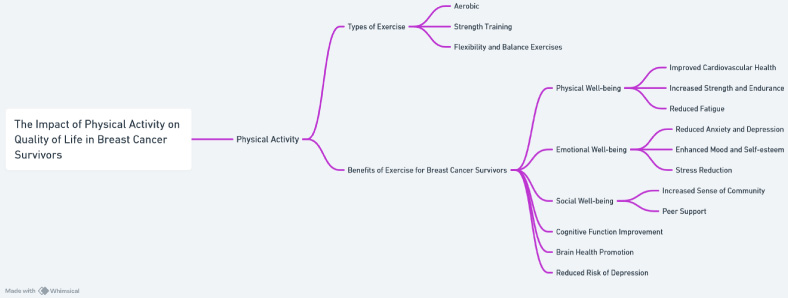
The impact of Physical activity on breast cancer survivor.
The results of this study support the benefits of physical activity for breast cancer survivors, including improved physical and emotional well-being, social support, and cognitive function. Research has shown that exercise can improve cancer survivors’ quality of life by improving physical function, mental health, and social engagement. Physical activity, such as aerobics, strength training, and stretching exercises, improves breast cancer survivors’ quality of life by improving cardiovascular health, strength, endurance, flexibility, social support, cognitive performance and disease outcomes (Fig. 2).
See Table 1.
Discussion
In 2023, Mengying Sun et al. investigated how physical activity affects quality of life, anxiety, and depression in breast cancer survivors in China. There were 26 studies and 2105 participants. Physical activity helped depression, anxiety, and quality of life, but not statistically [18].
In South Korea, Woo-kyoung Shin et al. (2017) discovered that high-activity people had lower weariness and pain levels and more outstanding sexual function scores. Physical activity boosted physical function in stage breast cancer survivors but impaired fatigue and sexual function in stages II and III [22].
Another randomized controlled trial by Dagfinn Aune et al. (2022) examined how physical activity affects breast cancer patients’ quality of life. Quality of life measurements FACT-G, EORTC QLQ-C30, and SF-36 showed consistent advantages. The study reinforces prior findings that exercise improves quality of life and physical function slightly but significantly [23]. This suggests that physical activity programs can improve overall quality of life [24].
A study of postmenopausal breast cancer patients found that 45% took aromatase inhibitors to prevent recurrence and increase quality of life. The survey indicated that 50% fulfilled ACSM leisure-time physical activity and weekly walking recommendations, and 36.5% met strength training goals. According to this research, healthcare providers must recognize particular relationships between symptoms, side effects, and physical activity [25].
Quality assessment of included studies
Quality assessment of included studies
In 2020, Ji-Hye Park et al. found that frequent exercise helps cancer patients. It improves mobility, reduces fatigue, manages pain, and reduces dyspnea. The study emphasizes the dose-response link between physical activity and quality of life, underlining the relevance of exercise for cancer patients [26].
Maria Chiara Bò et al. (2023) found that self-managed physical activity therapy can greatly help adult breast cancer patients. It can boost self-care, oncology results, and patient empowerment. PA can improve health and condition management since healthcare providers can help patients control their health through physical activity [27].
In line with earlier studies, Pedro G.F. Ramos et al. (2024) conducted a comprehensive evaluation of home exercise programs (HBE) on breast cancer survivors’ functional performance, physical activity, and adherence. Most of the 26 research involved organized or directed treatments. Most reported better functional performance, more exercise, and good adherence. HBE therapy may improve functional performance and physical activity in breast cancer survivors, according to this review [12,13].
Siobhan M. Phillips et al. (2020) discovered that daily chemotherapy symptom changes can limit activities. Women aged more than 18 years with stage I to III breast cancer wore accelerometers and rated symptoms for 10 days. During chemotherapy, symptoms were significantly associated with moderate to vigorous physical activity (MVPA) and light physical activity (LPA). Previous anxiety was linked to LPA the following day. This study encourages more research on symptoms and activity and whether controlling for symptoms improves chemotherapy-related physical activity promotion programs [29].
Boing et al. (2018) discovered that breast cancer patients often had decreased quality of life due to exercise. Physical activity and quality of life questionnaires were given to 174 women. Results showed that most women, especially those getting treatment, did not meet the physical activity criterion. However, walking length increased functional capacity loss and treatment-related symptoms [30]. According to the study, walking is an effective type of physical activity for women with breast cancer [37].
In 2023, Tzu-Chieh Wang et al. found that combining aerobic exercise and strength training improved the quality of life of breast cancer survivors after 12 weeks, decreased the likelihood of quitting exercise, and may have helped doctors and patients make appropriate exercise decisions [31].
According to Renee Turzanski Fortner et al. (2023), physical activity improved breast cancer outcomes. Pre- and post-diagnosis activity changes and intensity and type assessments were compared in this study. Increased post-diagnosis exercise was inversely connected to breast cancer-specific and all-cause mortality. Walking and strength training reduces mortality. It increased weekly walking by 1–3 h, which reduced all-cause mortality. These findings encourage breast cancer patients to be more active [32].
Rebecca D. Kehm et al.’s 2021 study found that recreational physical activity (RPA) lowers all-cause mortality and second breast cancer in women diagnosed with breast cancer between 1993 and 2011. The study included 4610 women after controlling for age, demography, and lifestyle. With a relative extra risk of 0.87, RPA and BRCA1/2 pathogenic mutations interacted. Maintaining or enhancing RPA in BC women, especially those with higher familial risk, could improve survival rates [33].
In 2018, Susan Aguiñaga et al. studied the impact of physical activity on psychological well-being in breast cancer survivors. The study comprised 387 patients who self-reported physical activity before and after diagnosis. High-active maintainers reported the highest quality of life and lowest weariness and depression. The study suggests survivors’ psychological well-being may depend on high physical exercise [34].
Ana Joaquim et al. (2022) examined how exercise affects breast cancer survivors’ quality of life, cardiorespiratory fitness, muscle strength, and body composition. In 83.3% of 101 qualified trials, physical activity improved health-related quality of life. It reduces weight and waist circumference and improves cardiorespiratory fitness. In order to improve health outcomes after breast cancer treatment, this study suggests that health practitioners advocate physical activity interventions [35].
Physical activity improves cancer patients’ quality of life and mental health. Physical function, treatment side effects, sleep, anxiety, sadness, mood, self-esteem, stress, and social involvement improve. Group fitness programs help cancer patients stay healthy during stressful times. People living with Cancer benefit from exercise [38–42].
Physical activity improves the quality of life, mental health, physical function, risk of death, empowerment, and exercise adherence among breast cancer survivors. Studies show that more activity has more benefits. Together, cardio and strength training may be more effective. Walking is a great exercise for breast cancer survivors and is easy to do. Healthcare providers help patients see the benefits of exercise and develop safe, effective workouts that meet their needs and restrictions.
Footnotes
Acknowledgements
We thank the publication management unit team of the graduate school for assisting in preparing this systematic review.
Ethics committee
Not applicable.
Conflict of interest
Each author declares that he or she has no commercial associations (e.g., consultancies, stock ownership, equity interest, patent/licensing arrangement etc.) that might pose a conflict of interest in connection with the submitted article.
Data availability statement
The data presented in this study are available on request from the corresponding author.
Funding
This article review received no external funding.
Authors contribution
NQA, MA, and PP study design; NQA, PP, and ANU databases search and articles selection; All authors participate in the debate and consensus on the articles to be included. NQA, ANU, and DIA manuscript writing. AA, ANU, FI, and DIA proof-reading of the manuscript.