




Abstract
INTRODUCTION:
In breast cancer patients undergoing mastectomy without reconstruction, an external breast prosthesis could aid patients’ recovery, improve body image and confidence by helping to regain a symmetrical chest appearance when dressed. However, external breast prosthesis preferences among Asian breast cancer patients were not widely studied. We aimed to compare patients’ experience with the conventional commercially manufactured standard-sized (small, medium, large, extra-large) bra and prosthesis versus customized hand-knitted external breast prosthesis with patient’s bra after unilateral mastectomy at a tertiary hospital. This is the first such study in Asian women, to our knowledge.
METHODS:
In this prospective study, participants used the conventional bra-prosthesis followed by the customized one consecutively, each for at least 3 months before they were administered an identical questionnaire at 3 and 6 months respectively. The questionnaire assessed the patients’ experience with the prosthesis on the aspects of comfort, body image and satisfaction etc. Patients were also invited for in-depth interviews.
RESULTS:
Of 155 eligible patients, 148 patients participated with a response rate of 95.5%. 99 (67%) participants preferred the customized prosthesis, while 38 (25.7%) did not. 11 (7.4%) participants were undecided. Seventeen participants underwent in-depth interviews until data saturation on major qualitative themes was achieved. More patients experienced excessive sweating (p < 0.0001), greater discomfort (p = 0.0195) and higher rates of prosthesis dislodgement (p = 0.0269) with the conventional bra-prosthesis.
CONCLUSION:
Customized external breast prostheses could be an alternative to the conventional ones for breast cancer patients with mastectomy, with additional benefits of less sweating, more comfort and less dislodgement perceived.
Introduction
Breast cancer is the most common female cancer globally and locally, where a growing number of women is being diagnosed and treated. Breast cancer is associated with physical, psychological, and body image challenges. The latter is especially true in patients who underwent mastectomy [1–3] since a woman’s breasts are often associated with femininity.
Nonetheless, surgery remains an established and effective treatment for breast cancer, and wide excision or mastectomy are commonly offered to patients. Factors, such as tumour to breast size ratio, tumour multifocality and patients’ preferences etc, affect the choice of surgery. After mastectomy, breast restoration may involve immediate or delayed reconstruction. In patients who declined breast reconstruction, an external breast prosthesis could be used. Since breast cancer patients could experience psychological trauma associated with breast loss during mastectomy, using an external prosthesis could help patients recover better, improve body image and confidence, by aiding these patients to regain a symmetrical chest when clothed.
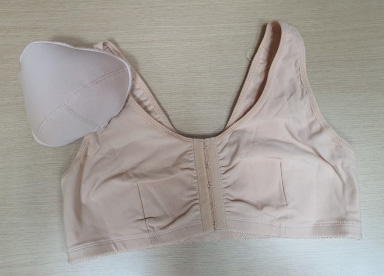
Conventional standard-sized commercially manufactured bra with prosthesis set, available in small, medium, large and extra-large sizes. This figure shows a set of medium size, with the prosthesis placed outside of the bra pocket for ease of viewing.
Despite the psychological benefits associated with the use of external breast prostheses, few studies have examined patients’ preferences in this context. Though the women’s reactions to the prosthesis may not be favorable initially [4,5], their satisfaction can improve over time [4,5], usually several years after mastectomy [6]. Some important factors that could affect external breast prosthesis acceptance and satisfaction included the fitting experience, relationships with breast care nurses and prosthesis fitters, attributes of the fitters and if there was adequate information and support throughout the process [4,5,7–9]. It was revealed in national surveys that respondents preferred to be fitted for their first external breast prosthesis by a breast care nurse in a hospital setting. For their subsequent prosthesis, these patients preferred to be fitted in the retail setting [10]. Regarding patients’ preferences with different types of external breast prosthesis, one study compared the adhesive versus non-adhesive silicone prosthesis [11] and found that 59.3% of the respondents preferred the self-adhesive type. In a survey involving Indian women, 42.9% were not using any prosthesis. Among those using prosthesis, cloth-like or cotton type external breast prosthesis were the commonly used type [12].
However, despite what we know, external breast prosthesis fitting remained a topic with little information and research [10,13,14], especially in the Asian women setting [8,9].
This study aimed to examine patients’ experience of using a conventional standard-sized (small, medium, large, extra-large) commercially manufactured bra with prosthesis set (Fig. 1) versus patient’s own bra with a customized hand-knitted (Fig. 2) prosthesis among breast cancer patients who had undergone unilateral mastectomy. This study is the first reported study, to the best of our knowledge, to examine external breast prosthesis preferences, using customized knitted prosthesis, among Asian breast cancer patients with mastectomy.
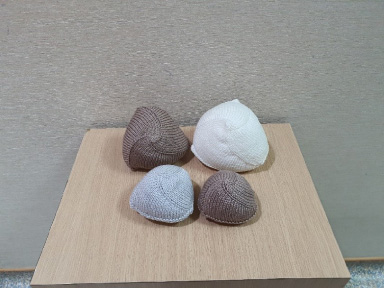
Customized hand-knitted external breast prostheses, with the size of prosthesis individualised based on each patient’s breast size.
A mixed-methods evaluation study involving a questionnaire, followed by an in-depth semi-structured interview was conducted. Participants used each prosthesis, the conventional followed by the customized prosthesis consecutively, for a minimum duration of 3 months for each prosthesis. The conventional prosthesis consisted of a bra and prosthesis, made of 90% cotton and 10% spandex, which are available as a set. This prosthesis was designed to be worn by patients about two weeks post-operatively. The bra had front buckles with non-adjustable bra straps. The prosthesis was inserted into a pocket of this conventional bra-prosthesis set and could be removed for washing purpose. In contrast, the customized prosthesis, which was made of 100% cotton, allowed the patient to use her own bra, with the customized prosthesis tailored using the patients’ bras. The customized prostheses were handknitted by a group of volunteers. It took an average about three hours to a day to complete a customized prosthesis, depending on the patient’s breast size. The fitting for both prostheses was standardized and done by a group of 4 dedicated breast care nurses.
The patients were then administered the same questionnaire after the use of each prosthesis for at least three months’ duration. The questionnaire consisted of two segments with a total of 25 questions. The first segment explored factors such as practicality, comfort, body image, satisfaction, and recommendation, with an open-ended section on the use of the external breast prosthesis. The second segment investigated the continuity of prosthesis usage. These questions were formulated after review by two healthcare professionals and four breast cancer patients.
Following the completion of the questionnaire, participants were also invited for an interview which gave the participants an opportunity to elaborate on their preferences and prosthesis evaluation. The interview was conducted till data saturation on major qualitative themes was achieved. The qualitative data was then evaluated with the quantitative data in a complementary manner [15].
Recruitment
Participants were recruited from a tertiary hospital in Singapore from 1st June 2016 to 31st October 2019 based on the following criteria: (1) breast cancer patients aged 21–80 years old; (2) history of unilateral mastectomy with a wound that had healed and willingness to undergo prosthesis fitting; (3) able to complete a self-administered questionnaire in English; if not fluent in English, willing to complete a self-administered questionnaire with the help of a research assistant and (4) local resident willing to commit to three to four visits for the study. Only patients who was fluent in English were invited to participate in the interview.
Statistical analysis
Based on 𝛼 = 0.05, a sample of 150 participants would achieve power of >80% to detect an effect size (𝛥∕𝜎) of 0.25, making the study adequately powered to detect small differences in the quantitative findings. In the analysis of quantitative endpoints, McNemar’s test for paired binary outcomes was used. This method is suitable for the analysis of correlated responses from the same participant, since each participant served as her own control.
Seventeen participants (mean age, 55 [range, 35–70] years) were selected for interviews based on convenience sampling, and 33 interviews (20 to 60 minutes) were performed to achieve data saturation. Of the 17 participants, 11 were involved in two or more sessions. The principal investigator conducted all the interviews. Qualitative analysis involved identifying major themes from the interview transcripts. The findings were reported under the following themes: initial reaction; impact of the use of prosthesis; impact on comfort, body image, satisfaction and recommendation etc.
Ethical considerations
The study was approved by the Singhealth Central Institutional Review Board (2015/2844), with written consent obtained from each participant.
Results
Of the 155 eligible women, 148 (95.5% response rate) were successfully recruited (median age, 59 [range, 28–80] years) (Table 1).
Demographics
Demographics
Impact of the prosthesis on the comfort, body image and satisfaction
67% (n = 99) of the participants preferred the customized prosthesis, in contrast to 25.7% (n = 38) who did not prefer it; 7.4% (n = 11) of the participants were undecided.
The participants reacted favorably when approached to try the prostheses. One felt that it was “good” and would “like to have a try.” Another was “surprised that such a product [was] available.” A third interviewee mentioned that “being told before the operation provided some comfort in knowing what to expect after. I am conscious about my appearance, thus I felt more positive knowing there was some replacement.”
Impact from the use of prosthesis
All participants reported the fitting experience as favorable. When asked about their general experience with the prosthesis, they felt “good” and “happy and joyful.” One said she “felt better” when she looked at herself in the mirror as she “felt it was the same as before.” She also said that she was very “glad that there [was] such an option [for] replacement” of the missing breast. Another added that “I don’t feel flat” (after a mastectomy). A third interviewee said, “I felt there was something to support me and I don’t look so weird when I go out.” A fourth interviewee further commented that “I can do many things and go out without people noticing one side is flattened. It was indescribable.”
A fifth interviewee elaborated that “there was a week’s lapse between the operation and prosthesis introduction. During the week, I was not confident about going out. I felt sad about going out or mingling with people I don’t know.” When she got the prosthesis she “felt better.” She added, “People do not know [that] I suffered from breast cancer … I was very happy to learn about the prosthesis.”
Impact on comfort
The participants experienced excessive sweating with the conventional prosthesis as compared to the customized prosthesis (p < 0.0001). Similarly, differences in comfort level were noted with more favouring the customized prosthesis for comfort (p < 0.0195) (Table 2). No significant differences were found between the two groups with regards to restricted movement of the upper body (p = 0.2382) or prosthesis becoming part of their body (p = 0.0768).
Some participants expressed concerns about the material of the conventional prosthesis being “too thick, very warm and causing excessive sweating” (Participant 97). 14 participants commented that the conventional prosthesis was “hot”. One participant (Participant 137) elaborated that the conventional prosthesis “material [was] not breathable. [In] previous months, the weather was extremely hot, and wearing the prosthesis, was extremely hot and at times, itchy.” Meanwhile, she commented that “overall, the second set of prosthesis [customized] was more comfortable and easier to use … wash[able and], breathable”.
Another participant 134 commented that, “during the past 3 months of wearing the prosthesis, I encountered problems such as the bra riding up and [causing] excessive sweating”. In contrast, the same participant commented that the knitted prosthesis “feels much more comfortable, cooler, as I am wearing my own bra. The first bra and prosthesis were really hard. Sometimes the bra rides up making the chest area painful and uncomfortable. Also, embarrassing to adjust in public”.
Participant 78 said that “the commercial bra looks like a singlet and there are seams which sometimes cause a little discomfort”; the bra did not look like a normal bra (Participant 155). Furthermore, the bra fit was poor and loose with the strap often falling off the shoulder (Participant 83), particularly, for small-built women. The customized set was not ideal either because it “shifts” but it was preferred because it “looks more natural, the size is comparable, and more balanced” (Participant 146). Participant 147 commented that “must use full cup bra, but looks nicer and balanced”. Although some dislodgement was felt, the participant preferred the customized than the conventional one because she could use it with her own bras (Participant 148).
Image of self, body and normalcy
Both prosthesis types affected social confidence and made mastectomy less noticeable (Table 2) though the difference between the two prostheses, on this aspect, was not statistically significant. The sense of disfigurement after breast removal was lessened by using a prosthesis and participants felt that the “prosthesis was extremely helpful” (Participant 66) post-mastectomy.
In the interviews, 94% (16/17) of the participants reported that they preferred the customized knitted prosthesis. As per their comments:
“The second set is good because I can just use my usual bra. I decided the moment that I tried it that I will prefer it over the first one. It fitted nicely in the bras I already had which come with pockets. I just had to slip it in”.
“After I got the second one, I have been using it throughout. I can use the second one with my own bra. For the first one, I had to use the given bra. After some time, it looked loop-sided”.
Since one participant received the customized prosthesis, she confidently said, “I don’t use the first set anymore, not even at home. I find the knitted one more comfortable. I only use it outside (outings), I don’t use it at all when I am at home”. She also added, “I feel normal. Not worried about people looking… at my breast. I dare to wear tighter clothing”. Another participant mentioned that she wore the customized prosthesis for swimming as it was of washable material and she was very pleased with the outcome. She said, “I wore it even for swimming, because the swimming suit is tight and it fitted nicely in the swimming costume” (Participant 25).
Another participant felt that “the first set is rougher on the scar especially immediately after the surgery … The second set is more comfortable and softer”.
Meanwhile, a third participant preferred the conventional type, stating:
“I prefer the first type because I like the material, it is soft and smooth. The bra and the prosthesis come together nicely. However, the prosthesis does not fit into another bra, except its own bra. The second one is not bad … [but] between the two, I like the first type. I prefer [the first set which has] a smoother material for the second set because it is quite furry and my operation site is quite sensitive”.
At the last interview, all participants were still using the prostheses, except for one participant who returned to work and started using a silicone prosthesis. She said, “it was too light for my breast size, it kept moving”.
Impact on satisfaction and recommendations
Approximately 67% (n = 99) of the participants reported that they preferred the customized breast prosthesis over the commercial breast prosthesis. The rates of dislodgement of the customized prosthesis was lower (p = 0.0269; p < 0.05). Participants reported that factors contributing to dislodgement included a “pocket [for the conventional prosthesis] [being] too big and wide” (Participant 18). It shifted and dislodged the prosthesis, making it “sit higher than the real breast” (Participant 3) and “move around easily” (Participant 56). Some participants encountered dislodgement challenges, and one resolved this by sewing a satin cloth to the bra to create a pocket to hold the prosthesis, while others used a safety pin to secure the prosthesis. These participants only used the prosthesis when they were out or receiving guests at home. The standard sizes of the conventional prostheses were limited to “small to extra-large (S to XL)” and the differences among sizes were “so huge …. and when arms were raised, the bra would also shrink, hence constant adjustment needed when wearing” (Participant 137). Nevertheless, the advantage of the customized prosthesis was that the participant “could wear (her) ‘old’ bras” (Participant 137).
The rates of satisfaction from the ease of maintenance were comparable in both sets (n = 114; 77%; p = 0.3692) (Table 2). Both types of prostheses were considered good, while the customized prosthesis needed less time to dry after a wash (Participant 154). Overall, using their own bra was an advantage as it felt “firmer, nicer, (and) easier to use” (Participant 153).
Discussion
In this study comparing the use of conventional bra-prosthesis set versus customized external breast prosthesis with patients’ bra in breast cancer patients, more excessive sweating, greater level of discomfort and higher rate of dislodgement were statistically associated with the conventional prosthesis. To the best of our knowledge, this study is the first reported study to compare customized hand-knitted external breast prosthesis with the conventional one among Asian breast cancer patients who had undergone unilateral mastectomy.
Breast reconstruction can be performed immediately or as a delayed procedure following mastectomy. However, in the immediate setting, it increases the length of surgery, which may increase the risks of complications in patients with co-morbidities. On the other hand, though performing the reconstruction in a delayed setting avoids the issue of a lengthy operation in the immediate setting, it constitutes another operation and can give rise to a poorer cosmetic outcome, in view of the scarring resultant from the previous mastectomy. Alternatively, in patients who do not desire reconstruction, an external breast prosthesis could be used, when clothed, to replace the removed breast.
The treatment of breast cancer follows a long-term process. In the initial phase, emphasis was placed on receiving cancer treatment which includes breast surgery [16]. However, post-operatively, some patients then had to deal with the psychological toll associated with the aftermath of surgery [3,17].
The use of external breast prosthesis post-mastectomy has been shown to be associated with psychological and emotional benefits [16,18], since some women viewed undergoing mastectomy as traumatic. Besides the psycho-emotional aspects, a systematic review also revealed that body image changes can occur in women diagnosed with breast cancer undergoing mastectomy [19]. The external prosthesis, in these cases, could reduce the post-mastectomy feeling of disfigurement, to support a sense of wholeness and femininity. Though body image was not statistically different between the conventional and customized prosthesis in this study, most patients in this study expressed a lessened sense of disfigurement and were more confident when meeting people when they were using the prosthesis.
Since the comfort of the prosthesis, in particular at the site of the wound site, and challenges associated with prosthesis use [6] were previously demonstrated as important factors [16,18] for determining the patient’s preference with the prosthesis, these factors were extensively enquired in this study. In this study, the participants expressed that they preferred the customized over the commercial prosthesis because of comfort differences. One of the contributing factors could be that the customized prosthesis could be used with patients’ own bras. In addition, the comfort of use was also affected by the material of the prosthesis. The customized prosthesis was perceived to be associated with less excessive sweating because it felt cooler and the material was more breathable, compared to the commercial prosthesis. The customized prosthesis was cited too to have a lower rate of displacement, hence making it less of a challenge when using it.
In this study, despite the statistically significant advantages of less excessive sweating and higher level of comfort etc associated with the customized prosthesis, there was no difference in the satisfaction rates between the two prostheses. This could be because satisfaction with the prosthesis was determined by several factors, with the experience of the prosthesis fitting cited as a contributing factor [4,5,7]. In patients undergoing mastectomy without reconstruction, patients were routinely informed during the pre-operative counselling about the use of external breast prostheses as an option for replacing the missing breast [4,9]. This pre-operative counselling is important as the quality of pre-operative counselling can affect post-operative outcomes [2,8]. After drain removal following mastectomy, patients were then fitted with a prosthesis in a private room. The fitting of the prosthesis was standardized and performed by a group of dedicated breast care nurses in this study to avoid the bias of prosthesis fitting experience from affecting the level of satisfaction with the prosthesis.
Strengths of this study included a high response rate and statistical power calculation to determine sample size. A mixed method evaluation was also used to allow in-depth quantitative and qualitative analysis of this topic.
This study was not without limitations. As this customized hand-knitted prosthesis was novel in our local setting, this pilot feasibility study focused primarily on patients’ experience with the prosthesis’s comfort and satisfaction. It did not examine the impact of the prosthesis on other characteristics, such as the quality of life, intimacy, psycho-emotional aspect and sexuality. These characteristics could be explored in future studies. This study compared the commercially available bra with breast prosthesis, which came as a set, compared to the use of patients’ own bra and customized knitted breast prosthesis. As a result, some of the patients’ perceived comfort and satisfaction level could be related to the bra, instead of solely on the breast prosthesis, resulting in some bias. However, since there are limited choices of commercially available external breast prosthesis locally and this commercially available bra with prosthesis set was the commonest used one at our institution, this commercially available external prosthesis and bra set was chosen as a control in our study. Finally, to reduce the bias from postmastectomy pain, the study could have been further designed for some patients to receive the customized prosthesis followed by commercial prosthesis for comparison rather than all patients receiving the commercial prosthesis followed by the customised prosthesis. This was not done in our study since the customized prosthesis was novel and its properties were yet to be defined while the commercial prosthesis has been certified to be suitable for use by patients about two weeks post-operatively.
Conclusion
In breast cancer patients who underwent mastectomy without reconstruction, an external breast prosthesis has certain benefits. While the conventional bra-prosthesis set yielded good outcomes, using a customized knitted prosthesis can offer additional benefits of less excessive sweating, higher level of comfort and lower rate of prosthesis dislodgement compared to the conventional bra-prosthesis. As a result, the customized knitted prosthesis should be offered as an alternative to patients who undergo external breast prosthesis fitting.
Footnotes
Acknowledgements
The study was funded by the Singapore Cancer Society Cancer Research Grant 2015. We thank Miss Linda Ee who supplied the knitted prostheses and gave permission to publish its use in this paper.
Conflicts of interest
The authors declare no conflicts of interests.