




Abstract
In the last few decades, the study of terminology has undergone a cognitive shift that has led to the development of several approaches that study the social, linguistic, and cognitive dimension of terms, such as Communicative Theory of Terminology (CTT) and Frame-Based Terminology (FBT). CTT was developed in the early 1990s and argues that the study of terminology should be based on a communicative perspective, taking into account aspects such as the communicators and the context of communication. FBT has been developed from 2007 and uses certain aspects of Frame Semantics to conceptualise specialised domains and create non-language-specific representations through the analysis of the domain event and on the study of the behaviour of the terminological units in texts. The two theories share many of the same premises and propose the representation of the concepts of a domain in an ontology. FBT also proposes a representation in frames. We explore how these two methods of domain representation can be used to represent the terminology of the domain of seafood in Germany and Spain.
Introduction
In domains related to trade, ontologies play a central role as an adjudicator of the correct interpretation of the terms used in communication. By referring to the position of a term in an ontology, one can ensure that the two parties in a trade are in agreement with each other. Over the past decades, international trade has grown considerably. In many cases, communication in international trade involves more than one language. In general, this requires translation. Given that technical translators generally work in many different domains, they have to rely on the domain expertise of the target text readers for a full interpretation of the text, but at the same time they have to ensure that this interpretation corresponds with the domain-specific interpretation of the source text. As argued by ten Hacken (2019), an adequate representation of terminology is an essential tool to make up for this. We will investigate here to what extent the requirements on ontologies from domain specialists and from technical translators can be served by the same representation. As a domain for our investigation we chose the trade and preparation of seafood. For the international dimension we compare Spain and Germany. More specifically, we consider the following questions:
What is the terminological reality of seafood in Spain and Germany from an economic and culinary perspective?
How can this terminological reality best be represented?
To what extent is the ontology of this domain similar in Spain and Germany?
Through the terminological coverage of a domain that has not yet been studied in depth, the problems of terminology within a culture and of equivalence between two cultures are presented and systematically addressed. This terminological work offers a proposal for terminological standardisation based on the real use in the domain.
The significance of food is not only biological, but also symbolic and cultural: food reflects the character of a society, its culture, values, religion, social history and understanding of existence. This is because each human group combines the taste, smell, and texture of food to create different universes and different ways of understanding existence. Given that food is such a complex cultural system, according to Faber and Vidal (2017), it is not surprising that its terminology is also imbued with cultural meaning. Seafood is closely related to fishery. Fishery is an activity that has been associated with humans since its origins. In this context, fishery should be understood not only as the extraction of fish and seafood for consumption using different techniques, but also as a way of understanding life that influences all the dimensions that make up the culture of a society. When we consider the situation concerning seafood in Spain and in Germany, the main difference is that Germany is a country that mainly imports seafood from other countries (LEBW, 2019), whereas Spain is one of the largest exporters of seafood in Europe (Dove, 2011). As for consumption, Spain is the fourth largest consumer of seafood, while Germany has one of the lowest per capita consumptions of seafood in Europe. This suggests that each culture has its own relationship with seafood and, accordingly, a potentially different terminological reality.
The first step in assessing the domain is to define and delimit it. First, a definition of seafood must be established, as this will be the basis for the delimitation of the domain. The definition of seafood used, for both the Spanish and German domains, consists of the following aspects:
Marine animal (hyperonym)
Non-vertebrate (attribute 1)
Edible (attribute 2)
This definition of seafood therefore excludes:
All animals that are non-vertebrate and edible, but not marine (e.g. crayfish)
All animals that are marine and edible but vertebrate (e.g. fish)
All animals that are marine and non-vertebrate but not edible (e.g. jellyfish in Europe)
As the question of whether something is edible or not is partly culturally determined, the term edible has been used to describe something that can be sold commercially in the country concerned. The criteria for selecting terms are largely the same for both languages. However, there are some differences that need to be considered. As seafood consumption in Germany consists mainly of imports, there are no major differences between the different regions in terms of designations and consumption. The situation is different in Spain, where regional differences are more common. In order to address this issue, we focus on the region of Andalusia for the Spanish domain. Andalusia is an important region in Spain in terms of seafood consumption and production.
For the domain of seafood in Spain and Germany, Jiménez (2021) developed a full bilingual terminological database. In Section 2, we describe the methodology used here, as well as the theoretical framework. We used the Communicative Theory of Terminology (CTT) proposed by Cabré (1993) as well as Faber’s (2015) Frame-Based Terminology (FBT). In accordance with Cabré’s approach to bilingual terminology, Section 3 presents separate ontologies for Spanish and German. We also present a frame corresponding to Faber’s (2009) frame for a different domain. In Section 4, we compare the merits of the different representations of terminology and evaluate them.
Theoretical background
In order to understand the context in which CTT and FBT were developed, it is necessary to look back to the beginnings of terminology as a discipline of its own. Terminology as an academic discipline emerged in the 1930s through the work of Eugen Wüster (1898–1977). Wüster outlined the principles that should apply to terminology work and established the basic features of a methodology for processing terminological data. In his view, terminology is primarily a tool for solving the problem of ambiguity in communication in science and technology. In order to achieve international comparability, Wüster proposed the description of terms by means of standardised definitions, representing both the characteristics of terms and the relationships between them. Firstly, Wüster’s proposal for terminology work represents an onomasiological approach, since, according to Wüster (1991: 1), all terminology work should take concepts as its starting point and ask for the corresponding designations. Secondly, Wüster’s (1991: 2) approach to terminology work focuses only on terms, not taking into consideration other aspects such as syntax or inflection. Thirdly, Wüster (1991: 2) advocates a synchronic approach to terminology, i.e. he suggests that terminology examines the state of the language at a particular point in time rather than taking into account the entire development of terminology. Furthermore, Wüster (1991: 87) argues that ambiguous designations (homonymy and polysemy) as well as multiple designations for a term (synonymy) should be avoided in specialised language. All these aspects point to a prescriptive approach to terminology work. In summary, Wüster’s main aims in terminology were to designate concepts, to distinguish and delimit them from other concepts, and to organise them in a system of relations (ontology).
Wüster’s allgemeine Terminologielehre (ATL, General Theory of Terminology) thus forms the basis of the classical treatment of terms. However, with the development of modern terminology theories, it has been criticised from various sides. In the 1990s, new approaches emerged that are informed by lexicographic techniques and aimed to present a more realistic and descriptive view of terminology by analysing it in real-life contexts of use. These new approaches focus on the social, linguistic, communicative and cognitive aspects of terminology and advocate a semasiological approach for the collection of terms.
CTT emerged in the early 1990s at Pompeu Fabra University in Barcelona. María Teresa Cabré laid the foundations for studies that were subsequently continued by several other researchers. CTT emerged as a response to the hegemony of ATL and offered a new view of terminology based on the actual use of terms in communicative contexts. Cabré’s (1993: 82–85) CTT describes terminological units in discourse and analyses the sociological and discursive conditions that give rise to different types of texts. In this context, CTT advocates a descriptive approach to terminology, arguing that terms must be collected from real texts and not invented or created by terminologists. Thus, CTT suggests that terminology work should focus on the descriptive nature of linguistic reality rather than on standardisation. In agreement with Wüster’s ATL, Cabré (1993: 170) assumes that terms are combinations of a designation and a concept that occupy a specific place within a domain.
Whereas Wüster takes the terms of a domain to be defined cross-linguistically, Cabré rejects the simple translation of designations as a way of producing a bilingual termbase. According to Cabré (1993: 338), bilingual terminology work requires collecting the designations used for a concept by the users of the respective language and, finally, if necessary, proposing alternatives in cases where terms in the target language are insufficient or non-existent. Cabré (1993: 208) also notes that concepts can be represented by definitions and by images. An image is an iconic entity that represents the idea that people have of a certain reality, although it is limited in that it represents only a single instance and not the whole concept. A definition, on the other hand, is the linguistic form that is intended to delimit the concept represented by a designation. In terminology work, Cabré (1993: 209) suggests using a terminological definition which describes terms only in relation to a specific domain, not in relation to the language system as a whole. Thus, CTT postulates that terminological definitions should reflect the systematic relationships between concepts within a given domain.
With regard to polysemy, Cabré (1993: 213) explains that it is treated quite differently in terminology than in lexicography. Whereas lexicography distinguishes between polysemy and homonymy, CTT follows the principle that a designation always corresponds to a single concept. In this sense, terminology considers the semantic value or meaning of a term only in relation to the domain to which it belongs. Thus, what is a polysemous term for lexicography becomes a set of different terms in a homonymous relationship for terminology. According to Cabré (1993: 217), synonymy is also an important aspect to consider when conducting terminology work. Wüster’s theory suggests that in terminology each concept should be expressed by a single designation. To this end, ATL has a tendency to reduce competing terms to a single form of denotation. However, Cabré emphasises the need to describe synonyms when they are used in practice. When it comes to representing the terminology of a domain, CTT bases its semantics on the conceptual representation in an ontology: [
In this context, terminological units are recognised as such because they represent the knowledge nodes of a structure and have a special meaning in that structure. Although these factors are the conditions for the status of a term, the conceptual representation, the knowledge structure or ontology and the organisation of the categories are not an essential part of CTT.
Cabré’s theory has also served as the basis for other approaches, such as Faber’s FBT. FBT is a recent cognitive approach to terminology developed by Pamela Faber in collaboration with terminologists and linguists at the University of Granada. It is a representational model of terminological concepts that combines cognitive linguistics and semantics and is inspired by Fillmore’s (1985) theory of Frame Semantics. FBT shares many principles with Cabré’s CTT, such as studying expressions by analysing their behaviour in real texts, thus taking a descriptive approach.
Faber (2015: 15) sees CTT as beneficial in many ways: it helped to establish terminology as a discipline within linguistics; it recognises the importance of cognition, communication and linguistics in terminology; and it takes into account different contexts of use, as well as important phenomena such as variation or multidimensionality. FBT also argues that trying to find a distinction between terms and words should no longer be the central aim of terminology work, and that the best way to study specialised knowledge units is to study their behaviour in texts (Faber, 2009: 120). However, according to Faber (2009: 115), Cabré’s theory has the disadvantage that it does not specify how conceptual representations are created, what their properties are and what constraints they might have. It thus lacks a focus on conceptual representation, knowledge structure or ontology, and category organisation.
The concept of frame is adopted by Faber (2015: 15) as a schematisation of a knowledge structure, represented at the conceptual level and held in a speaker’s long-term memory, that relates elements associated with a particular culturally embedded scene, situation or event of human experience. As its name suggests, FBT uses Fillmore’s (1985) frames to structure specialised domains and create non-language-specific representations. Such configurations are the conceptual meaning underlying specialised texts in different languages, and thus facilitate the acquisition of specialised knowledge.
Faber (2015: 15) notes that frames have the advantage of representing both hierarchical and non-hierarchical conceptual relationships. Although frame-like representations were originally developed by Fillmore, in FBT they show the novelty of being adapted to the structure of specialised knowledge units and their role in specialised domains. For terminological definitions, Faber, León and Prieto (2009: 6–7) postulate that these should not be limited to the specification of a hyperonym and necessary differentia. Instead, Faber (2015: 16) suggests that frames can serve as definitional models to provide more consistent and flexible representations of conceptual structure. In FBT, the definitional models mentioned are based on Pustejovsky’s (1995: 76) qualia roles, described by Pustejovsky, Havasi, Littman, Rumshinksy and Verhagen (2006: 1702) as in (1).
Formal role: the basic type distinguishing the meaning of a word.
Constitutive role: the relation between an object and its constituent parts.
Telic role: the purpose or function of the object, if there is one.
Agentive role: the factors involved in the object’s origins or coming into being.
Pustejovsky et al. (2006: 1702) consider the qualia structure as an expression of the features of a word’s meaning and as an interface between argument and event structure. According to Faber (2015: 25), the qualia roles listed in (1) express the different relations that can exist between concepts. The formal role in (1a) refers to a categorization, whereby the concept is assigned to a category and can be expressed by type_of relation. Thus, it can be deduced that the definitional model of (1a) is hyponymy. The constitutive role in (1b) describes the relationship between an object and its constituents and is represented as a part_of relationship. Thus, (1b) refers to meronymy. The relations represented in (1a) and (1b) are those found in a classical ontology and are referred to by Faber (2015: 23) as hierarchical relations. The telic role in (1c) refers to the purpose of the object, i.e. what it serves, while the agentive role in (1d) refers to the factors involved in the creation or emergence of the object, i.e. who or what made it. These relations can be identified in Faber’s (2009) first example of a frame, shown in Fig. 1.
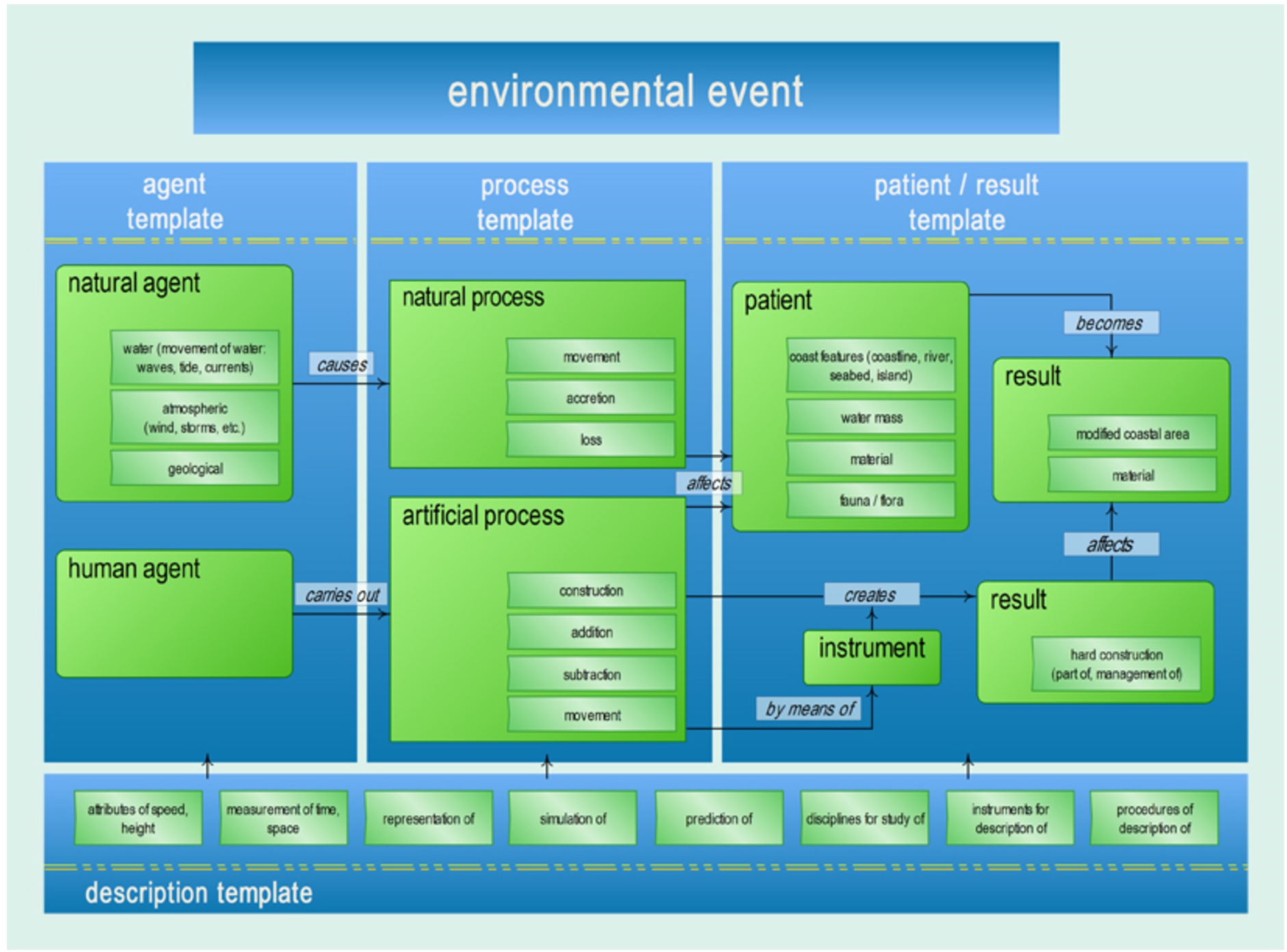
Environmental event by Faber (2009).
As can be seen in Fig. 1, according to Faber (2009), environmental events can have two types of agents that can trigger processes. Such agents can be inanimate (natural forces) or animate (humans). Natural agents such as water movement cause natural processes such as erosion. These agents therefore play the agentive role as described in (1d). This role can also be seen in the relationship between the patient of the natural process and the result (becomes). These processes in turn affect the patients (e.g. fauna/flora). There is no telic quale with natural agents, because telicity requires an intentional and purposeful action. The telic role as described in (1c) can only be found in relationships between an artificial process and its result (creates). Human agents can carry out artificial processes, such as construction, which can produce results or prevent effects that are normally caused by natural processes. Thus, according to León, Faber and Montoro (2012: 119), the relationship between natural agents and the events they cause runs parallel to the relationship between human agents and the events they consciously perform. This parallelism also extends to their subcategories.
In the representation of the seafood domain, not all elements of the frame proposed in Fig. 1 can be used. This is because frames mainly represent processes which are related to the roles (1c) and (1d), thus diverging from the classical ontology in which a taxonomy containing a classification related to the roles (1a) and (1b) is typically central. In fact, the domain of seafood, as represented in detail by Jiménez (2021), is mainly taxonomy-oriented, since the division of seafood into different classes is crucial for the representation of the domain. The relationships observed in the domain are therefore primarily hierarchical (hyponymy or meronymy) rather than process-oriented.
The objectives of our research were to observe how the domain of seafood could best be represented and to explore how different representation methods could be adapted to it. To do this, we chose two theories that focus on domain representation. Following the methods proposed by CTT and FBT, we have represented the domain of seafood in both an ontology and a frame. The frame is an innovative representation method proposed by FBT. Its application to our domain is part of a more general exploration of its contribution to the theory of terminology. The domain representation in an ontology is the classical and widely accepted approach for term representation and has been used as a baseline for comparison. This approach was introduced to terminology work by Wüster and maintained by Cabré. However, CTT rejects the idea of ontologies as cross-linguistic representations, arguing that each language should be treated and represented separately. Cabré’s view can be justified in our domain, since the resulting ontologies are in fact different, reflecting differences in cultural reality.
In order to represent a domain, it is necessary to first delimit it by means of a definition, which was presented and discussed in the introduction. As suggested by Cabré (1993: 92), the terminology work was carried out as follows. Once the domain had been defined and delimited, a list of ontologically and logically related concepts was drawn up for each language, which together form the structure of the seafood domain of each country. Each concept was then given a specific designation corresponding to the form actually used. In contrast to Wüster’s onomasiological approach, the semasiological approach adopted in CTT and FBT builds an ontology on the basis of real texts. Whereas in Wüster’s ATL, the starting point is the conceptual analysis of the domain, in the semasiological approach terms are identified in a corpus of language use. On the basis of a selection of published texts and subsequent expert interviews two monolingual termbases were created. Following the recommendations of Cabré (1993: 409), we created separate databases for Spanish and German, because we cannot assume that the same ontology applies in both languages. In fact, as indicated earlier, there are good reasons why they should not be the same. Starting from the lists of terms, we added information for each term, including its terminological definition, its relationships with other terms in the domain (hyponymy, meronymy, X is commercialised Y and X is consumed Y) and examples of its use in real contexts.
The terminology database therefore contains not only the names of individual types of seafood, but also the different classes into which they are divided and the parts of seafood that are relevant from a culinary perspective. These play an important role as hyperonyms and meronyms in both the domain representation and the definitions. As the structure of an ontology is more suitable for representing hyponymy and meronymy, these types of relationships are more prominent in the ontology than in the frame. In addition, the different methods of commercialisation and preparation of seafood were also included in the database, which also play a relevant role in the definitions and, where necessary, in determining the boundaries between the concepts of terms. These are represented in both the ontologies and the frame, but they are more prominent in the frame as this method is more process-oriented and therefore better suited to representing them. As suggested by Faber (2009: 127), a list of images was also included to help illustrate the terms.
The main problem encountered in creating the terminology database was synonymy, the fact that some concepts have different designations within the same domain. We adopted a descriptive approach towards synonyms. In cases where there were several designations for the same concept, all of them were included, but the designation that is most frequently used in the domain of seafood was chosen as the main form. The methodology we used is based on an alternation of top-down and bottom-up perspectives. The bottom-up perspective consists in extracting information from real texts from the domain in both languages. Since the concepts in the domain under study are mainly found in oral form or in documents such as menus, product labels or internet blogs, the frequency could not always be determined reliably by consulting a corpus. Where appropriate, it was supplemented by conducting internet searches. The top-down perspective consists of extracting information from specialised handbooks and other reference material, complemented by the help of experts in the field, in this case, fishermen, traders and cooks.
On the basis of the monolingual work carried out for the creation of the terminological databases and the representation of the domain in an ontology and a frame, an equivalence list was created to compare the Spanish and German terminological reality. Up to that point, all our terminological work had been carried out exclusively in one language in order to describe the linguistic reality of the country or culture concerned. These monolingual studies, which include the representation of relationships between the concepts and the characterisation or, if necessary, delimitation of concepts from each other, is the prerequisite for a cross-linguistic comparison of the terminologies, the aim of which is to assess the degree of equivalence.
The process of creating an equivalence list was carried out as suggested by Cabré (1993: 338). Once a terminology database had been created for each language, the designations corresponding to the same concept were related to each other. Elements such as the definition and the ontologies are the basic elements for checking correspondences. The first problem in creating the equivalence list was that some entries in one database had no equivalent in the other. According to Cabré (1993: 338), gaps in the respective lists should be filled by searching for supplementary material, consulting specialised lexicons and interviewing experts in the field. In order to find the equivalents, the concepts were checked in the bibliography of the field. Where necessary, we consulted field experts and showed them pictures of instances of the relevant concepts. Following another suggestion by Cabré (1993: 338), we also used multilingual texts standardised by an international body. The second issue encountered when compiling the equivalence list is that most of the equivalent terms have slightly different definitions in Spanish and in German. These differences do not lie in the zoological characteristics of the seafood, but in the way it is commercialised and prepared or consumed. In this context, Cabré (1993: 220) postulates that each language is associated with a particular view of reality and therefore a different way of describing its terminological universe. Nevertheless, in translation we need equivalents. By describing in detail how the concepts of the terms in German and Spanish differ, we provide translators with the information they need to come up with appropriate correspondences. The use of this information is determined in part by the translation brief, the instructions to the translator for the specific job. As explained by Nord (1997), the initiator of the translation job should determine the intended target audience and aim of the translated text, which Reiß and Vermeer (1984) call the skopos of the translation.
In parallel to the creation of the terminological databases, the domain of seafood was represented in two ontologies and then in a frame. In our domain the taxonomy plays a dominant role and processes are much less prominent. This is due to the fact that an important part of the domain is made up of the different types of seafood. The only elements of the ontologies that are not part of the taxonomy are the parts of seafood that are relevant from a culinary perspective, which are linked to the corresponding seafood in a meronymy relationship, and the two processes that take place, which represent the ways in which seafood is commercialised and prepared/consumed. Figures 2 and 3 show the ontologies that were created in parallel with the corresponding databases to represent the domains, based on the definitions established and later verified through expert interviews.
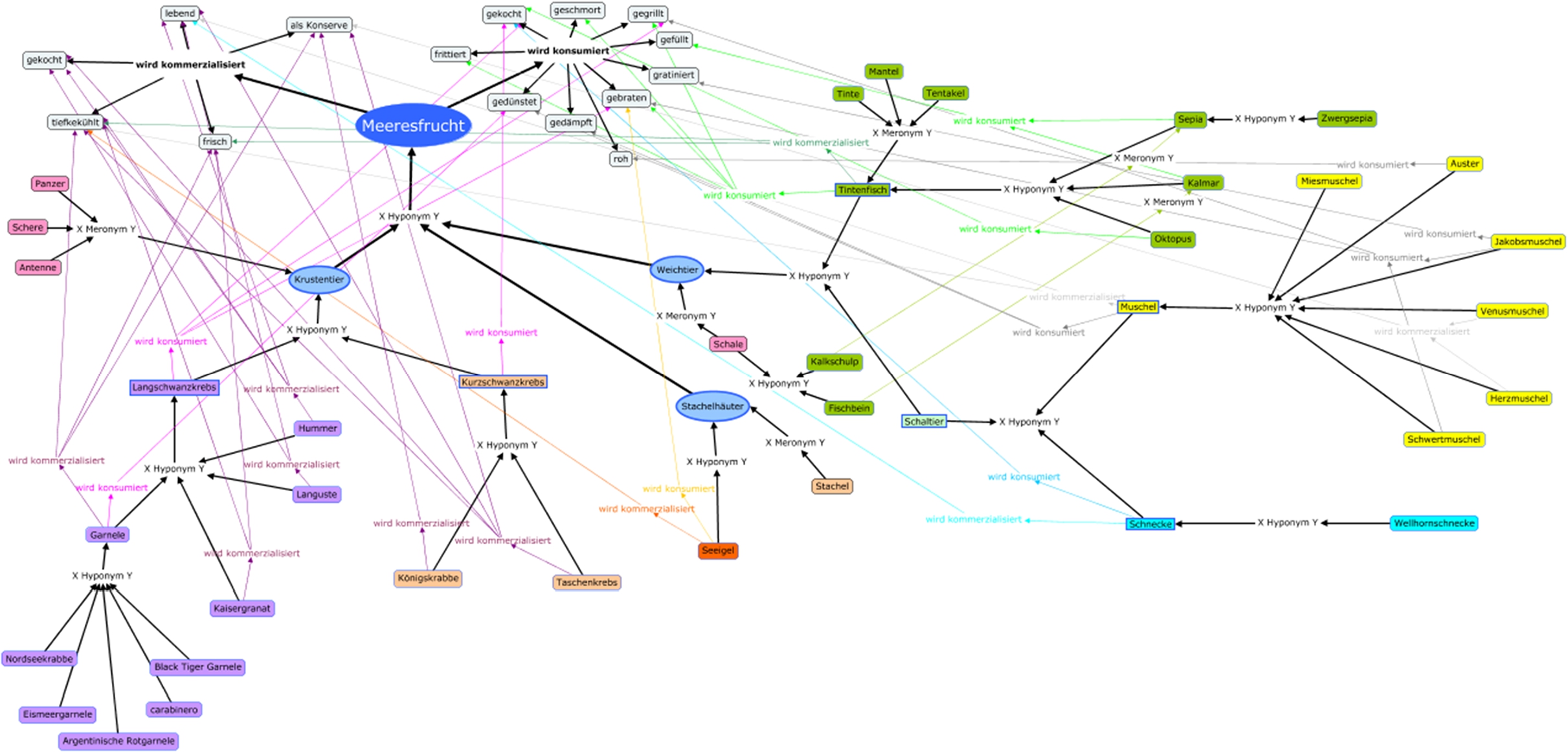
German ontology of the seafood domain by Jiménez (2021).
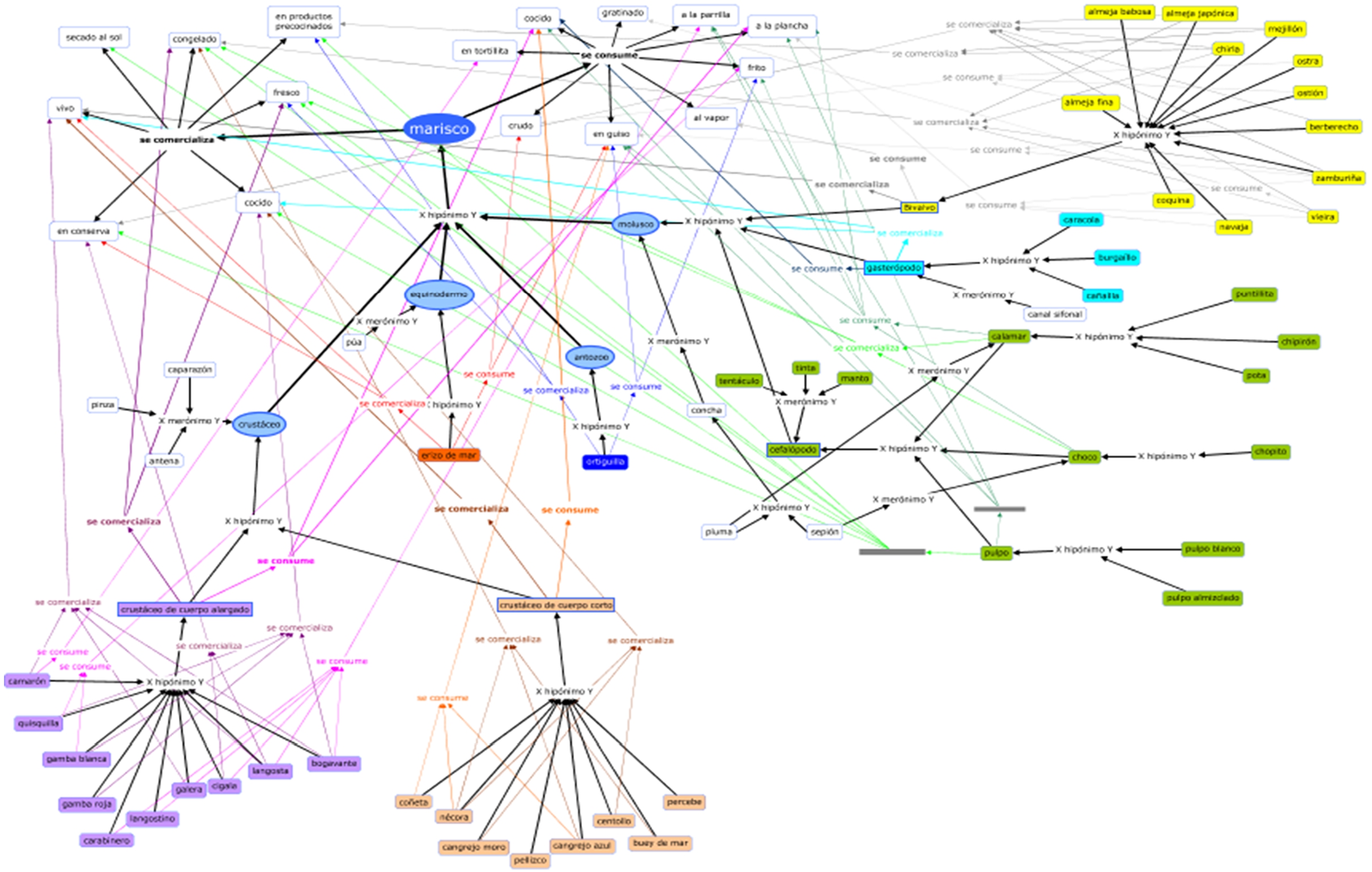
Spanish ontology of the seafood domain by Jiménez (2021).
As the ontologies created are too large for the format of this article and therefore not easily readable, we have only included them to give an idea of their structure and scope. Figure 2 shows the German ontology. The dark blue bubble represents the concept Meeresfrucht (seafood). Then, there are three light blue bubbles connected to it by hyponymy (X hyponym Y). These bubbles represent the three main classes of seafood and are divided into subclasses and then into individual seafood. The parts of the seafood that are relevant from a culinary perspective are also represented and linked to the corresponding seafood by meronymy (X meronymy Y). At the top left of the ontology represented in Fig. 2, the processes that take place in the domain are represented, namely those related to the commercialisation and preparation of seafood, so that each seafood is linked to at least one way of commercialisation and to one way of preparation.
Figure 3 follows a similar structure, but with some variations. The Spanish ontology has four main classes of seafood instead of three, and the number of terms forming the domain is considerably higher than in the German ontology. In fact, it is worth noting that the Spanish terminology database, with 76 entries, has 20 more entries than the German one, with 56 entries. For example, there are several types of shrimps, crabs and mussels that are common in Andalusia and are therefore part of the ontology shown in Fig. 3, but have no equivalent in Germany because they are not part of the cultural reality. Interestingly, the only German term that does not have an equivalent in the Spanish ontology is the general term Garnele (shrimp). One explanation for this could be that this term (which is used in German to refer to different types of shrimp) is too vague for the Spanish culture, where, according to our research, it is always specified which type of shrimp is being referred to. This reflects the cultural differences between the two cultures and confirms the hypothesis that the culture of a society shapes its terminology.
In ontologies as in Figs 2 and 3, all the terms of a domain are represented, together with their relationships. The definitions delimiting the concepts are presupposed in these figures. They appear in the termbase. Ontologies provide a detailed representation and are intended for experts. Due to their structure, they seem to be more suitable for representing the taxonomy of a domain. In an ontology, terms tend to be represented in a rather static way and without a communicative context. In Figs 2 and 3, both the parts of seafood and the processes that take place in the domain are linked to the individual seafood. In this way, each type of seafood is related to at least two other components of the ontology (way of commercialisation and way of preparation). In addition, most of them also have a hyponymic relationship with the class to which they belong and several of them have a meronymic relationship with the part or parts of their body.
Let us now turn to the frame as an alternative representation. In order to construct a frame for our domain, we took Faber’s (2009) frame for environmental events in Fig. 1 as a basis. Although the taxonomy of seafood is essential in our domain, it cannot be directly represented in a frame. Frames focus on events. In the case of seafood, three stages can be identified in the cycle from the birth of the animal until consumption. First, there is the growth of the animal. This also involves human intervention, in the form of farming, to stimulate and control this growth. Secondly, there is the harvesting and processing of seafood. Thirdly, we identified the commercialization and preparation for consumption. It is this third stage that we focused on. The events constituting the basis for this stage are represented in the frame in Fig. 4.
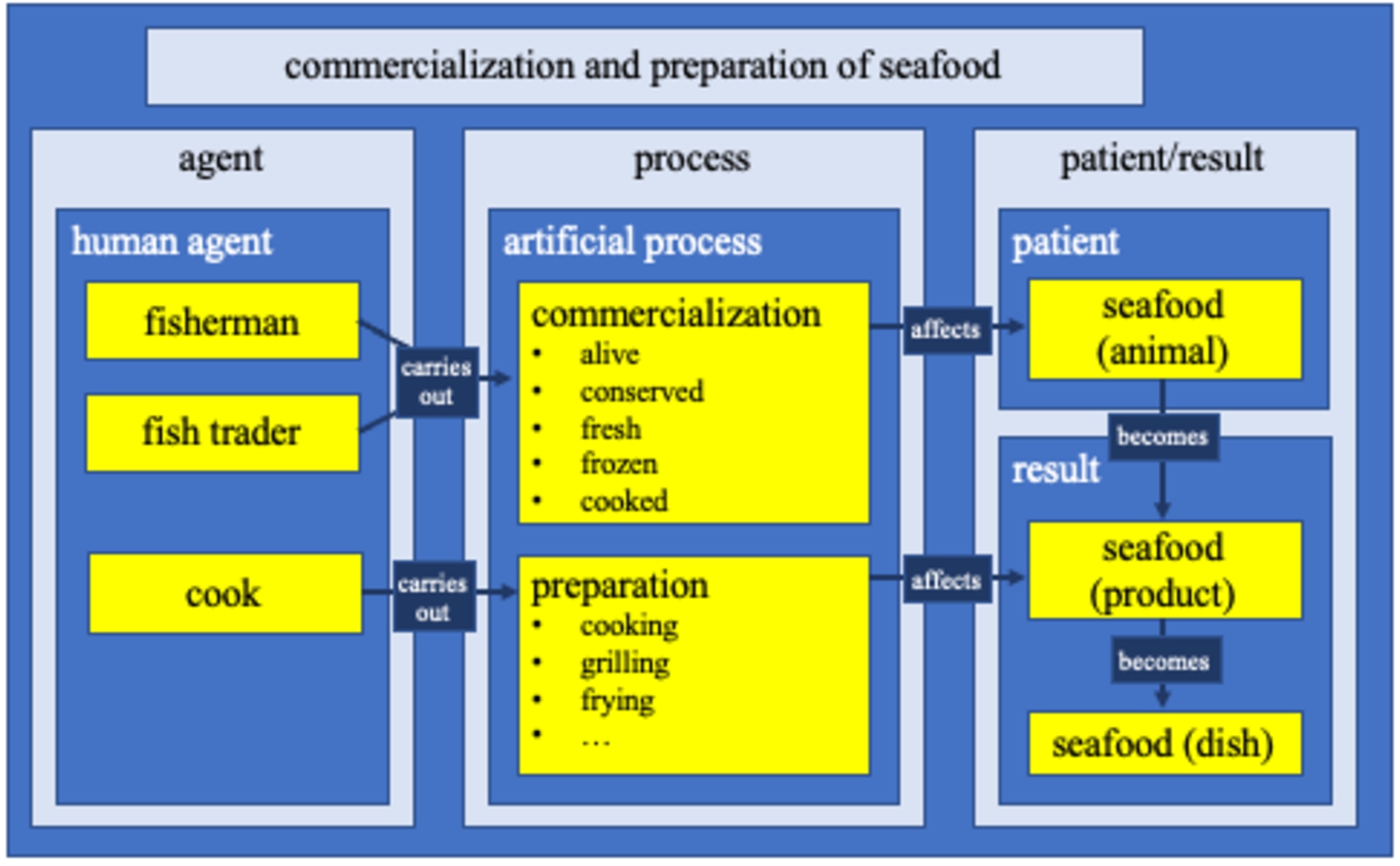
Frame of the seafood domain after Jiménez (2021).
The title of the frame specifies the events that are represented. As in the template proposed in Fig. 1, the left-hand box in Fig. 4 represents the agents, the middle box shows the two processes and the right-hand column contains the patients and the results of the actions. The left-hand box in Fig. 4 shows a first difference compared to the template in Fig. 1: since we are looking at it from an economic and culinary perspective, in the seafood domain there are no natural agents, but only human agents. The fishermen and the fish traders are the agents who carry out the commercialisation process. The bullet points that appear in the middle box refer to the different ways in which seafood is commercialised (top) and prepared (bottom). The middle box in Fig. 4 shows a second difference from the template in Fig. 1: in this domain there are no natural processes, but only artificial ones, i.e. carried out by humans. The process of commercialisation carried out by the fisherman affects seafood as animals. The output of the commercialisation process, which is seafood as a product, becomes the input of the preparation process. The cook then carries out the process of preparation, which affects the seafood as a product and transforms it into a dish ready for consumption. In this way, the two processes are combined in a single frame. The absence of natural agents and natural processes reflects the delimitation of the domain. When commercialization starts, the natural processes involved in the growth of the animals have terminated.
As frames are more process-oriented, the perspective had to be changed in order to represent the domain in a frame. This should not be seen as a disadvantage, as this type of representation provides an overview of the domain that the ontology does not provide. In fact, it is interesting to see how the domain representation in a frame works in a domain where processes are not central, since frames have typically been used to represent process-oriented domains. The main disadvantage of using a frame to represent the domain of seafood is the fact that, although it provides a general representation of the processes that take place in it, it does not provide information about how they affect the individual concepts, in this case, individual types of seafood. This means, it provides information about who carries out the processes, what types of processes there are, and who/what is affected by them, but it does not provide any information, as the ontology does, about how any particular kind of seafood is commercialised or prepared. Conversely, the frame provides generalizations about the type of information that is expected for each kind of seafood.
Faber (2009: 123) describes frames as cognitive structures based on experience that provide the background knowledge and motivation for the existence of words in a language and for the way in which these words are used in discourse. Frames have the advantage of providing explicit semantic and syntactic information about terms that ontologies do not usually provide. This includes a description of the conceptual relationships represented in a particular context of use. As demonstrated in Fig. 4, a frame can also be specified for a domain where events are not central.
This article focuses on the analysis and the representation of the domain of seafood in Germany and Spain. First, the domain was introduced and the research questions were presented. These can now be answered. The question of what the terminological reality in the domain of seafood in Germany and Spain is has been answered in many ways, such as through information provided by official sources and the representation of the domain in an ontology and a frame. The information gathered confirms that the discourse on the commercialisation and consumption of seafood is more articulated in Spain than in Germany. This difference is reflected in the ontologies, where it becomes clear that the Spanish terminology is larger and more finely structured than the German one.
For the question of how best to represent the terminological reality in our domain, we considered classical ontologies and frames. As in the domain we worked with the taxonomy has a central role, an ontology seems to be the best way to represent it. Frames are more suitable for representing process-oriented domains. However, we have seen that the frame has some advantages that complement the ontology, such as providing generalizations about the types of information that individual nodes in the ontology can be expected. As such, it can also be used as an overview of the domain by non-experts. Among non-experts, technical translators play a crucial role. As noted in Section 1, they need to access terminological resources without the detailed domain knowledge available to experts. Frames help them to interpret what they find in specialized termbases. Therefore, the best method to represent the domain comprehensively is a combination of an ontology and a frame.
The question of the extent to which the ontology of this domain is similar in Spain and Germany was answered with the ontologies shown in Figs 2 and 3. The cultural differences between the countries are reflected in the ontologies. A look at the ontologies provides visual evidence of the differences in scope and structure.
In this article we discuss the differences and similarities between the ontology and the frame and discuss which form of term representation is more appropriate for which type of domain. Looking at the qualia roles presented in (1), the ontology mainly contains a classification formed by the formal and constitutive roles representing the relationships of hyponymy and meronymy respectively. The frame proposed by FBT mainly contains processes related to the roles representing relations of function (telic role) and origin (agentive role). It can therefore be concluded that the representation of all four telic roles is not achieved by using a single term representation method, either in a frame or in a classical ontology. This leads to the conclusion that the best way to represent one domain such as the domain of seafood is to combine both methods of term representation. In Table 1 we present the differences between the ontology and the frame and illustrate why both forms of term representation complement each other.
Differences between ontology and frame
As Table 1 shows, if we look at the type of domain, the ontology is better suited for representing taxonomies, while the frame is a better method for representing processes. We have seen that the ontology is better suited to represent the seafood domain, as there are hardly any processes to represent. Nevertheless, the attempt to create an adapted frame in which the processes of commercialisation and consumption of seafood are represented resulted in a good overview of the domain, which brings us to the next point. Another important difference is that the ontology provides a more detailed representation and is aimed at experts, while the frame provides an overview of the domain that is also accessible to non-experts, even if it is a more superficial access to the domain. Furthermore, although the ontology provides a detailed representation of the domain, this representation method does not contain any explicit semantic and syntactic information, as is the case with the frame, which not only represents the specialised knowledge and organises it into categories, but also represents the semantic and syntactic behaviour of terminological units.
In the light of this research, the question may arise as to whether replication of this work in other domains and languages will again yield such clean results. Obviously, the domain will determine the form and structure of the ontology that represents it, as well as that of the frame. However, the results of our research suggest that similar results would be achieved in other domains. Domains based on a taxonomy are easier to represent in ontologies because the structure of ontologies is taxonomic in nature. As for frames, since they have not been used as much as ontologies, it will be interesting to see to what extent they can be applied as generally as ontologies. The influence of the language on domain representation will depend on the position of the domain in the culture of the language community concerned. This paper opens the door to new research that will shed light on how ontologies and frames could be adapted to be able to represent domains that may seem more difficult for them to represent. One idea for further research in this regard seems to be to develop a domain representation method that includes all types of relationships between terms within a domain or to adapt the already existent methods in order to broaden their scope.
After answering all research questions, it can be concluded that the terminological theories and methods used have been helpful in carrying out this analysis. In summary, this work has analysed and presented the domain of seafood from a terminological perspective that has hardly been researched systematically before, namely from an economic and culinary perspective. Furthermore, the concluding bilingual Spanish-German terminology comparison offers the possibility of a culinary rapprochement between the two cultures.