




Abstract
In the study of special languages and translation, the legal field is often insulated from other domains. This is primarily due to the extreme system dependence of the terminology of law, which results from a lack of a common legal system of reference throughout the world. The abstract nature of this human-made field and its dynamicity in view of the continuously evolving case law and constant changes in legislation make it difficult to illustrate its complex ontology through traditional terminology management techniques. Therefore, this paper argues for an interdisciplinary approach to constructing the ontology of legal concepts based on structural constituents from frame semantics and comparative law. Frames allowing for the representation of interconnected knowledge segments evoked by legal concepts and the distinction between micro- and macro-dimensions in legal comparison research make it possible to capture the complex ontology of legal terminology evoked in a specific point in time and a determined legal context. The ontological knowledge structure will be exemplified by terms from German social, commercial, employment, and tax law.
Introduction
Terminology was introduced as a theory by Wüster (1931), whose main goal was to standardize languages pertaining to a specific domain. This traditional approach, which he applied to the field of electrical engineering, has shaped the terminology management techniques that contemporary terminologists generally rely on in pursuit of establishing databases. As these often serve as suitable resources for translators dealing with specialist texts, the system of reference surrounding terminologies in different languages has become relevant when discussing the uniformity of specialized domains (Sager, Dungworth, & McDonald, 1980, pp. 70–76), mainly when it comes to exact sciences such as mathematics (Šarčević, 1997, pp. 66–67). Illustrating an entire structure of a specialist field, Roche (2007) introduces ontoterminology, which emphasizes the conceptual aspect of technical terms and pushes the traditionally dominant linguistic dimension into the background.
In this context, when juxtaposed with other specialist domains, the legal field has often enjoyed a special status. With regard to its ontological structure, one of the main features of legal languages – namely, their extreme system-dependence (de Groot, 2002, p. 228; Wiesmann, 2004, pp. 19–20) – adds complexity to working with terminology of law, which cannot be insulated from its national legal system. This is also due to the inextricable linkage between language and law, the latter of which cannot be expressed without words and sentences (Arntz, 2010, p. 17; Pommer, 2006, p. 15). In addition, the legal field is known for its abstract nature (Stolze, 2019, p. 374) and inherent dynamicity (Gémar, 2015, p. 483; Kjær, 1995, p. 54). As legislation and case law constantly evolve, it is impossible to solidify the meaning of legal terms, which would inevitably change in some way, shape, or form as the law develops.
Given these specificities inherent in legal terminology, continuing to regard the various abstract legal systems around the world from a mere terminological perspective has made it impossible to grasp and describe this continuously changing, non-universal domain. Therefore, this paper argues for a dynamic approach to constructing the ontological system in which legal terminology is imbedded. In this context, an adequate ontology can only be illustrated through an interdisciplinary approach when it comes to choosing the constituents of ontological structure, considering that it will take account of findings from both linguistics and legal studies. As for the linguistic component, frame semantics, initially developed to describe the individual understanding of general language by including the relevant encyclopedic knowledge pertaining to a lexical unit (Busse, 2012, p. 11) but successfully applied to specialized language (Faber, Márquez Linares, & Vega Expósito, 2005) and even specifically to legal communication (Engberg, 2018; 2020), allows for the representation of knowledge segments and their relation to other specialized frames through slots and fillers as well as intra- and inter-frame-relations (Fillmore, 1976; Varga, 2020). Frame-evoking legal terms can therefore be combined to illustrate the legal system, covering both micro- and macro-perspectives of legal ontology. With respect to the domain of law, ontological constituents can be found in legal comparison studies, where fungible and determining elements build both systems of reference of the nations to be compared (Constantinesco, 1971, pp. 263–264).
With such interdisciplinary frame-based approach, it is possible to illustrate a snapshot of the ontological legal system surrounding an entire set of legal terminology, established at a specific point in time during the continuous process of legal development.
Legal terminology in the study of specialized languages
As Arntz, Picht, and Schmitz (2014, p. 5) have demonstrated, terminology must be seen as a cross-disciplinary field of study since it aims to locate and analyze “designations [
It is essential to note that several authors have abandoned the traditional perspective on terminology. Temmerman (2000), for example, develops an alternative by introducing a socio-cognitive approach, which merges semasiological and onomasiological perspectives. Cabré Castellví (2000) criticizes the limited function of the traditional approach, shifting the focus to specialized communication. Another change, which is specifically relevant for the purpose of this paper, can be observed in Roche (2015), who emphasizes knowledge engineering and calls into question the traditionally linguistic dimension.
As the studies of specialized languages continue to foreground common features of languages used in a variety of subject matters, the legal field has often been insulated from other domains in several aspects, acquiring a special status in the light of terminology and specialist discourse. The area of law presents so many peculiarities and distinguishing challenges that jurilinguistics has emerged as an entire discipline, dealing with the special connections and synergies between language and law (Gémar, 2015, pp. 477–478; Vogel, 2017). Recent scholarship in the fields of legal linguistics and comparative law has even called into question the feasibility of translating legal texts into the language of other legal systems (see Chap. 2.2.1).
A language for special purposes
Authors such as Fluck (1996, p. 11) and Grass (1999, p. 12) observe that there is no consensus on a definition of specialist languages. Given the increasing number of concepts, and discipline-specific problems and questions that arise, it seems unlikely that, as linguistic research evolves (Mushchinina, 2009, pp. 36–37), precision in this category can ever be obtained. Abandoning the pursuit of a clear demarcation, Kalverkämper (1990) proposes positioning general language and specialized language at the ends of a scale. This allows researchers to determine the degree of specialization of a text by individually evaluating features that typically pertain to specialist language.
According to Stolze (2009, p. 44), however, the lack of a common definition does not interfere with the fact that specialist languages continue to fulfill specific purposes. One that is outlined by forensic linguist Thormann (2019, p. 49) is enabling efficient communication between experts. This is also in line with Lothar Hoffmann’s (1985, p. 53) traditional definition of special languages, who sees them as a combination of linguistic means used for specialist communication between persons active in a specific domain. If, in order to classify specialist languages, one focuses on the purpose of achieving domain-specific communication, the participants of such interactions must be located as well. As suggested by the same author, technical languages can be categorized vertically to cover the various constellations of specialized discourse, where recipients can also be laypersons (Lothar Hoffmann, 1985, p. 64; Roelcke, 2014, p. 160). This, however, contradicts the essential facet of this concept’s delimitation as suggested in Šarčević (1997, p. 9), namely the exclusion of laypersons in establishing the purpose of specialist languages. Correspondingly, the International Organization for Standardization (2019) equally restricts special languages to “communication between experts in a domain”.
This demarcation is of great relevance for the purpose of this paper, which consists in putting together a specialist ontology through frame-based knowledge segments for the legal field. Terms that are only to be understood by legal experts may be avoided in language used to communicate with a legal layperson as these are not destined to be universally accessible. This is why frames, which were developed to grasp the cognitive process of individual understanding of general language (Busse, 2012, p. 11), will be regarded as
Terminology science and management
Since Wüster (1931; 1974) introduced the General Theory of Terminology as the science of specialized terms, which presents a strong connection to the field of linguistics (Arntz et al., 2014, p. 5), a tool has existed to capture and standardize words and expressions in specific domains. According to Terral (2004, p. 877), the goal of terminology work is to establish a consensus regarding the connection between extralinguistic concepts and the signs used to designate them. In their comprehensive handbook on terminology management, which is based on the cornerstones of terminology science, Drewer and Schmitz (2017, p. 24) define the key objective of terminology work as the collection of specialized terms resulting in the establishment of terminological databases, glossaries, and specialized dictionaries.
For the field of specialized translation, multilingual terminological work plays a central role. Bilingual glossaries offer results of terminological research for specific language combinations. According to Felber and Budin (1989, p. 7), this task consists not only in finding equivalent terms between different languages, but also in a comparative activity, which is due to the fact that languages often represent concepts differently, causing gaps in designations and concepts (Drewer and Schmitz, 2017, pp. 26–27). This is reflected in Reinart’s (1993; 2009) publications on culture-bound elements, which can be found throughout various specialized languages, including the widely standardized domain of technology. In general, however, it must be noted that individual incongruencies do not constitute the main focus of practical terminology work, including in a translation context. Referring to exact sciences, for example, Šarčević (1997, pp. 66–67) speaks of common systems of reference, arguing that the extralinguistic reality of a field such as mathematics exists without strictly depending on a specific language.
The general idea of a referential system, introduced by Sager et al. (1980, pp. 70–76), has become relevant in terminology science and also plays a significant role in legal terminology in terms of the establishment of clear demarcations between similar legal terms (Grass, 1999, p. 17). This conception is a preliminary stage in Roche’s (2007, p. 2) application of ontology to the field of terminology, the necessity of which he justifies on the grounds of the traditionally dominant linguistic dimension of this field. Introducing ontoterminology, Roche develops a method that allows for the representation and structuring of a conceptual system as he puts the focus on the epistemological sphere of specialized terms, highlighting a knowledge system that is completely dissociated from any language discourse (Roche, 2007, pp. 9–12). The idea of an ontological construction of terminological conceptual systems that covers widely universal specialized domains can now be applied to the special case of legal languages, taking account of the specific constraints that the domain of law presents.
The special case of legal languages
Though there is no agreement on a delimited definition of special language (see Chap. 2.1.1), discussions about whether legal language constitutes one have been ongoing. Specialist languages are horizontally classified according to the world’s known academic fields (Lothar Hoffmann, 1985, p. 58; Roelcke, 2014, p. 155), bringing into being a specialist language pertaining to medicine for example. In this context, the legal field, which serves as a parallel specialist domain, has often been insulated from other fields of study due to its peculiar nature. Simonnæs (2002, p. 136) argues that the language of law may be regarded as a specialist language but that it cannot be strictly separated from general language. The close ties that the former has with everyday language constitute one of the special features endemic to the legal field. Schmidt-König (2005, p. 11) employs the term meuble to exemplify this particular interconnection: in standard French, the word refers to a piece of furniture; in a legal context, it evokes a very specific frame within the French legal system, namely a movable that would also encompass an animal. This linguistic choice showcases that both forms share the same formal designation but refer to different concepts, depending on what ontological system they are used in. According to Thormann (2019, p. 49), this is one of the reasons why legal terminology leads to confusion, especially when laypersons are involved in the communication process. Following the discourse surrounding the classification of specialist languages, one can argue that a clear demarcation is irrelevant to the language of law, as long as the focus is shifted to its purpose, namely enabling communication between legal experts. While abandoning the structuralist attempt of a clear delimitation, the distinguishing features of legal terminology must be outlined and taken into consideration in analyzing its ontological structure.
System-dependence as a distinguishing criterion
When describing the special case of legal languages, authors tend to distinguish between the legal field and the exact sciences. This distinction is particularly relevant for specialist translation and communication as well as contrastive terminology work, where technical terms from different languages that pertain to the same domain are compared. In subject matters such as mathematics, independent of the language, “signs refer to a common conceptual system and consequently a common knowledge system” (Šarčević, 1997, p. 66). According to Arntz (2010, p. 17), this universality also applies to other specialized fields such as technology and medicine. Šarčević (1997, p. 67) rightfully cautions, however, against oversimplifying this finding, which aligns with Reinart’s (1993) research on the variety of culture-specific concepts throughout the world’s disciplines.
With regard to the legal field, system-dependence undoubtedly constitutes one of the main features when scrutinized from a global perspective (de Groot, 1999, p. 204; Wiesmann, 2004, pp. 19–20). The reason for this, as outlined by multiple authors, is that the individual legal systems of the world’s various states are the result of historical processes and exist as integral components of particular cultures (Brand, 2009, p. 22; Sandrini, 1999, p. 9; Stolze, 2019, p. 374). When legal terms from different nations are compared, terminologists and translators observe clashes of different legal cultures, respectively consisting of culture-bound terms (Harvey, 2002, p. 40).
As a “system-bound discipline” (Engberg, 2013, p. 10), law manifests itself in the fact that “[e]ach national legal system uses terminology that does not necessarily correspond with the legal languages of other countries” (Brand, 2009, p. 22). Incongruency between legal systems has led to major intralinguistic researches such as Austrian linguist Muhr’s extensive project on German and Austrian legal terminology, which resulted in a lexicon of 2,000 legal terms that differ between both countries, including broadly used concepts, e. g. the different types of homicide (Muhr and Peinhopf, 2015). Following the traditional terminological approach, subtle differences in relations and knowledge elements cannot be disclosed, especially when terms are merely delimited by definitions. By building the ontological structure of system-bound legal language, one can argue that the use of the adverb necessarily in Brand’s observation becomes redundant as the individual frame relations and endless granularity of knowledge segments into subframes, which themselves constitute legal-culture-specific elements, can never be completely identical with the frame nets evoked by jurists in other countries. In developing a comparative approach for legal translation, Pommer (2006, p. 65) regards the general inequivalence of legal terminology, i. e. the fact that terms from different legal systems cannot be seen as full equivalents of one another even if they seem highly similar, as a necessary and initial assumption for an adequate methodology. This observation likewise aligns with the uncertainty numerous authors have raised regarding the possibility of legal translation (Glanert, 2011; Harvey, 2002; Legrand, 2005; Sparer, 2002). Legal comparatist Kischel (2009, p. 7) even goes so far as to call the idea of legal translation a “myth”, “a sublime aim never to be truly achieved”, which he links to the interconnections within each legal system, unlikely to be highlighted through anything other than ontological analysis. The generally proposed solution for this obstacle to legal translation is abandoning the quest for full equivalence (de Groot, 2002, p. 229) and finding approximate ones through legal comparison (de Groot, 2002, pp. 222–223). Comparing terms from two countries can be achieved by constructing the respective legal systems of reference through frames and frame relations, keeping in mind that a German legal terminology can only be illustrated ontologically if the adjective German does not refer to a natural language but to the Federal Republic of Germany, presenting a legal ontology that differs from the one in Austria and Switzerland.
Dynamicity of an abstract field
Compared to exact domains such as mathematics, the legal field belongs to the category of soft sciences, which by their substance cannot be rigorously specific (Glanert, 2011, p. 136). This has a direct influence on the stability and preciseness of this abstract man-made field of study. One of the main features that Gémar (2015, p. 479) attributes to the area of law is its innate ambiguity. According to Kjær (1995, p. 47), legal terms must remain flexible and elastic as they are open and subject to legal interpretation; their application must cover the greatest possible variety of extralinguistic scenarios, even when dealing with terms that are legally defined in statutes. This intrinsic feature directly affects the verbalization of legal concepts and the use of specialized terms, leading to a certain degree of instability between the plane of expression and the plane of content in law (Mushchinina, 2009, p. 36). The goal of establishing precision in the language used in statutes therefore remains a utopian ideal that is unattainable in practice; however, the preponderant necessity of a scope of legal interpretation justifies abandoning this objective (Mushchinina, 2009, pp. 34–35). As Sandrini (1996, p. 78) states, legal definitions must remain vague enough in order for courts to adapt them to concrete scenarios.
Apart from the general ambiguity of legal terms, it is important to note that the never-ending development of legal systems through legislation and case law results in the constant creation of new legal terms (Grass, 1999, p. 13). Over time, it is impossible to solidify legal terms and concepts (Gémar, 2015, p. 483). Their aforementioned vagueness not only enables legal development through case law but also allows a country’s legal system to change and adapt to its respective society (Glanert, 2011, p. 136). A legal system and its legal ontology must therefore be seen as a dynamic, constantly changing construct. As comparatist Großfeld (2003, p. 167) points out, it is a legal translator’s task to “catch these dynamics of the flow of time”. From the knowledge provided by case law and legislation, the ontological structure can thus be put together only as a snapshot of a specific moment in time, which can easily change minute to minute (see Chap. 3).
Last but not least, the abstract nature of the legal field must be taken into consideration when dealing with legal terminology. As a social science, law depends considerably on sociohistorical contexts (Terral, 2004, p. 887). One of the main purposes of this domain is to regulate human coexistence in a community (Mushchinina, 2009, p. 35; Sparer, 2002, p. 270). Legal provisions are destined to organize life in a community while reflecting the values the respective legal system is based on (Pommer, 2006, p. 43). The codification of law in the form of statutes specifically establishes and stabilizes social order and safeguards individual claims with the main goal of ensuring justice (Ludger Hoffmann, 1998, p. 522). The intrinsic nature of law causes abstraction to be one of the features of legal languages (Stolze, 2019, p. 374). Consequently, legal terms have no tangible equivalent in reality and only exist through language (Großfeld, 1984, p. 3). In contrast to natural sciences, legal concepts cannot be comprehended without the use of linguistic signs (Pommer, 2006, p. 15). While terms such as ‘possession’ and ‘ownership’ are a central focus of a plethora of court proceedings and legal discourse scenarios, they cannot be observed, expressed, applied, or even created as legal concepts without the use of language.
For a frame-based legal system of reference
Ontology had initially emerged in the field of philosophy to describe the nature of existence before it found its way into computer and information science (Gruber, 2009), which has become its preponderant domain of application, also considering the increasingly significant field of artificial intelligence, in which representation is a prerequisite for existence (Roche, 2007, p. 9). Today, in computer sciences, ontology is used and intended for knowledge modeling through classes, properties, and relationships (Gruber, 2009). In this context, it has proven relevant to a variety of disciplines, which can be exemplified by its use in bioinformatics, for which Bard and Rhee (2004) suggest bio-ontology for representation and knowledge structuring, while, in the area of mathematics, Johnson and Dampney (2001) propose the category theory as an ontological tool for research in computing. According to Roche (2015), the general use of ontologies as a tool of knowledge engineering opens the door to its application to modeling the notional system of terminology.
The uniqueness of legal languages, for which Grass (1999, p. 27) specifically points out the lack of a sufficient implementation of ontology at the end of the 20th century, makes it necessary to abandon the traditional approach to the terminology of law, which has so far mostly been dealt with in compliance with the principles of terminology management. In order to put together an adequate ontology of this domain, its intrinsic distinguishing features must be taken into consideration:
Due to the extreme system-dependence of law, no universal or general legal ontology can be created. While a legal term like contract is oftentimes demarcated by a definition according to terminological standards outlined in Drewer and Schmitz (2017, pp. 66–67), it remains a national (or even regional) construct that is not identical to the frame evoked in other countries. The American and British ontologies surrounding the respective concept evoked by the same signs differ in knowledge elements, e. g. with regard to the varying legal perception of good faith between both countries (Burton, 2015), as well as in their links to other legal concepts and legal sources governing contract law, which are never identical between nations. In this paper, the ontology depicts the legal system of the Federal Republic of Germany, therefore not corresponding with the same designations used in Austria or Switzerland. As exemplified in Chap. 4, this characteristic even goes below the national level as legal terms with the same naming are often not identical in meaning among different legal branches.
Legal terminology is characterized by vagueness and abstraction in order to be applicable to a variety of scenarios. Knowledge extracted for the construction of its ontology must be limited to the objective specialized legal information emanating from legislation, case law, and jurisprudence. No unnecessary concretizations should be made, and non-scholarly use of and elaborations on legal terms shall not be taken into account in order to maintain its abstractness, its applicability, and its openness to judicial interpretation.
Arntz et al. (2014, p. 5) argue that diachrony has no relevance for terminology. Piccini, Abrate, Bellandi, and Giovannetti (2021, p. 125), who present a model that specifically illustrates the diachronic evolutions of terms and concepts, explicitly criticize the general negligence of this dimension in traditional terminology work, which is limited to a branch of research involving, for example, the historical analysis of epistemological mutations in specialized discourse by Zanola (2014) and a typology of evolution phenomena in terminology dynamics introduced by Picton (2011). As for legal language, the ontology cannot be constructed independently of time. This circumstance has in fact led to extensive research on the history of legal languages, as conducted by Deutsch (2013). With new legislation constantly repealing, adding, and modifying legal concepts, and with courts evolving and adapting law via judicial decisions, the construction of frames varies at different moments in time. A frame-based ontology of legal terminology merely constitutes a snapshot of the legal field in the legal development process. In her comparison of the concept of marriage between France and Germany, drawn in 2005, Schmidt-König (2005, p. 158) names the union between a woman and a man as a prerequisite that both the French and German terms share as a distinguishing feature, insulating them from other nations’ legal traditions. However, this specific key frame element no longer exists. Same-sex marriage has since been legalized in both countries, rendering the knowledge segments captured in her research obsolete from this paper’s perspective.
Apart from the features distinguishing law from other specialist domains, it is also essential to take account of the interdisciplinary complexion of legal terminology. Specialized languages, destined to enable expert communication, primarily constitute linguistic research topics. In the case of legal language, law plays a pivotal role insofar as terminology – a cross-disciplinary field (Arntz et al., 2014, p. 5) – aims to observe and grasp already existing terms in legal discourse. This becomes especially clear when discerning the various facets of the recent field of legal linguistics, dealing with the role of language in law from both a linguistic and a legal perspective (Vogel, 2017). On this basis, it is necessary to develop an interdisciplinary approach to constructing legal ontology, which can be founded on frame semantics, a knowledge-based perspective in linguistics, as well as methodology from legal comparison studies, where legal systems are constructed and opposed to one another.
Construction and system of (specialized) frames
Following Busse (2012, pp. 11–13), frame semantics has been developed to describe the adequate understanding of general language by challenging the traditional structuralist perspective in linguistics, according to which every component of a language can be structured and delimited. This results in the general presumption that every word in a general language is precisely defined in a lexicon, where the ‘linguistic’ meaning of a lexical unit can be found. Frame semantics disclaims this restricting perception of a language by taking account of the entire knowledge that is activated as a result of the understanding process regarding general terms, which encompasses extralinguistic (or encyclopedic) knowledge as well. A frame, built through slots, which can be compared to blank data categories in terminology management, fillers, providing information for those slots, as well as relations, combining frames with their elements and other concepts (Varga, 2020, p. 27), therefore depicts a “building block” (Engberg, 2020, p. 271), a knowledge segment that is activated when reading or hearing a word or expression in a specific context.
Though initially developed for analyzing general language, frame semantics has been introduced into special languages, specifically into terminology and specialized translation. Faber et al. (2005, p. 3) applied frames for the complex representation of specialized fields, which they claim should be more than a list of objects. The authors highlight the relevance of the conceptual organization of terminology, in the context of which a frame-based network, which can be constructed through data extraction by means of corpus analysis, can more effectively illustrate the configuration of conceptual meaning than traditional terminology management techniques (Faber et al., 2005, p. 4). In her Frame-Based Terminology approach (FBT), Faber (2022, p. 356) presents the flexible nature of frames as an advantage to modeling the structure of concepts. Extracted from terminological definitions, frames “primarily stem from the nature of the concept itself as well as its combinatorial potential” (Faber, 2022, p. 358).
Based on Faber’s research, Lönneker-Rodman and Ziem (2018, p. 252) showcase how frames can be used both as analytical tools for knowledge structuring and formats for the cognitive representation of such knowledge. The authors outline the fact that terminology collections in line with the traditional approach result in glossaries in the form of simple lists of words (Lönneker-Rodman and Ziem, 2018, p. 254), which rarely depict the complex conceptual structure of terms (Lönneker-Rodman and Ziem, 2018, p. 277). Lönneker-Rodman and Ziem (2018, p. 284) therefore suggest a hybrid frame model based on two separate lines of research. The first aspect emanates from Minsky’s conception of frames, who suggests default assignments, allowing for the use of prototypical fillers for slots. This is exemplified by Minsky’s APPLE frame, in which the slot [form] is prototypically filled with the filler <round>, which can vary when constructing the frame of an individual apple (token) that might be shaped differently (Lönneker-Rodman and Ziem, 2018, pp. 266–267). On the other hand, the authors also base their hybrid format on Fillmore’s large FrameNet data base, offering a variety of slots, which can be used to represent terminological units (Lönneker-Rodman and Ziem, 2018, p. 284). By means of this model, terminological knowledge can be structured by granulating a frame into its fillers, which themselves constitute full-fledged frames, the meanings of which are as relevant for the understanding of the initial frame they are embedded in (Lönneker-Rodman and Ziem, 2018, pp. 278–279).
As for the domain of legal translation, Engberg (2018, pp. 38–39) has suggested the application of frame semantics in line with his classification of the translation of law as a knowledge communication process. Taking into account the special status that legal languages enjoy when juxtaposed with other specialized fields (see Chap. 2.2), the researcher proposes the following construction of frames for the comparative process:
Deliver characteristics of legal concepts with a focus upon relations of similarity and difference to concepts from other legal systems – as candidates for fillers in the conceptual frames that translators must build in order to make relevant formulation decisions in accordance with the translational situation. [
The author justifies the use of frames by claiming that they enable modeling of connections between isolated elements of a frame-evoking concept along relevant dimensions (Engberg, 2018, p. 40), which he puts on the same level as slots and sub slots while considering fillers the “material” that fit the respective dimensions (Engberg, 2021, p. 13). Extracted from “domain-internal sources” such as encyclopedias and statutes (Engberg, 2018, p. 40), frames enable readers of a legal text to construct a certain cognitive structure (Engberg, 2018, p. 39), thereby enabling the comparative legal translation process. The framing of terminology and its application to the legal communication process provide a descriptive tool that must be aligned with ontological techniques from the legal field, which are omnipresent in legal comparison.
Ontological approaches in legal comparison studies
Comparatist Husa (2015, p. 19) provides the following definition for the study of comparative law:
It is possible on the general level to present a blueprint definition and say that comparative research of law aims at lining up different legal systems in order to generate information. Comparative law is aimed at the legal systems of different States (or State-like formations) or their segments that are significant for research problems.
While its relevance may be discussed extensively, this discipline plays a specific role in contrastive terminology contexts. When legal languages from different nations are opposed or compared to one another, legal comparison becomes a necessary step (Kjær, 1995, p. 42). This is also the case when legal terminology is transferred into another language in a legal translation setting, which, according to most authors, entails legal comparison as a mandatory phase when more than one legal system is involved (de Groot, 2002, pp. 222–223; Engberg, 2020, p. 264; Prieto Ramos, 2011, p. 13). Comparison, which is of great relevance even in general translation studies (Pommer, 2006, p. 37), must, according to Grass (1999, p. 34) and Cao (2007, p. 29), be applied in legal translation specifically due to the general incongruence between legal terminologies of different nations. Gémar (2015, p. 481) and Bocquet (2008, p. 13), however, point out that such comparisons must be adapted to the translation process, a frequent observation that leads Pommer (2006) to develop a comparative method specifically retrofitted for translators of legal texts. On the other hand, adapted approaches grow out of the jurists’ research on general legal comparison, which itself is accepted as possible despite the general incongruence between legal languages due to a praesumptio similitudinis (Zweigert, 1973). This is due to the fact that nation-bound concepts such as those based on procedural law, though different between countries, can still be considered similar, allowing for a common basis for the understanding and transfer into another language, as Stolze (1999, pp. 174–175) exemplifies with formal-law terms.
This specific discipline is of great relevance for the construction of legal ontology as “lining up different legal systems” (Husa, 2015, p. 19) calls for putting together both objects of comparison in the first place, a task that in a purely national setting seems superfluous and therefore is usually not explicitly tackled. Sandrini (2009, p. 152) describes a legal system as consisting of legal institutions, legal provisions, and legal terms, which he classifies as building blocks of the system in question. Husa (2015, p. 19) goes even further with his illustration of what a legal system encompasses:
To simplify, legal system refers to the entity formed of legal norms, which in addition to statutory law and case law includes customary law, established legal practices, legal concepts and a specified way of handling and classifying legal concepts and norms. In most cases it is a question of a normative system of legal rules that are in force in a State or a State-like formation. ‘Legal system’ is said to be an entity formed by law in force or valid law. If we use the term ‘legal system’, we normally mean the more extensive entity that covers the ‘legal order’ (German Rechtsordnung, French ordre juridique) and legal thinking as well as including legal cultural dimensions.
The supplementary concepts Husa adds, such as legal thinking and established legal practices, challenge the simplistic perception of legal systems as mere combinations of equally valued building blocks constituting legal elementary particles, which has led Constantinesco (1971) to introduce determining and fungible elements for the purpose of grasping the spirit of a nation’s system through a differing balance.
In his groundbreaking publication on Comparative Law, Constantinesco takes on the question of how the respective objects of comparison can be built for the comparative process. This (implicitly) ontological approach allows for an analysis of both legal systems on micro- and macro-levels. The comparatist associates micro-comparison with isolated legal provisions and legal institutions, judging it as limited and as producing merely fragmented results as the legal system is disassembled into its tiniest cells, which in themselves are allegedly not too different from those in other systems (Constantinesco, 1971, p. 258). He argues for a shift of emphasis towards the macro-perspective, which is said to bring to the fore the real characteristics of a legal system (Constantinesco, 1971, p. 259). In order to illustrate the structure of any system, the author compares it with an atom (Constantinesco, 1971, pp. 262–264), consisting of an atomic nucleus that is surrounded by an electron shell; he then compares the atom to a planetary system with the sun as its core and other planets as mere surroundings. The atomic nucleus is built from neurons and protons. It is the smallest yet most important part of an atom, given that it carries all its weight. Applied to the legal field, the legal nucleus is described as the core containing all such legal elementary particles that constitute determining elements and are surrounded by a litany of fungible elements. The determining elements play a key role in his model as they are of ideological and teleological significance, giving the legal system its individual character and distinguishing it from others. Such elements are, for instance, the perception and the role of the law, which he illustrates by contrasting the former Soviet legal system, which constantly had to be adaptable to accommodate official ideology propagated by the Soviet Union, to the European and American legal systems, in which the law can be at direct odds with the principles of its nation (Constantinesco, 1971, p. 266). Other determining elements are the conception and role of the state, the fundamental rights of citizens, and judicial interpretation, which indicate whether the state is subject to the principle of separation of powers, whether its citizens are protected from certain extents of state authority, and what role a judge plays when it comes to interpreting legal provisions (Constantinesco, 1971, p. 267). This type of element, the knowledge of which is also considered essential in a legal translation context with regard to judicial interpretation and legal reasoning (Prieto Ramos, 2011, p. 13), directly influences the entire legal system and determines all other particles (Constantinesco, 1971, p. 265). This theory aims at creating an objective criterion for the classification of legal systems into overarching legal spheres (Constantinesco, 1971, p. 271).
Zweigert and Kötz (1996, pp. 4–5) likewise address the distinction between the micro- and macro-perspectives. While these comparatists do not specifically structure both levels according to relevance, they do use a similar classification. Micro-comparison concerns single legal institutions, issues, and rules and can be exemplified by the country-specific circumstances surrounding the custody of children in case of a divorce. The macro-perspective, on the other hand, deals with general questions such as methods of judicial interpretation, law-making procedures, and even the specific styles and structures in legislation and court decisions. While these perspectives on putting together a legal system do not depart from Constantinesco’s model, Zweigert and Kötz insist on the fluidity and blurriness of the separating boundary as both forms depend on one another. This is exemplified by the micro-concepts of medical malpractice and strict product liability. While both are primarily composed of the specific legal rules regulating the individual damages and liability, the authors see their relations to other concepts as equally relevant. To adequately illustrate the former, it is deemed necessary to indicate the specific conditions regarding the use of related evidence in court as well as the role of the expert witness that would testify to this matter. As for the second example, taken from the US legal system, it is important to note that the corresponding trial would include a jury, which would assess damage and damages while keeping in mind the significant success fee for US civil lawyers. According to the authors, micro-comparison is therefore of use only when the institutional surroundings, within which the micro-object has developed, are taken into consideration as well – an observation that puts Constantinesco’s separation according to relevance into perspective.
Finnish comparatist Husa (2015, pp. 100–101) engages the field of economics to exemplify both dimensions: while micro-economics deal with “small economic units” such as an enterprise or an individual line of business, the macro-dimension regards “extensive economic phenomena that take place on the national or international level”, including economic growth and unemployment. As for comparative law, the author refers to the differentiation proposed by Cuniberti (2019) and argues that micro-comparison deals with individual legal rules and legal institutions, the latter of which can refer to both a “positive law institution” such as a specific court or to “normative and operational legal institutions”, which encompass the legal concept of marriage, while macro-comparison is done on a higher abstraction level and takes place even between legal families or legal cultures, citing legislative methods and the doctrine of legal sources as examples (Husa, 2015, pp. 101–102). Just as Zweigert and Kötz point out, Husa emphasizes the impossibility of establishing a clear demarcation between the micro- and macro-dimensions, which forcibly leads to flexibility regarding a classification. The comparatist adds, however, that “there are no reasons for too rigid distinctions in a discipline so pluralistic as to its nature” as the approach chosen depends on the perspective and angle the comparatist takes in the scope of their “own knowledge-interest” (Husa, 2015, pp. 103–104).
An interdisciplinary approach to legal ontology
Adapting frames to normative legal languages
Since Faber et al. (2005) applied frame semantics to complex specialized disciplines, frames have proven suitable formats for conceptual representation (Lönneker-Rodman and Ziem, 2018). As Faber et al. (2005, p. 3) point out, such concepts must be placed in a specific setting. With respect to legal terminology, this depends on the context, text type, and legal subfield the term is used in. As illustrated in Chap. 4.1, the example Gesamteinkommen as well as its subframes <Arbeitsentgelt> and <Arbeitseinkommen> can only be represented in accordance with specific legal branches and evoke a different frame if used in another context. The hybrid frame model introduced by Lönneker-Rodman and Ziem (2018, p. 284) relies on the extraction of slot types from Fillmore’s FrameNet database. While this presents a helpful approach for the framing of terminology, the high degree of interdependency of legal terms does not allow for a limited number of relations and slots but must ensure a certain flexibility for the creation of these structural constituents depending on how legal terms must be interpreted by jurists in a specific context. This is showcased in the case study (see Chap. 4), where slots constitute very specific subframes defined by law, determining the frame they are part of.
This also puts two other aspects into perspective. For one, the reference to Minsky’s approach, allowing for the construction of abstract frames, the slots of which can be filled with different materials when the frames are linked to specific tokens, which is also in line with what Faber (2022, p. 356) describes as the advantage of flexibility, cannot be applied to legal terminology as a general approach. While some legal terms constitute concrete tokens of an overarching abstract term, such as the two types of approval Einwilligung and Genehmigung as specific types of the general Zustimmung in German civil law, their interpretation may be individually limited by certain case law, which would change their entire structure and relations to other concepts. Legal frames must therefore be constructed for the legal concept used in a specific context and emanating from a concrete legal branch. Secondly, the building of a frame network through data extraction by means of corpus analysis (Faber et al., 2005, p. 4) must be limited to the relatively few sources in law, such as legal encyclopedias and statutes (Engberg, 2018, p. 40), which are used by jurists, namely judges, when analyzing legal terms in courts, in order not to limit the vagueness that is required for interpretation and in order to ensure the normative function of legal terms. As for the relevance of the recursiveness in frames (Lönneker-Rodman and Ziem, 2018, pp. 278–279; Varga, 2020, p. 30), this plays a central role in legal terminology as the understanding of subframes is pivotal for the interpretation of the frames they are embedded in.
Gaining the reputation of an antithesis of the traditional structuralist perspective in linguistics, frame semantics has proven its utility for adequately describing the understanding process related to standard language (Busse, 2012, p. 18). Compared to technolects, general language is not inherently normative and can be perceived differently by individuals, making it necessary to conduct vast corpus-based analyses in order to establish what generally is understood by a lexical unit in a linguistic community. This constitutes the key distinction with regard to normative legal terms2
It is imperative to note that legal terminology presents a certain degree of vagueness and instability in order to remain adaptable to concrete scenarios and subject to interpretation as shown in Chap. 2.2.2. Therefore, the ontologist must grasp the semantic field as evoked by the current legal consensus based on applicable legal sources and legal scholarship without imposing interpretation on the prescribed openness.
While the need for ontological structuring of the legal system seems to be pertinent specifically in legal comparison studies, it is pivotal to note that comparative law and legal translation, where terminology becomes relevant, pursue different interests and goals (Engberg, 2013, p. 10), which is why the comparative approach must be adapted and connected to a translation process (Gémar, 2015, p. 481). Constantinesco’s reasoning regarding his take on the micro- and macro-dimension of legal terminology goes to the very heart of the study of legal comparison. He suggests abandoning the perspective of equal classification of legal elementary particles and hence transitioning from a micro- to a macro-perspective in order to illustrate the fundamental structures of a legal system (Constantinesco, 1971, pp. 270–271). This seems convincing with respect to the comparatist focus on classifying the world’s legal systems into legal spheres as the current major overarching groups such as the Anglo-American, European, and Islamic, respectively consist of sets of legal systems that share distinctive features. This primarily legal approach, however, does not constitute the main purpose of contrastive legal terminology. In his extensive research on this specific topic, Sandrini (1996, pp. 153–154) highlights the exact role that comparative law plays in working with terminology of law, which lies in establishing relations between legal terms of different systems while taking account of the relevant higher dimensions that a “rechtliche Mikrostruktur” [legal microstructure] is embedded in. When dealing with contrastive terminology, it is important to note that microconcepts – and therefore the entire micro-perspective – are the primary object of study and thus cannot be dismissed as being of secondary importance. By introducing determining elements, Constantinesco (1971, p. 266) creates a tool to locate the core of a legal system, which allows for the assessment of the role the legal system in question plays in the context of the official ideology of its nation. While this is relevant for legal studies as a discipline, the area of terminology work and management cannot grasp such overarching principles. Fungible elements are described as secondary, replaceable, already determined, and having only weak connections to and no influence on the legal system (Constantinesco, 1971, p. 269). While this might be true in the context of classifying and distinguishing the world’s legal systems, it can in no way be applied to contrastive legal terminology. Fungible elements, which encompass both legal norms and legal institutions (Constantinesco, 1971, p. 264), expressed by legal terms, are the key components of a legal system. According to Pommer (2006, p. 64), legal terms are the key information carriers of a legal text and represent the content of the legal system they emanate from. Their relevance manifests itself in a legal translation scenario: without establishing and comparing the terminological concepts of the French legal institution mariage and the German Ehe, a French-to-German translation of a legal document containing this legal term would not be possible. The author’s justification of the unsuitability of fungible elements for an adequate construction of a legal system lies in their transnational similarity: the extensive distinction between German law and the former Soviet legal system can only be illustrated via determining elements as isolated fungible elements tend to be similar between both jurisdictions, which might misrepresent the uniqueness of the individual states (Constantinesco, 1971, pp. 271–272). In the context of legal translation, on the other hand, the presupposed similarity between legal systems is limited by the principle of general inequivalence between terminologies of law. First off, the degree of similarity between legal institutions from different nations can only be evaluated through concept-based legal comparison, keeping in mind that they are in no way identical. As frame semantics shows, knowledge segments are built by knowledge elements and logically and ontologically connected through different types of relations, making it impossible to capture the exact same frame in another legal system of reference (see Chap. 3.1). In both contrastive legal terminology and the translation of law, legal comparison is the main tool that makes a foreign legal concept accessible to the recipient of the target legal language. This work functions specifically by comparing a concept from one legal language to a concept in the target legal system that has the highest degree of approximate equivalence (see Chap. 2.2.1). The presupposed similarity between fungible elements emanating from different legal systems therefore poses no threat to the uniqueness of the ontology of a legal system, but rather creates a fruitful basis for legal communication between jurists cognitively evoking different ontological structures.
The differentiation between the micro- and the macro-dimension proposed by Zweigert and Kötz (1996, pp. 4–5) is rather similar to Constantinesco’s approach, with one key distinction: instead of classifying the ontological dimensions according to relevance, the comparatists emphasize the interconnection between both perspectives, stating that micro-comparison cannot be done without accounting for macro-elements and vice versa. The micro-concepts designated by legal terms can only be adequately described and used as particles constructing legal ontology when embedded in a way that overarching principles are taken into account. However, in terms of terminology, the micro-terms must, in reference to Pommer (2006, p. 64) highlighting their role in legal texts, be considered the main compounds of the ontological structure. This is also in line with Husa’s (2015, p. 101) pivotal observation about the relevance of the extent of legal comparison for the choice of focus on either the micro- or the macro-dimension, considering it a “question of scale and focusing”. For the context of this paper, where the ontological system of reference of legal terminology, consisting of individual terms or concepts, is to be put together, the micro-dimension plays the most important role as it constitutes the starting point of the frame-based construction with frame relations linking the concept to the macro-dimension.
A frame-based legal ontology
By adapting system-constructing approaches from both the field of linguistics, where the semantical universe of terms can be illustrated by means of knowledge segments, and the study of comparative law, where the construction of the micro- and macro-dimensions of legal systems becomes necessary for enabling comparison, to normative, dynamic, vague, abstract and system-dependent legal language, an interdisciplinary approach to constructing the ontology of legal terminology can be created, taking account of preferences from both disciplines.
The concept of a referential system that was introduced into terminology (Sager et al., 1980, pp. 70–76; Šarčević, 1997, pp. 66–67) has allowed for the illustration of a knowledge system surrounding a specialized term, including in a multilingual and thus contrastive setting. In order to push the purely linguistic perspective on terminology into the background and thereby foreground its conceptual dimension, Roche (2007) applies ontology to terminology, shifting the focus to the construction of the extralinguistic reality that is merely expressed in linguistic signs. This makes it possible to define the
For a frame-based ontology of legal terminology, the micro-dimension can by all means reflect the legal institution as is the case in comparative legal studies since the legal concept is evoked as a starting point when reading or hearing a legal term in a specific context. As the activated frame is built by fillers, which serve as subframes in the given situation, these can be designated as part of the sub-micro-dimension of the initial frame. Determining the dimension according to slots and sub-slots also corresponds with Engberg’s (2021, p. 13) perception of frame dimensions in law. As soon as the sub-frame is analyzed and illustrated as a full-fledged frame, a shift in dimension occurs and the former subframe assumes its place in the micro-dimension, constructed by new sub-frames on the frame’s sub-micro-dimension. Contrary to the definition of the macro-perspective in comparative law, which refers to elements regarding the soul of a legal system and its position and role in the state (see Chap. 3.2), the macro-dimension for the ontological construction of legal frames must designate the frame network outside of the frame in the micro-dimension. This encompasses other frames that the frame chosen as a starting point is connected to via inter-frame-relations as well as any overarching frames that the analyzed frame may be embedded in. Considering that the ontology of a legal system cannot be constructed without a context, given that legal concepts are interconnected and become rearranged in a new setting, the types of dimensions depend on the frame that is activated as a starting point when perceived in a specific context, and the knowledge structure constituents are chosen in a way that they reflect the legal understanding of the term provided by authoritative legal sources.
Case study
Taking account of findings from comparative law, legal linguistics, and semantics, an interdisciplinary approach can be applied to constructing the ontological structure of a legal term. For the purposes of this paper, legal terminology cannot be regarded from a neutral and contextless point of view. Legal terms have a specific function and depend heavily on the text and situation they are found in. It is therefore helpful to use a legal text that would be the object of a translation process as a starting point in order to determine the exact role a legal term and its evoked frame-based knowledge structure play in the context in question. For the illustration of how this approach can be applied to legal concepts, the text type used for terminology extraction is a judicial decision rendered by a supreme court as a result of an appeal in error, the relevance of which can be justified by the fact that court judgments are generally translated for other nations to assert a specific right in a foreign country’s court or authority and are therefore scrutinized by terminologists and translators. As the presented legal terminology illustrates the legal system of the Federal Republic of Germany, it is important to note that the English words used to refer to concepts in this paper shall merely be regarded as descriptive and in no way considered legal equivalents suggested for translation for English-speaking countries.
Gesamteinkommen
The first example, Gesamteinkommen, which designates a type of income, can be extracted from a judicial decision rendered by the Federal Social Court of Germany (Bundessozialgericht). In Germany’s social law branch, the Bundessozialgericht serves as the final arbiter of appeals in error, as indicated in section 160 of the German Social Courts Act (SGG). The appellate judgment from October 18, 2022, marked
Die Beklagte stellte daraufhin fest, dass in der Zeit vom 1.11.2014 bis zum 28.2.2016 die Familienversicherung in der gesetzlichen Krankenversicherung (GKV) wegen eines zu hohen Gesamteinkommens [emphasis added] von mehr als einem Siebtel der monatlichen Bezugsgröße nicht bestanden habe [
It is necessary to note that this specific term can also be found in legal texts relating to the employment law branch of the German legal system as is the case in the appellate judgment marked 10 AZR 59/12 from April 17, 2013, rendered by the Federal Employment Court of Germany (Bundesarbeitsgericht):
Der Kläger hat die Auffassung vertreten, die Beklagte berechne den pfändbaren Teil seines Einkommens nicht zutreffend. Gemäß § 850e Nr. 1 Satz 1 ZPO seien zunächst die nach § 850a ZPO unpfändbaren Beträge mit dem Bruttobetrag abzuziehen und anschließend die auf das Gesamteinkommen [emphasis added] entfallenden Steuern und Sozialversicherungsabgaben in Abzug zu bringen. (Bundesarbeitsgericht – Pfändung des Arbeitsentgelts, 2013)
While the latter equally uses this term in conjunction with social security contributions, it is not related to the same signs that can be found in the social court decision. Instead, the term merely designates a person’s total income in a general sense without referring to a fixed legal definition of this term. In order to understand the social court decision’s use of the term Gesamteinkommen, on the other hand, it is important to keep in mind that German social law presents its very own definition necessary for the (re)construction of the corresponding frame.
As it is used in the social law branch as a specific subsystem of the German legal system in the context of family insurance, the applicable statute that deals with coverage of family members must be consulted. Section 10 Subsection 1 of Volume V of the German Social Insurance Code (SGB V) deals with this specific question and uses the legal term Gesamteinkommen as follows:
Versichert sind der Ehegatte, der Lebenspartner und die Kinder von Mitgliedern sowie die Kinder von familienversicherten Kindern, wenn diese Familienangehörigen [
5. kein Gesamteinkommen [emphasis added] haben, das regelmäßig im Monat ein Siebtel der monatlichen Bezugsgröße nach § 18 des Vierten Buches überschreitet[.]
In this section, the context for the use of this term becomes evident. It is employed to set a limit for the total income that allows family members to be covered by insurance without the obligation to pay own contributions. In order to construct the ontology of this legal concept, one must note that legal commentary, considered a relevant source in the German legal practice, refers to the social-law definition of Gesamteinkommen, set forth in another volume that is to be applied to section 10 SGB V (Knickrehm, Kreikebohm, & Waltermann, 2021, p. 1234). The definition in question can be found in section 16 of the Fourth Volume of the German Social Insurance Code (SGB IV), which states:
Gesamteinkommen ist die Summe [emphasis added] der Einkünfte [emphasis added] im Sinne des Einkommensteuerrechts; es umfasst insbesondere [emphasis added] das Arbeitsentgelt [emphasis added] und das Arbeitseinkommen [emphasis added].
In this legal definition, the example is defined as the total of the forms of income designated as Einkünfte as determined in German income tax law. At this point, two decisive observations can be made: not only does the designation Gesamteinkommen evoke two different frames, depending on whether it is used in social law or in employment law, but the term Einkünfte also must be semantically interpreted pursuant to its perception in income tax law. The adverb insbesondere used in section 16 SGB IV emphasizes two forms of Einkünfte without limiting the definition to these two options. According to legal commentary on this volume, this section constitutes the legal definition of Gesamteinkommen for all branches of German social security law, including the subdivision family insurance; in addition, it states that the forms of Einkünfte, a term in tax law that must be separated from Einnahmen, a similar-sounding tax law term (Winkler, 2021, pp. 202–203), constitute the concept in question that must be extracted from section 2, subsection 1 of the German Income Tax Act (EStG) (Winkler, 2021, p. 201), which reads:
Der Einkommensteuer unterliegen
1. Einkünfte aus Land- und Forstwirtschaft,
2. Einkünfte aus Gewerbebetrieb,
3. Einkünfte aus selbständiger Arbeit,
4. Einkünfte aus nichtselbständiger Arbeit,
5. Einkünfte aus Kapitalvermögen,
6. Einkünfte aus Vermietung und Verpachtung,
7. sonstige Einkünfte im Sinne des § 22[.]
These types of Einkünfte, which in number 3 and 4 reformulate the two forms of income emphasized in section 16 SGB IV, constitute the conclusive list of types that are subjected to income tax (Winkler, 2021, p. 202). With this normative legal information, the frame GESAMTEINKOMMEN can be built in its microperspective as it is legally constructed by the total of all types listed in the German Income Tax Act, without adding irrelevant knowledge elements that could restrict the mandatory vagueness allowing legal terms to be subject to judicial interpretation.
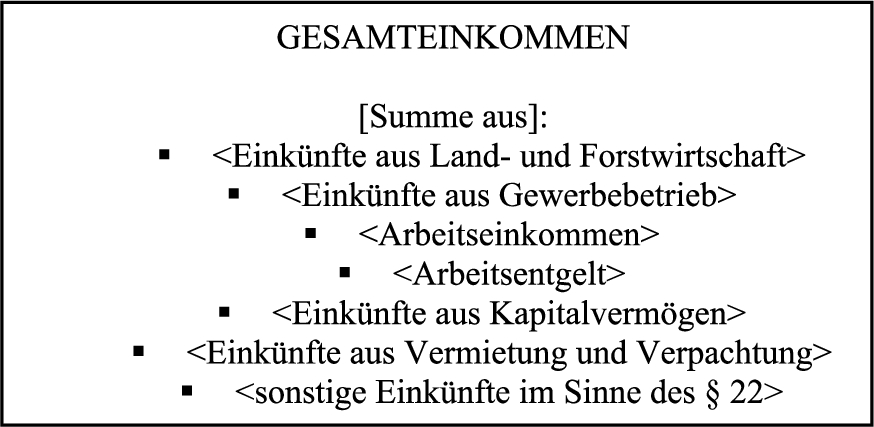
Frame GESAMTEINKOMMEN (level 1).
The knowledge segment that must be evoked in a German jurist’s mind when perceiving the lexical unit Gesamteinkommen in the social court decision can be illustrated by the frame in Fig. 1. As section 16 SGB IV sets forth that this constitutes the total (Summe) of what the Income Tax Act considers to be Einkünfte, the sole slot that is needed to introduce the enumeration of the fillers is [Summe aus]. At this point, it is imperative to note that this slot, which seems to be a general term at first glance, must be interpreted in the way described by legal doctrine: legal scholars point out that the term Summe has a specific meaning in German tax law and must be separated from the similar sounding term Gesamtbetrag, which encompasses other elements (Weber-Grellet, 2023, pp. 42–43). The subframe [Summe] would therefore have to be constructed as a frame and distinguished from the frame GESAMTBETRAG for the understanding of the frame GESAMTEINKOMMEN. This highlights the importance of extracting slots from the given legal situation and not solely relying on a set of general slots provided by the FrameNet database without scrutinizing their applicability. Compared to other specialized domains, this legal frame is constructed in accordance with the normative legal meaning provided in statutes without superfluous information being added in the form of slots and fillers, which could compromise the legal interpretation process with respect to this legal concept. It is therefore imperative to stick to only the legal information provided by the legal statutes in question and follow legal doctrine, i. e. legal commentary, to reconstruct the semantic understanding process that the abstract legal field is agreeing upon at the time of knowledge extraction. Due to the recursiveness of frames, each of the types of Einkünfte that make up the frame GESAMTEINKOMMEN in its microdimension serves as a subframe in this specific case, as does the slot [Summe], but constitutes its own frame in a lower dimension. The relation between each of these subframes can be named ‘complementary’ as they are complements of one another and, individually, a ‘component of’ or ‘part of’ the frame
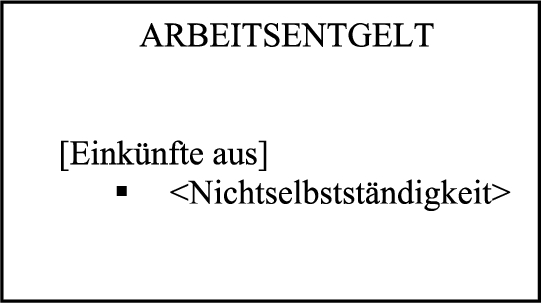
Frame ARBEITSENTGELT (level 2).
The subframes <Arbeitsentgelt> and <Arbeitseinkommen> must now be shifted from the sub-microdimension to the microdimension in order to be constructed as their own fully fledged frames. Usually, these concepts belong to the German social law branch and have their own legal definitions in the Fourth Volume of the German Social Insurance Code. The social law term Arbeitsentgelt is defined in section 14, subsection 1, sentence 1 SGB IV:
Arbeitsentgelt sind alle laufenden oder einmaligen Einnahmen [emphasis added] aus einer Beschäftigung [emphasis added], gleichgültig, ob ein Rechtsanspruch auf die Einnahmen besteht, unter welcher Bezeichnung oder in welcher Form sie geleistet werden und ob sie unmittelbar aus der Beschäftigung oder im Zusammenhang mit ihr erzielt werden.
Pursuant to this sentence, the term constitutes income from a type of employment called Beschäftigung; Fig. 3 therefore depicts the frame that would usually be evoked in a social law setting. Though the term Arbeitsentgelt is used in the Social Insurance Code, legal doctrine cautions about the incongruence between the social law definition of this term in section 14 SGB IV and the role it plays for the interpretation of the legal term Gesamteinkommen, which is due to the incongruent use of the term in section 16 SGB IV (Knickrehm et al., 2021, p. 1005). Scholars therefore point out that this term, which has no explicit legal definition in German tax law, must be interpreted pursuant to this exact legal branch anyway. The frame illustrated in Fig. 3, which represents the social law concept Arbeitsentgelt, therefore does not apply to the subframe <Arbeitsentgelt> in Fig. 1, even though it is used in the context of the social law term Gesamteinkommen. Once again, this complex interconnection and interdependence of legal semantics shows that traditional terminology work cannot adequately represent the ontological structure of a legal knowledge segment evoked in a very specific context and legal branch, which foregrounds the need for a more complex frame-based approach.
Consequently, after shifting dimensions to level 2, the tax law conceptualization of the new frame ARBEITSENTGELT must align with the illustration in Fig. 2. Pursuant to section 2, subsection 1 of the German Income Tax Code, the tax law interpretation of Arbeitsentgelt is construed as the income from a type of work designated as lack of self-employment (Nichtselbstständigkeit). This concept constituting the only subframe, information must be extracted from the German Commercial Code (HGB), which reads:
Selbständig ist, wer im wesentlichen frei seine Tätigkeit gestalten [emphasis added] und seine Arbeitszeit bestimmen [emphasis added] kann. (Section 84, subsection 1, sentence 2 HGB)
For the understanding of the frame that would illustrate the lack of self-employment, the two indications Gestaltungsfreiheit für die Tätigkeit (freedom of shaping one’s own professional activity) and freie Verfügbarkeit über Arbeitszeit (freedom to schedule working hours) must be taken in their negative forms. Since the frame
As shown in the first example, the nominal frame evoked by the use of the signs Arbeitsentgelt in the context of the social law term Gesamteinkommen constitutes a concept that is endemic to the branch of tax law. Taking a look at another judicial decision by the Federal Social Court of Germany from November 3, 2021, dealing with employments that require the payment of social security contributions, the legal term can be found in the usual social law setting:
Ein versicherungspflichtiges Beschäftigungsverhältnis liegt bis zum Ende eines Arbeitsverhältnisses daher auch dann (noch) vor, wenn der Arbeitgeber das Arbeitsentgelt [emphasis added] bis zu diesem Zeitpunkt – ggf bei einvernehmlicher und unwiderruflicher Freistellung – fortzahlt [
The frame that is evoked in this specific situation can now be constructed in accordance with the social law definition set forth in section 14, subsection 1, sentence 1 of SGB IV (see Chap. 4.1) as illustrated in Fig. 3. The filler chosen for this frame is the specific type of employment whose income constructs the frame in the micro-dimension, namely <Beschäftigung>. This knowledge element has a specific meaning in German social insurance law as set out in section 7, subsection 1 SGB IV: Beschäftigung ist die nichtselbständige [emphasis added] Arbeit, insbesondere in einem Arbeitsverhältnis [emphasis added]. Anhaltspunkte für eine Beschäftigung sind eine Tätigkeit nach Weisungen [emphasis added] und eine Eingliederung in die Arbeitsorganisation [emphasis added] des Weisungsgebers.
Any person who is considered to fulfill the criteria of Arbeitsverhältnis in employment law is automatically placed in the social-law category Beschäftigung, which however is not necessarily the case the other way around, making the knowledge elements of the employment-law term useful but not mandatory for the framing of Beschäftigung. In the second sentence of subsection 1, two indications (Anhaltspunkte) are mentioned. These are used in a social law setting to determine whether a person fits the type of employment called Beschäftigung and can be used as two subframes under the corresponding slot. As there is no legal definition for these two indications in any code or act, legal doctrine on that subject must be consulted to outline their specific understanding by jurists. Their frames on level 3 would be constructed according to their use in social law court practice in order to draw a distinction with regard to their meaning in standard language. The relation between these two indications can be named ‘interdependent’ because, even though they are not solidified components of the frame, both are taken into consideration with a certain flexibility by courts for the classification of a concrete situation as a Beschäftigung. As these fillers influence the understanding of the subframe <Nichtselbstständigkeit> for the understanding of Beschäftigung, their relations to this subframe can be described as ‘indicative of’ and, vice versa, as ‘indicated by’. Focusing on this specific filler only, the same information can be extracted from the German Commercial Code cited in Chap. 4.1. This commercial-law provision, which determines what self-employment means in German commercial law, has long served as the main source of information for the classification of the German employment-law term Arbeitsverhältnis when interpreted e contrario. In 2017, however, a new provision was introduced into the German Civil Code (BGB) (Rolfs, 2017), which has since provided specific indications on the employment-law term:
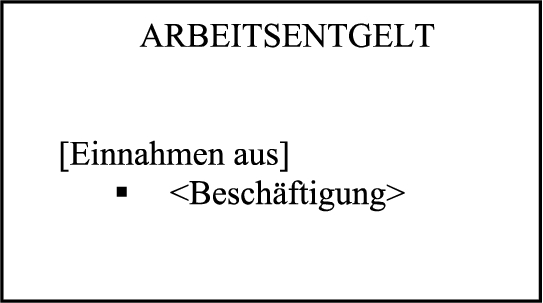
Frame ARBEITSENTGELT (level 1).
Durch den Arbeitsvertrag wird der Arbeitnehmer im Dienste eines anderen zur Leistung weisungsgebundener [emphasis added], fremdbestimmter [emphasis added] Arbeit in persönlicher Abhängigkeit [emphasis added] verpflichtet. Das Weisungsrecht kann Inhalt, Durchführung, Zeit und Ort [emphasis added] der Tätigkeit betreffen. Weisungsgebunden ist, wer nicht im Wesentlichen frei seine Tätigkeit gestalten und seine Arbeitszeit bestimmen kann. (Section 611a, subsection 1 BGB)
The provision from the German Civil Code lists different indications that serve as prototypical subframes constructing the employment-law term Arbeitsverhältnis. The filler <Weisungsgebundenheit> from sentence 1 designates the circumstance that a working person is bound by someone’s instructions, one of the indications that form the concept in question. Sentence 2 states two sub-subframes that on a sub-microdimension compose the subframe Weisungsgebundenheit. These knowledge elements have constituted the frame ever since the provision was introduced into the German Civil Code, which highlights the dynamicity of legal terminology as this specific frame had been constructed differently before 2017.
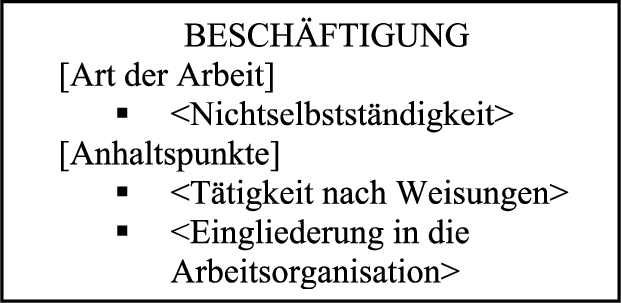
Frame BESCHÄFTIGUNG (level 2).
Whereas, at this point, level 3 and 4 can be illustrated with the information provided in the stated legal sources, it is important to point out again that the recursiveness of frames results in an endless granularity of such segments. Frames can be repeatedly divided into their subframes, which themselves can be split into sub-subframes. The dimensions must therefore be chosen depending on what legal concept is ontologically constructed. The presented levels show just one line of the endless taxonomic relation of legal frames and the interconnectivity of this complex field. It is important to note that inter-frame-relations also play a decisive role for the adequate description of legal concepts. These are horizontally linked to other concepts and domains, which indicate their context and separate them from similar terms. The taxonomic relation, however, is of central relevance as the existence of a legal concept depends on its subframes, which themselves constitute concepts that are regulated by the legal system and therefore constitute a condition for the adequate semantic reconstruction of the frame they are embedded in.
The ontology of legal terminology may have never been explicitly solidified in legal studies or contrastive terminology of law, but its need has been implicitly alluded to in various research areas. According to Arntz et al. (2014, pp. 39–40), the fundamental function of terminology is to enable systematic knowledge transfer, which itself consists of a combination of three functions: (1) a cognitive one that evokes knowledge, which justifies the necessity of knowledge-based frame semantics, (2) its use as a format of representation to allow knowledge to be communicated, and (3) its function as a conceptual order dynamically structuring information about objects and concepts, which the authors see as indispensable for the representation of knowledge. The notion of a referential system or system of reference has become relevant in the study of specialized language (Sager et al., 1980, pp. 70–76; Šarčević, 1997, pp. 66–67), and Grass (1999, p. 17) even emphasizes its use for a clear demarcation and separation between legal terms, which in a legal system are just rarely regarded as synonymous since they evoke very specific but, at the same time, relatively vague frames. By introducing ontoterminology, Roche (2007) explicitly shifts the focus of terminology to the conceptual dimension, insulating it from a purely linguistic perspective. This highlights the need for the construction of the ontology of terminology in general, with specialized terms referring to concepts endemic to a specific expert domain and merely using signs to designate them.
As shown in Chap. 2.2, certain considerable features of legal language confer a special status on this specific domain and insulate it from other disciplines, which are, to a certain extent, perceived as universal. When system-dependence is mentioned as its main characteristic, the need for some sort of organized system becomes evident. According to Wiesmann (2004, p. 20), legal language refers to a “Bezugsrechtsordnung” [legal system of reference], which is endemic to a specific nation and determines jurists’ legal acts. As Kjær (1995, p. 42) points out, legal language can no longer exist if it is dissociated from its legal context and legal reality, which explicitly affect the semantic structure of legal terms. The extreme system-dependence of legal languages even goes below the national level as becomes clear in Chap. 4 when terms expressed with the same signs but used in different legal branches or contexts are contrastively illustrated. A frame-based approach thus allows for the ontological construction of a specific frame evoked by a term used in a certain context and legal branch.
As for the legal system as a national construct, Engberg (2020, p. 271) establishes the perspective of law as an epistemic system. This perspective is nothing but the ontology of law itself as its abstract nature merely allows for its existence through organized knowledge. This is also in line with Šarčević (1997, p. 232), who defines a legal system as having its own legal realia, which she insists creates its own conceptual system and knowledge structure. Busse (1992, p. 281) suggests the perspective of law as an institution consisting in a complex of regulating norms. It is therefore obvious that the idea of an organized and interconnected knowledge system has been frequently evoked in connection with a legal system, which can be grasped by means of a legal ontoterminology that is based on knowledge-representing frames.
As frames constitute separate knowledge segments that include organized elements and are linked to other concepts, they are suitable to represent legal terms in context, which are designated as building blocks of a legal system by a sizeable amount of researchers (Pommer, 2006, p. 29; Rüthers, 1999, p. 117; Sandrini, 2009, p. 152). Describing the difficulties of legal translation, Simonnæs (2013, p. 156) explicitly positions legal concepts in the micro level of an entire legal culture and system in order to structure the objects of comparison for the contrastive juxtaposition of terms emanating from different nations, which corresponds with comparatists’ perception of legal terms in a legal system, placed in a micro dimension (Constantinesco, 1971, p. 270; Husa, 2015, p. 101; Zweigert and Kötz, 1996, pp. 4–5).
The interconnection between these building blocks has also been discussed in legal linguistic research. Sandrini (2009, p. 156) considers the systemic relations between legal terms and neighboring concepts a central reference point for the affiliation of a term with the specialized field of law. Accordingly, Busse (2005, pp. 31–32) classifies the solidified connections between the separate knowledge elements of a legal concept as the nucleus of the institutional character of legal concepts. Larenz (1983, p. 420) and Kjær (1995, p. 42) point to the complex inter-linking of legal provisions of a country, deeming it decisive for the semantic interpretation of legal terms, which cannot exist outside of the holistic interconnection of a legal system. Ultimately, the unique inter-linking of concepts within a legal system, anchored in a legal culture, is the key reason for Kischel’s (2009, p. 7) determination to present the possibility of legal translation as a pure myth, though it must be noted that his argument merely foregrounds the infeasibility of establishing absolute equivalence between legal systems due to unique ontologies, leaving the issue of translatability untouched.
These observations made in the areas of linguistics, terminology science, and comparative law pursue the goal of adequately tackling the special case of legal language, while taking account of its peculiarities. Whether it is the description of legal terms as interconnected units, building blocks, and knowledge segments or their positioning in a legal system, presented as a structured conceptual complex of knowledge, these suggestions foreground the necessity for an ontology specifically adapted to legal terminology. By applying frame semantics as a descriptive tool or format of representation to the language of law, the ontology of its abstract, extremely system dependent, immensely dynamic, and vastly intertwined terminology can be captured and illustrated for the reconstruction of the knowledge that objectively must be evoked in a jurist’s mind when perceiving a legal term in a specific legal branch in a given context.
Footnotes
Acknowledgements
This endeavor would not have been possible without the continuing and unqualified support from my Ph.D. supervisors, Prof. Dr. Michael Schreiber and Prof. Dr. Laurent Gautier. Furthermore, I would like to extend my sincere appreciation to the French research institute Centre Interlangues (TIL), based at the Université de Bourgogne, for financing this project.