




Abstract
We discuss currently open issues in the discovery and representation of knowledge patterns in computational processing of meaning, in order to improve interoperability and cognitive validity of web-based semantics. We present the current state of knowledge patterns (KP) in Knowledge Representation, the Semantic Web and Cognitive Sciences, focusing on an intensional abstraction of heterogeneous predicates as a formal foundation for KP.
A design Loop
After 20 years of Semantic Web, at least 60 years of attempts to build computational models of meaning, and 100 years from the publication of Ludwig Wittgenstein’s Tractatus Logico-Philosophicus [64], let alone the previous footwork of philosophers, linguists, and logicians, the situation with publicly shared, rigorous representations of meaning is only partly satisfying. The deep learning turn in artificial intelligence is adding new means for inductive inference and pattern discovery, but not much to the general problem: what are the basic bricks of meaning, if any, and their viable computational representation? How to make them converge (or diverge) according to the needs for local efficacy and global interoperability?
In work presented in 2010 for the inaugural issue of this journal [26], those building blocks were identified in Knowledge Patterns (KP) [10,21], a semantic web generalisation of frames in cognitive science, linguistics, and sociology literature, which have played a substantial role in early knowledge representation. The proposed approach was to empirically collect and use KPs for design, re-engineering and interoperability across data, schemas, lexicons, and interaction.
While in 2010 the amount of known KPs was limited to certain well known ontology design patterns [21,49] and informal linguistic frames, with examples of how different data models and data structures could be made interoperable through them, from that time some advancements have been made, which are briefly summarized in Section 3.
It is now time to assess where we are, and to take another step towards an integration of scientific efforts from related disciplines ranging from cognitive neuroscience to knowledge representation.
KP as relational knowledge
As Dedre Gentner [30] stated in a crystalline way: the ability to perceive and use purely relational similarity is a major contributor – arguably the major contributor – to our species’ remarkable mental powers.
The Semantic Web has started as a pragmatic way to use the Web as a platform to spread human semantics and human ability to process meaning. That platform was supposed to be decentralised, and to (unintentionally) realise the dream of a transparent negotiation of meaning, where entities have a public identity, with publicly known features that are encoded in public representations that can be dereferenced on the Web.
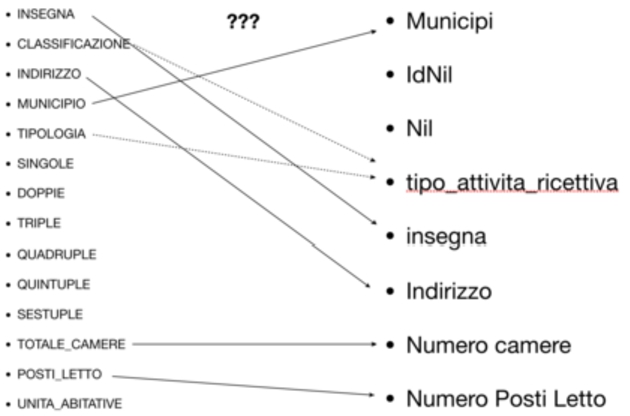
Incomplete mappings between accommodation schemas for Rome vs. Milan municipality data.
Eventually, the Semantic Web has created the conditions for web semantics to evolve: billions of multi-domain Linked Data triples, the international acceptance of governmental linked open data, the F.A.I.R. data movement,1
public administrations produce data with heterogeneous schemas, even for simple conceptualisations such as accommodations in Rome and Milan (Fig. 1): in most cases, it’s centralised efforts to create shared schemas, and complex refactoring procedures after data ingestion, which alleviate the problem.2
Cf. the DAF platform supported by the OntoPiA ontology network in Italy
web designers and content producers use their own tags, and only something like schema.org has enabled SEO and semantic search to take off;
DBpedia has evolved a large schema for Wikipedia data that is partly dependent on Wikipedia Infoboxes, partly on collaborative design of classes and properties, however, data needs cleaning, and only a stronger semantics as shown in [46] is able to detect the most severe problems emerging from bulk reengineering practices. Active work is being done also on Wikidata [61], but catching regularities in its massively heterogeneous entities is still an elusive task;
the decision making on sharing schemas is painful and subject to conflicts, let alone the cases when generic schemas, which are independent from an organisation’s control, and do not necessarily cover the same semantics, are nonetheless assumed as standard. A proper practice may be instead to analyse the requirements extracted from scenarios or competency questions, as recommended by state-of-the-art agile methods such as eXtreme Design [50], and only later to align the resulting ontology to existing ones. The ArCo ontology network [9] demonstrates the advantages of this approach;
a large amount of knowledge needs to be extracted from natural language, but the integration between natural language understanding, which is progressing towards shareable semantic representations such as AMR [4], and ontology design, is not yet widespread, despite the road has been opened by knowledge extraction methods [29] and massive integration of linguistic and factual resources [22].
Notwithstanding the long (15 years) activity of the Ontology Design Patterns community, with the substantial work collected in dedicated repositories,3
E.g.
Clearly, there is a difficulty in abstracting from local modeling choices, without a strong centralization, or a push towards the reuse of a quasi-standard. The reason probably lies in both the distance between domain expertise and ontology design practices, which require non-trivial logical competence, and in the existence of alternative terminologies, design solutions, and local alternatives, which make different but potentially overlapping schemas look farther than they actually are.
Semi-automated ways to design ontologies, to match them, or to inject interoperability, are still on the academic side of things, probably because of their limited friendliness, or conceptual coverage.
The suggestion here is to take the bull by the horns, which in this case means to accelerate the widespread collection of knowledge patterns where they actually are: existing ontologies, data models, large natural language corpora, linguistic resources, competency questions from formal and informal contexts, workflows, how-to repositories, commonsense knowledge bases; as well as when they can be extracted at scale: automatic construction of knowledge bases, schema induction, language models, etc. This is already happening (see Section 3), but at a pace and level of awareness that are too low to impact within a reasonable time. What is missing includes a good theory, and practical representation, collection, and reuse tools.
For example, much research for practical features and languages to facilitate ontology design, including e.g. OWL2 [40] punning (a.k.a. type reification [19]) and keys (a.k.a. identification constraints [8]), SPIN,4
The knowledge patterns emerging from this activity need to have both intensional and extensional representation. KPs should preserve their intensional nature, and avoid a strong commitment to specific logical primitives, in order to be robust against the evolution of knowledge representation, knowledge engineering, and alternative paradigms, including e.g. graph databases [52] and graph networks [7]).
However, a correspondence between KP intension and extension can be maintained by using a lightweight, pragmatic semantics, e.g. the Framester semantics, which is summarised in Section 6.
What are the main research questions for KP research? A partial list is proposed here as a checklist for the next years.
what KPs are known? is KP coverage enough to approximate human knowledge patterns? how to extend, evolve, learn, or discover KPs? how to enrich automated reasoning with an intensional characterisation of KPs? how to use intensional KPs to foster interoperability independently from the local representation of an ontology or conceptual model? In other words, how to employ KPs in ontology reengineering and ontology matching? what is the intensional difference between frames, roles, and selectional constraints or types? how to formalize KP compositionality? how to study higher levels of semantics, such as modalities, opinion, emotions, metaphors, narratives, and other macrostructures?
This is definitely an ambitious research programme, which has been partly carried out in the last 10 years.
Concerning known KPs and their coverage, some progress has been made, for example the Framester [22] knowledge graph is able to represent any linguistic or ontology predicate as a KP, and to reconcile it to a foundational layer initially provided by FrameNet [54] frames, and extended by aligning and incorporating predicates from multimodal resources. Hundreds of thousands of KPs have been automatically extracted from existing repositories [22,42]. Many more KPs can be extracted from existing data [48], or informal graphs such as Wikipedia links [43]. Now state-of-the-art formal knowledge extraction tools such as FRED [29] (see also Section 6) are able to extract KP-based knowledge graphs from text, and aligning them to Framester-based predicates.
The ability to make use of KPs for interoperability has been proved e.g. by FrameBase [53]. Another experiment has been described in [1] about reconciling different but related knowledge graphs (extracted from text), by exploiting KP embeddings and combinatorial optimisation.
An example of using KPs from the DOLCE foundational ontology [51] to clean up a knowledge graph is described in [46]. Examples of using KPs for representing higher levels of meaning are described in [28] about using a two-tier semantics for extracting knowledge graphs from text, and over-describing them with opinion KPs that improve the state of the art in aspect-based sentiment analysis. Another recent example [23] is about representing conceptual metaphors as KP mappings, and attempting to use the resulting knowledge base for both detection and generation of metaphors.
Tooling is also important for supporting the adoption of KPs. Recommendations such as ShEX and SHACL, jointly with languages such as SPIN and OTTR, seem valuable commodities to that purpose, even though they do not directly indicate KPs as use cases. Named graphs are also an underexploited possibility for adding a “graph of KP-based graphs” to complex ontologies and data.
Whatever the language or recommendation, there seems to be emerging a need for “packaging” subsets of axioms from an ontology, which make sense as a unit for designing, unit testing, rapid prototyping, customising inferential procedures. A reasonable hypothesis is that such packaging is ultimately motivated by the intuitive necessity to make ontologies better correspond to the cognitive principles used to organise knowledge, a.k.a. knowledge patterns (Section 4).
Finally, some recent work is being carried out outside of the semantic web community, but it has a lot of relevance for KP research in discoverying patterns that can be easily converted into KPs. Some examples includes end-to-end neural frame detection systems (e.g. [58]), and automatically constructed commonsense repositories from large scale data (e.g. Atomic [55]).
In the next sections we revisit the cognitive foundations of KP (Section 4), and the deeper problem of intensional compositionality (Section 5). Concerning KP semantics, in Section 6 we summarize a long-standing investigation into the nuances of intensional KP representation. How full-fledged reasoning with KP compositionality might impact existing automated reasoning techniques? Could we reduce the computational complexity of knowledge graphs and their matching by counting on the schematic nature of KPs, and automated translation into existing logical languages?
KP and cognition
The term knowledge pattern was firstly introduced by de Beaugrande [12]:8
A close usage of the term can be found earlier in a “creative engineering” book [2]: “knowledge pattern… by this is meant the knowledge and experience applicable to the technique of synthesis… There are three important parts to the knowledge pattern as regards creative work, (1) scientific knowledge, (2) design curiosity, and (3) the ability to generalize experience.”
the availability of global patterns of knowledge cuts down on non-determinacy enough to offset idiosyncratic bottom-up input that might otherwise be confusing.
La logique égocentrique est plus intuitive, plus «syncrétique», que déductive… Elle emploie des schémas personnels d’analogie, souvenirs du raisonnement antérieur, qui dirigent le raisonnement ultérieur sans que cette influence soit explicite.9
“Egocentric logic is more intuitive, more “syncretic”, than deductive… It uses personal patterns of analogy, memories of previous reasoning, which direct the subsequent reasoning without this influence being explicit.”
a schematic representation of a situation involving various participants, props [inanimate entities, ed.] and other conceptual roles, each of which is a frame element
a remembered framework to be adapted to fit reality by changing details as necessary… a frame is a data-structure for representing a stereotyped situation.
higher-level semantic or conceptual structures that organise the ‘local’ microstructures of discourse, interaction, and their cognitive processing.
a structured representation describing a stereotyped sequence of events in a particular context.
Since something can be invariant only if it remains unchanged under transformations11
Cf. Paul Dirac [13]: “The important things in the world appear as invariants… of… transformations”.
Cf. [41] for a detailed study on invariance and objectivity, and [31] for Gibson’s psychological theory of how invariances in stimulus-energy pair permanent (“projectable”) properties in the environment (“affordances”).
For example, a red ball might still be a red ball after being deflated, but a red ball to play volley cannot. Throwing paper waste on the street may be the same action on any street, but in a country the same action can be tolerated, in another not. A slap is a slap, but it could be voluntary or not, an aggression or a joke, according to the intention of who’s slapping, or to the observer’s perspective.
Knowledge patterns contain invariant features that make them appropriate as abstract data structures to be remembered/stored, and, as Minsky [39] noticed about frames, they can be adapted to fit reality by changing details as necessary. Minsky’s intuition can be used to propose KP dynamics as striking a balance between invariances (converging to universal patterns) and localities (tending to pattern divergence, adaptation or blending). Cognition works with patterns, but updates them to local observations, which are unique, because of the richness and compositional interference of actual (multi-modal) perceptions. This tension is reflected also in Barsalou’s simulation theory [5], which can be summarised as the defense that concepts are grounded by multi-modally-informed, situated simulations of the external world. Barsalou [6] also proposes that concepts can be shared thanks to a huge coordination activity aimed at establishing a common ground for mutual understanding.
The balance between adaptation and coordination suggested by Minsky, and re-proposed by Barsalou has some analogy in inconclusive results of neurological experiments that aimed at finding evidence for, or against, contextual dependency of core cognitive processes. For example, a recent fMRI metastudy by David Wisniewski [63] starts from the following dilemma: Some suggested that intentions representations in the fronto-parietal cortex change flexibly when external demands change (context-dependent coding). Others suggested that these representations are encoded in an abstract format that is not affected by changes in external demands (context-invariant coding) results to date are mixed, showing context-dependence in some, but context-invariance in other cases… depending on characteristics of intentions as well as environment, intentions can either be encoded in a context-dependent or a context-invariant format… to achieve both stability and flexibility of behavior under constantly changing external demands
Two questions emerge then for a computational treatment of knowledge patterns: what features characterize a pattern? how to be tolerant to pattern adaptation?
On one hand, since patterns have inherent invariances, they are useful to make predictions, to create expectations, to quickly judge something, to catch opportunities (affordances), to avoid obstacles, to diagnose a medical condition, to hypothesize a natural law, to establish a social norm, to maintain a physical, social, or individual equilibrium, etc. This massive importance make them key to interoperability across multiple representations.
On the other hand, in many contexts a pattern can be used analogically, approximately, partially, while still retaining some of its explanatory power. In other words, patterns retain their usefulness even when they do not fully correspond to a situation.
An extreme case happens when a KP is used to denote the special or unique quality of a situation, e.g. when a politician has a lot in common with a sportsman, or a gangster (cf. the cases described in an exploration of knowledge patterns emerging out of Wikipedia links [44]), or when one recognizes the unique way of nodding by a friend (uniqueness prizes “idiosyncratic bottom-up input”).
In addition, due to their tolerance to modification, knowledge patterns have a dynamics: they are adaptable (e.g. when applying a
Adaptability results in compositional problems that are easily interpreted by humans, but remain opaque even to sophisticated logical methods. For example, when we apply a
Knowledge Patterns, variously called schemas, frames, scripts, scenes, modeling components, data modeling patterns, etc., have been proposed as the core building blocks in ontology design [26], providing cognitive relevance, explicit situation boundaries, independence from a particular formalism, under the assumption of direct associations to modeling requirements. For example, in the classical blocks world example of AI, a generic
A reviewer wondered if relations like
A KP can be represented in a specific logical language, but it should also preserve an intensional representation that is invariant across logical languages. In their original presentation of KPs in knowledge representation, Peter Clark and colleagues [10] indicated category theory as the most adequate abstraction for KP representation. More recently, Oliver Kutz and colleagues [14] chose a close approach for the representation of conceptual blending. Our intention here has been to start from a more traditional mathematical framework, close to existing KR languages: a two-tier intensional/extensional logic, which can use the same basic semantic web languages or knowledge graphs in use today (see Section 6).
For example, a
Literature on compositionality is huge (cf. [34] for a recent palette of positions), but the basic argument is about the asymmetry between symbolic and semantic compositionality:14
Following common practice in knowledge representation, by semantic compositionality we mean that composed symbols are interpreted with respect to e.g. a model-theoretic semantics that grounds symbols into an intended world.
anaphoric composition: They got
modal composition: 23-year-old man dies after
hidden relations: this
world structure:
metaphoric composition: Breaking point: why the Kyrgyz
In practice, those cases are more or less easily understood by people, despite their asymmetry: what is lacking to computational semantics to approximate that ability?
Currently, we have sophisticated logical compositionality within ontologies: classes are associated with other classes via properties or taxonomical relations, properties are associated with other properties through chains, SWRL, or SPIN rules, classes are associated to properties via domains and ranges, or restrictions. We have an ontology compositionality via ontology import. We even have vectorial compositionality in vector space models of semantics [59], now enriched by deep learning techniques.
But we do not have a straightforward compositional machinery, let alone an algebra, to compose knowledge patterns. We can represent KPs in ontology modules (or alternatively in named graphs), and import them in a new ontology, or merging them into a graph. We could use intersection of predicates for e.g. an A cat is on the mat situation, predicating both
In fact, how to establish whether the result of composing a KP with another is a third KP? Our proposal is that we need a language to talk about intensional compositionality, jointly with a grounding into ontologies and off-the-shelf classes and properties. A beginning of such a composition style is demonstrated in Section 6. We exemplify here in more detail how KP compositionality provides a different view on well-known problems in natural language semantics and ontology engineering.
Framality Some compositionality effects on formal representations of meaning seem to derive from framality i.e. the hypothesis that KP (a.k.a. frames) are one of the motivating forces of contextual meaning. The hypothesis is supported by linguistic data, but also by neuropsychological studies (e.g. [62]) that report framal effects on selectional restrictions.
An example of framality can be given in adjectival semantics [25] as the ability of an expression to evoke a KP from the joint evocation of KPs emerging during interpretation. In the case of adjectives, a good example is the following pair of terms: Extroverted Surgeon vs. Skillful Surgeon. We might represent the two terms as a conjunction of predications, but while we can safely infer that all extroverted surgeons are extroverted in general, we are not safe at inferring that skilful surgeons are skilful in general. The likely reason is that
Another example of framality can be done with reference to meta-properties proposed by the OntoClean methodology [33]. E.g. a property is traditionally called rigid when it is true for an entity during the entire course of its life, as with the
In other words, the context of meta-level properties is maximal, while framality requires contexts to be bound to requirements or local conditions. Interoperability requirements may change this sanity assumption: if university data are integrated with personal data,
In that case, the legal validity of
Following from previous sections analysis of knowledge patterns, we provide here a more precise notion of KP as a reified relation that can be used to homogeneously represent relations as they can be evoked by natural language terms, logical constants, data modelling entities, informal terms such as those found in web formats: XML stylesheets, templates, microdata, infoboxes, JSON objects, etc. as well as “concept norms” as used in cognitive neuroscience [38], and “features” as used in machine learning. KP need to be independent from a particular representation or notation; in practice, we are talking about relational senses (Frege’s Sinn [18]) of symbols, i.e. their intension. We will defend the intuition that a relational sense has no fixed arity, and we will discuss how KPs as intensional relations are approximated extensionally in OWL implementations.
The notion is presented here in a succinct formal notation, but it is equally implemented in OWL2 as a schema16
We start with defining multigrade predicates [45,56]. A multigrade predicate denotes a polyadic relation. The notion was firstly introduced by Leonard and Goodman [37]: a relation without any fixed degree may be called a “multigrade relation” (p. 50).17 A predicate is the name for a relation that represents actual situations, but in the literature the two terms are often used interchangeably.
Multigrade predicates have a signature including argument labels. Some arguments can be optional, and even implicit. In other words, a signature can be expanded once new knowledge becomes available because of some inferential process, or knowledge evolution. For example, given the
In other words, the intensional signature of a KP is ideally open, so that its implementations would typically result as approximations as per the Open World Assumption – values can be missing – and Contextuality: arguments can be different in different contexts.
Approximation obeys pragmatic principles: availability of knowledge, local/evolving requirements, etc. For example,
When ontology matching is applied in order to enable interoperability, signatures need to be morphed into one another, and interpretation
As a consequence, semantic interoperability across heterogeneous data needs abstraction, which has to rely e.g. on a general intension of
KP as multigrade predicates can be easily represented in OWL2 by using punning [40], and a vocabulary to talk about their argument places (a.k.a. roles), and the types of things denoted by argument values.
This vocabulary already exists since 2003, as a knowledge pattern framework called Descriptions and Situations (D&S) [20,24,27]. D&S was originally intended as a two-tier modelling of the extensional and intensional semantics of predicates, with a focus on events or situations. The motivating use cases were in legal and medical ontologies, where we need to talk both about the world (e.g. organic or social facts), and about the way we observe or categorize it (e.g. a clinical condition or a legal norm).
In Framester D&S-inspired semantics, a KP is defined as a multigrade predicate

An automatically generated knowledge graph based on Framester semantics.
Axiom 3 is for semantic roles
Axiom 4 is for co-participation relations
Axiom 5 is for types
A simple example of Framester KP semantics is provided in Axioms 6–14 with a description logic representation of KPs and a sample of their projections evoked by the sentence: this jacket is made of cotton.18
The used predicates are all from the Framester knowledge graph, which can be downloaded and queried from
Use this API for an example:
An advantage of this intensional generalisation is its neutrality: no special knowledge representation language is required. E.g. a make concept may be represented in different ways: an object property from an ontology, a datatype property from a database refactoring, a class from another ontology, an individual from a linguistic ontology, etc. In the KP view to interoperability, they can be all aligned using either ontology or linguistic matching techniques, once intensional disambiguation has been performed.
Based on the two-tier semantics sketched here, we exemplify the formal problem of intensional compositionality (Section 5) with the sentence this jacket is made of cotton, which evokes a KP (
However, the formal semantics for the ⊗ operator needs to be investigated, and a comfortable solution for its extensional representation is yet to come. As anticipated in Section 5, a simple class intersection may fail to catch the actual situation. The actual situation is in fact a context to jointly interpret a piece of clothing, a causation event, and some substance. Representing the situation as an instance of an intersection of
We have presented a blended essay-position paper on the current state of knowledge pattern (KP) research. We have proposed an intensional abstraction for knowledge patterns (KP) on top of heterogeneous representation formats and languages. This is needed at a time when data is an essential fuel of society, but semantics is still a hodgepodge of approaches from different communities, and multiple computational and reasoning paradigms co-exist without much interaction, as with symbolic vs. sub-symbolic methods, scruffy vs. neat attitudes in modeling, proprietary vs. open representations, etc.
While the Semantic Web has induced a substantial leap forward in bringing a knowledge-level paradigm to computer science, its modelling practices have barely touched the problem of cognitive meaning processing. Cognition heavily relies on intensional schemas, and uses sensory data/entities to activate, and possibly adapting, them in order to make sense of the environment, store memories, resolve a problem, etc. (cf. Section 4).
In the Semantic Web, ontology evolution and matching are the main areas where semantic interoperability is addressed, and can be seen as the empirical counterpart to Minsky’s and Barsalou’s (cf. Section 4) notions of adaptation and need for coordination as forces for human knowledge sharing.
However, those authors showed us that adaptation and coordination are not randomly emerging, but happen on top of stable patterns. The research hypothesis of the Ontology Design Patterns community is that knowledge patterns can be used (once discovered and represented) as heuristics to coordinate evolution and matching, aiming at a simplicity that naturally matches human cognitive interpretation of the world. The fairly large literature on KP, and their related adoption, prove that the ambition is justified, even though discovering, representing, and sharing KP is less simple than expected. Firstly, because of the said dynamics of evolution/stability; secondly, because social, economic, and political reasons often work against it.
As an example, the current practices of accumulating data, and their automated analysis without an explicit shareable knowledge accessible to final users of semantically-enhanced systems, as argued in [15], hints at general policies that only partly work for coordination, focusing instead on local adaptations motivated e.g. by revenue optimisation.
The proposal for an intensional abstraction is therefore a call towards cognitive transparency in society: stable patterns are made available for the sake of interoperability across arbitrary knowledge organisation systems, which are often far from rigorous logical design, and their representation requires attention to how humans compose meaning.
It is a responsibility of the Semantic Web community to find scientific solutions and incentives to foster attention to those human factors in the adoption of semantic technologies.
Far from being complete, we have made an assessment of the state of play about knowledge patterns in the Semantic Web (Section 2–3), jointly with a review of why cognitive science can give us directions to design, extract, and use data and ontologies in the most efficient way when the problem is interoperability in the computational treatment of meaning (Section 4).
We have presented a simple, layered semantics for KP as multigrade predicates (Section 6), as currently implemented in the Framester data hub, and touched research issues concerning KP compositionality (Section 5).
The variety of situation types addressed by existing ontologies, let alone the larger societal scenarios, require a stronger push towards cross-disciplinary systematization of KP research. This can be helped by more semantics (i.e. more detailed axiomatisation in ontologies), but it requires the availability of a large-scale repository of cognitive patterns that enable complex similarity reasoning (KP matching, (un)predictable KP evolution) among ontologies.
Given the amount of work carried out in multiple communities in order to gather KP or KP-like data, we can conclude that such evolution is happening, specially considering that the difficulty of knowing our own ways of representing knowledge, and the effects that emerge out of a continuous activity of data production and coordination, constitute a formidable challenge.
We assume a positive lookout for the next years, when we may be able to make currently unrelated approaches converge, eventually gathering wider coverage and more detailed understanding of how KP emerge, change, and compose in our computationally-enriched societies.