




Abstract
We revisit the notion of initial sets by Xu and Cayrol (In Proceedings of the 1st Chinese Conference on Logic and Argumentation (CLAR’16) 2016), i. e., non-empty minimal admissible sets in abstract argumentation frameworks. Initial sets are a simple concept for analysing conflicts in an abstract argumentation framework and to explain why certain arguments can be accepted. We contribute with new insights on the structure of initial sets and devise a simple non-deterministic construction principle for any admissible set, based on iterative selection of initial sets of the original framework and its induced reducts. In particular, we characterise many existing admissibility-based semantics via this construction principle, thus providing a constructive explanation on the structure of extensions. We also investigate certain problems related to initial sets with respect to their computational complexity.
Introduction
Formal argumentation [3,6] encompasses approaches for non-monotonic reasoning that focus on the role of arguments and their interactions. The most well-known approach is that of abstract argumentation frameworks [19] that model arguments as vertices in a directed graph, where a directed edge from an argument a to an argument b denotes an attack from a to b. Although conceptually simple, abstract argumentation frameworks can be used in a variety of argumentative scenarios such as persuasion dialogues [16], explanations in recommendation systems [31], mathematical modelling [11], or as a target formalism of structured argumentation formalisms [28,35]. Formal semantics are given to abstract argumentation frameworks by extensions, i. e., sets of arguments that can jointly be accepted and represent a coherent standpoint on the conflicts between the arguments. Different variants of such semantics have been proposed [5], but there are also other (non set-based) approaches such as ranking-based semantics [1] and probabilistic approaches [26].
A particular advantage of approaches to formal argumentation is the capability to explain the reasoning behind certain conclusions using human-accessible concepts such as arguments and counterarguments. Works such as [2,27,29,31–33,36] have already explored certain aspects of the explanatory power of approaches to formal argumentation. Amgoud and Prakken [2] and Rago et. al [31] develop argumentation formalisms for decision-making that augment recommendations with arguments. In [33] an extension to abstract argumentation frameworks is developed that explicitly includes a relationship for an “explanation”, while Liao and van der Torre [27] define “explanation semantics” for ordinary abstract argumentation frameworks. Saribatur, Wallner, and Woltran [32] as well as Niskanen and Järvisalo [29] address computational problems and develop a notion for explaining non-acceptability of arguments to, e. g., verify results of an argumentation solver. Finally, [36] presents strong explanations as a mechanism to explain acceptability of (sets of) arguments.
In this paper, we revisit one of the fundamental concepts underlying approaches to formal argumentation (and abstract argumentation in particular) for the purpose of explaining, namely admissibility. Informally speaking, a set of arguments is admissible if each of its members is defended against any attack from the outside (we will provide formal details in Section 2). Many popular semantics for abstract argumentation rely on the notion of admissibility. In particular, a preferred extension is a maximal (wrt. set inclusion) admissible set and preferred semantics satisfies many desirable properties [5]. However, since a preferred extension is a maximal admissible set, it can hardly be used for explaining why a certain argument is acceptable: such an extension may contain many irrelevant arguments and its size alone distracts from the particular reasons why a certain member is acceptable. Our aim is to investigate why certain arguments are contained in, e. g., a preferred extension and how we can decompose such large extensions into smaller sets that allow us to justify the reasoning process behind such complex semantics. As a tool for our investigation, we consider initial sets, i. e., non-empty admissible sets that are minimal wrt. set inclusion. Initial sets have been introduced in [38] and further analysed in [39,40]. We contribute to this analysis with new insights on the structure of initial sets and, in particular, to the use of initial sets for the task of explanation. In fact, initial sets can exactly be used for the purpose mentioned before [38]: they allow us to decompose large extensions into smaller fragments, each of them representing a single resolved issue in the argumentation framework and thus showcases the reasoning behind certain semantics. This has been done already in some form in [38–40] but we present a new, and arguably more elegant, formalisation of that idea that allows us to derive new results as well. Using the notion of a reduct [8], we can concisely represent any admissible set as a sequence of initial sets of the original framework and derived reducts. Moreover, we characterise many admissibility-based semantics through a step-wise construction process using certain selections of initial sets (this has been hinted at using the original formalisation for complete and preferred semantics in [40]). We round up our analysis with a characterisation of the computational complexity of certain tasks related to initial sets, which is also missing so far from the literature.
In summary, the contributions of this paper are as follows:
We revisit initial sets and investigate further properties (Section 3) We provide a characterisation result of admissible sets and many admissibility-based semantics (Section 4) We analyse certain computational problems wrt. their complexity (Section 5)
Section 2 introduces preliminaries on abstract argumentation and Section 6 concludes this paper.
Complete proofs can be found in the appendix. A short paper presenting the main ideas of this work has been published before in [34].
Abstract argumentation
Let
Different semantics can be phrased by imposing constraints on admissible sets [5]. In particular, an admissible set E
is a complete ( is a grounded ( is a stable ( is a preferred ( is a semi-stable ( is an ideal ( is a strongly admissible (
All statements on minimality/maximality are meant to be with respect to set inclusion. For
Revisiting initial sets
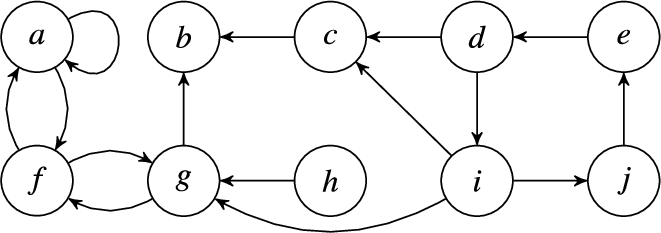
Admissibility captures the basic intuition for an explanation why a certain argument can be regarded as acceptable. More concretely, if S is an admissible set then Consider the argumentation framework
For
We continue Example 1. There are four initial sets of
As the previous example shows, an initial set is not supposed to provide a “solution” to the whole argumentation represented in an abstract argumentation framework, but “solves” a single atomic conflict (or in the case of
For S is unattacked iff S is unchallenged iff S is challenged iff there is
Note that only unattacked initial sets have been considered explicitly in [40]; in particular, note that every unattacked initial set S is a singleton
We continue Example 2. Here we have
Before we continue with characterising arbitrary admissible sets using initial sets in Section 4, we first contribute some new results on the structure of initial sets, therefore extending the analysis from [38–40].
Initial sets have an interesting property with respect to strongly connected components as follows. Recall that we can decompose an abstract argumentation framework
Consider again the argumentation framework
The following result shows that initial sets are always completely contained in a single
If S is an initial set of
If S is an initial set let
S is an initial set of
In other words, a set S is an initial set iff it is an initial set of a single
We close this investigation on the relationship of initial sets with
Let
If S is unattacked then
If S is challenged or unchallenged then
If S is challenged and
In particular, the final observation in the previous proposition states that conflicts between initial sets are always within a single
In [38,40] it has been shown that any admissible set (and in particular every complete and preferred extension) can be constructed by (1) selecting a set of non-conflicting initial sets, (2) adding further defended arguments, and (3) iterating this procedure taking so-called “J-acceptable” sets into account. In particular, the described mechanism involves iterative application of the characteristic function [19], computation of the grounded extension, and said notion of J-acceptability to provide those characterisations (and some further concepts). In this section, we provide a (arguably) more elegant formalisation of these ideas that allows us to derive characterisations of further semantics as well as some impossibility results. Results that are (partly) due to works [38–40] are annotated as such, all remaining results are new.
Our characterisations rely on the notion of the reduct [8].
For
As a single initial set S solves an atomic conflict in an abstract argumentation framework
Let
If
If
If
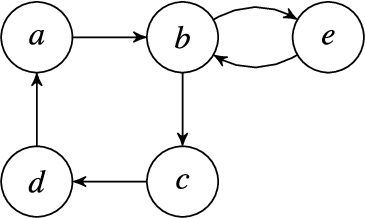
The above observations give an impression on how initial sets behave under reducts. So unattacked initial sets are always retained (item 1), conflicting initial sets are always removed (item 2), and non-conflicting initial sets are “essentially” retained (item 3). More precisely, while it may not be guaranteed that non-conflicting initial sets are still initial sets in the reduct, their arguments are still potentially acceptable, as the following example shows.
Consider the argumentation framework
The following results show that by an iterative selection of initial sets on the corresponding reducts, we can re-construct every admissible set. These observations have been hinted at in [38–40], but no formal proof had been provided. We make up for that now.
Let
Let S be an admissible set and
For the other direction,1
Note that this direction can also be shown by using the fact that admissible “semantics” is fully decomposable [4], but we explicitly prove it for matters of simplicity.
By recursively applying the above theorem, we obtain the following corollary.
Every non-empty admissible set S can be written as
Consider again the argumentation framework
Note that a decomposition
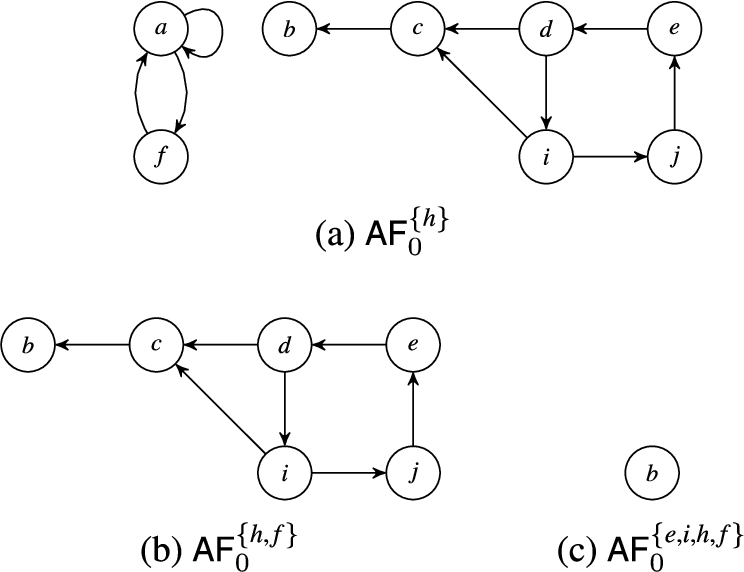
Reducts obtained from
Let us now discuss the wider significance of Theorem 1 and Corollary 1. For that, recall the standard approach to compute and justify the (uniquely determined) grounded extension of an argumentation framework
A state T is a tuple
A selection function α is any function
We will apply a selection function α in the form
A termination function β is any function
A termination function β is used to indicate when a construction of an admissible set is finished (this will be the case if
We will now define a transition system on states that makes use of a selection and a termination function to constrain the construction of admissible sets. For some selection function α, consider the following transition rule:
Given concrete instances of α and β, let
A semantics σ is serialisable with a selection function α and a termination function β if
A direct consequence of Corollary 1 is the following.
Admissible semantics 2
Although admissible sets are usually not regarded as a semantics, we can treat the function
In other words, any admissible set can be constructed by not constraining the selection of initial sets at all (
The following observation has been hinted at in [40], but not formally proven. Using the notions of selection and termination functions, we can make the construction principle of complete extensions explicit.
Complete semantics is serialisable with
Note that
Let
Grounded semantics has the same termination criterion as complete semantics, but constrains the selection of initial sets to those in
Grounded semantics is serialisable with
Note that
Let
For stable semantics, we do not need to constrain the selection of initial sets but only ensure that all arguments are either included in or attacked by the constructed extension.
Stable semantics is serialisable with
As before, we obtain the following characterisation of stable semantics in terms of the reduct.
Let
For preferred semantics, we simply have to apply transitions exhaustively. Note that this result strengthens Proposition 3 from [40].
Preferred semantics is serialisable with
Let
Our final positive result is about strong admissibility, which follows quite easily from the construction of the grounded extension.
Strong admissibility semantics is serialisable with
Let
A related result to the above observation is given by Baumann et. al in [9] (Definition 7 and Proposition 2). There, a strongly admissible extension E is characterised through the existence of pairwise disjoint sets
Missing from our results so far are the ideal and semi-stable semantics. Both of them cannot be serialised.
Ideal semantics is not serialisable.
The proof of the above theorem is given by the following counterexample.
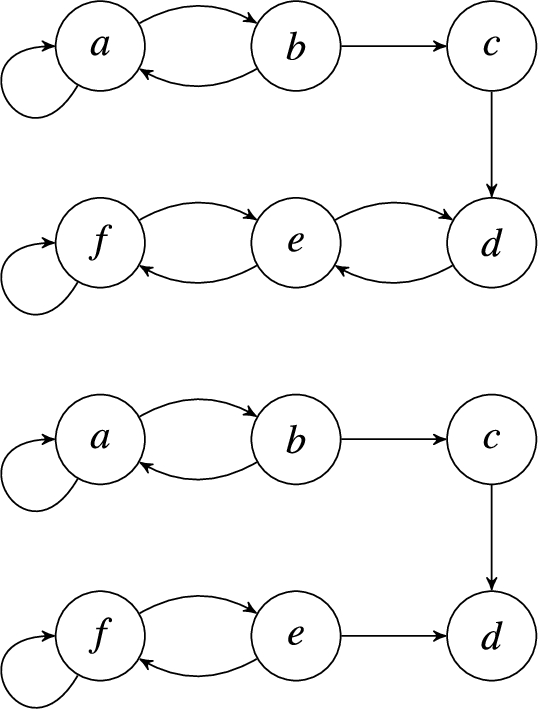
The argumentation frameworks
Consider the two argumentation frameworks
Note also that α cannot return just one of the two initial sets as they cannot be distinguished. In case 1, the ideal extensions of both
The above behaviour of ideal semantics is insofar surprising since the concept of unchallenged initial sets is closely related to the general idea of the ideal extension. Recall that the initial extension is the maximal admissible set contained in each preferred extension. This basically means that the arguments in the ideal extension are compatible with each admissible set and no admissible set attacks any argument in the ideal extension. On the other hand, an unchallenged initial set is likewise an undisputed admissible set, as there is no other initial set that attacks it. However, as the above example shows, unchallenged initial sets are not sufficient to characterise the ideal extension. We will discuss the relationship between unchallenged initial sets and the ideal extension a bit more below and in Section 5.
Likewise negative, but for somewhat different reasons, is the following result about semi-stable semantics.
Semi-stable semantics is not serialisable.
The reason that semi-stable semantics is not serialisable is that it needs some form of “global” view on candidate extensions to judge whether a set of arguments is indeed a semi-stable extension. We illustrate this in the next example (which also serves as the proof of Theorem 9).
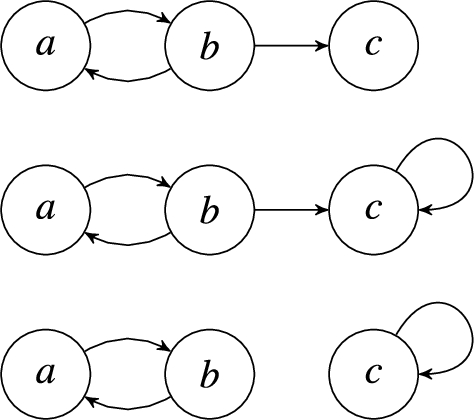
The argumentation frameworks
Consider the three argumentation frameworks
In cases 1–3, not all semi-stable extensions can be constructed for, e. g.,
The same argument from above can also be used to show that eager semantics is not serialisable. The eager extension is the maximal (wrt. set inclusion) admissible set contained in every semi-stable extension, see e. g. [5]. In Example 8, the eager extension of
The results of this section show that many admissibility-based semantics can be characterised through the notion of initial sets and a simple non-deterministic algorithm based on selecting initial sets at each step. This brings a new perspective on the rationality of admissibility-based semantics, as their basic construction principles are made explicit via an operational mechanism. This is similar in spirit to the purpose of discussion games [12] which model acceptability problems of individual arguments as an operational mechanism as well (here a dialogue between a proponent and an opponent). However, here we focused on the construction of whole extensions and not on acceptability problems of individual arguments.
The notion of serialisability also allows to define completely new semantics by defining only a selection and a termination function. For example, a straightforward idea for that would be the selection function
For every E with
Consider the following examples showing the difference between the above semantics and ideal semantics.
Consider again
Consider
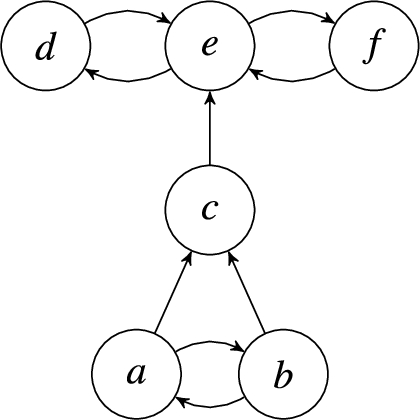
The argumentation framework
For future work, we intend to investigate the above and further possibilities for serialisable semantics in more detail.
In order to round up our investigation of initial sets, we now analyse them wrt. computational complexity. We assume familiarity with basic concepts of computational complexity and basic complexity classes such as
A query is adaptive if it may depend on a previous query; queries are non-adaptive if they can be posed in any order or in parallel.
We consider the following computational tasks for Given decide whether Given decide whether Given decide whether Given decide whether there is Given decide whether for all
Note that we do not consider the problems
Table 1 summarises our results on the complexity of the above tasks, all proofs can be found in the appendix.
Complexity of computational tasks related to initial sets. An attached “-h” refers to hardness for the class and an attached “-c” refers to completeness for the class. All hardness results are wrt. polynomial reductions
The results for
We get some different complexity characterisations for the different types of initial sets. All tasks for unattacked initial sets are tractable, as only unattacked arguments have to be considered. All tasks become harder (under standard complexity-theoretic assumptions) when only unchallenged initial sets are considered. In particular,
The complexity of the tasks for challenged initial sets are similar as in the general case, with two exceptions. Verification of challenged initial sets is intractable as another initial set has to found that attacks the set under consideration. Moreover,
In this paper, we revisited the notion of initial sets, i. e., non-empty minimal admissible sets. We investigated their general properties and used them as basic building blocks to construct any admissible set. We have characterised many admissibility-based semantics via this approach and concluded our analysis with some notes on computational complexity.
Initial sets allow us to concisely explain why a certain argument can be accepted (e. g., whether it is contained in a preferred extension). We can deconstruct an extension via the characterisation of Corollary 1, justify the inclusion of initial sets along this characterisation – e. g., by pointing to the conflicts that had to be solved –, and arrive step by step at the argument in question.
A recent paper that addresses a similar topic as we do is [10]. There, Baumann and Ulbricht introduce explanation schemes as a way to explain the construction of extensions wrt. complete, admissible, and strongly admissible semantics. Let us consider the case of complete semantics. Given
Although an abbreviated two-step procedure is also discussed.
As a by-product of our work, we introduced a new principle [37] for abstract argumentation semantics: serialisability. For future work, we aim at investigated relationships of this new principle to other existing principles listed in [37]. Another avenue for future work to investigate whether our characterisations of admissibility-based semantics can be exploited for algorithmic purposes [14]. It is clear, that there is no obvious advantage in terms of computational complexity by computing (for example) a preferred extension via our transition system as it involves the computation of initial sets at each step (which is an intractable problem as
Footnotes
Acknowledgements
I am thankful to the anonymous reviewers who commented on a previous version of this paper, in particular by giving valuable hints that allowed me to strengthen the results on computational complexity.