




Abstract
In 1995, in his seminal paper introducing the abstract argumentation framework, Dung has also established the first relationship between this framework and a logical framework (in this case: logic programming). Since that time, a lot of work have pursued this path, proposing different definitions, uses and exhibiting distinct relationships between argumentation and logic. In this paper, we present a survey of existing works about this topic and more especially those that address the following question: “How logic has been used for capturing various aspects or parts of Dung’s argumentation”. This survey covers many different approaches but is not intended to be totally exhaustive due to the huge quantity of papers in this scope. Moreover, due to the fact that each approach has its own specificities, sometimes antagonistic with the other approaches, and is also justified by its own context of definition or use, the aim of this survey is not to identify one approach as being better than another.
Keywords
Introduction
Argumentation has become an essential paradigm for Knowledge Representation and, especially, for reasoning from contradictory information [2,54] and for formalizing the exchange of arguments between agents in, e.g., negotiation [3]. Two main classes of approaches exist in computational argumentation: structured argumentation and abstract argumentation. The difference between these classes is on their starting point: works corresponding to the first class are about building arguments and identifying their relationships, whereas works in the second class consider that a collection of arguments interacting with each other is given [54], thereby disregarding the topic of building altogether. Because of these “abstract inputs”, abstract frameworks have greatly eased the modelling and study of argumentation, allowing to focus, in particular, on the different ways for determining “acceptable” sets of arguments called extensions.
The relationship between abstract argumentation and logic has actually been exploited right from the start, in the seminal article [54] introducing abstract argumentation where Dung establishes a formal equivalence between argumentation frameworks and logic programs. Since this work, this relationship has been the theme of intensive research, and several correspondences between abstract argumentation and different logical theories have been established. The number of works in this topic is so huge that there is a critical need to clarify the links between all these works and that is the main aim of our paper.
So, this article is a survey about abstract argumentation papers that have a strong emphasis on logic. Two categories of approaches can be identified: (1) approaches taking advantage of logic to capture various aspects of abstract argumentation; (2) approaches embedding “logical structures” into abstract argumentation.1
For instance, an encoding of logic programs under the form of argumentation frameworks, or the creation of an argumentation framework using logical knowledge bases (see for instance, papers as [14]).
For this paper, considering that this survey is published on the occasion of the 25 years of Dung’s approach, we have chosen to discuss only works related to category (1) for the following reason: this a well-delimited category whereas the second one is less clearly defined; in particular, one can found in the second category some approaches also related to the structured argumentation and not only to the abstract argumentation.
Focussing on the many papers that provide an answer to the question “How can logic be used for achieving abstract argumentation?”, we attempt to follow the same pattern for each work reviewed:2
Note that, even if we tried to give an uniform presentation of the different approaches, some of them will be sometimes over-represented, either because of the huge number of publications concerning them, or because of the need of some additional explanations (examples have been added in order to illustrate some complex notions used in the presented approaches).
Since at the heart of these works is a correspondence between argumentation frameworks and logical formulae (or sets thereof), we first identify the entry points of the correspondence. Indeed, while the main input is usually an argumentation graph, some approaches handle an extended argumentation graph, be it bipolar, recursive, weighted, with collective interactions, and so on. There may also be extra inputs, for instance, special requirements and constraints, a distinguished subset of the arguments in the graph, a given argumentative semantics.
Second, the aim of the approach reviewed is explicited, whether is it to provide a logical encoding of an argumentation graph, or to answer a question such as “is this subset of the arguments a preferred extension of the argumentation graph?”.
Third, we have a look at the type of logic employed in the work reviewed. Propositional logic is the most widely used, either as such or extended to Quantified Boolean Formulae, but some approaches resort to (possibly many-sorted) predicate logic, modal logics, as well as constructive logics (including intuitionistic logic) either directly or through a theoretical account of logic programming.
Fourth, we list the auxiliary items involved in the approach at hand, e.g., labellings, signed atoms.
Fifth, we deal with the question: Has the work reviewed been implemented?
We now present the content of our survey in more detail. Section 2 gives the necessary background about abstract argumentation [6,28,31,54,81]. Then the presented works are split over several sections, as follows.
Section 3 is devoted to a single approach, Abstract Dialectical Frameworks (see for instance [21]), a general formalism for representing complex dependence links between arguments. In our terminology, the input consists of a dependence graph (nodes represent arguments and edges represent dependence links) together with an acceptance condition (in the form of a logical formula) attached to each node and the outputs are the logical models of the acceptance conditions, permitting to retrieve labellings and extensions.
The approaches reviewed in Section 4 aim at giving a logical theory (in propositional logic) that encodes an argumentation graph [30,33,52,67]. Multiple approaches are reviewed, that mainly vary on the logic used for the encoding: propositional logic, either pure or extended in a number of alternative ways (sorted language, modal-like language). Additional properties may map models to extensions according to a given semantics.
Section 5 reports on two approaches whose aim is to express properties over a given argumentation graph, so that these properties can be used to characterize appropriate labellings of the graph [4,49,50]. Thus, the input consists of an argumentation graph (or an abstract dialectical framework, see Section 3) together with an extension-based semantics σ. The main feature of both approaches is that the output is a Quantified Boolean Formula whose models coincide with the σ-extensions of the graph (i.e., using names of the nodes of the graph as propositional atoms, the models of the formula are exactly the σ-extensions of the graph).
Section 6 is mainly devoted to an approach called YALLA [55],3
YALLA: Yet Another Logic Language for Argumentation.
In Section 7 are reviewed two approaches, [11,12] and [59], that, given an extension-based semantics σ, produce a formula
The purpose of the two approaches reviewed in Section 8, [25,36], is to encode labelling-based semantics by means of a set of logical formulae (these express the different constraints associated with a particular kind of labelling). Thus, the input is an argumentation graph together with a labelling-based semantics s and the output is a logical theory characterizing the labelling-based semantics s (depending on s, it can be that the logic needed is second-order).
The purpose of the works reviewed in Section 9 is to associate a logic program with an argumentation graph in such a way that logic programming semantics, applied to the logic program, capture argumentative semantics. In this research line, many works exist from the seminal work presented by Dung [54]: for instance, [24,26,61,83,84,89]. So, this section describes different mappings which allow to transform an argumentation graph into a logic program, all of them offering different characterizations of argumentative semantics in terms of logic programming semantics.
Section 10 reviews three methods for expressing abstract argumentation in modal logic [25,70,93], two of them taking as input an argumentation graph together with a labelling (the third method regards argumentative semantics as primitives of the language) while the output consists of modal formulae expressing the distinctive properties of a given argumentative semantics.
Section 11 deals with approaches resorting to a constructive logic (either intuitionistic or Nelson’s), where constructive negation is used to represent an attack in argumentation graphs and the models of the resulting formulae characterize the argumentative extensions of the input graph [63,68].
Lastly, Section 12 is an attempt to wrap all this up with proposing tentative conclusions suggested by the comparisons discussed throughout Sections 3–11.
We have adopted (or at least attempted to) a single procedure to present all the works reviewed in our survey, in order to make it easier for the reader to compare these works. Please note that, in the last section, we go through the same example treated in turn by all approaches in order to better illustrate the behaviour of each of them. However, it is not our aim to assess them in any way, and we are definitely not to claim that such and such approach is better than another approach.
Moreover, despite the apparent similarity in the approaches (they are all based on logic and all attempt to capture Dung’s argumentation model), it would be a formidable task to provide a comparative evaluation.
Finally, we make no claim for exhaustiveness. Some articles on the very topic of the survey may have gone unnoticed from us, others have been left out because we felt them having more emphasis on another topic or still other reasons. Of course, omitting to cite or to discuss these articles bears no quality assessment whatsoever on our behalf.
Argumentation frameworks
According to [54], an abstract argumentation framework consists of a set of arguments together with a binary relation between arguments.
(AF [54]).
An argumentation framework (AF) is a pair
Generally assumed to be finite.
An AF can be represented by a directed graph, called argumentation graph,5
We will often use “argumentation graph” in place of “argumentation framework”.
The AF defined by 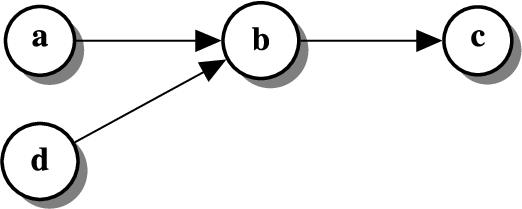
Many extensions of this framework have been proposed. For instance, bipolar abstract frameworks have been introduced first in [71,91]. They include a second relation between arguments, the support relation, that is a positive interaction (in contrast to the attack relation that is a negative one). In [31], the support relation is left general so that the bipolar framework keeps a high level of abstraction.
A bipolar argumentation framework (BAF) is a triple
A BAF can still be represented by a directed graph with vertices as arguments and two kinds of edges (attacks denoted by simple arrows and supports denoted by double arrows).
Consider the following BAF with only one support. 
However, there is no single interpretation of the support, and a number of researchers proposed specialized variants of the support relation (deductive support [17], necessary support [79,80], evidential support [81,82]). These proposals have been developed quite independently, based on different intuitions and with different formalizations. In [32], is presented a comparative study in order to restate these proposals in a common setting, the bipolar argumentation framework (see also [41] for another survey).
For instance, evidential support is based on the intuition that every argument must be supported by some chain of supports rooted in special arguments called prima-facie. Considering a BAF with an evidential understanding of the support leads to Evidence-Based Argumentation Frameworks (EBAF) which can be defined as follows [29]:6
An Evidence-Based Argumentation Framework (EBAF) is a 4-tuple
Another extension of AF is the higher-order AF with the idea of encompassing attacks to attacks in abstract argumentation frameworks (see [8] in the context of an extended framework handling argument strengths and their propagation). Then, higher-order attacks have been considered for representing preferences between arguments (second-order attacks in [76]), or for modelling situations where an attack might be defeated by an argument, without contesting the acceptability of the source of the attack [7]. Attacks to attacks and supports have been first considered in [64] with higher level networks, then in [92]; and more generally, in [42] an Attack–Support Argumentation Framework is proposed which allows for nested attacks and supports, i.e. attacks and supports whose targets can be other attacks or supports, at any level. Different names are given to these higher-order AF, depending on the kind of interaction that is handled: AFRA or RAF (with only attacks), ASAF or REBAF (with attacks and supports, necessary supports for ASAF and evidential supports for REBAF).
For instance, the definition of a RAF is as follows.
(RAF [28]).
A recursive argumentation framework (RAF) is a tuple
Note that an AF can be viewed as a particular RAF with
A RAF can also be represented graphically.
The RAF in which an attack named α (with
and
) being the target of an attack β (with
) can be represented by:
Still other extensions exist such as frameworks with collective interactions (SETAF: the source of interaction can be a set of arguments and not only one argument, as in EBAF or REBAF) and frameworks with weights over arguments or interactions.
Case of AF. Acceptability semantics can be defined in terms of extensions [54] following basic requirements:
An extension can “stand together”. This corresponds to the conflict-freeness principle.
An extension can “stand on its own”, namely is able to counter all the attacks it receives. This corresponds to the defence principle.
Reinstatement is a kind of dual principle. An attacked argument which is defended by an extension is reinstated by the extension and should belong to it.
Stability expresses the fact that each argument that does not belong to the extension is attacked by the extension.
Standard AF semantics are defined as follows:
(Extension-based semantics [54]).
Given S is conflict-free iff The characteristic function of S is admissible iff S is conflict-free and S is a complete extension of S is the grounded extension of It can be proved that the minimal fixed point of
S is a preferred extension of
S is a stable extension of
Note that the complete (resp. grounded, preferred, stable) semantics satisfies the conflict-freeness, defence and reinstatement principles.
2.1.1
Acceptability semantics can also be defined in terms of labellings, as in [6], for instance.
Let
Let An An An
Standard labelling-based semantics are defined as follows:
(Labelling-based semantics [6]).
Let
Alternative characterizations of complete labellings can be found in [25]. Let us recall them as they will be used in the remainder of this document:
(Characterizing complete labellings).
Let
If a is
If a is
If a is
a is
a is
Case of extended AF (BAF, RAF). The associated semantics are very often defined using a flattening process: the extended AF is turned into an AF, then the AF semantics are applied (see for instance [7]). In recent works (see for instance [29]), semantics for extended AF have been defined directly.
ADF (Abstract Dialectical Frameworks)
The aim of the ADF approach is the definition of a general framework for representing complex dependence links between arguments (these links impact the acceptability of the arguments). It is rather a theoretical approach but several implementations have been proposed. This approach has been introduced many years ago and one of the more recent synthetic paper about ADF is [21].
The input consists of a dependence graph (nodes are arguments, statements or positions and edges are dependence links) together with an acceptance condition attached to each node. This condition can be a propositional formula8
In ADF, this condition is generally a propositional formula, but there also exist some works on ADF that specify acceptance conditions as Boolean functions that may be represented in different ways. In this survey, we only consider the case where acceptance conditions are propositional formulae.
The outputs are the interpretations of the set of acceptance conditions. These interpretations allow to retrieve some labellings and extensions.
In this approach, the logic is used for encoding and interpretating the dependence links.
An ADF is a directed graph defined as follows:
An abstract dialectical framework (ADF) is a tuple
So the status of an argument depends on the status of its parents in the graph following the acceptance condition attached to the argument. The ideas are the following ones: First, the status “accepted” (resp. “rejected”, “unknown”) of an argument is related to its assignment with the truth value t (resp. f, u).9 t for true, f for false and u for unknown.
Second, let s be an argument, let
Note that the dependence links can be extracted from the acceptance conditions. So in general the ADF is defined only with the set of arguments and their acceptance conditions:
ADF semantics. In terms of semantics, two operators can be defined, one for two-values semantics and another one for three-valued semantics. The idea behind these operators is the following one: starting from a given interpretation, the use of the operator allows to browse the set of possible interpretations (two-valued or three-valued) taking into account the impact of acceptance conditions on the interpretations. The aim is to find a fixed point if it exists (it is always the case for three-valued operators).
Let
Thus, for v a two-valued interpretation,
In the case of a three-valued operator, the idea is similar. However, due to the existence of the third value (u for unknown) a specific technique must be used:
(Three-valued operator).
Let
Then semantics for interpretations can be defined using either a two-valued operator or a three-valued operator and a preordering between interpretations. Two preorderings can be defined:
(Preordering
on two-valued interpretations).
Let
(Preordering
on three-valued interpretations).
Let
Some semantics can be defined as follows:10
The definition for the stable models is not given here but can be found in [21] (a model being an interpretation v such that
Let v is complete for D iff v is admissible for D iff v is preferred for D iff v is v is grounded for D iff v is the
Note that the well-known relationships between AF semantics also hold for ADF semantics:
Let
Each stable model of D is a two-valued model of D.
Each two-valued model of D is a preferred interpretation of D.
Each preferred interpretation of D is complete.
Each complete interpretation of D is admissible for D.
The grounded interpretation of D is complete.
11
Note that the grounded interpretation is unique.
ADF as a modelling tool. An ADF can be used for modelling variants of abstract argumentation frameworks such as AF, BAF, RAF. A significant survey can be found in [85,86].
Case of AF: Let Case of AF with annotated links and/or preferences: An ADF can be used for expressing the impact of annotated links representing qualitative or quantitative preferences and/or preorderings between arguments. First, consider the case of a weighted AF (i.e. an AF with numerical weights attached to each interaction representing quantitative preferences).
A positive (resp. negative) value on a link means that this link is a support (resp. attack) link; A link is said “active” if its source node is accepted; A node will be accepted if the sum of the weights of all the active links pointing to it is positive (strategy sum-of-weights – sow). Qualitative preference can be handled in a similar way, particularly for the input arguments. Note also that these kinds of annotated links can be used for expressing richer interactions such as, for instance, those used in legal reasoning (notions of “valid”, “strong”, “credible” and “weak” arguments and principles of “scintilla of evidence”, “preponderance of evidence”). Case of BAF: An annotated AF can be used for modelling a BAF (particularly the qualitative version with + on the support links and − on the attack links). Nevertheless, as different meanings exist for the support, several encodings can be defined (see Ex. 2.1.2 in the next section). Case of AFRA, RAF: In an ADF, no recursive link exists. So in order to represent an AFRA or a RAF with an ADF, flattening techniques must be used (for instance, the one described in [7] for translating an AFRA into an AF). See Ex. 2.1.3 in the next section.
Example 3.2.6 given in the next section illustrates the above ideas.
The previous ADF definitions are illustrated on the following examples (most of them are issued from [21]).
Consider the ADF represented by: 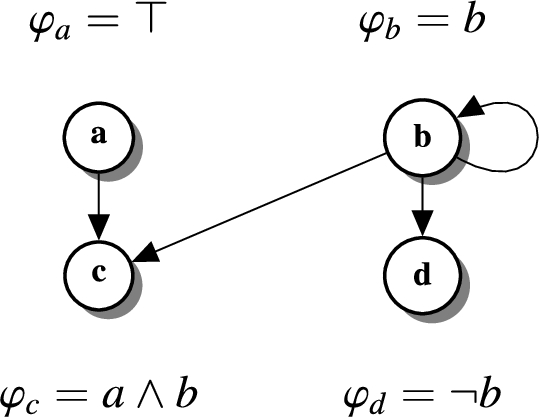
Intuitively,
The mechanism used for the two-valued operator is illustrated by Fig. 3 (given at the end of this paper) that represents the evolution of interpretations by the operator
Consider for instance
So, the operator applied to
Consider now
This example also illustrates the preordering
Unfortunately, due to the important number of three-valued interpretations of this example (
Following Def. 13,
Moreover,
The next example illustrates the three-valued operator and the
Consider the ADF represented by: 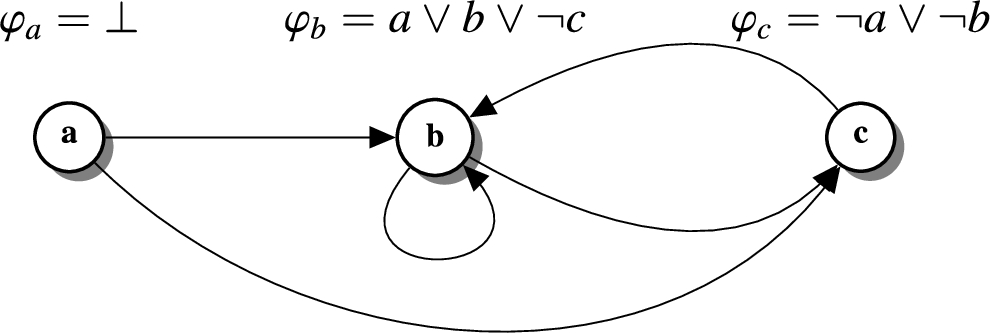
Figure 5 (given at the end of this paper) represents the evolution of interpretations by the three-valued operator
First, consider With With
Then, using
Another example of this process can be given with the interpretation
With
With
Then, using
In this example, the preordering
Here are some interesting three-valued interpretations:
The following examples illustrate the use of ADF as a modelling tool.
The sequence of two attacks can be translated into the following ADF: 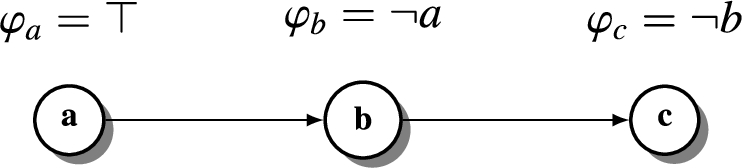
Applying the
Two attacks to the same argument can be translated into the following ADF: 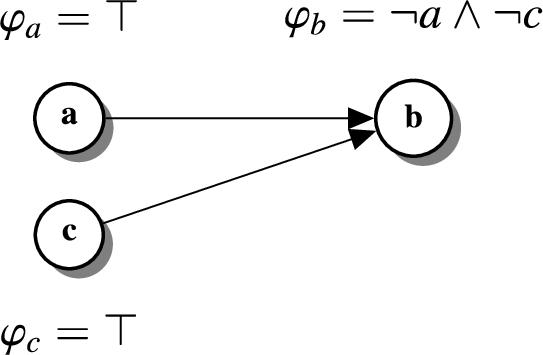
An even-length cycle of attacks can be translated into the following ADF: 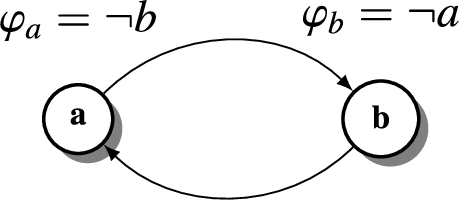
Applying the
The following graph represents a weighted AF. 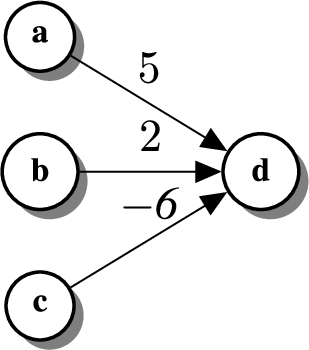
Considering that the set 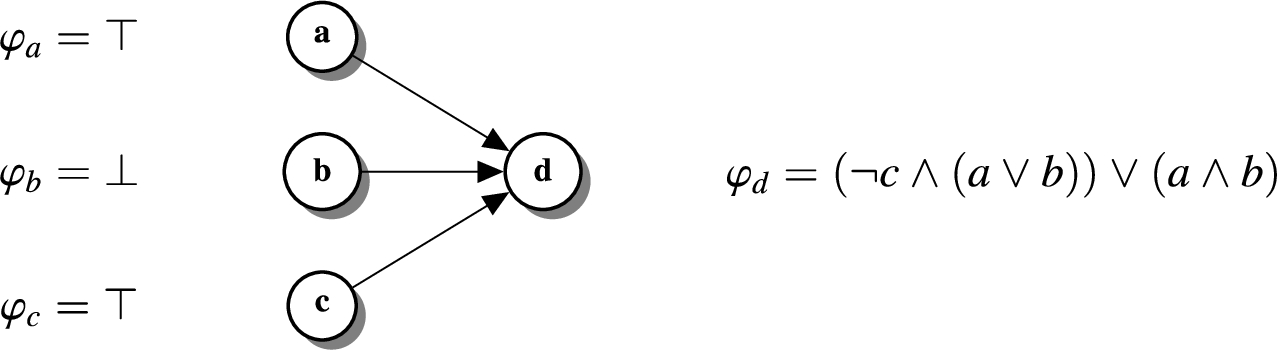
2.1.2
Let consider the following possible encoding: a positive link from a to b with
Consider now that the support is a deductive one. Then the meaning of this support in argumentation semantics can be described by the following assertion (the target of the support is impacted by its source):
With the proposed encoding, the sufficient condition given by
Indeed, the meaning of the necessary support from a to b in argumentation semantics can be described by the following assertion (the target of a support impacts its source):
The same problem appears when we try to represent a necessary support from a to b or when we use another encoding changing the direction of the link and the acceptance condition (a positive link from b to a with
A synthesis of the above remarks is given in the following table. Let us consider a support from a to b, denoted by the pair
In conclusion, as the acceptance condition in an ADF reads as a necessary and sufficient condition, and without another mechanism (specific interpretations for instance), it seems difficult to capture a support which is not both necessary and deductive in argumentation semantics.
2.1.3
Using the flattening technique, this RAF can be turned into the following AF (the RAF is translated into an AF by the addition of new arguments, one for each attack, and the definition of a new set of attacks; for more details, see for instance [7]): 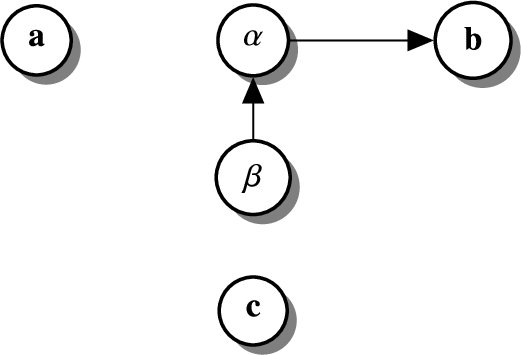
This AF can be in turn represented by the following ADF: 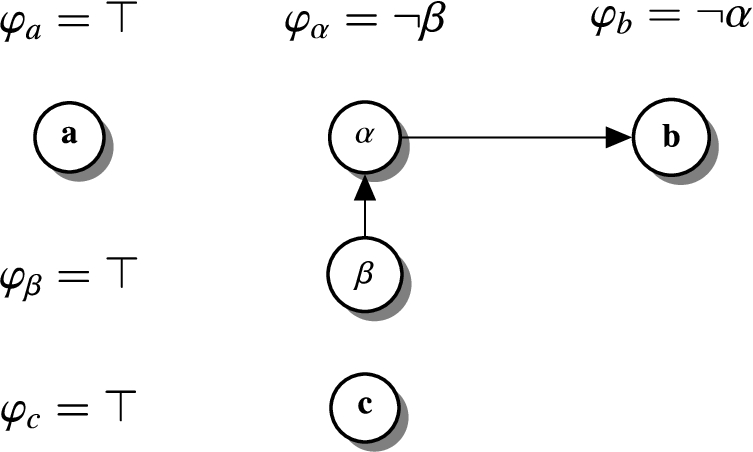
Several implementations have been proposed for ADF (see [22,23]). Here are some of them:13
This list is not exhaustive. For instance, the reader can also refer to YADF [19] or to k++ADF [75].
(DIAlectictal MOdels eNcoDing) is based on Answer Set Programming (ASP). DIAMOND translates an ADF into an ASP program whose stable models correspond to models of the ADF with respect to several semantics (i.e. admissible, complete, stable, grounded).
is a system for solving reasoning problems on ADF using Quantified Boolean Formulae (QBF).14
These formulae are a generalization of the propositional formulae in which both existential quantifiers and universal quantifiers can be applied to each variable.
(Uniform Account of Realizability in Abstract Argumentation) is a system based on ASP for deciding realizability of a given set of interpretations. It supports AFs, ADFs, the subclass of bipolar ADFs (BADFs), and frameworks with sets of attacking arguments (SETAFs). For each of these formalisms, realizability can be tested for the standard semantics, namely admissible, complete, preferred and two-valued models (stable semantics for (SET)AFs). In words, given a set of interpretations V, a formalism F and a semantics σ, UNREAL computes all knowledge bases K of type F having
is a Java tool for specifying and evaluating GRAPPA and ADF instances (GRAPPA being a semantical framework for graph-based argument processing − GRAPPA = GRaph-based Argument Processing based on Patterns of Acceptance). GrappaVis is a graphical tool for specifying GRAPPA and ADF-instances, evaluating them and visualizing the results of the evaluation. GrappaVis itself is a JAVA-application based on the JGraphX framework and therefore provides intuitive tools to draw GRAPPA / ADF instances. For the evaluation it makes use of two different types of ASP encodings.
As shown before, the ADF approach is able to encompass several approaches of abstract argumentation. The main difficulty rests in the choice of the right acceptance conditions appropriate to a given framework.
The idea to attach an acceptance condition to an AF has also been used in [43]. In this approach, a constrained argumentation framework (CAF) has been defined as an AF associated with an acceptance condition that is a propositional formula. As in ADF, this propositional formula is defined over a vocabulary built on the set of arguments. Nevertheless there exist important differences between a CAF and an ADF:
the graph used in [43] is a standard argumentation graph (links encode attacks) and not a dependence graph,
there is a unique acceptance condition in [43] and not one attached to each argument,
In [43] are defined new semantics by combining standard semantics with the satisfaction of the acceptance condition.
The following example illustrates this approach.
Consider the CAF built with the following AF and the propositional formula 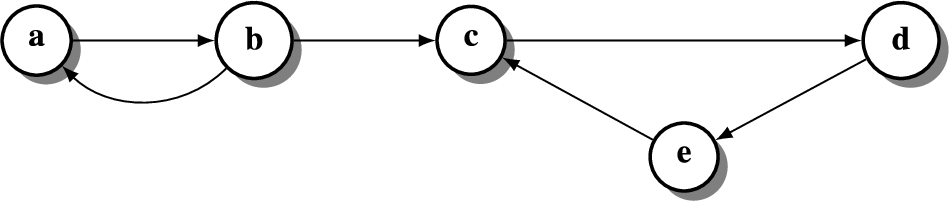
There are 2 preferred extensions
Then taking into account the acceptance condition C, only the first one can be considered as an extension for the CAF.
The approaches reviewed in this section aim at giving a logical theory (in propositional logic) that encodes an AF. That is, for each of these approaches, the input is an AF and the output is a theory in propositional logic. They are theoretical approaches, but the output theories supplemented with formulae capturing a given argumentation semantics, can be fed into a SAT solver. In these approaches, the logic (propositional logic, either pure or extended in a number of alternative ways: sorted language, modal-like language) is used to encode the AF. Additional properties may map models to extensions according to a given semantics.
The syntactic sugar way
The simplest approach for encoding an AF consists of introducing special propositional atoms in the language in order to denote the edges of the argumentation graph (
See also Section 6. In the YALLA language, a specific predicate has been introduced for encoding an attack between sets of arguments:
The description needs not include propositional atoms of the form
This approach has been presented in several papers [30,33,34]. The definitions presented here are those given in the more recent paper [33].
The theory generated by [33] consists of the following axioms:
For every
For every argument b in the input AF
Such formulae express (by transitivity of material implication) conflict-freeness of extension-based semantics:
The generated theory is bigger than for AFs. First, there are the following conflict-freeness axioms:
Of course, the generated theory includes RAF-dependent axioms (assuming the arguments of the input RAF are
Additional formulae are introduced for encoding the different principles that govern argumentation semantics. There are formulae for capturing the defence principle, the reinstatement principle and the stability principle. Then extensions under a given semantics (admissible, complete, preferred, grounded, or stable semantics) can be characterized by models of logical theories obtained by combining some of these formulae. See an example in Section 12.2.
The approach by Gabbay and Gabbay
In [67], for every AF, a theory is generated with the axiom:
Similarly, a conflict-freeness axiom is needed:
The theory generated by [67] consists of four kinds of formulae:
If y is unattacked then this formula is equivalent to
If y is unattacked then the formula
The complete extensions correspond to the models of the above theory. See an example in Section 12.2.
Note that the above formulae fail to provide a modular encoding of some principles of argumentation semantics such as for instance the defence or the reinstatement principles (so, it is not so easy to characterize, e.g., admissibility). This is a difference with the Cayrol–Fariñas–Lagasquie approach.
An additional axiom is introduced for characterizing stable semantics:
The corresponding stability axiom given in [33] is:
Both [30] and [67] prove that the models of the respective theory coincide with the extensions of the AF (the list of semantics dealt with in [30] is longer).
The approach of [30,33,34] has been implemented in
QBF-formalization of AF
The aim of both approaches [4,50] reviewed in this section is to express properties over a given AF, so that these properties can be used to characterize extensions of the AF. Thus, the input consists of an AF (or an ADF [49]) together with an extension-based semantics. The output is a quantified Boolean formula (QBF)18
These formulae are a generalization of the propositional formulae in which both existential quantifiers and universal quantifiers can be applied to each variable. With this formalism, one can ask whether a quantified sentential form over a set of Boolean variables is true or false. An example of QBF formula:
These are theoretical approaches but implementations are afoot using QBF solvers, and indeed such an implementation is QADF, due to Diller, Wallner & Woltran [50].
We first describe the approach due to Arieli and Caminada [4,5].
Let us recall that a labelling
For each argument a,
If a is
If a is
If a is
The assignments of truth values to (name of) nodes are captured syntactically, that is, through formulae. This is done as follows:
For an unsigned atom a and unsigned formulae ϕ, ψ, define the following signed formulae:
The encoding then expands to
For an unsigned formula ϕ:
The main definition is:19
Let
The role of
Also, stable extensions can be captured:
Quantified Boolean formulae enter the picture as minimization or maximization is required. For an AF such that
This formula can be read as follows. Considering a current labelling
3.4.1
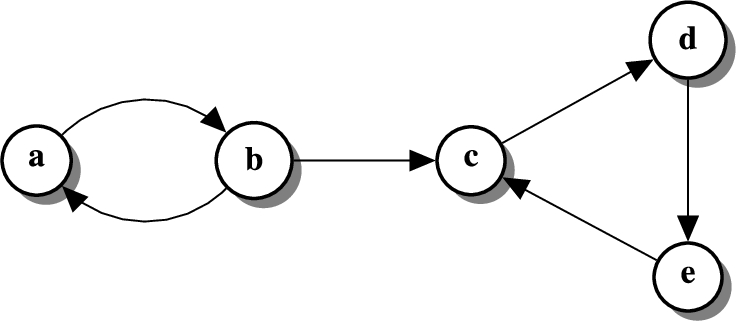
The corresponding theory is:20
This set of rules is partitioned in 3 subsets: rules for assigning to each argument the value t, then f, then u.
In the signed language,
The QBF-based formalization due to Diller, Wallner and Woltran [49,50] concerns ADFs.
This approach also uses a signed language, with the same atoms as given in Def. 14, namely
The same constraint (see
The main difference with the approach due to Arieli and Caminada is that the existence of the acceptance condition
The quantification ensures ranging over all interpretations: conjunction over all
This formula expresses that the current labelling is admissible. It can then be used to obtain a formula
The QBF approach has been implemented in the form of the QADF system (see the description in Section 3.3).
Dedicated languages for abstract argumentation
YALLA (Yet Another Logic Language for Argumentation)
The aim of this approach is the definition of a first-order logical theory capable of describing an AF and its standard semantics. In the basic language YALLA, an AF is described by specific axioms of the theory and formulae are interpreted by argumentation graphs. A variant of the basic language called
It is a theoretical approach (no implementation yet) introduced in order to express the properties of update operators in dynamic argumentation. Moreover,
Main definitions
[55] has proposed a framework for handling change in argumentation (addition or removal of arguments or attacks). All the definitions are related to a specific AF, called universe, setting the set of possible arguments together with their interactions. This universe is supposed to be finite and is denoted by the pair
During a trial concerning a defendant (Mr. X), several arguments can be involved to determine his guilt. The set of arguments
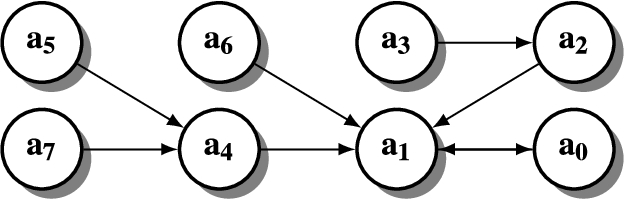
In [55], an AF is defined w.r.t. to a given universe
An AF on
The set of AFs that can be built on the universe
An example of AF on the universe
The prosecutor is trying to make accepted the guilt of Mr. X. She is not omniscient and knows only a subset of the arguments of the universe presented in Example 6.1.1 (a subset that is not necessarily shared with other agents). Moreover, her knowledge being based on the universe, any argument or attack that does not appear in the universe cannot appear in her graph. Here is her AF (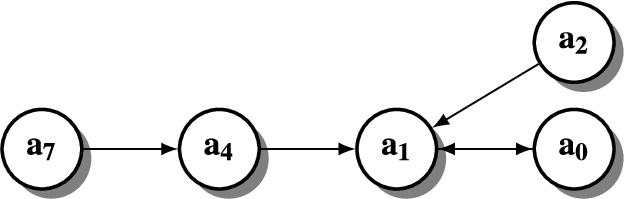
[55] has proposed a first-order logical theory capable of describing abstract AFs built on a given finite universe
For each function or predicate symbol, the arity is indicated by an exponent attached to the symbol.
As the logical theory has been built for describing AFs on a given universe, terms and formulae of the language
(Structure ).
A structure a unique element of the binary set theoretic union operator (function from the characterization of the subsets of the binary set theoretic inclusion relation (binary relation on the binary relation of attack between sets of arguments induced by
Among the formulae that can be built on the signature
Let x, y, z be variables of
An AF belonging to
(Formula describing an AF ).
Let the function
When t denotes a term of
Note that
Some additional notations are used for encoding the argumentation semantics: let
Then the principles used in argumentation semantics can be encoded in terms of
Let
t is conflict-free in t is admissible in t is a complete extension of t is the grounded extension of t is a stable extension of t is a preferred extension of
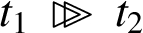


Due to the finite size of a universe, each
In [55]
3.2.4
An example of argumentation graphs built on a universe.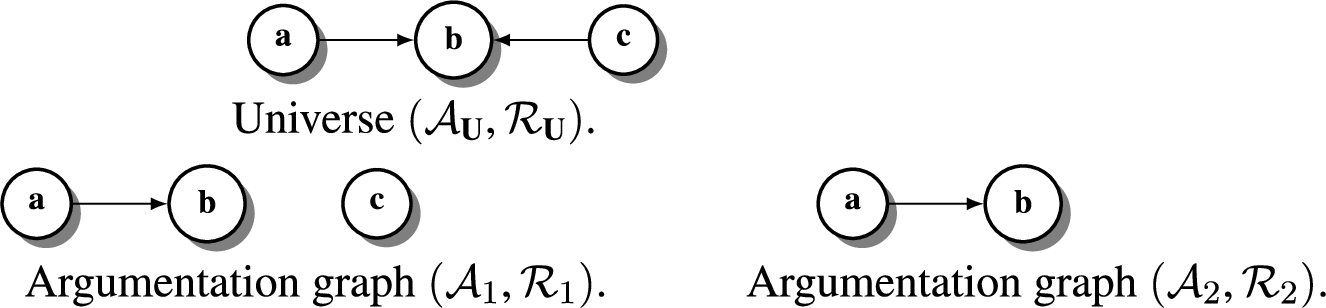
Let
We have
Moreover, following Definition 20, we have:24
Note that the absence of an attack is expressed only if this attack is in the universe:
More complex assertions can be expressed in
6.1.1
Two possible cases for the argumentation graph of Agent 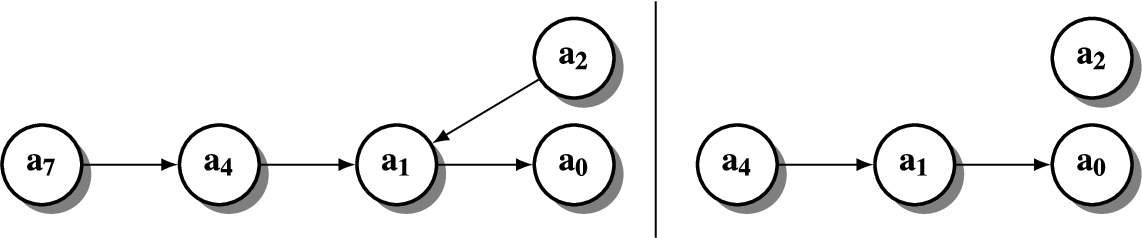
The knowledge held by
φ is satisfied by only two structures which correspond to
Note that
Other works propose dedicated logical languages for dealing with dynamics in argumentation frameworks. See for instance [18,44,45,48,51,52]. Moreover, it is worth noticed that a survey has been done in the context of dynamics in argumentation frameworks, see [53].
The approach by Villata et al.
In [93] is proposed a propositional logic of argumentation to specify and verify requirements in AFs. Note that a modal variant of this logic has been proposed (see Section 10).
The input consists of an AF together with requirements to be satisfied. The outputs are formulae encoding the framework and formulae encoding the requirements. Examples of such requirements are: “Argument a attacks argument b”; “argument a defends argument b”; “argument a or argument b is acceptable”; “if argument a is accepted (in an extension) then argument b is accepted too (in the same extension) and argument c is not accepted”.
The basic ideas of the logic for specification and verification are close to the ideas of YALLA. A model of the logic represents an AF, and such a model satisfies formulae representing the fact that arguments attack or defend each other, or whether sets of arguments are extensions. Moreover the models are built on a given universe of arguments.
Atoms of the language represent sets of arguments. The attack relation is explicitly encoded by a new logical connective ⊳. The formula
The above connectives allow the specification of requirements related to the structure of an AF.
In order to specify requirements related to the semantics, new kinds of formulae are considered such as
Note that all the verifications need a model-theoretic approach, as the logic has not been axiomatized. So the verifications have to be made at the AF level.
Encoding of extension-based semantics
In this section are reviewed two approaches that, given an extension-based semantics σ, produce a formula
The approach by Besnard and Doutre
The original proposal is [11], extended in [12]. Independently, an equivalent proposal is [94].
The idea is as follows. Let σ be an extension-based semantics,
Logic is used for specifying the principles of the semantics and the produced formula is parametrized by S (and by σ of course).
Description of the approach
For a given
Such a formula is constructed in view of the interpretation for a propositional symbol a: a is true means that a is in the extension.
Also, the usual conditions underlying admissibility in extension-based semantics are captured:
General test:.
In the above formula,
For example, in the formula enabling to determine whether S is a stable extension of
Some implementations
Besnard and Doutre’s approach has been used in many different implementations. Here we focus on four examples.
In [12 ,13] and thanks to the project SESAME (see [10]), an implementation has been proposed under the form of a software allowing the definition of semantics with logical formulae (aggregation of formulae, each of them representing a requirement that must be respected by the set of arguments candidate, such as conflict-freeness, or defence).
In [95], the encoding proposed by Besnard and Doutre in [11] is extended in order to take into account the semi-stable semantics. Then two extensions of SAT are used, the minimal correction sets (MCS) and the backbone (BB): consider a CNF propositional formula Φ, the MCS problem consists in the computation of the minimal sets of clauses issued from Φ such that, after their removal, Φ becomes satisfiable; the BB problem consists in identifying the litterals that are true in each model of Φ. The idea of this paper is to establish links between the MCS and BB problems and the computation of semi-stable, eager and ideal extensions.
In [72], the encoding proposed by Besnard and Doutre in [11] is used in two different ways. First, it is used directly in a SAT solver for computing the semantics that are in the first level of the polynomial hierarchy. Secondly, it is extended with some weights for computing the semantics that are in the second or more level of the polynomial hierarchy (with a flavour of constraints programming techniques) then used in a Partial Max-SAT solver (the Partial Max-SAT problem is an optimisation problem that consists in satisfying the more possible clauses of a given formula with respect to the weights given to each clause). These algorithms have been implemented in a software called CoQuiAAS.
In [74], the encoding proposed by Besnard and Doutre in [11] is extended for the computation of three new problems: find an extension that is maximal in terms of cardinality, repair a set of arguments in order to transform it into an extension, and adjust an extension such that it contains (or not) a given argument. Each of these new problems is encoded in logic and solved either by an iteration of SAT solver calls, or by a Max-SAT solver call.
The CEGARTIX approach
In [59], a specific encoding of some extension-based semantics is proposed, using two propositional symbols for each argument (for an argument a, the symbols are
For a given
As it is said in [59]: “The first line declares the conditions for admissible sets following the definition: any admissible set must be (i) conflict free and (ii) each argument in the set must be defended by the set. The second line declares (i) the value of auxiliary atoms
Here is a small illustration to give some insight into the intuition behind the items a is defended by the extension is encoded by Let us assume that: By definition of From the end of the second line of Moreover, from the first part of the first line of So we obtain
Models of
Then this encoding is used in a software called CEGARTIX (see [58,60]) that computes skeptical and credulous acceptance under given semantics. It is based on NP-oracles (basically the MiniSAT solver).
Encoding of labelling-based semantics
The purpose of the works reviewed in this section is to encode labelling-based semantics25
by a set of logical formulae. These formulae express the different constraints associated with a kind of labelling (complete, grounded, stable, preferred). One of the approaches has led to implemented systems for computing semantics.In [25], metalevel approaches are proposed for talking about argumentation. A metalevel approach describes an argumentation framework from “above”, using another language and logic. The metalevel language can be classical logic or modal logic. The case of modal logic will be presented in Section 10. Here, we focus on the metalevel approach that uses classical logic for encoding argument labellings.
The logical language includes the equality predicate (“=”), a binary predicate R and the three unary predicates
Intuitively, given an AF denoted by
Let us consider the following classical theory denoted by
Any model of the above theory Δ with domain D defines an argumentation framework
Then other labellings can be characterized as particular models of Δ. For instance, the grounded labelling is obtained with a model that minimizes
An example of the use of circumscription in order to solve AF reasoning problems is described in [1].
When dealing with a specific AF, additional axioms are needed. They use “=” and constant names for denoting the arguments. Let
Let
In [36], three propositional symbols are defined for each argument:
Other formulae are defined for expressing some constraints about labellings. For instance, the fact that “an argument has one and only one value in a labelling” is expressed by the formula:
Several combinations of these formulae are proposed in order to encode complete labellings.
Note that in the case of a finite AF, the encodings of complete labellings proposed in [36] and [25] can be matched, owing to the equivalence between the alternative definitions of complete labellings provided in [25] (see Section 2.2).
Some implementations
At least three systems have been developed using the approach proposed in [36].
In [36], an algorithm using a SAT solver is proposed for computing the preferred semantics. This algorithm is called PrefSAT.
In [37], a system called ArgSemSAT is proposed including PrefSAT for computing the preferred semantics. It also includes an approach proposed by the same authors using a decomposition of the argumentation graph in its strong connected components (SCC) and the computation of the preferred extensions by a propagation process across these SCCs with a call to a SAT solver for each SCC.
In [9], a software called LabSAT allows the computation of extensions for several semantics (complete, stable, preferred, grounded) and also the resolution of the credulous and skeptical acceptance problems. It uses the encoding proposed in [36].
Moreover, due to the ICCMA competition [16], many other solvers have been developed. See for instance [38–40,62,77] (once again this list is not exhaustive).
Argumentation frameworks and logic programming
The close connection between AF semantics and Logic Programming (LP) semantics goes back to Dung’s work [54]. Dung introduced a transformation from LP to AF, and showed that stable models (resp. the well-founded model) of a logic program correspond to stable extensions (resp. the grounded extension) of the associated AF. These results have been extended by connections between LP 3-valued stable models (resp. regular models) and complete (resp. preferred) extensions [24,96]. Roughly speaking, the purpose of these works is to provide an argumentative semantics for logic programs. So following our choice presented in Section 1, these works are out of the scope of this survey.
In the same paper [54], Dung also introduced a converse transformation from AF to LP, and showed that stable extensions (resp. the grounded extension) of an AF can be obtained as stable models (resp. the well-founded model) of the associated logic program. These results have been extended to relate other AF semantics to LP semantics [24,26,61,83,84,89]. In that case, the purpose is rather to apply computational techniques of Logic Programming to argumentation and so matches with the topic we are interested in. In this context, note that the relationship between argumentation and logic programming has been the subject of intensive research. Currently, there are different mappings which allow to transform an AF into a logic program, all of them offering different characterizations of argumentation semantics in terms of LP semantics. A summary of these characterizations can be found in [83] with all the associated references. Moreover, some works have also considered the issue of using ASP-solvers to compute the extensions of AFs under different semantics [47,61,69,90].
In the following, we first consider some works relating a (simple) AF and Logic Programs. Then we consider generalizations to enriched argumentation frameworks (BAF, RAF). The works reviewed in this section can be distinguished according to the following features:
AF semantics can be encoded under the form of extension-based semantics as in [54,84], or under the form of labelling-based semantics (as for instance in [24,89]).
Different semantics of AF correspond to different semantics of a same logic program as in [24,54] or different semantics of AF are all characterized by the single 2-valued stable model semantics of different transformed programs as in [89].
Note that all the logic programs that we consider below are normal logic programs, that is logic programs whose rules may contain weak negation (i.e. negation as failure, with the symbol
From an AF to a logic program
The input is an AF. The output consists of a logic program P together with the characterization of some of the standard argumentation semantics (at least the grounded semantics and the stable semantics) using the models of P (two-valued or three-valued models depending on the considered approach).
The logical formalism enables to encode attacks. Moreover, depending of the approaches, the concept of attack is encoded in an explicit way (as for instance in [26,54,84]) or in an implicit way (as for instance in [24]).
Two kinds of work can be distinguished. The first kind lies in the spirit of Dung’s work and concerns works using two-valued models for LP semantics. The second kind of works uses three-valued models for LP semantics.
Towards logic programs under 2-valued semantics. Let us start by the initial approach of [54]. Given an AF The rules describing the attacks in The rules defining acceptability: The rules defining defeat:
where
The approaches described in [26,83,84] propose an alternative transformation considering not only attackers but also defenders. The common idea is to encode attack in an explicit way through a literal
The characteristic features of these approaches are:
The logic program includes weak negation (i.e. negation as failure, with the symbol
The encoding captures both conflict-freeness and admissibility principles.
The predicate
The logic program P contains two parts P− and P+: P− encodes conflict-freeness and P+ encodes admissibility.
P− contains rules of the form
P+ contains rules of the form
Then, acceptability can be encoded through the predicate
There are correspondences between standard argumentation semantics (grounded, stable, preferred, complete) and two-valued models of the logic program (well-founded, stable, p-stable, supported models).
Note that acceptability is defined by default. That is close to the reinstatement principle. In particular, if an argument x is not attacked, it does not appear as the head of any rule, so x will be accepted.
3.2.3
3.2.4
Consider the following AF: 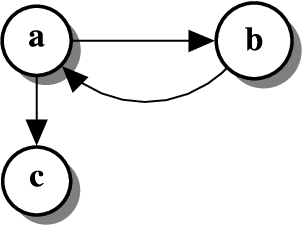
The associated logic program is:
3.4.1
The approach of [89] is rather different in the sense that it proposes several transformations of an AF in different logic programs, each one encoding a labelling-based semantics. These semantics are all characterized by the single 2-valued stable model semantics.
Given an AF, each logic program consists of two parts:
the rules encoding admissibility, which will belong to all the different programs,
the rules specific to each semantics.
For instance, let us give the program representing the grounded semantics. The first part contains rules defined as follows:27
Note that the rules with an empty head represent constraints.
The part specific to the grounded semantics contains rules of the form:
3.2.3
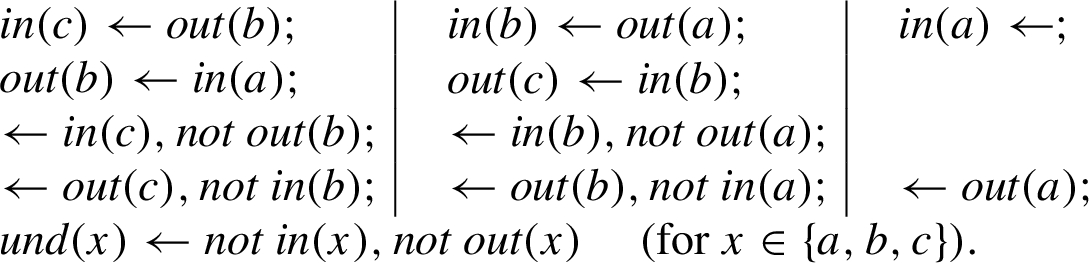
The unique stable model is
3.2.4
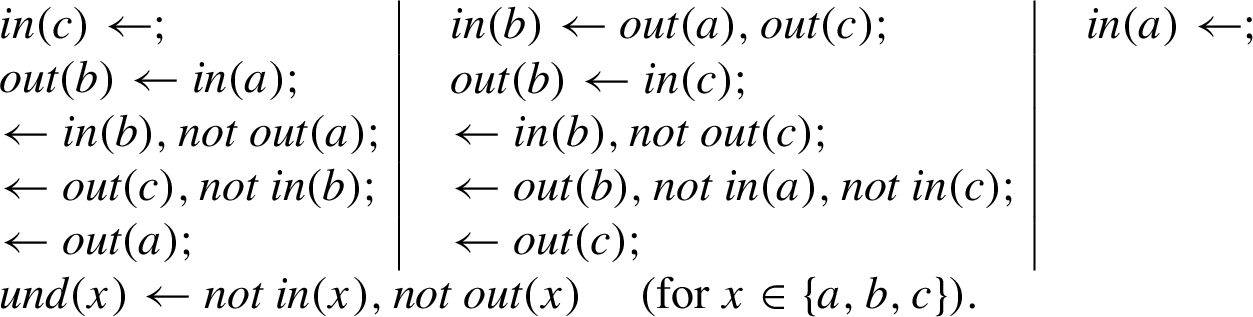
The unique stable model is
9.1.1
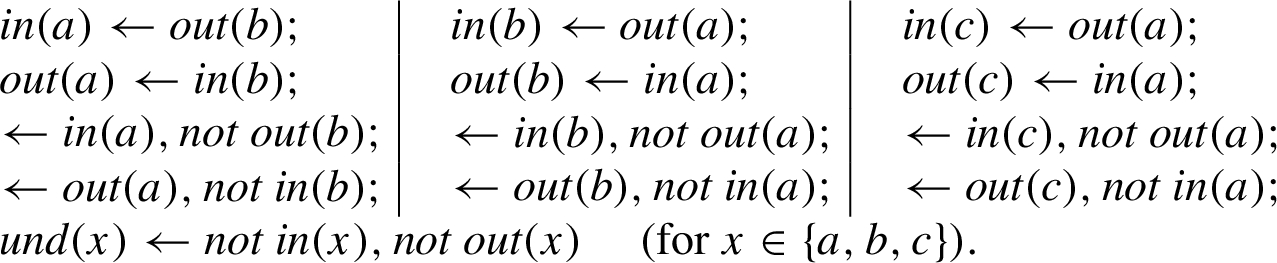
The unique stable model is
Towards logic programs under 3-valued semantics. Let us consider the approach described in [24]. The idea is to encode attack in an implicit way, that is as a rule of the logic program, without any additional predicate. Each argument generates a rule with the name of the argument as its head and the name of the attackers in the weak part of its body. The characteristic features of this approach are:
No predicate is needed. Each argument becomes an atom of the program P. The logic program includes weak negation (i.e. negation as failure, with the symbol The logic program contains rules of the form The logic program is a simple program, that is a program with at most one rule with head x for each argument x. Moreover for each rule of the program the body only contains weak atoms (atoms of the form There are correspondences between standard argumentation semantics (complete, stable, grounded, preferred) and three-valued models (3-valued stable, 2-valued stable, well-founded, regular) of the logic program.
3.2.3
3.2.4
9.1.1
3.4.1
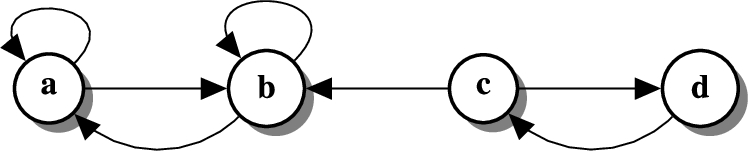
Consider the following AF: The associated logic program is:
Now we consider generalizations to enriched argumentation frameworks: a framework accounting for both attack and support interactions, called AFN, and a framework accounting for higher-order interactions.
AFNs and logic programs
Let us briefly review the work done by F. Nouioua (unpublished report, private communication). That work examines the connections between an Argumentation Framework with Necessities (AFN) and logic programs under three-valued semantics. Both directions are considered but following our choice we discuss only the case when an AFN is encoded into a logic program.
An AFN [78] is a kind of BAF, where the support is collective and is interpreted as a “necessary support”: Given E a non-empty set of arguments and a an argument, E is a “necessary support” for a means that the acceptance of a requires the acceptance of at least one argument of E. Note that in AFN semantics, acyclicity of the support relation is required among accepted arguments. In other words, in a given extension, support for each argument is provided by at least one of its necessary arguments and there is no risk of deadlock due to necessity cycles.
An AFN is encoded into a logic program as follows:
For each argument a, an atom a and a rule For each set of arguments E that necessary supports an argument, an atom e is created. The body of the rule For each support E, there is a rule There are correspondences between AFN labelling-based semantics and three-valued semantics of the program which is obtained. Consider the following AFN: The associated logic program is:

In [65] higher level extended argumentation frameworks are considered, where attacks on other attacks are allowed, at any level. A translation from a higher level framework into a logic program is suggested, as follows:
The atoms of the logic program are all the arguments and all the attacks.
For each e, argument or attack, if e is not attacked, the rule
Assume that e is attacked by the arguments
The above formula must be turned into several clauses in order to get a normal logic program.
Gabbay, in [65], proposes to define the semantics of a higher level extended argumentation framework through known semantics for logic programs, using the above transformation.
However, to the best of our knowledge, this way was not pursued by the author. Instead, Gabbay in [66] proposes to give up the logic programming approach for defining the semantics of higher level argumentation frameworks. Indeed, the new approach consists in rewriting higher level attacks as frameworks with a special kind of collective attacks (called joint attacks).
Note that another connection could be considered between another variant of higher level extended argumentation frameworks, called REBAF, and logic programs (private communication by J. Fandinno). A REBAF [29] is a generalization of AF that allows the representation of both recursive attacks and evidential supports. It is also a generalization of EBAF (see Section 2) with attacks and supports targeting other attacks or supports. Nevertheless, this connection is not in the scope of this survey since this is the encoding of a logic program into a REBAF and, up to now, the other direction (from a REBAF to a logic program) has not been considered.
Some implementations
Some implementations using logic programming have been proposed. The first one uses a translation of an AF into a logic program. The other ones do not propose a translation of an AF into a logic program but use logic programming for computational issues.
(Answer Set Programming Argumentation Reasoning Tool) supports reasoning in AFs using the ASP formalism (see [57] for the description of the tool and many references). The core of ASPARTIX handles AFs. It provides encodings for computing extensions or performing credulous/skeptical reasoning in AFs. A broad range of argumentation semantics is dealt with. ASPARTIX also handles several other frameworks built on top of AFs, including for instance AFs augmented with preferences (PAFs), BAFs, AFRAs, SETAFs (AFs where attacks are carried by sets of arguments). presents dialectical proofs for the credulous acceptance problem in constrained argumentation frameworks (CAF, see Section 3.4). A CAF is a generalization of AF that allows additional constraint on arguments to be taken into account in the definition of admissible sets of arguments. A dialectical proof is formalized by a dialogue between two players, the proponent and the opponent. Dialectical proofs are computed by an ASP program which consists of facts encoding a CAF and rules encoding what a dialectical proof is (that is the legal-move function of the dialogue). The models of the logic program correspond to the dialectical proofs of the CAF (see [73] for the description of the ASP solver ASPeRiX and its application to the credulous acceptance problem in a CAF). proposes a Boolean algebra to encode acceptability semantics for AFs. A subset of arguments is represented by a Boolean vector and the attack relation is represented by a Boolean matrix. Then series of Boolean operations on vectors and matrices are introduced so that acceptability semantics (namely the admissible, stable and complete semantics) can be encoded by Boolean constraints. These constraints are translated into logic programs and solved using a Constraint Logic Programming over Boolean variables (CLPB) system, which is an instance of the general CLP scheme that extends logic programming with reasoning over Boolean domains. The implementation uses SWI-Prolog, a Prolog system equipped with a CLPB system. Experiments have been conducted, with a comparison with the approach using the solver ArgSemSAT [37] (see Section 8.3).
Argumentation frameworks and modal logic
As outlined in [25], there exist several methods for expressing argumentation in modal logic, among which the object-level approach and the meta-level approach. Roughly speaking, in the object-level approach, an AF and its logical translation share the same language (each argument becomes a logical atom), whereas a meta-level approach talks about an AF from “above”, using another language and logic (for instance a modal logic).
We first recall some modal logic background. Then, we present three examples of meta-level approaches. In the first two, the input consists of an AF together with a labelling. The output consists of modal formulae that express the characteristic properties of complete and stable semantics.
Finally, we briefly present an object-level approach.
Modal logic preliminaries
The modal logic K is a propositional system with the modal operator □ (and its dual ♢), the usual logical connectives, the symbols ⊤, ⊥ and atomic propositions
Models for K have the form
Satisfaction is defined as follows:
A holds in
The system K can be axiomatized as follows:
propositional tautologies
If
The approach by Grossi
In [70] a well-known modal logic (the extension of K with universal modality) is used to formalize basic notions of argumentation theory.
Let
An assignment I on
That is, the codomain of I is the powerset of
An argumentation model has the form
The following statements are interesting in argumentation theory:
“argument a is attacked by the set of arguments E”; “argument a is defended by the set of arguments E”; “the set of arguments E attacks an attacker of argument a”.
In order to express these statements, two modal operators are used:
As usual, there are also the dual operators
The semantics is as follows: In a given model
Consider for instance the particular case of a labelling. Let a be an argument.
Given an argumentation model
The modal logic that is obtained is an extension of the modal logic K, denoted by
Consider the particular case of a labelling. A labelling
Then model-checking can be used in order to determine whether a given formula is conflict-free, admissible, stable.
Furthermore, Grossi, in [70], presents a game-theoretic proof procedure based on model-checking games for the logic
Note that an additional modal machinery including a least fixed point operator is needed to capture the notion of grounded extension.
The meta-level approach of [25] is close to the approach of [70]. It can be summarized as follows. Given
Arguments are viewed as possible worlds; so
The attack relation becomes the accessibility relation.
A labelling becomes an assignment of three propositional atoms
More precisely, given
The modality □ means “being attacked by”, namely
Note that the modality □ corresponds to the modality
Complete labellings can be characterized with a set of axioms including for instance:
Then, stable and complete extensions are characterized by the following equations. Let E be a propositional letter denoting a set of arguments (see an example given in Section 12.2).
E is stable iff E is a complete extension iff
The extensions can be obtained as fixed point solutions for the above equations.
The modal setting of Villata et al.
The purpose of the work reported in [93] is to define a logic for specifying and verifying requirements for AFs. A propositional variant has been presented in Section 6. Here we consider the modal variant, which allows the expression that some semantics admit multiple extensions and also the expression of properties of the attack relation (such as irreflexivity, or symmetry for instance).
The main difference with the modal approaches of [25] and [70] is that these works describe semantics in the modal language, whereas [93] considers semantics as primitives of the language.
The approach of [93] presents the following features:
Sets of arguments are viewed as possible worlds.
The attack relation is interpreted as an accessibility relation among worlds. That implies that the attack relation represents a collective attack (a set of arguments taken together may attack another set of arguments).
There are two modal operators:
As in the propositional variant, primitives of the modal language (such as
The modal logic that is obtained enables to express characterizations such as:
For any pair The grounded semantics admits a single extension:
The object-level approach of Caminada and Gabbay
The object-level approach of [25] can be summarized as follows. Given
Arguments are viewed as atomic propositions in the modal provability logic
The content of
The possible world models of
The modal formula
The provability logic axioms and rules of modal logic K
Translation of an AF into intuitionistic logic
The translation of an AF into an intuitionistic logic theory has been first considered in [68]. The idea is to use intuitionistic negation to model an attack. The intuitionistic models of the obtained theory characterize the complete extensions.
More recently, [63] presents a translation of an AF into Nelson’s constructive logic, an extension of intuitionistic logic including the notion of strong negation as a means to deal with constructive falsity. This logic allows to capture an AF under the stable semantics, at the object level, in the sense that arguments in AF become atoms in the corresponding logical theory and interactions between arguments are expressed by logical connectives. Moreover the translation allows to deal with enriched argumentation frameworks such as frameworks with collective attacks, and frameworks with attacks and evidential supports.
Background about intuitionistic logic
Let us recall that:
Intuitionistic implication
Strong negation
Intuitionistic negation is defined as
Then, a new implication connective, ⇒, allows the formalization of the “non contradictory” inference principle (NC): “no belief can be held based on contradictory evidence”.
Intuitively,
Abstract argumentation and intuitionistic logic
In [63], intuitionistic logic is used for translating an AF or an EBAF.
Translation of an AF. The translation presented in [63] relies on the following intuition: under the constructive logic point of view, an attack is a “means to construct a proof of the falsity of the attacked argument based on the acceptability of the attacker”. Moreover, the acceptability of ϕ is identified with having a consistent proof of it (i.e. there is a proof of the truth of ϕ and there cannot be a proof of the falsity of ϕ).
Then the above intuition of the notion of attack is formalized by a new connective:
In other words,
Given
Regarding how other extension-based semantics could be characterized in constructive logic is an open topic.
Translation of evidential argumentation frameworks. In the case of an argumentation framework with collective attacks and evidential supports (EBAF) the translation uses the connectives ⋀, ⇝ and ⇒.
Let
Using the notation
Note that the support from the set of arguments B to an argument b is translated by the formula
As for the case of an AF, in [63] it is proved that there is a one-to-one correspondence between the stable extensions of an EBAF (defined in [29]) and the equilibrium models of the theory
Analysis and conclusion
In this section, we first compare the reviewed approaches according to several criteria. Then, we illustrate the associated encodings on an example. And finally we will conclude this survey.
Comparison criteria
Recall that our initial choice was to identify and to compare approaches that “use logic for doing argumentation”.30
The other direction could be the object of another survey that would cover the relationship between logical frameworks and formal argumentation, including structured argumentation.
At least four criteria can be used:
The first comparison criterion is about the input taken into account by the different approaches. In each case, the input consists at least of a graph. Except in the ADF approach, this graph usually represents an AF. Moreover, in some approaches, the AF is extended into either a bipolar AF, or a recursive AF, or an AF with collective interactions, or with weighted arguments/interactions, or with preferences, or built on a given universe. In some approaches, an additional input is needed: either constraints or requirements that must be satisfied by the output or “candidates” that must be studied in order to satisfy some properties. Table 1 synthetizes all these cases. The first comparison criterion: the input
The second criterion is about the aim of the approaches that use logic for doing argumentation and is related to the produced output. Two kinds of aim can be encountered:
Either the aim is to obtain a logical encoding of the input AF; in this case, the output is a set of formulae; Or the aim is to encode argumentative semantics; in this case, the output is a set of logical formulae whose models correspond to extensions or labellings for a given argumentation semantics possibly with additional constraints; sometimes, it is also possible to check whether some “candidates” are actual extensions or labellings for a given semantics.
It is worth noting that if an approach covers the first aim, it also covers at least part of the second one. Indeed, it is very difficult to encode an argumentation graph without taking into account the meaning attached to the notion of attack (at least the notion of conflict-freeness). Table 2 synthetizes the aims of the reviewed approaches.
The second comparison criterion: the aim
The third criterion is about logic. Several logics are encountered: propositional logic, first-order logic, QBF formalism, logic programming, modal logic, intuitionistic logic. Table 3 synthetizes the different cases.
Note that the complexity of the chosen logic must be taken into account: it is more or less difficult to compute models and to establish the link between these models and the output that must be produced. This point is related to the next criterion.
The third comparison criterion: the used logic
The fourth criterion is about the existence of implementations: some approaches are yet to be implemented, whereas some others have led to different implementations, some of them being used in the ICCMA competition (see for instance [72]). Table 4 synthetizes all these implementations.
The fourth comparison criterion: the implementations
The following example illustrates the different encodings that can be obtained.
2.1.1
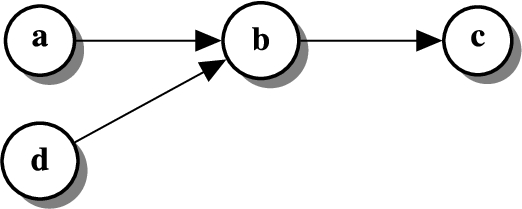
See Section 3. The AF is encoded by the following dependence formulae:
The language is propositional with the vocabulary Several approaches exist, each of them including an encoding of semantics.
See Section 4.2. The vocabulary is defined as follows:
The AF is encoded by the set of formulae:
The different requirements of the standard semantics are also logically encoded. For instance, for the complete semantics, the defence and the reinstatement principles are respectively encoded by:
Then, the models of See Section 4.3. The language is propositional with the vocabulary Without trivial formulae such as, for instance, The models of this base characterize the complete extensions (here there is only one model corresponding to the unique complete extension See Section 6.1. The language is first-order. Considering that the input AF is also the universe, the encoding produces the formula Φ:
Then, considering a set of arguments t, one can check whether t is an extension for the given semantics. For instance, t is a complete extension if the following formula is a tautology:
See Section 9.1. The approach uses logic programming. The AF is encoded by the following logic program:
The complete extensions are characterized by the supported models of the logic program. Here, there is only one supported model ( See Section 9.1. The approach also uses logic programming, with propositional symbols. The AF is encoded by the following logic program:
There are correspondences between 3-valued models of the logic program and argumentation semantics. For instance, the complete extensions of the AF are characterized by the 3-valued stable models of the associated logic program. See Section 11. The logic is equilibrium logic, with the vocabulary However, only the stable semantics has been characterized in terms of equilibrium models.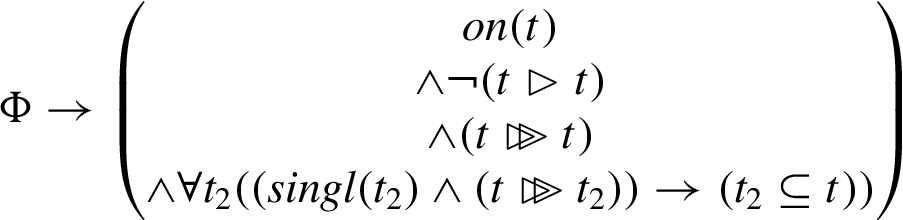
The approaches presented above allow the characterization of some semantics, given the logical encoding of the AF. Some other approaches give a characterization of semantics without encoding the input AF. They try to identify and to encode some principles governing the input semantics. In some cases, the produced formulae can be instantiated on a given AF, particularly in order to compute the extensions/labellings, or to check whether a given set of arguments is an extension (or whether a given labelling is correct w.r.t. the input semantics).
See Section 7.1. The language is propositional with the vocabulary Then, given a set of arguments S, it can be checked whether S is a complete extension. See Section 7.2. The language is propositional with the vocabulary Models of Φ characterize the complete extensions of the AF ( See Section 5. The logic uses quantified Boolean formulae (QBF formalism). The formulae can be instantiated on a given AF. For the considered AF, the complete labellings are characterized by the following formula:
See Section 8.1. For the considered AF, the complete labellings are characterized by the following formula:
See Section 10.3. The modal formula characterizing the complete extensions is quite simple. The difficulty lies in computational issues.
See Section 10.2. The logic is a modal logic. The modal formula characterizing the complete extensions is the following one:
Here again, the difficulty lies in computational issues.
Considering that this survey is published on the occasion of the 25 years of Dung’s approach, we have chosen to discuss approaches that relate logical theories and abstract argumentation in a specific sense: “How logic has been used for capturing various aspects or parts of Dung’s argumentation”. In view of the numerous proposals on the topic, it seemed to us of interest to look at them in the same place (this paper) and in a common way (whereas authors often introduce their approaches with some bias, no matter how sensible and well-taken). So, the presentation of each approach has been designed in order to answer the same set of questions: What is the aim? What are the “inputs” and the “outputs”? What is the type of the logic used? Do implementations exist?
In Section 12.1, we have given some criteria/traits/features/properties to get comparisons [similarities and differences] out of the answers to these questions; then in Section 12.2, a same example has been used in order to illustrate the behaviour of the presented approaches. The number and the diversity of these approaches are so huge that this comparison is limited but we still believe it has some value. Indeed, each presented approach has its own specificities, sometimes antagonistic with the other approaches, but also justified by its own context of definition or use. And we think that it is difficult and perhaps impossible to give here a more precise evaluation.
Nevertheless, some “use cases” could be proposed for which an approach makes a better choice that another one.
A first example of “use cases” could be: when your “input” is an AF (only simple attacks between arguments) and we are only interested in a very efficient computation of extensions, an encoding using [11,12] coupled with a SAT solver could be a good choice (note that some of the best solvers of the ICCMA competition do this choice [16]).
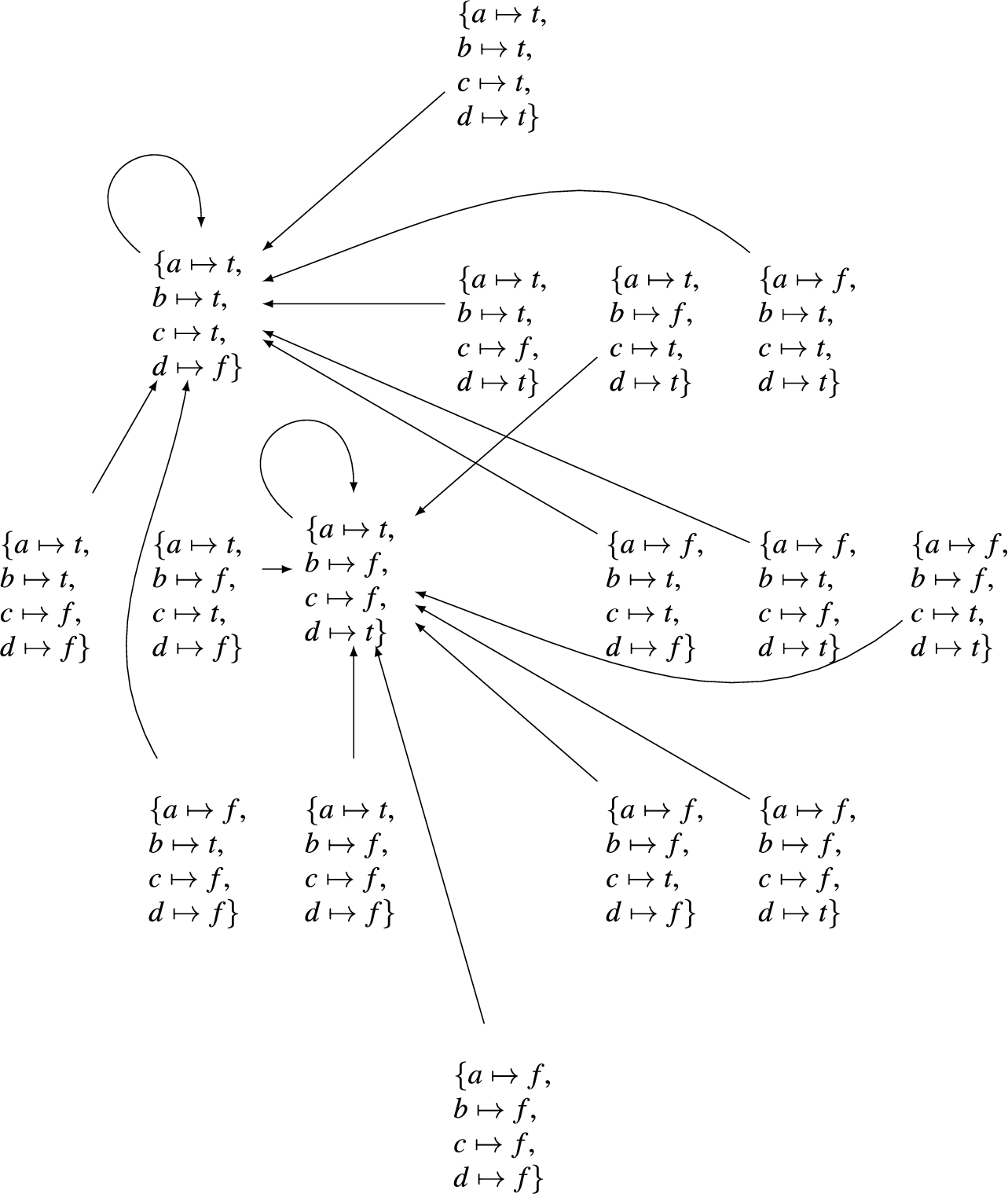
ADF approach, Example 3.2.1: set of two-valued interpretations and
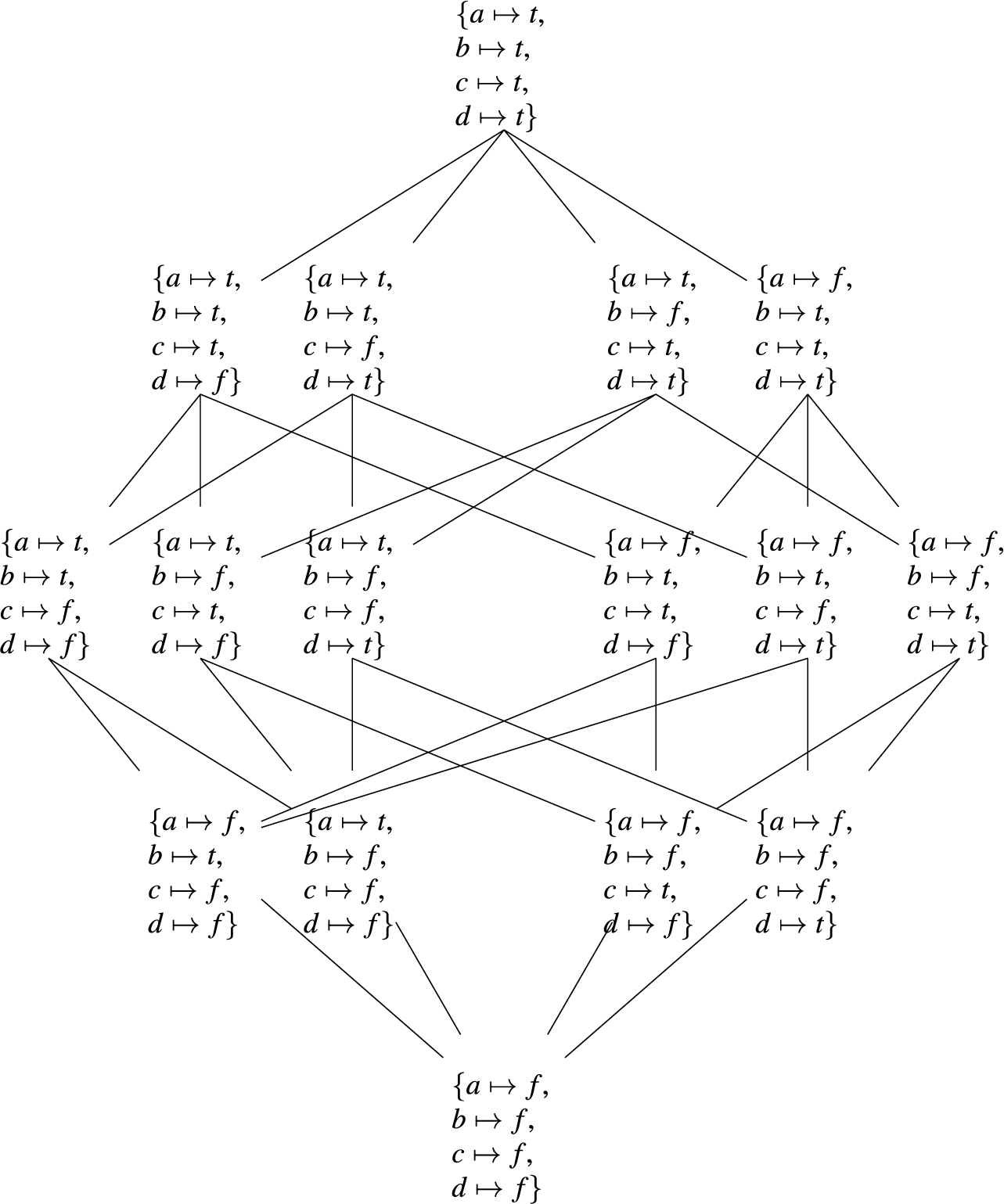
ADF approach, Example 3.2.1: the complete lattice built from the set of two-valued interpretations and the
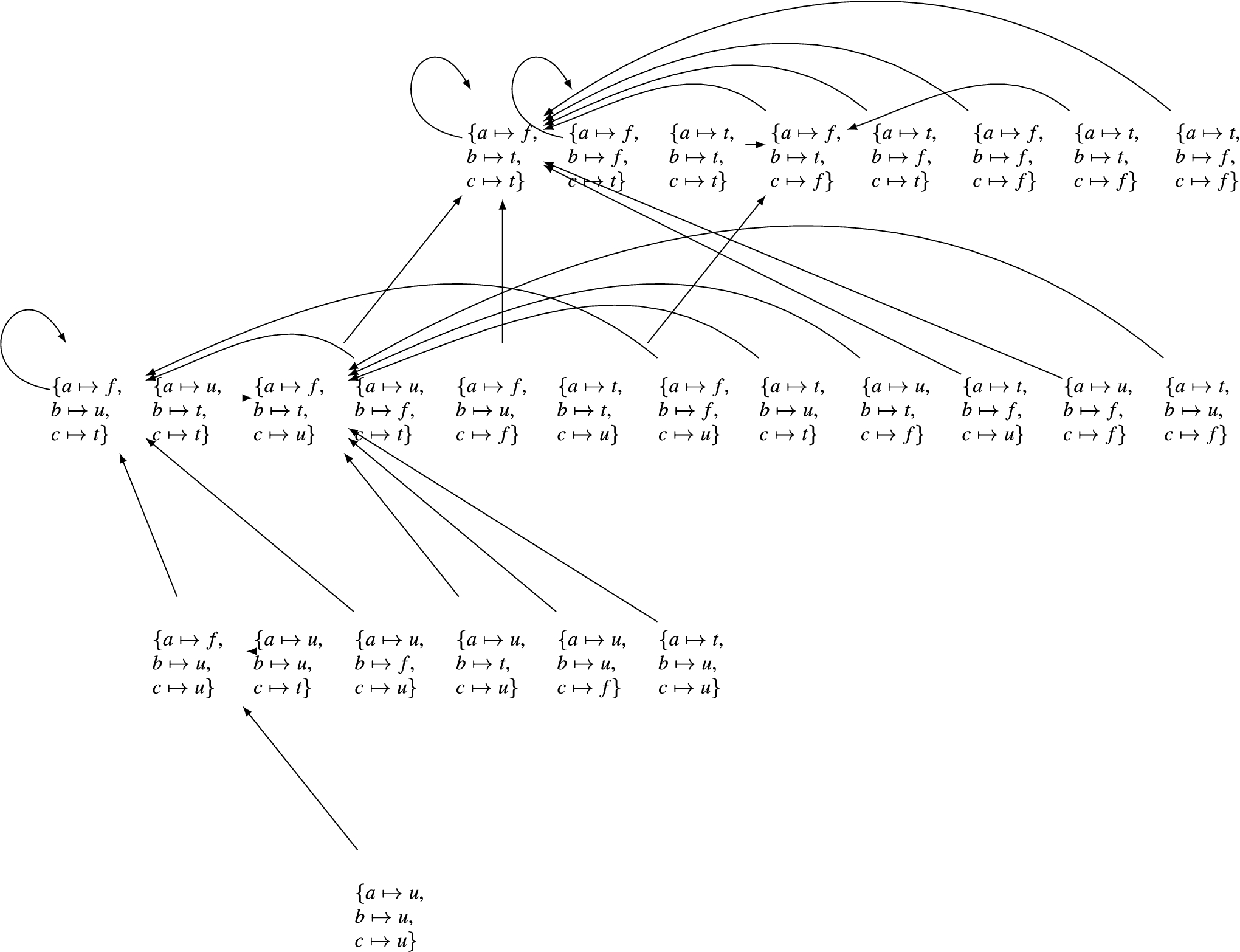
ADF approach, Example 3.2.2: set of three-valued interpretations and
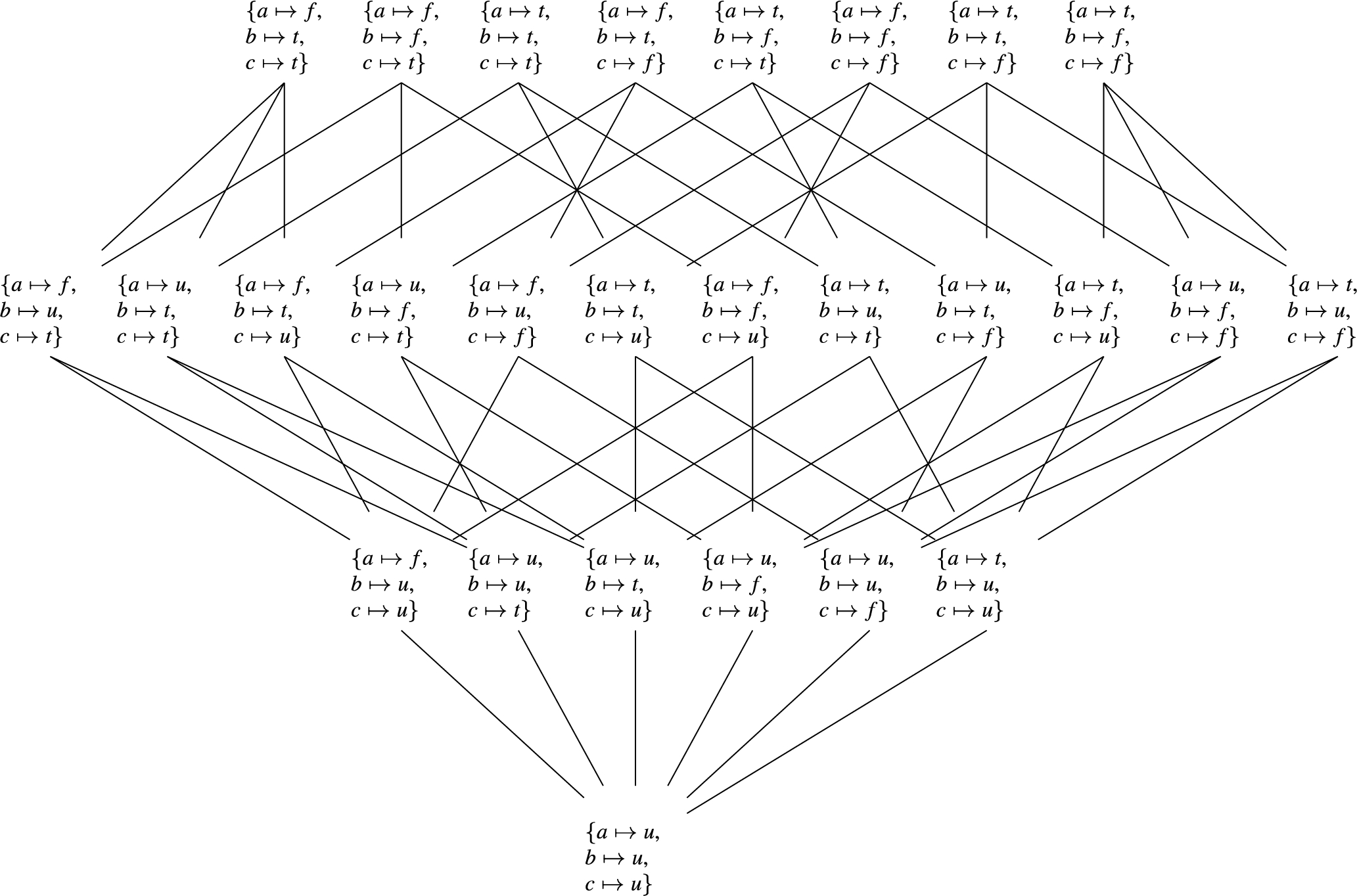
ADF approach, Example 3.2.2: the complete meet-lattice built from the set of three-valued interpretations and the
Another example of “use cases” could be: your “input” is an argumentation framework with several enrichments such as weighting functions, and we want to compute labellings. Obviously the approach defined in [11,12] cannot be used whereas an encoding by an ADF [21] coupled with one of the ADF solvers (and there are many ADF solvers) could be a better choice.
But if your input is an argumentation framework with recursive interactions, perhaps it would be better to use an encoding of this framework using the approach proposed in [33] coupled with a SAT solver in order to obtain the extensions.
Another point of view could be the size of the logical knowledge base corresponding to the encoded framework: clearly the encoding in propositional logic proposed in [59] is lengthy compared to the encoding in modal logic proposed by [70].
On another hand, expressiveness can also be taken into account since it differs depending on the approach under consideration. An example can be found when we compare the YALLA approach for instance with the encoding proposed in [33]: both use a first-order language, but YALLA is also able to reason about extensions, and not only about argument acceptance (for each semantics, there is a first-order formula in YALLA expressing that a subset of arguments is an extension under this semantics).
And of course, in a computational point of view, an existing and efficient implementation could offer a preponderant advantage. For instance, this is generally the case of approaches using propositional logic [11,59] compared to those using modal logic [25,70].
All previous “use cases” clearly show the multiplicity of points of view and that leads us to conclude that one cannot obtain a definite answer to the question of what approach is best.
Footnotes
Acknowledgements
This work has been supported by the Centre International de Mathématiques et d’Informatique de Toulouse (CIMI) through contract ANR-11-LABEX-0040-CIMI within the program ANR-11-IDEX-0002-02. Moreover, the authors wish to thank Sylvie Doutre and Luis Fariñas del Cerro for the fruitful exchanges and discussions.