




Abstract
In this work, we question the ability of existing ranking-based semantics to capture persuasion settings, emphasising in particular the phenomena of procatalepsis (the fact that it is often efficient to anticipate the counter-arguments of the audience) and of fading (the fact that long lines of argumentation become ineffective). Some widely accepted principles of ranking-based semantics (like Void Precedence) are incompatible with a faithful treatment of these phenomena, which means that no existing ranking-based semantics can capture these two principles together. This motivates us to introduce a new parametrized ranking-based semantics based on the notion of propagation which extends the existing propagation semantics (In Proceedings of the 6th International Conference on Computational Models of Argument (COMMA’16) (2016) 139–150) by adding an additional parameter allowing us to gradually decrease the impact of arguments when the length of the path between two arguments increases. We show that this parameter gives the possibility of choosing if one wants to satisfy the property Void Precedence or not (and then capture procatalepsis) and to control the scope of the impact of the arguments (and then to capture fading principle). We also propose an experiment to show that the new semantics remains stable when this parameter varies and an axiomatic evaluation to compare it with existing ranking-based semantics in the literature.
Introduction
Expressing our opinions is common in our social worlds: from politics (in political debates), law (defense attorney vs. prosecutor), academia (debates between authors and reviewers), business (convincing others to buy a product) to our personal lives. In being as much at the heart of human reasoning and interactions, it is not surprising to find much research related to argumentation in disciplines such as psychology, linguistics or philosophy. However, argumentation is also by now an acknowledged branch of one of the main subfields of artificial intelligence (AI), namely knowledge representation and reasoning (KR), that is particularly concerned with reasoning with incomplete, uncertain and conflicting information. It is widely used in areas such as multi-agent systems, common-sense reasoning, and decision making. Argumentation, in the field of artificial intelligence, is a reasoning model based on the construction and evaluation of arguments [29].
The arguments and the conflicts between arguments involved in the argumentation process can be represented with an argumentation framework. In this work, we focus on the one proposed in [15] which is very abstract in order to grasp the characteristics of many other argumentation frameworks. An abstract argumentation framework is a set of abstract entities, called arguments, representing any piece of information (e.g. beliefs, statements or actions to be performed), linked with some attacks, which indicate the existence of conflicts between the arguments. Thus, an argumentation framework is often represented by a directed graph, in which nodes represent arguments and arrows represent the attack relation between arguments.
Once the argumentation framework is built (from a knowledge base [6] or from textual data [12,23]), the next goal concerns the evaluation of the arguments on the basis of their interaction. For this evaluation part, many methods, called semantics, have been introduced in the literature. Extension-based semantics (complete, grounded, preferred and stable) are the first family of semantics to be proposed in Dung’s seminal paper [15]. Their main task is to find sets of arguments which can be jointly considered as accepted. Sharing the view that identifying sets of mutually acceptable arguments is not sufficient for some applications (see [11,22] for more details), gradual (assigning a value to each argument) [6,14,22,24] or ranking-based (returning a ranking between arguments) [2,3,8,13,16,27,28] semantics have been proposed. Each of these proposals has some merit, and nicely designed examples convince indeed that, in some situations at least, they should be the method of choice.
When it comes to comparing these approaches (beyond their formal properties like convergence or uniqueness of solution), things become difficult. This is so because the basis of comparison is not so clear in the first place, with different proposals focusing on different properties. In [4,9], many existing semantics were compared on the basis of properties for ranking-based semantics mentioned in the literature. However, even the relevance of some axioms may be very much dependent on the context. This corroborates, to a certain extent, one of the aspects addressed by Prakken and De Winter [25] concerning the danger of abstracting from the context that gave rise to an argumentation framework. What is often missing to compare these approaches is thus a clear indication of applications (or contexts) they target. Is a given semantics appropriate for finding a “good” solution to a problem of decision making? Of negotiation? Of persuasion? All of these problems? We claim that even though a semantics satisfies interesting properties in theory, it does not necessarily mean that this semantics can be used to solve any kind of problem. In this work, we choose to focus on the context of persuasion to substantiate this claim. Persuasion is an activity that involves one party (the persuader) trying to induce another party (the persuadee) to believe (or not believe) certain information or to do (or not do) some action.
Among the different approaches used in persuasion, some well documented principles question some properties widely satisfied by existing ranking-based semantics: procatalepsis and fading.
∙ The procatalepsis principle aims to strengthen an argument by dealing with possible counter-arguments before their audience can raise them. To illustrate this principle, we extend an example from [7, p.85]: a (fictional) sales pitch intended to persuade someone to buy a specific car. The representation of this example as an argumentation framework is depicted in Fig. 1.
The car x is a high performance family car with a diesel engine and a price of 32000
In general, diesel engines have inferior performance compared with gasoline engines
But, with these new engines, the difference in performance [...] is negligible
In addition, even though the price of the car seems high
It will be amortized because the diesel engines run longer before breaking than any other kind of engine.
The seller’s objective is here to increase the acceptability of
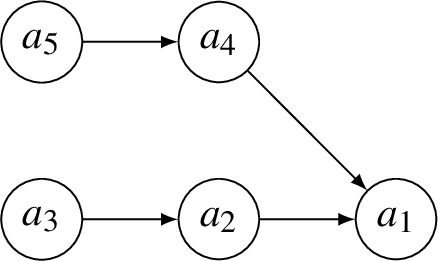
Argumentation framework illustrating a (fictional) sales pitch using the procatalepsis principle.
∙ The fading effect states that long lines of argumentation become ineffective in practice, because the audience easily loses track of the relation between the arguments. This principle is supported in practice by the work of Tan et al. [30] which shows (in the context of their study, an extensive analysis of persuasive debates which took place on the subreddit “ChangeMyView”1
These elements show that current ranking-based semantics are poorly equipped to be used in a context of persuasion. Our contribution is a new ranking-based semantics which is able to account for these phenomena. More precisely, this semantics is based on the notion of propagation and extends the existing propagation semantics [8] by adding an additional parameter whose purpose is to gradually decrease the impact of arguments when the length of the path between two arguments increases. Most importantly, this parameter makes it possible to regulate how these principles are satisfied. In general, this contribution could thus be used as an ingredient for developing strategies for computational persuasion techniques [18].
After a refresher on abstract argumentation and on the ranking-based semantics in Section 2, we introduce, in Section 3, the two principles commonly used in persuasion (procatalepsis and fading) and explain why the existing ranking-based semantics are not able to capture these principles. Section 4.1 presents the basic principle of propagation on which our proposal, detailed in Section 4.2, is built. This new semantics uses two parameters and we show, in Section 5, that one of these parameters allows us to control the convergence speed, the score of influence of the arguments and it gives the opportunity to satisfy or not satisfy the procatalepsis principle. Finally, in Section 6, we provide an axiomatic evaluation of our new ranking-based semantics for the different values of this parameter and we compare the set of satisfied properties with the set of properties satisfied by existing ranking-based semantics in the literature.
This paper is a substantial development of the initial work presented in [10] in the sense that motivation, discussion, examples and analysis have been extended or added. More precisely, it extends this previous work as follows: additional properties for ranking-based semantics have been included, illustrated and formally defined in Section 2; a formal definition of the procatalepsis principle has been added in Section 3 to formally demonstrate its incompatibility with the Void Precedence (VP) property; the study of the influence of the parameters provided in Section 5 is expanded; the set of existing ranking-based semantics has been extended in Section 6 in order to compare axiomatically our semantics with all of them; all proofs together with the associated counter-examples have been included in the Appendix.
Dung’s framework
In his seminal work [15], Dung formalizes argumentation through an abstract argumentation framework in which there is no assumption on the nature of the elements it contains. More precisely, neither the structure nor the origin of the arguments are required. Then, an argumentation framework is composed of a set of abstract arguments and of a relation of conflict between them.
(Argumentation framework).
An
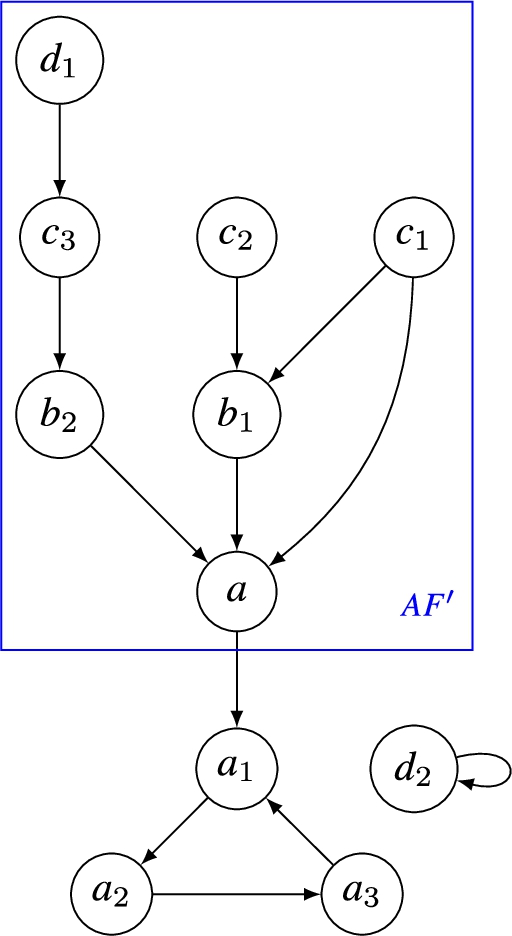
From a mathematical point of view, an argumentation framework is a directed graph where a node represents one argument and an arrow between two nodes represents an attack from an argument to another one. Let us introduce different notions related to the graphs that we will use in this article.
(Path).
Let
According to the length of a path between two arguments, the argument at the beginning of this path can be an attacker or a defender of the argument at the end of the path.
(Attacker, Defender).
Let
A branch is a path such that the argument at the beginning of the path is not attacked.
(Branch, Root).
Let
The ancestors’ graph of an argument x is a subgraph of an argumentation framework, that contains x and its the attackers and defenders, as well as all the attack relations between these arguments. Let
An argumentation framework. On the argumentation framework represented in Fig. 2, one can find:
a path of length 2 a cycle The argumentation framework (Ancestors’ graph).
Dung’s framework comes equipped with various types of semantics used to evaluate the arguments. Among these semantics, the ranking-based semantics aiming to rank-order a set of arguments in an argumentation framework from the most to the least acceptable. Thus, unlike classical semantics which assign an absolute status (accepted, rejected, undecided) to each argument, this semantics compares pairs of arguments. We refer the reader to [1,11] for a complete overview of the existing families of semantics in abstract argumentation and for the differences between these approaches (e.g., definitions, outcomes, applications).
(Ranking-based semantics).
A
Many ranking-based semantics with different behaviors have been introduced in recent years [2,3,8,13,16,27,28]. These semantics have often been defined along with a set of properties, each of which represents a specific criterion (e.g. quantity or quality of the direct attackers of an argument), aiming to highlight the unique behaviour of the proposed semantics [2,13,24]. Bonzon et al. [9] grouped these properties, generalized and defined new ones in order to propose an axiomatic comparison of existing semantics. Note, however, that none of these properties are mandatory. Indeed, some of these properties are not independent of each other because incompatibilities and dependencies can exist between them [5,9]. These properties are therefore an excellent indication to better understand the behavior of these semantics and remain the only way to compare existing ranking-based semantics with new ones. They are also a first step to the ambitious research question of defining fully characterized classes of ranking-based semantics with respect to a subset of properties.
General properties
Let us begin with two general properties. First, it seems natural that the ranking on the set of abstract arguments should be defined only on the basis of the attacks between arguments and should not depend on the identity of the arguments.
(Isomorphism).
An isomorphism γ between two argumentation frameworks
The property Abstraction states that if there exists an isomorphism between two argumentation frameworks, then they should have the same ranking for a given ranking-based semantics.
(Abstraction (Abs) [2]).
A ranking-based semantics σ satisfies Abstraction if and only if for any
The next property, called Independence, considers that the ranking between two arguments x and y should be independent of any argument that is neither connected to x nor to y. In other words, if the graph which represents the argumentation framework is composed of several disconnected subgraphs then the arguments in a subgraph have no influence on the arguments in another subgraph. The set of such subgraphs is called connected components.
(Connected components).
The connected components of an argumentation framework
(Independence (In) [2,24]).
A ranking-based semantics σ satisfies Independence if and only if for any argumentation framework
The purpose of the Total property is to distinguish between semantics that return a total preorder and those that return a partial preorder between arguments.
A ranking-based semantics σ satisfies Total if and only if for any
(Total (Tot) [9]).
Best and worst arguments
We may have expectations regarding the best and worst arguments that we may find in an argumentation framework.
Void Precedence states that a non-attacked argument should be strictly more acceptable than an attacked argument.
(Void Precedence (VP) [2,24]).
A ranking-based semantics σ satisfies Void Precedence if and only if for any
Self-Contradiction states that an argument that attack itself should be strictly less acceptable than an argument that does not attack itself.
A ranking-based semantics σ satisfies Self-Contradiction if and only if for any
(Self-Contradiction (SC) [24]).
Direct attackers
Two criteria often used by the existing ranking-based semantics to compare arguments are the cardinality and the quality (i.e. level of acceptability) of the direct attackers.
Cardinality Precedence focuses on the cardinality of direct attackers in saying that the greater the number of direct attackers for an argument, the weaker the level of acceptability of this argument.
(Cardinality Precedence (CP) [2]).
A ranking-based semantics σ satisfies Cardinality Precedence if and only if for any
Quality Precedence focuses on the quality of direct attackers in saying that the greater the acceptability of the direct attackers for an argument, the weaker the level of acceptability of this argument.
(Quality Precedence (QP) [2]).
A ranking-based semantics σ satisfies Quality Precedence if and only if for any
To compare the direct attackers of two arguments, let us introduce a relation that compares sets of arguments on the basis of their rankings.
((Strict) group comparison [2]).
Let
Counter-Transitivity states that if the direct attackers of y are at least as numerous and acceptable as those of x with respect to a ranking-based semantics σ, then x should be at least as acceptable as y.
(Counter-Transitivity (CT) [2]).
A ranking-based semantics σ satisfies Counter-Transitivity if and only if for any
Strict Counter-Transitivity, states that if the conditions in the definition of Counter-Transitivity are satisfied and either the direct attackers of y are strictly more numerous or acceptable than those of x, then x should be strictly more acceptable than y.
A ranking-based semantics σ satisfies Strict Counter-Transitivity if and only if for any
(Strict Counter-Transitivity (SCT) [2]).
Direct defenders
Defense Precedence states that, when two arguments have the same number of direct attackers, an argument with at least one direct defender should be strictly more acceptable than an argument without any direct defender.
(Defense Precedence (DP) [2]).
A ranking-based semantics σ satisfies Defense Precedence if and only if for any
When DP says that it is better for an argument to be defended, it could be interesting to know if different kinds of defense of an argument have the same impact on it. Two kinds of defense of an argument are then defined: the simple defense and the distributed defense.
(Simple defense and distributed defense [2]).
Let
Distributed-Defense Precedence states that if two arguments have the same number of direct attackers and the same number of direct defenders, then it is preferable for an argument that each of its defender attacks a distinct direct attacker in order to weaken all of them instead of focusing on a specific direct attacker so as to greatly weaken it (but at the price of leaving its others attackers unaffected).
(Distributed-Defense Precedence (DDP) [2]).
A ranking-based semantics σ satisfies Distributed-Defense Precedence if and only if for any
Consider the two argumentation frameworks illustrated in Fig. 3.
Distributed-defense precedence.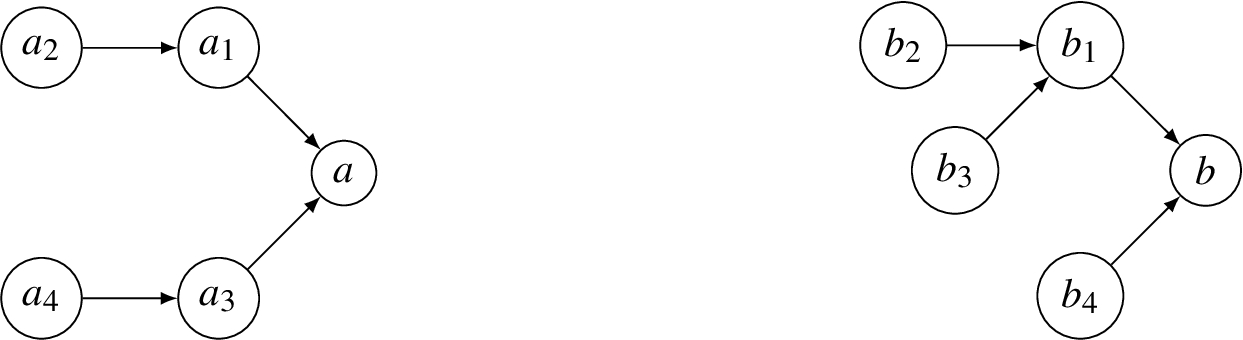
The two arguments a and b have the same number of direct attackers (
The property Attack vs Full Defense allows us to make a distinction between the semantics which consider that a defense just cancels the effect of an attack (which can thus have the consequence of maintaining or increasing the acceptability of the targeted argument) and those which consider a defense as a weak attack (the impact of the attack is less important but it still has a negative effect on the targeted argument). Thus, an argument without any attack branch should be ranked higher than an argument only attacked by one non-attacked argument.
A ranking-based semantics σ satisfies Attack vs Full Defense if and only if for any acyclic
Global properties
“Global” properties specify if some change related to the branches in an argumentation framework can improve or degrade the ranking of one argument. They help answer questions such as: what is the effect on the acceptability of a given argument with an additional attack branch? Is the effect the same if it is a defense branch? Does the length of the branch matter?
Let us first recall how the addition of an attack branch and the addition of a defense branch to an argument are formally defined.
(Attack and defense branch added to an argument).
Let
In order to evaluate the impact of an additional branch on a given argument x of an argumentation framework
Addition of a branch
The first property concerns the attack branches and states that adding an attack branch to any argument decreases its level of acceptability.
(Addition of an Attack Branch (+AB) [9]).
A ranking-based semantics σ satisfies Addition of an Attack Branch if and only if for any
Let us consider the argumentation framework illustrated in Fig. 4. If σ satisfies +AB then
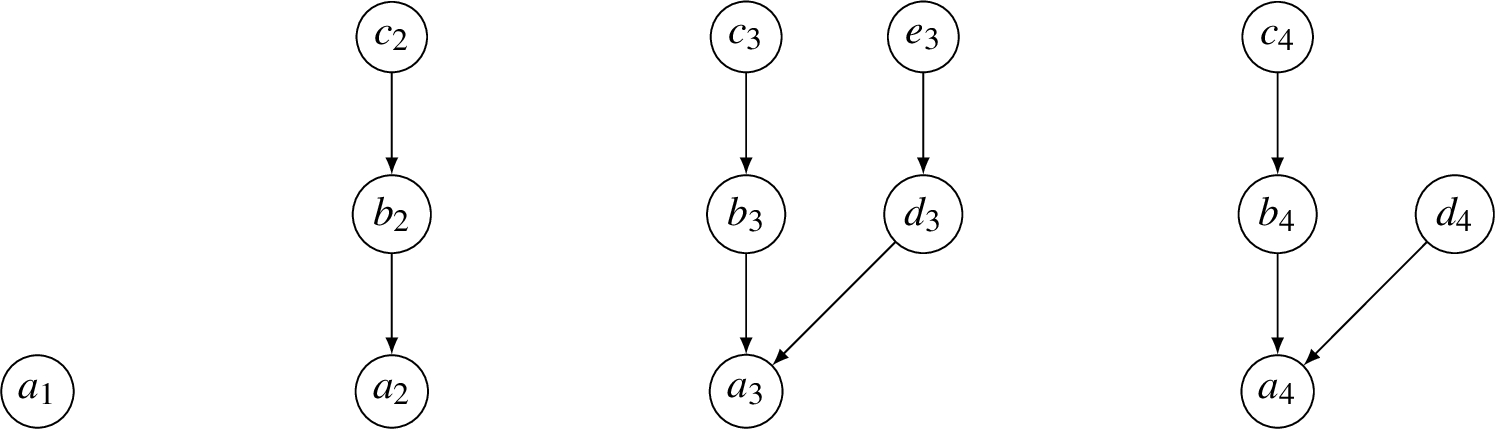
Argumentation framework with different configurations of branches.
The two following properties concern the defense branches. The first one states that adding a defense branch to any argument increases its level of acceptability.
A ranking-based semantics σ satisfies Strict Addition of a Defense Branch if and only if for any
(cont.).
If σ satisfies ⊕DB then
Addition of a Defense Branch is defined in a more specific way: adding a defense branch to any attacked argument (therefore excluding non-attacked arguments) increases its level of acceptability.
(Addition of a Defense Branch (+DB) [9]).
A ranking-based semantics σ satisfies Addition of a Defense Branch if and only if for any
(cont.).
If σ satisfies +DB, the same conclusion as ⊕DB can be done except for
Increasing the length of a branch
Two additional properties based on the increase of the length of a branch have been introduced. Let us recall that, for these properties, the “meaning” of the initial branch and the one of the increased branch have to be identical. In other words, if the initial branch is an attack (resp. defense) branch then the increased branch must be an attack (resp. defense) branch too. And, to keep the meaning of a branch, the only solution is to add a defense branch to the argument at the beginning of the branch.

Argumentation framework with different lengths of branch.
The first property states that increasing the length of an attack branch of an argument increases its level of acceptability.
A ranking-based semantics σ satisfies Increase of an Attack Branch if and only if for any
Let us consider the argumentation framework illustrated in Fig. 5. If σ satisfies ↑AB then
The second property concerns the defense branch and states that increasing the length of a defense branch of an argument decreases its level of acceptability.
A ranking-based semantics σ satisfies Increase of a Defense Branch if and only if for any
(cont.).
If σ satisfies ↑DB then
Equal acceptability
The property Argument Equivalence ensures that the acceptability of an argument depends only on (the structure of) its attackers and defenders. Formally, two arguments with the “similar (isomorphic)” ancestors’ graph (which, as a reminder, is an argumentation framework containing the argument and its attackers and defenders) should have the same ranking.
(Argument Equivalence (AE) [9]).
A ranking-based semantics σ satisfies Argument Equivalence if and only if for any
The property Non-attacked Equivalence is a particular case of Argument Equivalence because it focuses on the comparison between the non-attacked arguments.
(Non-attacked Equivalence (NaE) [9]).
A ranking-based semantics σ satisfies Non-Attacked Equivalence if and only if for any
Another possibility for detecting when two arguments are equally acceptable consists of taking into account their direct attackers. Suppose that two arguments, x and y, have the same number of direct attackers. If, for each direct attacker of x, there exists a direct attacker of y such that the two attackers are equally acceptable, then x and y are equally acceptable too.
A ranking-based semantics σ satisfies Ordinal Equivalence if and only if for any
(Ordinal Equivalence (OE) [9]).
Ranking-based semantics and existing persuasion principles
In the literature [2,9,17,26], many ranking-based semantics were compared on the basis of the properties recalled in the previous section. However, the relevance of some properties may be very much dependent on the context of application. Indeed, what is often missing to compare these approaches is thus a clear indication of the applications they target. For example, for online debate platforms, satisfying the property Total (Tot) may seem natural to ensure the comparison between all the arguments and thus guarantee a result to the users. Conversely, for the same platforms where votes are assigned to each argument and represent their social support, a possibility would be to reward a more aggressive non-attacked argument. Thus, such properties like Non-attacked Equivalence (NaE), considering that all the non-attacked arguments should be equally acceptable, should not be satisfied.
Among the many existing fields in argumentation (e.g., negotiation, persuasion, deliberation), we choose to focus on the context of persuasion in argumentation. Persuasion is an activity that involves one party (the persuader) trying to induce another party (the persuadee) to believe (or not believe) certain information or to do (or not do) some action. In our context, persuasion is unidirectional [19] and focused on a “targeted argument”, the aim being for the persuader to increase the ranking of this argument. The assumption is that it makes it more likely for the persuadee to believe the targeted fact (e.g., practizing exercise is good for your health) or perform the targeted action (e.g., buy a specific car). It has been observed that the three-valued approach of Dung was too restrictive in that context [19], and thus ranking-based approaches can be more appropriate.
Among the processes used in persuasion, we shall concentrate on two well documented phenomena in persuasion (procatalepsis and fading) and draw a parallel between each of them and existing properties for ranking-based semantics.
Procatalepsis
Procatalepsis, or prolepsis, is a figure of speech in which the speaker raises an objection to their own argument and then immediately answers it. The goal is to strengthen this argument by dealing with possible counter-arguments before their audience can raise them [33]. An example of the use of the principle of procatalepsis in practice is presented in the introduction and illustrated by an argumentation framework in Fig. 1. In this kind of persuasion context, it is clearly more convincing to state the more plausible counter-argument to
In order to formally define the procatalepsis principle in the context of abstract argumentation, we first need to formally define the argumentation frameworks that we call persuasion pitches. A persuasion pitch is a tree shaped argumentation framework where an argument x, called the targeted argument, has only defense branches.
(Persuasion pitch).
An argumentation framework
A persuasion pitch is denoted by
Condition (1) means that the targeted argument has no attack branch while condition (2) states that it has at least one defense branch (the length of defense branches does not matter here). Condition (3) guarantees that the argumentation framework is in the shape of a tree centered on the targeted argument x, i.e. it contains only the arguments used in the pitch which are related to x (i.e. for which a path to x exists).
The argumentation framework depicted in Fig. 1 is a persuasion pitch
Let us now formally define the procatalepsis principle in the context of abstract argumentation. We define this property by saying that a ranking-based semantics satisfies Procatalepsis if a number of defense branches is sufficient to make a targeted argument from a persuasion pitch at least as acceptable as when it does not have any (i.e. it is not attacked).
A ranking-based semantics σ satisfies Procatalepsis if and only if there exists a
We have deliberately made this definition a little more flexible than its original definition because we think it would be a mistake to claim that adding a unique defense branch will always be sufficient to make the targeted argument at least as acceptable as a non-attacked argument. Indeed, one can for example think that in Fig. 1, the defense branch composed of arguments
What is striking is that procatalepsis blatantly contradicts the property Void Precedence (VP), considering that a non-attacked argument is strictly more acceptable than an attacked argument. Recall that, as remarked in [9], this property is satisfied by all existing ranking-based semantics. Thus, no ranking-based semantics has yet been proposed where Void Precedence is not satisfied, implying that there exists no ranking-based semantics which can capture the procatalepsis principle.
No ranking-based semantics can satisfy both Void Precedence (VP) and Procatalepsis (PR).
The fading principle states that long lines of argumentation become ineffective in practice, because the audience easily loses track of the relations between the arguments.

Argumentation framework with a long line of arguments.
In focusing on the argumentation framework depicted in Fig. 6, the fading principle concerns the limit until which the length of a path between an argument and another one is too long to have an impact on the targeted argument. For example, if one considers that the arguments situated at the beginning of the paths with a length greater or equal to 5 have no impact on a given argument, then arguments
In practice, the fading principle is supported by the work of [30] which shows (in the context of their study, an extensive analysis of persuasive debates which took place on the subreddit “ChangeMyView”2
In this section, our goal is to build a ranking-based semantics which allows us to catch the procatalepsis principle and the fading effect.
For the fading effect, a solution could be to use an attenuation factor to gradually decrease the impact of arguments. This is used for instance by the counting semantics [28] where the damping factor α (a value between 0 and 1) is used. For the procatalepsis principle, we want that an attacked argument with many defense roots and few or no attack roots (like
Propagation with attenuation
We propose the extension of the propagation principle introduced in [8] with the elements previously put forward. Recall that the idea of propagation is to assign a positive initial value to each argument in the argumentation framework (arguments may start with the same initial value or start with distinct values where non-attacked arguments have greater value than attacked ones). Then each argument propagates its value into the argumentation framework, alternating the polarity according to the considered path (negatively if it is an attack path, positively if it is a defense one).
But, in order to catch the persuasion principles, we formally redefine the propagation mechanism by including a damping factor δ aiming to decrease the impact of attackers situated further away along a path (the longer the path length i, the smaller the
(Attenuated propagation).
Let
Let us compute the valuation P of each argument in
Let us focus on the argument f. One can see that f begins with an initial weight of 0.5 because it is attacked,
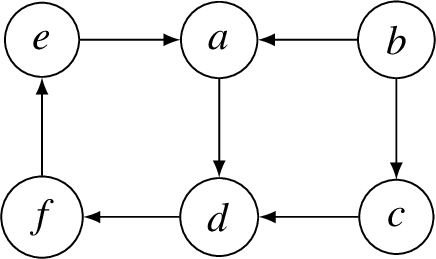
An argumentation framework
Computation of the valuation P of each argument from
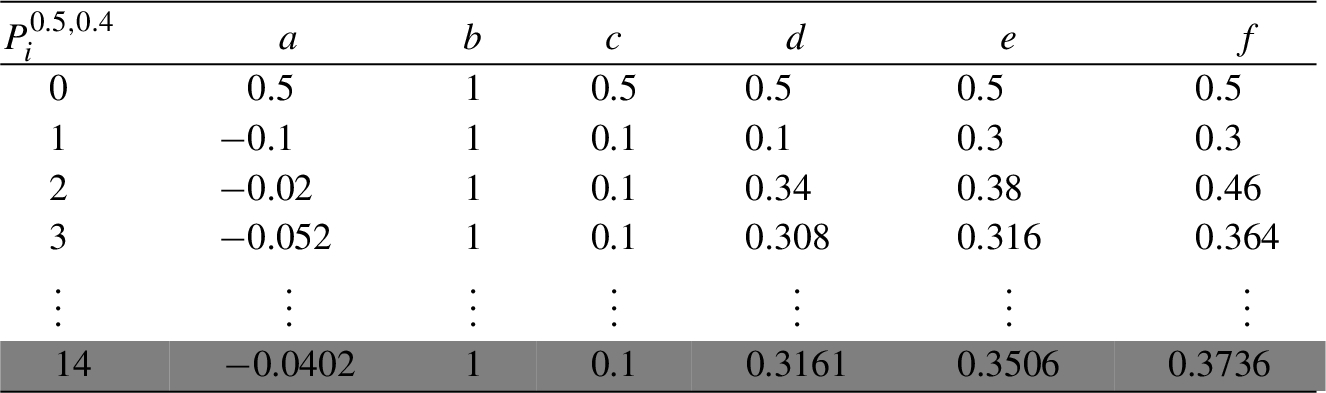
The following proposition answers the question of convergence of the valuation P. The convergence is guaranteed by the use of the damping factor, but also because the set of arguments which attack or defend an argument for a given length of path is finite and limited by the number of arguments in an argumentation framework.
Let
Let us now compute the propagation number of an argument by using a fixed-point iteration (the outcome is guaranteed with the previous proposition).
Let
We want to insist on the fact that the propagation number assigned to each argument is just used to relate and compare arguments of a given AF, and that it should not be used as an (isolated) measure.
(cont.).
The propagation number of each argument in
Variable-depth propagation
Let us now define a ranking-based semantics using the propagation number and taking into consideration the persuasion principles. As stated in the introduction of this section, a solution to catch the procatalepsis principle is to only take into account the roots of the arguments. Formally, it is possible when
However, we do not want our semantics to be too “disconnected” from the principles that make the strength of ranking-based semantics: distinguishing arguments by taking into account the quality and the quantity of the arguments that attack or defend them. This is why we apply a second phase to break ties among arguments equally valued in the first phase. From a technical point of view, this means we re-run the propagation phase but this time setting an initial weight
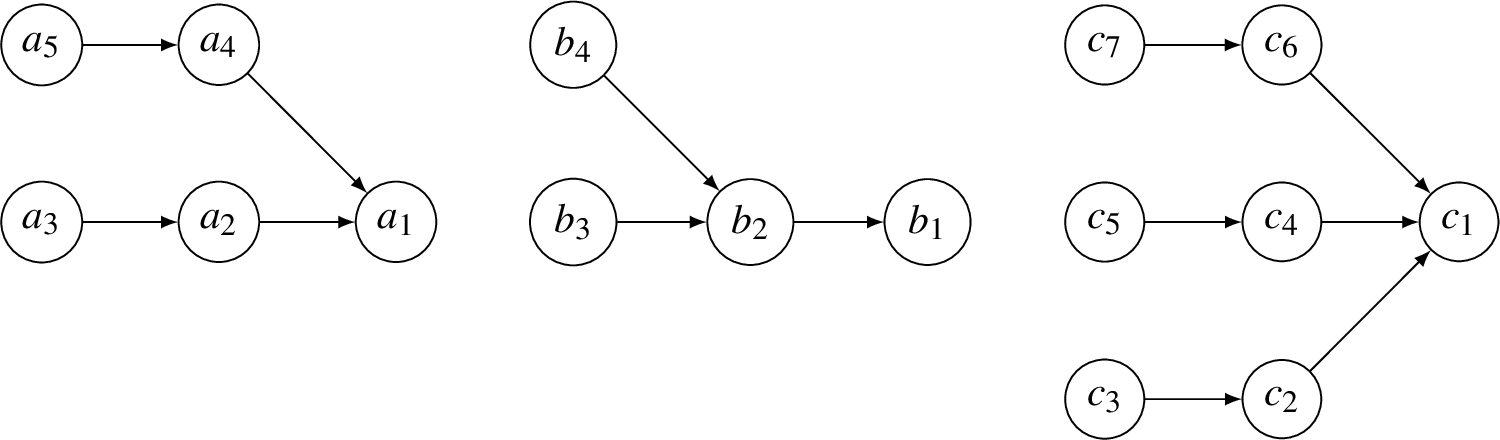
Two arguments
Let
(cont.).
According to the previous definition, we first need to compute the propagation number of each argument when
We obtain the following propagation numbers:
Thus, we obtain the following pre-ranking:
Note that no arguments are equally acceptable here, so it is not necessary to perform the second phase. Thus,
Computation of the valuation P of each argument from
when
and
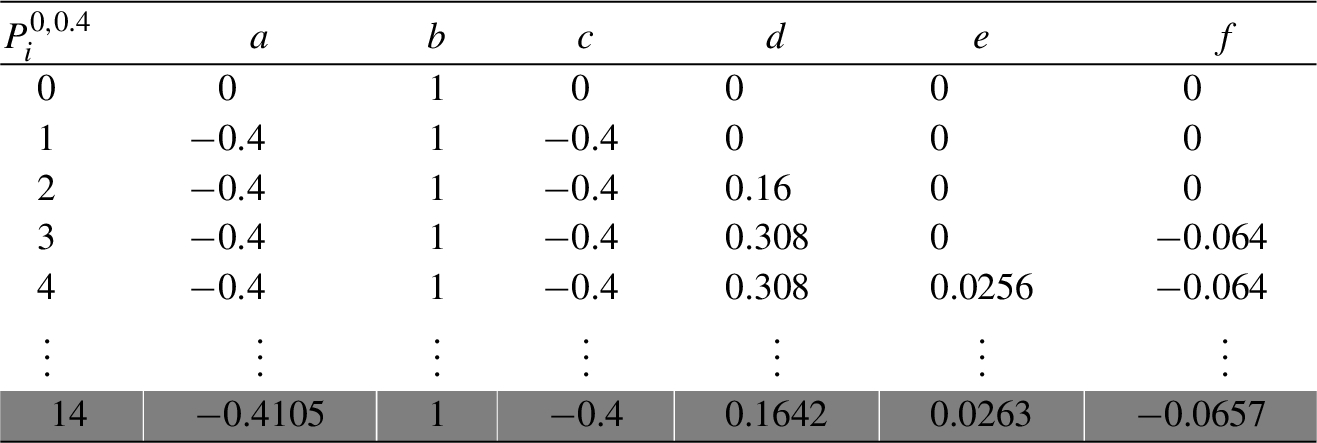
Computation of the valuation P of each argument from
Let us give another example where the second phase is needed to distinguish two arguments.
Let us compute the ranking returned by
Valuation P for each argument in the argumentation framework depicted in Fig. 8 when
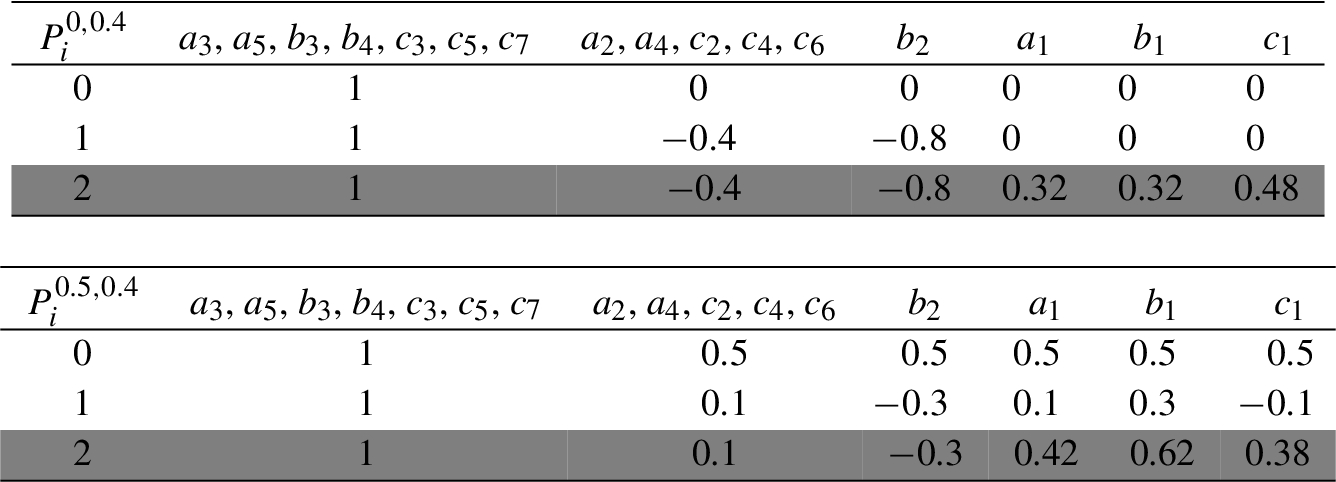
According to the definition of
The definition of the propagation number (see Definition 4.2) is based on two parameters: ϵ and δ. Let us, in this section, characterise their roles and their impacts on the ranking computed when the variable-depth propagation is used.
Parameter ϵ
Recall that the parameter ϵ has a key role to distinguish the two phases aiming to compute the ranking between arguments. However, a concern might be that the value of ϵ might change the ranking obtained. We show that this is not the case:
Let
Please note that even though different values of ϵ do not change the ranking between arguments returned by
Controlling the scope of influence of the arguments
The parameter δ is defined as the damping factor allowing us to decrease the impact of the argument when the length of the path increases. Following this, there intuitively exists a length such that the impact of arguments situating at the beginning of this path is negligible compared to the nearest arguments. Thus, the role of this parameter is to choose the scope of influence of the arguments in the argumentation framework, in addition to guarantee the convergence of the valuation P. For instance, with a value of δ close to 0, only the nearest arguments (so a small part of the argumentation framework) are taken into consideration to compute the different propagation numbers, whereas with a value of δ close to 1, (almost) all the argumentation framework will be inspected. Consequently, two different values of δ can produce different rankings for the same argumentation framework. Following the principle of the fading effect, it is natural to assume that arguments located at a long distance from another argument become ineffective. In terms of design, it seems very interesting to have the ability to control this parameter so as to specify a maximal depth after which arguments see their influence on the value of others vanish.
To better understand how to take the fading principle into account in using δ, let us detail the algorithm used to compute the propagation numbers.
A positive number is assigned to each argument: We increase the step i by 1 and we add (or subtract) the score computed during the previous step ( If, between two steps, the difference, for all valuations P, is smaller than a fixed precision threshold μ (i.e. In practice, we consider that a process is stopped when, for each valuation, the difference between two steps is smaller than a precision threshold.
Let
Consider the argumentation framework
Through the formula given in Proposition 4, we can determine, for each maximal depth, which value of δ should be used. For example, Fig. 9 represents the arguments which propagate their initial value to f (from
If the function defined in Proposition 4 allows us to select an appropriate δ in order to capture a given maximal expected depth (representing the fading effect), a legitimate question could concern the interval of values of δ to ensure the convergence at a specific depth i. However, it is not possible to answer this question in the general case, because of the diversity of argumentation frameworks. For example, suppose that one wants to consider a length up to 5 (no more no less). With an argumentation framework without cycles and with a maximal path smaller than 5, the process will be obviously stopped before. Thus the condition cannot be respected. It is for this reason that we only focus on the maximal depth.
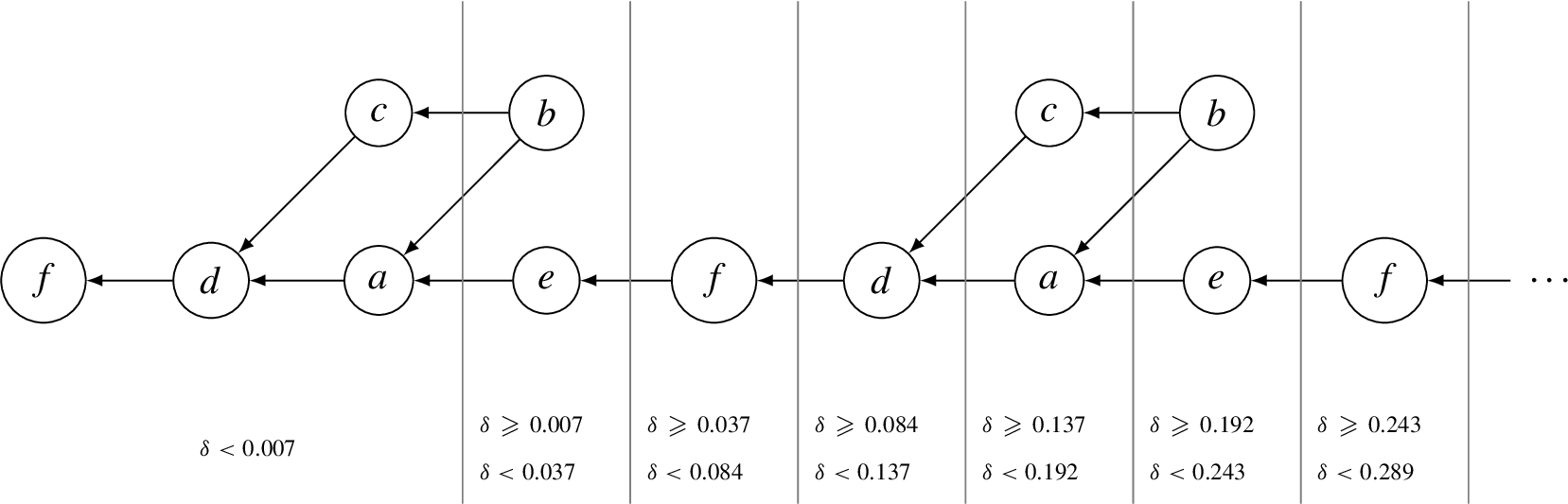
Arguments which propagates their value to f according to the value of δ.
Finally, we can also find a computational advantage to represent the fading effect. Indeed, as the number of steps needed to find the propagation number of each argument is smaller than (or, in the “worst” case, equal to) when all of the argumentation framework have to be considered, the ranking is computed faster. An example of a practical use of our semantics would be to apply it to the persuasive debates from the subreddit “ChangeMyView”. We would then have to parameterize delta in order to take this aspect into account. In addition to satisfying the fading principle, this will reduce the computation time because it will not be necessary to go through the whole graph to evaluate these arguments.
As shown in Fig. 10, for a given argumentation framework, different values of δ can produce different rankings. Indeed, when
In light of these differences, one may be worried that the diversity of rankings could be so high that the semantics becomes too sensitive to small modifications of the parameter δ. To check this, we applied our variable-depth propagation on 1000 randomly generated argumentation frameworks4
The generation algorithms are based on the three algorithms used for producing the benchmarks of the competition ICCMA’15 [32].
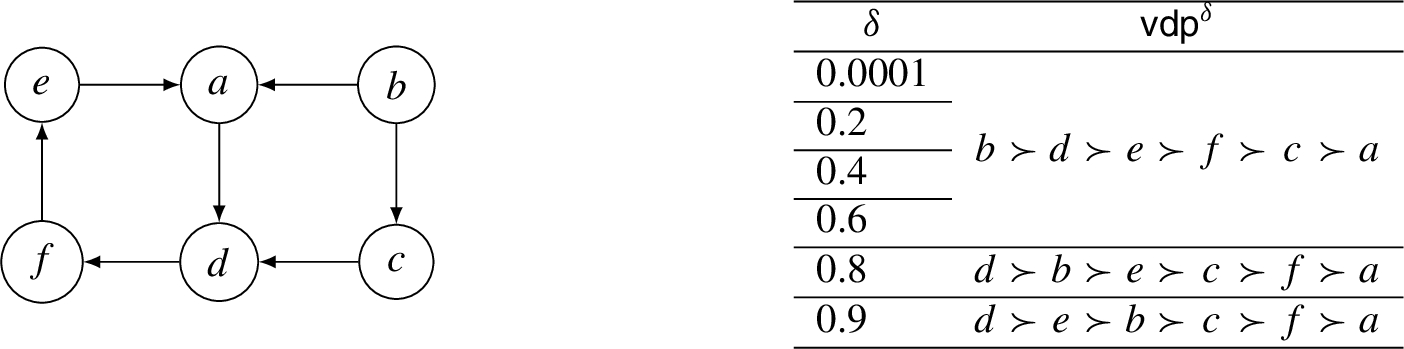
An argumentation framework and the rankings returned by
Let
A Kendall’s tau coefficient of 1 (
Table 4 contains, for each pair of δ, the average Kendall’s tau coefficient, from the results previously computed, that we multiply by 100 to obtain a percentage of dissimilarity.
Percentage of dissimilarity between the rankings from
with
Percentage of dissimilarity between the rankings from
The results show that the obtained rankings stay pretty close since the biggest dissimilarity between the smallest and largest value of δ is 13.74%. This dissimilarity remains overall very small, showing that the semantics remain quite stable as the parameter varies.
The question now is whether these differences are only caused by the fading effect or if δ has an impact on other domains too. In the following section, we will check which properties recalled in Section 2.2 are satisfied by
We now investigate the properties satisfied by our variable-depth propagation semantics
Void precedence
One of the very distinctive features of
Let us compute the rankings of the argumentation framework, which represents the sales pitch aiming to persuade someone to buy a car used to explain the procatalepsis principle (see Section 3), in using variable-depth propagation with several values of δ. The results are given in Fig. 11.
The different rankings computed with 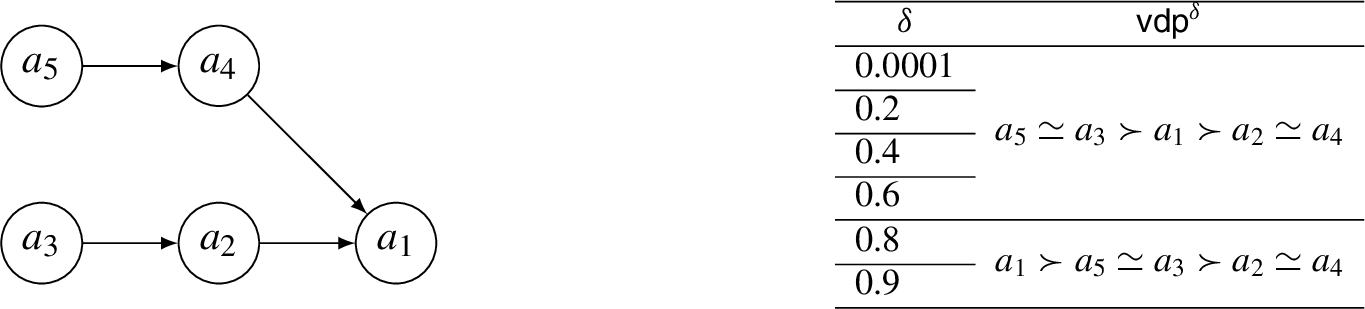
Indeed, one can remark that the non-attacked argument
Let us formally determine which are, for a given argumentation framework, the values of δ which ensure that the non-attacked arguments are more acceptable than the attacked arguments:
Let
De facto, there exists a threshold for the parameter δ which VP is satisfied.
For any argumentation framework, if
The argument
So if
Thus, our method departs from other approaches in its treatment of the Void Precedence property, but to a certain extent only. Let us take the example of persuasion pitches to illustrate this. As a reminder, a persuasion pitch
Let
if
if
Interestingly, it turns out that in the context of our method, the Void Precedence property is related to the property Defense Precedence.
If
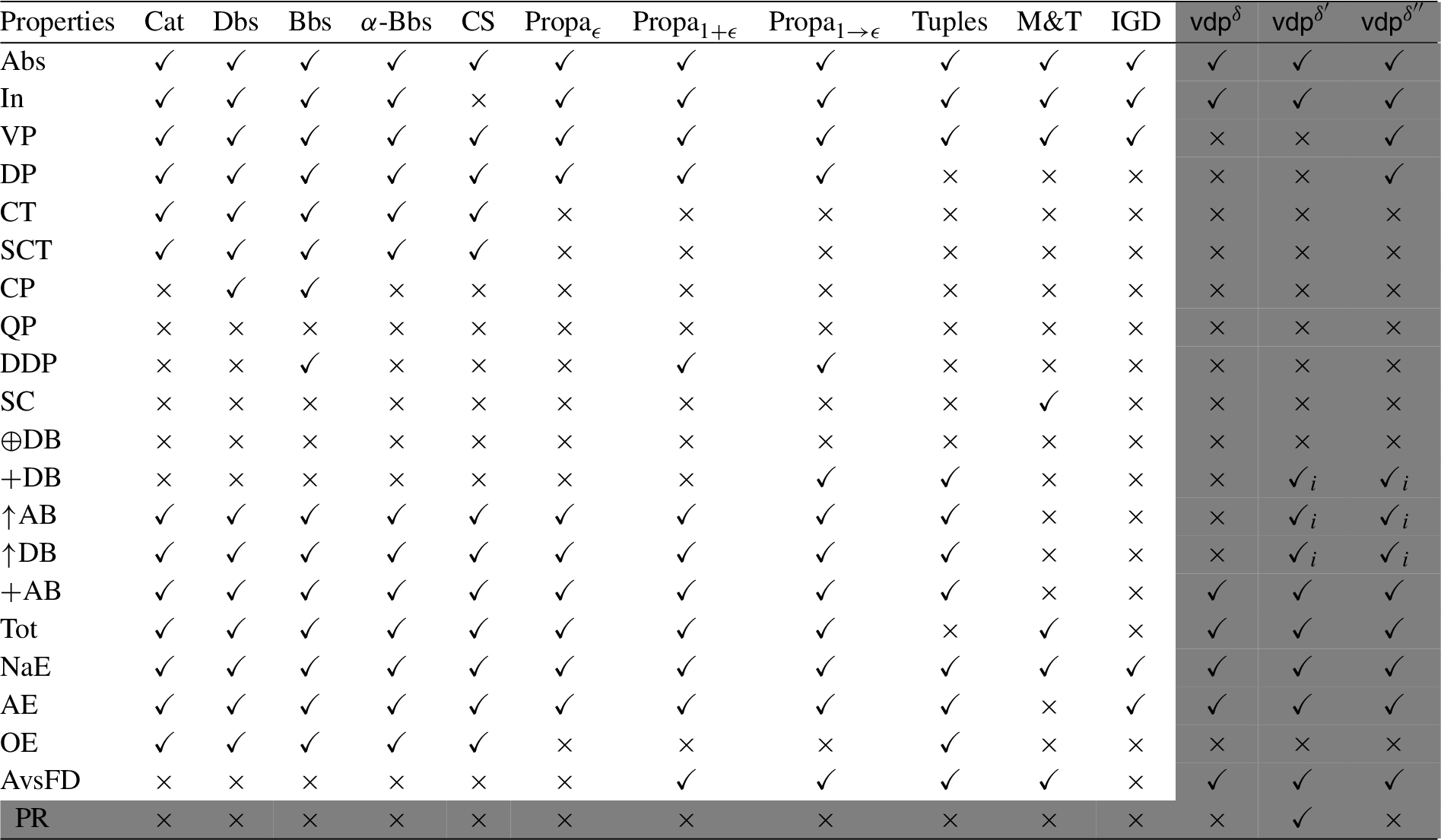
However please note that this is not the case for ranking-based semantics in general because some of them satisfy VP but not DP (see Table 5).
Let us now check which properties, among those defined in Section 2.2, are satisfied by the variable-depth propagation semantics
Let
Some global properties like +DB, ↑DB and ↑AB are not satisfied because of the fading effect. Indeed, when the branch, which is added or extended, is too long, the arguments at the end of this branch have no impact on the targeted argument. This is why we propose the definition of the corresponding properties (
Summary of the properties satisfied by
Formally, we need to redefine how an attack or a defense branch is added:
Let
We are now able to define the “i-version” of +DB, ↑DB and ↑AB.
(Addition of a Defense Branch with a maximal length i (
)).
Let
(Increase of an Attack Branch with a maximal length i (
)).
Let
(Increase of a Defense Branch with a maximal length i (
)).
Let
Consequently, for a given maximal depth i, it is enough to choose a value of δ large enough to guarantee that the sequence converges (see Proposition 4 page 69) after taking into account the added or extended branch. As we want
Let μ be a precision threshold and i the expected maximal length. If
All these results are reported in Table 5. For the purpose of comparison, we also include in this table the results of some existing ranking-based semantics from the literature where the same set of properties has been already checked [9]. Namely, these semantics are: the semantics h-categoriser Cat [6,27], the Discussion-based semantics Dbs and the Burden-based semantics Bbs [2], the α-Burden-based semantics α-Bbs [3], the Counting semantics CS [26,28], the three propagation semantics
Each of these existing ranking-based semantics satisfies Void Precedence and therefore violates the principle of procatalepsis (PR).
The ranking-based semantics Cat, Dbs, Bbs, α-Bbs, CS,
We first remark that for any value of δ,
It is clear that, like the Tuples-based semantics, the “local” properties like CT, SCT, CP, QP, DDP or SC cannot be satisfied by our semantics which mainly focus on the branch and not only on the direct attackers and direct defenders.
In this work, we have highlighted the fact that none of the existing ranking-based semantics is really appropriate for the context of persuasion, emphasizing in particular two well-documented phenomena occurring in practice: procatalepsis (the fact that it is often efficient to anticipate the counter-arguments of the audience) and fading (the fact that long lines of argumentation become ineffective). Indeed, all existing ranking-based semantics commit for instance to the Void Precedence property, which is incompatible with the procatalepsis principle. This motivated us to introduce a new parametrized ranking-based semantics based on the notion of propagation. More precisely, we extend the existing propagation semantics [8] by adding an additional parameter allowing us to gradually decrease the impact of arguments when the length of the path between two arguments increases. The role of this parameter is manifold because it allows:
the convergence of the method which guarantees the existence of a result; the decrease of the impact of further arguments and then to capture the fading effect, by selecting a maximal influence depth; to give the possibility to choose if one wants to satisfy the Void Precedence property or not (and then represent procatalepsis in persuasion pitches).
We believe that this method offers a useful tool for persuasion, for instance to evaluate the relative impact that may have different persuasion pitches.
In addition to the study of our new ranking-based semantics, the message we want to convey through this work is that, despite detailed studies of the properties for ranking-based semantics, it is important to also evaluate existing semantics with respect to each targeted context/application. This will allow a potential user (expert or not in the field of argumentation) to facilitate her choice among existing ranking-based semantics. Of course, we are aware that this work is a preliminary step in order to formalize the process of persuasion. Indeed, many additional elements (beliefs of the opponent, credibility, personality, shared goals, length of a discussion, etc.) must be taken into consideration in order to properly formalize and evaluate the arguments and especially the impact they have on the opponent. It would be interesting, for example, to draw inspiration from what is done in computational persuasion (e.g., [18–20]) where the role of the persuader is played by a system that can engage in dialogues with users to persuade them to accept or reject a given persuasion goal.
Finally, our methodology clearly focus on persuasion. However, it may also prove inspiring in other settings: by questioning the relevance of the existing semantics in other application contexts like negotiation (trying to resolve a conflict of interest by reaching a deal), deliberation (trying to reach a decision on a course of action), etc. We may find out that some specific phenomena are not properly captured, and that other adjustments are required.
Footnotes
Acknowledgements
We thank the reviewers for their useful comments on the previous version of the paper. This work benefited from the support of the project AMANDE ANR-13-BS02-0004 of the French National Research Agency (ANR).