




Abstract
In the 1980s, Pollock’s work on default reasons started the quest in the AI community for a formal system of defeasible argumentation. The main goal of this paper is to provide a logic of structured defeasible arguments using the language of justification logic. In this logic, we introduce defeasible justification assertions of the type
We first define a new justification logic that relies on operational semantics for default logic. One of the key features that is absent in standard justification logics is the possibility to weigh different epistemic reasons or pieces of evidence that might conflict with one another. To amend this, we develop a semantics for “defeaters”: conflicting reasons forming a basis to doubt the original conclusion or to believe an opposite statement. This enables us to formalize non-monotonic justifications that prompt extension revision already for normal default theories.
Then we present our logic as a system for abstract argumentation with structured arguments. The format of conflicting reasons overlaps with the idea of attacks between arguments to the extent that it is possible to define all the standard notions of argumentation framework extensions. Using the definitions of extensions, we establish formal correspondence between Dung’s original argumentation semantics and our operational semantics for default theories. One of the results shows that the notorious attack cycles from abstract argumentation cannot always be realized as justification logic default theories.
Keywords
Introduction
Defeasible reasoning is a key concept in the development of computational models of argument. Defeasible reasons became a topic of interest for AI researchers largely due to Pollock’s work [63], which brought closer together the ideas of non-monotonic reasoning from AI and defeasible reasoning from philosophy. To highlight the importance of defeasibility for the study of reasoning, we use a variant of Pollock’s “red-looking table” vignette [63], previously discussed by Chisholm [28]. Suppose you are standing in a room where you see red objects in front of you. This can lead you to infer that a red-looking table in front of you is in fact red. However, the reason that you have for your conclusion is defeasible. For a typical defeat scenario, suppose you learn that the room you are standing in is illuminated with red light. This gives you a reason to doubt your initial reason to conclude that the table is red, though it would not give you a reason to believe that it is not red. However, if you were to learn, instead, that the original factory color of the table is white, then you would also have a reason to believe the denial of the claim that the table is red.
The example specifies two different ways in which reasons defeat other reasons: the former is known as undercut and the latter as rebuttal, according to Pollock’s [63] terminology. Learning additional information about the light conditions incurs suspending the applicability of your initial reason to believe that the table is red. In contrast, learning that there is a separate reason to consider that the table is not red will not directly compromise your initial reason itself. The differences between undercutting and rebutting reasons are illustrated in Fig. 1.
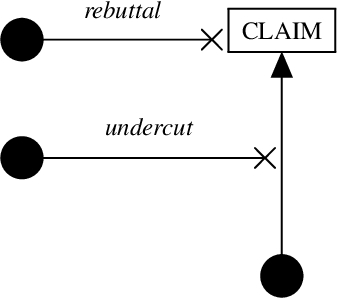
The types of defeat: undercut and rebuttal.
An argument relying on default reasons is itself regarded as defeasible. The formal study of defeasible arguments is already well-developed, most prominently in the frameworks for structured argumentation represented in the 2014 special issue of this journal (vol. 5, issue 1): ABA [76], ASPIC+ [57], DeLP [42] and deductive argumentation [20].1
The acronyms ABA, ASPIC and DeLP refer to “Assumption Based Argumentation”, “Argumentation Service Platform with Integrated Components” and “Defeasible Logic Programming”, respectively.
The idea of finding a logical system with arguments as object-level formulas has already influenced the formal argumentation community. One especially interesting contribution in this direction is the logic of argumentation (LA) by Krause, Ambler, Gøransson and Fox [51]. These authors present a system in which inference rules manipulate labelled formulas interpreted as pairs of arguments and formulas2
The system has been used to develop applications that support medical diagnosis [31,40]. In LA, labels
In order to formalize arguments, we embrace the strategy of using a formal language with labelled formulas. In justification logic, such labelled formulas represent pairs of reasons and claims. They are written as the so called “justification assertions”
The idea of explicit proof terms as a way to find the semantics for the provability calculus
In Section 3, we will present the benefits of using this logical language when justification assertions are given with argumentation semantics. The language of justifications is expressive enough to combine desirable features of the mentioned structured argumentation frameworks in a single system. Here are some outcomes that a reader can expect from our approach:
We show that default justification logic fulfills Pollock’s project of defining a single formal system with strict and defeasible rules reified through deductive and default reasons. The four mentioned approaches dealing with structured argumentation are useful generalizations on how to understand arguments, but the problem we address here is how to unify their meta-analysis into a logical theory of undercut and rebuttal.
Our system abstracts from the content of arguments, but, unlike ASPIC+ or ABA, represents arguments in the object language with default reasons. Compared to the level of abstraction in our logic, frameworks like ASPIC+ and ABA could be justly considered as meta-approaches to argumentation. As a most important contribution, our logic does not abstract from reasons. Reasons are represented as separate terms alongside the usual representation of statements and inference rules.
Although ABA, ASPIC+ and deductive argumentation can generate Dung’s frameworks, they cannot be said to provide a logical realization of Dung’s frameworks because they do not define a specific logical system. In default justification logic, Dung’s attack graphs, whose nodes can be interpreted as existential statements of the type “There is some argument”, are realized with an explicit logical formula
The logic we present here is capable of capturing all the components of Toulmin’s six-fold argumentation scheme, with the exception of what he calls “qualifiers”. The presence of elements like “warrant” and “backing” leads to a multi-layered understanding of an argument.4
Toulmin’s book The Uses of Argument [77] is an acclaimed anti-formalistic argumentation monograph that separates logical methods and argumentation theory [81, p. 219]. Toulmin himself stated [77, p. vii] that the aim of his book was “to criticize the assumption, made by most Anglo-American academic philosophers, that any significant argument can be put in formal terms”. One of the aims of this paper is to reunite logical methods and argumentation theory.
With the help of these distinctions, we are able to verify apparently conflicting claims about the nature of defeat in the literature. For example, ASPIC+ correctly models undercut by referring to the exclusion of a rule that does not apply in a given context. However, at the “lower” level of the argument backing, undercut eliminates an assumption made in justifying that rule — which suggests that this type of attack might be reduced to an assumption attack, as claimed in e.g. ABA. Such meta-disagreements on the nature of defeasibility can be reconciled in a fine-grained account of arguments.
Justification logic enables us to integrate default logic and argumentation theory. Our logic remedies an important limitation of constructing arguments as Reiter’s defaults [81, p. 227]: Reiter’s defaults are givens and it is not possible to provide reasons for why they hold. Introducing justification logic as the basic language of default rules supplies them with a formal version of Toulmin’s warrants and provides a way to further reason about the acceptability of rules. In this way, default logic with warrants is able to subsume formal argumentation semantics.6
The rest of this article is structured as follows. The next section introduces the basic justification logic system for reasoning with certain information. Then we use this formal system to introduce default justifications based on default rules with justification formulas. The “red table” example will be used as a running example that illustrates the use of such default rules. A preliminary survey of this system was carried out in [60]. The system enables us to interpret formulas of the type
Soon after Artemov developed the logic of proofs (LP) in [6], a possible worlds semantics for this logic was proposed by Fitting [33,34] in order to align justification logics within the family of modal logics. Syntactic objects that represent mathematical proofs in the logic of proofs LP are then more broadly interpreted as epistemic or doxastic reasons by Fitting [33,34] and Artemov [11]. A distinctive feature of justification logic taken as epistemic logic is replacing belief and knowledge modal operators that precede propositions (
Although justification logic introduced the notions of justification and reason into epistemic logic, it does not formally study the ways of defeat among reasons and it takes admissibility of reasons as a primitive notion. Given the pervasiveness of commonsense reasoning, we know that only a restricted group of epistemic reasons may be treated as completely immune to defeaters: mathematical proofs. But mathematical reasons form only a small part of possible reasons to accept a statement and, being a highly-idealized group of reasons, they have rarely been referred to as reasons. Fitting’s possible worlds semantics for justification logics was meant to model not only mathematical and logical truths, but also facts of the world or “inputs from outside the structure” [36, p. 111]. Yet the original intent of the first justification logic LP to deal with mathematical proofs, together with the fact that mathematics is cumulative, is reflected in its epistemic generalizations. Accordingly, reasons that justify facts of the world were left encapsulated within a framework for non-defeasible mathematical proofs.7
See [17, p. 620] for a discussion on the difference between mathematical proofs and persuasive arguments. For a more encompassing overview of standard justification logics see [10] or [53].
Non-mathematical reasons and justifications are commonly held to depend on each other in acquiring their status of “good” reasons and justifications. Still, the questions related to non-ideal reasons have only recently been raised in the justification logic literature.8
The first proposed formalism that includes the idea of evidence elimination specific to a multi-agent setting is by Renne [73]. Baltag, Renne and Smets [12,13] bring together ideas from belief revision and dynamic epistemic logic and offer an account of good and conclusive evidence. Several approaches ([48,49,55,59]) start from the idea of merging probabilistic degrees of belief with justification logic, while [32] and [74] develop a possibilistic justification logic. In [39], Fitting introduces a paraconsistent formal system with justification assertions where contradictions can be interpreted as conflicting evidence.
Justification logics with modal semantics opened up a possibility to study formal systems for non-defeasible epistemic reasons. These systems include an explicit counterpart to the modal Truth axiom:
In fact, in [35, p. 156] we find three different truth axiom schemes. Varieties of systems with the truth axiom have been extensively studied and described in e.g. [35] and [52].
What are the formal ingredients of justification logics? The language of justifications builds on the language of propositional logic, which is augmented by formulas labelled with reason terms (
Another common operation on justification terms is sum. Intuitively, if one takes that a reason term t justifies some formula F, then one is allowed to affix any other reason u term by the use of sum so that the new reason term
Since we assume in the next section that an agent starts to reason from indefeasible information, we want our underlying logic to represent “factive” or “truth-inducing” reasons. However, additional constraints on the system are not necessarily needed to introduce the system of default reasons. For the sake of formal clarity, we leave out standard axioms and operations that ensure positive or negative introspection, although these can be easily added. Accordingly, an adequate logical account of factive justifications is the logic
Justification logic
Syntactically, knowledge operators take the form of justification terms preceding formulas:
Axioms and rules of JT
We can now define the logic of non-defeasible reasons
As Fitting [34,35] shows, we can also technically consider dropping the operator + from our language. In this way we obtain the logic that he calls
All the instances of propositional logic tautologies from
From F and
If F is an axiom instance of A0-A3 and
Proof constants are justifications of basic logic axioms. In justification logics, basic logic axioms are taken to be justified by virtue of their status within a system and their justifications are not further analyzed. Moreover, all the justification assertions of the format
This is required to ensure that standard properties as Internalization [6] hold.
The Constant Specification set is the set of instances of rule R1.
The use of constants in R1 above is unrestricted. In such format, the rule generates a set of formulas where each axiom is justified by any constant at any depth. The set of formulas obtained in this way is called the Total Constant Specification (
For example, one such constant specification is defined by Artemov [8, p. 31]: “
Axiomatically appropriate: for each axiom instance A, there is a constant c such that Injective: each proof constant c justifies at most one formula.
The logic If F is an axiom instance of A0-A3 and
The semantics for
The condition for justifications of the type ‘
We define a function reason assignment based on If
If
A truth assignment
For any formula For any For any term t and any formula F, if
An interpretation
In the absence of the reflexivity condition, it is possible that
(
consequence relation).
Due to Restriction 2, the consequence relation for
(
closure).
For any closure
We can prove that the compactness theorem holds for the
A compactness proof for
A set of formulas is
See the Appendix. □
In this section, we develop a system based on
We start from the above-defined language of the logic
Our logical framework of defeasible reasons represents both factive reasons produced via the axioms and rules of
(Default Theory).
A default theory T is defined as a pair
Each default rule is of the following form:
In order to avoid any misunderstanding, we avoid the name justification for the formula
For any formula
For any formula
For any default rule
Note that the term u does not need to be fresh in the sense that it cannot appear in two different defaults’ consequents.17
Compare Artemov’s [8, p. 30] introduces “single-conclusion” (or “pointed”) justifications that enable handling “justifications as objects rather than as justification assertions”.
A formal way of looking at a default reason of this kind is that
One can think of our use of the operation “·” in default rules as the same operation that is used in the axiom A1, only being applied on an incomplete
Analogous to standard default theories, we take the set of facts W to be underspecified with respect to a number of facts that would otherwise be specified for a complete
Let us again consider the red-looking-table example from the Introduction to see how prima facie reasons and their defeaters are imported through default rules.
Let R be the proposition “the table is red-looking” and let T be the proposition “the table is red”. Take
Suppose that instead of learning about the light conditions in the room as in
The entire example can be described by the following default theory
Each defeater above is itself defeasible and considered to be a prima facie reason. The way in which prima facie reasons interact is further specified through their role in the operational semantics. By the end of this section, we explain the workings of the operational semantics that determines the acceptable reasons given a definition of a default theory.
The logic of default justifications we develop here relies on the idea of operational semantics for standard default logics presented in [3]. Let us informally describe the role of the steps of operational semantics in determining acceptable reasons. First, in the operational part of the semantics, default reasons are taken into consideration at face value. Then we check dependencies among default reasons in order to find out what are the non-defeated reasons. Finally, a rational agent includes in its knowledge base only acceptable pieces of information that are based on those reasons that are ultimately non-defeated. An important part of the latter step is an acceptance semantics analogous to the argument acceptance semantics of formal argumentation frameworks.
The basis of operational semantics for a default theory
(Applicability of Default Rules).
For a set of We follow the convention of omitting parentheses around the expression
Reasons are brought together in the set of
The set
We need to further specify sequences of defaults that are significant for a default theory T: default processes. For a sequence Π, the initial segment of the sequence is denoted as
A sequence of default rules Π is a process of a default theory
The kind of process that we are focusing on here is called closed process and we say that a process Π is closed iff every
(Infinite Closed Process).
For a theory
From the compactness of
To illustrate how the basic notions of the operational semantics work, Fig. 2 shows the process tree for the default theory
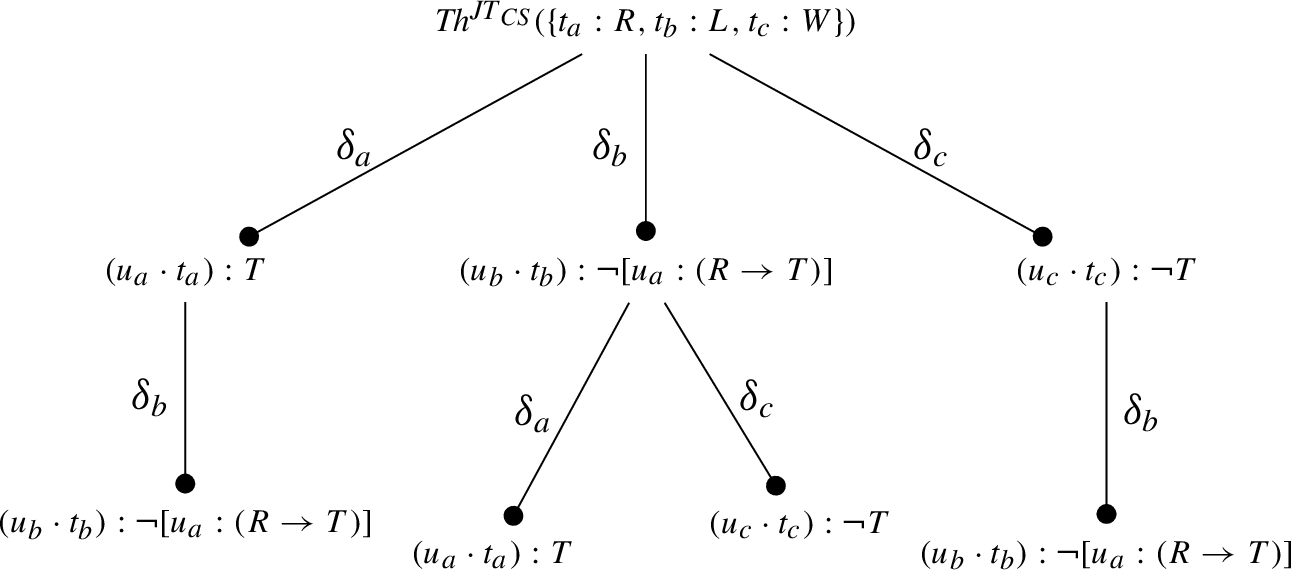
The process tree of
The figure shows that
We have already discussed the key components of our operational semantics that bear some similarity to standard default theories. Now we develop our new argument semantics that builds on the expressivity of the justification logic language. We show that the default variant of the application operation is essential to the way in which we represent arguments and their mutual attacks in justification logic.
In a complete specification of
Toulmin explains [77, p. 91] inference-licensing warrants as follows: “...taking these data as a starting point, the step to the original claim or conclusion is an appropriate and legitimate one. At this point, therefore, what are needed are general, hypothetical statements, which can act as bridges, and authorise the sort of step to which our particular argument commits us.”
A set of all such underlying warrants of default rules is called Warrant Specification (
For a default theory
We will use warrant specification sets that are relativized to default processes:
The extension of the application operation to its defeasible variant opens new possibilities for a semantics of justifications. In particular, it enables reasoning that is not regimented by the standard axioms A1 and A2 of basic justification logic [7, p. 482]. For instance, if a set of
In explaining the basics of the operational semantics, we qualified the semantics of rebutting attacks as being straightforward. Rebuttal is already captured in the mechanism of multiple extensions known from standard default theories. What requires additional explanation is the semantics of undercutting defeaters. Notice that each formula
Although the application axiom A1 does not say that
Notice that a (
One way to model exclusionary reasons and undercutters in default logic is to use non-normal defaults. However, with the use of non-normal defaults, many desirable features of default logics are lost, and this holds already for semi-normal defaults [3, Chapter 6]. Besides that, the use of justification logic warrants provides an elegant way to subsume argumentation semantics in default logic. For a more extensive discussion on the benefits of warrants over non-normal defaults see [61].
We have already discussed why the semantics of undercut cannot be reduced to the existence of multiple inconsistent extensions. Nevertheless,
Later, in Lemma 24, we characterize the relation between rebuttal and undercut formally.
A reason u undercuts reason t being a reason for a formula F in a set of
We will also specify the way in which sets of
A set of
One can think of Γ as a set of reasons against which the reason t is tested as a reason that justifies the formula F. This is further elaborated in the semantics of acceptability of reasons. By introducing default reasons through default application and considering rebuttal and undercut among such reasons, it is possible to take an argumentation perspective to justification logic formulas. For example, Fig. 3 provides an intuitive Toulminian interpretation of the default reasoning steps with justification formulas in Example 8, where each step can be associated with a corresponding step in the Toulminian argument scheme.23
A reader should take the following two provisos into account here. Firstly, Toulmin does not use the term “undercutter”. Instead, Toulmin uses rebuttal as an ambiguous concept that, among other kinds of defeat, covers for circumstances in which the general authority of the warrant would have to be set aside [81, p. 235]. Secondly, our scheme does not include “qualifiers” [77, p. 94] that indicate the strength of the step from grounds to claim.
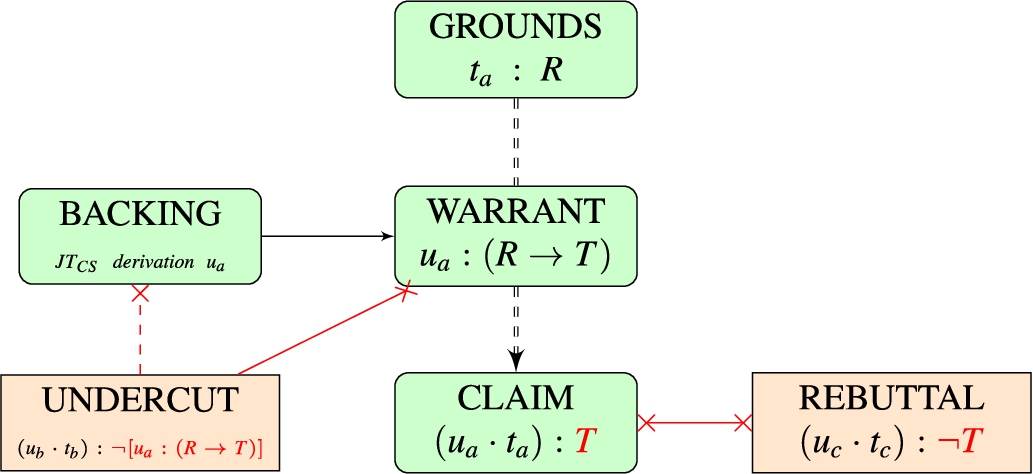
Toulminian layout of arguments in Example 8.
Note that the formula
A reader may notice here that the self-referential mechanism in which the language of justification logic treats its own reasoning steps within the language gives a three-layered understanding of arguments. The first layer is an argument seen as a pair of reason terms and formulas, e.g. the formula
By introducing default reasons in justification logic it becomes possible not only to use argumentation terminology in talking about formulas of the type
The semantics of reason acceptance starts from characterizing conflict-free sets of
(Conflict-free sets).
A set of
Note that, if a set of formulas
For a theory
The property of
The theorem ensures that, for any non-empty process Π, a set of conflict-free formulas
As stated before, the set W contains certain information and this means that any information from W is always acceptable regardless of what has been collected later on. Therefore, any set of formulas Γ that extends the initial information contains W. To decide whether a consequent of a default δ is acceptable, an agent looks at those sets of reasons that can be defended against all the available counter-reasons. For any set of
For a default theory
An agent looks at finding a defensible set of arguments in the space of all possible arguments defined by all certain information taken together with the consequents of applicable defaults. Accordingly, for a default theory
Informally, an agent has yet to test any potential extension against all the other available reasons before it can be considered as an admissible extension of the evidence base.
(
-Admissible Extension).
A potential extension set of
After considering all the available reasons, an agent accepts only those defeasible statements that can be defended against all the available reasons against these statements.
The two latter definitions introduce the idea of “external stability” of knowledge bases [30, p. 323] into default logic by taking into account that only those reasons that are able to defend themselves against the reasons that question their plausibility eventually become accepted. In addition to that, our operational semantics prompts an implicit revision procedure. Any new default rule that is applicable to the set of formulas
(
-Preferred Extension).
For a default theory
In other words,
(Zorn [83]).
For every partially ordered set A, if every chain of (totally ordered subset of) B has an upper bound, then A has a maximal element.
(Existence of
-Preferred Extension).
Every default theory
If W is inconsistent, then for any default δ, negation of the consistency requirement
Assume that W is consistent. In general, if there is a finite number of default rules in D, any closed process Π of T is also finite.
For the case where D is infinite and closed processes
The semantics of defeasible reasons enables us to define additional types of extensions that are not necessarily based on the admissibility of reasons. One of them is the stable extension familiar from formal argumentation theory [30]:
For a default theory
The intuition behind the definition is that every reason left outside the accepted set of reasons is attacked. To understand the process semantics workings of the stable extension definition, we can parse this definition into two components. First, it is clear that a stable extension
For a default theory
By Theorem 6, we know that there is some segment
If a potential extension Γ of T undercuts all the formulas left outside, then Γ also has to maximize admissibility with respect to set inclusion. This straightforwardly leads to the following lemma:
Every
We can check that in the red-looking-table example,
However,
Let P be the proposition “The elephant looks pink”, let E be the proposition “The elephant is pink”, and let H be the proposition “Robert suffers from pink-elephant phobia”. The pink elephant example is then described by the default theory
Notice that in the original formulation of his pink elephant example, Pollock introduces [64, p. 120] an intermediate inference between the rules
The theory
In addition, we can easily define other significant notions of extensions in formal argumentation. In particular, we can define variants of Dung’s [30, p. 329] complete and grounded extension:
For a default theory
(
-Grounded Extension).
For a default theory
Note here that the we know that there is the smallest potential extension which is
Unsurprisingly, the results for different types of extensions from [30] are valid for our default theory extensions.
Every
Assume that
It does not hold, however, that every
Considering some proposition as justified might be seen as a function of interacting reasons. Each of the presented
To illustrate the differences among the above defined semantics, we will elaborate on an example of a single default theory whose
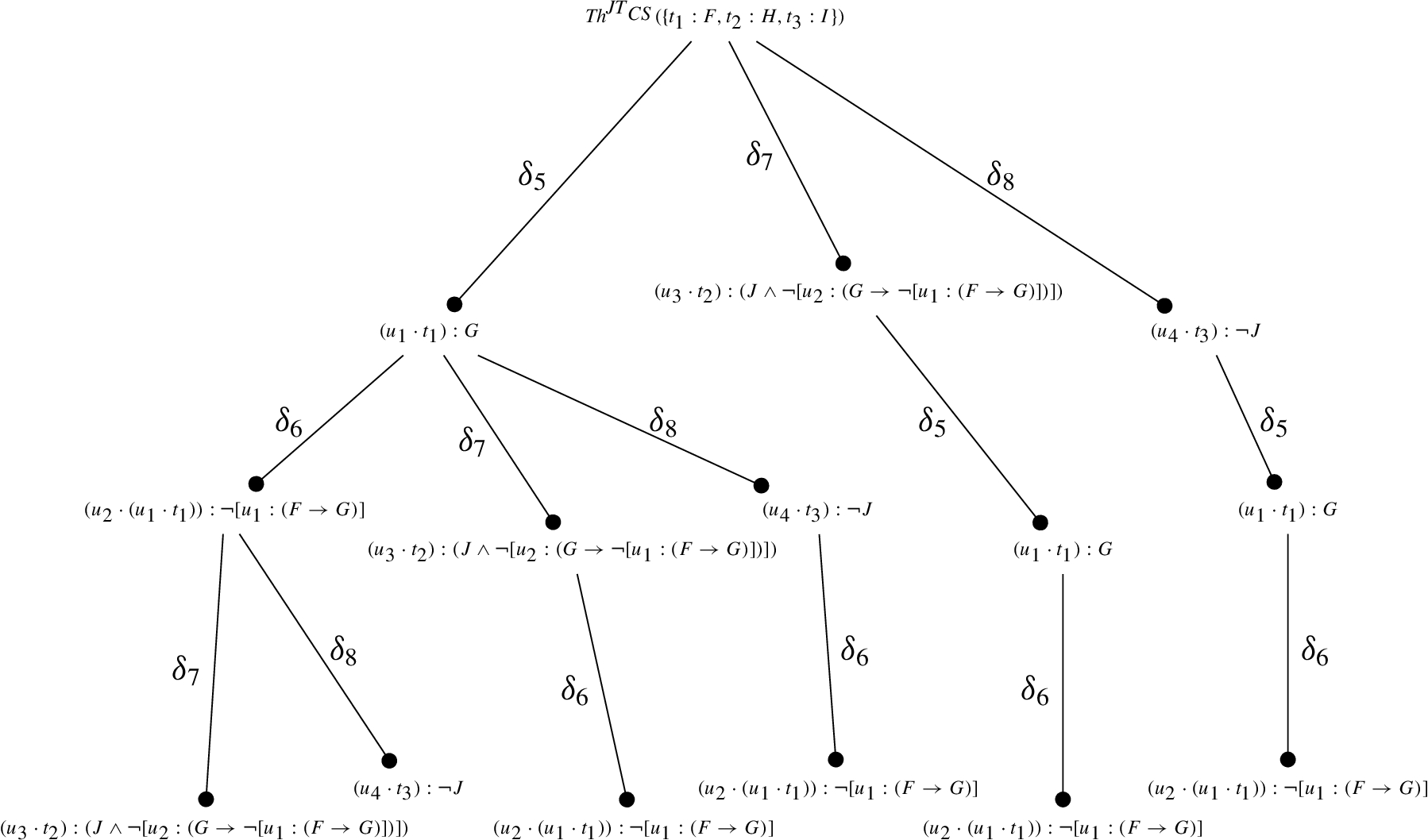
The process tree of
In total, the theory
It is possible to specify conditions under which different
A cycle of undercuts is an infinite periodic sequence of
Rebuttals among formulas ultimately derive from the property of
We are ready now to give the conditions for the coincidence of There are no sets of
The following theorem shows that
Compare [30, p. 331] for well-foundedness of abstract argumentation frameworks. Here we adapt the proof idea for the coincidence of extensions of well-founded abstract argumentation frameworks that can be found there.
Every well-founded default theory
Firstly, if a
Assume that a well-founded theory T has a
Therefore, since T is well-founded, it has a unique
Abstract argumentation frameworks (AF) inquire into the problem of the acceptability of arguments based on their mutual conflicts. More precisely, an argumentation framework is a pair of a set of arguments, and a binary relation representing the attack-relationship (defeat) between arguments. These frameworks are abstract in at least two ways: they neither represent the structure of arguments nor do they specify the exact nature of attacks between them. The study of abstract arguments was initiated in [30]. From then on, there have been many attempts to develop frameworks where the structure of arguments is included, most notably in the ASPIC+ framework [68].
In this section we examine connections between abstract argumentation frameworks and our logic. The semantics of justification formulas
We can say this also about the formula
We first focus on the possibility of mapping from default theories to AFs. To establish the connection between default reasons semantics and AF semantics, we need to restrict our attention to a subclass of our default theories. Since our logic is more expressive with respect to attack relations, we focus on non-complex default theories where attack relations are defined only by looking at the union of logical consequences of each consequent of a default rule. In this way, each default rule is taken separately as a self-contained argument. To achieve this, we first specify what it means for two default rules to block each other’s applicability. For a process Π of If two defaults δ and For a process Π of T, a reason t such that
In other words, we require for any defeat that occurs in a theory T to be derivable only from a consequent of a default rule because joint attacks cannot be represented in Dung’s [30] framework.
Using default justifications, one can look into the details of arguments’ structure, including grounds, warrants, backings and different ways of attack, while Dung’s framework treats arguments abstracting from their contents. This means that any translation from default theories with justification terms to Dung’s framework has to “forget” information about arguments’ structure. Having restricted our target theories to non-complex theories, we can now describe a mapping “⟹” called Forgetful projection. Forgetful projection converts each formula
Recall the theory
Since forgetful projection does preserve the structure of conflicts among groups of arguments, it is possible to compare
For a formula
See the Appendix for a proof sketch. □
Intuitively, forgetful projections of justification logic arguments outline a single perspective on argumentation, namely that of opposition among arguments. Note that there are extensions of Dung’s framework that formalize joint attacks from sets of arguments such as [58]. In a framework with joint attacks, Proposition 32 can be generalized to any default theory with justification formulas.
One may also ask whether the other direction of translating from argumentation frameworks to default theories always works. Since the content of arguments is not specified in Dung’s framework, it is only possible to retrieve incomplete information about justification logic counterparts of Dung’s frameworks. For any argument in Dung’s framework, there are many justification logic realizations. Starting from a directed graph obtained from a framework
The algorithm treats every single arrow in Dung’s graph as a specification of
It is possible that an obtained formula has a complex structure and, for example, entails both a rebutting and an undercutting reason for some formulas.
The problem can be generalized to a class of unwarranted argumentation frameworks. An argumentation framework There is an infinite sequence For any two distinct arguments There exists no argument C outside the sequence such that: for some A from the sequence C is not a member of an infinite sequence for no two distinct arguments D and E from
The conditions above eliminate realizations of a small subclass of graphs with “floating” cycles, but they do not eliminate the possibility to realize cycles of attacks in general. In the abstract argumentation [16] and defeasible reasoning [65] literature, only the semantics of odd-length cycles of attacks (or of defeats) is notorious for undesirable properties that odd-length cycles entail for different types of extensions. In our default reason theory, both odd- and even-length “floating-attack” cycles have no direct counterparts. This will be explained below in details.
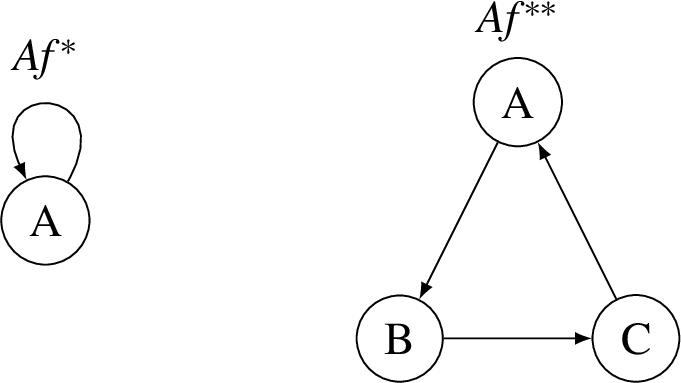
Unwarranted argumentation framework examples.
Informally, we can say that such unwarranted frameworks violate the following postulate for structured argumentation frameworks:
Prior to any challenge there must be at least one reasoned claim.
From the perspective of our default theory, the frameworks
Once additional argument features are considered, and in particular arguments’ warrants, the structures from Fig. 5 can be proved to be impossible. The following theorem shows that, in our default theories, floating-attack cycles without at least one outgoing edge to an argument outside the cycle are not possible.
For a sequence
Assume that there is a cycle of undercuts in a set of formulas
The theorem ensures that cycles of asymmetrical attacks among arguments are possible only if there is an outlying argument and this argument is attacked by an argument in the cycle. Although our justification logic cannot realize the subclass of unwarranted frameworks, this result does not exclude circular argumentation from it in general. However, the result does show that there are constraints on interpreting directed graphs as argumentation frameworks and these constraints are due to the inclusion of additional argument features into our system.
In the literature about abstract argumentation frameworks, there are attempts to provide frameworks
By fleshing out the content of these arguments in our default theory, it becomes clear that there is more to this example than the cycle of three attacks is able to show. There are two kinds of arguments involved in resolving the conflict among the claims to the status of the best club. First, the fact that Ajax has won recent matches against Feyenoord, provides a reason to claim that Ajax is the best club. Secondly, the same fact provides grounds to question the claim that Feyenoord is the best club. The first argument can be an attacker only as a rebuttal, while the second argument is an undercutter. Analogously, arguments can be provided with reference to Feyenoord and PSV, as we will formalize below.
Let
Theory
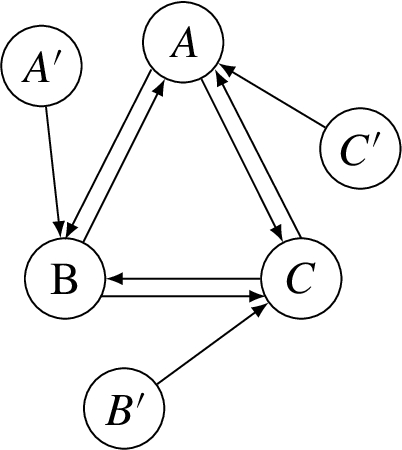
Abstract attack structure of Example 34.
By excluding unwarranted Dung’s frameworks, it is possible to formalize the Realization procedure (“
The following proposition characterizes realizations of warranted
An argument
See the Appendix for a proof sketch. □
In Dung’s framework arguments are only implicit and one can consider each argument A as a statement of the following type “There is an argument A”. When realized in justification logic, each of these existential statements can be instantiated with an explicit argument structure
One may wonder what is the significance of (un)warranted abstract argumentation frameworks for formal argumentation in general. We will conclude this section by pointing out what could the realization results from justification logic contribute to our understanding of arguments. The most important insight given by the justification logic realization of AFs is that once we include reason terms into our formal language, we bring forward the requirements on the logical language that are only implicit in representing arguments as graph nodes. One of these requirements is that the reasoning structure that we call “backing” in this paper has to be built according to the axioms and rules of the underlying calculus of reason terms. According to it, it is impossible to build a “proof term” or a reason term that would support and undercut one and the same conclusion, which is the result obtained in Theorem 33. However, an isolated AF cycle requires a possibility to have a default reason term, without other default reasons as its subterms, that supports and undercuts a conclusion introduced in a single consequent formula of a default rule.
Such loops and cycles that correspond to attack relations in AFs cannot easily be exemplified in natural language either. Even self-defeating argument that require more than a single default inference are difficult to exemplify, as Pollock’s pink elephant example witnesses. Starting with the work in [22], it has been argued that attack loops could be exemplified with the statement “I am unreliable” or, using the third-person perspective, “An agent says that the agent is unreliable”. In the same vein, the above discussed three-node cycle of attacks has been exemplified [24] by a scenario featuring agents who question one another’s reliability in the following way.29
Suppose that there are three agents, namely Bert, Ernie and Elmo. If Bert says that Ernie is unreliable, then everything that Ernie says cannot be relied on. If Ernie says that Elmo is unreliable, then everything that Elmo says cannot be relied on. Finally, If Elmo says that Bert is unreliable, then everything that Bert says cannot be relied on. This creates a cycle of attacks among Bert, Ernie and Elmo.It is in such borderline examples of arguments that we can value the precision of the justification logic language. Natural language allows the type of self-referentiality featured in the sentence “I am unreliable”. With the use of the justification logic language, we can see that such examples belong to a special group of statements that require the logical machinery of propositional quantification or that of quantification into sentential position [78, §3.5]. In an extended language with propositonal quantifiers, we could represent the statement “I am unreliable” with the following formula
There are two findings related to the above examples that deserve our attention in the context of modelling arguments. Firstly, if the above examples are to be taken as arguments on a par with arguments that do not require such strong logical machinery, they should not be considered as a part of the default reasoning paradigm of argumentation. Such examples of argumentative attack belong to the plausible reasoning paradigm. In the default reasoning paradigm, which is the paradigm we investigate in this paper, argumentative attacks result from attacking defeasible inferences, as illustrated by rebutting and undercutting attacks form Example 8. In the plausible reasoning paradigm, argumentative attacks result from adding new information that questions old information and, thereby, it might question old conclusions. Notice that undercutting and rebutting attacks do not question the reliability of old information. For example, concluding that the table is white, rather than red, cannot question the fact that the table looks red under the red lighting. On the other hand, if you question the old information that the table is red looking, then you compromise both old information and any default conclusions that may follow from old information. This type of attack is called “undermining” and it is defined as an attack on premises of an argument [79, p. 626]. In the Bert-Ernie-Elmo attack cycle, the three sources of information are undermined in such a way that the testimonies of the three agents question one another in the proposed order. This differs from the attacks induced by default inferences, where some default step is being questioned, rather than the credibility of information sources.
Secondly, default justification logic shows that argumentation frameworks that include such arguments on a par with other defeasible arguments do not consider the paradoxical nature of the mentioned example. In an important sense, ASPIC+ is still too abstract to capture the intensional paradox created by adding propositional quantification in the justification logic representation of attack cycles.30
See [70] for a discussion about intensional paradoxes. Intensional paradoxes belong to a “class of paradoxes of self-reference whose members involve intensional notions such as knowing that, saying that, etc.” [70, p. 193].
Section 3.1 shows that default rules with justification formulas are expressive enough to model elements of arguments that are traditionally seen as extra-logical, such as warrants and backings. The results from Section 4 establish the logic of default justifications as a system that explicitly features the structure of arguments and uses Dung’s methods for argument evaluation. The
According to [1], the exact formulation of rationality postulates for structured argumentation frameworks depends on the family of a logical language that they use: rule-based or classical. In frameworks with rule-based languages, a distinction is made between strict rules (rules without exceptions) and defeasible rules (rules that may have exceptions). Arguments are built according to the available strict and defeasible rules. Examples of such systems are ASPIC+ [68] and DeLP [41]. In frameworks with classical languages, arguments are built from a knowledge base using an underlying monotonic logic. Examples of frameworks that use classical languages are [18] and [19]. The framework described in [18] is based on a propositional language, while that of [19] is based on a first-order language.
Following [1], we will first consider five postulates, originally formulated for argumentation frameworks built on classical languages. In general, classical-logic based argumentation frameworks start from the idea that there is some knowledge base with classical logic formulas. We define arguments from that (possibly inconsistent) knowledge base as pairs of sets of formulas and conclusion formulas such that a conclusion formula is classically entailed by a set of formulas. We will here present the five postulates without committing to Amgoud’s definition of an argument. We do so deliberately, because the definition of an argument for classical-logic based frameworks cannot be applied to our logic. The reasons will be given shortly after we present the postulates. We give their “framework-neutral” formulation, leaving the exact definitions of framework extensions, arguments, sub-arguments, strict rules, premises and conclusions unspecified:
The set of conclusions for each extension is closed under strict rules. If an argument is contained in an extension, then all the sub-arguments of the argument are contained in the extension. The set of conclusions for each extension is consistent. If each premise and the conclusions of an argument are conclusions of an extension, then the argument is contained in the extension. If an argument is not involved in any conflict, then the argument is contained in each extension.
Delimiting the notion of argument in default justification logic
To discuss whether rationality postulates hold for a system, it is required to have a precise definition of an argument. Note that default justification logic offers both a narrower and broader understandings of an argument, which may include implicit components. The narrower understanding takes every formula of the type
Although the idea of a classical-logic based system is closer to our default logic, the postulates given by [1] are not directly applicable to our logic. While the logic of default justifications uses
On the other hand, rule-based languages introduce the differentiation between strict and defeasible rules, but these rules are not a part of the base language. In contrast with, for example, [68], arguments in justification logic are built via the operations in the
Our logic takes the middle way between rule-based systems and classical-logic based systems by combining the distinction between strict rules and defeasible rules with logical dependency of arguments via
Note that this corresponds to Toulmin’s ambiguous use of the term “warrant”. For example, [77, p. 91] refers to warrants as both rules and statements in a single paragraph.
Even without directly applying the postulates for classical-logic based argumentation, we can check whether the desiderata on which [1] builds the rationality postulates hold for our logic. We first examine three postulates from [1, pp. 2032–2035] that are easily adaptable for our logic. For any The set of conclusions for each The set of conclusions for each It is not needed to distinguish between the direct and indirect version of this postulate. This distinction rests on the assumption that, by their definition, extensions of an argumentation framework are not closed under strict rules. However, in our logic, this follows from the definitions of
If some argument
The satisfaction of the consistency postulate is guaranteed for each default theory
The free precedence postulate requires that the system infers all the arguments and, in general, formulas that do not conflict with any other argument. As stated above, we take arguments in the narrower sense of formulas
For the two additional postulates from [1], the notion of a sub-argument of an argument needs to be defined. We will start again from the narrower understanding of an argument in the sense of any formula If a formula If a formula
If an argument
The following two postulates require rational acceptance of an argument with respect to its substructure:
If an argument If each sub-argument and the formula F for some argument
The sub-arguments postulate can be seen as a dual version of exhaustiveness, in the sense that it requires that all the steps of an accepted argument should also be accepted [1, p. 2029]. This postulate is not directly satisfied by our logic. Take, for example, an argument
Does that mean that arguments introduced by default rules are based on unjustified reasoning steps? We can show that this is not the case. Although the sub-arguments postulate is not directly satisfied, the basic idea behind the postulate is: “an argument cannot be accepted if at least one of its sub-parts is bad” [1, p. 2033]. This desideratum holds because, even if the sub-argument
Recently, a number of authors including [23,44,82] have discussed the way in which the Ex Falso Sequitur Quodlibet principle in the underlying logic of an argumentation system may threaten plausibility of acceptability semantics outputs for the system. We explain the intuition behind the problem of “trivialisation” [44, p. 199] that the Ex Falso principle causes in the case of rebutting attacks, but a reader can refer to the mentioned sources for a more technical elaboration of the problem. In a nutshell, argumentation systems with strict and defeasible rules allow that arguments using defeasible rules have contradictory conclusions, say φ and
The effects of trivialisation are recognized, for example, in the context of the ASPIC+ framework. To test whether a system is susceptible to the problem, Caminada, Carnielli and Dunne [26] propose the rationality postulate called “non-interference” for generalized defeasible theories based on propositional logic. We take For two syntactically disjoint defeasible theories
In default justification logic, the basic
Let For two syntactically disjoint default theories
Assuming consistent and syntactically disjoint default theories, we can check that our default justification logic satisfies the
To conclude the discussion about rationality postulates, we will indicate several limitations on giving a systemic evaluation of default justification logic in this paper. Firstly, default justification logic as presented in this paper does not yet model all the varieties of argumentative attacks as, for example, enabled in ASPIC+.33
There are also further differences in the basic languages underlying our logic of arguments and the examples that initiated the non-interference postulate debate. Consider, for example, the statement “John says the cup of coffee contains sugar”. In standard structured argumentation frameworks, the underlying language is usually assumed to be a classical logic language. If we take propositional logic, the statement is formalized using a propositional formula, e.g., ‘s’. Justification assertions are richer expressions and this opens up a possibility to go beyond the propositional language and indicate that a certain reason supports a formula. As we do in the examples in this paper, the statement would translate into the justification assertion ‘
The logic of default justification has a similar connection to abstract argumentation frameworks as standard justification logic systems have to their modal logic counterparts. Artemov [6] provided a proof of the Realization Theorem that connects the logic of arithmetic proofs LP with the modal logic S4. The result has been followed up by similar theorems for many other modal logics with known “explicit” justification counterparts.34
See [38] for a good overview of realization theorems.
In the general context of default logics, our logic introduces some new technical properties for normal default theories that are still to be thoroughly investigated. Among them are revision of extensions and interaction of different defaults that does not rely on their preference orderings, as commonly done in default logic [29]. An extensive account of default reasons that makes use of preference orderings on defaults is developed by [47]. Horty’s logic is based on a propositional language and develops from a different notion of reasons, which are not explicitly featured in the language itself. He uses the idea of preferences to represent undercutters or exclusionary reasons.
Our work provides a complementary addition to the study of less-than-ideal reasons in justification logic. Among related approaches, the logic of conditional probabilities developed by [59] introduces a way to model non-monotonic reasoning with justification assertions. Their proposal is based on defining operators for approximate probabilities of a justified formula given some condition formula. Using conditional probabilities, the logic models certain aspects of defeasible inferences with justification terms. Yet the system can neither encode the defeasibility of justification terms in their internal structure nor model defeat among reasons, to mention only some differences from our initial desiderata.
Baltag, Renne and Smets [12] define a justification logic in which an agent may hold a justified belief that can be compromised in the face of newly received information. The logic builds on the ideas from belief revision and dynamic epistemic logic to model examples where epistemic actions cause changes to an agent’s evidence. Concerning the possibility of modelling defeaters, the logic offers two dynamic operations that change the availability of evidence in a model, namely “updates” and “upgrades” [12, p. 183]. Evidence obtained by updates counts as “hard” or infallible, while upgrades bring about “soft” or fallible evidence. With the use of these actions, epistemic models can represent justified beliefs being defeated, for example, by means of an epistemic action of update with hard evidence. In this way, however, the mechanism by which reasons may conflict with one another is simply being “outsourced” to an extra-logical notion of fallibility and, therefore, the logic does not directly address the ways of defeat that we formalize in this paper.
Several interesting paths could be followed in connecting the logic of default justifications with formal argumentation frameworks. Among frameworks with abstract arguments, the AFRA framework [15] with recursive attacks offers a possibility of representing attacks to attacks. This conceptual advance is useful in connecting default reasons to abstract arguments. More obviously, our logic is closely related to the frameworks with structured arguments, which is why connections with systems such as ASPIC+ [68], DeLP [41], SG [46] and the logic-based argumentation framework by [18] are interesting to explore. Since each of these frameworks elaborates on the notion of defeat, a thorough comparison to our logic would shed light on their formal connections. A different logic-based perspective on argumentation frameworks is given by [27] and [45]. Both papers start from the idea of studying attack graphs and formalizing notions of extensions from abstract argumentation theory using modal logic, with the former approach being proof-theoretical and the latter model-theoretical. A further interesting research venue in the field of argumentation theory is the one about the logical interpretation of prima facie justified assumptions in [80]. The DefLog system which is developed there is closely related to ours in motivation, but it develops from a perspective of a sentence-based theory of defeasible reasoning instead of a rule-based or argument-based approach.
Further developments are possible starting from the basic form of default rules with justified formulas. We indicate some of the possibilities to extend the basic logic. On the technical side of the logic, we used only the expressiveness of normal default rules and we still need to investigate how to add non-normal default rules. Since all processes are successful for normal default theories, it is interesting to see whether the logic has some further desirable properties such as, for example, goal-driven query evaluation.
It is also possible to use the first-order variant of justification logic [37], instead of the propositional justification logic used here. This is an intriguing direction because of the possibilities it opens. To mention one of them, a first-order warrant of a default rule would fully correspond to the Toulminian warrant, being also generally applicable to all the objects as a rule schema. Defining default rules on such rich language would be one step closer to a full account of structured arguments.
One of the ongoing projects started in [62] is to add the dynamic aspect of default theories with justification terms. Besides the existing mechanism of extension revisions, we also consider changes to a default theory and adding belief-revision-style operations to deal with such theory changes. A similar proposal is given in [4] for standard default theories. This completes the logic proposed here because it enables modelling an additional kind of defeat that was only briefly mentioned in this paper, namely undermining defeat. This form of defeat is understood as an attack on the premises or assumptions of an argument [79, p. 626] and premises can be interpreted as the information contained in the set W for a theory
At this point, our logic is presented as single-agent. Since argumentation is distinctively dialogical and multi-agent practice, developing a multi-agent generalization of the default justification logic stands as one of the main future goals. The problem that needs to be initially addressed is how does inclusion of multiple agents essentially differ from the already existing argument exchange through default reasons.
Finally, the logic of default justifications has a potential to link the formal analysis of knowledge with mainstream epistemology. Ever since the concept of justification entered into epistemic logics, there has been a tendency to model mainstream epistemology examples, proposed by e.g. Russell, Dretske and Gettier, with the use of justification logic [7,8]. With the introduction of default justifications, however, we gain flexibility for a more full-blooded integration of the formal theory of justification with the study of knowledge in philosophy, since paradigmatic examples include both incomplete specification of reasons and defeated reasons. Potential benefits of a non-monotonic system of justifications in this context were anticipated by Artemov in [7, p. 482] where he states that “to develop a theory of non-monotonic justifications which prompt belief revision” stands as an “intriguing challenge”.
Footnotes
Acknowledgements
I am grateful to Allard Tamminga, Barteld Kooi and Rineke Verbrugge for their generous advice and valuable comments on the previous versions of this manuscript. My research is supported by Ammodo KNAW project Rational Dynamics and Reasoning awarded to Barteld Kooi. I am also grateful to the three reviewers of the Argument & Computation journal for their constructive suggestions that helped me to improve this paper.