




Abstract
In his pioneering work on Abstract Argumentation, P.M. Dung set a wide scenario by connecting stable models in Logic and Game Theory to simple Abstract Argumentation Frameworks (AAF), which are essentially directed graphs in which arguments are represented as nodes, and the attack relation is represented by arrows. From such abstraction and simplicity, it is possible to capture important properties in many different fields. The Stable Marriage (SM) problem is exactly one of such representable problems. Given two sets of individuals partitioned into men and women, a matching is stable when there does not exist any man-woman match by which both man and woman would be individually better off than they are with the person to which they are currently matched. Stable matchings correspond to stable extensions if an AAF is correctly generated from the given SM problem. In this paper we elaborate on the original formulation by Dung, by also encoding SM problems with ties and incomplete preference lists into AAFs. Moreover, we use Weighted Abstract Argumentation to represent optimality criteria in the optimal extension of SM problems, where some matchings are better than others: criteria may consider only the preference of either men, or women, or a more global view obtained by combining the preferences of both.
Introduction
In his seminal paper on Abstract Argumentation [16], P. M. Dung develops the core notions behind the collective acceptability of arguments. In addition, he shows that some major approaches to non-monotonic reasoning in AI and Logic Programming are special forms of such a theory, and that the same theory can be used to capture the solutions of n-person Games and Stable Marriage (SM) problems. In this paper our wish is to tribute such a pioneering work by designing and applying a Weighted (Abstract) Argumentation approach to the latter problem, that is SM problems.
The SM problem [20,27] and its many variants [25] have been widely studied in the literature, because of the inherent appeal of the problem and its important practical applications. A classical instance of the problem comprises a bipartite set of n men and n women, and each person has a preference list in which they rank all members of the opposite sex in a strict total order. Then, a matching MT is simply a bijection between men and women. A man
In this paper we also consider the Optimal Stable Marriage (OSM) problem [25,27], whose goal is to find a matching that is not only stable, but also “good” according to some criterion based on the preferences of all the considered individuals. Classical solutions deal only with men-optimal (or women-optimal) marriages instead, in which every man (woman), gets his (her) best possible partner.
In this work, we cover part of the plethora of the SM problem extensions which are not investigated in [16]. More in particular, we investigate to what extent a simple formalisation as the one provided by Abstract Argumentation Frameworks (AAFs) [16] is capable of representing incomplete lists of preferences and ties. Further on, we also take advantage of Weighted AAFs, and in particular of c-semiring based WAAFs [5,8], in order to consider optimisation criteria characterising OSM problems. C-semiring based WAAFs can be described by a tuple
The paper is structured as follows: in Section 2 we introduce the necessary background notions about c-semiring based WAAFs [5,8]. Section 3 introduces the SM and OSM problem variants; this section reports the original encoding of the SM problem in a framework, but it also proposes some novelty, as for instance a view of preferences using c-semirings. Section 4 shows how incomplete lists of preferences and ties among them can be represented in AAFs. Afterwards, Section 5 adds optimisation to the picture: we show how to optimise different criteria in weighted frameworks, as WAAFs based on c-semirings. Section 6 positions the work with respect to the related work on Cooperative Games, and, in general, Game Theory. To conclude, Section 7 wraps up the paper with final thoughts and future work.
Weighted Abstract Argumentation with C-semirings
In this section we rephrase some of the classical definitions in [16], with the purpose to parametrise them with the notion of weighted attack and c-semiring [4]. Such notions, e.g., the one of w-defence, are the premises behind the stable semantics we then propose in Section 2.1. This background section is mainly extracted from the results in [5,8].
We start by recalling a few preliminary notions about classical Abstract Argumentation. In his pioneering work [16], P. M. Dung proposes Abstract Frameworks, where an argument is an abstract entity whose role is solely determined by its relations to other arguments:
(Abstract Frameworks [16]).
An Abstract Argumentation Framework (AAF) is a pair
A semantics is the formal definition of a method (either declarative or procedural) ruling the argument evaluation process. In the extension-based approach, a semantics definition specifies how to derive a set of extensions from an AAF, where an extension
(Conflict-free sets [16]).
A set
All the semantics proposed in [16] rely (explicitly or implicitly) upon the concept of defence:
(Defence [16]).
An argument b is defended by a set
An admissible set of arguments [16] must be a conflict-free set that defends all its elements. Formally:
(Admissible sets).
A conflict-free set
After describing basic properties of extensions, the only semantics on which we focus in this paper is the stable one.
(Stable semantics [16]).
A conflict-free set
We now start introducing our formalism to represent frameworks where weights are associated with attacks. The following definitions present WAAFs based on c-semirings, or
(C-semirings [4]).
A commutative semiring is a tuple
(Semiring-based WAAF [9]).
A c-semiring based Weighted AAF (
The idempotency of ⊕ leads to the definition of a partial ordering
In Fig. 1 we provide an example of a
Boolean c-semirings can be used to model Abstract Argumentation à-la-Dung [8].

An example of WAAF.
A c-semiring value equal to the top element of the c-semiring ⊤ (e.g., 0 for the Weighted c-semiring) represents a no-attack relation between two arguments: for instance,
In Definition 2.8 we define the attack strength for a set of arguments that attacks an argument, a different set of arguments, or an argument that attacks a set of arguments; the former and the latter are what we need to define w-defence. In the following, we will use ⨂ to indicate the ⊗ operator of the c-semiring
Given a a set of arguments an argument a attacks a set of arguments a set of arguments
For example, in Fig. 1 we have that
(w-defence (
)).
Given a
As previously advanced, a set
Note that, when considering the partial order of a generic c-semiring, we will often use “worse” or “better” because “greater” or “lesser” would be misleading: in the Weighted c-semiring,
Moreover, in the following proposition classical defence [16] and w-defence collapse one into the other in case we adopt the boolean c-semiring:
Given a
Although c-semirings have been historically used as monotone structures where to aggregate costs [38, Ch. 9], the need of making ⊗ non-monotone raised in many different applications, thus requiring to define an inverse operator for it. A solution comes from residuation theory [12], a standard tool on tropical arithmetic (studying c-semirings with an idempotent +), which allows for obtaining a “weak” inverse of ⊗.
Let
Since a complete3
If
Since all the previously listed instances of c-semirings are cancellative, they are uniquely invertible as well. For instance, considering the (i) Weighted and (ii) Fuzzy c-semirings:
Having introduced ⊘, the notion of w-defence given in Definition 2.9 can be relaxed in order to be less restrictive. The result is γ-defence, and it is parametrised on a threshold-value γ: such γ is used to consider arguments that are not “fully” w-defended, i.e., for which
(γ-defence (
)).
Given
Considering the example in Fig. 1, for instance
-stable semantics and properties
In this section we redefine the classical stable semantics [16] by exploiting both the notion of (i) an inconsistency amount α inside an extension (to be tolerated), and (ii) the concept of γ-defence. All classical semantics are extended as
In Definition 2.14 we relax the notion of conflict-freeness: conflicts can be now part of the solution up to a cost-threshold α. Such sets are now called α-conflict-free:
(α-conflict-free sets).
Given a
With respect to the
We now introduce
(
-admissible sets).
Given
Still considering Fig. 1, the set
Definition 2.16 proposes Dung’s stable semantics revisited in a
(
-stable semantics).
Given
For example, considering Fig. 1, the set
We conclude this section by summarising some formal results related to α-conflict-free and
Given
the set of ⊤-conflict-free sets in the set of ⊤-conflict-free sets in
the set of
the set of
the set of
the set of
the set of
for each
for each
We divide this background section in two: in Section 3.1 we described the SM problem and its variants, while Section 3.2 reports the original formalisation of SM problems as AAFs, given by Dung in his pioneering work [16]. Both these sub-sections contain some novelty, since definitions are rephrased by using c-semirings with the purpose to pave the way for the results in the subsequent sections.
Stable matchings
An instance of the classical SM problem [18] comprises n men and n women, where each of these individuals has a preference list in which all the members of the opposite sex are ranked in a strict total order (i.e., no tie). All men and women must be matched together in a couple such that no element x of couple a prefers an element y of different couple b that also prefers x: this statement represents the overall stability condition. If such an
In the original formalisation of the problem [18], it is supposed to have two sets of cardinality n:
We initially define
The SM problem was first studied by Gale and Shapley [18]. They showed that there always exists at least one stable MT in any problem instance as previously described. In addition, they also proposed a
In general, there can be more than one stable matching: in a uniformly-random instance of an SM problem with n men and n women, the average number of stable matchings is asymptotically
The classical SM problem was extended [18] in order to find an SM under a more equitable measure of optimality, thus defining an Optimal SM problem (OSM) [19,24,25,27]. For example, in [24] the authors maximise the global satisfaction in an SM by simply summing together the preferences of both men and women in a matching. This sum needs to be minimised since
A third criterion consists in minimising the sex-equalness cost [26], as represented in Equation (3):
Finding a solution satisfying the goals represented by Equation (1) and Equation (2) already found their solution in polynomial time by using ad-hoc algorithms, such as [24] and [19], respectively. These algorithms exploit a lattice structure that condenses the information about all the stable matchings. On the contrary, reaching the optimality represented by Equation (3) was proved to be an NP-hard problem, for which approximation algorithms are proposed [26].
In the following, we consider preferences as more general values taken from a c-semiring, instead of a position in the preference list of an individual; thus, we suppose to model weighted preference lists [24]. For this reason we define a c-semiring-based extension of SM, by changing the co-domain of p into S:
(C-semiring-based SM/OSM).
An
The description given in Definition 3.1 is capable of representing both ordinal preference lists and weighted ones: the former can be straightforwardly encoded in the latter. Briefly,
A different variant of the SM problem, but still compatible with respect to SM/OSM ones, allows incomplete preference lists: an SM problem has incomplete lists (SMI) if an individual can exclude a partner whom she/he does not want to be matched with [25] (some preferences are omitted). Therefore, function p is partial: there exists some
Conversely,
given any two couples
in a strongly stable matching a pair
Note that, since the set of preferences is in general partially ordered in a c-semiring, a strict
in a weakly stable matching a pair
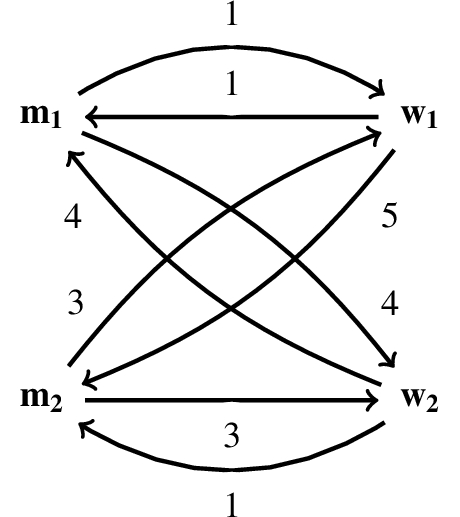
An OSM problem represented as a bipartite graph. Preference lists are complete and with ties (w.r.t.
Hence, if a matching is super stable then it is also strongly stable; if it is strongly stable then it is weakly stable [25]. A weakly stable matching always exists and can be found in polynomial time [22] in classical SM problems. Super- and strongly-stable matchings may not exist instead. Nevertheless, allowing ties in preferences means that the problem of finding an optimal weakly stable matching using Equation (1), Equation (2), or Equation (3) (i.e., considering OSMT problems) becomes hard even to approximate: there exists a positive constant ϵ such that there is no polynomial time approximation algorithm with approximation ratio
Moreover, even the solution of a classical SM problem becomes harder in presence of ties and incomplete lists (SMTI): the SMTI problem is proved to be an NP-complete [25].
In Fig. 2 we present a small example of an
In [16] P. M. Dung shows how his theory based on Abstract Argumentation can be used to investigate the logical structure of the classical SM problem solutions (and others, as n-person games). The SM problem can be formalised as the task of finding a stable extension of
To assemble a framework representing a SM problem, the set of arguments
Given an
In [16] it is also proved that the set of stable extensions and the set of stable marriages correspond.
(Stability [16]).
A set
From previous results in the literature, reported in Section 3.1, we can immediately derive some simple statements about existence and enumeration complexity of stable extensions, which can be straightforwardly proven by the fact that stable matchings and stable extensions correspond.
(Existence of stable extensions).
Given any (classical) SM problem, the corresponding
An SM problem always have one solution at least, hence a stable extensions always exists. □
From well-founded frameworks and their absence of cycles [16] we can derive sufficient conditions for the uniqueness of a stable matching.
In
A framework F is well-founded [16] if there exists no infinite sequence
The following corollary derives from the complexity of enumerating stable matchings.
Given any SM, the problem of enumerating all the stable extensions in the corresponding
Counting the number of stable matchings in an SM problem is ♯P-complete [23]. □
From Corollary 3.4 and the results in [14], it is possible to relate stable and semi-stable extensions.
In
Theorem 3 in [14] states that the set of stable and semi-stable extensions coincide if a framework has at least one stable extension. According to Corollary 3.4, a stable extension always exists in F. □
In addition, the following statement relates the presence of some pairs in all possible matchings.
Given a
If there exists
To conclude this section, we show a simple example of an SM problem (complete preferences without ties) and its encoding as an AAF. The preference function p is expressed in tabular form in Fig. 3. The obtained AAF is represented in Fig. 4, where the only stable extension is given by
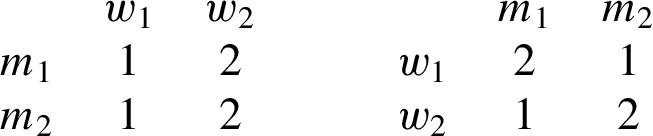
An SM problem given in tabular form, with men preferences on the left and women preferences on the right, e.g.,
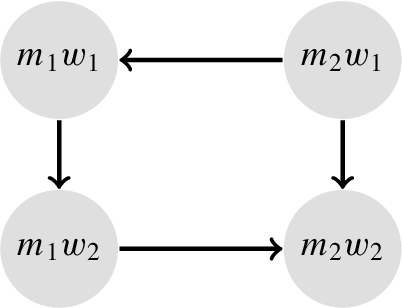
The AAF encoding of the SM problem in Fig. 3. The only stable extension is
In his original encoding, P. M. Dung does not show how to deal with ties and incomplete lists. In this section we extend the formalism in [16] in order to extend his work along this direction.
Argumentation frameworks and incomplete lists
The first issue we address is the absence of some preference values from a list: if x does not express a preference with respect to y (different sex), this means that matching x and y is not allowed. To model this case we refer to Definition 4.1.
(SMI and AAFs).
Given an
Hence, the only difference with Dung’s original formulation (encoded in Definition 3.2 by using c-semirings) is that the assembled AAF has indeed less than
Note that the proposed formalisation is equivalent to removing an argument representing a couple that is never preferred, i.e., which is only attacked without attacking any other couple.
Figure 5 presents an example of an incomplete list for
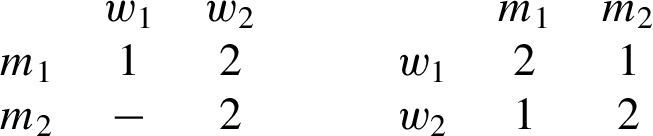
An SMI problem, where “−” means

The AAF encoding of the SM problem in Fig. 5. The only stable extension is
Being
In mathematical logic, the
Attacks are added to the AAF in the same way as in [16] and they enforce stability of couples. The side condition requires the single presence of every man and every woman in the matching, despite incompleteness. If this condition is not satisfied, then the obtained stable extension
As an example of non-existence, if we consider the preference lists in Fig. 3 and we remove the entry between
Ties can be managed in different ways if the goal is to obtain either weakly- or super-stable matchings (see Section 3).9
Strong-stability is left to future work (see Section 7).
Being
If
Hence, to model parity between preferences, the use of asymmetric attacks is enough to model the underlying uncertainty between two equivalent choices represented by a tie.
On the other hand, in order to model super-stability, instead of
Being
If
An example of
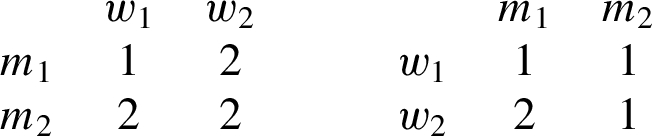
An SMT problem (i.e., with ties with respect to
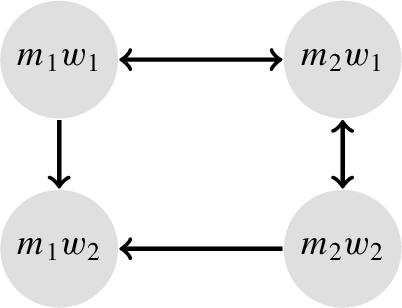
The AAF encoding of the SMT problem in Fig. 7, modeling weak-stability. The two stable extensions are
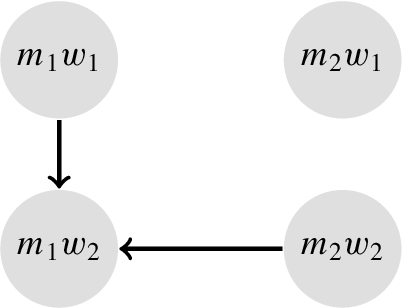
The AAF encoding of the SMT problem in Fig. 7, using super-stability. The only stable extension
In this section we present a larger example of an SMTI problem, hence considering both incomplete lists and ties, and we show how the stable extensions on the derived AAF represent all the (super- and weakly-stable) solutions. We use the following definition, using weak-stability.
(Weakly-stable SMTI and AAFs).
Given an
(Equivalence, incomplete lists, and weak-stability).
Being
The proof directly derives by Theorem 4.2 and Theorem 4.3, by satisfying both incompleteness and ties in preference lists respectively. □
As as result of Theorem 4.4, by only replacing
ConArg Website:
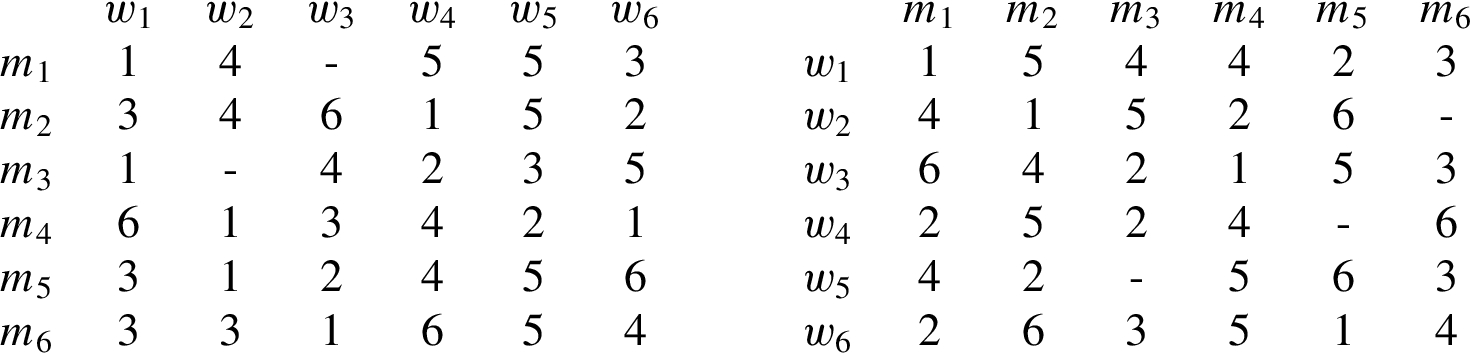
A larger
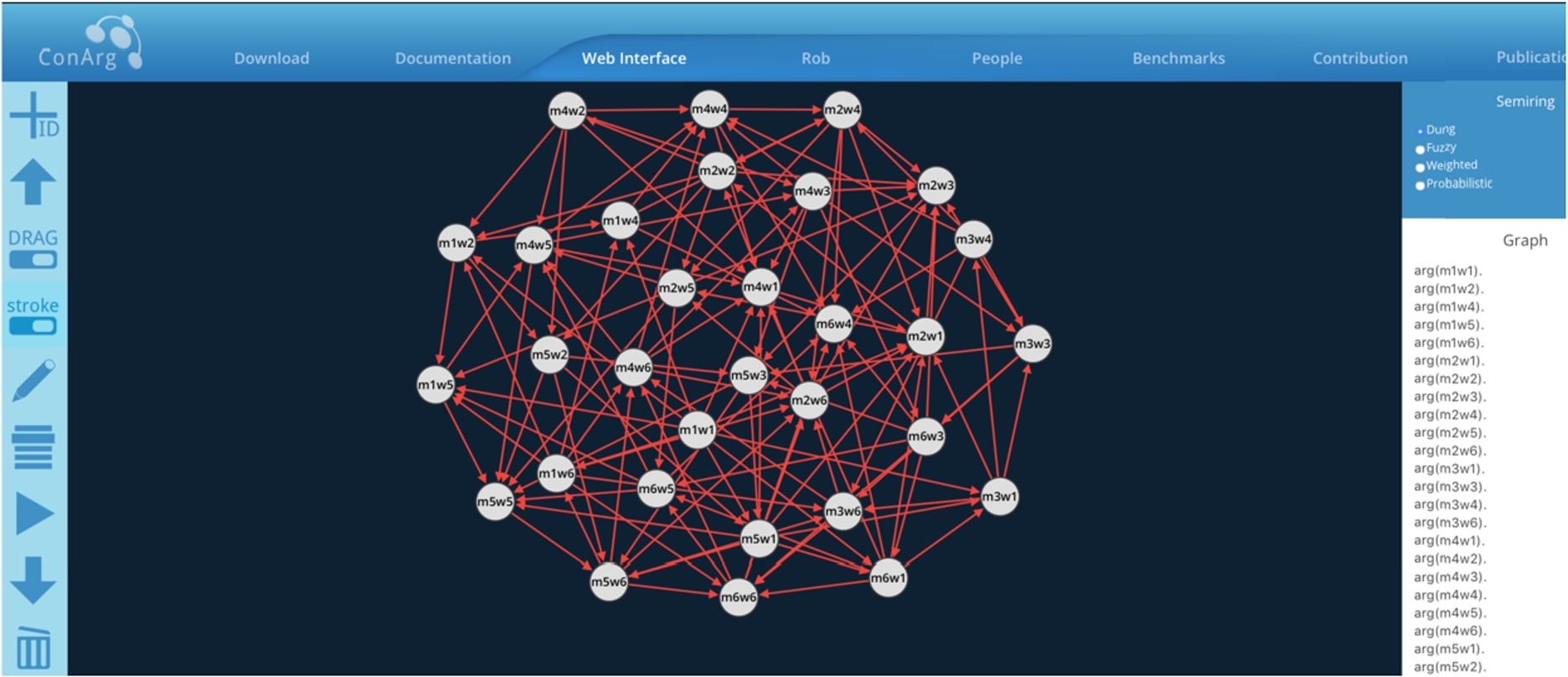
The example with 6 men and 6 women in Fig. 10, drawn in the Web interface of ConArg.
The three solutions are the same as what obtained on the same case-study by using an Integer Logic Programming approach in [2], hence validating the result in the practice.
If we assemble the framework with the purpose to model weak stability (hence using
Referring to Section 3, men and women biased optimality criteria were the first objective functions proposed to distinguish different kinds of satisfaction among all possible matchings obtained as result. However, further criteria were proposed to suggest fairer criteria, or at least considering both the preferences of men and women, as, for example, the egalitarian cost. In this section we show how to represent these problems in AAFs, and obtain such solutions as stable extensions.
Preferences on arguments
We start by labelling arguments with weights. We use c-semirings and their operators to model preference values and find the best stable extension, but we do not adopt WAAFs introduced in the background section (Section 2), where attacks are weighted: this second approach will be proposed in Section 5.2 instead. Considering the three optimisation criteria in Section 3, all of them can be captured by using a c-semiring
By embedding the Weighted c-semiring
Moreover, we can also represent man and woman optimality by using the Weighted c-semiring
For men-optimality:
while for women-optimality:
We now formally describe what introduced above:
(OSMTI to weighted frameworks).
Given an
and each argument
Having defined a framework as in the above definition, we now declare how to reach optimality according to the different proposed criteria.
(Modelling criteria with c-semirings).
The best solution according to ⊕, found by composing the preference values of arguments using ⊗ on the stable extensions found by Definition
5.3
, optimises the
by using
by using
by using
by using
While adding attacks as suggested in Definition 5.3 let us obtain stable extensions which correspond to weakly-stable solutions (see Theorem 4.5), optimisation is built on top of stable extensions, and it is achieved by construction given
Note that sex-equalness (Equation (3)) cannot be locally modelled by costs on single arguments, since it is the global satisfaction of men and women whose difference is minimised. In this case, arguments can be labelled with a couple
The Cartesian product of c-semirings is still a c-semiring (see [4]).
We consider again the four weakly-stable matchings obtained on the example represented by the preferences in Fig. 10:
Table 1 shows the egalitarian, regret, sex-equalness, man-optimal, and woman-optimal costs obtained for these four matchings on the example in Fig. 10. These values were obtained by using a Python script that, besides building the .apx file with the framework as given in Definition 5.3, also runs the dockerised13
Docker:
The Docker image of ConArg is downloadable from the repository with command
Docker SDK for Python:
The best matching for both the egalitarian and sex-equalness criteria is
The egalitarian, regret, and sex-equalness cost obtained for the four matchings of the example in Fig. 10. Moreover, we report the man-optimal and woman-optimal costs. In bold, the best solution according to the specific criterion. We compute and report also the sex-equalness cost even if it cannot be straightforwardly generalised with C-semirings by using Term (1)
Finally, we show how to use the WAAFs proposed in [5,8] and summarised in Section 2 with the purpose to use weights on attacks instead of arguments. In this way we manage to encode optimisation criteria directly in the model and solve them by using ConArg, without performing an optimisation step after having searched for stable extensions.
First we need to label attacks in a proper way: for example, self-attacks on arguments are associated with the cost of a couple according to one of the criteria proposed in the literature, e.g., the egalitarian one. The cost of attacks between arguments impose the constraint to never match the same man/woman with two women/men. Attacks need to be directed from the couple with the better to the argument with the worse preference, as proposed in all the other previous definitions, including Dung’s original proposal. The cost of these attacks is ⊥: this means these constraints cannot ever be broken.
The formal description of the proposed construction is given in Definition 5.3. Since the definition uses
(OSMTI to WAAFs).
Given an
where
In Fig. 12 we show an example of OSMTI problem, while Fig. 13 represents its encoding as WAAF using Definition 5.3. Even in this example we suppose to use the Weighted c-semiring.
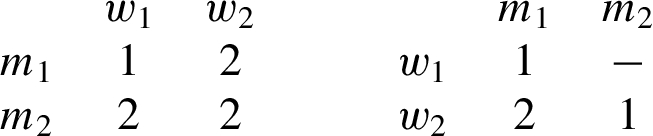
An OSMTI problem (i.e., with ties and incomplete lists), with men preferences on the left and women preferences on the right.
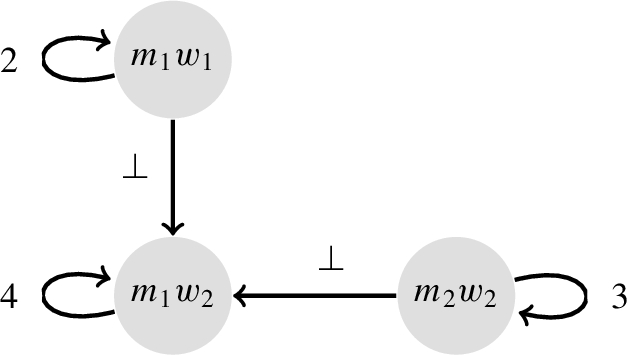
The WAAF encoding of the OSMTI problem in Fig. 12. The value of self-attacks is computed by using the egalitarian cost of the couple represented by each argument.
By relaxing the internal inconsistency α,16
See Section 2.1: α limits the cost of all the attacks included in an extension (aggregated through ⊗).
We can now formally show how
Being
Attacks are oriented as in the formalisation given by Dung [16]: they represent preferences in the same way, but they are associated with ⊥. Therefore, there is not possibility to include two attacking arguments, if not allowing
The choice of labelling attacks instead of arguments is also preferred from the point of view of implementation: ConArg uses such a threshold to cut the search space as soon as a partial solution has a cost which is already above α.
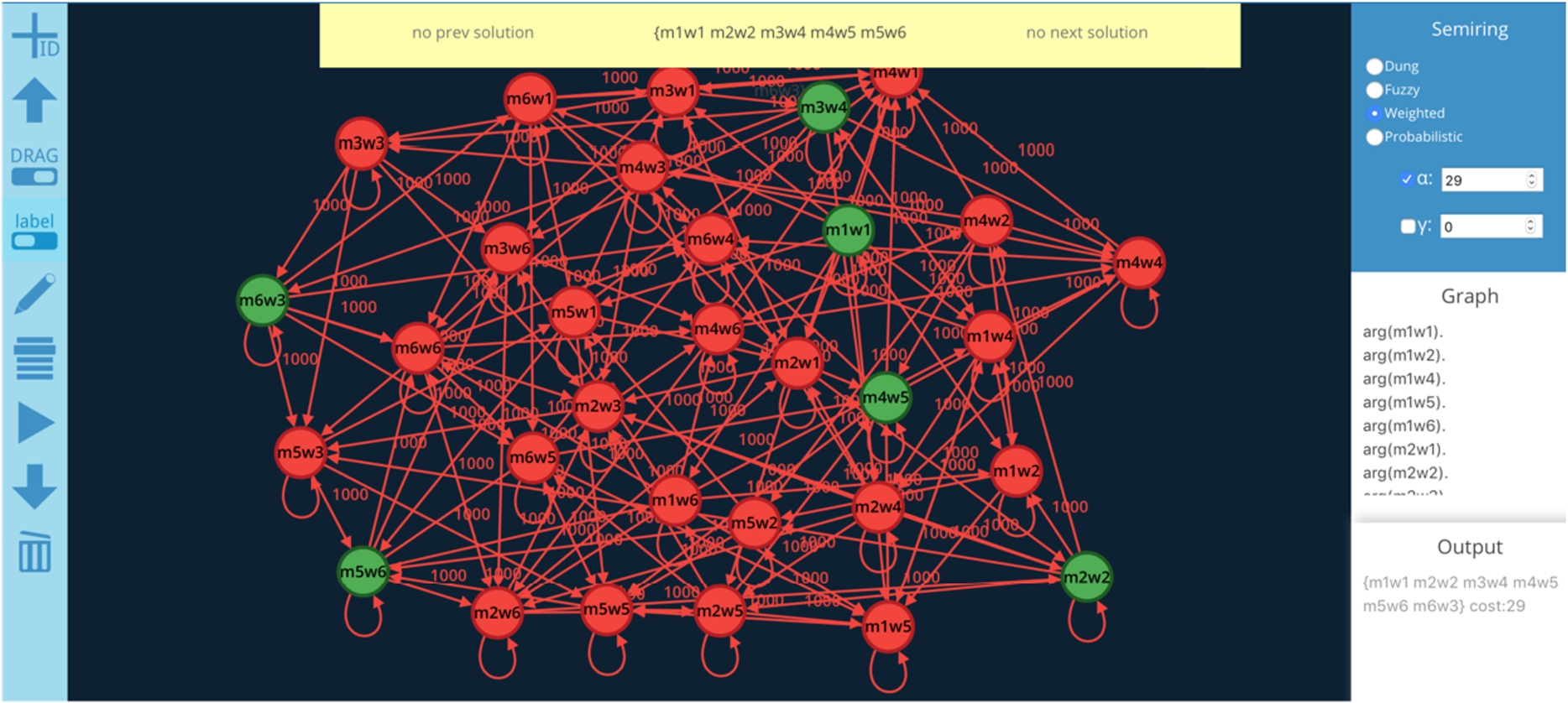
Figure 14 highlights the single
Still within the model represented by WAAFs in Section 2, the last achievement follows the relaxation of constraints enforcing stability of matchings by worsening γ, which in Section 5.2 is always ⊤.17
See Section 2.1: γ represents a penalty that can be paid if an argument is not “completely” defended: Section 5.2 uses
A similar approach is proposed in [33] using Constraint Programming. There the authors provide a generalisation of the classical notion of stability, requiring that there are not two people that prefer with at least degree α (where α is a natural number) to be married to each other rather than to their current partners. The fact that α-stability leads to a larger number of stable marriages with respect to the classical case is important to allow new stable marriages where some men, for example, the most popular ones or the least popular ones, may be married with partners better than all the feasible ones according to the classical notion of stability.
In the approach we describe in this paper instead, attacks from better to worse preference values are labelled with
As previously introduced, for each of these attacks we also add an inverse attack, from the worse to better preference score. The value associated with this attack is
A simple example of this construction is represented by the problem in Fig. 15, and its corresponding WAAF in Fig. 16. This example uses the egalitarian cost, hence
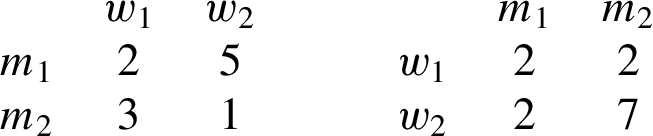
An example of an OSMTI problem. We suppose to use the Weighted c-semiring.
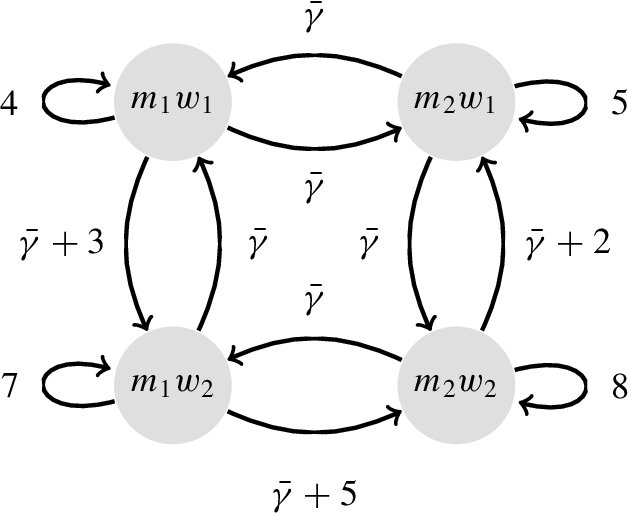
The WAAF encoding of the matching problem in Fig. 15. The value of self-attacks is computed by using the egalitarian cost;
Given an
where
Figure 17 reports the results obtained by ConArg on the WAAF created according to Definition 5.5 from the OSMTI problem in Fig. 10. Even in this example we set values on arguments to represent the egalitarian cost. The tool returns three
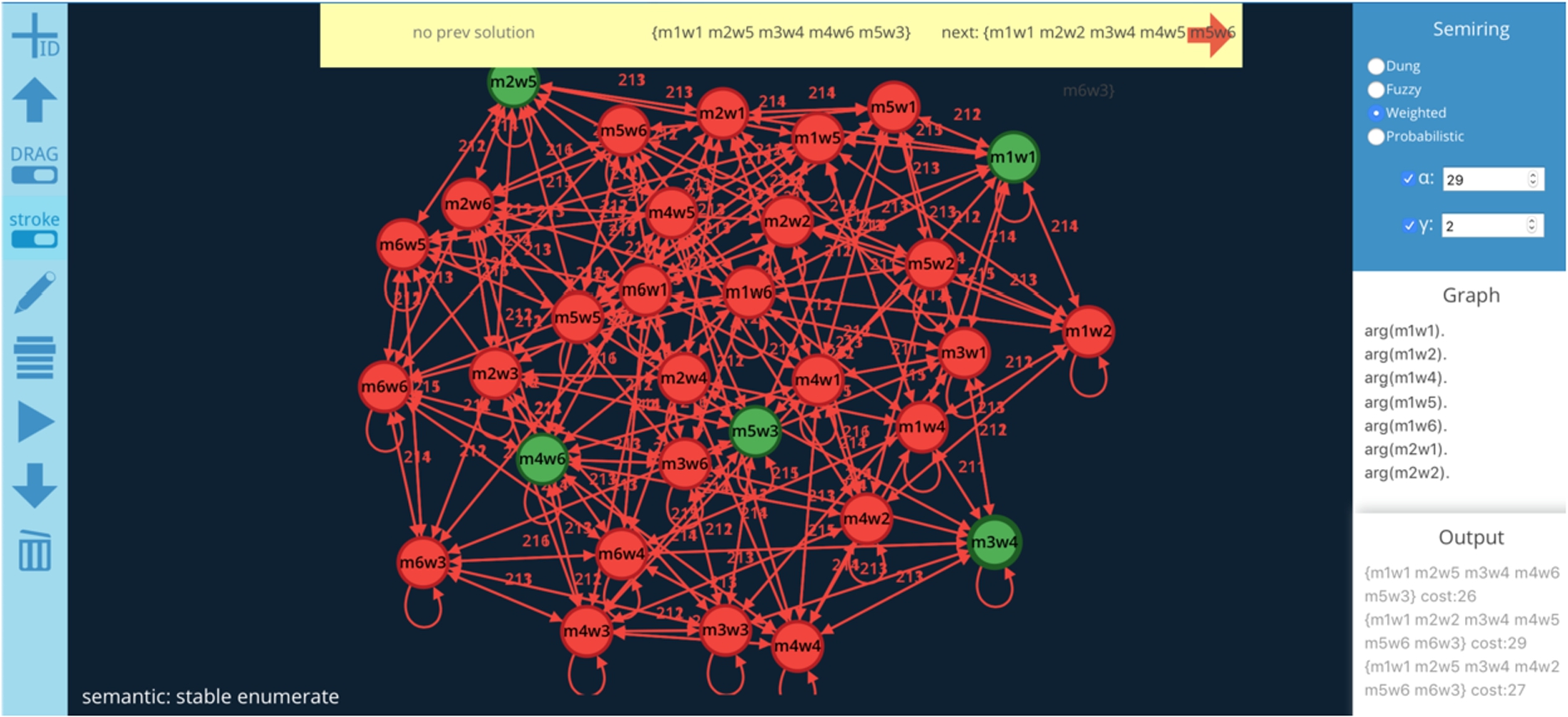
The relaxed matchings related to the OSMTI problem in Fig. 10, with
The third matching is not perfect: by adding inverse attacks with respect to Section 5.2, clearly it is easier to reach stability even with less arguments. In addition to the first matching, which is
In [16, Section 3], Dung shows how his theory can be used to investigate the logical structure of the solutions to important practical problems, thus supporting the correctness of the proposed approach. The first application example is about Argumentation in n-person Games [31], while the second relates Argumentation and the SM problem. In particular, Dung extends the problem by considering same-sex marriages (x loves y if x prefers y to all others), whose solution is given by finding preferred extensions in this new AAF. In case of a set of people
Apart from this paper, to the best of our knowledge no other work has been committed along the same line of research, as we instead aim at in this paper. Nevertheless, from a game theoretical point of view, stable matching problems are equivalent to the problem of finding a core element in some corresponding Cooperative Game with or without transferable utility.18
Transferable utility is a key concept in Cooperative Game Theory: it is transferable if one player can losslessly transfer part of its utility to another player.
Because of the aforementioned motivations, the remainder of this section is thus dedicated to the two branches of research strictly related to this paper. The first one adopts Cooperative Game approaches to measure an acceptability score of arguments in coalitions (sometimes also used in ranking-based semantics), while the second one collects works that link Argumentation and Game Theory. A survey of what Game Theory can do for Argumentation and vice-versa is presented in [40, Ch. 16]: an agent may use Game Theory to analyse a given argumentative situation in order to choose the best strategy, and, on the other hand, it is possible to design the rules (e.g., and Argumentation protocol) in such a way as to promote good argumentative behaviour.19
In the aim of Mechanism Design is to design game-rules in such a way that self-interested agents behave in some desirable manner (e.g. tell the truth).
Papers measuring the strength of arguments are reported in the following. In [30] the authors propose a two-person Strategic Game between a “proponent” and an “opponent”, where the strategies of the players are subsets of arguments, and the pay-offs of the game are based on the structure of the directed graph associated to the AAF. The players need to compute a strength value for the argument to play: the obtained score satisfies a number of appealing properties that can be derived mathematically from the minimax theorem from Von Neumann’s theory.
In [13] the authors propose a way to compute the relative relevance of arguments by merging Abstract Argumentation [16] into a Game Theoretic coalitional setting. In their framework, the worth of a collection of arguments can be seen as the combination of the information concerning the defeat relation and the preferences. Then, the Shapley Value is applied to elicit a relevance values for the single arguments from scores obtained for sets of arguments.
In [3] some of the authors of this paper deploy a Game-theoretic approach for analysing the acceptability of arguments in a generic AAF. The result is a ranking-based semantics, which sorts arguments from the most to the least acceptable. In the computation of such a ranking, the authors again adopt the Shapley Value formula, in order to fairly distribute costs among several entities in coalitions.
Papers on Argumentation more broadly related to Game Theory are presented in the following. In [36] the authors introduce a Game-theoretic Argumentation Mechanism Design, which enables the design and analysis of Argumentation mechanisms for self-interested agents. They then design a particular direct mechanism and prove that it is strategy proof under specific conditions: the computed strategy profile in which each agent reveals its arguments truthfully is a dominant strategy equilibrium. The work in [32] extends [36] by exploiting the preferred semantics to compute outcomes, instead of the grounded one.
The authors of [35] are interested in the dynamics of an Argumentation. They map Dung’s frameworks into Extensive-form Games of perfect information, and present algorithms for determining equilibria for the Argumentation Fames that are guaranteed to terminate.
Utility functions are also studied in [37], where Strategic Argumentation20
In Strategic Argumentation, an agent employs a strategy, typically in the form of a heuristic, which selects appropriate arguments given some contextual knowledge.
Strategies and utilities are often used in persuasion dialogues, where a generic persuader presents arguments to convince a user to change her behaviour. Some examples are works as [11,21].
In this paper we have worked along one of the several directions pioneered in the ’95 seminal work by P.M. Dung [16], more precisely, on the strong ties between Abstract Argumentation and the Stable Marriage problem. As far as we know, except for Dung’s paper, this topic was not studied in successive studies, as suggested by the literature reported in Section 6.
We started by showing how possible variants of the classical problem can be modelled and solved: incomplete lists and ties in men/women preferences. After this, we have shown how to model different optimality criteria in the literature of the OSM problem, e.g., the egalitarian cost. We achieved optimisation by first labelling arguments with preference values, and then labelling attacks, thus reconnecting to c-semiring WAAFs presented in [5,8]. By tolerating an internal relaxation (we call α) it is possible to consider and limit the cost of a matching. We have used a parametric structure of costs, that is a c-semiring, with the purpose to generalise the results to different optimisation criteria: in this paper we model the egalitarian and regret costs, men and women optimality. Finally, in the same WAAF setting, we have introduced a possible relaxation of marriages, by playing on a defence-based threshold that measures the strength of defence (we call this relaxation γ).
The formalism provided by Abstract Argumentation is rich enough to model all the aforementioned problems, even if it is sometimes necessary to refine the obtained matchings by checking further side conditions, e.g., if a marriage has n couples in presence of incomplete lists in classical SM problems.
In the future we plan to further investigate related topics. For instance, we plan to use Weighted Abstract Argumentation to study and model strategies in Cooperative Games, from a more general approach than just focusing on marriages. We think of using weights on arguments/attacks to study (strictly or weakly) dominant strategies: many simple games can be solved using dominance. Iterated Elimination of Dominated Strategies [17] (IESDS) is a common technique for solving games that involves iteratively removing dominated strategies: we would like to check how we can simplify the corresponding abstract framework in order to obtain the same solutions (as extensions). We believe using WAAFs can capture more properties than just classical Argumentation, since we can directly embed pay-offs of players in the model and optimise according to different criteria. In general, we aim to proceed in the study of Cooperative Games with Argumentation by taking advantage of the stability of sets, and optimising the pay-off of the obtained coalition. Some initial steps towards this direction, whose goal was to define ranking semantics using the Shapley value obtained from a given coalition of arguments, were proposed in [3].
Additional problems, strictly related to the SM one, are the Stable Roommates (all participants belong to a single pool, not divided into different sexes), the hospitals/residents (a hospital can accept more than one resident), or the assignment problem, which consists of finding, in a weighted bipartite graph, a matching in which the sum of weights of the edges is as large as possible. Our intent is to apply the same Argumentation-based approach presented in this paper to these problems as well.
Moreover, we would like to investigate how to represent strong-stability, in which super-stability is requested only for one of the partners in a blocking pair, and not both of them (otherwise just super-stability is requested).
Finally, we would like to investigate possible relaxations of the SM problem through formalisations in Abstract Argumentation, as the one proposed in Section 5.3. This can be helpful in case a matching problem has no solution, and nevertheless it is desirable to have something very close to it, even if it requires a small sacrifice of some couples in the matching. Other representations not constrained by the use of WAAFs can be used to explore different notions of relaxation and their effect.
Note also that other weighted defences can be used in the formalisation of the OSM problem in Section 5: we plan to generalise the presented results by using [15] and [29].
Footnotes
Acknowledgements
This work has been supported by the following two projects funded by the authors’ Department: Argumentation 360 (“Ricerca di Base” 2017–2019) and “Rappresentazione della Conoscenza e Apprendimento Automatico (RACRA) (“Ricerca di base” 2018–2020).