






Abstract
As adolescents enter Piaget's ‘formal operations’ stage, they become capable of self-knowledge, self-correction and self-reflection [1]. Thus, behavioural strategies employed to cope with negative events may give way to more internal, cognitively based strategies [2]. Cognitive models of adult psychological adjustment assert that cognitive factors may interact with life stress, beyond direct influences, to predict adjustment [3]. Negative cognitions have been found to exacerbate the impact of stress on psychological adjustment in adults, thereby increasing vulnerability to psychological maladjustment in the face of life stressors [4,5].
Although the majority of studies investigating stress and coping to date have focused on adults, evidence of similar patterns has also been found in adolescents. Chang and Sanna [6] found that psychological adjustment, in response to life hassles, was substantially poorer for adolescents who used a pessimistic coping style than for those who used an optimistic style. Abramson et al. [7] found negative cognitive style to be a significant predictor of suicidal symptoms in late adolescence, even after controlling for past suicidality, past clinical depression and personality characteristics.
Rumination and mindfulness
Two common but contrasting coping dispositions are rumination and mindfulness. Rumination has been defined as a tendency to focus repetitively on symptoms of distress and their possible causes and consequences, without attempting to remedy the situation [8]. Mindfulness, on the other hand, describes a type of awareness or attention that is present-focused and free of preconceived, evaluative assumptions or judgements [9].
In adults, rumination has been found to increase the severity and duration of depressive symptoms [10], predict raised levels of anxiety [11], impair autobiographical memory retrieval during social problem solving [12], and impair concentration during academic tasks [13]. According to Teasdale [14], ruminative cognitive coping strategies may perpetuate depression by involving excessive pondering over unchangeable personal inadequacies, maintaining the discrepancy between actual and desired self-states.
Studies on rumination in adolescents and children have suggested that a tendency towards rumination increases the likelihood of depressive symptoms [15,16]. Additionally, adolescents who ruminate have been found to be more likely to suffer high levels of anxiety, particularly in the presence of negative life events [16]. Rumination is also thought to contribute to the aetiology of bulimic, substance abuse and depressive symptoms in female adolescents [17]. Nolen-Hoeksema [18] suggested that a combination of rumination and uncontrollable life stressors during early adolescence, particularly among girls, brings about depressed mood.
In a study comparing the effects of various cognitive coping strategies on adults and adolescents, Garfenski, Legerstee, Kraaij, van den Kommer and Teerds [19] demonstrated that, although adolescents used rumination as a coping strategy less often than adults, rumination emerged in both adults and adolescents as a significant predictor of symptoms of depression and anxiety. The authors concluded that rumination has a substantial impact on psychological well-being and the connection between maladaptive coping mechanisms and psychopathology is already present in adolescence.
Mindfulness is a concept that originated in Eastern philosophical and religious beliefs, and has recently gained interest as a construct worthy of psychological research. Due to its focus on the present and lack of preconceived judgement, mindfulness is said to enable clarity of perception and more balanced emotional responses to situations [9]. Not only does mindfulness refrain from comparing, categorizing or evaluating, it also avoids contemplating, introspecting, reflecting and ruminating upon events or experiences from the past [14,19]. Regardless of how pleasant or aversive an experience observed in the present moment may be, mindful attention involves viewing it with compassion, interest, open-heartedness and friendliness [20].
It appears that the most important aspect of mindfulness in regulation of negative affect may be its ability to receive information in an unprejudiced, non-judgemental manner [21]. Based on this premise of bare attention and pure awareness, the concept of mindfulness has generated the creation of several psychological interventions. These include mindfulness-based cognitive therapy [22], mindfulness-based stress reduction [23], dialectic behaviour therapy [24], and acceptance and commitment therapy [25].
Training in such interventions has demonstrated benefits in both clinical and non-clinical populations [1,26]. From a psychological perspective, mindfulness-based interventions have been found to reduce depressive relapse [27] and reduce depression in treatment-resistant patients [28]. These interventions have also been shown to reduce anxiety symptoms in adults [29–31] and children [32]. Thus, there is clear support for the efficacy of mindfulness-based interventions across a range of psychological problems.
Life hassles and mental health
Everyday life stressors, or hassles, have been found to be associated with adolescent psychological maladjustment such as depression and suicidal ideation [33,34], and have also been reported to predict general psychological symptoms [35,36]. Kohn and Milrose [37] developed a hassles scale specifically for use with high school students: the Inventory of High-School Students’ Recent Life Experiences, or IHSSRLE. The IHSSRLE is purported to measure only the frequency, not the severity, of hassle events, negating the possibility of overlap in affective content with many outcome measures of adjustment [6].
Rationale and hypotheses of the present study
The deleterious psychological effects of life hassles on adolescents have been shown to be moderated by styles of coping such as optimism/pessimism, whereby pessimism exacerbated psychological maladjustment in adolescents faced with life hassles, and optimism resulted in more adjusted outcomes [6]. Rumination has been shown to exacerbate psychological problems such as depression and anxiety, whereas mindfulness interventions have been found to attenuate the negative effects of life stressors on psychological outcomes. Studies involving mindfulness have, however, largely focused on the efficacy of one or more mindfulness-based treatment modalities, rather than on dispositional mindfulness, per se. It is unclear whether dispositional mindfulness is innately present in adolescents, or whether it only occurs in this age group following mindfulness training. Additionally, dispositional rumination, as defined by Brinker and Dozois [38], has yet to be assessed in an adolescent sample.
The purpose of the present study with an adolescent sample was to investigate whether rumination and/or mindfulness moderate the relationship between life hassles and psychological dysfunction. We measured adolescents’ recent experience of life hassles, assessed their disposition for rumination and mindfulness and examined their level of psychological dysfunction on three outcome variables: depression, anxiety and stress.
First, in line with the evidence presented, it was predicted that greater exposure to life hassles would be positively associated with higher scores on all three measures of psychological dysfunction. Second, greater dispositional mindfulness was expected to predict lower levels of depression, anxiety and stress, whereas greater rumination was expected to predict increased levels of depression, anxiety and stress. Finally, dispositional rumination and dispositional mindfulness were expected to significantly moderate the relationship between life hassles and psychological adjustment, whereby rumination would exacerbate this relationship and mindfulness would attenuate the relationship.
Method
Participants
Participants comprised 317 students (154 males and 163 females) aged between 14 and 19 years (M = 16.1, SD 1.1), recruited from a non-government high school on the Central Coast of NSW. Grades 9 – 12 were represented in the sample: 23% Year 9, 27% Year 10, 29% Year 11 and 21% Year 12. This sample represented a response rate of 79% of a total of 400 students who were invited to participate. Minor amounts of missing data (< 2%) were imputed using the expectation maximization algorithm in SPSS 16.0.
Measures
Following demographic information (age, grade and sex), questionnaires consisted of 116 items designed to assess recent life hassles, dispositional rumination, dispositional mindfulness and psychological dysfunction. The individual measures were organized randomly to negate order effects. Measures of internal consistency (Cronbach's α) reported below were obtained with the current sample.
Inventory of High-School Students’ Recent Life Experiences [37]
Recent life hassles were measured using this 41-item measure of negative experiences specific to high school students. Respondents are requested to rate the frequency with which they have experienced each item (e.g. ‘Lower grades than you hoped for’, ‘Having your trust betrayed by a friend’) over the past month, on a 4-point scale (1 = not at all a part of my life, to 4 = very much a part of my life). The IHSSRLE is claimed to be relatively uncontaminated by subjective distress levels [37] and showed excellent internal consistency (Cronbach's α = 0.93). Mean scores were used in subsequent analyses.
Ruminative Thoughts Style Questionnaire
Dispositional rumination was measured using this 20-item scale [38]. Respondents are asked to rate on a scale of 1 (not at all) to 7 (exactly like me), how well each of the items describes them (e.g. ‘I can't stop thinking about some things’; ‘Even if I think about a problem for hours, I still have a hard time coming to a clear understanding’). The measure demonstrated excellent reliability (Cronbach's α = 0.94) and mean scores were used in subsequent analyses.
The Mindful Attention Awareness Scale
In this 14-item measure of dispositional mindfulness [39], respondents are asked to rate, on a scale of 1 (almost always) to 6 (almost never) how often they encounter the experiences described (e.g. ‘I find it difficult to stay focused on what's happening in the present’; ‘I find myself listening to someone with one ear, doing something else at the same time’). This scale showed excellent internal consistency (Cronbach's α = 0.87) and mean scores were used in subsequent analyses.
The Depression Anxiety Stress Scales-21
Current symptoms of depression, anxiety and stress were measured using the short form of the DASS [40]. The DASS-21 assesses current symptoms of depression (7 items: e.g. ‘I felt I wasn't worth much as a person’, Cronbach's α = 0.88), anxiety (7 items: e.g. ‘I felt scared without any good reason’, Cronbach's α = 0.79); and stress (7 items: e.g. ‘I found myself getting upset by quite trivial things’, Cronbach's α = 0.85). Participants are asked to rate the degree to which they have experienced each item in the past week, on a 4-point scale indicating severity/frequency (0 = Did not apply to me at all; 3 = Applied to me very much, or most of the time). Participants’ scores were doubled prior to further analysis (i.e. a range of 0 to 42 for each scale) to conform to the DASS norms.
Procedure
Information sheets were sent to parents/guardians along with consent forms and a covering letter from the Principal. Students who agreed to participate, and also received their parent's consent to do so, were tested in groups of between 19 and 25 and completed the pencil and paper questionnaire in the presence of the second author and a classroom teacher.
Results
Descriptive statistics
Means, standard deviations and zero-order correlations for all variables used in the study are presented in Table 1. As predicted, there was a significant negative correlation between rumination and mindfulness, and significant correlations between sex and all other variables used in the study. Age was also positively correlated with life hassles, rumination, symptoms of depression and stress. For these reasons, both sex and age were entered as covariates in all subsequent analyses.
Zero-order correlations, means and standard deviations for variables used in the moderation analyses
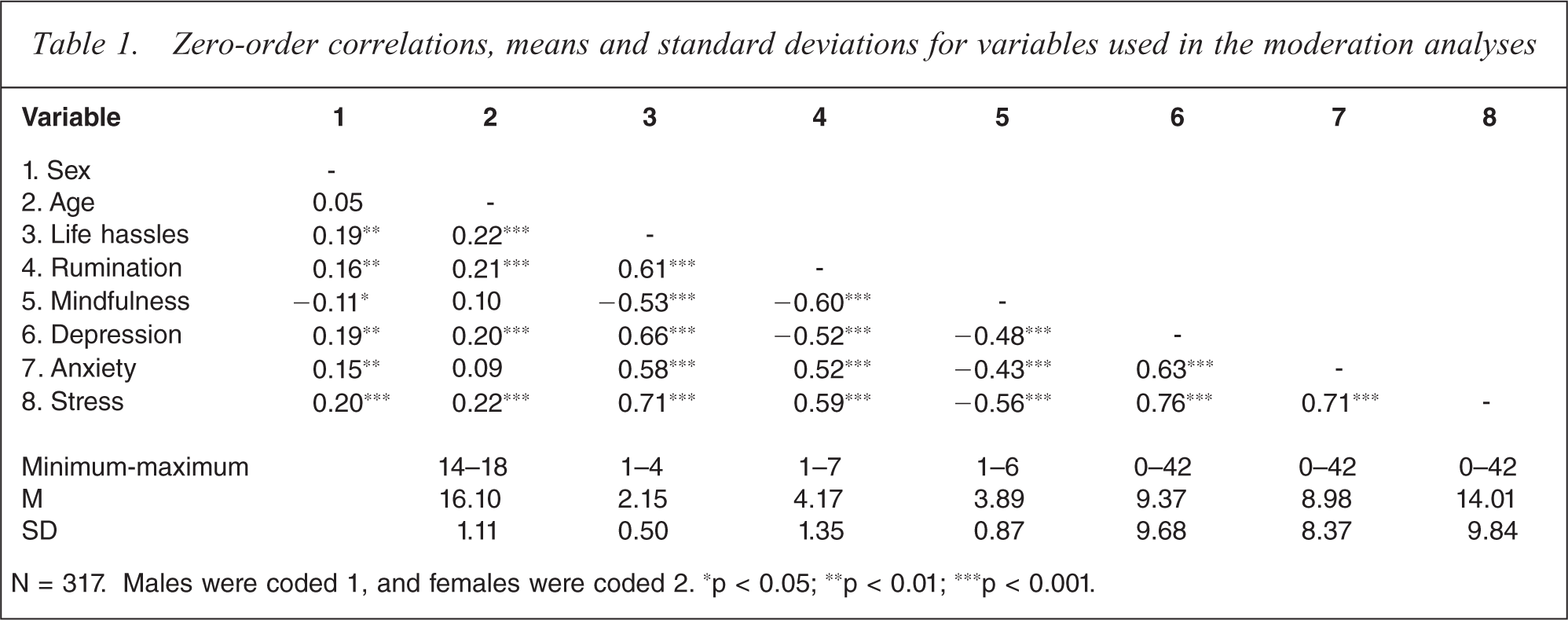
N = 317 Males were coded 1, and females were coded 2. ∗p < 0.05; ∗∗p < 0.01; ∗∗∗p < 0.001.
According to the clinical norms for the DASS [40], scores in excess of two standard deviations above the normed means for depression, anxiety and stress are defined as ‘severe’. In the current sample, 14% of students reported severe levels of depressive symptoms, 20% reported severe levels of anxiety and 14% reported severe levels of stress1.
1The school Principal was provided with group-level DASS data, along with a recommendation that affected students be encouraged to self-identify and seek appropriate psychological treatment.
Moderation analyses
Six multiple regression analyses were conducted to test whether life hassles predicted depression, anxiety and stress and to investigate whether these anticipated effects were moderated by either dispositional rumination and/or dispositional mindfulness. For each analysis, life hassles served as the predictor and either rumination or mindfulness served as the moderator, together with their interaction with life hassles. Given the observed sex differences in all variables, and the significant correlation of age with a majority of variables, sex and age were entered as covariates in all analyses. Following the recommendations of Cohen, Cohen, West and Aiken [41] life hassles, rumination and mindfulness scores were centred by subtracting the mean prior to computing the interaction term.
The output from the moderation analyses revealed that the residuals were non-normally distributed and heteroscedastic, possibly biasing the standard errors associated with the regression coefficients and producing potentially misleading significance tests [41]. This issue was addressed by using AMOS (Amos Development Corporation, Spring House, PA, USA) 16.0 to re-compute all significance tests with standard errors based on 1,000 bias-corrected, bootstrapped samples.
Rumination as a moderator
Results of the three regression analyses involving rumination as the moderator are presented in Table 2. The regression model explained a significant and substantial amount of the variance in depression (49%), anxiety (40%) and stress (55%). Furthermore, dispositional rumination explained unique variance in depression, anxiety and stress, after controlling for life hassles and the covariates. In addition, the predicted interactions between life hassles and rumination were significant for the analyses predicting depressive symptoms and anxiety, but not for the analysis predicting stress.
Summary of regression analyses investigating whether rumination moderates the relationship between life hassles and four measures of psychological dysfunction
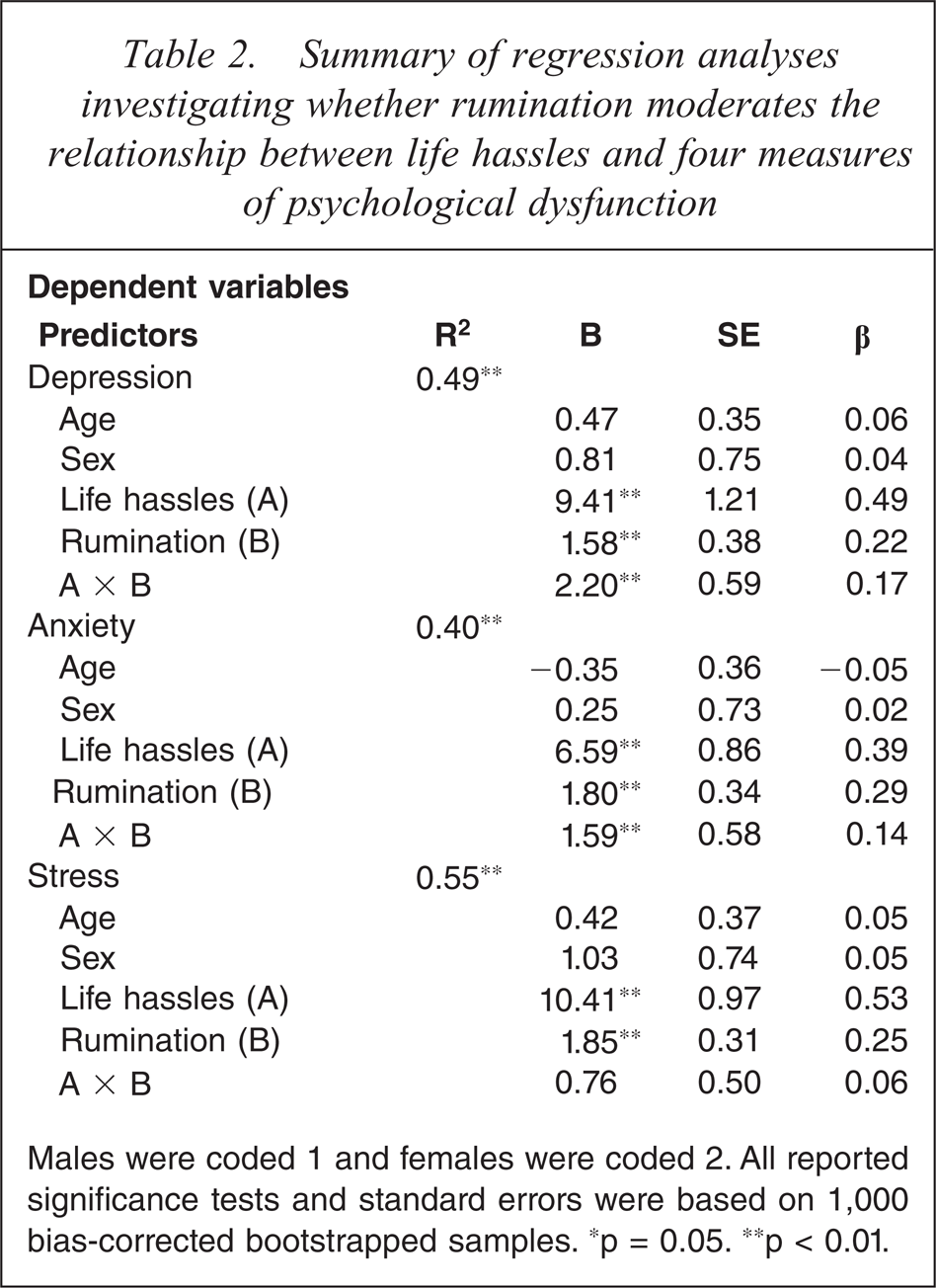
Males were coded 1 and females were coded 2. All reported significance tests and standard errors were based on 1,000 bias-corrected bootstrapped samples. ∗p = 0.05. ∗∗p < 0.01.
To interpret the two significant interactions, SPSS syntax developed by O'Connor [42] was used to create plots and compute standardized simple slopes tests. Prior to computing the plots, the variance associated with the covariates (age and sex) were partialled out from each of the variables involved in the interaction tests. The resulting simple slopes plots for the interaction tests are presented in Figure 1. The slopes represent the magnitude of the relationships between life hassles and depression and anxiety, for three levels of rumination: low (1 SD below the mean), moderate (mean) and high (1 SD above the mean). Examination of the simple slope coefficients indicated that dispositional rumination accentuated the predictive effects of life hassles on both depressive symptoms and anxiety. That is, as rumination increased, the strength of the relationship between life hassles and the DVs also increased.
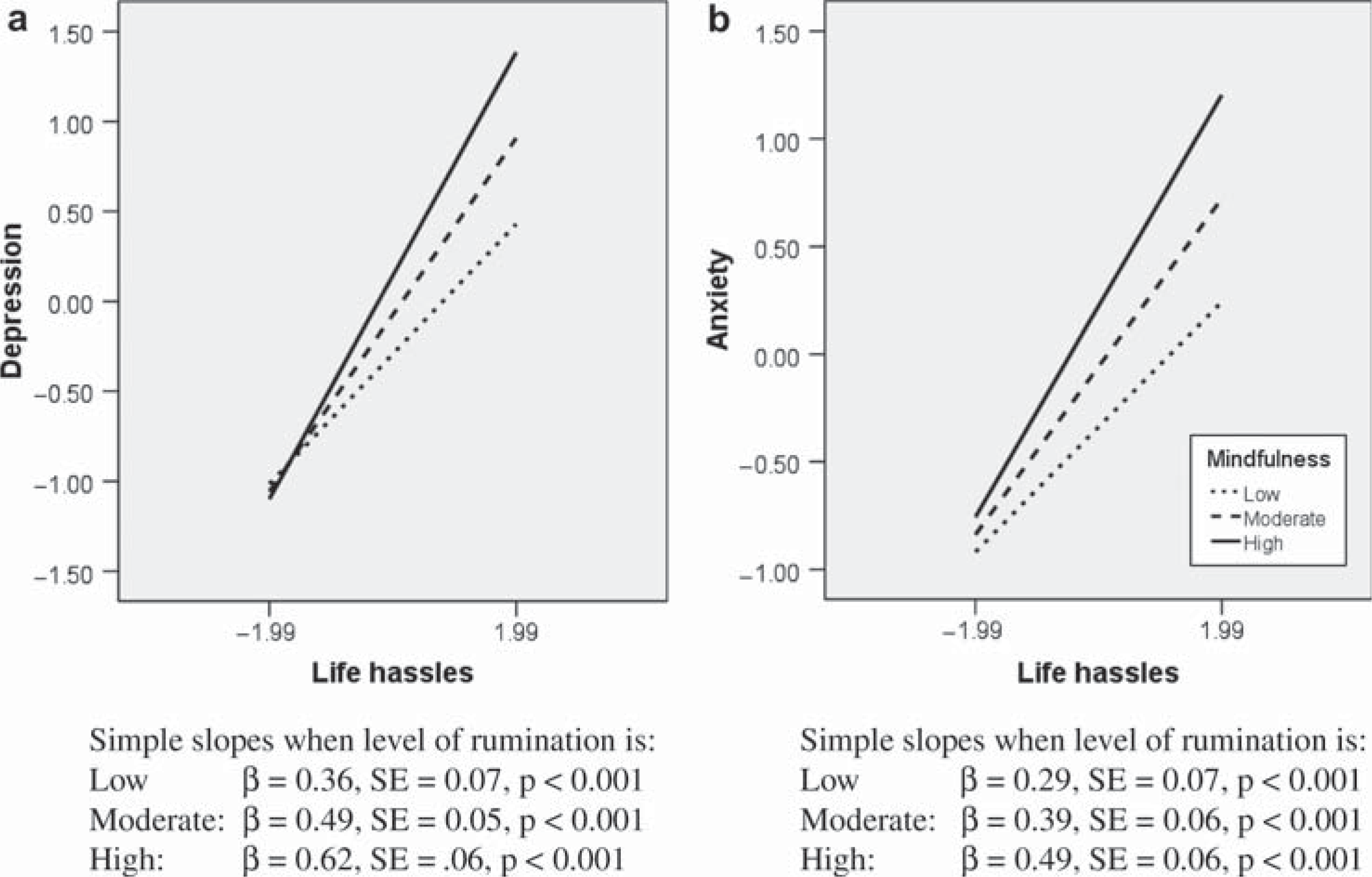
Plots and simple slopes for significant 2-way interactions between life hassles and rumination predicting (a) depression and (b) anxiety. Variables on each axis represent standardized residuals after partialling out the covariates, age and sex.
Finally, although the hypothesized interaction between rumination and life hassles was not significant for stress (t = 1.49, p = 0.14), it is worth noting that the interaction trended in the predicted direction. That is, respondents with more life hassles reported tended to be more stressed if they were also dispositionally predisposed to rumination.
Mindfulness as a moderator
Table 3 contains a summary of the three regression analyses investigating mindfulness as a moderator of the relationship between life hassles and symptoms of depression, anxiety, and stress. As was the case with the previous set of analyses involving rumination, the regression model involving mindfulness explained significant variance in depression (49%), anxiety (38%), and stress (56%). Dispositional mindfulness explained unique variance in depression, anxiety and stress, after controlling for life hassles, age, and sex.
Summary of regression analyses investigating whether mindfulness moderates the relationship between life hassles and four measures of psychological dysfunction
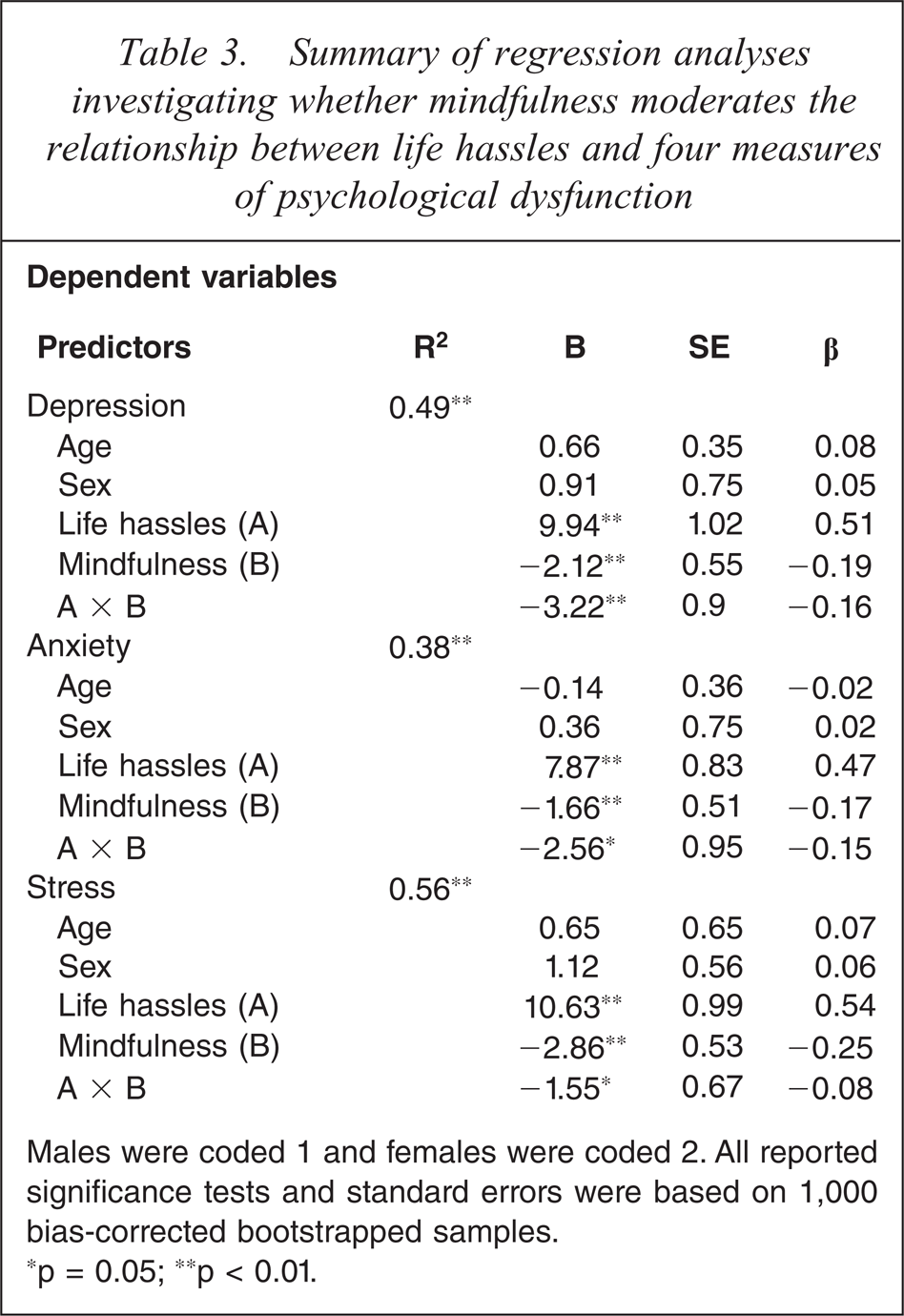
Males were coded 1 and females were coded 2. All reported significance tests and standard errors were based on 1,000 bias-corrected bootstrapped samples.
∗p = 0.05; ∗∗p < 0.01.
Furthermore, the interaction between life hassles and dispositional mindfulness was statistically significant for all three dependent measures. To interpret these interactions, SPSS syntax developed by O'Connor [42] once again was used to create plots and compute standardized simple slopes tests and the covariates, age and sex were first partialled out from each of the variables involved in the interaction analyses. Examination of the simple slope coefficients (see Figure 2) showed that mindfulness attenuated the predictive effects of life hassles on all three mental outcomes assessed in the study (symptoms of depression, anxiety, and stress). That is, as dispositional mindfulness increased, the magnitude of the relationship between life hassles and the negative mental outcomes decreased.
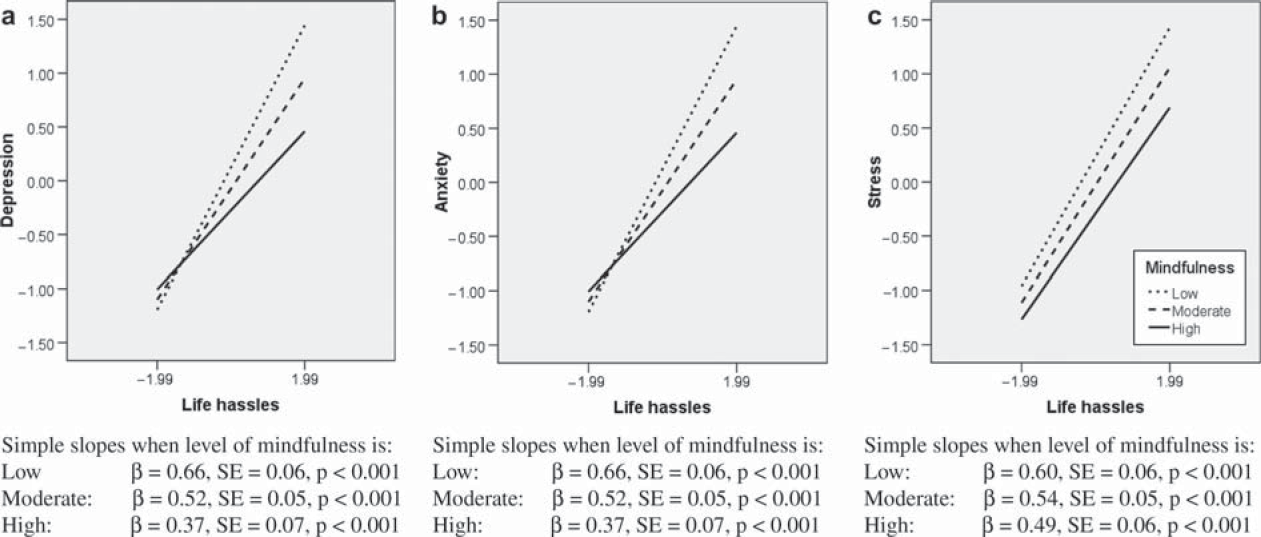
Plots and simple slopes for significant 2-way interactions between life hassles and mindfulness predicting (a) depression, (b) anxiety and (c) stress. Variables on each axis represent standardized residuals after partialling out the covariates, age and sex.
Discussion
This study examined the relationships between recent life hassles, a disposition for rumination or mindfulness, and psychological dysfunction in an adolescent sample. Specifically, we investigated whether rumination and/or mindfulness moderated the relationship between recent life hassles and three types of psychological dysfunction (depressive symptoms, anxiety and stress). Our results indicated that adolescents who experienced more life hassles reported more depressive symptoms, anxiety and stress. A series of moderation analyses demonstrated that, as predicted, dispositional rumination exacerbated the relationship between recent life hassles and symptoms of depression and anxiety. However, rumination did not moderate the relationship between recent life hassles and stress. The moderating effects of rumination on the relationship between life hassles and symptoms of depression and anxiety are consistent with previous findings reported in the literature. These earlier findings indicate that dysfunctional cognitive responses to negative life events, and the degree to which individuals become stuck focusing on those negative cognitive responses, may be risk factors for depression [43], as well as other psychological problems such as anxiety and alcohol abuse [44].
As expected, a disposition for mindfulness attenuated the association between recent life hassles and depression, anxiety and stress. This finding is consistent with the literature on dispositional mindfulness, which has shown it to be associated with lower levels of mood disturbance (symptoms of depression, anxiety and stress), and higher levels of subjective well-being (higher positive affect and satisfaction with life, lower negative affect) [20,45]. Dispositional mindfulness scores have also been shown to inversely correlate with various indicators of psychopathology [46]. The findings of the present study lend further support to the growing evidence surrounding the salutary effects of a mindful disposition in coping with everyday life hassles. This suggests that mindfulness training may be useful in enhancing coping with everyday distress and more severe conditions of disorder or distress [47].
Overall, the findings of the present study indicate that cognitive styles, such as a disposition for rumination or mindfulness, may go some way towards explaining individual differences in psychological adjustment of adolescents faced with life hassles. Despite this promising finding, however, caution must be exercised when interpreting its implications. Causal inferences are not justified given that the data are correlational. It is possible, for example, that individuals suffering symptoms of depression or anxiety are more prone to rumination in the face of life hassles than are psychologically healthy adolescents. Future research in which dispositional rumination and mindfulness are investigated experimentally would add further clarity with regard to causality. Longitudinal tracking of adolescents, taking into account their dispositions for ruminative or mindful coping, would clarify the picture further still. As an area that unquestionably holds great promise for both psychological and physical well-being, dispositional mindfulness demands more rigorous empirical investigation.
Mindfulness-based interventions have been shown to be efficacious in dealing with existing psychological problems, as well as recurrence of suicidal behaviours. Additionally, dispositional mindfulness can occur independently of mindfulness training [20] and can also be enhanced by training [48]. Research has also shown that mindfulness can be taught to children [32], and can easily be taught to groups of up to 30 people [23]. Therefore, interventions to increase dispositional mindfulness during childhood could feasibly be incorporated into primary schools’ health education curriculum. This preventive measure may also reduce the need for therapy in the future, obviating the need for rumination and other maladaptive modes of coping. The ‘way of being’ in mindfulness may arm adolescents with a vital means of protection from the potentially destructive effects of inevitable life hassles on their psychological adjustment.