




Abstract
Mental disorders and substance misuse account for 24% of the non-fatal burden of disease for children aged 0–14 years old in Australia [1], and for 60–70% of the burden of disease among 15–24-year-olds [2]. The stigma often associated with mental illness can add to suffering as well as increase barriers to treatment [3]. In Australia, recent efforts have focused on the common mental disorders such as depression, and encouraged patients of mental health services to share their experiences though a range of mass media [4]. Further, journalists have been targeted through the provision of factual and accessible information about mental illnesses [5] and the national peak body, the Mental Health Council of Australia, has supported an inclusive approach that attempts to appeal to every family to promote the idea that mental illness is not rare and is relevant to all families [6, 7].
Most people obtain some of their knowledge about mental health from the media [8]. By controlling and framing which depictions and points of view are solicited, how problems or other issues are defined and the types of solutions considered, news media can help to set public agenda on health issues and may also shape parental attitudes and responses towards their children's mental health [9–12]. Although many news frames are possible and new frames regularly emerge, there are a number of themes that are commonly used to convey health-related stories, including ‘gawp’ stories (depictions of eccentricity, abnormality and bizarre behaviour), moral tales and falls from grace; scientific marvels; danger in the familiar; and the wisdom of common sense cures [13, 14].
Historically, coverage of mental illness by the news media has often reinforced negative stereotypes of people with mental illnesses [14–16] such as depictions of dangerousness and violence, despite these stereotypes being poorly supported by evidence [17]. In our recent study primarily of adults in the Australian free-to-air television news, however, we found that depictions of mental illness were predominantly positive or neutral, including positively rated human interest stories of coping and recovery, compared with findings from previous studies. The results of that study supported the importance of including those with histories of mental illnesses in the news item as well as the importance of a broader media focus on more common forms of illnesses [18].
There is little research on news media representations of children and adolescents with mental illness; we are aware of only one study that analysed news paper coverage related to children with mental illnesses [19], and none that included television news and current affairs. While stigma associated with mental illness has negative implications for adults, it is compounded for children and adolescents because of their vulnerability and lack of power [9]. Family stigmatization including blaming parents for a child's mental illnesses may decrease parents’ willingness to seek treatment for children experiencing symptoms of mental illness [9], potentially affecting their lives far into the future.
In addition to the news angle and overall treatment of mental illness in the news, the choice of who represents children and adolescents with mental illnesses may determine how these illnesses are portrayed to viewers, thereby either contributing to a positive and realistic representation of youth with mental illness or further reinforcing commonly held stereotypes and negative views. Previous studies have found that when adults with mental illnesses represent themselves, news items tend to be more positive [18, 20].
In this present study we examined more closely the depiction of mental illness in children and adolescents and tested the hypothesis that the mostly positive portrayal of adults with mental illnesses in television news also applies to young people with mental illness.
We also explored prevalent news themes specific to young people and mental illness in television news reports. This study also analysed first-person television coverage of children and adolescents with mental illnesses, comparing this with how first-person depictions of adults are framed.
Methods
The sample of televised items was drawn from the University of Sydney's Australian Health News Research Collaboration digital database, which consists of all news and current affairs items related to health aired on all five free-to-air Sydney television stations [21]. All items that actually physically depicted a child or adolescent with a major focus on mental health that were aired between May 2005 and October 2007 were identified from a total of 13 356 health-related items.
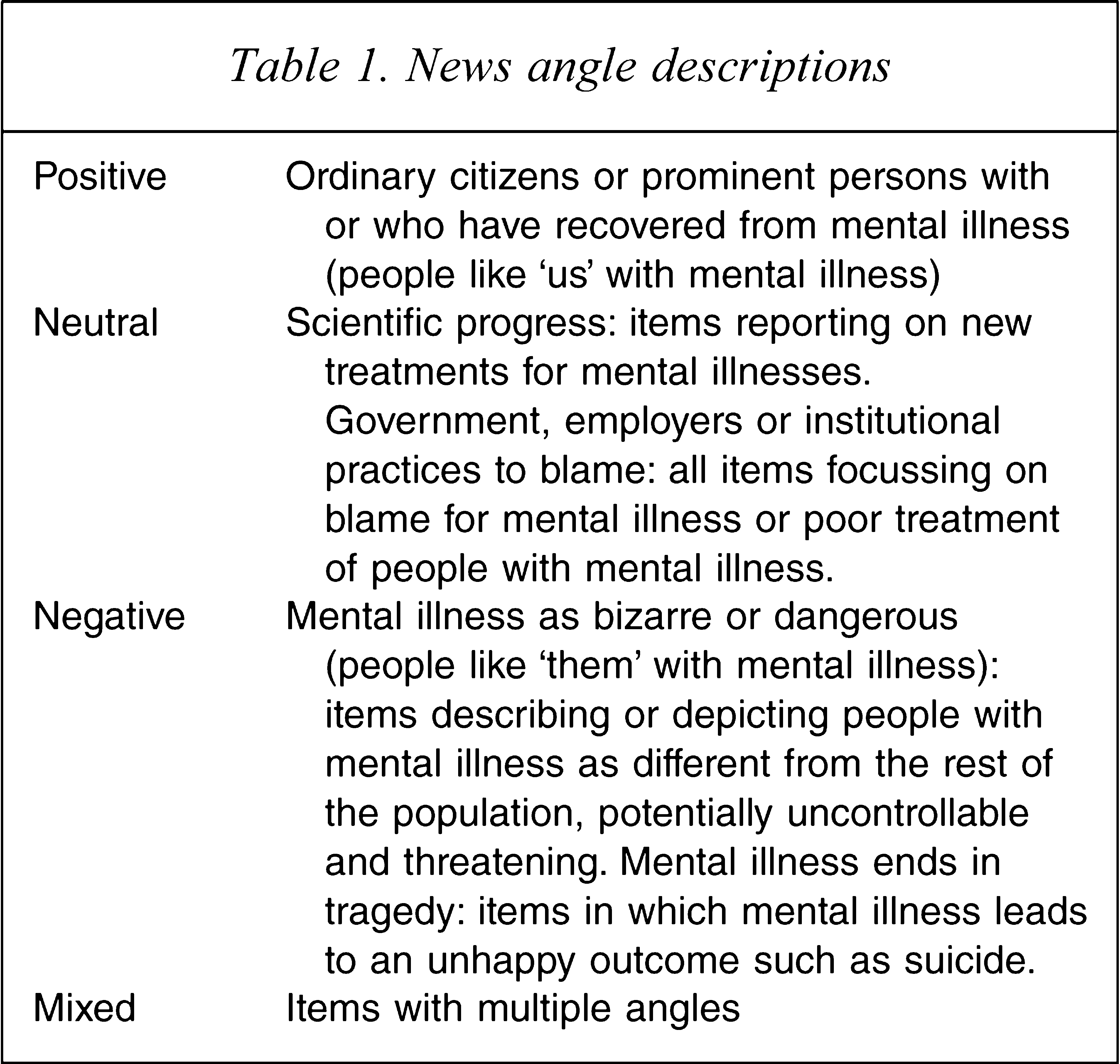
A content and frame analysis coding system developed for the previous study of the depiction of mental illness in people of any age [18] was used to code items for: gender of the child or adolescent appearing in the item, presence of any references to mental health resources, first-person depiction of mental illness, and news angle, or overall theme of the item. The coding scheme for news angle was developed using an iterative process of observing depictions, identifying common themes and then collapsing the diversity of primary, explicit themes into four broad categories (positive, neutral, negative, and a category for mixed angles; Table 1) and subjecting them to inter-coder reliability testing. A similar process was used to develop a coding system for news actor depictions. Children or adolescents appearing in items were coded as depicting themselves as either ‘one of us’ (positive or neutral depictions) or ‘one of them’ (negative depictions such as displaying bizarre or threatening behaviour).
News angle descriptions
The initial coding was completed by two authors (LM and NJ). Additional qualitative analysis was completed by one author (CH), to explore any subthemes that were specific to items about children and adolescents. SPSS (SPSS, Chicago, IL, USA) was used for statistical analysis. χ2 analysis (Fisher's exact test or Pearson as appropriate) was performed to show any significant differences between the items depicting adults or children.
Results
Kappa interrater reliabilities for the coding system were 0.62 for news angle and 0.60 for news actor [18], indicating good agreement [22]. A total of 264 (2.0%) of 13 356 news items on any aspect of health depicted a person of any age with a mental illness. Of these, 35 (13.3% or 0.3% of the entire health news database) focused on mental health issues relevant to children or adolescents.
All five channels aired items with first-person depictions of children or adolescents with mental illnesses with no statistically significant differences between the five channels (p = 0.199) on the frequency of such depictions.
Twenty-one items (60%) depicted male subjects, and 14 (40%) depicted female subjects with or recovered from mental illness. Most items (21, 60%) did not name a specific mental illness. When a specific type of mental illness was identified, however, by the journalist or another news actor (14 items, 40%), attention-deficit–hyperactivity disorder (ADHD) and depression were most common with six items (17%) and five items (14%), respectively. Similar to findings in another study [23], few items (three or 8%) provided information about resources available for parents or young people affected by mental illness.
First-person depictions
Longer current affairs and documentary programs often feature many interview subjects, sometimes showing groups in therapy or care. In order to not overweight these longer items compared to briefer news items, only the first child or adolescent to appear in any item was coded.
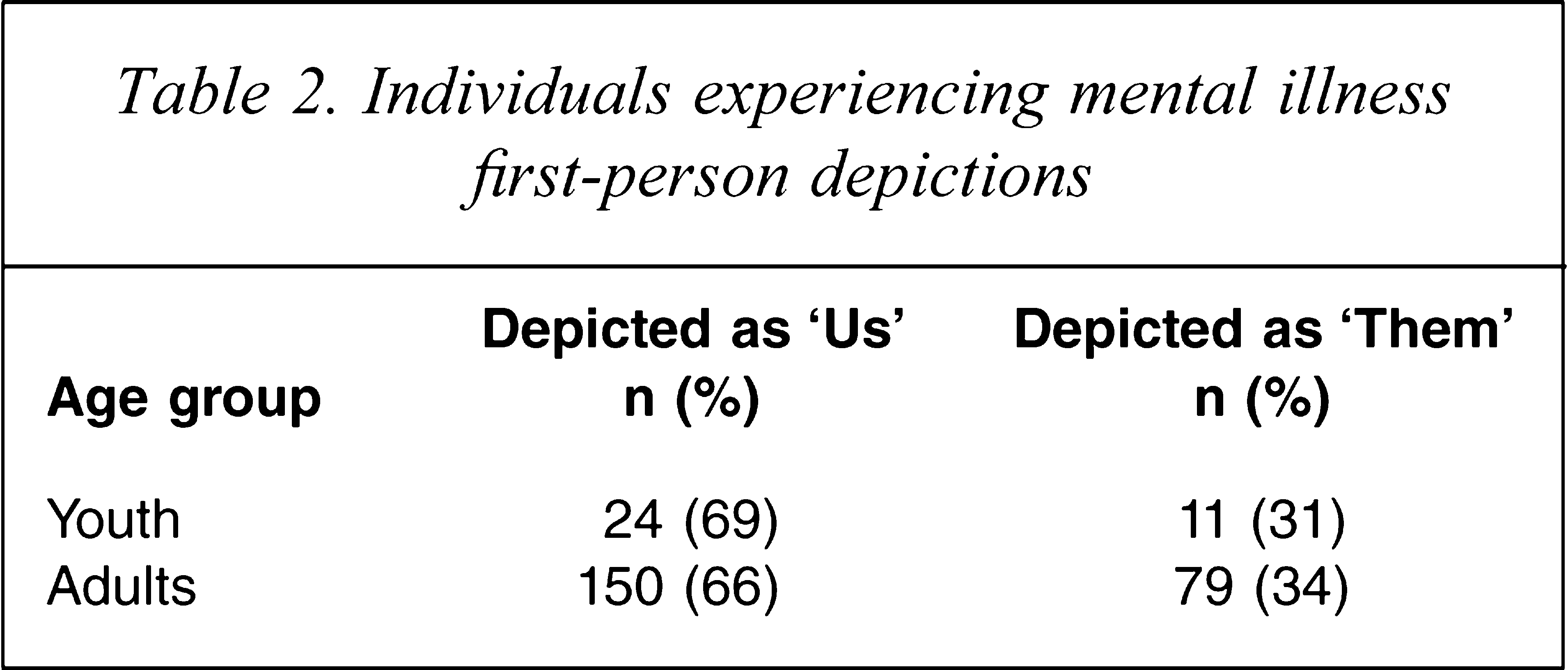
Twenty-four (69%) of first-person depictions showed children and adolescents with mental illnesses as ‘one of us’ (Table 2). This is similar to the 66% of items in the adult-only sample. Fifteen (63%) of the 24 items rated as ‘one of us’, were of male subjects and nine (38%) were of female subjects. Eleven (31%) of the young people depicted themselves as ‘one of them’. Five (45%) were female and six (54%) were male.
Individuals experiencing mental illness first-person depictions
News angle
Twenty-nine per cent of items related to children and adolescents were broadly categorized as having positive news angles, significantly less than the 66% of the adult sample (χ2= 17.8, p < 0.001, 95% confidence interval (CI) = 21–53%; Table 3). The positive theme occurring most frequently was that of an ordinary child or adolescent who was recovering or had recovered from a mental illness (nine items, 26%). Only one item (3%) showed a prominent person recovering from mental illness.
Thirty-seven per cent of the sample included neutral items, including seven (20%) that focused on blaming the government or some other institution and six (17%) featuring scientific solutions or treatment breakthroughs. There was no significant difference between the neutral items for young people compared with adults (χ2 = 3.4, p = 0.07, 95%CI = 2.4–31%).
Types of news angles in the coverage of youth and adult mental health
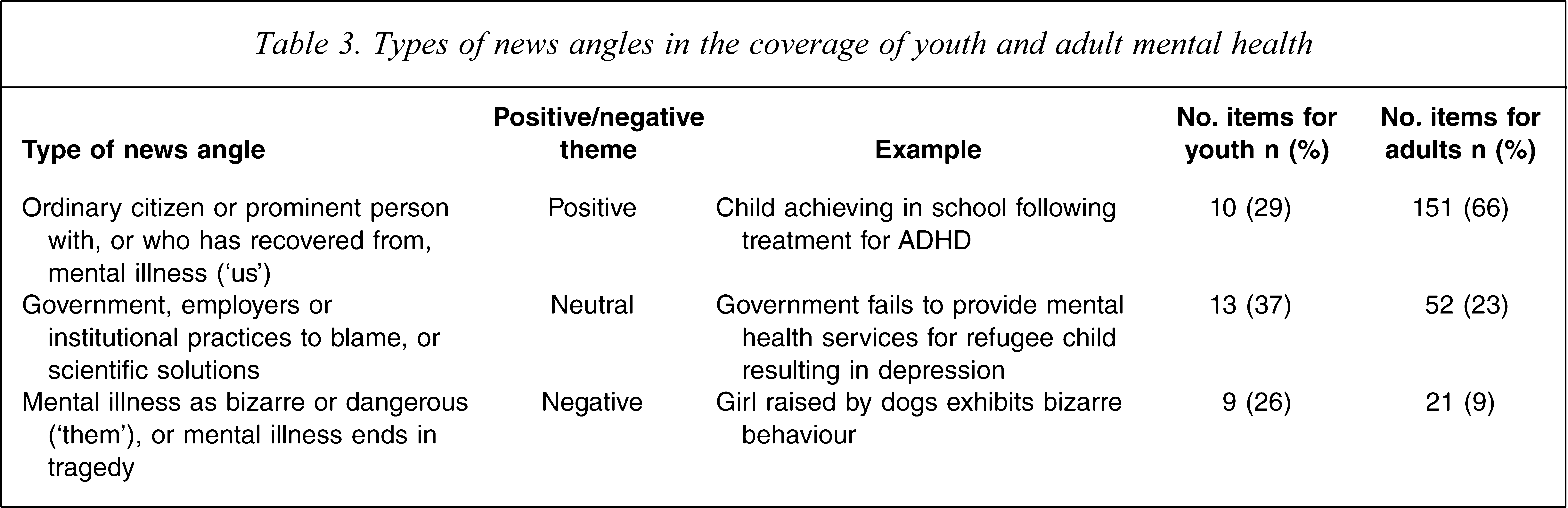
Twenty-six per cent of items created a negative association with children/adolescents with mental illnesses, including four (11%) that represented young people with mental illnesses as bizarre, dangerous or threatening, and five items (14%) that showed mental illness ending in tragedy, typically suicide. There was a significant difference between the proportion of negative news angles in the sample of youth compared to the 9% found in the adult sample (χ2 = 8.2, p = 0.009, 95%CI= 1.5-31%). There were also three items (9%) that had a mixed news angle.
Because little attention has been given to television news media treatment of mental illnesses in children and adolescents, deeper qualitative analysis was undertaken to explore in more detail any subthemes that were specific to children and adolescents with mental illnesses. In addition to the news angles described here, an anti-medication theme was apparent in 12 items (34%). Of these 12 items, five had explicit themes that were anti-medication, typically blaming either government or the pharmaceutical industry for allowing medications with ‘many negative side-effects’ to be promoted for children. These items led with comments such as ‘potentially fatal side-effects of common medication being investigated’. An additional seven items made references to the dangers or ineffectiveness of common medications and included journalists’ comments such as ‘even when drugged to the eyeballs he is still uncontrollable’. A counter opinion was sometimes given by a psychiatrist or paediatrician, but the overall focus for each of these items was of children or adolescents being prescribed drugs that should cause concern because of their dangers or dubious efficacy. In contrast, only two items (5%) explicitly described research that found medication to be effective for children and adolescents with mental illnesses.
Discussion
The media provide a mixed view of young people with mental illness. News angles were fairly evenly split between positive (29%), neutral (37%) and negative (26%) main themes. The present study found fewer negative themes than a previous study of Australian print media that included all ages [24] and a US print media study that found that ‘behaviour that is troublesome to others’ was the most frequent theme for mental health articles related to children [19]. Two important differences between the present and other studies are that this is an analysis of television media whereas others have examined print media. The present study also included only items that actually physically depicted a person with or recovering from a mental illness, which may have resulted in the exclusion of items related to illegal behaviour. Nevertheless, in the present study youth still did not fare as well as adults in television news. Items related to young people with mental illness included positive themes significantly less often than in the case of adults with mental illness (29% vs 66% for adults) and negative themes significantly more frequently (26% vs 9% for adults). When a young person with a mental illness represented themselves, however, these first-person depictions were very similar to the adult depictions, with positive/neutral depictions in 69% and 66% of the items, respectively.
In the context of development of headspace: the national youth mental health foundation, the relative invisibility of young people with mental health problems has emerged as a key issue [25, 26]. In efforts to increase rates of appropriate use of mental health-care services, public exposure of those who have sought and have been assisted in recovering from mental health problems are likely to be as important as similar role-modelling that is used to promote a wide variety of health issues. By having young people describe their own experiences with mental health interventions [25, 26], reductions in the stigmatization of mental health problems may occur as people increasingly see that there is no shame or regret involved. Young people who are doing well after periods of mental illness, however, may not see any reason to expose themselves on television and risk being stigmatized [27], or may not be supported appropriately to do so. Moreover, parents who need to consent to their children or adolescents appearing on television may also have concerns about protecting their children's and their own privacy, believing there to be no perceived benefit from the exposure [9]. Additionally, clinicians may be reluctant to expose young people with disorders to wider public scrutiny. It has been IH's experience that young people can respond very positively to these experiences, but some services specifically warn against this type of activity.
Systematic investigation of the impacts on young people of appearing on television may be an important line of study. It would seem especially important that efforts are made to minimize situations where young people are depicted negatively by pre-ordained story lines. In addition to contributing to overall stigma, negative depictions could also result in increased individual ridicule and subsequent social disruption for a young person already coping with the effects of a mental illness.
The anti-medication subtheme that emerged in the present study may also help to explain the less positive portrayals of young people with mental illnesses compared to adults. The relatively recent addition of common medications for ADHD to the Australian Pharmaceutical Benefits Scheme (PBS) [28] resulted in a large increase in the utilization of these medications, which attracted increased media scrutiny. Medication for children with ADHD remains controversial in the public arena, despite the establishment of the safety and efficacy of the common ADHD medications approved in the PBS [29]. Research on public attitudes towards the medication of children for mental disorders suggests that the public remains uncomfortable about medication. One US study found that 57% of the public supports the provision of psychiatric medications to children who express suicidal ideation, with only 34% supporting medication for oppositional behaviour and 30% for children with hyperactivity or attention disorders. These preferences were not associated with demographic factors, general attitudes towards psychiatric medication, or respondents’ willingness to take medication themselves [30]. This suggests that these attitudes are more specifically about medicating children rather than general beliefs about psychiatric medicines. A recent Australian-based study found that fewer than half of both the adolescents and adults surveyed believed that recommended psychiatric medications would likely be helpful [31]. This conservatism towards medication for children in combination with media emphasis on more common disorders such as ADHD could have contributed to less positive portrayals of children and young people.
Another potential explanation for the less positive results for young people with mental illnesses relates to young people's access to appropriate comprehensive treatment. While treatment access for adults has increased significantly through the 1990s in Australia, interventions that specifically target young people are only just beginning to emerge [2, 32]. Readily accessible options that appeal to both young people and their parents may provide more success stories and potentially more confidence on the part of youth and parents to share their stories. Limited treatment options may also have contributed to the infrequency with which resources such as contact details were included in the television items. The development of headspace service sites across Australia, and the related national and local community awareness campaigns are an important opportunity to influence this process [25, 26].
The present study had several limitations. The relatively small sample of children and adolescents (35 items) meant that very few items could skew the results. Only one media medium (television) was used, which lends itself to briefer and more superficial treatment of news items. Fruitful areas for further research could include comparisons between the treatment of children and adolescent in print versus television news media.
In conclusion, this is to our knowledge the first analysis comparing the portrayal of adults versus children and adolescents experiencing mental illnesses for television news. While young people did not fare as well as adults in terms of overall positive themes, first-person depictions resulted in more positive representations of young people with mental illness. Increases in effective treatments for children and adolescents with mental illness, as well as the provision of appropriate support and protections for young people who are willing to appear on television, may be an avenue for enhancing the portrayal of child and adolescent mental illness in television news.
Footnotes
Acknowledgements
Funding for the database was provided by a grant from the Cancer Council NSW and for the study by the Brain and Mind Research Institute.